The Spotify Playlist


The Big Chill

The Big Chill features one of my favourite screen funerals. The assembled guests are gathered in an old fashioned small town church. There’s crying; Glenn Close consoles the mother of Alex, the deceased, as the minister intones the order of service, where the burial will happen, where the reception is going to be held. He’s almost comically sombre. Cut to JoBeth Williams making her way to the organ at the front of the church as the Minister continues: “And now, Karen Bowers, an old college friend of Alex’s, will play one of Alex’s favourite songs…”

She sits at the keyboard, sighs, open up the rests and then – in monotone – the opening bars of The Rolling Stones’s ‘You Can’t Always Get What You Want’ incongruously pulses out. Cut back to the congregation, to his friends, and they’re smiling, William Hurt giggles and suddenly you know everything you need to know about them, their friendship and their connection to Alex. The music continues as we watch the coffin being loaded into the back of the hearse. Then, as the guests leave to attend the wake, the organ gives way to the original track, the lyrics in this setting are laced with irony: “I saw her today at a reception…”

thanks to Google Street View

Life In 2003, I revisited the three places I lived as an undergrad in Leeds. Now, thanks to Google Street View, since the little car apparently took these photos last summer, I can see what they look like five years later.

First year: Macaulay Hall , Beckett Park Campus:


View Larger Map

The car didn't quite drive that way, but it's the building in the centre. Sometimes we'd have seminars there and I could attend in my slippers.


Second year: 69 Richmond Avenue.


View Larger Map

That window at the front was my bedroom. Notice the To Let sign. I wonder if this still a student house, or it just means it hadn't been secured by anyone for the summer.


Third year: 38 Harold Walk.


View Larger Map

My bedroom this time was behind the window on the top right. The wall between me and that bathroom was basically made hardboard and I could hear everything. I think the block paving outside is new.

Is it possible for you to do the same? Perhaps we could start one of those meme things.

Just for fun, I look for the University of Manchester (where I was a post-grad). The photocar must have visited Oxford Road on a wet Sunday at the crack of dawn:


View Larger Map

I love that even so, there's still at least one student crossing the street.

y'know for kids


Music Having already gone a little bit country, Jewel Kilcher continues her genre odyssey with Lullaby, y'know for kids. Features her rendering of Somewhere Over The Rainbow. As you'd expect, it's on the Fisher Price label. Can't imagine where she'll go after this, though her ballroom dancing related accident will keep her out of action for a while. Something piano based?

applications for mobiles

Music Quick round up of Spotify related links:

Cambridge News now publish a playlist connected to their What's On Guide -- who's gigging in the area, stuff they've reviewed etc.

Simon Wilson in Money Week reflects on what Spotify could mean for the music industry and why they should get behind it.

Music Ally reads between the lines on the recent job adverts and guesses that they're developing applications for mobiles.

Google Street View

Liverpool Life Now that Google Street View has reached Liverpool, I thought it would be fun to revisit some of the old posts on this blog and try to find the places I was describing. I've put the results up on Liverpool Blogs, for a change.

largely unwatched on my PVR

TV Ian Jones offers a perfectly reasonable assessment of Comic Relief Night:
"They believe every Comic Relief Night must have “a Peter Kay in it”. Preferably the man himself, even if, as in 2005 and 2007, he’s not actually live in the studio. Or, as was the case this year, even if he’s not actually done anything new at all, but is still “in it” thanks to a caption that introduces stand-up Jason Manford with the patronising statement “is he Peter Kay’s son?” and a clip from a DVD that was released in the shops a few years ago in which Peter talks about filming his appearance for the 2005 fundraiser which viewers are reminded was “the most famous Comic Relief video ever”."
I still have the whole thing sitting largely unwatched on my PVR. I don't know if I can face it. I miss the ramshackle early days when the comedians were actually in the studio and there was some attempt at being cutting edge. At least Dame Edna Average isn't taking up whole hours anymore.

"You've got the touch... you've got the power... yeah!"

Music Stan Bush submitting new version of The Touch (one of the greatest rock records of all time) for the Transformer's sequel. Here's the original. Isn't that great? You probably had to be there.

middle brows

Ihavenoidea Graham Linehan comments on the Sunday Express's recent front page atrocity which essentially said that the survivors of the Dunblane massacre were 'shaming' their dead classmates by having a life and doing the sorts of things teenagers tend to get up to. Just when you think the middle brows can't sink any lower they invariably do.

um

Legal Wow, um, huh. DC Comics is dead. Does that mean Marvel Comics has won?

cultivated a fair few grudges

TV I've cultivated a fair few grudges across the years, and I'm less embarrassed about some more than others. But none of them really come close to Tucker Carlson, who five years ago when presenting a CNN discussion show called Crossfire was on the receiving end of Jon Stewart's verbal lashing, one so clever that it turned Carlson's own audience against him and its said ultimately led to the programme's cancellation.

Carlson recently appeared on CNN and its apparent he's not entirely forgiven Stewart yet. In fact, he says that partisanship was behind The Daily Show's recent interest in CNBC which led to the Jim Cramer interview. The Huffington Post have a transcript and clip of the meltdown in which Carlson seems to keep changing his mind on what his own personal politics is depending upon the point he's trying to make.

In talking about this, the presenters of "Reliable Sources" do not let him rest and harangue him, agreeing pretty much with Stewart's approach and his message -- that journalists need to be doing their job properly -- exactly what Stewart was saying all those years ago on Crossfire. The only defence Carlson seems to have is exactly the one he had five years ago -- Stewart had one of the few John Kerry interviews and didn't ask him any tough questions. Well no, because Stewart isn't a journalist. And he's pissed off that some people in the US actually calling themselves journalists don't seem to be be either.

Thank god for the BBC.

televised theatre

Theatre Following on from my perennial rants about we savages in the provinces missing out on West End theatre, Picturehouse at FACT, presumably after the success of their opera screenings, will be showing the National Theatre's new production of Ted Hughes's Phedre starring Helen Mirren live on some big screens at the end of June. I'm assuming that the aesthetic will be like televised theatre with close-ups to emphasise the action.

it's probably one of the reasons I graduated


Film Kristin Thompson’s Storytelling in the New Hollywood is the kind of book you wouldn’t ordinarily encounter unless you were studying film either as new craftsman or from an academic perspective. It’s essentially three hundred and nineties pages explaining how film narratives work across a range of genres and types of story, how they keep our interest between the opening and closing credits, how scenes dovetail into one another and why characters interact the way they do. That's where I encountered it and even though I was a relative layman, I came away with a new appreciation of the work that goes into a crafting a film beyond the costumes, sets and special effects. That all of that’s worth naught if the script fundamentally doesn’t work, and I'd suggest that it's probably one of the reasons I graduated.

For decades scriptwriters have been taught that traditionally a film must have three acts. Both experts Syd Field and Robert McKee agree that a film opens with a set up, then a middle portion where most of the action occurs and a wrap up and each section is divided by some kind of transitional moment, most often a plot point. Screenwriters these days generally defer to this three act structure and in the main its agreed that the set-up and climax each use a quarter of the duration and the mid section a half. One obvious example (and the one that Thompson offers) is Speed which literally has three sections: the lift sequence, the bus, the train. Typically, when a film is having problems, one excuse is that the third act isn’t work, a joke made in Altman’s The Player and taken to post-modern extremes in Jonze’s Adaptation in which Charlie Kauffman deliberately seems to sabotage the film by inserting a terrible third act because the fictional version of himself also can’t find a proper ending.

Though Thompson doesn’t disregard this out of hand, she offers a viable, and having reflected on this for a while, watertight alternative. She says that in fact the majority of films have four portions/sections or near equal duration. She says that nearly all of them contain a set-up which introduces the main character(s) and their goal(s), a complicating action where the impediments are enunciated, a development section in which the character(s) come to terms with their lot and a climax in which everything is resolved and goals are reached, followed by an epilogue and that these are separated by turning points that send the story off into a new direction. Time out these turning points and they’re almost equidistant from one another across the film with about a five minute margin of error (Doctor Who fans will already see in this, as I did, why the old four episode story model worked so well -- and how the best stories didn't just have a cliffhanger at the end of episodes one to three, but one which sent the story off in a new direction. The Deadly Assassin -- good. Most eighties stories -- bad).

Effectively, she’s splitting the Field/McKee middle act in two and saying that in a lot of cases a film changes tac at the ‘mid-point’. So in Jaws, the set-up introduces Sheriff Brody and the problem of the shark attacks. The first turning point is the town meeting where Quint offers to kill the shark. The complicating action is the appearance of Hooper and the decision to keep the beaches open whatever and the next turning point is the town agreeing to give Quint the jog. At this mid-point the film changes into a shark hunt, the developing action is the guys at sea and getting to know one another, and the next turning point is them bonding and deciding one a plan of action. The climax is them carrying that out. The film’s about two hours long and each of those turning points happens every half an hour.

She offers a couple of qualifications to take care of shorter or longer films which don’t obviously split into these four sections. Some shorter films retain a three section structure, omitting the complicating portion. In When Harry Met Sally, the set-up is Harry meeting Sally across the years, the turning point is them agreeing to be friends. The development action is their friendship tipping over into something more, the next turning point is them sleeping together, and then the climax is them falling in love. Longer films tend to have five sections, with an extra development section stuffed in somewhere. Her example is Heat – to cut a looong story short – the extra development section is the extended heist; she also notes that most of the turning point action happens to Bobby De Nero’s character – you can usually tell who the ‘main’ character is in a film if all of the turning points happen to them.

Believe me, when I first read the extended version of that I wasn’t able to look at film the same way again. Because, it’s true. With a few more exceptions – mainly were the writer and director are being deliberately obtuse – every film pretty much fits this structure. Grab a calculator. Think of a favourite film, find out the duration, divide it by four, think about when the story moves forward and there you have it. To an extent it’s natural. As Thompson says they have to be written this way in order to keep the audience’s interest and I’d also argue that the reason some so-called art house films can be a trial to watch is because they’re all setup and climax or even setup and complicating action. At the back of the book the writer offers evidence that the reason some films are ‘bad’ is because one of these sections is over sized – an opening or climax is rushed and the middle of the film is too long and it’s just boring.

She applies this model to ten films of increasingly complexity including Back To The Future, Groundhog Day and Hannah and Her Sisters. Each is described in detail pointing out the nuts and bolts of the writing, the structure of the script and most specifically where the turning points are. Under her rules it becomes apparent that Groundhog Day is actually far more conventional that it appears, unusual only in that the antagonist is the situation rather than a specific person. The book was published in 1999 so she missed the head-fuck that was 21 Grams, but I hope she’d come to the same conclusion I did – that there’s a single story thread that runs through the film with Sean Penn as the lead character, with all of the turning points turning up as expected, with flashes back and forth dangling off and Watts and Del Torro as supporting characters.

The discussion areas I found most invaluable at college are about ensemble films, which have multiple protagonists; the rules are relaxed slightly with these though the turning points in each of their stories all happen in roughly the same five minutes and are often unified with a party scene where they all appear or as I noticed in a lot of these things with a montage sequence. And the more characters and stories there are, the longer the film, because they all have to be satisfied and satisfying to watch. There are short cuts that can be taken (if you’ll pardon the expression) but that would lead to a regurgitation of the rant about Love Actually that constituted one third of the final chapter of my dissertation. But it has to be said that it's through this book, my admiration for Paul Thomas Anderson's Magnolia grew; watch how he deals with all this in the central hour by slowing down the 'temporal duration' or in other words, shows us an hour's worth of story even though just half an hour passes within the world of the film.

The upshot of all this, once you’re aware of it, is that no matter how ghastly a film is, you can at least gain some ‘entertainment’ from trying to work out how these sections time out and what the turning points are and even try and predict what that next turning point is going to be. I was sitting through the horrible remake of The Women this morning, which is the kind of film in which a character only exists to be pregnant so that it can end with a birth and has the audacity to have Candice Bergan who plays Meg Ryan’s mother warning her daughter never to have botox even though Ryan’s face no longer moves naturally. One of the gags is that, like its predecessor there are no men at all in the film, but what that leads to here are scenes which seem to be happening in an alternate reality where the streets of New York are only populated by women. All the indications in the advertising too suggest this is going to be a Steel Magnolia’s style ensemble piece when actually it’s all about Ryan’s character’s marital problems.

The set-up introduces the women, the lifestyle and the turning point is Ryan finding out about her husband’s affair and deciding not to tell him. The complicating action is her meeting the new object of his affections (Eva Mendes who’s the best thing about the film but I probably would say that wouldn't I?). I guessed the next turning point -- her telling her husband that she knows and the potential divorce. The developing action is her rock bottom and losing control. The next turning point is Bette Midler telling her to pull herself together and decide what she really wants and the climax is Ryan opening her fashion house, becoming an independent woman and then deciding to give her husband a second chance now that she’s paradoxically become an independent woman. Annette Benning’s character might have a lot of scenes but she doesn’t really have a story of her own; her job being on the rocks and the betrayal are just so that Ryan’s character lacks a friend to talk to and someone to show that she’s being not a great mother, in other words make her look and feel more rubbish. And sure enough, in a film which is 110 minutes long, a turning point happens every twenty-six minutes with a short epilogue of six minutes that includes the credits.

The fact that I can offer this kind of analysis demonstrates how clearly Thompson puts forward her thesis; though some of the writing could be overtly analytical and usually is in similar books, that isn’t the case here and even I was able to grasp her technique. It’s worth noting too that the opening chapter doesn’t just set up this analyses but all puts it in context by exploding the myth that the seventies brought new storytelling ideas and transplanted a kind of European flavour to Hollywood. That was only reflected in a fraction of the films on release and rarely in the successes. The top grossers, Love Story or The Godfather still relied heavily on this kind of classic storytelling, though she's quick to underscore that fundamentally there isn’t anything wrong with that, since it doesn’t always lead to simplistic mush like The Women but is also the backbone to something as psychologically complex as Silence of the Lambs. In the end, as with all art, it’s not just the technique that counts but how it’s used.

impact

TV Indecision 2008 Forever describes some of the reaction to the Stewart/Cramer smackdown. Something I've not seen mentioned is the way that Stewart pulled up archive clips to knock holes in whatever defence Cramer was trying to formulate. I wonder if this would work on UK tv. Imagine Jeremy Paxman interviewing Gordon Brown and having a raft of these handy and ready to go if the Prime Minister contradicted a pledge he'd made earlier -- the impact would be rather heavier than what usually happens which is the journalist reading out the quote only to be told its been taken out of context.

Yes, I know.

TV The Sci-Fi Channel rebranding. As 'SyFy'. I don't care if they fund Battlestar Galactica. They can sod off right now. More at Topless Robot. Yes, I know.

smugness

Film I've decided that I rather dislike James Corden and Mathew Horne, mostly because they have the smugness of a mid-80s Hale & Pace. But I'd still very much hoped that Lesbian Vampire Killers would turn out to be good, if only because Paul McGann's a co-star. Oh dear:
"Let's get one thing straight. It's not drivel because of its lesbian titillation. It's just drivel. The Beavis and Butthead mentality is just another reason to loathe it, like Page Three of The Sun."
The rest of the review is at SFX. I liked Beavis and Butthead.

refreshingly outrageous

Books Elizabeth Wurtzel recently visited New York University and spoke to students about the pharmaceutical industry before giving to their student blog one of her refreshingly outrageous interviews. On Octomom:
"What is that about? What does that say? She’s had octuplets, and six others. I think the doctor who implanted her with these octuplets should be forced to have sex with her for the rest of his life. They should make a sex tape. That would definitely solve things."
She's turned into Pheobe from FRIENDS.

this isn't safe for work

Radio Did he realise at the end of the record? At the end of the show? In the car home?


Yes, unbelievably, this isn't safe for work. Depending on where you work, obviously.

The Spotify Playlist


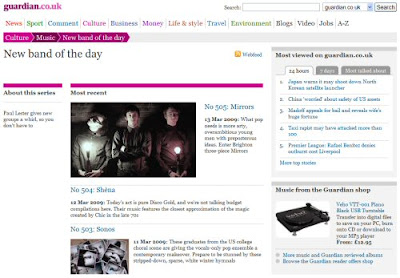
The Guardian's New band of the day

Hometown: The Guardian's website

The lineup: Cobra Dukes, White Rabbits, Goldspot, The Japanese Popstars etc.

The background: Every day for the past two and a bit years (baring weekends and public holidays), ex-Melody Maker writer Paul Lester has been posting at The Guardian's website with a recommendation for a new band or singer that might be the next big thing. He offered a good explanation of his mission recently on the occasion of the column winning a 'Record of the Day' award for his troubles:
"I'd known for some time that the music industry's future depends not on the glory that is the back catalogue of The Beatles, but on the new Strokes or the next Amy Winehouse. Luckily there was a stack of CDs of new, young or unsigned bands on my desk halfway up to the ceiling that I could use as an argument for a new daily column assessing the artistic worth and/or commercial potential of such new musicians and groups."
The selections are only part of the story; each day Paul also offers an incredible little music columns, which as well as offering a biography of the musician also describes where they fit in musical terms or ruminates on the state of the art form. I'd love to know how he manages to be this perceptive on a daily basis, yet here he is on day five-oh-five ruminating on how music isn't as deliberately pretentious as it used to be.

Last week, the column reached five hundred so to celebrate I decided to try and construct a Spotify playlist which included all of his choices. As you'd expect, not everything is on there -- some unsigned bands remained unsigned, others have produced music which is only available on vinyl and the rest probably just hasn't been licensed yet. The 'not' list (see below) is extensive, but considering how much of this music didn't chart, get airplay, has been ignored, it shows the depth of Spotify's catalogue. Some of the EPs are obscure enough that they're only illustrated using a picture of the centre of the 7-inch.

It's an eclectic selection; though there is a fair amount of guitar and garage bands, Paul has been careful to balance out the genres, with a little bit of country, some folk and even the soft centre of All Angels. He admits that he's not always been successful -- some of these bands prove how poignantly truthful the fictions created using the random album cover meme can be, with albums and tracks called 'You're supposed To Be My Friend', 'Waited Up 'til It Was Light' & 'Gee Wiz But This Is Lonesome' and bands with names like Prinzhorn Dance School, The Orange Lights, Annuals and The Tough Alliance presumably still trying to chip away at edifice of the music industry trying to create a foothold.

Paul has also been very successful in his predictions; on this list you'll also find New Young Pony Club, Just Jack, The Maccabees, Robyn, Dragonette, Amy Macdonald, The Hooiers, Scouting for Girls, Eugene McGuiness, The Ting Tings, Adele, MGMT, Duffy, Little Boots, Lady Gaga and The Maybes? who are all at least famous enough that I've heard of them. If you decide choose to listen to the playlist from top to bottom -- they're in the order that they appear on the website -- it's quite exciting to turn up on something familiar after a mysterious half hour. Reminds me of the moment in John Peel's programme when he'd suddenly decided to drop in something by The Clash.

But I think what this collection shows is that there isn't really a formula for success; compare the work of any of the artists who have 'made it' with some of the others and there's not that much difference, it's just that Kate Nash happened to know the right people or be in the right place at the right time or is just that little bit more commercial. In fact there are plenty of hidden gems, like Janelle Monae who manages to traverse a dozen different genres sometimes in the same track, The Checks with their glam rock revivalism and Skeletons whose 'Fill My Pockets Full' turns the raw sounds of the city into an avant guard backing track to something that might be dance. I guess.

The buzz: "As far as I'm concerned, the Guardian's "new band of the day feature" makes the world go round." -- Lizzy Minneapolis

The truth: Very little duff music and some real gems you've never heard before.

Most likely to: Find the next Lady GaGa, god help us.

Least likely to: David Vandervelde, Love Minus Zero, Late Night Movies, Goldenboy, Jack Savoretti, Alex Delivery, Last man Standing, Shakes, Malpractice, Tussle, Heloise & The Savoir Faire, Parka, The Procession, The Lionheart Brothers, Radar, Low vs Diamond, Sister, Taylor Mills, The Tigerpicks, Jacob Golden, Bjorn Torske, Patrick Cleandenim, Dúné, Sorcerer, My Federation, The Daniel Pemberton TV Orchestra, Lord God, The Heavy, How I Became The Bomb, Erika Jayne, A Thief, Good Neighbour, Chris Letcher, The Lovers, Alloy Mental, Arthur & Yu, Circuits, Oh No Ono, Green Pitch, Black Daniel, Forever Like Red, Kennedy, Swimmer One, Sam Champion, This City, Liz Green, I Am Finn, The Cloud Room, Nelson, SoundOfzZz, The Broken Hearts, Big Linda, The Brightlights, Ben Esser, USE, XX Teens, The Author, Sarabeth Tucek, Morton Valence, Lauren Rose, Slow Club, Bombay Bicycle Club, Dude 'N Nem, Thao, Elle s'appelle, The Outside Royalty, Friends of the Bride, The Holy Ghost Revival, Asa, One eskimO, Paper Round Kid, The Elephants, Ebony Bones, Primary 1, Josh Weller, The Beasts of Eden, Temposhark, Grant Langston & The Supermodels, Lesser Panda, NiTasha Jackson, The Wave Pictures, Idle Lovers, Kav, The Explorers Club, OK Tokyo, Oh Laura, The Postmarks, GoldieLocks, Isosceles, Lucy & The Caterpillar, Mumford & Sons, Nicole Atkins And The Sea, Arms, Barringtone, Trouble Over Tokyo, Sian Alice Group, Collapsing Cities, Underground Heroes, Get Well Soon, Rosie and the Goldbug, Cashier No 9, Magistrates, James Combs, Pygmy Globetrotters, Boy Crisis, The Winchell Riots, Babygod, Oh, Atoms, Charli XCX, Pavilion, The War On Drugs, James Yuill, Archangel, Mama Shamone, All the Saints, Petit Mal, Hearts Revolution, Fenech-Soler, Hockey, To the Bones, Daniel Land & the Modern Painters, Amazing Baby, The Fantastic Laura B, The Coast, Stonefoxx, Les Gars, Stars and Sons, Women, Kenan Bell, Girl Talk, Burning Pilot, Soda Boys, The Operators, The Tenants Supermen, Deadfisch, Jay Jay Pistolet, The Jessie Rose Trip, The Big Pink, The Chemists, Chew Lips, Plugs, Alex Roots, Cosmo Jarvis, The Pains of Being Pure at Heart, The Temper Trap, Hothouse, Solid Gold, Catherine AD, Deer Tracks, The Invisible, Milke, Will and the People, Sad Day for Puppets, Apes & Androids, The Voluntary Butler Scheme, Absent Elk, DM Stith, The dø, Ellie Goulding, Terry Lynn, My Toys Like Me, Sky Ferreira, The Good Natured, Kidbass featuring Sincere, Goldheart Assembly, Banjo Or Freakout, Steve Appleton, Fredo Viola, Dave I.D., Daisy Dares You, Sonos and Mirrors are not on Spotify. Yet.

What to buy: The playlist includes the tracks which Paul has mentioned in this section. Unless he's suggested an album or EP, which case I picked the top item on the artist's page. Unless they're not on Spotify. Obviously.

File next to: The Unsigned Band Review, Daily Tunes, Pop Justice Song of the Day

Links:
http://www.guardian.co.uk/music/series/newbandoftheday
http://open.spotify.com/user/feelinglistless/playlist/3e3nN7JFxBzJ6pytAA8muU

Next Saturday's new playlist: The Big Chill

Farting Corbett

Elsewhere I've not done one of these for a while, but I've reviewed tonight's Comic Relief special episode of The Sarah Jane Adventures for Behind The Sofa. To balance things out, I somehow forgot to include any jokes. Oh well.

From Raxacoricofallapatorius with Love.


TV Who wrote those questions? Was that you Pixley? I'll get to the special episode of The Sarah Jane Adventures in the next paragraph, but it’s worth pausing for a moment to take in the Mastermind Special that followed it. As well as offering journalists a mallet to hit Davina McCall over the head with because she couldn’t identify the inspiration behind the tv show that made her famous (bless), we were also treated to the awesome moment during David’s specialist subject round where, after a series of questions about the new series, whomever it was (Gary Russell? Gary Gillat? Spilsbury?) wrong-footed us all (well, those of us playing along at home) with a poser about Delta and the Bannermen (one for the kids), allowing us and David, after a few seconds to get our bearings, to shout ‘Ken Dodd!’, as incongruous an entertainment name as you’re likely to hear on the modern floor of Comic Relief. Well done you.

And well done the production team of The Sarah Jane Adventures for collecting a prestige slot on this year's telethon, ten years since The Curse of the Fatal Death seemed to be the last time we'd ever see anything Who related on the small screen, and turning in something rather fun. Sure, the plot was rather less complicated than Moffat's time twister, amounting to Ronnie Corbett beaming into someone’s house and inflicting his one man show on them, but there’s not a lot you can do in five minutes, with just your main set, seven regular cast members to give something to do and a special guest star. Quite rightly given the context, writers Clayton Hickman (first tv credit!) and Gareth Roberts offered some good puns and a parade of fart jokes. I honestly didn’t get the two Rani’s until the second time around, but the sudden appearance of the chair and meandering story worked, as did the veiled references to Ronnie Corbett's golfing buddies.

It’s interesting, how, after so long in the post-Barker wilderness, in the past few years Corbett has been rehabilitated enough by his prat fall in the Peter Kay video for Comic Relief (Is This The Way To) Amarillo) for him to be a perfectly reasonable addition to the earlier evening end of Comic Relief. He certainly looked the part in that suit (perhaps a shrunken version of the one John Cleese wore on The Frost Report?) and I quite like the idea of an ambassador for the Galactic Alliance whoever they are and whatever they do. You might grumble that he turned out to be yet another Slitheen and the mass of exposition that explained the appearance, but like it or not, they’re the most recognisable nu-Who invention to have previously turned up in SJA and for once the gas ventilation whatsitthingamydoodaa actually sort of made sense in context.

Squint closely enough at whatever this was called (‘Funny for Money?’ ‘The Two Ranis?’) and for better or worse you could see a microcosm of the first couple of seasons of the series; visiting comedian playing the bad guy, Luke looking earnest, Clyde and Rani trading jokes, Sarah Jane momentarily holding back the tears, plenty of nostalgic references for the adults that constitute the real audience, a combination of Mr Smith and the Sonic Lipstick saving the day and a speech reminding the villain not to mess with this world saving dysfunctional group dynamic that meet inside the roof of Georgian-style property.

They’re already nitpicking on the Doctor Who Forum (“The Slitheen aren’t a race, they’re family.” “cringeworthy writing and acting” “really slowing down and dissipating the atmosphere” “obvious 'plot'”) which is a shame because it’s heart was in the right place. True, it was no Time Crash, but it’s wasn’t trying to be – different motives and deliberately trying to make you just laugh not cry as well (for a change) (damn you, Moffat) and I did. Laugh I mean. Hah, ha. Plus, has there been a funnier and disrespectful use of K9 than clamping him and having a red nose appear on his schnoz? It's certainly more entertaining than what his creators have done for his own spin-off. Have you seen that? Ugh.