Showing posts with label shakespeare. Show all posts

32 Bodleian Library


Books  Twelve Books That Changed The World (2006) is a book and four part ITV documentary series in which Melvyn Bragg highlights a series of British volumes which he thinks, have had the most profound effect on humanity.  There are the obvious choices: On The Origin of Species, The King James Bible, Principia Mathematica and the Magna Carta.  The more specific choices: A Vindication of the Rights of Woman, Married Love, On the Abolition of the Slave Trade, Experimental Researches in Electricity and The Wealth of Nations.  The probably aimed at the channel's core audience: Book of Rules of Association Football.  

Over the years I've been hoarding documentaries about Shakespeare and found this on a DVD-R which I must have recorded off-air at the time.  This would have been in the period when I was recording from a separate Freeview box direct to disc so everything is in the wrong aspect ratio  (which is also why all the screenshots on here look a bit weird).  It opens with a trailer for GMTV followed by an advert for digital switchover to offer some historic context and includes weather forecast which probably also captures perfectly what life was like in the UK in 2006:

The grand finale is the First Folio.  There's not much you can do with ten minutes of screen time, so Melvyn offers a brief outline of how the book was published, a mix of scenes from the plays (mainly sourced from the BBC Shakespeare although there's a bit of Branagh and Kurosawa sprinkled in) and contributions from Yale University's Professor Harold Bloom and the then Director of the Folger Shakespeare Library Dr. Gail Paster who aid Melvyn in collectively offering a general sense of the historical importance of the Folio in the development of the English language.  There's also a nice moment when some international acting students translate the text into their own language.


There are actually three different Folios in the programme (four if you count a facsimile used when Melvyn's quoting from the preface).  Dr Paster has one of the Folger copies on the desk beside her, but its in profile and there's not enough visual information to work out which one.  There's a single shot of the contents page of a folio which isn't the one seen elsewhere (we'll get to that).  Despite having an unfolded crease down the middle I've not been able to identify from Rasmussen and West's catalogue The Shakespeare First Folios which copy this is from.  The third is the one which is the reason why we're here.


A slow vertical pan reveal Melvyn sat behind a table covered in a black cloth with the First Folio before him.  Although it might have been obvious to some of you which of the Oxbridges this is, I was sent off on a tangent by the book which uses images from the Cambridge owned editions.  Did I phone the rare books section at Cambridge University to see if the numbers connected to the picture credit meant anything?  I may have.  Did they?  No, no they didn't.  Not that it mattered.  I soon realised the shields on the chairs were from Oxford which led to the Bodleian which has large sections of its rare books collection digitised and available to view online.

The Bodleian Library has two Folios of which this is probably the more photogenic.  The other, Bodleian Library Arch. G c.7 is the original deposit copy sent by the Folio's printmaker William Jaggard to the library.  There's much to be said about how it was sold off as worthless to a local bookseller when the Third Folio was published in 1664 and only returned to Oxford in the early 1900s after they outbid the Folger library.  That copy doesn't appear on screen because as you can see from the digital scan it was not taken care of to say the least with whole chunks of the pages torn out.  The section listing its condition in Rasmussen and West's catalogue stretches to three and a half pages.

The digital scan of the copy which does appear, Bodleian Library Arch. G c.8 also has had a difficult life but at least the relevant pages are intact and for the most part looks very impressive on the table in front of Melvyn.  I was ultimately able to confirm which copy it was because a shot of title page include a partial glimpse of the opposite side where the "To the Reader" unusually appears has been pasted in from another source, a Fourth Folio edition if the pencil note underneath is to be believed.  The title pages from Hamlet and Romeo and Juliet which are shown also match this copy, the latter notably because of a burn mark at the top of the page.


The history of this folio is pretty straightforward.  The provenance begins with eighteenth-century literary scholar Edmond Malone (there's a Reynolds portrait of him on his Wikipedia page), a man after my own heart who devoted part of his life to trying to deducing the order in which Shakespeare wrote his plays.  This was published in the complete works edited by Samuel Johnson and George Steenvens in 1778, an order which is still largely followed.  Malone later fell out with Steevens, notably when he published his own complete works which he said would be "more scientifically and methodically edited than the Johnson–Steevens edition was ever likely to become."

As part of his research Malone collected many books including the Folio, although it's not known where he procured it in 1780.  He treated it as a working copy and/or scrap book and there are notes about the nature of the play strewn throughout, various engravings of luminaries like the Earl of Pembroke pasted in and a facsimile of Shakespeare's signature.  How much of this was Malone or the previous owner isn't clear although its pretty startling to see a Folio treated in this way.  On one page Malone has even included in what's supposed to be an engraving of Shakespeare taken from the Steevens' complete works with a note underneath explaining that it's not actually the playwright, but James I.

On his death, he left a lengthy instruction to his brother Richard, Lord Sunderlin, that the lot be given to Trinity College Dublin.  But Richard was an Oxford man, so decided to ignore all that.  He initially loaned the collection to James Boswell The Younger, son of Samuel Johnson's biographer who was working on the second edition of the Johnson/Steeven complete works.  After Boswell died, Richard finally deposited the Elizabethan books including the First Folio to the Bodleian in 1821 and auctioned off the rest.  It's been there ever since, appearing in two Shakespeare exhibitions in 1916 and 1964.


But what about the contents page?  Although the Bodleian edition is in pretty good order, the box at the bottom of the page contains a note from Malone in which he noticed how Troilus and Cressida seems have have been a late addition, which is a bit too much detail for a fifteen minute segment about the book late night on an ITV Sunday.  Two Oxford Colleges, Queens and Wadham both have their own copies but the entries in The Shakespeare First Folio don't mention the crease you can see above and best will in the world I'm not going through the rest of the book trying to match it.  Perhaps it was filmed as a pick-up when the crew visited the Folger library?

Further appearances:


This copy also appeared in the 2002 series Great Britons in which the BBC tasked the public to vote on who they believed to be the best people in British history.  After an initial vote, the top ten nominees each received a presenter led documentary in which an advocate, in Shakespeare's case Fiona Shaw, offered an argument as to why their candidate was the best.  32 Bodleian Library appears in two shots, the title page with the tell tale pasted in "To The Reader".


The other shot is of the cover, during a crossfade from the bust in Holy Trinity Church.  In the end, Shakespeare was fifth behind Churchill, Brunel, Princess Diana and Darwin but ahead of Newton, Elizabeth, Lennon, Nelson and Cromwell.  

Cinematic Shakespeare.


Film  Recently, in the lead-up to the 400th anniversary of the publication of the First Folio, the BBC has broadcast a series of archive Shakespeare productions including a Hamlet double bill on one Sunday night, which would have tested the metal of even his biggest fan (and I speak as someone who once listened to three full-text audio versions in a day).  

Sadly it hasn't been the complete canon - showing versions of all 36 plays was probably a big ask in 2023.  But this will have been the first opportunity some viewers will have had to see Peter Hall's The Wars of the Roses or Hamlet at Elsinore (incorrectly labelled as part of "The BBC Television Shakespeare" on the iPlayer which was at least a decade and a half later).

Nevertheless, this has provoked me to finally get around to a series of occasional blog posts I've been thinking about for a few years of putting together various Shakespeare collections or "festivals" with productions which share a format or media.  Until now, that's always felt pretty tricky because not all of the plays have been available in all the formats or media I've wanted to cover.  

We're in a time when most of the plays are at the most accessible they've ever been, between physical formats and streaming services and so I thought it would be fun to finally create such lists in case anyone is interested in watching their way through the plays and would quite like some recommendations.  Up first, Cinematic Shakespeare or how I'm going to spend December.

*    *    *    *    *


Of all the plays you would think might be the first to survive on film, it wouldn't be King John.  But there he is, actor-manager Herbert Beerbohm Tree playing the doomed monarch in poisonous, fearful death, silently intoning Shakespeare's words back in 1899.  The Folger Shakespeare Library has a lengthy article about this which explains that it was shot on stage at the Palace Theatre on September 20th, the same night Tree's own stage production began its sun at Her Majesty's Theatre.  

Shakespeare has flourished in film since with hundreds of productions across most of the rest of the canon.  What we're concerning ourselves with here are those which as projects were originated and shot on film (so no direct stage transfers) or HD in a so-called "classical Hollywood" style with all the visual tricks that entail.  The text could be cut or rearranged, but the words coming out of the actor's mouths are Shakespeare's.  

Here is my curated list in First Folio order.  As you'll see I've tried to pay respect to both theatrical and cinematic history (Ken, Larry, Orson etc).  It's also fair to say that some of the choices are by default because they're the only version of the play to fit the criteria.  We still await the retro-noir version of Measure for Measure I've had in my head for decades (and just turning the colour off on the BBC 1994 Performance version isn't quite the same).  Anyway, I hope you enjoy it.


THE COMEDIES

Propero's Books (1991)  After numerous attempts with various directors, John Gielgud finally played the title character of The Tempest in Peter Greenaway's eclectic, avant-garde visually stunning treatment.  Greenaway plays with the notion of Prospero as Shakespeare's avatar and the popular belief that in writing the text and the sorcerer's words he was bidding farewell to his life's work.  If you are treating this as the opening film of a festival, it's a great introduction.

Two Gentlemen of Verona  There have been no cinematic versions.

The Merry Wives of Windsor  There have (mostly) been no cinematic versions.  See Chimes at Midnight.

Measure for Measure   There have been no cinematic versions.

The Comedy of Errors  There have been no cinematic versions.

Much Ado About Nothing (1991)  There's not much of a contest here, this has Ken and Em at their zenith shot beneath the golden Tuscan sky in a rendering of the play which makes sense of the comedic scenes as well as the tragic.  More than most of Branagh's films, this has him clashing Hollywood and UK theatrical royalty together, with Denzel meeting Briersley and BRIAN BLESSED and Ben Elton playing sidekick to Michael Keaton.  Also the first major screen role for Kate Beckinsale.

Love's Labour's Lost (2000)  Ken's version of this prequel to a lost play drew criticism from some for cutting almost three-quarters of the play and turning the whole thing into a 1930s musical (especially with this being the only film version of the play available) but the result is so adorable I'll forgive everything.  The cuts are also immensely clever.  In its complete form, LLL can be difficult to follow in places, but through production design and costume, everything here is perfectly clear.

A Midsummer Night's Dream (1999)  The apogee of the 90s Shakespeare film cycle, this Branagh-influenced version returns to a Tuscan setting (still referred to as Greece in the text) and has John Sessions as Philostrate.  The magic of the forest is given the full special effects treatment and the whole of the cast is just so gosh-darn adorable, with Michelle Pfeiffer at her imperious best as Titannia and Kevin Kline offering his thoroughly cute Bottom.

The Merchant of Venice (2004)  The casting of the Sicilian Italian-American Al Pacino as Shylock looks pretty dated in retrospect, but Michael Radford's production does at least notice that this isn't a particularly funny play, cutting most of the box-checking scenes and highlighting the animosity between the ethnic and religious groups in Venice.  It's also notable for its location shooting in Venice and doesn't downplay the homo-erotic aspects of some relationships.

As You Like It (2006)  Back to Branagh for his final Shakespeare production on film (so far) which transposes the play to a late 19th-century European colony in Japan after the Meiji Restoration amongst the English traders who were fascinated by the local culture.  Future Doctor Who Romola Garai plays Celia, with most of his usual repertory appearing and Kevin Kline joining as Jaques.  Theatrically released in the UK, it was produced for HBO back when they did this sort of thing.

The Taming of the Shrew (1967)  Taylor and Burton bouncing off the walls of Cineceta and each other.  Unlike her husband, Liz hadn't acted Shakespeare before and after much persistence, she was able to lobby director Franco Zeffrelli to redo the first week's shooting at the end once she'd got the hang of the iambic pentameter.  Cuts include the induction with Christopher Sly and most of the Lucentio and Bianca subplot.  Michael Hordern is delightful as Kate's father  

All's Well That Ends Well   There have been no cinematic versions.

Twelfth Night (1996)  Considering its popularity, it's surprising that Adrian Noble's country house take is the only version of the play on film.  It's perfectly fine with a strong cast led by Imogen Stubbs and Helena Bonham Carter with Ben Kingsley as Feste, REG as Aguecheek, Mel Smith as Toby Belch and Nigel Hawthorne as Malvolio.  Once again it feels of a piece with Ken's style but he'd already produced a TV version for Channel 4 in 1988 with Briesley in the yellow britches.

The Winter's Tale   There have been no cinematic versions (in 1968, Frank Dunlop adapted his Edinburgh Festival stage production but even that isn't available).


THE HISTORIES

King John  There have been no cinematic versions (apart from the 1899 version which wouldn't count anyway).

The Hollow Crown (2012-2016)  For the tetralogies, you've two choices.  The Hollow Crown allows you to follow the whole damn story with shared casts, all of the best actors of the period reading Shakespeare's words in a style which is essentially Game of Thrones without the dragons, with Henry VI is heavily cut and runs across two episodes.  Or you can treat some of the plays individually and take a more eclectic approach.  See below:

Richard II  There have been no other cinematic versions.

Chimes at Midnight (1966)  Out of circulation until recently due to licensing issues, Orson Welles's labour of love essentially pulls all of the Falstaff scenes from the various plays including The Merry Wives of Windsor and spins them into a relatively coherent screenplay.  The director makes for a rambunctious lead character and the eclectic cast includes Gielgud and Jeane Moreau as Doll Tearsheet.  

Henry V (1944)  To ease us out of the Welles, it's back to one of the grandparents of Shakespeare on film.  Opening in a recreation of an Elizabethan theatre to underscore the artifice of what's ahead, like a backstage musical the stage becomes a near-infinite space across which the battle of Agincourt and everything else in Larry's interpretation takes place.  Sacred enough that when Ken wanted to make his version, the effort was branded as precocious.

Richard III (1955)  Olivier played Richard on stage, but his film version is a different entity with a new cast and production design.  Apparently, it wasn't well received by critics at the time but the opening monologue has become iconic and it's said many actors work hard not to play it like Olivier (Ken parodies this during the audition scene of In The Bleak Midwinter).  The late, lamented Network released a wonderfully crisp restoration of this which is worth tracking down.

Henry VIII (1979)  Director Kevin Billington, in an effort to shift the play away from its usual presentation as a pageant, shot this on location at Leeds Castle, Penshurst Place and Hever Castle, often in the rooms where the historical action is presumed to take place.  As a result, it looks more "cinematic" than a lot of the films on this list not least because everyone looks absolutely freezing, their breath steaming throughout.  The DVD transfer is pin-sharp.


THE TRAGEDIES

Troilus and Cressida (1981)   There have been no cinematic versions.

Coriolanus (2011)  In this modern dress adaptation, director Ralph Feinnes transfers ancient Rome to the Balkans during a pseudo-Yugoslave war, with the actual Jon Snow offering backstory at the beginning in the style of a newscast.  Rattles through a cut text in a couple of hours, Fiennes cuts a commanding, bloodthirsty figure as the title character, nevertheless crumbling in the face of Vanessa Redgrave's Volumnia.  Mother knows best.

Titus (1999)  Like Coriolanus, Julie Taymor's film refuses to accept the play's original setting, instead clashing together designs from various periods of history, from ancient Rome to Mussolini's Italy through the eyes of the contemporary small boy introduced at the beginning who enters the production as young Lucius is really just messing about with toy soldiers.  Which doesn't make it any less gruesome, Tony Hopkins serving revenge with Lectorish glee.

William Shakespeare's Romeo + Juliet (1996)  Could it be anything other than Baz Luhrmann?  Few productions have convincingly suggested these two could fall in love overnight, but when Leo and Claire furtively gaze at one another through the fish tank you're sold.  Also manages to make you forget this is a play you've seen a dozen times before, with the various contrivances absolutely heart-sucking.  One for the ages.

Timon of Athens (1981)   There have been no cinematic versions.

Julius Caesar (1953)  Developed in reaction to Olivier's Henry V, this full-tilt classical Hollywood production re-uses sets from Quo Vadis and was shot in black and white so as not to draw comparison and to suggest contemporary film reels reflecting the still evident fascist movements in Europe.  Features James Mason and Gielgud as Brutus and Cassius, Marlon Brando as Mark Anthony and a host of recognisable character actors from that period.  

Macbeth (1948) Orson Welles: "I thought I was making what might be a good film, and what, if the 23-day shoot schedule came off, might encourage other filmmakers to tackle difficult subjects at greater speed. Unfortunately, not one critic in any part of the world chose to compliment me on the speed. They thought it was a scandal that it should only take 23 days. Of course, they were right, but I could not write to every one of them and explain that no one would give me any money for a further day's shooting . . . However, I am not ashamed of the limitations of the picture."

Hamlet (1996)  Branagh's magnum opus, a four-hour production of a conflated text collecting as much Hamlet as Shakespeare wrote, including some odds and sods from Q1.  As with 99% of productions, Ken and his cohorts are too old for their parts (is everyone in court a mature student?) but this is Shakespeare rendered in 70mm with more stars than a Record Breakers Christmas Special.  Briersley's spymaster Polonius steals the show.

King Lear (1970)  Pitch dark Bergmanesque production from Peter Brook with Paul Schofield's Lear against a blasted wilderness, shot in the wintery dune country of Denmark's Jutland Peninsula.  Visually it's absolutely extraordinary, the grain of the 16mm creating the impression that we're watching action filmed in a documentary style in the deep past.  Probably in my top three favourite Lears, along with Kurosawa's Ran and the RSC production with Romola Garai amongst others.

Othello (1995)  Although there had been earlier indie productions starring Ted Lange and Yaphet Kotto, this was the first mainstream production to feature a black actor in the lead role, the fantastic Laurence Fishburne.  It's adapted and directed by Oliver Parker and Ken only plays Iago, but manages to feature some of his usual ensembles, Michael Maloney and Nicholas Farrell.  Shot on location in Venice and Cyprus, David Johnson's cinematography gives it an erotic thriller feel.

Antony and Cleopatra (1972)  Having yet to have the chance to see this, here's a take from the BFI's old ScreenOnline website:  "Emphasising spectacle at the expense of subtlety (even to the point of recycling shots from the 1959 Ben-Hur, in which Heston had starred some thirteen years earlier!), this adaptation shows little feeling for the emotions at the core of the story, and is torpedoed by the lack of chemistry between Heston and South African actress Hildegard Neil, who is arguably miscast as Cleopatra."

Cymbeline   There have been no cinematic versions.


Up next:
Shakespeare Adaptations.

Always Read The Label.

Life  This is not the blog post I was planning to write and if your blogger had any sense, he'd just go off and do something else.  But I'm here now so I might as well post something.

This time last week, I'd just arrived in Stratford-Upon-Avon after a brutal overnight stay at the budget Ibis hotel in Birmingham.  By budget, they mean cheap.  The bed is a futon mattress on some glorified pallets.  The wash basin is in that room.  The shower makes a periodic groaning sound which I can only attribute to being in sympathy with the rest of the plumbing when someone flushes a toilet.  The breakfast is "continental" meaning lots of bakery products, catering fruit and yoghurt and two small mounds of reformed pork and ham.  There's no kettle in the room.  Instead you have to pay £1.50 for a paper cup to be used in a coffee machine.

When I was last in Stratford, the RST was still being refurbished so I was keen to see what it looked like now and so booked myself on a tour.  As it turned out, this was mostly a look at the building were costumes and some props are made, which was still fascinating but did also mean we didn't get to see inside the auditorium (which was apparently closed for rehearsals).  The tour did however include a five minute glance through the on-site permanent exhibition, currently closed to the public due to continuing refurbishment work in the Swan Threatre below.  It acts as a good finale for this tour because it includes costumes from across the history of RSC productions.

At the start of the exhibition is a Folio and so you can imagine my excitement.  With just minutes to spare, I quickly took a photo of the book and the label pleased that I'd unexpectedly been able to tick another one off the list.  It also looks extremely pretty with the reflection of a stained glass window shining across its display case.

Later I consulted the Eric Rasmussen (et al) book listing the first folios and assumed it must be (39) The Theatre Copy from The Shakespeare Centre with its interesting story about the Pope and a misunderstanding.  In 1964, three members of the RSC, Dorothy Tutin, Derek Godfrey, and Tony Church visited Rome to give a recital of Shakespeare's plays at the Palazzo Pio in front of the pontiff and a couple of thousand guests.  They took their folio along for it to be bless by the Pope at the conclusion of the performance.  Unfortunately something was lost in translation and he took it as a gift.  After some diplomatic shenanigans, the folio was eventually returned.

All of which hilarious pot pourri, sorry, popery would have made for a decent blog post.  Except when I just sat down to write, I read the label which accompanied the folio (something which I'd not had time for during the tour).

As you can see, this is not that First Folio.  It is a Second Folio.  The Second Folio has its own publication history and by rights should be greeted with just the same awe as the first edition.  As the Shakespeare Birthplace Trust explains, it's the first attempt at "editing" the existing text, with 1700 corrections and the additions of far more stage directions.  It has the first work of John Milton to see print, "An Epitaph on the admirable Dramaticke Poet W. Shakespeare", written when he was 22 and part of an extra page of effigies for this edition.  There are only 250 copies of the Second Folio in existence which is only a few more than the first.

But this tickylist project is not about the Second Folio, it is about the First Folio and so this is not the blog post I was planning to write.  When and if I do clasp eyes on  (39) The Theatre Copy from The Shakespeare Centre, there'll no doubt be something quite similar to this with some extra material about the provenance and a few other oddities.

Always read the label.

The Tudors: Passion, Power and Politics at the Walker Art Gallery.

History  On numerous occasions over the many (many) years, I'd have a good moan on here about how little of London's non-contemporary art takes a trip up North.  Here's a version of the rant and although much has changed in the intervening years, through Tate Liverpool having a slightly more relaxed policy to including pre-1900 as a feature of their exhibitions and a few paintings from private collectors being included at National Museums Liverpool shows, I eventually decided to take myself to the art and spent the best part of four or five years visiting the various galleries in London on a monthly basis including spending whole afternoons just visiting a couple of rooms at the National Gallery.

That obviously stopped when the pandemic began but I just managed to visit the National Portrait Gallery at the beginning of 2020 to see the Tudor galleries at the end of a day spent following a Shakespeare walk around London, the chronology of the British monarchy laid out in a series of faces humanising these historical figures, albeit in the propogandist painting style of the period mainly by unknown artists copying earlier paintings by other unknown artists of Hans Holbein.  These works were often created as part of diplomatic missions, often with a dating aspect like a mid-1500s Twitter in which swiping left led to war.

So you can imagine how deep my eye roll was when I read that ironically what potentially could be the contents of the Tudor gallery at the NPG was going to be visiting the Walker.  Finally, a selection of the nation's treasures on tour ... which I just happened to have seen for free relatively recently and in an exhibition I'd now have to pay for.  But having complained for years about these national treasures not going on tour it seemed churlish to not pay to see them again and add to the all important visitor numbers which my be impressive enough to lead to more of this sort of thing find its way here.

And this really is most of the Tudor gallery at the NPG in a different venue, as though a portal has been opening up into the space in London.  The rare opportunity for the paintings to go on tour has been facilitated by the temporary closure of the gallery for refurbishment and an imperative to keep them accessible to the public in some form.  Before the Walker, The Tudors: Passion, Power and Politics was at The Holborne Museum in Bath (or Barth) and perhaps the most impressive element is just how much of the exhibition is sourced from there.  This isn't an occasion when a few key works are padded out with elements from NML's own collection.

The lions share of the exhibition is themed around Henry VIII and Elizabeth I with Edward, Jane and Mary slotted in between.  At one end of the main room portraits of Henry's six wives are gathered and at the other end Elizabeth's "favourites" (fuckboys) so if you're interested in scandal, they're all here before so many of them lost their head before literally losing their head.  Although the exhibition includes the Walker's own world famous portraits of both, the Holbein copy and the Hilliard, there are multiple images of both monarchs from various, usually anonymous, hands.  But all of the key figures are represented.

If I had to make a recalibration in my expectations, it's that this isn't an art exhibition, its a history exhibition illustrated through painting.  Almost all of the portraits are accompanied by biographical information but very little that places them within an art historical context.  Obviously this is mostly to be expected.  Most these are works by unnamed artists and its the person who they depict which is of most interest.  But I would have preferred to see more of the kinds of information seen on the NPG's website about technique and attribution (although I could perhaps have simply had the website to hand via an ipad).

Plus this is my first proper exhibition in over two years (or indeed visit to an art gallery at all really) so I'm also a bit out of practice in navigating artworks and labels and other visitors.  Gallery fatigue set in quicker than usual which meant that when I reached the last of the three rooms, which looked at how the Tudors reflected out into the world, through exploration, slavery and culture its possible I could have spent more time absorbing the display.  But it's also true that once you've seen half a dozen roughly similar men in tights and ruffs and well appointed beards, they begin to blur into each other.

Unsurprisingly the advertised Shakespeare portrait isn't the Chandos - the painting with an accession number NPG 1 doesn't travel much - and I have it on my wall at home anyway (or a jigsaw at least).  The playwright is represented instead by the Martin Droeshout's engraving created for the First Folio (although this is apparently from one of the second or third editions).  But given how much of the collection is here, I'm very interested to know what the economics of the show were in terms of insurance and cost of travel.  The impressively massive Ditchley portrait of Elizabeth I is here which looks too big to fit through the doors.

So was The Tudors: Passion, Power and Politics worth the advanced price of £13.  Yes, I suppose, kinda?  I know that if I hadn't seen the paintings in London already on a couple of occasions and the Henry VIII show at the British Library in 2009 (with which this also shares a few items) I'd probably have been a bit less blasé about everything, indeed I know I wouldn't.  But it was nice to be in a space with these important treasures and to have them within walking distance of home (just about) (took me about fifty minutes) rather then three hour train journey (including the tube).  More please, and soon.

The Sotheby's Folio Update.

Commerce    Back in June I wrote about seeing a Shakespeare First Folio in London ahead of its sale in New York.  As The Guardian reports, the book's been sold:
"An original copy of William Shakespeare’s first collected book of plays has been sold for more than £2m at Sotheby’s auction house in New York."
Hopefully whoever bought it will enjoy having it and perhaps loan it out once in a while.  A lot of the copies in private hands are sat in vaults in Tokyo.

This also means that the Folio was the most valuable item in the room that day.

Cultural Vandalism.

Theatre The New Yorker has an interview with director Robert Icke on the occasion of his new production of Hamlet at the Armory in New York City. We could have a discussion about the writer's slightly dated assumption as to how Q1 was written (which has pretty much been disowned in most of the latest editions of the play I've read) but it's this section about how they're going to restructure the play which I'm here to repost a twitter thread about. The section starts reasonably enough talking about being mentored by Anne Barton then goes off the rails pretty quickly:
Among the plays he and Barton discussed was “Hamlet.” Barton, he learned, was impatient with the character of Ophelia: in her introduction to the Penguin edition of the play, she called Ophelia “naïve, passive and dependent.” Icke told me, “We talked about ‘Why isn’t Ophelia’s story moving? Why do you never care? Why do you never follow that story—and why is it never clear why she’s mad?’ I always feel like Ophelia is sidelined in productions, and even in the text.” Icke proposed a dramaturgical solution, arguing that the play would work much better if two early scenes were transposed, and Polonius and his two children—Laertes and Ophelia—were introduced before Hamlet is told by his friend Horatio of the sighting of his father’s spirit. “I always felt that you were getting Part Two of the more important story before you were getting Part One of the less important story, and that made the less important story feel genuinely irrelevant,” Icke explained. “It was always, like, ‘That guy’s going to see a ghost! And, by the way, here’s some advice about your trip to France.’ And you think, I don’t care about that—there’s a ghost!”

Icke’s Almeida production contains this structural change, so that Hamlet’s complex relationship with Ophelia is introduced—in the form of Laertes warning her to deflect any advances from the Prince—before Horatio informs him of the appearance of the Ghost. “I think it makes a huge difference as to how you are invited to take seriously the Ophelia bit of the story—and it gives me a hugely valued excuse to get Hamlet and Ophelia together alone onstage for a moment,” Icke said. The revision not only enriches the emotional dynamic between Hamlet and Ophelia; it frames Ophelia’s tragedy-within-a-tragedy as the story of a young woman whose family is so uncertain of its social position that it cannot allow her to pursue her own desires. In this context, it becomes piercing when, after Ophelia’s suicide, Gertrude expresses a belated wish that Ophelia had been her son’s bride. “You’re, like—what? Gertrude was fine with it? Everyone was fine with it?” Icke said. “That was something Anne Barton said that was really helpful to me—that all the ingredients are there for the match to proceed, and what happens is just about insecurity, and that Ophelia doesn’t believe in herself enough. There’s nothing either good or bad but thinking makes it so. So much of the play is like that.”
Apart from it messing up the time scheme of the play, the whole point of Hamlet and Ophelia's relationship is that it exists through third party reaction and report. Like much of Hamlet, we're supposed to use our imaginations to fill in the blanks.  It is fair to say Ophelia isn't one of Shakespeare's richest female roles but given that he'd already written some of his great comedies with their strong female leads, As You Like It and Love's Labour's Lost. I take it in good faith that the reason he wrote Ophelia in this way is because she's a reflection of what the male characters perceive her to be.  She's not a complete character on purpose, for better or worse.

That's the problem with so many Hamlets - and Shakespeare productions in general.  The director thinks its their job to explain inconsistencies or have a "take" on the thing.  But its up to the audience, us, to fill in the blanks.  They might ask, where's the creativity?  It's in the sets and costumes.  It's in the casting.  You'll find nuance and variation from how the show looks and how they play the roles.  Doing ridiculous things like changing the structure and interpolating text from elsewhere as seems to be the norm at the Globe of all places right now, is cultural vandalism, just as it was in the restoration period.  I thought we'd gone past that.

It's interesting how much more orthodox I've become about such things over the years.  Perhaps its my age.  Note I'm less bothered about this happening on film because that rarely pretends to be anything other than an adaptation of the play (even if in some cases the cuts are so severe as to lose the sense of thing).  No, it's stage productions, which give off the vibes of somehow getting to the heart of the play, whilst cutting an hour out of it or putting the scenes in a different order or selling themselves as a modernisation of a play which largely works because of its historical nature.  

Cataloguing BBC Radio 4's In Our Time using Dewey Decimal Classification.

Radio  In Our Time is a weekly live BBC radio discussion programme in which the broadcaster Melvyn Bragg and several academics elucidate a topic of a  philosophical, historical, cultural or scientific nature.  It's been on air since October 1998 and its format has changed little in that time, a moment in the week to listen to a group of very clever people saying some very clever things for forty-five minutes.

The series has clocked up nearly a thousand episodes and its inevitable with an archive that rich that a listener is more likely to catch-up on instalments which cover subjects with which they might casually be interested or being studying at school or university.  Except the website only sorts the episodes into very broad topics, culture, history, philosophy, religion and science so someone wanting to hear about mathematics or theatre has to wade through many pages of other topics.

Which is why, with my librarian's brain, I hit upon the idea of sorting the episodes using a library classification system and after the comparing a few decided Dewey Decimal Classification system (DDC) would suit the purpose because it's less complicated to work through than others and will be most familiar to readers due to its prevalence in public libraries.  Also Library of Congress can be astonishingly obtuse with all of its letters AND numbers.

Find below the results of my free time this past week and a half.  As you can see it's pretty logically ordered, a combination of following an abridged copy of DDC designed for small libraries originally published in 1979, Classify (an experimental classification site which aggregates the choices of thousands of librarians across the planet) and this Wikipedia page which has the most recent names for class names and hierarchical divisions.

Classification is automatically a compromise.  You're applying a numerical label to an object which it wasn't really designed for, so on some occasions, especially with something like In Our Time which revels in obtuse topics, there isn't a perfect place for the episode to go.  Also I've only used the a heading when it pertains to an episode which is why it looks like there are gaps in the sequence.  Melvyn and the gang haven't covered every sub-division in the DDC.

Every title below links to the episode's page on the Radio 4 website.  

You'll notice that if you're on a PC and you hover over many of the links have what would be the original shelf number which was part of the initial iteration to show I'd done the work.  But it became too fiddly to update since so I've left them out and some of the items have moved around since then too.  There are too many of them to remove so we're stuck with them, but this paragraph was by way of explanation.

You might also like to hear, Melvyn talk to Mishal Husain on the Today programme to mark the 1000th episode.

Anyway, I hope this is of some use to you and if it is, please consider leaving a Ko-Fi donation.  The most recent episodes are here and I'll try to keep this list updated as much as possible.


The Hamlet Gamble.

Theatre  The last Hamlet I reviewed was from Shakespeare's Globe in April 2020, which I was fortunate enough to see via YouTube during lockdown.  Their latest production, from the Sam Wannamaker Playhouse was due to be streamed this month, but they cancelled sighting the cost.  Now the professional reviews are out, I should be pleased.  It sounds horrendous:
"I can just about understand why Holmes introduces a speech from Romeo and Juliet, but not why he replaces the gravediggers’ dialogue with a rambling contemporary improv routine and a singalong of Kenny Rogers’ The Gambler, all performed by the show’s composer/musician Ed Gaughan. This is the most misguided interpretation of the scene since I saw it done in the mid-90s as a rap that ended with the words “now I’m gonna neck Ophelia”."
Here's the key problem with this - it's for people who already know the play. I'm still curious to see it, because any variation from norm is always interesting especially if there's a particular intellectual underpinning. Lord knows, after seeing the play forty-one times in different versions, it's the variations on the main theme which keep it interesting.  It sounds brilliantly awful.

But I shiver to think about the people for whom this could be their first introduction to the play and Shakespeare in general.  Will any of this make any sense?  Isn't adding in lines from Romeo and Juliet simply confusing?  Not to mention my usual annoyance that you wouldn't do this sort of thing to other artforms, so why must Shakespeare's writing continually endure this desecration?  [via]

The Arden Research Handbook of Shakespeare and Textual Studies.

Shakespeare   Not having met anyone with the same fannish zeal about Shakespeare as your blogger does, on a par with Doctor Who, films and whatever new album Taylor Swift has released that week, I've no idea if we share the same interests or what's in vogue.  Is it the production history or a connection with a particular playhouse?  Is it the language of the plays, the sheer level of poetry beaming out of every page?  A particular play which seems to contain all of life's answers for better or worse?  Or is it the textual history, the inquiry into how a play's been transmitted, from the hand of Shakespeare and his collaborators, through the first printshops, to successive editors to the Arden Shakespeare currently to hand.  How much what we're reading or watching is by the man himself or a corruption which has inevitably cropped up across the centuries?

It's all of the above, of course it is, at least for me.  But it's the latter on which I'm particularly laser focused, the impossible search for the complete authorial voice, because there's a huge gap between what's generally known about the canon and how much of it was written by Shakespeare and the actually, that at least a dozen or so of the plays in the canon have been filtered through other hands and yet more anonymous plays for which he may have contributed.  Not to mention how mis-readings of manuscripts by weary "hands" in the print shops have led to some lines losing all sense, compounded by subsequent editors trying to rationalise what was originally meant creating yet more misunderstandings.

You can imagine the excitement (yes, excitement) with which I greeted the news of The Arden Research Handbook of Shakespeare and Textual Studies, a guide to current research related to the plays on the page from the book trade within which they originally found publication, through a history of canonical studies to plays are edited and attributed in the modern age.  After seeing the press release from Arden, I put in a request, expecting perhaps a watermarked pdf but a couple of weeks later a hardback academic edition arrived by courier.  Even after all these years, it's still quite thrilling to have a book which would otherwise be on the shelf of an academic library all to myself, especially considering the price.

For the most part, this is a fully accessible read at least for this amateur with a pretty strong working knowledge of the subject.  As the preface explains, this new series of handbooks is designed to "provide researchers and graduate students with both cutting-edge perspectives on perennial questions and authoritative overviews on the history of research" or other words in this case, the state of play for textual studies in 2021.  It's to be used as a companion to material that appear in standard Shakespeare editions, some of which may be reprints of materials originally prepared twenty years ago, if not decades earlier and demonstrate that the discussion continues, that the publication of a play is a comma, not a full stop.

The book is split into four sections.  The introduction and first part set the scenes on textual studies, what they encompass and how they'll be investigated further as the book progresses.  Part Two offers the protein of this protean effort covering Shakespeare's manuscripts, the status of the earliest printed texts, how they fit within the early modern publishing industry, canonical studies and a history of editing from Rowe onwards.  Computerised processes are covered by part three, from algorithmic attribution studies to internet editions of the plays.  The final section offers a chronological publication history, a glossary of key terms, a full bibliography and list of resources.

As expected the key takeaway is that nothing is settled.  Everything I'd read to this point seemed to imply that Shakespeare's identity as hand D on the manuscript copy of Sir Thomas More held at the British Library was boiler-plated but the opening pages of the essay on manuscripts casts doubt on the methodology which has led to that attribution, suggesting that even if they're Shakespeare's words, there's no proof that it's his handwriting.  This logical, if emotionally dispiriting approach pervades the whole book, which lays bare the fallibility of academics and how even with decades of study behind them, that they're more than likely to bend the evidence around a misty-eyed fantasy of this genius and reflect that in their books.

There are two Shakespeares.  There's the working playwright who did well enough in his career to retire to Stratford and leave some money and property to his family on his death and a legendary being who's developed since,  Starting with the promotional material that preceded the collection of plays the publishers of the First Folio had the rights to, this transmogrification continued through Alexander Pope's edition which relegated to footnotes the sections he thought were unworthy of the writer to the proliferation of collected and individual editions in the twentieth century developed by editors with their own mission to find the platonic ideal of these plays either my conflating them together or publishing different versions as separate entities.

Except such things are impossible.  Everything is guesswork.  In his chapter on early printed texts, John Jowett demonstrates by printing them as a list how the single line from 1 Henry IV, "This matcht with other did, my gratious L." as originally printed in the first quarto in 1598 had by the seventh publication in 1632 become "This match with other like, my Gracious Lord," which is more readable to contemporary eyes but changes the underlying sense of what the line means (noting in the endnotes that Q1 itself is a reprint, Q0 only surviving as a few odd pages).  A modern editor has to somehow rationalise these differences and then make these value judgements a thousand times across the whole play.

But as the book demonstrates, as facsimiles of particular editions become much more widely accessible through digitisation, with online databases set up collecting such vagaries as contemporaneous margin notes, editors are no longer just at the mercy of the surviving printing of a play.  There's a much wider context of materials across the theatre and publishing industry of the time which can illuminate how inconsistencies within the text could be as a result of a barely legible original manuscript being worked from because we have the publications and the handwritten papers upon which they were based.  Editing a play may be guesswork, but the process is more educated than its ever been.

All of which leaves me in the condition of looking at an edition of any play with Shakespeare's name on it and thinking "well, yes, possibly".  My assumption is most schools work from a standard edition and certainly when I was at school we were given copies of the Arden 2 to work from.  But I also owned the Penguin editions of both, little appreciating that the texts in each were either subtly or significantly different.  How do university students writing about the plays from a critical perspective navigate this, especially a play like Hamlet and its three versions.  Do they find themselves having to constantly compare and contrast a given characters motives across all three?

But the fact of me asking those questions is the point and why the book succeeds in its aims, to demonstrate that textual studies is much more than whatever end point an editor proposes their new edition to be.  There's no doubt that this will be of use to students who're interested in delving deeper into the texts they're studying but there's enough here to be of interest to a wider audience so I'd certainly recommend you put in a reservation or request at your library to get your eyes on a copy, assuming Arden don't release it in a cheaper paperback format somewhere along the line.  This is important work, at least in the sphere of literature and deserves the widest audience possible.

The Arden Research Handbook of Shakespeare and Textual Studies edited by Lukas Erne is published by Bloomsbury. £117.00 hardback. ISBN: 9781350080645. Review copy supplied.

Arden Shakespeare Third Series Complete Works.

Books
The publication of this complete works ends Arden's decades long process of editing the third series of Shakespeare's plays, begun in the 1980s with the first play, Henry V, printed in 1995.  Although there was a similar volume in the meantime which included material from the second series, this is the first to collect the Third's more eclectic approach to presentation in a single volume.  Arden's had four different publishers or imprints since work began.  Work on the fourth series began in 2015, the results of which won't be released for some time yet.

This complete works follows roughly the same structure as the individual volumes.  There's an introduction offering a general overview of the production of the plays which includes a short biography of the writer, the works in performance and print and their legacy.  The language is slightly less academic than usual, perhaps because there's an expectation that a wider audience might purchase a complete works for the shelf and the paperback in particular is a very reasonably priced option in comparison to some.

After the poems, the plays are then presented in alphabetical order from (ironically) All's Well That Ends Well through to The Winter's Tale, unlike the Oxford Complete Works presents them in date order or the RSC edition which mostly follows the First Folio.  The Oxford just has one version of Hamlet and two Lears, but the Arden does the opposite, having previously offered Q1 & F in one volume with Q2 in the other.  It also includes Double Falsehood which even the most recent edition of the Oxford forsakes in favour of a page explaining the existence of Cardenio.

These are the plays as they were originally published, pruned of their footnotes but retaining the editorial presentation choices.  Sir Thomas More has additional labels noting which hands in the original manuscript held at the British Library wrote each section with different fonts utilised if this occurs in the middle of a speech.  The Lear uses san-serif Fs and Qs to denote which passages are singularly present in each version of the play. 

Each play is heralded by a single page introduction, essentially an abstract of whatever the original editor thought was important in the individual publications.  A bibliography at the back of the book lists hundreds of books and websites covering all aspects of Shakespeare scholarship, a whole degree course across six pages.  This is followed by an index of sonnet first lines, the first lines of the songs across the plays and finally a glossary, which means I finally have an explanation for what a "fardal" is.

Despite already owning the majority of the Arden Thirds thanks to review copies and my own wages, this is still an invaluable possession.  Alphabetising the plays makes them much easier to cross reference between texts and the various introductions are a swift reminder of what to look for when encountering the plays, finding a decent middle ground, both scholarly and accessible.  So congratulation to Arden for reaching this milestone and I can't wait to see what the fourth series has to offer.  Arden of Faversham perhaps?

Arden Shakespeare Third Series Complete Works. Edited by Ann Thompson, David Scott Kastan, H. R. Woudhuysen & Richard Proudfoot is published by Bloomsbury. 2020. ISBN: 9781474296366. Review copy supplied.

The Nineteenth Book I've Read This Year.

Books The author of numerous much thicker books about Agincourt offers a quick but dense survey of Henry V's life, referring only briefly to Shakespeare when necessary to debunk some of the outrageous myths. The general sense is that as with most of his "history" plays, Shakespeare concertinaed events for dramatic purposes, with the wedding to Catherine happening some time after the key battle rather than as though she was simply a prize for his victory.  But overall in following the distillations of the same chronicles which are still the bedrock of historical research into Henry V, Shakespeare's play is more accurate than some of his other works.

The Eighteeth Book I've Read This Year.

Books James Shapiro looks at key moments in the culture war still raging in the US and investigates how they were influenced by the canon. Much of it is hair raising. We discover that the abolitionist John Quincy Adams was incredibly queezy about Othello, a point which he expounded upon to Fanny Kemble, sister of Richard, at a dinner party, day (to paraphrase) that Desdemona got what she deserved for marrying an "n-word". That Ulysses S Grant almost went on stage as Desdemona in his younger days. How anti-English sentiment caused riots during a production of Macbeth in New York. That John Wilkes Booth believed himself to be a modern Brutus when he assassinated Lincoln who himself used to spend hours quoting a discussing Shakespeare with anyone who'd listen. There are also fascinating chapters about the making of Kiss Me Kate and Shakespeare in Love, rounding out with an essay about what happened when the assassination of Caesar in the Trump inflected Shakespeare in the Park production went viral (Shapiro worked as an advisor).  Marvellous stuff.

Almost Hamlet:
Ophelia (2018).


Film When this adaptation of Lisa Klein's novel was announced in 2016, it seemed initially like something of an outlier given that the cycle of Shakespeare related movies ended not long into the new century. But given the strengthening of the lead character's arc, it of course fits more properly the cycle of YA adaptations, a period take on the likes of Twilight, The Hunger Games and the Hermione Granger franchises.  This is Ophelia as self-actualised woman and a reframing of the play's revenge plot as an allegory on the destructiveness of toxic masculinity.

The film opens with a ten-year-old Ophelia joining Hamlet Snr’s court and becoming a maid in Gertrude’s household, moving up the ranks as a lady in waiting. From a young age she’s desperate to read Ovid and though she’s informed that she won’t get anywhere with men if they think she’s more intelligent than they are, it’s precisely her wit which leads to her gaining Hamlet’s attraction, the one thing which sets her apart from her bitchy court rival Cristina. Slowly events edge towards the action of Shakespeare’s play but it's quickly apparent that not everything will be as it seems.

Director Claire McCarthy and screenwriter Semi Chellis keep very close to the book (which I reviewed here).  As there, the events of the play are for the most part kept off screen, although like the book, Ophelia often hides behind tapestries and around corners so that she can witness plot points which will pertain to her own story arc, keeping everything from her point of view.  But unlike a Tom Stoppard play, they're not simply filling in the gaps or presenting parallel action, the events of the play are significantly rewritten with new characters introduced and motivations disambiguated.

As Ophelia says in her opening narration, ".. it is high time I should tell you my story, myself" which implies in this version of Elsinore, when Horatio was called upon to tell Hamlet's story, he filled in the blanks with wild stories of ghosts, portraying his friend as the hero and sidelining the female participants, who in Ophelia's case is the one to tell Hamlet, soto voce in the "nunnery" scene about his uncle's murderous betrayal.  Tonally, it's also very post-Game of Thrones retelling with Gertrude given a touch of the Cersei Lannisters which Naomi Watts clearly relishes. 

Although the novel was more generally influenced by fashions and furnishings of the late-Victorian or early Edwardian painters, the author featuring an image from W.G. Simmonds's The Drowning of Ophelia on her website, the film is instead set in world straight out of the pre-Raphaelite brotherhood, the opening with a recreation of Millais' Ophelia, Daisy Ridley floating serenely on the surface of the water after violently poising herself.  Ridley sports bright red Rossetti hair, and some frames seem designed to replicate a Burne Jones, Holman Hunt or most often Waterhouse's  paintings.

As with the novel, the film is perhaps less comfortable when it has to directly recreate scenes from the play as the text has to be rewritten to accommodate the cod medieval idiom of the rest of the dialogue.  Dropping Shakespeare directly into these moments would have been clunkier, but listening to a rewrite of the most famous phrases in the English language is impossible without thinking about the originals.  Polonius's proverbs in particular suffer largely because the Shakespearean has itself has so richly shaped our language.

It's impossible to be po-faced about any of this.  Shakespeare didn't originate Hamlet, his was an iteration of a much older legend and although this is closer to his play, like The Prince of Jutland (the one where Christian Bale eats a tree), everything is up for grabs, these are just story points available to be shuffled around.  Anyone complaining that Shakespeare's text is tossed out of the window won't also have come to terms with the fact that Ophelia is a severely under female role, especially in comparison to other areas of the canon.

Not unlike Pride and Prejudice and Zombies, there is a slight element of sadness that there isn't also a straight production of Hamlet with this cast also in the world.  George MacKay catches the impulsive youthfulness of Hamlet which is often missing elsewhere, and Devon Terrell brings a real sense of warmth and friendship to Horatio.  But Ridley particular seems like she would really stand out even in a full production of the play, capturing Ophelia's passion, impulsiveness and intellect, traits so often missed by directors and casts who focus on the title character's struggle.

The Seventeenth Book I've Read This Year.

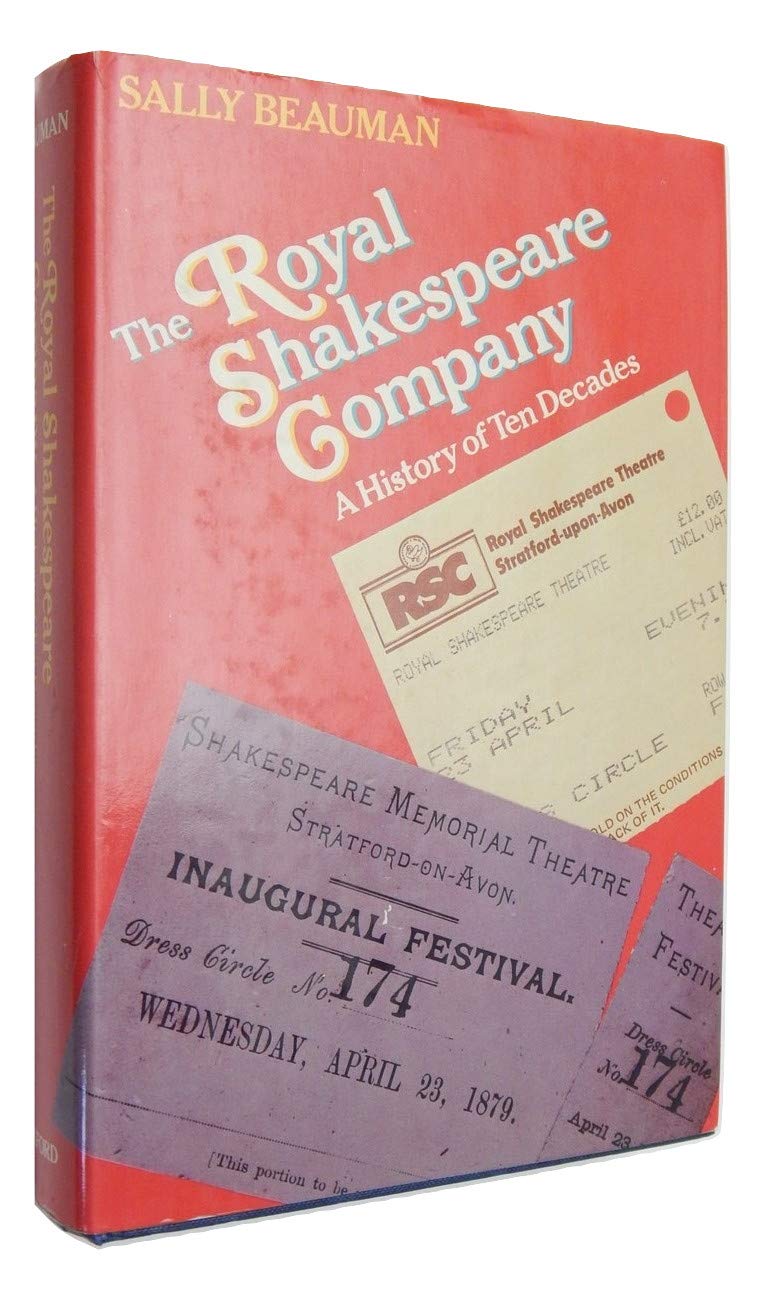
Books One of those books which is so readable there's a loss when it inevitably ends, especially since, having been published in 1982, it unavoidably misses out on covering another forty-years of history. More than simply the theatrical history of what appeared on stage, Sally Beauman's RSC: A History in Ten Decades instead investigates the origins of the RSC, from its original scrappy week long annual event to commemorate Shakespeare (which for years didn't even mount a production), through the building of its various venues, its many directors, the financial wrangling between the board of directors and then the arts council, the rivalry with the National Theatre and how its on stage fortunes have been dictated by critical and academic tastes.

Despite her own association with the company (at time of writing she'd been married to one of its key actors Alan Howard for ten years), Beauman is unafraid to editorialise on the shortcomings of its key players, the text is incredibly gossipy, and the architecture of the auditoriums.  At its peak, the RSC was running six or seven different performance spaces between Stratford and London with numerous seasons of plays and transfers and if nothing else, the book has helped me to understand the provenance of the various programmes I've been collecting lately.  The moment when the book stops, just on the eve of The Barbican opening feels like an extremely exciting time as the company's reputation had reached one of its many zeniths.

You can smell the spaces and rehearsal rooms.  When Trevor Nunn succeeded Peter Hall, he wanted to create a more professional almost monastic atmosphere and to that end replaced the stage cloth, the large sheet in the rehearsal room which represented the acting space.  Over the years it had become incredibly dirty and so it was ripped out and replaced with a brand new, bright white fabric and the rule was that it had to remain that way, whatever the cost, smoking, food, drink and shoes banned from the space and it remained that way through all of his rehearsals.  Then John Barton took over to rehearse his Twelfth Night and when Nunn returned afterward the sheet was as dirty and filled with cigarette burns as its predecessor.  He realised that some things couldn't be changed.

A chronological list of available Royal Shakespeare Company productions and where to watch them.


Theatre is ephemeral.  Records often exist. There will be programmes. Costumes kept in archives along with photographs, annotated scripts, director's notes.  But outside of the publication of the text, it's mostly fleeting, an experience between actors and audiences which mostly lives on in the memories of participants, for better or worse.

Some productions survive.  Quite often they'll be recorded by the company or theatre either on audio or video, usually with a camera filming the whole stage from a fixed point, available for future academics and practitioners to view at the theatre or connected building.  The National Video Archive of Performance contains plenty of those.

Increasingly, though, national theatres including the National Theatre are filming their productions for a commercial audience, either through cinema projection or DVD release or both.  During the lockdown many of these recordings have been made available for free or a small donation and there are now streaming subscription services containing dozens of past shows.

Britbox have recently made twenty-five of the recent RSC Live presentations available alongside their television archive for £5.99 a month and I thought it would be useful or interesting to watch them in their original seasons and recreate the thematic connections, the experience of turning up in Stratford-Upon-Avon and looking at the poster outside.  Which necessitated making a list.

Then I wondered what other Shakespeare productions across the years are available in some form or other, outside of their archived audio or video, whole shows and also excerpts either in compilation releases or television documentaries.  How much of the RSC's bard history is available to the general public either filmed in theatre or reproduced in a studio setting?

Plenty and not much.  As you'll see, from this chronology I've created over the past week, people with academic credentials have access to a number of mid-twentieth century productions recorded for BBC television through Box of Broadcasts (and the BBC Shakespeare Archive Resource).  Outside of that there are a few other similar studio bound reproductions, usually starring Sir Ian McKellen.

There are also excerpts, snatches of productions or whole acts and the sources for these are included below (records or documentaries), although I've excluded the particular Act or Scene numbers to keep the list relatively simple to read, but that's usually a click away.  The link in each title will take you to a production profile which may contain photographs.

Where possible I've also linked to somewhere you can actually watch or see these plays, either right then or through subscriptions and purchases.  There is further archive material on the RSC website, the Birthplace Trust archive (which was invaluable in compiling this list), the RSC's YouTube channel begun in 2010 and the exhibition pages at Google Arts & Culture.

Richard II in New York.

Theatre Because Shakespeare in the Park is cancelled this year, WNYC in New Tork have recorded a radio version and it's available to download here. Cast includes Lupita Nyong’o, Stephen McKinley Henderson, Merritt Janson and Phylicia Rashad.

41: Michelle Terry.


Theatre  During his interview for Playing The Dane, the BBC documentary which sparked this project, Richard Briers when asked what was perhaps most memorable about his performance says, he "was a very fast Hamlet". That's equally applicable to Michelle Terry and indeed much of this 2018 production from Shakespeare's Globe which she also directed. At two and a half hours plus interval, pretty much the whole of the text is covered which on the one hand allows for the inclusion Reynaldo and almost full strength Fortinbras but also less time for moments to breath.

Which looks like this is going to a negative survey of the production, that couldn't be further from the truth.  I loved this production for all of its faults, not least because it seems so unlikely that I've seen it at all.  With operation lockdown having caused so many playhouses to go dark, many of them have taken their work online, streaming old productions for a fee, free or a donation and Shakespeare's Globe is no exception, streaming some old recordings onto YouTube every fortnight for the forseable starting with this Hamlet.  Here it is to watch online for the next twelve days.

The production received mixed reviews at the time which looks to be a function of what Terry was trying to achieve with her first few productions as artistic director.  After a few rocky years under Emma Rice who some loved for her experimental artiface and disruption of the Globe's founding principles, notably spotlights, artificial sound and elaborate staging which others hated for much the same reason, Terry must have felt the pressure to present the work in a diametrically opposite style with a return to the fundamentals of shared light and natural speech projection across a bare stage.

For some that would have been a retrograde step, for others, in other words, me, it is an expression of why the Globe originally existed, to somewhat presents them in a way which would be familiar to audiences four hundred years ago.  The somewhat in that sentence is important.  This is a Hamlet of inclusiveness and gender fluidity, which is still experimental on its own terms and makes simplicity a strength, foregrounding performance and chemistry over concentrating where the actors are standing ready for cues, or at least offering the appearance of such.  

Those aesthetic choices then.  Bare stage.  Costumes which for the most part look like they've been pulled out of the Globe's stores offering a kind of history of the place, with the odd ensemble entirely familiar for those of us who've followed their work over the years, clashing styles and eras in the same scene and across characters.  In the same scene we find an actor in t-shirt and jeans interacting with another wearing what looks like Falstaff's armour from the Dromgoole production of Henry IV with another in a dress from the candlelit Duchess of Malfi.

Which should jar, except perhaps because we're now steeped in post-modernity we somehow accept it just as we do for the most part the casting choices in which the key male parts and Ophelia are all gender flipped.  As with the costuming that looks back into theatre history contrasting today's blindcasting approach with the stringent Elizabethan patriarchy, especially since initially Shubham Saraf wears period corsetry which on occasion seems to work against his performance especially since he's not playing it in an overtly feminine manner.

Female Hamlets usually have to decide whether to attempt to deny their gender or embrace it and although the text retains the original pronouns, Terry brings her entire self to the table in one of the most complex performence I've seen her give so far.  She's a force of nature wringing the full comedy from the text on the one hand and embracing the tragedy of the mission which has been placed on her shoulders by one of the most naturalistic Hamlet Snr's I've seen, a rare occasion when we're able to see how close father and son were.

Which isn't to say Terry isn't above choosing overt ways in which to express the Prince's well being.  For much of the play she's dressed as clown, visually demonstrating how the character is using madness as a mask for hide his true intentions, the face paint smearing, the costume raggedy as it becomes less and less apparent whether this has become a pose or embodiment until in the last movements of the play.  When the "readiness is all" they disappear completely, replaced by a more familiar black coat, embodying the traditional Hamlet silloette.

Such nuance also extends to attitude.  Deaf actor Nadia Nadarajah plays Guildenstern and signs her role with Rosencrantz and in their earlier scenes together Hamlet providing a necessary translation for some parts of the audience.  Hamlet signs his replies, with  "I have of late—but wherefore I know not—lost all my mirth" becoming a magnificent gestural dance as he makes sure his friend heres every word contrasting with the attitudes of Polonius and Claudius with their haphazard and ignorant approaches.

As the veil of suspicion decends on Hamlet's relationship with his friends, so does his tollerance for Guildenstern's disability.  Although they're able to communicate still when Rosencrantz is still in the room, in their short scene together just before the closet scene, when Hamlet is railing at what he sees as a traiterous entity, Guildenstern is persistently signing perhaps unable to understand what the Dane is saying to him.  A small piece of stage business becomes a key moment in our understanding of how Hamlet's psychology is changing.

As ever with filmed Globe productions, the crowd are often as distractingly visible as the actors, a mix of rapture and boredom.  Terry chooses to address "To Be" at a groundling which, as any interaction with the audience often does, leads to some laughter which undercuts the mood and feels like one of the weaker performance choices not least because whilst holding the punters hands, Terry still looks up and address the rest of the crowd robbing it of the intimacy which must surely have been initially intended.

This Hamlet does not wallow in the text's ornamentation.  The pentameter feels all over the place, with a free attitude to punctuation and line reading.  But a more traditional approach often puts too much emphasis on lines which Shakespeare clearly meant to be thrown away as an after thought although a solution isn't found for Polonius's asides during the fishmonger.  At least the actor is able to logically address them to the audience rather than himself or the sky as often happens in shows which pretend that the spectators don't exist.

A multi-faceted production which would no doubt repay repeated viewings, hopefully it'll be made available commercially soon.  If this production is anything to go by, Terry really has brought the Globe back to being the institution I recognise from the Dromgoole days and even (grudgingly he says) before.  For that reason amongst many, I was happy to drop them a donation, a fiver, the groundlings rate, to help them through these challenging times.  I know there are more existential causes right now but this Hamlet was well worth the money.

The Tenth Book I've Read in 2020.

Books   Sometimes the editors in these Arden Shakespeare either rebel against the typical format or at least offer an alternative to orthodoxy.  In the appendix bout sources, David Scott Kastan notices "many serious editions of Shakespeare, like the Arden series, have lengthy discussions devoted to the sources of the plays, and often reprint substantial sections of Plutarch or Holinshed or other texts that Shakespeare clearly read and transformed into drama" before heading off into a few pages of essentially saying there's actually little point because no one can be really sure beyond the obvious examples.

The editor could as well be commenting on this volume's narrative predecessor Richard II which does all those things.  Kastan on the other hand, assumes that we know these other books exist and will probably already have access if we're studying the play.  So rather than simply regurgitating their arguments at length instead investigates the topics he's most interested in.  That makes this one of the more readable Ardens as it keeps the purer lit-crit to a minimum and instead delves into the history of the play and how it fits within the context of theatrical and literary history.

He notes, for example, how the focus of the play has developed over time, from Henry Percy as the heroic figure, to Falstaff as the comedic headliner to the present moment when, thanks to the play usually being presented with the various other sections of this Henriad it's about the tortured relationship between father and son and the fight for legitimacy of both Henrys after the deposition of Richard.  Which is one of the things I love about Shakespeare.  Historically, for the most part, the texts haven't changed and yet they have the capacity to fuel our current interest in having drama with an emotional and intellectual depth.