Showing posts with label life props. Show all posts

Life Props:
Hillary Clinton Tim Kaine 16 t-shirt.

Politics A friend in the US has been kind enough to send me a Clinton/Kaine 16 campaign t-shirt.  As well as actually wanting to register my support from across the atlantic, it was also prompted by seeing a "Dole/Kemp" t-shirt in a documentary and deciding it might be nice to have a historic or historical item for the future depending on which way the election goes.

You might have noticed me tweet a photograph the first time I wore it.


This was the day I visited the Museum of Science and Industry in Manchester and although I wasn't unaware enough that it might attract some attention not to include a spare t-shirt in my backpack.  In museum, and entire family passing by me in the railyard at the back kept their eyes fixed on my chest as I walked towards them. There were also comments. One of the invigilators said that she liked the t-shirt and another older woman who'd stood next to me during a presentation explained that she "admired my fashion statement."  Both were American judging by their accents.

In the days I've worn it since, the attention is always there.  The odd glance as I pass by, people reading my chest.  I've been pointed at from a car a few times.  I assume it's because of the t-shirt.  I hope it isn't something else.  Part of me wonders if I should wait until after the election before wearing it again when it becomes a blue t-shirt with words on.  But I genuinely want Clinton to win and wearing the t-shirt is a tiny way of showing that even if it probably has zero chance of changing the minds of any random US tourists who might notice it on their rounds about the city.

Life Props: A cheap hardback A4 lined book


Life In the early 1990s, when I should have been studying for my A-Levels and with the internet not having been invented yet, for reasons that have dropped through the cracks of my brain, the younger version of me collated/edited a volume of writing that he was particularly impressed at the time. Having thought it lost in time, it dropped out of a pile of old magazines that had been gathering dust, early Heat magazines and the first ever issue of Personal Computer World. A cheap hardback A4 lined book with about a hundred pages, half of which has been written on in a variety of black inks.

After a carefully planned out index/contents page which must have been compiled once the rest of the book had been filled in, the first page contains the following introduction. Even though the rest of the book is handwritten, this was typed into First Word Plus running on an Acorn Archimedes and printed out on a dot-matrix then stuck. The school had made me prefect in the school computer room, which though it meant that many lunch times would be spent supervising young kids more interested in scanning pictures of Jet from the Gladiators into the computer than doing any actual work, had the reward of being able to use the computers during free periods.

I didn’t have a girlfriend at school.

It’s not a great piece of writing; it’s very naïve in places and betrays a scratchy knowledge of the subject – though notice even at that age the differences between different editions of Shakespeare’s plays was a topic with which I had a keen interest. If the sixth paragraph makes little sense at least it's pondering what I would have made of the internet had it been available then. Probably, downloading pictures of Jet from The Gladiators and whole lot more besides.

Introduction -

During our time on Earth, many (including myself) have tried to answer the question of what gives Man the compunction to create literature, and why only a select few actually get their work into print. What gives each work its individuality and why anyone has the right to say whether a work should be allow to be given out to a wider audience.

Before the innovation of mass printing techniques, if a work was popular it would be hand copied by scribes by the people who actually wanted the work. This meant that piece of writing (The Canterbury Takes by Chaucer for example), would only gain a very small audience, and because of the differences in skill of the scribes (either through style of laziness), the final editions might eventually not be what the writer intended.

Matters were made either worse or better (depending upon your point of view!) with the invention of the simple printing press by Caxton. This innovation meant that some writing could be read by more people, but it was still a thing for the rich to actually own a large collection of printed books, and these still contained problems due again to lazy typesetters (hence the differences between the Folio and Quarto editions of William Shakespeare’s plays – whose original intentions will have to be left to theologians and critics until time-travel is invented).

Slowly, more advanced methods came into use, and more and more writers got into print. And, while many classic works were written, many of these works were composed (in my opinion) by writers fill of their own importance, who wrote about things which would appeal to a very small audience and which were beyond many reader’s comprehension – and very often anyone but the writer.

At the start of the pop-culture of the twentieth-century, the pulp novel appeared. It was once said that there is a novel in all of us, and it seemed as though everyone on Earth wanted to set out to prove it. Everything from ‘The Incredible Melting Man’ to ‘French Passion Goddess’. It was during this time that my favourite genre, ‘Science Fiction’, came to a head. Even at this time some great writing was produced, and many writers began asking, and answering themselves questions ‘best left to saints’.

Now, in the 1990s, the written word has come to something of a renaissance. The written word has become an even more popular form of media, and has over taken the television as a more open type of entertainment. Indeed, television has become little more than a supplement, and perhaps even a breeding ground for ideas.

Here is my own personal and totally biased selection of quotations from many sources. Everything from poetry of my own and by other writers, to song-lyrics which have given me some kind of meaning, to prose and a meaningful or amusing retort between two characters in a novel.

So, to you, the reader, here’s wishing you a good read, and I hope that whichever century it is to you right now, it will give you some idea of what kind of literature a teenager of the 1990s might have liked (we weren’t all philistines you know!).

Stuart I Burns,
February 1992.
Understand that over the years this volume's importance has built up in my head attaining mythic status, the literary equivalent of Son of Rambow. My memory was that during this period, I discovered art and film and literature and began to think about the world in a far more complex way than before, that it was full of Shakespeare and movie quotes and song lyics and that it captured the moment when stopped being a teenager.

That's all there; it's also a mess of John Donne and Gerard Manley Hopkins, but also song lyrics from Debbie Gibson, Wilson Philips, Paul Simon and The Bangles the profundities that topped the sitcom Family Ties. Page 61 features quotes from Woody Allen, Art Linson and Lewis Mumford. Flicking through the pages is like talking to someone who doesn't yet know what they like, but whatever it is they think they like they like it very much.

It ends on the scene from the film Stand By Me, the one in which River Phoenix tells Wil Wheaton that he won't amount to anything because people have an expectation that he's a dead beat that won't amount to anything. Perhaps I was subliminally pointing to something I've always had to deal with (and I suspect we all do) the difference between the person I project, the person I think I am, and the person I really am.

I don't buy shoes.

Life I don't buy shoes. That is to say I don't buy shoes for pleasure. I don't have a shoe collection. In fact, when the 'what number of shoes do you own?' conversation develops which it always seems to amongst any group of people who've nothing in common and nothing else to talk about, I'm forced to admit I have two pairs. What I'm wearing (or wearing when the conversation is taking place) and some foot torturers for best.

It hass always been this way, as long as I can remember. There was a phase in my twenties when I had three pair, but I still seemed to only wear one of them so that was redundant. I'm a create of habit, and I'm sure this habit is one of the few I've not grown out of since school. I'm 34. I do have retired pairs now, broken old leather things which have gone past their usefulness and I probably only keep in case I need to lie and say I have more than two, but really, yes, just two.

I'm choosy about shoes. Walking about Manchester today I must have seen hundreds, but could find fault with all of them. More often than not it's because looking at their thin soles, fragile sides, wiry laces and knowing how I tend to treat the things once they're on my feet, I know that it's really not worth spending the price of a holiday on anything too stylish, whatever stylish is these days. They won't last twenty-four hours.

They must be robust. Thick soles, snug sides. I also tend to dislike the styles. I like a patternless round frontage to look down at, yet everything seems to have wild old moccasin style stitching, or from the sides leading up to a point. Or some giant, grotesque brand logo on the side which looks like it was designed by a teenager on an exercise book during a boring lesson. Wrong, wrong, wrong.

I walked and walked today, in and out of shops. Chains, independents, also the kinds of place which lead to the treatment Julia Roberts received first time around Pretty Woman, were nothing has a price on and you know that there's a reason for that.

I glance about at people's feet looking for ideas and realise that I don't like what they're wearing either. I curse myself for not hopping on that bus to Cheshire Oaks and buying some clones of what I'm wearing again, of sticking with what I know, instead of taking this risk of trying something different.

As time goes on all of the shoes are beginning to look the same. When I do find a pair I otherwise quite like they've got bright yellow stitching. I briefly consider buying them anyway and colouring them in before realising that's stupid. But this whole thing was stupid. What was wrong with me? What is wrong with me?

I'm desperate enough ultimately to get a bus then tram then bus out to the Trafford Centre even though I know it's just the same shops (just smaller, huddled together under roof) hoping that perhaps the stock's different, that perhaps that place I saw four years ago, last time I went to Trafford Centre, would still be open.

It wasn't.

But I found these in Clarks. And on budget:


I've decided to buy some trainers as well. I'll have any colour as long as they're not white.

Life Props: Odeon London Road

Odeon London Road closes.

The Odeon London Road closed last night because a new multiplex has been added to the Liverpool One development and for obvious reasons the chain didn't want to have two cinemas operating in the town. Originally opened in the 1930s as the Paramount and converted to five screens in the seventies by Oscar Deutsch's group, this was the last of the original big picture houses in the city. Tragically the building is to be demolished to make way for "a Tesco or a hotel or something" according to the box office clerk when I popped in last week to check. Though that is understandable -- a cinema has such a specific utility it's not easy to simply convert it to another purpose and perhaps it's best that than what's happened to the Odeon on Oxford Road in Manchester, a ghostly shell which stands abandoned. Oscar Deutsch entertains our nation. Except in Liverpool, he'll be doing it somewhere else.

Last time I visited was for Ocean's 13, a couple of years ago. The projection was horrible, the sound poor, the print quality dreadful. Someone sat that the back of the screen chatting on their mobile phone throughout. It was refurbished in the late nineties and split into ten screens, the art deco exterior replaced with the somehow already dated branding that's there now. Five largish screens split into a array of tiny ones, with screen ten offering a picture the size of an average plasma screen. It lost some its soul, the maroon walls and orange lighting replaced with cobalt blue walls. Comfier seating perhaps, but now it was a proper multiplex and though the new tagline bleated that Odeon were 'fanatical about film', this seemed like a factory for the things, a production line of presentation which seemed to also coincide with start of the drift downwards of the behaviour of the audiences.

Still, as I stood on London Road today watching a chippy boarding up the windows, I couldn't help but feel nostalgic. For ages, this was my cinema. True the ABC Lime Street had the wrap around screen experience and 051 at the bottom of Mount Pleasant showed 'proper films' (art house), but if I was in town, or had just finished work and needed a quick fix of cinema, this Odeon was just across the road, and I'd be there all night. Glancing across at my dvd collection, I'm amazed at the sheer number of films I experienced first here, from The Lion King to Rushmore via The English Patient, and bunch of others not released by Disney or a subsidiary. Even at school, I'd install myself there with my friend Tris on a Sunday afternoon in front of whatever film was on -- one week Father of the Bride 2 another Seven and spend the next hour talking about what we'd seen. This is where I saw Groundhog Day, on the night that I finished school. I usually tell people that it was the Hyde Park Picture House in Leeds that really sparked my interest in film. On reflection, it was probably here.

Updated 20/4/2011 The building has now been demolished.

Review 2006: Life Props Christmas Special

Annette asks:
What is your favourite film and why?
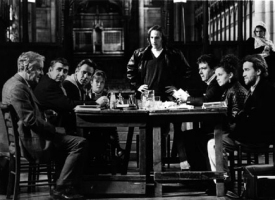


In The Bleak Midwinter (1995)


It's December 1995, I'm at university the first time around and I live very close to the one cinema I would say that I ever really loved, The Hyde Park Picture House in Leeds. In The Bleak Midwinter turned up pretty much unheralded but I'd read about it in Empire Magazine who gave it a sparkling review and having loved everything else Kenneth Branagh had directed (yes, even Dead Again) and being someway into a lifelong appreciation of Shakespeare I knew had to go and see it..

The Hyde Park was the kind of cinema in which any film could potentially be packed out because the audience tended to go see whatever was on. I took my tall friend Dave with me, even though he wasn't sure if it was his kind of thing - in black and white and about theatre - and we sat at the back of the balcony because there was more legroom.

I'd like to be able to give you a long flowing description of the experience of seeing it for the first time but I really can't. I remember being enchanted and laughing a lot and feeling very Christmassy afterwards and Dave saying that it wasn't what he was expecting and that he really enjoyed it but other than that I'd say that it just made me more excited about seeing Branagh's Hamlet the following year, this almost being a rehearsal for that.

It wasn't until the following Christmas, when I was given the video that I really fell for the film. There was certainly the nostalgia factor - I'd left university by then and it reminded me of a good night out at a place that I wouldn't necessarily be able to go back to with someone I hadn't seen in months. But it was also that it somehow managed to distill everything I felt about Shakespeare into an hour and a half and was also brilliantly funny and touching.

The following year, in 1997, I watched it around Christmas time again while I was wrapping my presents. And again in '98 and since then it's become part of the ritual. When I say that I watch it every Christmas, I really do. Which seems like the definition of a favourite film. Each viewing it means more or less to me than the year before depending on what else is happening in life. Last year I was at university again nd it just fitted into the many hundreds of other films I seemed to be watching. This year I noticed that the main character mentions in his opening monologue that he's thirty-three and I realised that I'd be the same age as him next time I see it.

Perhaps I should provide some background because I know that this isn't a film many people have heard of (it's not even available on dvd). In The Bleak Midwinter (or A Midwinter's Tale as it's called in the US) features Branagh and Shakespeare stalwart Michael Maloney as Joe an out of work actor who decides to produce Hamlet at Christmas time in a disused church in his sister's home village of Hope. With him are a group of actors, some in the offseason from seaside shows, all with their own neuroses and the film charts the rehearsal process and the production. It very much follows the structure and style of the Hollywood backstage films from the heyday of the studio system, except with obvious nods and influences from sources as diverse as Woody Allen, Ealing comedies and silent cinema.

Branagh says that it isn't autobiographical, but when Joe describes his passion for the play, that he saw it when he was fifteen and it changed his life that's exactly what the director has said about seeing Jacobi at the RSC all those years ago. His motivation for making the epic film version of the play later mirrors one of Joe's needs here - to try and make something which has a reputation for being musty and boring and making it exciting for a new generation, essentially dragging out of slow amateur schoolroom readings.

Having tried acting and been around a few actors I can absolutely say that the film captures the brilliance and pain of the art, the fact that it can boil down to bringing the deep seated emotional crap that you try to suppress up to the surface in order to entertain others. But what is really clever, is that having suggested from the opening that all of the characters are pretentious and affected and everything everyone expects actors to be - John Session's raving queen and Richard Briers grumpy old man, for example, in a series of carefully chosen two-handers he carefully peels away the surface and reveals them to be perfectly normal people like us, absolutely aware of the mask they're otherwise wearing to get by in the profession.

I think the film was derided at the time as another opportunity for Ken to give his chums something to do, but I thought it was unfair, particularly since it allows them to reproduce the fragile chemistry that any short term group dynamic has but also because many of them are producing what I think are career best performances. People like John Sessions or Celia Imrie, so often stuck playing grotesques and eccentrics are brilliant here when demonstrating the serious side of their all too camp exteriors. Gerard Horan, latterly typecast as policeman is beautifully touching as Carnforth the man with the drink problem. To be honest the only weak link is Jennifer Saunders with her mad American accent who looks like she's charged in from a Comic Strip skit, but there no doubt she's fulfilling the role of the big producer redolent of the genre.

The film is composed rather like a something from earlier in that century - most of the action plays out in medium or wide shots in deep focus with the actors moving into the foreground and back again creating the effect of seeing characters on a theatre stage - there are very few close ups and they only appear late in the film as the group is fractured and the infighting and arguments have begun in earnest. There are montage sequences, such as the audition process and the costuming but Branagh uses a series of jump cuts and juxtapositions to move the story forward.
Branagh employs lighting akin to film noir which fits the mood of the play in production and there are some lovely compositions as the actors walk in and out of silhouette.

Noir is also implied in the costumes that are finally selected for the production within the film which have a kind of 40s gangster style - and there's a spectacular use of a machine gun which accentuates that idea which I don't want to give away. There's also very little music. The film opens with Noel Coward singing 'Why Must The Show Go On' and ends with a plucked instrumental version of the titular Christmas carol. It's a brave stylistic choice but it gives room for the actor's performances to provide the emotional core and make the one musical moment from inside their story - when Nina (Julia Sawalha) sings Ophelia's lament - all the more heartbreaking.

It has dated slightly. One of the jokes hinges on Mighty Morphin Power Rangers which to be honest seemed out of the date at the time although the target audience will at least have heard of it - I'm not sure what the equivalent now would be - probably Xbox or Wii. Also, when Nicholas Farrell's Tom is auditioning for Laertes, he goes into a wild digression about how relevant Hamlet it and mentions that it's like Bosnia. That would be Iraq now I suppose. One element that hasn't aged is the crucial plot point of the filming of a giant sci-fi trilogy that could be the new Star Wars, especially since we've actually had a new Star Wars trilogy (coindentally featuring Celia Imrie as a fighter pilot) and since and everything seems to be about pre-planned franchises and series now.

Some other things I noticed watching it again the other night - the (uncredited) puppet theatre girl in the audition scene is Katy Carmichael who played Twist in the sitcom Spaced. The brilliance of the acronym LCA - Less Crap Acting. Joan Collins as Joe's agent gives probably her best performance since classic Star Trek's City of the Edge of Forever. That Maloney is the best Doctor Who we never had and is completely wasted playing the range of wackos always seems to now in tv dramas - this is the man who stole Juliet Stevenson from Alan Rickman in Truly Madly Deeply after all.

Stylistically different to anything else what Branagh has directed but still with that love of theatre and theatrics it touches me each year and even with the darkness it somehow manages to put me in the Christmas mood. There is a scene within in which people talk about what makes their life worth living and someone mentions Brief Encounter and offers to buy someone a copy for Christmas. Do yourself a favour and hunt a copy of this down in time for next Christmas because if you're a reader of this blog I really think you'll enjoy it.


Which seems like the perfect moment to run through my ten favourite films of 2006. Something that happened this year is that I stopped getting too excited about release dates and being really quite disappointed with most of the films I've seen at the cinema. But anyway I've managed to hash together the following. Happy Christmas!

Clerks II
Somehow managed to be nostalgic about the original and also a development. Funny, touching and just as quotable. Won't be able to see The Lord of the Rings trilogy in the same light again.

Mission: Impossible III
One of, if not the best action film of the year cruelly overshadowed by its star's public activities. Never thought I'd ever see Simon Pegg and Tom Cruise in the same frame together. Actually enjoyed this more than Casino Royale which was too damn long.

The Prestige
Although it didn't quite manage to sustain its finely balanced storytelling into the final reel, it's still a magnificently atmospheric film with great performances. Yes, even David Bowie.

Superman Returns
About as good as you would want it to be, although I've since wondered if there was slightly too much stylization going on and not enough action - but as an iteration of an old myth it works brilliantly and seeing those credits and that music on the big screen again was gutwrenching.

An Inconvenient Truth
Save the debate about whether this is a real film, I saw it at the cinema which is good enough for me. Brilliantly presented the case for global warming and managed to turn the non-election of AlGore into the White House look like a very big mistake indeed.

The Russian Dolls
This ramshackle sequel to The Spanish Apartment has bags of heart and the moment when Kelly Reilly was left on the railway station platform was one of the saddest of the year. The perfect antidote to having to sit through Love Actually five times when writing my dissertation.(pictured)

A Cock and Bull Story
Somehow managed to make me laugh at two of my least favourite comedians. Another triumph from Michael Winterbottom, this managed to be slapstick and intelligent at the same time.

The Squid and the Whale
Demonstrated once again that shorter films are often the best. Direct and to the point, Noah Baumbach's film seemed to distill what Woody Allen has been trying to do shots and editing since the 90s and succeeds ahead of him.

Volver
The first Almodovar film I've really engaged with, and Penelope Cruz's best performance in years. Particularly worked because as well as being a relationship drama, it was a mystery.

Pan's Labyrinth
With a caveat. I don't think it's the Citizen Kane of fantasy Mr. Mark Kermode although it is still a great historical film about the civil war with one of the greatest devils on screen this year in the shape of that Captain.

Life Props


Spring and Fall
Gerard Manley Hopkins

I don't read much poetry. Well actually given that I love Shakespeare I'm not sure that is true - his work is mostly poetry. What I should say is that I don't read or listen to much poetry that isn't spoken by a character within some scene to move a plot along. I'm not embarrassed by this - I believe that some people will concentrate on particular art forms through habit and given my life story and lifestyle I'm just not predisposed. Some people love poetry, some love opera, some love landscape paintings and I don't really love any of the three. Which isn't to say I'm not aware. I think I could tell Wordsworth from Hughes, Milton from McGough.

Most of any poetry that I've read was inevitably at school and that meant John Donne during his jack-the-lad phase and Gerard Manley Hopkins. Knowing me, I'd imagine that I would have fallen into Donne with all his lusty metaphysical verses, all relationships and stories. But for some reason I found Mr. Hopkins to have far more resonance, which is odd because his work is about praising God and nature and all the things that this city dwelling non-denominational spiritualist tends to shy away from.

But unlike much other poetry I've read, to me it's about what isn't being said, the choice of words, and the imagery being evoked which seems to suggest an underlying sadness, an understanding that whilst all of these effervescent, exciting, beautiful things exist, they will eventually end, everything will end. I'm not saying this because I'm a depressing person (I don't think), not really but it's a kind of brilliant realism, that Donne couldn't often muster and in some cases in just a few stanzas Hopkins often evokes something that Shakespeare can't convey in five acts and three hours.

If anyone has heard of Hopkins, when asked for their favourite may mention The Windhover, the bird that's really Christ. There's a magic to the way that the words and the poets experimental stress patterns somehow replicated the movement of 'daylight's dauphin' through the sky (some might remember the Kes-alike sequence in Jimmy McGovern's underrated tv series The Lakes in which the words of this poem are narrated over John Simm character taking a bird-of-prey for a flight). Sometimes Pied Beauty might get a vote with its rhythmic adjectives and painterly descriptions of trout and mole-holes and the hymnal opening and closing. The really cool choice would be God's Grandeur because it brings the pictures of his nature poems to a reminder of human endevour and (I think) our ongoing pounding of the planet which up until that point had not ruined nature which he puts down to the nestling of the Holy Spirit. But for me Spring and Fall is perfect, so much so that I named two television series that didn't happen and a fake company after it (see here).

During school I probably largely passed by the poem, just something else to learn, or something I could read out in class to try and impress Helen Back, a girl I was deeply, madly, passionately in love with. As is sometimes the way with these things, as with Shakespeare, once I left school and finally had a chance to read the poetry properly, understand and enjoy it, the words began to resonate with me. It's a very sad poem really. It's about telling a child that whilst they think they're crying about the coming of autumn and the leaves browning and falling, they're actually crying about having to grow older, because they will get older, and die. It's a harsh message, especially to pass to someone who might think that life will continue to be a long golden summer punctuated by christmases and easters, harvest festivals and leaf falls. By giving the addressee a name, Hopkins makes it personal and we are almost in Margaret's position or being reminded that we were all young once, and ignorant about what a cold, dark place the world can be. That's my dullard understanding, there's a fuller explanation here.

Most art, especially art that someone might describe as their favourite has that quality - you'll often describe it as a favourite for reasons that have nothing to do with the item itself and its true meaning. The reason that this my favourite poem is that outside of its formal qualities, and to this untrained eye it is perfect, Hopkins provides a get out clause, a positive note within the gloom. It's the title - Spring and Fall - for all Margaret's and our grief autumn leads to winter and winter leads to spring and renewal and a return to the kind of beauty evoked by Pied Beauty (although the double meaning is noted - 'spring' isn't just a season here, but its also Margaret's tears).

As I get older the poem for reasons probably beyond its real meaning keeps reminding me that nothing is over, that up until the great coat getting moment that nothing is set in stone, that actually, y'know you might think that nothing can get better and that even though your stuck in a rut and you've (sorry) entered a winter of discontent but that spring is out there waiting for you if you just believe hard enough. Although I'm in limbo right now, I've just completed a lifelong dream and anything which happens now will be amazing.

[This very special Life Props celebrates National Poetry Day 2006.]

Life Props: The Mug

Life Props: The Mug


I can't remember when I bought The Mug. It was in the Oxfam charity shop on Aigburth Road in Liverpool. It stood out against the usual glass juicers and umpteen thimbles. I do know I was having a grim day and it made me laugh, especially since I had a copy of The Guardian in my bag. I think I paid fifty pence. I've treasured it ever since.

Was it some sort of freebie, either given to a relative by someone who works for the paper or in a goody bag at an event sponsored by The Guardian? Were they stuffed into the hands of students at a freshers fair, perhaps in The Bag, along with The Dish, The Plate, The Hat, The T-Shirt even The Towel?

It's the opposite of Magritte's painting, which wasn't a pipe. This is a mug. It says so. It's informative, much like the paper. I like objects which actually have their function written on them - I have a set of pasta dishes with 'Fusilli Pasta Ravioli' around the edge. But that's mostly decorative, whereas this is a statement of intent.

As of Monday, The Mug will be out of date, old news. As well as changing size, The Guardian newspaper is re-designing and one of saddest aspects to go is the title logo. As the editor Alan Rusbridger describes in today's preview copy:
"The title piece - a radical piece of eighties design genius with its then startling juxtaposition of italic Garamond and chunky Helvetica - will have been replaced by a more contemporary one using a new font designed especially for the Guardian."
The new logo looks a bit bland to me - it lacks a distinctiveness, despite the colour. I'll get used to it. And at least I'll have a reminder of how the paper used to look every time I make a cup of tea.

Life Props: Hall Photo (1993)

Life Props: Hall Photo (1993)


This photo was taken towards the end of my first year at university. I don't remember whose idea it was but I think it was felt to be the thing to do, to somehow draw a line under the year in readiness for the independence of smaller shared accomodation. I think the first time I heard of it was when someone knocked on the door of my room at tea time. In case you don't know I'm standing on the very far bottom right with the long hair, the navy blue jacket, greeny-orange coloured shirt and blue jeans with dirt on the knee. Amazingly I'm not the unconventional one, although at no point do I remember this being the style of the early nineties. The creases in the photo are because this is a colour photocopy of the one original copy which we all clubbed together to buy.

I'm startled not only by the number of those faces which I recognise and can name, but also by the proportion who I never spoke to for whatever reason. When we all moved into the hall everyone seemed like they were friends with everyone else. We'd sit in each others rooms until all hours or have adhoc corridor parties. But naturally that was the first week. People interact that way so that they can get a feel for who they have the most in common with.

I didn't really understand that. It seemed as though that was how it was going to be for the rest of the year. So in the second week when people I thought I was getting along with suddenly seemed colder or in those times when I was in rooms and felt generally ignored felt less welcome. That cocktailed with my rampant homesickness and possible low esteem to turn me into a nervous wreck. I remember coming home from seeing Sleepless in Seattle alone and looking around the darkened hall and seeing lots of closed doors with light peaking through the doorframes and feeling left out. Until now this memory was blocked out, but I sat on the cold, concrete stairwell and cried, as everything decended, feeling even worse because no one heard me or came out to ask what was the matter. I seemed alone and unwelcome. That was the older version of me. Now, I would have picked one of the doors, given it a knock and engratiated myself. But I was overwhelmed by the experience and the fact that what support network I had at home then was gone.

In the following days and weeks I made friends. In fact, I replayed a pattern from school and which would continue right up until today. A collection of friends who were all different and would never connect together if they ever met but who I got along with. I could have gone further. I was actually fairly square at university. I didn't really drink then either and too many times I think everyone would be out clubbing and I'd be in the library studying or curling up in front of a video. But I was the first person in my family to go to university, and at school I'd had a certain work ethic drilled into me, so I didn't want to let my grades drop even in the first year when I would have passed to the second year automatically anyway.

Most students probably look back at their time at university with some regrets either because they wish they'd been less of a hellraiser or like me that they'd made the most of the time they'd had. There were people I could have got on better with because the channels of understanding weren't in place or we just weren't fated to be 'chums'. But I'm not much of a conformists (although to a degree less so then). Perhaps the Debbie Gibson poster on the wall of my room in the first semester might have been a mistake.

Dave Foster, middle top row, tall, curly hair. He'd be the person I would end up spending the most time with over the three years at college (we'd always keep finding each other no matter the different shared houses we'd end up in), my particular memories of him at Macauley Hall were the late nights. There would usually be four of us, him and I, Paul the hall president (directly underneath him with the beard) and Paul's friend Andy. We'd regularly still be awake at 3am -- I lost a lot of sleep over those eight months. It would either be marathons of Star Trek, or X-Wing (which was the pc game of the time) or just watching satellite tv (Paul was the only halls resident in history to have a Sky system in his room). Usually, eventually, there would come a time in the evening when they'd want to go to the kebab house, Raj Putts, which was open until 4am. I only ever went once (it was a long walk). I had planned to get the pitta full of meat and hot sauce. In the event, after I'd seen the spinning lump it was coming from I plummed for a salad pitta. A sign of weakness perhaps, but I still think I would have been getting over the event until this day if I'd followed everyone else into the meat and heat.

One row back from the front is Karen Lopez. One night I was in the laundry room reading and washing and Karen came in with a basket of clothes. We'd never been great friends, but we'd chatted in hallways and I think I'd been up to her room a couple of times (which describes my relationship to most of the people in the hall). Karen who was always happy and hyper, looked shaken and depressed. I asked her what was wrong and she told me. It was one of the best nights I spent that year. Before Uni, at school and out I had always ended up being a listener and problem solver. My mouth can run away with me sometimes, but when I need to shut up I will. In those first few months no one seemed to need me. I like being needed. So when Karen started talking I suddenly felt at home again. She'd had an arguement with her boyfriend (Andy, top row) and it seemed permanent. I just sat and listened, until long after we'd forgotten about the laundry. It's one of times when you don't remember exactly what was said, just the impression. I think I might have said some things about it not being the end of the world, about how two people love each other then can work it through. Whatever it was they got back together that night. I maintain that they would have done that anyway, but it just nice to have helped again. Just once.

But of everyone the one face which stands out is on the front row. Rosie Holt. She's the one in purple. Of all the people it would be nice to see her again. She's the one who on reflection was so unlike me and yet so close to who I think I am. She tried my patience sometimes, but equally I probably didn't give enough of a chance. I think we were friends, but too often she'd shock me enough that I'd run away and hide; at times I'd want to be quiet and Rosie would be there -- I'd think she was interupting but actually she was keeping me sane. Last time I saw her was ten years ago. I met her in the Merrion Shopping Centre in Leeds after I'd heard she left University. We didn't talk for long -- whoever she was with was hurrying her along (so mid-nineties) but there was something about her which made me worry. And I've worried about her for a whole decade. I've put her name in the 100 things I post in my user profiles online. Spookily, this exact day last year I posted on the weblog that someone had found the site by googling for the name Rosie Holt. Then tonight, as I was writing this, trying to remember someone's name, I inevitably looked on Friends Reunited. And there she was. Rosemary Holt now. Her entry says: "I am working in Glasgow, bringing up my 4 year old daughter and 'net surfing most of time!" Doesn't closure come from the strangest of places? Perhaps Rosemary might stumble on this sometime and we will see each other again.

This photo for me is about people, and memories of people. There's Phil Wynne who I'd chat to every night before I went to bed, and Andrew De Swarte who'd go the local supermarket a hairsbreath before closing so that he could gather up the reductions. Unlike a holiday snap which might remind the owner of a single moment, this is the record of an entire year of my life. Even if not everyone made it to the steps on time (Jess, Benoit, Anne-Marie) they're also there by association. I'd probably never known so many people at once before and at the same time not known them at all. But it also lets me see how far I've gone in ten years. Although my hair looks almost exactly as it did then, so something things aren't supposed to change.

Life Props: Scarf

Life Props: Scarf


Until I started secondary school I never really wore scarfs. This was the time of the parka and to have the fur and the wool together was suffocating. The few I had were mostly decorative from a time I was almost a football fan. In particular a two-tone to commemorate one of the Everton-Liverpool FA Cup finals. Strangely despite hardly ever watching the sport it hung on my wall for years when I was a youngster.

When I did move up to the big school I had a scarf in my the school colours, blue and black. This from my Mum the knitting guru . It was always tricky rationalising how it fitted with blazer and tie but I somehow managed. It's still hanging off my chair on my room and until the weekend I was still taking this one out when it was bitterly cold.

My university scarf was fifteen feet long. It arrived by post in a show box when I was in halls. My Mum had been on sick leave from work and decided that she would finally knit the scarf I'd wanted since I saw Tom Baker dash around a quarry in the 1970s. It was all in black and very thick. In all the years we were together I never worked out how to wear it comfortably. It would bunch around my neck adding an extra chin and if I didn't throw it around my shoulders five times I'd end up walking on it. But I loved it to bits for what it said about me and how warm it made me feel. Then one fateful night earlier this year I went to a pub in the city centre and saw a really good band. So good in fact that I left the scarf behind when I left. I never saw it again. I was crushed and as you can see it took me months to come to terms with the fact and move on. But they were a good ten years.

I bought this new scarf at the weekend. It's from RedGreen and as far as I can see features their slightly Christmassy corporate colours. It's just right -- thick enough to keep my neck warm and thin enough that I'm going to half throttled when I go out in the morning. Original price £29. I bought it for £7 because it was the last one in the shop which makes me style conscious and lucky. I was bit worried that it was mainly for women, but the sales assistant convinced me it was unisex. Although I love it to bits, I think the mulled wine and cake which they were giving away in the shop might have swayed my purchasing decision.

Life Props: Gap Bag

Life Props


Gap Bag


I carry my bag everywhere. It's only on very rare occasions I'll go anywhere without it strapped to my back and frankly I can't understand how anyone manages to survive without something to keep their belonging close at all times. It's like a tiny caravan, a way of keeping with me all the comforts that I need to get me through. I'm not quite Ally Sheedy in The Breakfast Club, but on an average day it contains: a book, my portable cd player, couple of cds, an umbrella, a copy of The Guardian, a bottle of water, camera, film, pen, pad, travel comb, travel toothbrush and toothpaste and spare batteries. In the past I've also carried a jar of coffee, towel (no really), weather mac and jumper.

Of all the bags I've had over the years, this is the one I've loved the most (if it's possible to feel anything for an inanimate object). Over the years I've had everything from a typical sports bag to a cloth ethnicy thing by way of briefly a briefcase. For well over two years I was using one of those school backpacks which WH Smith sell hundreds of. That was mostly fine, but over time the stitches came undone and the light bits of foam which were holding the straps together began to show. I thought I wouldn't ever want anything differentwith its pouch on the front for my cds and adjustable strap. It was my companion in Paris and other places but over time I tested it's limits and eventually it began to feel too small.

So about six months ago I began to actively seek a replacement. I was looking for what I had, but better. I looked online and in place after place, trying new bags on for size to see which fitted. But none of them did. The strap would be too short, or there wouldn't be a pocket. Frequently I'd put those bags back on the shelf or hook and wonder who could find a use for some of them, with their garish colour schemes or pointless pockets.

I eventually met this one in a Gap store of all places. Ironically I was in the middle of reading Naomi Klein's No Logo and even as I swung it over my back for the first time I felt like I was cheating on her somehow, as though she was standing in the doorway of the shop, looking in at me and shouting, 'Am I wasting my breath?' But it was snug, it fitted the contours of my body perfectly and it was just big enough - but not so large everyone who saw me might think I was on my way to meet Sir Edmund for an adventure. As I paid for it Naomi's ghost disappeared in a rationalization - the bag had given a whole group of people at different places in the supply chain a job they might not otherwise have. So long as they were getting paid something that was sort of okay even if it was in a dictatorship. But what isn't made in China anymore?

But this wasn't my bag yet. It wasn't quite right. The cloth hook at the top, the only use for which seemed be to let it hang in the shop was flicking against my ear. So that was sewn down onto the strap. The large metal buckle on that strap was fairly loose and would move a bit as I took the bag on and off which meant the bag itself would fall away from my back. I adjusted it to the length I needed and that was sewn down too. There was also a pouch dangling there for holding a mobile - the phone I had at the time wouldn't fit so that was removed. Some things I couldn't change - it felt weird on my shoulder - but that was understandable because I was used to something else being there. The music pouch on the front with the hole for headphones was perfect for the iPod I don't have but my cd player wouldn't fit in.

I forgave all this because of the size and shape. The old fitted inside the new with bags of room to spare. I was suddenly able to carry magazines around without having to role or bend them. I could go shopping and fit everything on my back leaving my hands free. Whenever I've gone away anywhere it's been my only hand luggage because I can get a change of clothes and everything else in there. It has a weight itself which means it can carry weight. When I'm traveling and tired I rest my head on it and if I need support it'll stop the back pain. If I'm in a tight corner it has an ordinary handle on the side so I can take it off and carry it normally through narrow gaps in shops and on buses.

There will be a time when this bag stops looking so shiny and new when the fact I can't listen to music as I walk around very easily will start to annoy. But at the moment the scuff marks on the Gap logo make it looked lived in rather than old and I can carry my cd player in my hand. Until then, it's carrying my weight.

Life Props:Natalie Imbruglia's 'That Day'

Life Props


Natalie Imbruglia's That Day


When I was commuting to work in Manchester, each day four things kept me sane. Writing this weblog which I began ironically just as I had less time write anything but also when I had a massive number of things I could write about. The sure decision going into the job that I would be there for one calendar year, until the same day one year later. The Guardian newspaper. The music. It actually took me a few months to buy a portable cd player, a Matsui which was cheap but suited the purpose. I carried with me a selection of albums in a pouch, picked mostly randomly from my collection. It was a broad mix from the Deacon Blue best of compilation (the first cd album I bought) to Mike Figgis music for his film Leaving Las Vegas. An average train journey was fifty minutes which was the length of most of the albums which was just perfect.

After a while I began to vary the music and actively looking for things I wouldn't listen to usually because I had the time to experiment. The lamented and sometimes lamentable Travels with Matsui articles on the weblog were a reaction to this as I trundled through Pink Floyd and Britney Spears. It was an interesting experiment, but after only a few weeks it began to annoy me. I needed music I could hide in for those journeys, envelope me from the madness of the packed train or the misery of the delays or the sheer tiredness. The sheer unfamiliarity of what was happening in my ears did help matters. So instead I started looking for things which were new but familiar, which I was still discovering but which sounded like they were written to appeal to me. It was about here that I first discovered World Music with Verity Sharpe's Late Junction compilations, and fell for Shelby Lynne's second album after reading a really good interview with her in The Guardian. Again as a form of synergy I put together a soundtrack for the weblog which to a degree reflects how my musical tastes were changing during that time.

Then there was Natalie Imbruglia's song That Day. It's from her second album White Lilies Island. If ever there was an unsung hour of music. Second records are always tricky and many artists fall apart. Not this one. Her first Left of the Middle was a fairly big hit, largely on the back of her recording of Torn, ironically the only thing she didn't write herself. Predictably the rest of the piece is nothing like that, sometimes dark, sometimes deadly. So the inevitable follow-up was also dissimilar to the hit and was ignored by critics and the public alike. As is the way of things, I thought it was brilliant. I suppose now I should be careful not imbue it with a mythic quality it can't withstand if you happen to hear it, but for me, during that time, it was a transporter, away from the man in front of me across the train table whose long legs kept crunching into mine (for example). I'm listening to it right now and wonder if it had been released this year during the Norah Jones / Joss Stone era if it would have found a richer audience - it has that quality you see of winding down and luxuriating.

But to return to That Day. It's the first track on the album, but I discovered in on the late pop and comedy tv station PlayUK which I'd watch before going to work, while I ate my Crunchy Nut Cornflakes. For about two weeks it was on every morning just before seven o'clock, just before REM's Imitation of Life. It's actually not that remarkable. Imbruglia appears in a dark green corridor - like an old fashioned subway. Silhouetted passers-by walk away from us as the singer steps forward, brilliantly lit, sometimes looking at us sometimes away. But it wasn't the video I was looking forward to, it was the song.

A conundrum of words. That aren't sung. It's quite close to rap, but not in an angry or aggressive way, like poetry without the beats being too obvious or in any kind of order. Hammering out the rhythm on a table it sounds more like morse code. It also doesn't adhere to the pop regime of two verses, chorus, two verses, chorus, bridge, chorus repeat to fade The second time I heard it was so that could work out what the words all were. The third time I just about managed, and by the fourth I was addicted. Like REM's It's the End of the World ..., it's there to be mastered, keeping all those words in place as deftly as she does. When I bought the single I played it over and over trying to drag myself through it. I remember standing in the kitchen making dinner, the cd single's inlay in hand working my way through the lyrics, marveling at her verbal dexterity. To this day I still can't do it. I always trip over 'Sad, scared, small, alone, beautiful'.

It wasn't until I was sitting on that evening train home, ('which had been delayed by approximately thirty minutes due to a points failure') utterly depressed, that the lyrics finally sank in ...

That day, that day
What a mess what a marvel
I walked into that cloud again
And I lost myself
And I'm sad, sad, sad
Small, alone, scared
Craving purity
A fragile mind and
A gentle spirit
That day, that day
What a marvelous mess
This is all that I can do
I'm done to be me
Sad, scared, small, alone, beautiful
It's supposed to be like this
I accept everything
It's supposed to be like this

That day, that day
I lay down beside myself
In this feeling of pain, sadness
Scared, small, climbing, crawling
Towards the light
And it's all I see and
I'm tired and I'm right
And I'm wrong
And it's beautiful

That day that day
What a mess
What a marvel
We're all the same
And no one thinks so
And it's okay
And I'm small
And I'm divine
And it's beautiful
And it's coming
But it's already here
And it's absolutely perfect

That day, that day
When everything was a mess
And everything was in place
And there's too much hurt
Sad, small, scared, alone
And everyone's a cynic
And it's hard and it's sweet
But it's supposed
To be like this

That day, that day
When I sat in the sun
And I thought and I cried
'cause I'm sad, scared, small
Alone, strong
And I'm nothing
And I'm true
Only a brave man
Can break through
And it's all okay
Yeah, it's okay

It's those final two lines. 'It's all okay, Yeah it's okay.' I know that they're not supposed to have the same resonances I was getting from them (probably for her a handy way to step away from the mic for a few moment while the band plays). But the little tired man hiding at the back of my mind agreed with her. Actually, yes it will be ok. I've heard other people tell stories like this, how the right song, at the right time can save them. And I'm sure my family and friends had said something similar to the lyric before. I don't understand why some singer I've never met in a song I'd heard many time would be more convincing. But Natalie Imbruglia was. Yes, it was all okay, yeah it was ok. I was going to be ok.

Its power comes and goes. It's there on my hard drive and WinAmp will pull it out of the many days of music now and then. Sometimes it drifts through un-noticed and sometimes, like the other day, it'll break through the fog when I think it's all going wrong to remind me that it actually isn't. That the end is in sight that the next good thing is on it's way and I shouldn't worry because ...

'It's all okay, Yeah it's okay.'