Showing posts with label chronologies. Show all posts

A Chronological Viewing Order For All of Lucy Worsley's Documentaries.


TV   In the past couple of weeks the latest series of Lucy Worsley Investigates has been released on BBC Two and the iPlayer.  Not knowing what to expect, I headed into the first series, starting with The Witch Hunts and was struck once again with Worsley's ability to present difficult subjects with intellectual rigour but in an inclusive style that doesn't patronise the viewer.  

Until recently, every morning I'd watch a documentary of some sort, but age and tiredness have meant I've strayed instead into drama or "whatever's on YouTube".  I'd like to try to get back to that place and after completing the Witch Hunt (so to speak) wondered if Lucy Worsley could be my guide.  She hasn't produced that much, I thought, so it would be a good way back in.

But as her Wikipedia page revealed that she's created quite a large body of work in the past decade or so across various periods of history and BBC networks.  So, I then thought, perhaps I could just do the Investigates series and see where I go from there.  Then the part of my brain which wants to put everything in chronological order decided to take over and ...

Find below all of Lucy Worsley's appearances in history programmes, either presenting or as a guest in chronological order based on subject.  The years are what appear to be when the stories begin or the date of the particular event she's covering based on the programme synopsis or else googling around and squinting.

You'll notice I've arranged them around royal houses.  So much of her work is about the inner workings of court so this seemed appropriate, although it's also irrelevant in the 20th century.  At the bottom are all of the shows which couldn't fit easily into the main chronology because they're so thematic it would be impossible to try and slot them in anywhere.  

Also because I'm a masochist, I've also linked to each episode's programme page.  Quite a lot of what's here is available on the iPlayer and if it isn't, BBC Four will probably repeat it in the next twelve months anyway.  Otherwise there are probably various nefarious ways of finding them in the places you already know where to look.

* - Lucy was just a contributor
** - Portion of a programme

NB:  I've removed Lucy's name from the titles for the most part to stop this looking monotonous.

The Wessexes


The Normans


The Plantagenets


The Tudors


The Stuarts


The Hanoverians


The Saxe-Coburgs


1903    Suffragettes


The Windsors


1940    Blitz Spirit


Thematic


All The Doom's Day stories And Where To Buy Them.


TV  With this being an anniversary year for Doctor Who but without an actual television programme until November, much as they did in 2020, BBC Studios are co-ordinating another multi-merchandising platform storyline.  Doom's Day is somewhat less expansive (and expensive!) than Time Lord Victorious and has a much clearer chronology in that we follow Doom, a single protagonist across a whole day on the trail of the Doctor.

The official website is here and has a few problems.  For one thing, whoever created it ironically doesn't know how the 24 hour clock works, so when faced with a list of times like 1600, 1700, 1800 and 1900 (each is the given start time for a particular adventure from BBC Audio) says that the story "takes place between 1600 and 1900 in Doom's Day" which would mean the final chapter has zero duration (it does this a couple of times).

But there also isn't a simply way of seeing all of the adventures in a simple chronological list so that you can see how all the comics, the novel and various audios slot together.  Find below a simple chronological list so that you can see how all the comics, the novel and various audios slot together.  They've kept this pretty simply in comparison to last time with the various types media clustered together, the DWM comic into Titan comics, BBC Audio into Big Finish (which is where the story ends obviously).


Where possible I've offered to the cheapest options.  The main site links to the BBC Audio story on vinyl (£29.99) but it will be available on a much cheaper CD release (£13) and I've also included the Kindle editions of the Titan comics.  Anything linked to Amazon has an affiliate link too, which should not be taken in any way as the reason for this exercise, at all.  Anyway, congratulations Sooz on all of this.  I'm really looking forward to it.

Alistair Cooke's Letter From America: A Chronology.


Radio  Letter From America was a weekly series on Radio 4 which ran from the mid-1940 to the mid-2000s in which the broadcaster and journalist Alistair Cooke commented on the week's news from the United States in a fifteen minute essay.  Documenting the history of the country over the past five decades, every episode of filled with contemporary details often glossed over in hindsight.

Across its 58 year history, 2869 episodes were broadcast of which about 1,550 survive, 900 in the BBC's own archives and another 650 previously thought lost until they were revealed by two listeners who'd been diligently recording ever episode for decades.  Home taping might have been killing music but it was saving this precious speech radio.  

Every extant episode is now available on the BBC website.  Unfortunately, like In Our Time, they're locked into a programme page format which isn't easily navigable when that many episodes are involved and so I decided to create the following chronology to make them more accessible and create the ability to easily skip to a particular year and re-experience that history through the words of Alistair Cooke.

To that end, I've also augmented the radio episodes with transcripts of lost episodes from elsewhere as well as Cooke's US-related journalism from other outlets, notably The Guardian where he was a foreign correspondent from 1947 to 1972 and which led him to be on the ground during these historic moments, like the Montgomery bus boycott and RFK's assassination.  Those entries will be marked with their source and in italics.  Enjoy.


A viewing order for all of Star Wars.

Film  Yes, I know.  The web is littered with articles listing "the best order to watch Star Wars" or some such, but so, so many of them get it wrong.  Apart from ignoring the chronological viewing order of The Clone Wars and how the final season works in relation to Revenge of the Sith and The Bad Batch, they're rarely itemised by the episode, mention Forces of Destiny or include still blatantly canonical nonsense like the Ewok movies (no matter what Lucasfilm says).  So modelled on my viewing order for the Whoniverse, here's some click bait which you might nevertheless find useful.

Some notes.  It's up to you on which order you decide to watch the episodes of The Clone Wars and Resistance which take place simultaneously with a film.  I've put them after each film as a kind of "meanwhile" but this viewing order isn't really for people who haven't watched most of this before.  This chronology also focuses TV and film because they're traditionally considered to be the most canonical (although I'm tempted to include the adaptations of lost stories from The Clone Wars at some point).  I will keep this updated as each new series or film is released.

The shorts are the biggest problem because they weren't really designed to be watched in sequence (and the Star Wars website offers few answers) so any kind of attempt to find a logic placement is fruitless.  Forces of Destiny episodes have been grouped together under the relevant years for ease of watch, although suggestions welcome, especially in relation to The Clone Wars and Rebels tie-ins.  The Resistance shorts have been timed to fit between the two episodes of the Season One mid-season break when they were uploaded to YouTube.

For an explanation of how calendars work in Star Wars visit the Wookiepedia, which was the source for much of the dating here.  Basically BBY is Before Battle of Yavin and ABY is After Battle of Yavin, which obviously made sense when that was the great victory which brought down the Empire.

[Key: VIS=Visions, FOD=Forces of Destiny, TCW=The Clone Wars, TBB=The Bad Batch, OBI=Obi-Wan Kenobi, REB=Rebels, MAN=The Mandalorian, BOB=The Book of Boba-Fett, AHS=Ahsoka, RES=Resistance, RSS=Resistance Shorts, TOJ=Tales of the Jedi, TOE=Tales of the Empire, TOU=Tales of the Underworld, YJA=Young Jedi Adventures, YJAS=Young Jedi Adventures Shorts, ACO=The Acolyte, AND=Andor, SKC=Skeleton Crew, MOV=Films.]

A Viewing order for the The X-Men franchise.

Film Welcome to the feelinglistless breakroom, I'm Stuart Ian Burns.  

About four years ago, after the release of Logan, I attempted to put the X-Men films into some kind of logical viewing order with only minor success. After seeing someone I follow on Twitter try to make sense of it, I had a brainwave. Rather than treat them as a single narrative, just assume they take place in different realities, ala the Sony Spider-Man films and watch them as such, like an anthology series about mutants. 

Logan's Run. 

X-Men Origins: Wolverine 
X-Men 
X-Men 2 
X-Men 3 (or whatever it's called in your end of the world) 
The Wolverine 
X-Men: Days of Future Past 

As I suggested last time, there's a version of these films in which the same Wolverine character is the protagonist who finally has his redemption at the close of Days of Future Past, having undone the mess of X-Men 3. If you watch just these films, they tell a complete story (assuming you're kind enough to accept there are two mutants both called Sabretooth for some reason).

Old Man Logan. 

The Gifted 
Logan 

As I misinterpreted on first viewing, Logan is supposed to be set in a different continuity, perhaps one in which the events of Days of Future Past didn't end favourably. I'm also boldly suggesting that this is the same world TV's The Gifted happened, which also has an absent X-Men and mutants on the run from sinister forces.

The Do-Over.

First Class
Days of Future Past 
Apocalypse
Dark Phoenix

Time works differently in this reality, people or at least mutants, don't age at the same rate as the others.  Essentially this is the reality which breaks off after Wolverine time travels.  Versions of at least the first two films in the 00s trilogy do happen after Dark Phoenix and the final result is much the same but perhaps even further into the future (to explain the different casting especially of your Mom).  This also helps explain the various casting changes from the "Prime" universe, notably Emma Frost.

Elseworld.

Fant4stic
Deadpool
Deadpool 2
The New Mutants
Legion

Ridiculously, Deadpool is referenced on screens and documents in the airplane scenes of Fant4stic which means they're in the same continuity.  Putting Deadpool in a different reality to the other films explains why Colossus is so different to them and it bolsters The New Mutants a little bit by making this other X-Men the one they're referring to with their fate leading in to Legion as the terminal point for mutants in this reality.

What do you think?  Leave a comment and don't forget to like and subscribe. For feelinglistless, I'm Stuart Ian Burns.

NYCHistory:
New York on Film
in Chronological Order.


Introduction.

After ninety days in lockdown, my imagination is naturally trying to focus on other people and places, constantly reminding myself that there is a world outside of this tiny flat, somewhere I used to be and will be again.  One of, if not the key support in this has been film, with its capacity for time travel, to provide a window onto what we might describe as the before, when we didn't live in fear of others and the physical disaster they might accidentally inflict on us.

One of the places I keep returning to is New York.  Ever since my film diet evolved in my mid-teens, it's been impossible not to idolize it all out of proportion, fascinated by its size, its landmarks, its atmosphere.  Of course this is all through the filter of film and it's easy to romanticize a place when you've never actually been there, but at university, in halls, I'd sit in the doorway of my room and pretend it was the window ledge of a brownstone watching the world go by.

Why then create a chronology?  The idea's been swirling around me for a few months, as I wondered if it was possible to track the building and development of this metropolis through cinema, to see what the earliest narrative about the city is and compare period and historical films with the movies produced in the era they're depicting.  Would there be clustering around the larger events in the city's history?

Find the results below.  The spine of this list is a page at the Wikipedia which I've trusted to give me accurate information about when films are set, so there are bound to be errors and do let me know if you spot anything.  The plan is for this to be an organic chronology with films being added in and out if it's obvious that something should or shouldn't been in here.  It will continue to evolve, there are plenty of documentaries to add.

Some rules I've worked by.  The chronology only includes films intended for theatrical release.  There have been hundreds of television series and movies over the years about New York but the ultimate intention for the list is that someone might actually sit down and watch the films in a particular year or even the whole thing (if they do nothing else for the rest of their lives) and adding lots of television most of it probably unavailable would just complicate matters.

Other than that the list is inclusive for the most part.  If a film has any scenes set in New York, they're included, even if they weren't actually shot in the city itself.  It's about how the city has been depicted over the years  But it has to have scenes set in New York or be are about the city and its people.  Films which show and talk about the reality of 9/11 are in here, the many interchangeable conspiracy documentaries are not.

As to the date when a film is included, it's been a judgement call.  If a film covers a long time span, I've tried to place it in the moment when the city has the most impact on the story.  If it isn't a historical film, I've just assumed its set in the year of release based on the information available from the synopsis, watching the trailer and my own memory of seeing the film.  Again, there will be errors.  Do let me know etc etc.

Finally, the documentaries are marked in italics in case anyone decides to stick with reality, or at least reality through a documentarian's eye.  I haven't separated out the newer films set in an older period because it made the chronology even more difficult to read.  Plus its an incentive to click the link on an interesting sounding title and discover when the film was made in contrast with those around it.

If I've learnt anything from this exercise, it's that there are many films by well known directors with incredible casts which have become all but forgotten, especially from the 1960s and 1970s.  Remarkably a lot of them are available for rental on streaming services, so it's worth checking JustWatch if something takes your fancy.

A Viewing Order for all of the Claire Temple episodes in the Netflix MARVEL series.


TV Claire Temple, so winningly played by Rosario Dawson is my favourite character in the whole of the MCU, films or television. Appearing across the Netflix series, she's always the one thing I look forward to and indeed in Iron Fist she's about the only reason to continue watching later in what's otherwise a quite boring and confused series.

 With The Defenders finally arriving in a month's time, I don't currently have time to binge repeat everything so I've decided to just watch those episodes featuring Temple, see how much of a coherent story they are on its own.

As an aid, I've created this watch this for the episodes in which she features across the series which about three of you might also find useful too:

Daredevil (Season One).

2. Cut Man
4. In the Blood
5. World on Fire
6. Condemned
11. The Path of the Righteous

Jessica Jones (Season One).

13. AKA Smile

Daredevil (Season Two).

3. New York's Finest
10. The Man in the Box
11. .380

Luke Cage (Season One).

5. Just to Get a Rep
6. Suckas Need Bodyguards
7. Manifest
8. Blowin' Up the Spot
9. DWYCK
10. Take It Personal
11. Now You're Mine
13. You Know My Steez

Iron Fist (Season One).

5. Under Leaf Pluck Lotus
6. Immortal Emerges from Cave
8. The Blessing of Many Fractures
9.The Mistress of All Agonies
11. Lead Horse Back to Stable
13. Dragon Plays with Fire

The Defenders.

1. The H Word
2. Mean Right Hook
3. Worst Behaviour
5. Take Shelter
7. Fish in the Jailhouse
8. The Defenders

A viewing order for the X-Men franchise.

Film Bryan Singer and co-screenwriter Simon Kinberg have taken some time out during the promotion for X-Men: Apocalypse to explain how time travel has fixed the X-Men universe. [link via]

I thought it was pretty well explained on the Days of Future Past Extended blu-ray but it essentially boils down to a similar approach to JJ Abrams in Star Trek except with Wolverine as the emissary between the timelines rather than Spock.

Spoiler warning for Days of Future Past.

The events of Days of Future Past have wiped out:

X-Men
X-Men 2
X-Men 3 (or whatever it's called in your end of the world)
X-Men Origins: Wolverine
The Wolverine

And now the official X-Men Cinematic Universe contains, in chronological order:

X-Men: First Class
X-Men: Days of Future Past
X-Men: Apocalypse
Fan4stic
Deadpool

BUT

Wolverine consciousness has passed from one timeline to the other.  So the Wolverine walking around in the future scenes in Days of Future Past is the same one who turned up at the beginning of X-Men.

Which is were it gets complicated because for him to take control of the alt.Wolverine in that future means the mind of alt.Wolverine has to be wiped over; he shows no signs of actually remembering anything that happened to this other Wolverine up until that point.

Luckily he's not apparently in Apocalypse so we won't actually see the alt.Wolverine walking around, having a life before the "real" one comes along and murders him later.

BUT it does mean that it's possible to have a chronological viewing order for the X-Men films if you want to see them from Wolverine's perspective (give or take some suspension of disbelief in regards to Sabretooth) (you could just assume them to be two different characters with the same name which does already happen a lot in comics):

X-Men Origins: Wolverine
X-Men
X-Men 2
X-Men 3 (or whatever it's called in your end of the world)
The Wolverine
X-Men: Days of Future Past

My preference is for the Extended Cut of DoFP because it nicely bookends Wolverine's friendship with Rogue.

This leaves out:

X-Men: First Class
X-Men: Apocalypse
Fan4stic
Deadpool

unless you want to sit through First Class just for his cameo.

Presumably the next Wolverine film will be set after DoFP.  As Singer says in the interview, what he's now making are prequels to the alt.future scenes in DoFP.

Of course as a result of all this, Hugh Jackman once took a break from filming DoFP to promote The Wolverine which was essentially being wiped out in franchise terms by the very film he was making.

Except if you look at the series instead from Wolverine's perspective, the closing scenes of DoFP have an even greater emotional resonance because of one of the subplots in The Wolverine.

Perfectly simple really.

A viewing order For The Fast and the Furious franchise.

Film Having very much enjoyed Justin Lin's Better Luck Tomorrow, not to mention his subsequent Fast & Furious films, I have considered a rewatch of the whole series, except as fans know, and there are a couple, the whole timeline is messed up because of Han's fate in Tokyo Drift, which has been somewhat explained in Fast & Furious 6. Nevertheless, here's a short viewing order for the Fast & Furious films and their various spin-offs.

The Fast and the Furious

{Better Luck Tomorrow}

[Turbo-Charged Prelude]

2 Fast 2 Furious

[Los Bandoleros]

Fast & Furious

Fast Five

Fast & Furious 6

The Fast and the Furious: Tokyo Drift

Of course watching them in this order for the first time creates a massive plot spoiler for Tokyo Drift in much the same way as The Empire Strikes Back is presumably a bit underwhelming if you've had to sit through the prequels for the first time. There are people who've done this. I've seen the online complaints.

Plus for this to work, you have to assume that all of the films between Better Luck Tomorrow and Tokyo Drift either happen within about four years or that Tokyo Drift was set in the future when it was made. Considering its locale that's not too much of a stretch.

Perhaps if I do rewatch this lot, I will look out for dates and see if the continuity people have been paying attention.

Beyond that, you do have to at least admire that Lin's determination to keep the Han character within the films led to its biggest biox office successes actually being midquels to a franchise outlier with about as much to do with the other films as Season of the Witch does to the other Halloweens. Or judging, by F&F6, at least it did ...

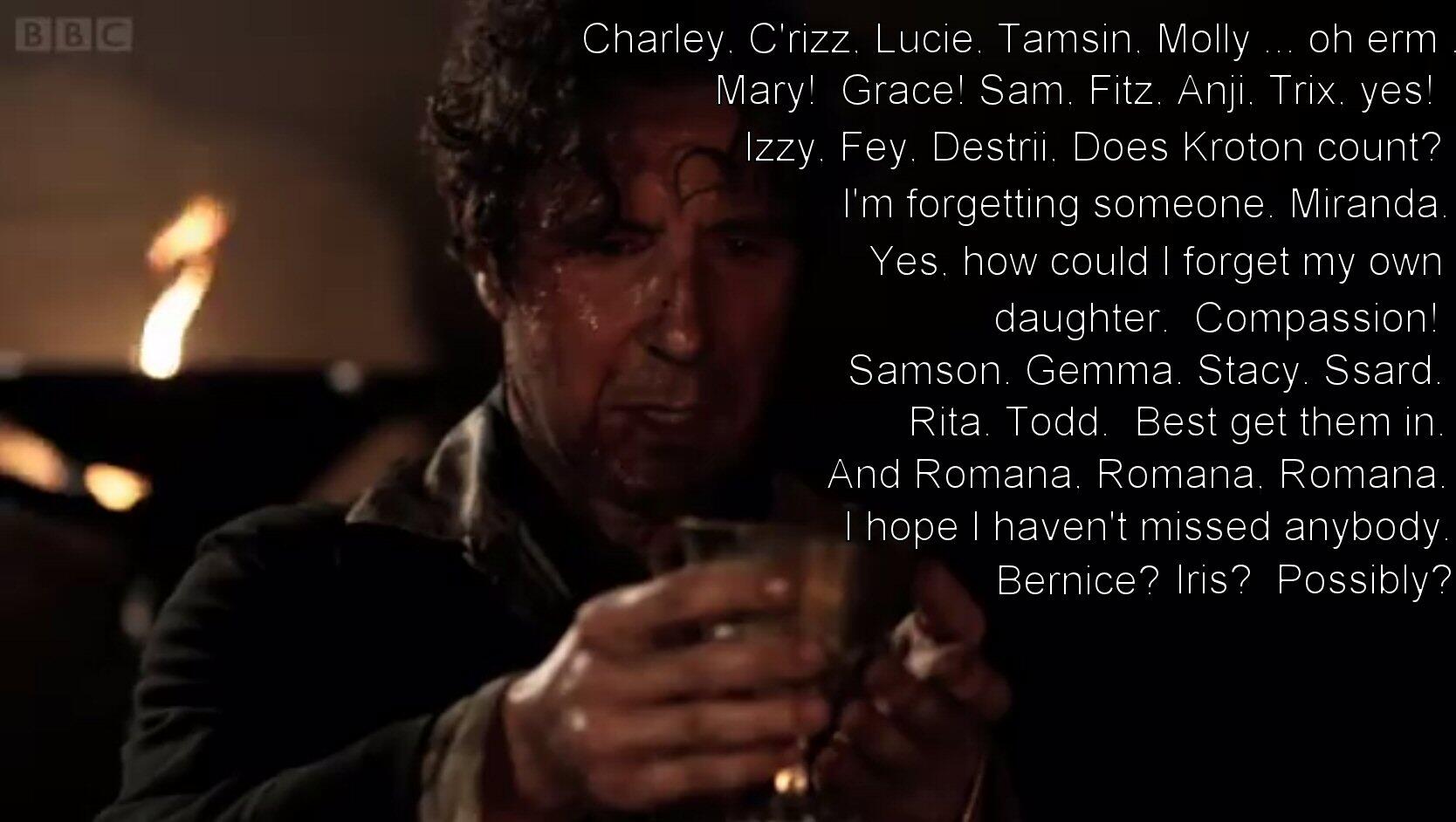
A viewing. reading and listening order for the Eighth Doctor.


TV(ish) Renewed interest in the 8.0 model of the Doctor played by Paul McGann fuelled by The Night of the Doctor - see above - three million views - have led some to look at his appearances, in the comics, in the books, in the audio adventures and wonder. "Which order? Which?" Possibly.

A search online leads to a range of opinions and chronologies, many chronologies.

Glance through those and you'll find many ingenious ways they've found for the various often contradictory series to intersect, entirely ignoring such things as character development and that any shared-universe fiction will contradict itself no matter what happens (I'm looking at you Lucas).

But really it's all terribly simple, especially since all three media have pretty much their own internal continuities.

1 The TV Movie

Which is inevitable. Can't be helped.

2 The Eight Doctors by Terrance Dicks

The first of the BBC Books which follows on directly from the TV Movie.

3 The Dying Days by Lance Parkin

Bit of a controversial one this. The last novel published by Virgin Books before the BBC revoked their license, it's also the only one to star the Eighth Doctor. Has to go here, but because it's from a different publishing company and it's retrospectively explained that his new companion Sam has been left at a Greenpeace rally. He's gone for three years part of which is spent on ...

4 The Radio Times comic strips

Usually forgotten but important since his companions return in one of the ...

5 The rest of the BBC Books

All of them in order.

6 The Doctor Who Magazine comics

All of them in order.

7 The Big Finish Audios

All of them in order, which is Shada, then Mary's Story from A Company of Friends (see below), then her trilogy, then all of the original series with Charley Pollard as the companion, then the follow on series with Lucie Miller then Tamsin as the companion, then these new Dark Eyes boxed sets.

8  The Night of the Doctor

See above.

Which seems simple enough.

Except, for various reasons some fans like to think that the comics and audios happen in the three year gap we've just discussed. Not least because the version of his home planet Gallifrey which appears in both is rather different to the one which develops in the books.

Except, coincidentally both the books and comics ended in similar circumstances in the wake of the new series with most of their plotlines resolved and the Doctor and his companions heading off into an unknown future.

Plus The Name of the Doctor, in which Eighth makes a point of mentioning the audio companions suggests that they're very recent for him. If The Gallifrey Chronicles or The Flood had just "happened"? Wouldn't it have looked a bit like this?


Which means that there's nothing to say that at some point between the close of the books and the start of the comics, and the close of the comics and the start of the books some event or other might have caused the changes to be rolled back, the Doctor left travelling alone again ready for the next set of adventures to start.  Not everything will quite make sense but as I've said before, Doctor Who's continuity ebbs and flows.  None of it really makes sense or is internally consistent.

Nevertheless, thank goodness DWM didn't follow through with the original plan of showing the regeneration.

And having the audios last, from the first, Shada, through to the latest season means that we fans of 8.0 can enjoy a series of ongoing adventures which are edging ever closer to another time war (there are several) and the events of the new series, still filling in a gap, but one which ends in the story which was once only in our heads and is now available on Youtube, the iPlayer and a forthcoming home release.  For goodness sake.

Oh and the various short stories and comic flashbacks, including the rest of the audio anthology The Company of Friends, fitted in whenever it seems like they should be. There's not the room here for that.

Now, wasn't that interesting?

[A version of this post was originally published here on the occasion of Paul unveiling his Dark Eyes costume.  It seems even more relevant now that the audios at least have become noticed.  No one would blame you for skipping most of the novels.  There are hundreds and it took me nearly eight years to read through them.]

Whoniverse: A viewing order for all the episodes in the modern Doctor Who, including Torchwood, The Sarah Jane Adventures, Class and Redacted.

Dalek Wedding

TV Readers with long memories will remember that back in 2010, the halcyon days when Dalek and Fear Her were still set in the future, I constructed a viewing list for all of the contemporary episodes of Doctor Who. It was never perfect and ultimately failed because I became very exercised about where Planet of the Dead was supposed to go, something which I still think is the nuWho equivalent of the UNIT dating controversy. Nevertheless, some people apparently found it quite useful for this or that reason.

Well, its 2013, the 50th anniversary of the series and as you will have gathered in the midst of watching my way through all of Doctor Who, hopefully before the special episode is broadcast on 23rd November, usually a whole story a day. Oh yes. I'm half way through The Key To Time season. For quite a while I wondered if I was going to bother with nuWho when it became apparent that of course I should, but what also of the spin-offs? My expectation is that I will if I have the time and with that in mind I decided I needed to put together a watch list for that too which favoured the pre-Moffat intricate contemporary chronology of the show.

And so, armed with AHistory and the TARDIS Datacore, I set about putting together the following. As you can see this wasn't as easy as the original because of the time travel episodes of the mother series, especially in series five, oddly, where the order of the contemporary episodes is all over the place. Narrative sense prevailed with the understanding that a three month shoot backwards or forwards should be treated in the same way as 5 billion years or whatever. Oh and I know the numbering is a bit strange but I think it makes some sense without having to mess about too many decimal points and letter codes.

There are a few other anomalies. I decided to put Children of Earth after The Waters of Mars (flipping the transition order), suggesting that the reason the Doctor's awol is because he's wrapped up in his own issues. Which adds a certain irony to Gwen's speech about the Doctor in episode five. He's not looking down on you. He's nowhere to be seen. There's also the bonkers insanity of mixing Torchwood's s2, SJA's s1 and Doctor Who's 4th in together, which is how AHistory has it, thanks to internal dating and seasons. We'll see how it works when we get around to it.

Also, Torchwood's Miracle Day still doesn't logically fit anywhere but AHistory rather heroically spends about three pages explaining away continuity errors in the show and the vagueness of some of the dates in Doctor Who itself to suggest that it happens between Night Terrors and The God Complex, with the assumption that the Doctor deliberately drops his friends off after the Miracle has ended. Which does mean you have to sit through Miracle Day half way through s6 of Who, but at least you can do so in the knowledge that some half decent episodes are coming up in your future.

If you spot any other problems, do let me know through the usual channels, especially if I've forgotten something really important.  I've ignored prequels in the main, but Night and the Doctor are there even if the placements are complete guesses.  Does Music of the Spheres count?  Does the National Television Awards 2011 sketch? I suppose they do, but well, Gwen's face in Torchwood's End of the Road.  I haven't included any of the other prequels and whatnot, but there's a list of them here.  Also if you want to know what happened before Night of the Doctor, I've also compiled an Eighth Doctor chronology here.

I've made everything available to buy easily on this Amazon page.  Anyway ...