
Showing posts with label the eleventh doctor. Show all posts
Showing posts with label the eleventh doctor. Show all posts
The Science of Doctor Who.
TV So anyway, yes, The Science of Doctor Who, the only piece of televisual Matt Smith playing the Doctor I had outstanding, both for scrutiny and review which I’ve finally seen in high definition from the 50th anniversary boxed set. Fairly typically while the rest of the world was all light sabres, Millenium Falcons and “Is that Cumberbatch?” I was watching Charles Dance firing chemicals at a Bunsen Burner.
Someone I know hasn’t seen the second half of The Ultimate Guide short so that there’ll forever be some piece of Eleventh Doctor out there he’s tantalisingly never seen, but I’m not like that. I’m too much of a completist. Plus having blubbed my way though Time of the Doctor (which is odd considering how disappointed in it as a send off I was the first time), I wasn’t quite ready to let him go just yet.
There he is, Matt Smith, all Doctorish, flying around the TARDIS, pushing levers saying sarcastic things to Professor Brian Cox and generally demonstrating all the reasons why he’s still so beloved by so many people and was probably the reason the show broke the US. Or rather was the reason the US finally embraced the show and more to the point have been discovering its history.
The story such as it is here, is about inspiring Brian to feel confident enough to produce a brilliant lecture and in time honoured timey-whimeyness, we’re essentially cross cutting between the lecture itself and the various moments before he’s about to give it. The drama inserts also serve to introduce the lecture’s various chapters about travelling forwards and backwards in time and about aliens.
The script this time is by Stephen Thompson and it really captures the Eleventh Doctor’s manic energy, ideas flying off in all directions and manages to be something other than simply pieces to camera. Bits of it are genuinely hilarious especially Professor Cox’s perfectly timed reaction to The Silents and poignant in the closing moments when we’re reminded of how inspiration can come from all sorts of places.
Is it canonical? Well of course it is, there's nothing in here to suggest this isn't the Whoniverse's Professor Cox giving a lecture in the Whoniverse, the Doctor having landed the TARDIS backstage, if not necessarily this lecture, which strenuously keeps clear the differences between that fictional universe and ours. Thanks again, then, Matt Smith. It's been a time.
The Doctor, the Widow and the Wardrobe Live!
Doctor Who Christmas Special with live BBC Orchestra from Ryan Owen Eddleston on Vimeo.
TV Sometimes Vimeo presents some real finds. Uploaded to the portfolio account of Ryan Owen Eddleston, director of photography, is a recording of this live event in which conductor Ben Foster and the BBC Symphony Orchestra provide a live score for Doctor Who's The Doctor, the Widow and the Wardrobe. Happy Christmas!
Talking About The Regeneration.

TV Happy New Year! I hope you’ve enjoyed the almost Doctor Who free month on the blog, though it’s fair to say that the one review I posted, that review, was the busiest post by quite some margin, not that I pay attention to such things obviously (over a thousand!). Now that last year’s over with, I’m going to try and find some measure of sanity about that. This was never meant to be a Doctor Who blog. It just sort of became that last year, just as it becomes a blog about the Liverpool Biennial now and then or Shakespeare, or everything, or nothing. Usually nothing. Nevertheless, Happy New Year!
Anyway, back to Doctor Who and after cogitating on it some more since the broadcast and the iPlayer rewatch, I’ve decided that actually The Time of the Doctor is a thrilling, extraordinary piece of television even if it’s not a thrilling, extraordinary piece of Doctor Who. To put what amounts to a meditation on aging and mortality on Christmas night between Call The Midwife and Eastenders masquerading as family drama (which to some extent neither of those are) was a very brave and commendable thing to do, even if the result was by turns baffling and uneven. Like some other episodes, its reputation will no doubt grow over time.
Something I didn’t address in that original review, mostly because it was already three thousand words long and I’d spent the best part of Boxing Day writing the damned thing, was the mechanics of the regeneration. As is so often the case, my theories about how all of that would be dealt with through the utilisation of River Song’s energy in Let’s Kill Hitler proved to be wronger than a wrong thing which is wrong about everything, proving to be far simpler and indeed for more old school Who with the Doctor merely being granted a whole new regenerative cycle by the Time Lords, which is what it is.
The method of revealing the Eleventh Doctor’s mortality was interesting, simply having him divulge it in the middle of the episode, though to be sure that was dulled somewhat by Moffat himself “revealing” as much beforehand in interviews right down to the inclusion of what amount now to two different incarnations of the Doctor both played by David Tennant. We’ll talk about that in a moment. But the point is, like so much of the episode, the really exciting stuff, the stuff which should have been a major discovery or at the very least been revealed dramatically was sectioned off into reported speech and exposition.
That’s especially true when you consider the range of options available, like pretending the metacrisis regeneration didn’t count so that all of this mortality stuff sat on the shoulders of the Twelfth Doctor (thereby making sense of the business at Lake Silencio) (yeah, right), chasing around the universe fully aware of what’s happening (though it’s true by making the Eleventh Doctor the last one it does make sense of the business in Let’s Kill Hitler). We can be wonder exactly when Moffat decided this was the Doctor’s last incarnation. When he thought up the War Doctor? Before then?
My preferred option, at least in terms of the melodramatic options, was for the Doctor to assume he’s dying then regenerate anyway and for him and us be left with the mystery of exactly how he managed to beat the rules. Had he miscounted? Was the rule only meant for him? This would have added an extra level of jeopardy because he’d never quite know if the next time he regenerates it’ll be his last. We’ll know different because we know the thing will continue for, y’know, like, ever, but it would be a constant reminder to the Doctor of his own mortality and also temper is god-like status somewhat.
Yet in the end, this is probably the best of the lot. Choosing something from the show’s history and thereby underscoring how in the show’s fiftieth year that history has now become an even more integral part of the revival, it elegantly kicks the problem ahead another thirteen incarnations so that whatever production team is working on the show in fifty years time (or whenever) will essentially be faced with the same problem and gifted the same story opportunities which could just as well include any of the ideas in the previous few paragraphs in whatever format Doctor Who is being made then.
What’s interestingly been misunderstood by a lot of viewers is the mechanics of this particular regeneration. The actual regeneration happens when the Doctor throws his arms out and destroys the alien fleet with the flames, in a scene which seems to deliberately echo the similar scene with Melody Pond in Let’s Kill Hitler with the Nazis when she’s still in her regenerative cycle. The scenes in the TARDIS afterwards are when the Doctor’s body is breaking in the new regenerative cycle, which is why he looks young again, he’s rebooting. The shift to Capaldi is that new regenerative cycle kicking in.
The Stolen Earth/Journey's End have been messed about with too now, I suppose. The Time of the Doctor gives us confirmation the the Tenth Doctor did regenerate then but kept the same face and apparent personality. But does this mean Tennant effectively and perhaps unknowingly played two different incarnations of the Doctor? That the one who was running around in the 2009 specials is a different man and yet the same man? Would the Tenth Doctor pre-metacrisis have made the same decisions as he does during The Waters of Mars et al? Shouldn't there be two Tennants standing here?
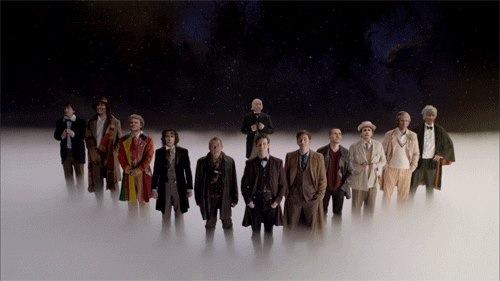
The other thing I didn’t talk around in the review was Trenzalore and the extent to which the Doctor’s changed history. The Doctor hasn’t changed history, I don’t think. Trenzalore is still potentially in his future ready to be robbed by whoever makes off with his actual remains ready for the auction in Alien Bodies. It’s just that it didn’t happen during The Time of the Doctor. So everything which happened in The Name of the Doctor still could and should. Unless I’m completely wrong and misunderstood the ending just as I did with The Day of the Doctor. Presumably it’ll be explained away in some exposition in the next season.
Right then, onwards with the wild speculation about what Capaldi’s first season will contain. One of his first lines is, in relation to the TARDIS, “D’ya happen to know how to fly this thing.” Assuming this isn’t just some old fashion post regenerative malaise, Moffat could take that single line and run with it. What if, when a Time Lord has been gifted a whole new regenerative cycle, it also takes much longer for them to gain their memory back. So when the “Eleventh” Doctor talks about remember every moment of when the Doctor was him, the irony is that he doesn’t, that like the Eighth Doctor post The Ancestor Cell, he only remembers bits.
That opens up all kinds of interesting narrative possibilities. If, for example, the TARDIS, which has shown a surprising amount of self-awareness post The Doctor’s Wife, practically has to fly itself or at the very least land itself, so that her behaviour is very much like it was fifty years ago screen time, the Doctor and his companion never knowing where they’re going to end up next (even if, as with back then, its usually some time in Earth’s history anyway). This would also take away the idea of the TARDIS as taxi service and make it a genuine lifeline and jeopardy magnet just as it was in the old days.
Plus if the Doctor can’t remember his own history, perhaps he’ll have to rely on Clara who’s somewhat seen it all, creating a shift in the dynamic of the classic companion relationship because it’s the Doctor asking all of the questions of his friend about what to do to fight the antagonists and how to work his sonic screwdriver. This will be even more acute because “Eleventh” so assiduously went about removing himself from history apparently so “Twelfth” can’t even really rely on own legend. If the Daleks do know who he is now though, that makes them an even greater threat because they know what he’s capable of but he doesn’t.
Which makes the loose arc of the next series about the Doctor getting his memory back so that he can control the TARDIS again. There are some reasons this is also unlikely. If you’re Capaldi and finally able to play the Doctor, would you want to play a version who doesn’t remember his own history? Also we know the Patternoster gang are back thanks to the Blue Peter competition and unless the TARDIS somehow manages to land in their company in its random trip through the universe it seems unlikely we’d go there unless the TARDIS and Clara decided that they needed their help.
Either way I think this is the kind of out of the box thinking which Moffat should be heading towards if he’s going to reimagine the series again. As has been pointed out to me by separate people in different places, Moffat has pretty much undone most of what Russell T Davies wanted to do, which is probably as it should be. But what I would like is a return to old fashioned Who storytelling, of simply landing in a place with no other reason than random curiosity and heroics which aren’t about filling in the gaps of a story arc. In other words, more of The God Complex and less of The Rebel Flesh. Oh and no more sodding time paradoxes.
Review 2013: The Doctor:
The Time of the Doctor.

TV Happy Boxing Day! Well there we are then, it’s all over for another year and all that's left to pick up the pieces and move on. If NORAD’s tracked Santa across the planet in the lead up to Christmas, Twitter’s been trailing the fan reaction to The Time of Doctor just as successfully as each country received its festive broadcast and its fair to say the reaction has been a bit mixed, and quite often within the same person. I know because that person is me. For a proportion of the story I was somewhat delighted but as the narrative span towards its inevitable conclusion, I began to detect my internal production monologue intoning, its sonorous voice disrupting my enjoyment of what was on screen until by the end, it distracted me to such a degree that as the credits rolled, I sighed and said “Goodbye Matt”, and then “Oh dear.”
My internal production monologue is a bit like the production subtitles on dvds, except instead of Martin Wiggins or someone offering facts about weather conditions on location, scheduling problems and why Pertwee looks a bit peaky in a given scene, it begins to question exactly why the present production team decided to do this or that. Samples from last night’s performance include: “What’s with all the Rose references? That’s the stand in Powell Estate. The severed head of an enemy plugged into the TARDIS as a navigational tool.” “Isn’t using a monologue over this a bit risky? Isn’t that having a distancing effect especially since we don’t recognise the voice?” “Monoid!” “Oh right, so the material in The Ultimate Guide was shot at the same time as this.” “The Rings of Akhaten music now?”
During Matt’s regeneration scene it was pretty much shouting: “Fish fingers and custard. Oh bless. So we’re going to be seeing visions of the Eleventh Doctor’s past. Bet Caitlin Blackwood’s back for it. Oh look there – no hold on that’s not Caitlin. Well obviously, because she’s probably a bit older now, so no that’s not the first face the Doctor saw with that face. But that little actress looks nothing like Caitlin, which is why they keep hiding her face. That’s distracting and even more so since we saw actual Caitlin in the flashback when the crack was revealed. Why didn’t that just use Caitlin? I mean she is a bit older now, but we probably would have accepted it. Was she busy? There could have been a line, something about getting older, “Everything looks older to me now” that sort of thing. Oh Karen’s back. Sob. I miss her…”
Which is pretty much where I was when Matt was giving his final speech, worrying about why Caitlin Blackwood had been replaced, which is probably why I was a little bit under-whelmed (and poor Caitlin's spent most of Boxing Day telling people why it wasn't her on Twitter). But in all honesty I was a little bit under-whelmed by the whole thing but in no way should this be seen a criticism of the writer Steven Moffat particularly, because as had also been pointed out on Twitter there’s been a lot of The Time of the Doctor being used to make pretty personal attacks on a writer who clearly loves Doctor Who to the point of “Monoid!” and that sort of thing and its his love of the show which led him to write The Time of the Doctor in which he decided as he always does to try something to new, to strive to produce the unexpected. Sometimes that leads to Blink. Sometimes that leads to this.
Quite often, too often for my own good, this internal production monologue begins muttering because I know I’m going to write one of these things afterwards, but that also means it’s a decent barometer of just how good a story is because it’s entirely silenced, just as it was during The Day of the Doctor (which I’m still not reviewing) when it only really piped as it tried to understand exactly what all the Gallifrey business was at the end. The inverse reaction to this Christmas episode on Twitter in comparison to the 50th anniversary special not to mention The Night of the Doctor has been the very definition of “how quickly they forget”. Though to be fair, I don’t think any of us would assume that the best regeneration episode of the year wouldn’t be the one for the Eleventh Doctor.
Anyway, after giving twelve or so hours for the rest of my brain think about it, here’s what I think my internal production monologue didn’t quite understand last night. One of the elements of Doctor Who, at least since The Rescue, is that for all the companion’s position as the audience’s point of view character, the Doctor has been the protagonist and that’s been true of nuWho and particularly true of the Smith era, and especially true of this year’s episodes as he went about unravelling the mystery of the impossible girl and The Time of the Doctor is arguably at its best right at the beginning when it’s about Doctor and Wilson, sorry, Handles, investigating the mystery of the planet, what you could call for want of a better description, the more traditional Who elements, the running around and talking quickly in the hopes that something presents itself.
Except, also right from the beginning, right from the moment Tasha Lem’s voiceover begins, we’re distanced from the action, at one remove because everything which we’ve absorbed about the grammar of film and television tells us that we’re watching events in the past tense, which have already happened, which pulls us right out of the now. This isn’t anything new of course, and Doomsday was supposed to tell the story of, as she tells us, when Rose died. Except because it’s Rose, we’re ok with it and accept it as a kind of trailer for future events, the flash page of a comic book adventure. But because this isn’t a voice we recognise and because it’s poetic and full of mythic portent, just like The Hungry Earth before it, we’re put in a frame of mind which says that we’re watching the then rather than the right now.
Such things are purposeful creative decisions, and Moffat perhaps had in mind to give his story some weight. But given that this is a regeneration story it already has weight because regeneration stories always do. But then Moffat adds an extra level of distancing by telling the story from Clara’s point of view, by making her the protagonist rather than the Doctor. Structurally the piece is quite similar to The Parting of the Ways, with Clara worried about a Doctor who’s deposited her back on Earth for safety while he fights his battles in the future. Except in that episode, the cross cutting between the two still kept the Doctor to the fore including the heart stopping moment when it because apparent that he’s lied to Rose about being able to save day when he really can’t, a beat which is also repeated here.
Except, crucially, when we do see the Doctor on Trenzalore, he still doesn’t have narrative agency because Tasha Lem’s describing events and everything happens in montage and we’re still seeing the then rather than the now and as he gets older, the aging, and the reaction to the aging slowly shifts to Clara to the point that when the Doctor finally goes from being big space Gandalf, to old, basement Bilbo Baggins, it’s revealed to us through Clara’s eyes. Perhaps Moffat has in mind to create a bookend to An Unearthly Child, to have a frail old Doctor being discovered through the companion’s point of view with the companion as properly the protagonist again after all these years, but as an audience we’re left trying to fill in the blanks of the Doctor’s new past when we should be paying attention to be present.
But, I suspect, our subliminal dissatisfaction runs even deeper than that. When Clara visits in the Doctor’s middle age, information that the Time Lord has already discovered, like who the Silents and Silence are, why his TARDIS exploded, essentially all of the mysteries of the past three years are simply described to him, her and us anticlimactically across a table, which is, quite frankly, in terms of narrative closure, awful. Moffat forgets at this crucial moment that as an audience, however corny it might be, we need the catharsis of the watching the Doctor’s reaction to these revelations however much they might feel like old news to the writer, who’s more interested in dropping in the shocks and surprises of the Dalek trap and giving the Doctor another opportunity to kiss one of his friends and it’s that dissatisfaction which is what I think killed the episode stone dead last night.
There is also the Lost syndrome, of having built a set of mysteries which couldn’t really satisfactorily be paid off and perhaps Moffat realised this and decided it was best to give them simple answers then move on. It’s a choice, I suppose. As is often the case in this era, I’ll be interested to see how this effects the rewatching of previous stories when these were just massive questions. Lost is pretty much unwatchable now for just this reason but I don’t think The Big Bang will be simply because there’s too much other fun stuff happening as well. Same with The God Complex, though I think I much preferred not knowing what was in the Doctor’s room rather now knowing that it’s one of the “cracks”. One of the best things about The End of Time is that we still don’t know who Claire Bloom was playing. Random mysteries are great.
Such a shame. Some of this is outside the writer’s control because of the absence of Amy Pond. Structurally, since this is the final degree of a three year arc which began in The Eleventh Hour, it should be Amy Pond and to some extent Rory who are here at this final end and the Clara material is Moffat dealing with similar issues that J Michael Straczynski had when cast members, notably Michael O'Hare and Claudia Christian upped and left Babylon 5, in having to transfer their participation in the storyline to another character. If Karen could somehow have been engaged to be in the episode for longer it might have worked, there’s then the problem of giving Clara something relevant to do that’s also fresh and new and mores to the point not unfair to Jenna Coleman.
Some would see it as a benefit, having this character who doesn’t understand the action that went before able to ask the relevant questions for all the people who apparently only watch the show on Christmas Day, which at this point doesn’t seem like nearly enough to warrant it that much. Plus I’ve heard reports of people having to spend the whole thing explaining it to their relatives anyway despite Clara’s narrative intervention. It's just that when she sees the fish custard it means nothing to her and although Jenna does her best with it, she’s unable to give quite the look of recognition it requires, because she's not Karen Gillan playing Amy Pond.
There were other niggles. Linked into the distancing effect is wondering about the extent to which Christmas is a real town. It’s clearly not supposed to be a magical, unchanging place like the Planet Albert in the Eighth Doctor novel Grimm Reality. The population has generations, aging around the Doctor. But it doesn’t develop, the Doctor’s benevolence and the threat of invasion apparently keeping it in cultural and socio-economic stasis but also oddly thriving because there are still people walking around at the end despite successive invasions. Though to be fair said invasions weren’t as spectacular as they might be, the dramatic dictators “idea” and “budget” forever staging coups against one another, though the wooden Cyberman is a brilliant idea. More of that please.
Anyway with all that in mind, it was a pretty dark comedown after an otherwise very good Christmas Day. Then I woke up this morning (dur-dur-dur-dur-dum) and watched it again first thing on the iPlayer and like the second spoonful of Alpen blueberry flavoured porridge in a pot which I had for breakfast (just add water), it was much more enjoyable second time around, now that I knew what to expect, all of its virtues in crystal clear HD with its crunch bits of dried apple (or as is the case with the iPlayer the annoying logo in the corner of something which was obviously recorded while it went out rather than uploaded directly from the broadcast master and for the life of me I don’t know why some programmes are off-air and some others aren’t) (perhaps it’s the powdered milk).
If Moffat still doesn’t quite seem to know how to deal with the post-arc Clara, he is at least going about the business of giving her such things as a family that doesn’t just exist in flashback and isn't about her being a nanny and there’s some interesting business here, as we’re introduced to another couple of generations of the Oswald family, and her relationship with her grandmother is especially fractious, since she seems to some extent have decided to fill in the gap left by her mother, offering boyfriend suggestions and the like. This could just be local colour though. Unlike Davies, Moffat isn’t much in the business of building up the parts of his companion’s family and it’s unlikely that we’ll see Capaldi’s Doctor’s contrasting approaches to domesticity as we saw in The Christmas Invasion.
Moffat and the design team also had in mind to show the contrast between a twenty-first century Christmas and the version that appears in the Bruegel paintings which sometimes appear on the classier cards blu-tacked to bookshelves and fireplaces of the modern household, Clara’s family meal in bright, albeit grey snowless daylight, the Doctor’s final years played out against endless, frosted darkness. Perhaps it should have swapped titles with The Night of the Doctor. There’s also something quite melancholy about how in The Christmas Invasion, dinner around the table is all celebration and giggles, whereas here its arguments and tears, the former full of life, this a synthetic experience, an almost ritualistic experience for all concerned. The reality is probably somewhere in between I fear.
Jenna's performance is remarkable too given the material. She's funny, smart and clockwork in her timing and able to somehow play the emotional rollercoaster of watching her friend grow old and die and subtly changing her chemistry with him over the course of a Christmas meal. It’s also important in the rush to dismiss how her scenes played out not to ignore just how fabulous Orla Brady is as Tasha Lem, even if like Clara her character’s relationship with the Doctor mainly makes her seem like she was created to deal with the absence of another character, in this case River Song. She’s not, having River in that position would have been weird, but she’s written as much the same character, especially in relation to how she amorously reactions to the Doctor, simultaneously wanting to love him and destroy him.
But of course this is Matthew’s final adventure and as has been so often the case in the darkest corners of the past few years he elevated the material and was, well, he was, doing his best with the only vaguely amusing nudity stuff, clearly loving the wig stuff (wasn’t the final scene with Karen essentially about two people acting with semi-bald heads?) before really storming through to the dismount and the metafictional loss of his bow tie. As even David Tennant’s admitted, Smith has been the show’s biggest asset over the past few years, perhaps even the reason it broke North America and like Tennant, you almost wish that they could simply continue making adventures for him even after he’s regenerated. There’s always just been something about his face, even when obscured by latex, in which you just know he’s the Doctor and it’ll all be fine.
As regeneration scene go this is a bit of a mix of the old and new. Like The Tenth Planet his regeneration comes about because his body is dying of old age, but it is also because of a selfless sacrifice, albeit one drawn out across centuries, defending Christmas even when he could simply jump into his TARDIS and go. Like the Fourth and Fifth Doctors, he is visited by echoes of his past, Amy the new Adric, I suppose. Like the Eighth Doctor it’s a regeneration which brings him into some new physical territory in this case a whole new regenerative cycle and like Ninth, his companion looked on dumbstruck, and like Tenth, like Captain Jack, she is entirely appreciative of the change that is to come. Like some of those, but unlike Tenth the second time around, he is absolutely content with finally going.
His final speech is sheer poetry, good enough to put in an upmarket Christmas cracker. Here it is in full. “It’s started. I can’t stop it now, this is just the reset. A whole new regeneration cycle. Taking a bit longer. Just breaking it in. It all just disappears doesn’t it, everything you are gone in a moment like breath on a mirror? Any moment now, he’s a comin’ … The Doctor …. And I always will be. But times change and so must I. Amelia! The first face this face saw. We all change when you think about it. We are all different people all through our lives and that’s ok, you gotta keep moving so long as you remember all the people that you used to be. I will not forget one line of this. Not one day. I swear. I will always remember when the Doctor was me.” Then his actual final line. “Hey.” Sob again.
Just as Twitter’s tracked the global viewing audience, it’s also been tracking people who’ve watched it again and like me, seen its virtues the second time around, how like so much of the Doctor Who we’ve disliked the first time around, we’ve watched again and loved. Like I always say, Who is still amazing even when it’s rubbish, and much of The Time of the Doctor is amazing. Of the future? We’ve barely begun with Capaldi but already I’m detecting a bit of Tom about him, especially in that shot when the TARDIS spins out of control and his hand seems to grasp towards us rather like this publicity shot from City of Death. He’s keeping his accent which is all to the good too. Doctor Who’s moving on, it’s regenerating and I for one can’t wait, whoever’s in charge, both on and off screen. Good night, raggedy man.

Updated 01/01/14! I've since written almost as much again about the regeneration and the mechanics thereof. Which you can read here.
The Battle of Demons Run: Two Days Later, The Inforarium, Clara and the TARDIS & Rain Gods.

TV As with the previous boxed set extras, the minisodes on Doctor Who’s season seven boxed set generally attempt to fill in narrative gaps from elsewhere in the series, either because there wasn’t enough time to relevantly enunciate them within a story or because the content was somewhat implied anyway. Unlike previous releases these aren’t all set in the TARDIS console room and presumably for budgetary reasons whilst they're consequently much more visually spectacular, they're also rather shorter. But it’s surprising just how much narrative can be fitted into a couple of minutes even though as ever there’s a sense that in a way these are just the kinds of stories the series itself might have benefited from telling.
The Battle of Demons Run: Two Days Later was previously only available on iTunes I think, and explains just why Sontaran Strax is walking around, breathing and in the employ of Madam Vastra in The Snowmen despite the events of A Good Man Goes To War. Like the other two prequels, it’s more of a piece of sketch comedy demonstrating that the BBC need to commission a spin-off featuring the characters as quickly as possible even though they never will and we’ll be eternally disappointed. Does it make much sense? No. Does it spoil his rather good death scene? A bit. Should we be pleased that unlike so many other great characters who’ve met horrible deaths in Doctor Who that aren’t villains that he was resurrected? Yes, yes indeed.
Set just before the series begins, perhaps, The Inforarium explains one of the ways in which the Doctor manages to wipes the memory of himself from half the known universe and the other half. The density of the writing is such that I missed the Doctor’s justification for keeping the librarian in the timeloop right at the beginning the first time around, but it still seems amazingly cruel recalling his treatment of The Family of Blood (or perhaps its my general solidarity with information scientists). It’s end of a project begun in World War Three when the Ninth Doctor hands Mickey the cd-rom, though it’s worth asking how successful it is if UNIT are still capable of having gathering all of that information about him in The Day of the Doctor.
Functionally, Clara and the TARDIS is doing similar things to the Meanwhile In The TARDIS scenes from season five’s boxed set, with on this occasion Amy being given the once over by her successor. But again this ties into the season as the TARDIS, which has gained a more obvious sentience post The Doctor’s Wife, makes fun of this young woman living within her innards. There’s a dreamlike quality to those closing moments which recall the multiple Worfs in the Trek episode Parallells, or for that matter the multiple Amys in Time/Space and we’re not quite sure if what we’re seeing is Sexy messing about with her internal chronology ala Journey to the Centre of the TARDIS.
Credited to Moffat but written by Neil Gaiman, Rain Gods is the scene which was left out of The Doctor’s Wife, reworked to feature River Song instead of her parents and a rare chance to see another one of those adventures with those two which presumably fill up their diaries. “Have we done the planet of the rain gods yet?” That sort of thing. Of all these stories, it’s the one which suggests the road not travelled which would have been River Song taking over as the companion rather than Clara for the final eight, the possibility of seeing the two of them in adventures which are simple romps and not about some ruddy great plot point, in other words, him taking her with him as teased in The Angels Take Manhattan.
WHO 50: The Final End:
The Day of the Doctor.

TV Right then here we are. It’s the evening after the night before, Adele’s on, and I really don’t want to be here, which I appreciate isn’t the best way to start any review, but when it’s a review you really don’t want to write, it’s probably perfect. You know when … I mean when … well … there we are. See, can’t even get my words out. But yes, if ever there was a time when I didn’t want to be sitting at a keyboard tapping away it would be now. There are certain moments in a fans life when they’re facing up to the fact that having made a promise earlier in their life, they want to do everything in their power to break it. So when I promised myself of all people that I’d review my way through all broadcast nuWho (and it’s spin offs), you know as a bit of a challenged, I’d be faced with something as patently unreviewable as The Day of the Doctor.
Oh no I mean it’s reviewable. I could sit here and knock out ten paragraphs relatively easily given the episode's general richness, metatextuality and all of that sort of thing, but the point is, I don’t want to. Even though I wasn’t with all the people throughout the country in cinemas dodging spectral Dalek stalks and multiple sonic screwdrivers and in my usual spot at home alone in front of the television I won in the competition, the experience was so, well just so, and the episode, well just, so, that I don’t want to spoil things by picking it apart. I probably will. When I watch it again (which I haven’t yet), I’m sure I’ll be looking for things to dislike, moments which are gloriously brilliant because they’re so gloriously wrong, the nuWho equivalents of Sarah Jane falling down a short incline. But in this moment when I’m still enjoying the glow of the memories of squeeing for an hour or so I just simply can’t or won’t.
How do I put this into words? It’s a bit like trying to review a party. Imagine, and yes, I know there are people who're keeping quiet becuase this is their job, but this is really talking about the rest of us, imagine if you’d been to a very good party and then someone the next day asked you to write a review. For a start you’d essentially have to relive the thing, memories of conversations and dancing and the snacks, if there are snacks, bubbling back to the surface (in various ways) and although this obviously isn’t quite the same, especially since it’s entirely possible to experience this party in HD on a screen somewhere, possibly in 3D, by piecing together your memory of the experience, you’re bound to find the flaws, because life’s like that. No moment is perfect, there are always flaws, because perfect moments are generally unreliable because they’re supported by a scaffold of hopes, dreams and possibly alcohol.
Parties, especially if they’re the kinds of parties I used to be invited to when I used to be invited to parties tend to go something like this: the uncertainty of whether drinks will be supplied by the host or yourself so that when you bring a bottle of wine as a present, you’re wrong and you end up drinking water from the tap all night because you don’t drink wine. There are the people too, the friends you know will be there, those you hope will be there, the old friends who’ve decided to surprise everyone and those who haven’t shown and you know will be regretful and always wonder about what they might have missed. There are the decorations which dazzle, the music some of it familiar, some of it not. Plus there’s the after party which are rarely a good idea, followed by the taxi back to someone’s flat when all that’s left is to giggle at each other’s jokes and hope the night won’t end.
Yet despite all of that, the following morning, even if you have a hangover you’ll be smiling because all you can remember are the good things, the general feeling of belonging to something and if not that the images, when everything became slightly unhinged and you’re sure you saw someone walking around in a rubber outfit wearing a crown or some such. But if you do remember something that doesn’t quite make sense, like the person who’s behaviour’s disappointed you or when everything you thought about someone else is turned upside down or someone you’ve had your eye on is unexpectedly married, then what you have to do, and what I’m going to do is not worry. Forget about it. Leave it to one side and above all, don’t analyse. If I’ve been guilty of anything in my life it’s overanalyses of everything, especially conversations, especially conversations with other people and it’s never done me much good.
Do you feel the same? I wonder if you do. Certainly the people who have reviewed The Day of the Doctor, particularly the professionals, have been all mentally over the place, partly because for the first time, they watched it for the rest of us, the entire globe it felt like, all watching Doctor Who at the same time, which is magnificent. Some of those are barely reviews too, either lists or a three paragraph synopsis or what amounts to an observational piece that wouldn’t be out of place on the late, lamented Home Truths. I’m not just saying this because he’s a friend, but the best review I’ve seen so far is from Neil Perryman and Sue his wife in space, who live blogged the episode on The Guardian’s website because it captures the experience of watching the thing, of attending the party. That’s also true of this piece from the New Yorker that captures the reaction of fans in a downtown bar.
So if this isn’t a review, if I am, forgetting about it, how does this manifest itself, in other words, if I was to give myself the latitude to mention anything I might have mentioned in the review that this isn’t, what would that be, what should we be forgetting, how do we cope? Well, obviously it’s Gallifrey, of course it is. No longer a ball of smouldering rubble, it’s now, utilising one of the preventative strategies from another Time War in the Eighth Doctor novels, sitting in a pocket universe somewhere waiting to be discovered and the Doctor is absolved of his survivor guilt and for extra measure no longer a child murderer, which until last night, I hadn’t ever consider he would be, because in the classic series, although Romana mentions being a Time Tot, I didn’t consider the implications of that. The mythology which underpins nuWho has changed fundamentally. Moffat himself says so to Buzzfeed of all people.
At which point, narratively speaking, nuWho should unravel because it’s been retconned. We can’t watch any of it again with the same eyes. The survivor guilt of the Ninth or Tenth Doctor (this is going to be confusing) which underpinned that first season is now the product of a faulty memory and considering that the Ninth (or Tenth) Doctor is there at the end helping to carry Gallifrey into that pocket universe, a really faulty memory. The End of Time makes practically no sense now. I mean it didn’t make much sense before (White-Point Star) (the drumming, the constant drumming), but how can Gallifrey be dragged through time out of a timelock if it’s in a pocket universe, and well, Gwen’s face in Torchwood’s Miracle Day’s End of the Road. You know the one. The one which is swiftly followed by an expletive. As retcons go, and this is a retcon, it’s an especially juicy one.
Yet, and oh yet, you can forget about it. I know you’ll be wanting some reasons, so here are some reasons. Firstly, Doctor Who isn’t like other franchises and the brilliance of Doctor Who is that unlike most other franchises, reboots, retcons and mythology changes are inbuilt. From The Time Meddler to The War Games to The Deadly Assassin to, well, make a list, across its fifty years, the show hasn’t just changed its lead actor, the ship, and the way it tells its story, it’s changed that story. Across the format, no single item of Doctor Who has an internal consistency, everything contradicts itself and the reason its lasted fifty years is because it’s entirely capable of that. Six years into the original series, the otherwise mysterious Doctor was given a race and a home planet, massive paradigm shift. Now, audaciously, eight years into the new series, we have something approaching the same thing.
It’s not quite the same thing, because it seems to change the narrative of what we’ve seen before. Genesis of the Daleks is probably a better example in which, thanks to the Doctor’s meddling, all of the Dalek stories beforehand happen in a different way if at all, because he’s set their development back a thousand years, which is why whenever someone attempts to put together a chronology of the Daleks its all over the place. On a smaller scale, Mawdryn Undead messes up the dating of the UNIT stories of the seventies even further because the Brig is supposed to be working in that blasted school at the same time as when the original production team assumed he should be still fighting the Bok, giant maggots and the like. One of the ref works, the Radio Times 20th anniversary special, I think, when explaining various bits of mythology is filled with the qualifications, “Before Mawdryn Undead” etc. Retcon, after retcon.
None of which makes Doctor Who impossible to watch. We don’t rewatch the Pertwee era trying to work out if Day of the Daleks “happened” or if The Green Death happened in the same way, or at least we shouldn’t and we shouldn’t treat the everything leading up to The Day of the Doctor any differently. Some people will and some people already are. I’ve seen “Moffat has ruined Doctor Who” type comments online, people clutching the Russell T Davies era like a sacred relic, which it obviously is because it’s the reason I’m not writing this review, but they’re getting Doctor Who wrong. Moffat’s looked at the past few years and decided the soulful last of the timelords business has run its course. As he said to Buzzfeed, the Doctor needs a new goal, whatever his face looks like, even if as he doesn’t say, it turns the series into Red Dwarf, the Dungeons and Dragons cartoon, Ulysses 31 and both versions of Battlestar Galactica.
Secondly, you can forget about it if you treat the narrative of the show in the same way I do, with the reboots, retcons and mythology changes not just inbuilt but hardwired into the narrative of the show because of all the time travel, because, sigh, time can be rewritten. My post back in July explains this in greater detail, and better than I’m about to, but essentially, everything before The Day of the Doctor happened as is because in that version of history the Doctor think he killed all the children. Now we’re watching a version of history where he doesn’t. There’s possibly different version of The End of Time in which the Tenth/Eleventh Doctor regenerates for slightly different reasons which we can only imagine (unless someone produces an audio). In some ways it strengthens the earlier narrative because it now has an undercurrent of the Doctor not just learning to deal with his own whimsiness again but also why he was wrong.
Like I said, if I’ve been guilty of anything in my life it’s overanalyses of everything, and I think that’s just expressed itself again. Sorry about that. But isn’t that also true of parties, even if you’re not in the hypothetical situation of being asked to write a review, you simply can’t help yourself and can’t help rationalising what happened? Unless this is just me and my neuroses. Or Jeff Goldblum’s character in The Big Chill who says, “I don't know anyone who could get through the day without two or three juicy rationalizations. They're more important than sex” and even though Tom Berenger notes that nothing is more important than sex, Jeff replies “Oh yeah? Ever gone a week without a rationalization?” I haven’t been able to go five minutes probably especially when faced with something as secretly complex as The Day of the Doctor or my feelings about, well, no indeed, let’s keep that for another time.
All of which apologia should explain why I’m not reviewing The Day of the Doctor in the hopes that I can keep the memory of last night locked, wishing that Tennant could be Doctor at the same time as Matt Smith for real, jumping up and down and squeeling and pointing at the screen when Capaldi’s eyes appeared, of coring at the sight of Tom, the Dunkirk spirit on Twitter during the aftershow on BBC Three and then giggling for a solid half hour during The 5(ish) Doctors Reboot, more than I have at anything comic all year and the general feeling of belonging to something in a way which I never really did when I was flirting with religion in my mid-teens or at the kinds of parties I used to be invited to when I used to be invited to parties, even though I was in my usual spot at home alone in front of the television I won in the competition. Why would I want to spoil that?
WHO 50: 2013:
The Bells of St. John.

Life The first social network I ever joined, I mean online as opposed to hanging around the sixth form common room at school doing The Guardian crossword, was probably the Leeds Metropolitan University email service. A text based, Telnet terminal sort of a thing, it was in 1993 and it wasn’t out of choice but necessity. But for those of with an enquiring mind it was just possible to do the sorts of thing which would later be possible in more open environments such as randomly finding strangers to talk to by entering keywords and names into the search boxes and then emailing whoever appeared, a useful displacement activity on a wet November Sunday afternoon when we should have been working.
After a while, “friendships” would develop. Not to the point of actually wanting to meet the person, you were at university, probably in halls and already had quite enough friends anyway, but strong enough that you’d be pleased if you saw their email address and subject line if you logged onto the email server in one of those idle moments on a wet November Sunday afternoon. Quite often you wouldn’t actually talk about personal details. It was mostly chatter about the weather or films or the kinds of things people still talk about in more public surroundings now that personal emails have largely been replaced by comments under blog posts, instant messaging and Twitter.
But of course there was always the itch and there was the moment that you began to wonder what a person was like in real life. Hello, Zoe. Say what you like about Norah Ephron’s You’ve Got Mail, for all the dated technology, the fundamentals are exactly right, at that time you could still conduct an online friendship with a stranger who remained a mystery, you would spend a lot of that time imagining what they were like. Zoe seemed remarkable. Funny, intelligent and sharing many of my interests and in the two weeks we emailed each other it all seemed like it was leading up to something if I could just get over the sheer horror of having to ask first and then realising I’d entirely misjudged the situation.
Well, the inevitable other element of Norah Ephron’s You’ve Got Mail played out in widescreen. I’m sitting in the computer annex, which at that university amounted to a low ceilinged musty room at the top of a Georgian building whose previous use had been a farmhouse, next to an extraordinarily pretty girl wearing a dark blue sports sweater, who I notice (not that I made a habit of spying on other people’s work but the monitors were inches away from each other) is replying to the email I’d sent to Zoe that morning the contents of which included the phrase, “and there’s this weird bloke sitting next to me who can type very fast” which given the odds and descriptive accuracy was clearly supposed to be me.
I froze. I was stuck or at the time I thought I was. If I turned to her and introduced myself she’d know I’d been looking at whatever she was typing which didn’t look too good. But if I replied, what was I supposed to say? In hindsight, with twenty-odd years worth of hindsight in fact, the plan should have been to simply have gotten up and walked and lived to type another day saving both of us the ensuing embarrassment. Or to have purposefully not checked my email. Or, well I don't know, but anything but what I did do. I replied to the email saying hello and that I was the weird bloke sitting next to her who can type fast, assuming that it would be a prelude to an introduction, us both laughing over the coincidence before deciding to go for a coffee, then a drink, then friendship and all the things that come afterwards.
The results were farcical. With her not making eye contact she began to reply to the email I’d just sent, with me unable to do much (as my heart pounded) but glance at her screen (remember, inches apart) and her stopping off mid sentence to type onto that screen to stop looking and to wait for the email which I duly did and read after she’d packed her bag and left me sitting there reading, the gist being that she was horribly embarrassed by the whole thing and that it would be best if we stopped emailing each other. A couple of subsequent replies to the contrary from me went understandably unanswered and that was that, the first offline contact with someone I met online and an excellent example of why those random email contacts were best kept virtual.
Given the number of people I’ve met on and offline since, it is strange that I remember her name. Luckily subsequent offline contacts with someone I’ve met online have gone rather better even when they’ve been just as random, though the coincidences aren’t quite as expressive given that they’ve tended to be at private views and those sorts of functions and I have my own face as my Twitter avatar. Plus we do know more about each other or tend to be capable of finding out unless there’s some so-called Catfish element and whatever it is we're interacting with isn’t real (or less real than what passes for the online versions of us no matter what we say about their accuracy). I wonder if Zoe’s on Twitter?
Who 50: 2011:
Night and the Doctor.

TV Right then, hello, just a couple of weeks until the 50th anniversary, big Doctor Who writing moment, so I thought I’d best do something to get back into practice after the long summer gap since the last time the show was broadcast. Some housekeeping. As you can see WHO 50’s reached 2011, which leaves only a couple of years left and nearly a month before November 23rd. Rest assured that in the eleven months since I wrote the introduction, I’ve solved this surmountable problem, if not quite to the point of deciding what to include in the title after the colon instead of the year. I don’t imagine you’ll be too surprised by the solution.
Night and the Doctor is a series of linked (well four of them are) short adventures produced for inclusion on the season six home release (although there’s a strong suspicion that one of them is a deleted scene). Whereas the two pieces from the previous year’s release, Meanwhile, in the TARDIS... (reviewed here) fit solidly within the ongoing narrative of the series filling in the gap between adventures, Night and the Doctor (well four of them) are more thematically connected, though they do continue to Meanwhile’s methodology of filling in character beats which the main episodes have little time for.
The final, slightly rogue part of Night and the Doctor is Up All Night, two minutes in the company of Craig, Sophie and Alfie from Closing Time, for which it’s a direct prologue. Apart from Craig stressing about breaking his new son in much the same way as does for much of the subsequent episode and a chance to see more of the delightful Daisy Haggard, there’s not much else to it, especially in comparison to the other instalments. It works in much the same way as the official prequels to other episodes of the series as a taster to come, which is odd because it wasn’t released in the same way as them (hence the assumption that it's a deleted scene with an upgrade). But at least it’s in the right place in the box set.
Most of them are thrown together on the same disc as The Doctor’s Wife and the Ganger two-parter, even though they’re actually more naturally set later in the series when it has already been revealed who River Song is to the Ponds which means they’d be something of a literal spoiler for someone, and there has to be someone, greeting this series for the first time and who hasn’t seen A Good Man Goes To War or Let’s Kill Hitler yet. It also disrupts the narrative on, say, an epic rewatch and something I should have realised when putting together my own list (though I’ll have corrected that before you read this, I expect).
The first is Bad Night, in which Amy discovers that while she and Rory are asleep, the Doctor’s having adventures without them. The adventure he's currently having without them is ridiculous and funny and the stuff of Doctor Who Adventures from what we see of it, and Matt has great fun playing up the wilder eyed, gesticulating element of this incarnation all fish bowl farce and desperate shouting, with Karen playing the straight woman. That’s the first of its pleasures, a chance to see these two existing in a way that doesn’t really happen in the main series with Rory assuming some of her and our attention, something somewhat underscored by the ending.
The notion of (a) companions sleeping on the TARDIS and (b) the Doctor meanwhile having adventures without them hasn’t really been addressed before. There were periods in the classic series which did play up the notion of the TARDIS as a home, with rooms and kitchens and the like, notably early in the Hartnell, Davison and McGann years (whole chunks of novels about the Doctor, Fitz, Sam and whoever just hanging around place), but much of the time we were expected to believe that one adventure pretty much led to another and to another, the essential human bodily requirements sneaked in, unseen between stories.
But if we do assume that (a) companions have always slept on the TARDIS and (b) the Doctor has always had adventures without them, a whole skein of spin-off adventures in which a given incarnation is travelling alone become less problematical. No need to assume, unless explicitly stated, that all the Fourth Doctor’s solo adventures, like the early Doctor Who Weekly stories, take place between The Deadly Assassin and The Face of Evil or The Invasion of Time and The Ribos Operation. He might just as well be travelling with Sarah, Leela or one of the Romanas, nipping out while they’re getting some shut-eye.
The next short, Good Night offers a more clearer bit of narrative house cleaning, addressing the fact that somehow Amy and Rory and though he goes unmentioned Kazran Sardick from A Christmas Carol, have two different versions of their personal history in their head from before and after history was changed. Logically they shouldn’t. If history is being changed, they should change too and they shouldn’t be aware of the difference, see Donna Noble in Turn Left, though if that was case, there’d be no logical reason for Amy to remember the Time Lord’s existence and bring him into Whoniverse 2.0 in The Big Bang.
As with all of these TARDIS based episodes, it shows Moffat at his poetic best, the Moffat of “The Panorica, that’s just a fairy tale…” and “We have until the rain stops.” You might wonder if the reason he ends up writing the same story over and over again is because he’s more interested in the stuff in between and that that same story is his way of including that kind of poetry without it seeming over-egged. The Rings of Arkanoid is an example of a story where such things can go catastrophically wrong, largely because the Doctor’s shouting them at a planet, the Who equivalent of that bizarre moment in post-Sorkin The West Wing episode Disaster Relief, which had poor Josh losing his temper with a building.
But like Bad Night, this also offers some tangential explanation for a few of the franchises oddments. When the Doctor says that time’s being rewritten all the time, and so their memories change, he’s suggesting that in the physics of the Whoniverse, causality and consciousness are somewhat disconnected, that it’s possible for someone’s timeline to change without their memories doing the same and although they themselves can’t quite put their finger on what’s missing it’s always there. The Doctor probably hasn’t delivered Rose’s red bicycle when he says it but it becomes a fond memory because he suggests it will happen.
The next two, First Night and Last Night are really one "long" story with a cliffhanger and go some way to explaining how the Doctor and River can have had so many adventures even taking into account the two hundred odd year gap towards the end of the six series. Young River, middle-aged River and old River (for want of better descriptions) at various stages of their experiences with the Doctor in just the kind of farce of which Moffat is a master, and where the cornerstone of his sitcom days, in Joking Apart and Coupling. Replace Matt Smith with Robert Bathurst, add in some stand-up comedy sequences, and replace River with a drunk woman and it’s practically the last episode of the first series.
We're watching the Doctor fulfilling his promise of keeping her entertained while she's in prison. The young River is the version experiencing the oddness of this older man dropping and knowing everything about her, the middle-aged River is right in the middle of the excitement and the older River is just days away from her mortal death in the Forest of the Dead, though as we discover later, that’s not the last time she’ll see her beloved. These are massive, huge character moments, which another series might have worked into the main drama, thrown in as a bonus feature on the blu-ray (and as such they’re missing from most reference works).
The most significant is visit to the Singing Towers of Darillium given extra portent after the implication that The Name of the Doctor is River’s final appearance. I bet most of you, like me, assumed that we see the moment when the Doctor turned up on her doorstep with the sonic and took her on this journey, knowing the implications and the tragedy of that, and it would be in the main show, presumably right next to his regeneration, yet here it is, or at least some of it. It’s the last time she’ll see him before he has Tennant’s face, but is this the last time he sees her? Is there a sense that he’s getting the moment over with for himself?
Never mind River flirting with the Doctor, Moffat’s flirting with the viewer, all of these unseen and unseeable adventures, that by implication keep the Doctor mysterious. Perhaps in a few decades, future fans with a license and the original actors will take it upon themselves to write and produce these stories for download, a Companion Chronicle about Jim the Fish, but actually it’s the not knowing which makes them interesting and extraordinary. As the web has demonstrated time and again when discussing story arcs with a few scant implications and ideas, consumers can often be wildly imaginative.
There are some fans who suggest that River should have remained in the library, an artefact of some incarnation in the far future, her origin a mystery and that she’s been diminished through each subsequent appearance. I both agree and disagree. It’s true that the characters in Doctor Who with the greatest narrative power are those who remain enigmatic, The Guardians, the Billis Mangers and The Shopkeepers, with their ambiguous motivations. When River was just some figure from the Doctor’s future, it’s true that she had a special power within the context of her first story, which remained right up until the broadcast of A Good Man Goes To War.
Yet for all that she’s still a mighty character and now when rewatching The Silence in the Library, there’s an agency shift which thanks to Euros Lyn’s direction and Alex Kingston’s performance seems entirely planned, in which we see a River who is heartbreakingly realising that it’s the moment she’s always feared (as she mentions to Rory in The Impossible Astronaut) when she’ll look into the Doctor’s eyes and he won’t remember her. An old episode gains a sub-plot with a whole new emotional resonance. Her line “Doctor, please tell me you know who I am.” has a whole new destructive force. There can’t be many series capable of that.
WHO 50: 2010:
Victory of the Daleks.

TV Some people liked the redesign of the Daleks. I'm not one of them. Admittedly, that wasn’t always the case and on broadcast, my post-match review suggested “their new bulk gives them even greater weight and menace within the studio, and it was rather amazing to see so many practical examples spinning around in one shot, this half dozen having more substance than a thousand computer generated versions.”
While the comment about their practical nature is true, just as that’s true of all the practical Daleks when they appear, on reflection, I was being tediously kind. They’re plainly too big, too plasticky and over-emphasise their various parts, like the ball around the eye-stalk as it reaches from their head and the hump, the infamous, terrible hump.
If his audio commentary on the dvd release is a guide, Mark Gattis didn’t like the hump much either noting, rightly, that it changes the classic silhouette of the pepper pots, which I’d add was so perfectly engaged with and paid tribute to in the first nuWho redesign which respected that they’re been through a war and as the Red and Black Dalek had shown previously, quite capable of reflecting a hierarchy.
Similar the "Bracewell Daleks" featured earlier in the episode are a more coherent progression of the gold Daleks, evocative of period tanks and referencing somewhat the imagery of the war which ultimately caused their genesis, the irony of course being that they're fighting, albeit as a maneuvering tactic the war machine which influenced their fictional creator.
It’s noticeable that subsequently, “the new paradigm” has receded to the back a bit since, in the shadows mostly for Asylum of the Daleks, with furious retconning from a production team surprised by the negative reaction suggesting that this was always meant to be the leadership class and that the previous predominantly golden model were always supposed to remain. Yes, ok, if you like.
Compare this with the treatment of the initially equally reviled new versions of the Silurians, not helped by the revelation, in the subsequent Brilliant Book via a concept sculpture, that the reinvention was initially to be closer to the 70s versions before budgetary constraints and practically requirements came into play. That they weren’t meant to be the same species didn’t quell the annoyance of some fans.
In contrast, I rather liked them and their ability to express a far greater range of emotions in a Draconian sense than their earlier cousins and thanks to Madame Vastra they’ve become a little bit loved by everyone else too, arguably a similar process to that experienced by the new Sontarans beyond their initial adventure, though to be fair they were never really a design classic.
But the image of the Zygon from the 50th anniversary special and the recent Martian suggest that through all of these mistakes, however fortuitous in places, lessons have been learnt, that re-establishing a character or race doesn’t need to be about throwing out the old, but simply updating it, constructing the original designs with newee, better more realistic materials. Roll on the Draconians. Please?
The Name of the Doctor.

TV Where do we start? Let’s start with Alien Bodies. Alien Bodies is an Eighth Doctor novel by Lawrence Miles. I’m about to spoil the book so if you haven’t read it and have any intention, I’d shift your gaze downwards five paragraphs. As you know, or you will by the end of this sentence, Alien Bodies is about the Doctor attending an intergalactic auction with its single lot of a relic containing his final remains. As with The Name of the Doctor it’s a very funerary piece of work that’s also extremely funny and ultimately changes our view of the character because it gives him a finite end albeit one that’s presumed to be very far in the future.
Like The Name of the Doctor it also references a Time War, one which is revealed in future novels to include the destruction of Gallifrey, an act which actually negates Alien Bodies from happening in the same way because it stops the Doctor’s relics from existing in quite the that form. Part of the story arc involves an alternative version of the Time Lord, the Grandfather Paradox, who has a coincidental resemblance to the Ninth Doctor, but whose actions in actively continuing the war are what the Eighth Doctor is fighting against when he destroys his own planet (as it turns out for the first time).
Why that’s interesting in the context of The Name of the Doctor, is that it too features an alternative version of the Time Lord, the one, we must assume now, who destroyed Gallifrey, and because as we know now he can't be an old version of Eighth or Ninth (see far below), absolves them of the action in quite the way it’s been portrayed over the past eight years on television and in some of the books. In AHistory, Lance Parkin makes a pretty good argument for both destructions of Gallifrey being the same space-time event seen from different points of view, that perhaps the Grandfather Paradox regenerated into the Ninth Doctor.
Even now the climax makes me giggle. Not since The Stolen Earth's surprise regeneration have we had a conclusion this “sexy” and so much metafictionally about the language of tv though in this case it’s one based on we the audience finding out a piece of information rather than something particularly happening to the Doctor who knew about this all along. The fact that John Hurt is somehow playing the Doctor has been heavily spoilt in advanced already, thanks to a tasty set photo ala those early shots of Rose from Partners in Crime and the words coming out of John Hurt's own mouth. It’s the somehow which is interesting (again see below).
Was Alien Bodies and its ensuing arc in the novels rattling around Steven Moffat’s head when writing this series of Doctor Who? Let’s look at the evidence. As I noticed in 2008 when coincidentally reviewing The Forest of Dead (of which this is a semi-sequel), Moffat was an avid reader of the books including the Lawrence Miles material. Alien Bodies also includes the concept of the Doctor’s then companion Sam having alternative versions and in the Time/Space sketches, the Doctor talks about the TARDIS entering “conceptual space”, a Lawrence Miles invention from Alien Bodies (see this review of that here). So if you want to infer all of this, you can.
But and this is a big but, designed especially for those of you who skipped the past five paragraphs (hello again!), The Name of the Doctor is one of those episodes. A glance at the TARDIS Datacore page for it shows that like similar season finales, and more-so thanks to it being an anniversary year, narrative stuff from across the franchise’s half century of existence, and although most of it’s on the nose animated gifs and wav files, some of the underlying html, java and python is notable for those of us who spend more time than we should pouring over Lance Parkin’s AHistory, TARDIS Datacore pages and other reference “works”. See also something Paul Magrs has noticed from his own work.
Did I enjoy it? Yes! Is it any good? Well … I suppose having said all of the above it depends what you want from Doctor Who. To be fair to the show, a few episodes this series have returned to first principles with bases under siege and alien invasions, but there is a point where you have to show more of the Doctor on his adventures saving all of those lives rather than of the Doctor chasing his own tail or indeed tale. Partly the current approach is as a result of this being the 50th anniversary and wanting to respect that past and introducing something new, or at least reveal something new about something in those fifty years.
But (small but this time) I do hope once the 50th is over and the eighth series begins, whenever the hell that’s going to be, though it’s good that we know finally that it is going to be, that we’ll have another brand spanking approach, that the story arc isn’t about the Doctor or the companion or a mix of the two, ending in another paradoxical situation of some form or other related to same existing or not existing or revealing something which is/was already in plain sight. We’ve done that and it’s been thrilling. It's thrilling here, but now even I’m asking for something else. Across a whole series of thirteen episodes because the split season thing isn’t working.
Right, now that I’ve got all that off my chest, what about The Name of the Doctor? What about The Name of the Doctor? Like I said, I loved it. Even though it does have roughly the same structure as The Pandorica Opens, The Wedding of River Song and The Angels Take Manhattan, of the Doctor receiving a message which forces him to confront that which he should never confront which is ultimately resolved by messing about in his own time stream, like the other older standards, it’s how that’s deployed what really matters and this is an excellent example largely because we like spending time with the characters.
If Clara (more on whom later) still seems a bit consistent in relation to how confident she’s supposed to be, which isn’t to criticise Jenna’s playing which has exponentially improved across the season, especially her comic timing, Strax, Jenny and Vastra will remain, like Jackie, Donna and Wilf in Russell’s era, his greatest creation and he clearly loves writing for them, notably Strax, whose line “Surrender your women and intellectuals!” will become the quote we all secretly wish would be put on the posters, t-shirts and badges even though we know that by implication it’s really, really wrong.
Does The Name of the Doctor ruin The Forest of the Dead? No more than everything else which has been inserted into Professor River Song's backstory. The Silence in the Library and its following episode were always stronger when River was a mystery, someone in the Doctor's future. I remember watching the story on the afternoon before the broadcast of A Good Man Goes To War, knowing that I wouldn't be able to enjoy it in quite the same way again. Taking into account my previous comments, she'll also be back despite what happens here; the Doctor still has to pass to her his sonic screwdriver, take her on her final trip in the TARDIS, the dramatic possibilities of which Moffat is unlikely to ignore (even if the fact Clara didn't recognise her rules her out of the being the person who gave Clara the Doctor's phone number).
His handling of the Doctor is also really strong. Having built him up, as usual, as the great, fearful mythic god like figure, he’s shown entirely outwitted (apparently) by teenagers and a blindfold. When he’s confronted with his greatest fear, his first thought is to ask Jenny, who last he’s heard is dead, if she's ok. Whether that is Moffat or “business worked out in the rehearsals” (which judging by the production subtitles on the classic dvds how the entire Troughton era was thrown together) (“The scripted line was…”) it’s an attention to detail which hasn’t recently been deployed that often. Jenny was kind to him. Saved his life. Now she’s under his protection.
Moffat's handling of the Doctor’s darkness is equally muscular. Notice how, when listing his vanquished, those bathed in blood, Solomon the Trader is included. Remember how annoyed some of us were about his death, how it seemed to be in cold blood, how it was somehow, along with his approach in A Town Called Mercy, an indication of there being something wrong with him. Well, Mr G Intelligence seems to be suggesting here that it’s just him. That’s just the way he his. He’s The (Oncoming) Storm, The Beast, The Valeyard. Even in these earlier incarnations he’s capable of the inhuman, the morally ambiguous. Unless you’re under his protection.
None of which should really be a surprise. We all like to hold him up, largely because most of the time that’s how the franchise tends to portray him, as a white-hatted figure, Roy Rogers. But he’s The Man With No Name, or man with a name though not even, really a man. In comics terms, his publicist might portray him as Superman, but really he’s The Batman. Which when glancing back at my review of Dinosaurs on a Spaceship, makes me feel rather foolish. Nothing happened between seasons as I suggested there. Moffat’s saying he’s just like that. The Doctor, can be, and often is a shit. He’ll still brain you with a rock if you’re in the way.
Much of this is the Great Intelligence’s own moral justification for his upcoming actions, gutturally spit out in one of REG’s best ever performances (and if only he’d played the Shalka Doctor with this conviction) (not that it would have mattered in the grand scheme of things but at least it would have made it a bit more watchable) (perhaps he’ll do it again for the dvd as a special feature) but I suppose the retrospective point being made about Solomon and the Dominators and all the other human looking people he’s exploded is that they’re all monsters even if they look like the people he’s usually defending.
Trenzalore. Remember back in The Wedding of River Song when the descriptions of what would happen here gestured towards the epic? Again we're in "arguable" territory. Arguably Silence did fall when the question was asked. Or rather time imploded in on itself when the GI entered the Doctor's time stream causing a cataclysm big enough to destroy the universe. It's interesting there were no specific callbacks or explanations, apart from a mention of poor old Dorium. But it is another example of Moffat's slightly woolly approach to story arcs which assumes we've forgotten why things are happening anyway.
Now then Clara. In my review of The Snowmen I pondered, “it is still possible that she is fragments of the same figure blown across time Scaroth like?”, to which the answer is yes, yes it is. Of course everything else I said in ensuing paragraphs is utter bollocks and most of the speculation from the past seven reviews, but I was in fairly early. Like Scaroth from City of Death, she’s blasted across time with a goal, her goal being to save the Doctor. A lot. Through a method which makes about as much sense as Amy Pond remembering a whole universe plus Time Lord and TARDIS back into existence, Clarke’s Third Law in full effect.
How are these adventures supposed to play out? Does the Great Intelligence arrive at all points in the Doctor’s timeline inserting himself into all of his adventures at some point forcing them to go wrong, helping the Drahvins to invade the Rill’s ship, manufacturing more evidence of the Doctor’s guilt in Cranleigh Halt and buying Chloe Webber a Costco sized batch of crayons before one of Drahvins suddenly realises she doesn’t need to take orders and sabotages their ship, one of the flappers in the hall happens to witness the Doctor edging out of the hidden passages or as a teacher buys out all of Costco’s crayons for her school’s Olympic art competition?
Are we supposed to now watch Doctor Who on the assumption that every coincidental piece of luck and continuity error might not just be due to the Time War, the Faction Paradox or the cracks in time, but on a more human level, one of Clara’s aspects keeping an eye on the Time Lord? If that’s the case, no wonder the TARDIS took a dislike to her. While she’s taking the Doctor where he needs to go, Clara’s already there to help out, unseen in the background. She’s a benevolent version of Mila from the dying embers of the Sixth Doctor and Charley Pollard audios, at which point I refer to the comments I made some paragraphs ago.
Except there’s an inconsistency. When Clara appears in all of these eras, “Doctor?” she asks. “Doctor?” Except as per her three appearances in the series, these fragments, recreations, whatever, don’t know who he is initially, he has to explain to them anew each time. They don’t have his name. Yet here they are peering at him in his literal cliffhanger from Dragonfire entirely recognising who he is despite his predicament and it has to be the same set of events because this is an ontological paradox. Clara wouldn’t be there if the Doctor hadn’t found her intriguing enough in her other versions to have her as his companion/assistant until he worked out who she is/was/will be.
The rendering of Claras appearances through time should be squee inducing but there’s no way of getting past how these don’t quite work. For one thing, the merging of Jenna with the old footage simply doesn’t match in most shots, often cutting between 80s video and 10s HD, or between actual footage and stand-ins running at a different pace. Much of it looks like a poor cousin of similar YouTube experiments and indeed many people on Twitter noted afterwards that they should have asked “the Babelcolour guy” Stuart Humphreys to have done the colourisations, especially since he’s apparently achieved magic on The Mind of Evil restoration.
The lack of accomplishment in these scenes was illuminated still further last night during the Eurovision Song Contest, when presenter Petra Mede was also merged seamlessly into a similar variety of footage in various states of restoration from the history of that franchise, with the ABBA footage a particular success thanks to the engineer noticing the halo effects on the tape and replicating that in Mede’s appearance. Perhaps if the Gallifrey footage had appeared in black and white retaining the mis-en-scene of the era we might not have been pulled out of it quite so much. Perhaps if Jenna had been acting opposite David Bradley instead.
Which is a shame because Clara’s costumes are well chosen to evoke their given era, especially in the case of the Seventh Doctor era in which they recreated almost companion Ray from Delta and the Bannermen’s threads to the nearest stud. Some doubling up across Doctors, and what looks like Emma’s jumper from Hide. Incidentally I’m not sure where all this leaves the Doctor’s remark about Clara’s dress being a little bit “too” tight from last week. I generally didn’t notice it but friends have thought it a bit creepy. I’m still not sure especially having watched how the Doctor talks to Liz in Spearhead from Space earlier which is very in period, my dear, my girl. Such a man's man.
The use of stand-ins works much better later in the episode, running through the Doctor’s essence in their various costumes, the First Doctor version looking not unlike Richard Hurndall version anyway. The Eighth Doctor is here too briefly, twice, with his velvet jacket. Say what you like about the JNT costumes, at least they’re immediately recognisable. Notice how the Tenth Doctor isn’t much here, saving his cameo presumably for the 50th. Will he be the Time Lord? Will he be the human version from the alternative universe (my hunch?). Still plenty of time to go until we find out.
Woody Allen says, though I’m paraphrasing, that he has a perfect version of each of his films in his head beforehand and what we receive his failed attempt at recreating that. All of my writing is like that and this review in particular, due to my cold, so thanks for keeping with it. Sometimes these things need to be written simply so that they're not in my head and the idea of waiting another few days until my head cleared was unbearable. Who knows what last night’s version would have been like. If I wasn’t perpetually knackered and coughing. If Eurovision hadn’t been on. If this hadn’t been the season finale but just episode eight.
Glancing back across these thirteen odd episodes, has the whole thing been the creative failure some have suggested? Well, no, at least not more or less than most previous seasons in the show’s history. Always remember: between The Sensorites came between The Aztecs and The Reign of Terror. The Twin Dilemma happened after The Caves of Androzani. The Curse of the Black Spot segwayed into The Doctor’s Wife. Even The Name of the Doctor brings some sense to a couple of its weaker instalments, metaphysically recreating the leaf from Akhaten and repairing a reset button, making it clear the Doctor remembered the Journey all along.
It’s still never less than watchable. Mostly. It’s still Doctor Who. The Snowmen’s still a triumph, closely followed by Hide and The Crimson Horror. Asylum of the Daleks could have been a classic if we’d been able to see more of the older models instead of having to squint (notice the parallel with The Name of the Doctor which brought us some their foes older models at the other end of the season). The Power of Three is excellent up until the final moments when Berkoff’s boredom unbalances everything. The Angels Take Manhattan falls apart under the weight of its own existence. Nightmare in Silver is the catastophic failure of the year. Oh well.
For one final time, cue speculation, or rather repeated speculation. John Hurt’s Doctor. As I said earlier he can’t be the older Eighth Doctor because the stand in version dashed past the prone Clara or some older Ninth Doctor for the same reason which ruins my old theory, so he has to be some interstitial incarnation, the one who destroyed Gallifrey and ended the Time War, the one who had “the moment” in The End of Time, which is both very exciting indeed and disappointing because it presumably removes the Eighth Doctor’s notional cameo from the same story. Let’s hope he’s back for the 50th to make up for it. Paul’s apparently just gone and got a new sonic screwdriver from Weta ...
She Said, He Said.
TV Uploaded and broadcast after tonight's episode, She Said, He Said is a nuWho equivalent of the Troughton Web of Fear trailer filmed in the style of the Steve Lyon penned framing material with Ian Chesterton from the VHS release of The Crusade or with all that memorabilia Tom's Shada escapade ("Beat you cock!"). We're offered two contrasting approaches to the soliloquy, looking everywhere other than at the audience or addressing us directly, which means Jenna-Louise is left to uncomfortably talk into space until she's confronted by the Tussaud's version of the Eleventh Doctor.
Exposition wise, it's mostly a tease, offering a synopsis of what we already know, though it does illuminate something which has been bothering me for the past seven weeks. Other than the Doctor, Clara's barely spoken to anyone else about herself in an intimate way. There's the small child in Arkadin and the Professor in Cold War, and herself in relation to the TARDIS but most of anything she's done has been plot based, generic companion stuff. In that sense, this is the longest time we've spent with her covering the existential essentials and we still only scratch the surface. She loves him, but she's not sure why.
Although the unreversed "He Said, She Said" is a relatively common phrase, it does also give me the opportunity to recommend the underappreciated and generally ignored 1991 film of the same name starring Kevin Bacon and Elizabeth Perkins as television journalists falling in and out of love, which utilises a Roshomon structure (cf, The Girl with Two Breasts episode of Coupling) to show the situation from their differing gendered and interpersonal perspectives, which is also, obviously what this prolquel is attempted to do too (and we're back on topic).
Subscribe to:
Posts (Atom)