Film Now that the country is entering lock down and London is starting to resemble the opening episode of Doctor Who's Invasion of the Dinosaurs, it's becoming mighty clear that we're all going to be clinging to our usual comfortainment which probably includes films.
Plenty of us are subscribed to one or two streaming services and I've been wondering just how widespread some of the "hacks" I've picked up over the years are. So I thought I'd put them up here just in case. Note the following is with the UK in mind but there tend to be versions of these things abroad too.
Here's everything off the top of my head right now. If there's anything else, expect a series of follow-up posts.
Just Watch
Just Watch is a search engine for streaming services so that you can find out where a film is available and at what price or if it's on a subscription service.
The site is available worldwide and covers all of the major and some of the minor services including Netflix, Amazon, NowTV, iPlayer (and the other terrestrials), Disney+ and Mubi. Here's the page for When Harry Met Sally.
But you can also filter by service which means you can get a preview of what's available before signing up. Here's Disney+. Here's Shudder. There are similar services available, but I've found Just Watch to be the most user friendly.
New On ...
Streaming services are tragically bobbins at letting its users know what films have been added to their catalogue each day. Netflix has added a preview area but that doesn't over everything.
Thanks be to @maft who has worked some magic on various API and produced websites and Twitter feeds which update daily with the whatever has been added to Amazon Prime, Netflix and NowTV.
Here's a link to the Netflix page.
Here is a link to NowTV.
Amazon Prime's a different basin of sea monkeys. Unlike other services as well as licensed material it also allows some user uploads, so a lot of rubbish is added each day. Maft has coded around that to get rid of most of the shite, but has created two pages just in case.
The gold should be here.
The junk should be here.
But as you can see, depending on how the material is added to Amazon's database it could end up on either of them. Of the three, Amazon's is always the more interesting with some really oddball documentaries and archival material.
Finally, you can also look at the various services by year. The 1993 page on Netflix is incredible.
Vodzilla
Vodzilla's coming soon pages offer a preview of what's due to be uploaded the following month on the main services. Sometimes its a bit threadbare and doesn't cover everything, but it's a useful indicator in case there's something which you have on your dvd-by-post list and would prefer to stream instead.
MUBI
When it's working, MUBI has a live stream page which runs the films which are currently in their catalogue randomly throughout the day, if you're in the mood to experiment. There isn't a schedule so you may end up watching something which is half way through though.
If you're staff or student at a university or college, you can also get MUBI for free.
Visit https://mubi.com/filmstudent or https://mubi.com/filmteacher, enter your details and you should get an account with a four or five year expiry date.
Film Films From Reputable Sources
Bookmark those genre pages, guys. All of these also have apps on most if not all streaming sticks and smart TVs.
BBC iPlayer - this page sorts the items with latest broadcasts first, most of which are available for between a week or month. Scroll further down and there's a few Sony Pictures films from the turn of the century which have a much longer expiry period, should you want to revisit the AJ Tomb Raiders.
All4 - generally stuff which has been recently broadcast which can include material which hasn't received a UK theatrical release.
My5 - an unmitigated shitshow to be honest with, thanks to tie-up with PlutoTV some full blooded theatrical releases mixed with TV movies and other dross. Incredibly this currently include's Hal Hartley's Fay Grimm, which is so rare, it's barely seen the outside of the film festival circuit.
Google Play - A bit empty at the moment, but worth keeping an eye on.
BFI Player - a massive collection of archival material from the BFI, far too much to even consider describing here, from silents, shorts to feature films. Most of it has to be searched but you could keep an eye on the collection pages. Here's one for musicals. This Google search provides a haphazard list of the others.
National Film Board of Canada - see above but from the Canadian film industry. The website has recently updated and is much more user friendly. Does include plenty of feature films, but some are only available in Canada.

Showing posts with label life hacks. Show all posts
Showing posts with label life hacks. Show all posts
Y Kant Stuey Read?: My Latest Strategy To Finish More Books.
Books As we've established, I'm a very slow reader. While others seems to work through two or three books a week and hold down a full time job (probably because they read books for a living), in most circumstances it takes me ages to finish a book. After a while I find it difficult to concentrate on the words or when I can concentrate, it takes me at least a minute to read each page (or at least that's how it feels). God knows how I managed this.
Ever on the look out for new ways of trying to speed up my reading capacity, or at least make it more palatable I've tried a few things over the years. Reading on a Kindle did help for a while, but the cost of books on that platform is incredibly expensive. Audiobooks help, but not everything is available, sometimes the reader's voice is so soothing it's easy to blank on what they're actually saying and again, it's expensive even with the Audible trick.
One of my more successful attempts was to read fifty pages a day which was fine for shorter books but lemon difficult for literature or anything with even a hint of complexity. I was pretty proud of the amount of literature I read in 2013 (including the Bible) but eventually came unstuck trying to conquer The Mysteries of Udolpho and got lost amid the tiny text and obtuse phraseology. My propensity for non-fiction hasn't helped over the years either.
Here's my latest trick which I'm calling the Ten Chunk Rule. That probably needs some work. Essentially, it's to look at the page count of the main text and then separate the book into sections of 10% each (ignoring chapters and headings) and so ten chunks. My current read, Emma Dabiri's Don't Touch My Hair is about 230 pages, so each chunk is 23 pages long. Next on the pile is Susan Sontag's On Photography which is 207 so ten sections of twenty pages.
Then the rule is to only read 10% of the book in each session and stopping and having a break even if I feel like I can read more. At the moment, two sessions a day feels about right, one in the morning, one in the evening, which means I can get through a book in five days, which is a big achievement for me. My plan is to try and read fifty books this year, not a huge amount by some standards but it's nice to have a goal. We'll see.
How does this work with books which are longer than the average length? I recently bought the Dwarsligger edition of John Green's Paper Town which is 607 pages and so about 60 pages a day, but that is modern fiction and the page count seems to be dictated by the format. Perhaps if it's very long, I'll break it into 5% sections or very short, 20% sections. Either way, my long unread signed copy of Simon Garfield's The Last Journey of William Huskisson looks far less onerous now.
Ever on the look out for new ways of trying to speed up my reading capacity, or at least make it more palatable I've tried a few things over the years. Reading on a Kindle did help for a while, but the cost of books on that platform is incredibly expensive. Audiobooks help, but not everything is available, sometimes the reader's voice is so soothing it's easy to blank on what they're actually saying and again, it's expensive even with the Audible trick.
One of my more successful attempts was to read fifty pages a day which was fine for shorter books but lemon difficult for literature or anything with even a hint of complexity. I was pretty proud of the amount of literature I read in 2013 (including the Bible) but eventually came unstuck trying to conquer The Mysteries of Udolpho and got lost amid the tiny text and obtuse phraseology. My propensity for non-fiction hasn't helped over the years either.
Here's my latest trick which I'm calling the Ten Chunk Rule. That probably needs some work. Essentially, it's to look at the page count of the main text and then separate the book into sections of 10% each (ignoring chapters and headings) and so ten chunks. My current read, Emma Dabiri's Don't Touch My Hair is about 230 pages, so each chunk is 23 pages long. Next on the pile is Susan Sontag's On Photography which is 207 so ten sections of twenty pages.
Then the rule is to only read 10% of the book in each session and stopping and having a break even if I feel like I can read more. At the moment, two sessions a day feels about right, one in the morning, one in the evening, which means I can get through a book in five days, which is a big achievement for me. My plan is to try and read fifty books this year, not a huge amount by some standards but it's nice to have a goal. We'll see.
How does this work with books which are longer than the average length? I recently bought the Dwarsligger edition of John Green's Paper Town which is 607 pages and so about 60 pages a day, but that is modern fiction and the page count seems to be dictated by the format. Perhaps if it's very long, I'll break it into 5% sections or very short, 20% sections. Either way, my long unread signed copy of Simon Garfield's The Last Journey of William Huskisson looks far less onerous now.
Ultraviolet codes and where to use them.
Film Anyone who's bought a DVD or BD from certain film studios over the past decade will know about the Ultraviolet (UV) codes which appear in the case so that the films you've bought can be streamed on other devices without the need for the actual disc. I've never completely understood why this was useful, but I can see why it might be if you're on holiday or can't be bothered walking to a shelf, pulling the DVD out and putting into the player or don't have access to them anyway through a streaming service.
About six months ago, Ultraviolet closed, and users were given the option to migrate their purchases to Google Play via a system which effectively meant you could purchase them on that service for free. After some initial teething problems to do with not every film being available on Google Play so couldn't be shifted over, the system worked well and has ultimately been more convenient than any of the earlier options with the titles showing up both on the Movies apps and YouTube.
What isn't generally known is that most of those Ultraviolet codes don't expire. Although the packaging will often give a redemption date, for whatever reason, it was never implemented. So earlier this evening I was able to register a UV code which was supposed to expire at the end of 2015. But it was fine. Same for another that should have been out at the end of 2016. And notice that I was still able to use those codes even though UV is dead (The Conjuring and Elysium in case you were wondering).
This is where for once it looks like someone's had a thought about this. On the UV inserts there's a redemption website were one is able to redeem the code and although these have usually been scrubbed of UV branding they still work. Entering the code punts you to the Google Play story were you can "purchase" it for free.
There are some discs which still suggest a visit to Flixster which used to be key streaming service for the titles. That now redirects to the migration page for collections. But those codes can still be traded in if you visit the given redemption page for the film company instead. So for The Conjuring that was Warner Bros. If you still have any old Flixter codes, a Google Play purchase awaits instead.
For convenience, I thought I'd provide a list of some of the redemption pages for all of the major studios, some googling around might reveal others.
Apple
20th Century Fox
Disney
Paramount
Sony
Universal
Warner Bros
Liongate seems a bit hinkey. The old UV page has a link back to Flixter which Google Chrome doesn't like. Or else there's another page which looks more like a phishing exercise, despite the Lionsgate copyright at the bottom. Also there's something about forcing customers to use a new proprietary streaming app. Ugh. Googling for The Weinstein Company (ugh) leads to the Sony redemption page.
Final note. Now that DVDs are going for pence in some charity shops this can be a good way of building up a digital collection, assuming that the code haven't already been redeemed. But how they're redeemed at Google Play seems to change from release to release. In some cases, DVDs become HD streams, BD become SD streams or they match. There doesn't seem to be a particular rule. But it is also true that an SD stream of a film still looks better than its shiny disc counterpart.
About six months ago, Ultraviolet closed, and users were given the option to migrate their purchases to Google Play via a system which effectively meant you could purchase them on that service for free. After some initial teething problems to do with not every film being available on Google Play so couldn't be shifted over, the system worked well and has ultimately been more convenient than any of the earlier options with the titles showing up both on the Movies apps and YouTube.
What isn't generally known is that most of those Ultraviolet codes don't expire. Although the packaging will often give a redemption date, for whatever reason, it was never implemented. So earlier this evening I was able to register a UV code which was supposed to expire at the end of 2015. But it was fine. Same for another that should have been out at the end of 2016. And notice that I was still able to use those codes even though UV is dead (The Conjuring and Elysium in case you were wondering).
This is where for once it looks like someone's had a thought about this. On the UV inserts there's a redemption website were one is able to redeem the code and although these have usually been scrubbed of UV branding they still work. Entering the code punts you to the Google Play story were you can "purchase" it for free.
There are some discs which still suggest a visit to Flixster which used to be key streaming service for the titles. That now redirects to the migration page for collections. But those codes can still be traded in if you visit the given redemption page for the film company instead. So for The Conjuring that was Warner Bros. If you still have any old Flixter codes, a Google Play purchase awaits instead.
For convenience, I thought I'd provide a list of some of the redemption pages for all of the major studios, some googling around might reveal others.
Apple
20th Century Fox
Disney
Paramount
Sony
Universal
Warner Bros
Liongate seems a bit hinkey. The old UV page has a link back to Flixter which Google Chrome doesn't like. Or else there's another page which looks more like a phishing exercise, despite the Lionsgate copyright at the bottom. Also there's something about forcing customers to use a new proprietary streaming app. Ugh. Googling for The Weinstein Company (ugh) leads to the Sony redemption page.
Final note. Now that DVDs are going for pence in some charity shops this can be a good way of building up a digital collection, assuming that the code haven't already been redeemed. But how they're redeemed at Google Play seems to change from release to release. In some cases, DVDs become HD streams, BD become SD streams or they match. There doesn't seem to be a particular rule. But it is also true that an SD stream of a film still looks better than its shiny disc counterpart.
Please, Just Shut Up.
Web One of my absolute favourite Google Chrome and Firefox extensions is Shut Up which turns off below the line comments on every applicable website and in such an invisible way that for the most part you can't see the join.
On The Guardian's website, you can't tell the difference between the articles which have or haven't had the comments turned on.
Although it doesn't work quite right for every website, group blogs like Metafilter and message boards where discussions are the point become wastelands.
But if you're just tired of people you don't know shouting opinions about things they clearly don't know anything about, this which will change your life forever.
Or at least make the web slightly more pleasant to use.
Chrome version.
Firefox version.
On The Guardian's website, you can't tell the difference between the articles which have or haven't had the comments turned on.
Although it doesn't work quite right for every website, group blogs like Metafilter and message boards where discussions are the point become wastelands.
But if you're just tired of people you don't know shouting opinions about things they clearly don't know anything about, this which will change your life forever.
Or at least make the web slightly more pleasant to use.
Chrome version.
Firefox version.
Buying Audible audiobooks on the cheap.
Books Or rather, cheaper.
I noticed this over Christmas when buying some of the 99p offers. They'd include the ability to add narration so that the reader and swap between text on screen and having the book read to them - which turns out to be the actual, complete audio book.
Here's an example.
The Kindle version of Doctor Who: The Day She Saved the Doctor: Four Stories from the TARDIS is currently £3.49.
You can currently add Audible narration to your purchase for just £2.99 which is £6.48.
The audiobook alone is £12.24 outside of an Audible subscription. So that's a saving of £5.76.
Obviously the savings vary. The current no 1 in the Kindle chart is The President is Missing by Bill Clinton and James Patterson at £9.99. Extra audible narration read by the likes of Dennis Quaid (who played Clinton himself in The Special Relationship) is £7.99, so £17.98. The audiobook is
£19.24 so about £2.50 cheaper.
These audio books all appear in the Audible app and downloadable.
Obviously, whether you want to spend that much money on something you don't physically own is up to you but that's true of all legal digital media.
I noticed this over Christmas when buying some of the 99p offers. They'd include the ability to add narration so that the reader and swap between text on screen and having the book read to them - which turns out to be the actual, complete audio book.
Here's an example.
The Kindle version of Doctor Who: The Day She Saved the Doctor: Four Stories from the TARDIS is currently £3.49.
You can currently add Audible narration to your purchase for just £2.99 which is £6.48.
The audiobook alone is £12.24 outside of an Audible subscription. So that's a saving of £5.76.
Obviously the savings vary. The current no 1 in the Kindle chart is The President is Missing by Bill Clinton and James Patterson at £9.99. Extra audible narration read by the likes of Dennis Quaid (who played Clinton himself in The Special Relationship) is £7.99, so £17.98. The audiobook is
£19.24 so about £2.50 cheaper.
These audio books all appear in the Audible app and downloadable.
Obviously, whether you want to spend that much money on something you don't physically own is up to you but that's true of all legal digital media.
What does someone on your street think about something?
Online I've long known that it's possible to use a wildcard search on Tweetdeck to fill a column with a stream of everything on Twitter at a given moment or at least as much as the API can handle to update with. But only today did I notice that you can combine this with a location search to essentially see what people are tweeting in your local area, as close as a 100m.
Within the "location" box you can search for your own city or locale. When the map shifts close, change the radio to 100m and then shift the map to where you live and click. The circle shifts to exactly where you live. Change the radius to 1km and you have a stream of tweets from people who have their location turned on.
For my part that just means people visiting Sefton Park which could be exciting on an event day. But I've increased the radius to 10km and turned on "verified users only" to limit things a bit which means I have a constantly updating news wire about Liverpool and a few of the surrounding areas. Which isn't to say that opening it up to anyone isn't an entertaining free for all.
There are probably journalistically useful ways of utilising this. If there's a major event happening you could choose the locale then narrow the radius until you're very close, so long as you have a rough idea of the area and patience with the map as it floats around in the tiny window. Eurovision night should be a hoot ...
Within the "location" box you can search for your own city or locale. When the map shifts close, change the radio to 100m and then shift the map to where you live and click. The circle shifts to exactly where you live. Change the radius to 1km and you have a stream of tweets from people who have their location turned on.
For my part that just means people visiting Sefton Park which could be exciting on an event day. But I've increased the radius to 10km and turned on "verified users only" to limit things a bit which means I have a constantly updating news wire about Liverpool and a few of the surrounding areas. Which isn't to say that opening it up to anyone isn't an entertaining free for all.
There are probably journalistically useful ways of utilising this. If there's a major event happening you could choose the locale then narrow the radius until you're very close, so long as you have a rough idea of the area and patience with the map as it floats around in the tiny window. Eurovision night should be a hoot ...
Phantom Photo Storage in iProducts.
Technology Recently I've been having dire warnings of my iPad's memory being over extended both because of Twitter's insistence of keeping a cache of all the tweets including images that it looks at (only fixable by deleting then reinstalling the app) and photos. The Usage list in Settings suggested my photos section was a bloated, bloated place.
Once I'd convinced the Windows 7 machine to find the relevant folders and copy the images I wanted to keep over there was then the problem of deleting what was still there. But even after having visited the Photos app and deleting everything, the app itself indicated that it was still holding a mass of data of some sort I couldn't see.
To Google and once of the most bonkers technological quirks since Y2K and a fix found on Apple's discussion boards from a user called scabthepoet which I'm going to reproduce below so that it's in more than one place. I can't find more identity details for them so if it's you and you stumble here and you'd like me to take this down or provide better credit, let me know, but know you're an utter, utter genius:
Just as an aside, the trick seems to be to take the date back to way before you bought your product - I went to 2012. Later than that doesn't seem to work as well. Let me know how you get on.
Once I'd convinced the Windows 7 machine to find the relevant folders and copy the images I wanted to keep over there was then the problem of deleting what was still there. But even after having visited the Photos app and deleting everything, the app itself indicated that it was still holding a mass of data of some sort I couldn't see.
To Google and once of the most bonkers technological quirks since Y2K and a fix found on Apple's discussion boards from a user called scabthepoet which I'm going to reproduce below so that it's in more than one place. I can't find more identity details for them so if it's you and you stumble here and you'd like me to take this down or provide better credit, let me know, but know you're an utter, utter genius:
- Go to Settings
- Date & Time
- Untoggle "Set Automatically"
- Manually change the date back. For example, if today is March 15, 2015, choose August 1, 2014. (You can change it back once we're done)
- Close out of that
- Open "Photos"
- Select "Albums"
- If, like me, you had already cleared out everything from the Camera Roll and "Recently Deleted" folder, you'll smile to see that your "Recently Deleted" folder now has thousands of images back. Those are your phantom photos
- Open it, "Select" and start deleting
- Now, go back into Settings - General - Usage - Storage - Manage Storage - and you'll notice your Photo & Camera is empty if you deleted everything
Just as an aside, the trick seems to be to take the date back to way before you bought your product - I went to 2012. Later than that doesn't seem to work as well. Let me know how you get on.
Twi-mail.
About Every now and then, close as I am to my ratio limit, I use the really excellent ManageFlitter to have a clear out of my Twitter follows, to shed people who clearly don't use the service, never really did or tweet that often.
One of the problem is that that there's always the odd organisational feed which offers one tweet every couple of days but which still is always something pretty interesting.
The BBC Archive feed is good example, pointing followers to often otherwise underpublicised new clips on the BBC website or noting when an archive repeat will be on television. But sometimes whole days will pass between tweets.
I'd naturally unfollow a feed like that but I don't want to lose sight of them.
Here's what I've done. I've set up an If This Then That recipe.
IFTTT is a useful way of triggering a thing to do a thing when it's done a thing. Reader's Digest offers a useful explanation.
So, whenever @bbcarchive tweets, I get an email with the content of the tweet therein and I've set up a filter at Gmail so that all of those twi-mails go into one place. Which is really useful.
Unlike twi-mail which barely works as a word. Sorry.
One of the problem is that that there's always the odd organisational feed which offers one tweet every couple of days but which still is always something pretty interesting.
The BBC Archive feed is good example, pointing followers to often otherwise underpublicised new clips on the BBC website or noting when an archive repeat will be on television. But sometimes whole days will pass between tweets.
I'd naturally unfollow a feed like that but I don't want to lose sight of them.
Here's what I've done. I've set up an If This Then That recipe.
IFTTT is a useful way of triggering a thing to do a thing when it's done a thing. Reader's Digest offers a useful explanation.
So, whenever @bbcarchive tweets, I get an email with the content of the tweet therein and I've set up a filter at Gmail so that all of those twi-mails go into one place. Which is really useful.
Unlike twi-mail which barely works as a word. Sorry.
“Why don’t you…?” #bbcgetcreative: http://t.co/Wx4Azy41lb pic.twitter.com/CgTfgtV4mv
— BBC Archive (@BBCArchive) February 19, 2015
How to follow Facebook pages via RSS and email.
Web I don't think I've posted about this before but if I have, my apologies. But it is insanely useful and I am tweaking it slightly, so I think it's worth repeating.
It's still possible to subscribe to Facebook pages via RSS.
This website has a tutorial. It works.
Facebook didn't remove the functionality, which used to be available via the usual channels on pages and in the URL box on most browsers. They simply hid it. Now you can get it back.
Ultimately a lot of Facebook pages are still filled with a certain amount of noise and repetition because they're desperate to be seen in a person's feedpageriverthingywhateveritscallednowdoodah. Wall?
My workaround is to turn the RSS feed into emails.
Having found the working RSS feed, I feed it into Blogtrottr and ask it to email me a daily digest which includes a glanceable index at the top.
Incidentally, Twitter also still has RSS feeds available. So does YouTube. Installing Google's own RSS Subscription Extension in Chrome reveals them as a link at the top of the page. As with Facebook, I have daily emails sent via Blogtrottr when videos are uploaded to the YouTube channels which is really useful when those channels upload only rarely.
It's still possible to subscribe to Facebook pages via RSS.
This website has a tutorial. It works.
Facebook didn't remove the functionality, which used to be available via the usual channels on pages and in the URL box on most browsers. They simply hid it. Now you can get it back.
Ultimately a lot of Facebook pages are still filled with a certain amount of noise and repetition because they're desperate to be seen in a person's feedpageriverthingywhateveritscallednowdoodah. Wall?
My workaround is to turn the RSS feed into emails.
Having found the working RSS feed, I feed it into Blogtrottr and ask it to email me a daily digest which includes a glanceable index at the top.
Incidentally, Twitter also still has RSS feeds available. So does YouTube. Installing Google's own RSS Subscription Extension in Chrome reveals them as a link at the top of the page. As with Facebook, I have daily emails sent via Blogtrottr when videos are uploaded to the YouTube channels which is really useful when those channels upload only rarely.
Bill Cosby’s Three Proven Strategies
Books Bill Cosby’s Three Proven Strategies for reading faster. It probably works best if you do the voice:
"Here’s how to preview: Read the entire first two paragraphs of whatever you’ve chosen. Next read only the first sentence of each successive paragraph. Then read the entire last two paragraphs.I skim a lot. Over the years I've developed a memory which seems to be largely based on knowing where a piece of knowledge is rather than necessarily what it consists of. Which does mean I can also be a bit forgetful. The other day I saw a photograph from Christmas morning in 1998 and although I was holding and wearing presents I still have and cherish, I couldn't remember the moments in which I'd been given them. Which is a bit worrying, but probably a "natural" sign of ageing.
Previewing doesn’t give you all the details. But it does keep you from spending time on things you don’t really want — or need — to read.
Notice that previewing gives you a quick, overall view of long, unfamiliar material."
Firefox Greasemonkey and Google Chrome script for Google Reader sorting subscriptions and feeds by the number of unread items mimicking that popular feature from the now defunct Bloglines.
AskMe I'm going to get right to the point:
Firefox Greasemonkey and Google Chrome script for Google Reader sorting subscriptions and feeds by the number of unread items mimicking that popular feature from the now defunct Bloglines.
or
Google Reader Sort Subs.
I shifted from the Bloglines RSS reader to Google Reader not long after I realised it was broken and wouldn't be receiving much in the way of development funding and new(ish) owners Ask officially announced its closure.
One of the features I've missed terribly was the ability to sort by RSS feeds by the number of unread items so that I could easily see which haven't been looked at in a while/have the most content to read through.
This seems to be something of a holy grail for a number of users. Search the Google Reader forums and there are dozens of requests. I've made one myself before and here's what I think is the most recent.
I Asked Metafilter to see if a script exists. After a couple of misunderstandings with users who didn't understand the question, Michael, the same genius who created the script to remove duplicate items last year offered to have a go at putting something together.
And succeeded. Here's his technical explanation.
What this boils down to is if you install the Greasemonkey/Chrome script, a couple of buttons will appear above the feed list and you'll then be able to sort them in ascending or descending order, up or down. Just like Bloglines.
Unlike Bloglines, the sort isn't permanent. Delete a folder or refresh the page and the original alphabetical search will assert itself. But the sort is still just one click away.
Thank you once again Michael.
Now, once Google adds a save feed search feature, Reader will be just about perfect.
Firefox Greasemonkey and Google Chrome script for Google Reader sorting subscriptions and feeds by the number of unread items mimicking that popular feature from the now defunct Bloglines.
or
Google Reader Sort Subs.
I shifted from the Bloglines RSS reader to Google Reader not long after I realised it was broken and wouldn't be receiving much in the way of development funding and new(ish) owners Ask officially announced its closure.
One of the features I've missed terribly was the ability to sort by RSS feeds by the number of unread items so that I could easily see which haven't been looked at in a while/have the most content to read through.
This seems to be something of a holy grail for a number of users. Search the Google Reader forums and there are dozens of requests. I've made one myself before and here's what I think is the most recent.
I Asked Metafilter to see if a script exists. After a couple of misunderstandings with users who didn't understand the question, Michael, the same genius who created the script to remove duplicate items last year offered to have a go at putting something together.
And succeeded. Here's his technical explanation.
What this boils down to is if you install the Greasemonkey/Chrome script, a couple of buttons will appear above the feed list and you'll then be able to sort them in ascending or descending order, up or down. Just like Bloglines.
Unlike Bloglines, the sort isn't permanent. Delete a folder or refresh the page and the original alphabetical search will assert itself. But the sort is still just one click away.
Thank you once again Michael.
Now, once Google adds a save feed search feature, Reader will be just about perfect.
Call Centre Tips.
Commerce I've just sent a version of the following to someone in a comment in the spirit of waste not, want not ... it's on the subject of dealing with a genuine complaint at a call centre. Based on my experience on both sides of the phone:
The secret of call centres (which people often don't really know unless they've worked for them) is that the person they're speaking to is always at the bottom of a very tall ladder. Oh and if you're especially nice to them, they're more likely to give you the world if they're empowered to do so.
If you can't get any joy from the initial advisor, you can ask to speak to their manager (sometimes call a team coach) either via a callback or they may take over the call. Often they're more likely to give you things like refunds or if it's a particularly bad failure on their part compensation.
If that doesn't work -- or they don't manage to convince you that the company hasn't done anything properly wrong (which sometimes they can better than the advisor), they too will have a manager (sometimes called a floor or ops manager) and someone above them all of whom you should be able to talk to if you need to.
That said, some places also have a customer care team and if you have a complaint you'll be transferred to there and it's their job to make you happy. That was a particular joy during my brief stint at Nat West because it meant that we personally didn't have to deal with the above escalation procedure.
Failing all of that there will be a proper complaints/escalation department abd you should be able to get their details from the advisor or by googling the name of the company and "complaints department" with the usual regional adjustments.
'reprinting' some of the old Virgin & BBC novels
Books A comment in this post about marketing for the Amazon Kindle has led me to discovery that might be useful to someone who shares my lifestyle. It transpires that the Kindle isn't just locked into Kindlese and will quite happily cater for the MobiPocket format.
One byproduct of that is that Kindle users will be able to read four of the eBooks which turned up at the BBC's Doctor Who website earlier in the past decade 'reprinting' some of the old Virgin & BBC novels. Here's a list of what's available, followed by a direct link to Mobipocket file:
The Empire of Glass by Andy Lane [mobipocket]
The Sands of Time by Justin Richards [mobipocket]
Human Nature By Paul Cornell [mobipocket]
Nightshade by Mark Gatiss [mobipocket]
The other four, Scales of Injustice by Gary Russell, Well-Mannered War by Gareth Roberts, Lingbarrow by Marc Platt and The Dying Days by Lance Parkin haven't been converted sadly, but there are printable versions which you might be able to save as a text (.txt) file.
In case you're wondering, I'm not suddenly flush -- no real Kindle in my hands -- I've been reading them using the Kindle for PC desktop application on the netbook I bought with my Christmas present money, using the EeeRotate software to turn the screen image around and make it more book like:
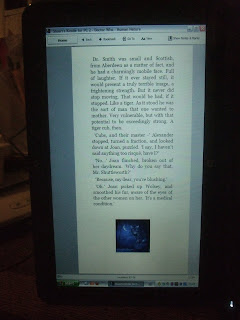
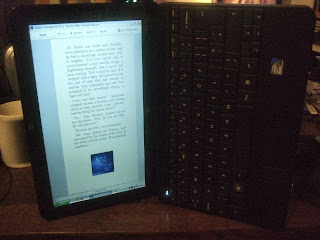
Mobipocket's own website has 11653 free books available, many of which Amazon is charge two to five dollars for.
One byproduct of that is that Kindle users will be able to read four of the eBooks which turned up at the BBC's Doctor Who website earlier in the past decade 'reprinting' some of the old Virgin & BBC novels. Here's a list of what's available, followed by a direct link to Mobipocket file:
The Empire of Glass by Andy Lane [mobipocket]
The Sands of Time by Justin Richards [mobipocket]
Human Nature By Paul Cornell [mobipocket]
Nightshade by Mark Gatiss [mobipocket]
The other four, Scales of Injustice by Gary Russell, Well-Mannered War by Gareth Roberts, Lingbarrow by Marc Platt and The Dying Days by Lance Parkin haven't been converted sadly, but there are printable versions which you might be able to save as a text (.txt) file.
In case you're wondering, I'm not suddenly flush -- no real Kindle in my hands -- I've been reading them using the Kindle for PC desktop application on the netbook I bought with my Christmas present money, using the EeeRotate software to turn the screen image around and make it more book like:


Mobipocket's own website has 11653 free books available, many of which Amazon is charge two to five dollars for.
'I've loved, I've laughed and cried.'
Politics Blair's was a good resignation speech, and suitably Shakespearean, philosophical in places, legacy sealing in others. Delivering it on his home turf allowed him to deliver it with the audience reacting in the correct places avoiding the uncomfortable pauses that have beset his appearances in recent weeks. As always he was desperate to come across as someone who could be trusted and I think it's the first time I've seen him admit to there being failures, but his message seemed to be -- put yourself in my shoes -- would your choices have been any different?
Watching it on television live at lunchtime though, I had an uncomfortable feeling throughout that I'd heard some of the sentiments before. Of course when he said what's sure to be his epitaph -- 'I did what I thought was right' I was geekily reminded of Ben Kenobi's advice to Luke Skywalker in The Empire Strikes Back: 'You must do what you feel is right'. But there was something else, something ... elusive. And then it struck me -- he looked like he wanted to burst into song. Each time he said 'I did...'
He seemed desperate to say, 'I did it my way...'
Tonight I looked back over the speech and indeed the similarities with the Frank Sinatra standard are pretty amazing. Except for the section in the middle comparing what it's like in Britain before and after his primeministership, it's almost as though he gave his advisors a copy of the lyrics and said: 'Base it on that.' Here then is the proof -- with Blair first then Sinatra in italics. Take it away Tony and Frank ...
Blair's resignation speech
My Way
I have come back here, to Sedgefield, to my constituency, where my political journey began and where it is fitting it should end.
And now, the end is near
Today I announce my decision to stand down from the leadership of the Labour Party. The Party will now select a new Leader. On 27 June I will tender my resignation from the office of prime minister to the Queen. I have been prime minister of this country for just over 10 years. In this job, in the world today, that is long enough, for me, but more especially for the country. Sometimes the only way you conquer the pull of power is to set it down.
And so I face the final curtain
It is difficult to know how to make this speech today. There is a judgment to be made on my premiership. And in the end that is, for you, the people, to make.
My friend
I can only describe what I think has been done over these last 10 years and, perhaps more important, why.
I'll say it clear
I have never quite put it like this before.
I'll state my case, of which I'm certain.
I was born almost a decade after the Second World War. I was a young man in the social revolution of the 60s and 70s. I reached political maturity as the Cold War was ending, and the world was going through a political, economic and technological revolution.
I've lived a life that's full.
I looked at my own country, a great country - wonderful history, magnificent traditions, proud of its past, but strangely uncertain of its future, uncertain about the future, almost old-fashioned.
I've traveled each and every highway;
I ask you to accept one thing.
And more, much more than this,
Hand on heart, I did what I thought was right. I may have been wrong. That's your call.
I did it my way.
I give my thanks to you, the British people, for the times I have succeeded, and my apologies to you for the times I have fallen short.
Regrets, I've had a few;
I don't think Northern Ireland would have been changed unless Britain had changed, or the Olympics won if we were still the Britain of 1997.
But then again, too few to mention.
As for my own leadership, throughout these 10 years, where the predictable has competed with the utterly unpredicted, right at the outset one thing was clear to me.
Without the Labour Party allowing me to lead it, nothing could ever have been done.
I did what I had to do
But I knew my duty was to put the country first. That much was obvious to me when just under 13 years ago I became Labour's Leader. What I had to learn, however, as prime minister was what putting the country first really meant.
And saw it through without exemption.
Decision-making is hard. Everyone always says: 'Listen to the people.' The trouble is they don't always agree. When you are in opposition, you meet this group and they say: 'Why can't you do this?' And you say: 'It's really a good question. Thank you.' And they go away and say: 'Its great, he really listened.' You meet that other group and they say: 'Why can't you do that?' And you say: 'It's a really good question. Thank you.' And they go away happy you listened. In government, you have to give the answer - not an answer, the answer.
I planned each charted course;
And, in time, you realise putting the country first doesn't mean doing the right thing according to conventional wisdom or the prevailing consensus or the latest snapshot of opinion.
Each careful step along the byway,
It means doing what you genuinely believe to be right.
But more, much more than this,
Your duty is to act according to your conviction.
I did it my way.
All of that can get contorted so that people think you act according to some messianic zeal.
Yes, there were times, I'm sure you knew
Doubt, hesitation, reflection, consideration and re-consideration, these are all the good companions of proper decision-making.
When I bit off more than I could chew.
But the ultimate obligation is to decide. Sometimes the decisions are accepted quite quickly. Bank of England independence was one, which gave us our economic stability.
But through it all, when there was doubt,
Sometimes, like tuition fees or trying to break up old monolithic public services, they are deeply controversial, hellish hard to do, but you can see you are moving with the grain of change round the word.
I ate it up and spit it out.
Sometimes, like with Europe, where I believe Britain should keep its position strong, you know you are fighting opinion, but you are content with doing so.
I faced it all and I stood tall;
Sometimes, as with the completely unexpected, you are alone with your own instinct.
And did it my way.
In Sierra Leone and to stop ethnic cleansing in Kosovo, I took the decision to make our country one that intervened, that did not pass by, or keep out of the thick of it. Then came the utterly unanticipated and dramatic - September 11th 2001 and the death of 3,000 or more on the streets of New York. I decided we should stand shoulder to shoulder with our oldest ally. I did so out of belief. So Afghanistan and then Iraq - the latter, bitterly controversial. Removing Saddam and his sons from power, as with removing the Taleban, was over with relative ease.
I've loved, I've laughed and cried.
But the blowback since, from global terrorism and those elements that support it, has been fierce and unrelenting and costly. For many, it simply isn't and can't be worth it.
I've had my fill;
For me, I think we must see it through. They, the terrorists, who threaten us here and round the world, will never give up if we give up.
my share of losing.
The British are special. The world knows it. In our innermost thoughts, we know it. This is the greatest nation on earth.
And now, as tears subside,
It is a test of will and of belief. And we can't fail it.
I find it all so amusing.
So, some things I knew I would be dealing with. Some I thought I might be. Some never occurred to me on that morning of 2 May 1997 when I came into Downing Street for the first time.
To think I did all that;
Great expectations not fulfilled in every part, for sure. Occasionally people say, as I said earlier: 'They were too high, you should have lowered them.' But, to be frank, I would not have wanted it any other way. I was, and remain, as a person and as a prime minister, an optimist. Politics may be the art of the possible - but at least in life, give the impossible a go.
And may I say - not in a shy way,
So of course the vision is painted in the colours of the rainbow, and the reality is sketched in the duller tones of black, white and grey.
No, oh no not me,
But I ask you to accept one thing. Hand on heart, I did what I thought was right.
I did it my way.
I may have been wrong. That is your call. But believe one thing if nothing else. I did what I thought was right for our country.
For what is a man, what has he got?
I came into office with high hopes for Britain's future. I leave it with even higher hopes for Britain's future. This is a country that can, today, be excited by the opportunities not constantly fretful of the dangers. People often say to me: 'It's a tough job' - not really. A tough life is the life the young severely disabled children have and their parents, who visited me in Parliament the other week. Tough is the life my dad had, his whole career cut short at the age of 40 by a stroke. I have been very lucky and very blessed. This country is a blessed nation.
If not himself, then he has naught.
The British are special. The world knows it. In our innermost thoughts, we know it.
To say the things he truly feels;
This is the greatest nation on earth.
And not the words of one who kneels.
It has been an honour to serve it. I give my thanks to you, the British people, for the times I have succeeded, and my apologies to you for the times I have fallen short.
The record shows I took the blows -
Good luck.
And did it my way!
Watching it on television live at lunchtime though, I had an uncomfortable feeling throughout that I'd heard some of the sentiments before. Of course when he said what's sure to be his epitaph -- 'I did what I thought was right' I was geekily reminded of Ben Kenobi's advice to Luke Skywalker in The Empire Strikes Back: 'You must do what you feel is right'. But there was something else, something ... elusive. And then it struck me -- he looked like he wanted to burst into song. Each time he said 'I did...'
He seemed desperate to say, 'I did it my way...'
Tonight I looked back over the speech and indeed the similarities with the Frank Sinatra standard are pretty amazing. Except for the section in the middle comparing what it's like in Britain before and after his primeministership, it's almost as though he gave his advisors a copy of the lyrics and said: 'Base it on that.' Here then is the proof -- with Blair first then Sinatra in italics. Take it away Tony and Frank ...
Blair's resignation speech
My Way
I have come back here, to Sedgefield, to my constituency, where my political journey began and where it is fitting it should end.
And now, the end is near
Today I announce my decision to stand down from the leadership of the Labour Party. The Party will now select a new Leader. On 27 June I will tender my resignation from the office of prime minister to the Queen. I have been prime minister of this country for just over 10 years. In this job, in the world today, that is long enough, for me, but more especially for the country. Sometimes the only way you conquer the pull of power is to set it down.
And so I face the final curtain
It is difficult to know how to make this speech today. There is a judgment to be made on my premiership. And in the end that is, for you, the people, to make.
My friend
I can only describe what I think has been done over these last 10 years and, perhaps more important, why.
I'll say it clear
I have never quite put it like this before.
I'll state my case, of which I'm certain.
I was born almost a decade after the Second World War. I was a young man in the social revolution of the 60s and 70s. I reached political maturity as the Cold War was ending, and the world was going through a political, economic and technological revolution.
I've lived a life that's full.
I looked at my own country, a great country - wonderful history, magnificent traditions, proud of its past, but strangely uncertain of its future, uncertain about the future, almost old-fashioned.
I've traveled each and every highway;
I ask you to accept one thing.
And more, much more than this,
Hand on heart, I did what I thought was right. I may have been wrong. That's your call.
I did it my way.
I give my thanks to you, the British people, for the times I have succeeded, and my apologies to you for the times I have fallen short.
Regrets, I've had a few;
I don't think Northern Ireland would have been changed unless Britain had changed, or the Olympics won if we were still the Britain of 1997.
But then again, too few to mention.
As for my own leadership, throughout these 10 years, where the predictable has competed with the utterly unpredicted, right at the outset one thing was clear to me.
Without the Labour Party allowing me to lead it, nothing could ever have been done.
I did what I had to do
But I knew my duty was to put the country first. That much was obvious to me when just under 13 years ago I became Labour's Leader. What I had to learn, however, as prime minister was what putting the country first really meant.
And saw it through without exemption.
Decision-making is hard. Everyone always says: 'Listen to the people.' The trouble is they don't always agree. When you are in opposition, you meet this group and they say: 'Why can't you do this?' And you say: 'It's really a good question. Thank you.' And they go away and say: 'Its great, he really listened.' You meet that other group and they say: 'Why can't you do that?' And you say: 'It's a really good question. Thank you.' And they go away happy you listened. In government, you have to give the answer - not an answer, the answer.
I planned each charted course;
And, in time, you realise putting the country first doesn't mean doing the right thing according to conventional wisdom or the prevailing consensus or the latest snapshot of opinion.
Each careful step along the byway,
It means doing what you genuinely believe to be right.
But more, much more than this,
Your duty is to act according to your conviction.
I did it my way.
All of that can get contorted so that people think you act according to some messianic zeal.
Yes, there were times, I'm sure you knew
Doubt, hesitation, reflection, consideration and re-consideration, these are all the good companions of proper decision-making.
When I bit off more than I could chew.
But the ultimate obligation is to decide. Sometimes the decisions are accepted quite quickly. Bank of England independence was one, which gave us our economic stability.
But through it all, when there was doubt,
Sometimes, like tuition fees or trying to break up old monolithic public services, they are deeply controversial, hellish hard to do, but you can see you are moving with the grain of change round the word.
I ate it up and spit it out.
Sometimes, like with Europe, where I believe Britain should keep its position strong, you know you are fighting opinion, but you are content with doing so.
I faced it all and I stood tall;
Sometimes, as with the completely unexpected, you are alone with your own instinct.
And did it my way.
In Sierra Leone and to stop ethnic cleansing in Kosovo, I took the decision to make our country one that intervened, that did not pass by, or keep out of the thick of it. Then came the utterly unanticipated and dramatic - September 11th 2001 and the death of 3,000 or more on the streets of New York. I decided we should stand shoulder to shoulder with our oldest ally. I did so out of belief. So Afghanistan and then Iraq - the latter, bitterly controversial. Removing Saddam and his sons from power, as with removing the Taleban, was over with relative ease.
I've loved, I've laughed and cried.
But the blowback since, from global terrorism and those elements that support it, has been fierce and unrelenting and costly. For many, it simply isn't and can't be worth it.
I've had my fill;
For me, I think we must see it through. They, the terrorists, who threaten us here and round the world, will never give up if we give up.
my share of losing.
The British are special. The world knows it. In our innermost thoughts, we know it. This is the greatest nation on earth.
And now, as tears subside,
It is a test of will and of belief. And we can't fail it.
I find it all so amusing.
So, some things I knew I would be dealing with. Some I thought I might be. Some never occurred to me on that morning of 2 May 1997 when I came into Downing Street for the first time.
To think I did all that;
Great expectations not fulfilled in every part, for sure. Occasionally people say, as I said earlier: 'They were too high, you should have lowered them.' But, to be frank, I would not have wanted it any other way. I was, and remain, as a person and as a prime minister, an optimist. Politics may be the art of the possible - but at least in life, give the impossible a go.
And may I say - not in a shy way,
So of course the vision is painted in the colours of the rainbow, and the reality is sketched in the duller tones of black, white and grey.
No, oh no not me,
But I ask you to accept one thing. Hand on heart, I did what I thought was right.
I did it my way.
I may have been wrong. That is your call. But believe one thing if nothing else. I did what I thought was right for our country.
For what is a man, what has he got?
I came into office with high hopes for Britain's future. I leave it with even higher hopes for Britain's future. This is a country that can, today, be excited by the opportunities not constantly fretful of the dangers. People often say to me: 'It's a tough job' - not really. A tough life is the life the young severely disabled children have and their parents, who visited me in Parliament the other week. Tough is the life my dad had, his whole career cut short at the age of 40 by a stroke. I have been very lucky and very blessed. This country is a blessed nation.
If not himself, then he has naught.
The British are special. The world knows it. In our innermost thoughts, we know it.
To say the things he truly feels;
This is the greatest nation on earth.
And not the words of one who kneels.
It has been an honour to serve it. I give my thanks to you, the British people, for the times I have succeeded, and my apologies to you for the times I have fallen short.
The record shows I took the blows -
Good luck.
And did it my way!
Too Many Secrets
RSS Jason from Download Squad is having difficulty keeping up with all of his RSS reading and is asking for strategies. I use the Sesame Street approach:

On each day I generally only read the feeds whose title begins with the given letter, unless it's the end of the month in which case I chase themes. So today's internet was brought to me by the letters Z, U, N and G on the number 26.

On each day I generally only read the feeds whose title begins with the given letter, unless it's the end of the month in which case I chase themes. So today's internet was brought to me by the letters Z, U, N and G on the number 26.
Subscribe to:
Posts (Atom)