Showing posts with label the books i've read in 2020. Show all posts

The Twenty-First Book I've Read This Year.

Books   None of you will remember my startled tweets of a few years ago on seeing A Star Is Born and how sections look like Loose Cannon reconstructions of missing Doctor Who stories.   A quick glance online revealed this was an attempt to restore scenes from the film which had been cut during the initial release, this new version having become the de facto version on shiny disc releases.  Ronald Haver's brilliant book is the story of the tumultuous making of the picture and his later attempt at producing that complete restoration, his search for missing footage and how this version of the film is as good as its going to get.

Although Haver does cover the gossip about Judy Garland's behaviour on and off set, much of the main section of the text describes the technical nitty-gritty of film making, the lighting, costume and photography.  There are staggeringly detailed and completely fascinating discussions about the development of various screen ratios and how the film began in production on a cheaper Cinemascope knock off, Warnerscope, before that footage was scrapped and reshot in the more superior format.  Similarly, Technicolour was not the original choice but the results were just too good to pass up which is why the film now has such a ravishing image.

On completion, A Star Is Born was just over three hours long and even at that length beloved by audiences and critics on initial release.  But the bottom line men at the studio complained that it limited the number of showings per day and outside the supervision of the director George Cukor and any sense of film editing, went in an gutted the release prints to remove key blocks of scenes (including whole songs) reducing the running time by half an hour.  Instructions were sent out to cinemas to replicate these changes and the cut footage was sent back to the studio for destruction.

A young Haver saw the shorter version and then spent the rest of his life on a quest to see the longer version, assuming it must be out there somewhere.  With some friends and the eventual backing of the studio, he searched dozens of film vaults and connected with private collectors and although the key sequences were lost, he did find a complete audio track for the full version which became the basis for the reconstruction, a miraculous achievement in 1983, long before digital restoration.  This is a first rate book for anyone interested in filmmaking history and the fight to preserve that history.

The Knight, The Fool and the Dead (Time Lord Victorious).

Books As many of you will know, Time Lord Victorious is a cross-platform Doctor Who festival spread across various ranges and licencees. In essence it's the Eighth Doctor era but with a more cohesive structure and narrative thronds weaving in and out various audios, books and comics. Individually they're supposed to make sense but the user gains a richer experience from listening and reading it all.

Steve Cole's novels seems to be at the epicentre.  In the aftermath of The Waters of Mars, the Tenth Doctor runs from his mistakes into the Dark Times and discovers a race of beings, the Kotturoh are travelling the galaxy rewriting the DNA of other races to some master plan, potentially being the source of the very concept of death as its expressed in the Doctor's own time.  He decides to stop them.

From the beginning we can tell that something has broken inside the Doctor, that without anyone to stop him, his usual benevolence has become infected by malignancy.  He's sharper, more cantankerous, less patient and more than ever willing to trying to bend reality to his will if he believes its for the good of the cosmos and damn free will.  In his head, the ends justify the means.

He's become the kind of figure that David Collings inhabited in the Big Finish Unbound story Full Fathom Five.  Still the Doctor, but something is off and we can only imagine how Tennant would have played it, this whole portion of his life having almost been skipped over on screen ten years ago.  So it's quite a bold step to make it the premise of a story which is ostensibly for children.

The Eighth Doctor's participation is limited to a flashback interlude perhaps set during the Big Finish strand of stories (I presume, I'm saving them) then a huge, barnstorming appearance at the end.  Judging by his costuming on the cover of this book's sequel (coming soon!), it's his Time War iteration so he's traveled from one universe wide wave of destruction to participate in another.  Busy life.

Steve Cole was series editor during Eighth's formative prose years and it's a pleasure to see him write the character again, coming across as a more meditative soul than his counterpart from four incarnations hence.  He's more clearly defined here and closer to his Big Finish counterpart than in some of the short stories of recent years, which just demonstrates the co-ordination at play across this whole project.

Placement: Just before the first Big Finish Time War series?

The Nineteenth Book I've Read This Year.

Books The author of numerous much thicker books about Agincourt offers a quick but dense survey of Henry V's life, referring only briefly to Shakespeare when necessary to debunk some of the outrageous myths. The general sense is that as with most of his "history" plays, Shakespeare concertinaed events for dramatic purposes, with the wedding to Catherine happening some time after the key battle rather than as though she was simply a prize for his victory.  But overall in following the distillations of the same chronicles which are still the bedrock of historical research into Henry V, Shakespeare's play is more accurate than some of his other works.

The Eighteeth Book I've Read This Year.

Books James Shapiro looks at key moments in the culture war still raging in the US and investigates how they were influenced by the canon. Much of it is hair raising. We discover that the abolitionist John Quincy Adams was incredibly queezy about Othello, a point which he expounded upon to Fanny Kemble, sister of Richard, at a dinner party, day (to paraphrase) that Desdemona got what she deserved for marrying an "n-word". That Ulysses S Grant almost went on stage as Desdemona in his younger days. How anti-English sentiment caused riots during a production of Macbeth in New York. That John Wilkes Booth believed himself to be a modern Brutus when he assassinated Lincoln who himself used to spend hours quoting a discussing Shakespeare with anyone who'd listen. There are also fascinating chapters about the making of Kiss Me Kate and Shakespeare in Love, rounding out with an essay about what happened when the assassination of Caesar in the Trump inflected Shakespeare in the Park production went viral (Shapiro worked as an advisor).  Marvellous stuff.

The Seventeenth Book I've Read This Year.

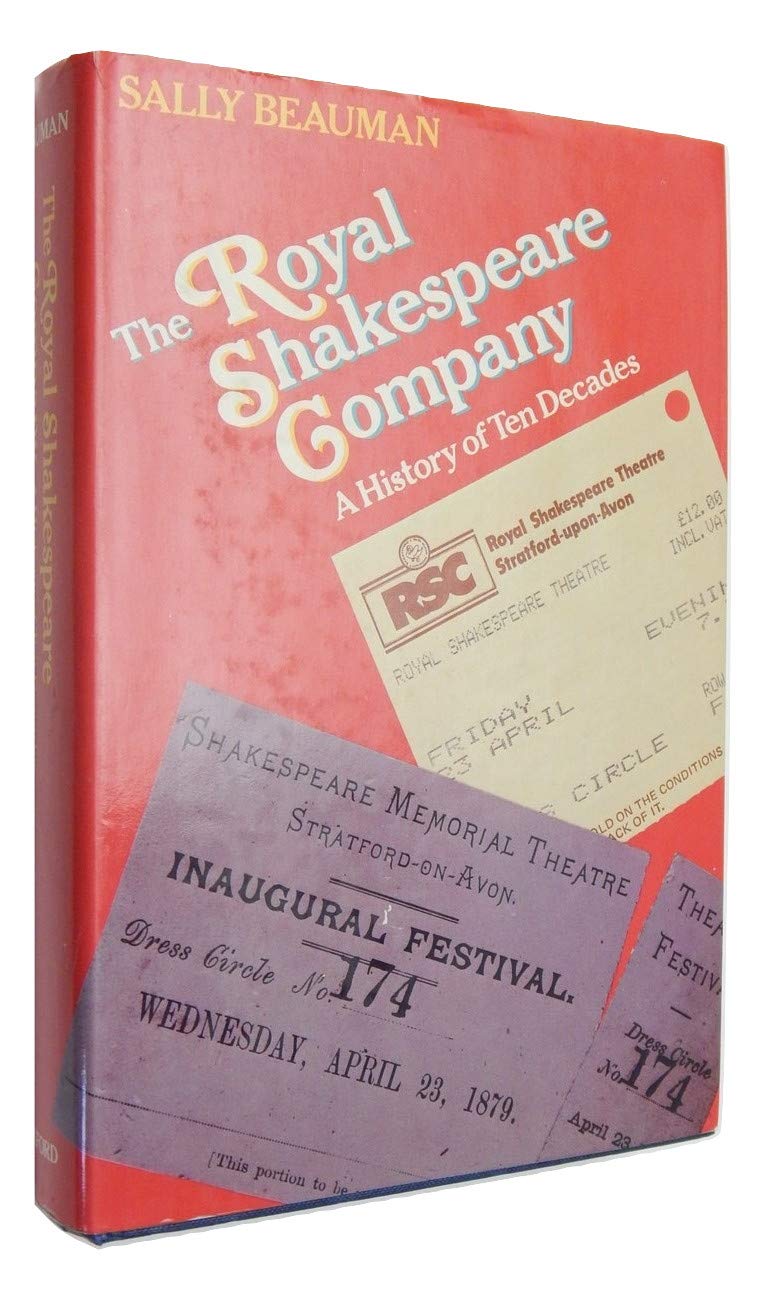
Books One of those books which is so readable there's a loss when it inevitably ends, especially since, having been published in 1982, it unavoidably misses out on covering another forty-years of history. More than simply the theatrical history of what appeared on stage, Sally Beauman's RSC: A History in Ten Decades instead investigates the origins of the RSC, from its original scrappy week long annual event to commemorate Shakespeare (which for years didn't even mount a production), through the building of its various venues, its many directors, the financial wrangling between the board of directors and then the arts council, the rivalry with the National Theatre and how its on stage fortunes have been dictated by critical and academic tastes.

Despite her own association with the company (at time of writing she'd been married to one of its key actors Alan Howard for ten years), Beauman is unafraid to editorialise on the shortcomings of its key players, the text is incredibly gossipy, and the architecture of the auditoriums.  At its peak, the RSC was running six or seven different performance spaces between Stratford and London with numerous seasons of plays and transfers and if nothing else, the book has helped me to understand the provenance of the various programmes I've been collecting lately.  The moment when the book stops, just on the eve of The Barbican opening feels like an extremely exciting time as the company's reputation had reached one of its many zeniths.

You can smell the spaces and rehearsal rooms.  When Trevor Nunn succeeded Peter Hall, he wanted to create a more professional almost monastic atmosphere and to that end replaced the stage cloth, the large sheet in the rehearsal room which represented the acting space.  Over the years it had become incredibly dirty and so it was ripped out and replaced with a brand new, bright white fabric and the rule was that it had to remain that way, whatever the cost, smoking, food, drink and shoes banned from the space and it remained that way through all of his rehearsals.  Then John Barton took over to rehearse his Twelfth Night and when Nunn returned afterward the sheet was as dirty and filled with cigarette burns as its predecessor.  He realised that some things couldn't be changed.

The Sixteenth Book I've Read This Year.

Books Mark Kermode recommended this after an interview on the film review show when all Richard Dreyfus wanted to talk about was what a shit Michael Cimino had been rather than publicise his new release.  It's stunning a stunning memoir covering the production of all the films on the cover plus Convoy, The Wicker Man and The Man Who Fell To Earth.  Not just a string of showbiz annecdotes (all of which are incredibly funny and illuminating), it demonstrates in detail the role of the producer in putting together packages to sell to studios and working on set day-to-day to keep the production moving on budget and schedule.  Essential.

The Fifteenth Book I've Read This Year.

Books Does this count as a single book given that it's about the length of a New Yorker article and it has "an essay" written on the cover? Well, since Amazon are selling it as a single entity, yes. Since Sedaris's work is often best heard than read, I bought the audiobook, in which the author narrates the piece in less than half an hour.

The tone is rather like one of his older This American Life contributions. He talks about his signing tours and how various themes often develop which leads to a very funny passage in which he finds himself having to search a town in order to hand a random stranger $50 (honestly this makes sense within context).
The results are hilarious. Would recommend.

The Fourteenth Book I've Read This Year.

Music At the beginning of the year, I had such plans, one of which was to read at least a book a week. Then the lockdown happened and in order to keep my sanity, I've moved onto a project based mentality which is currently to watch my way through Kurasawa's career in the afternoons and a Eurovision Song Contest each evening. We'll see how long that lasts. At the start of the lockdown, I was going to watch lots of Shakespeare and read Plato's Republic but I feel like my brain's shrunk so you make do with what you have.

On the upside, it also means I'm now able to say I've listened to all of The Beatles back catalogue in chronological order thanks to the late Ian MacDonald's superb book and this Spotify playlist which sequences the tracks in the same order as his scholarship.  After stuttering through the incredibly dense introduction which puts the group in the context of the 60s, their cultural impact and vice-versa, I'd read the entry for a given a track the give it a listen through the author's critically constructive filter.

MacDonald doesn't pull punches in the way a disappointed fan often doesn't.  He approaches anything past Sgt Peppers with the caution many Doctor Who fans view the John Nathan Turner era, still sublime in many ways but never quite reaching the heights of past glories.  As is so often the case, once any of the fundamentals of what made an artistic endeavor good begin to dissipate, usually the harmony between creators, it can't be recreated.  Boringly for The Beatles, it was the usual rock and roll standbys of too many drugs and too much money.

But by god, when The Beatles were good, they were sublime.  Sat in my armchair with Spotify pumping the tracks through my TV speakers, I was frequently in awe at what was achieved back then and how much of popular music, yes, even now, was defined by them either through appropriation or as a reaction to it.  The era which the author dismisses out of hand due the group's drug filled miasma still managed to produce All You Need Is Love, I Am The Walrus and Hello, Goodbye (arguably due in part to the group's drug filled miasma). 

Economical too.  It's extraordinary how many of their most memorable songs are under two minutes long and only about a fifth of the tracks break the three minute barrier.  Just sixteen last longer than four minutes.  The longest, the magisterially avant-garde Revolution 9 clocks in at eight minutes twenty-two (the shortest is Her Majesty from Abbey Road at twenty-two seconds).  MacDonald isn't interested in such metrics though.  At the top of each entry is a list of credits, recording dates and other info, but not track duration.

At the end of this magical mystery tour, what I've I learned?  Chiefly and cruelly that Ringo couldn't sing, his only decent song Octopus's Garden, the Love album released many years after the group split up containing the best arrangement.  That it isn't George Harrison's guitar which gently weeps but Eric Clapton.  That the reason that half of the production on Let It Be album sounds out of place is because John had Phil Spektor complete the album without consulting the rest of the group, finally hammering the stake into the coffin of his friendship with Paul.

On a technical level that the songs were not recorded in any semblance of the order they appear on the album or as single units created one after the other.  Their earliest songs still required more than one recording day to get right through George Martin's steady hand.  Also that up until Sgt Peppers the US distributors often butchered the running order of those albums to create more releases which meant American audiences experienced the music in a vastly different container to the UK.  Now, bring on Eurovision.

The Thirteenth Book I've Read This Year.

Books Rather like the Arden Shakespeares, The Black Archive has an eclectic author led format. Some include a thorough commentary on the production of the show, teasing out facts which haven't already been uncovered by Andrew Pixley, a Fact or Fiction from the monthly report to the subscribers or the Production Subtitles on the shiny disc. Others, acknowledging that those things exist, choose to spin-off a series of essays inspired by the story, considering its place with the canon of Doctor Who and wider science fiction.

Una McCormack's four essays on The Curse of Fenric cover its part in Thatcher's downfall (ish), compares it to other Who stories set during World War II or consuming its iconography, how its representation of women compares to elsewhere in the franchise and science fiction in general and finally the Doctor's development into a deity of sorts.  Lucidly and accessibly written, there are few assertions in here which I can take issue with and its frequently eye opening, especially on the status of modern companions and other narrative decisions.

Having recently watched Fenric in the context of the recent revelations in the revival of the series, you can see how script editor Andrew Cartmel laid the groundwork even if JNT squashed (on religious grounds), his idea of suggesting the Doctor as a powerful God-like being who existed before the Time Lords.  Retrospectively you can almost imagine that the Seventh Doctor is at least unconsciously aware of his previous life and has an insight which few Doctors before or since have been able to tap into.

The book is also a treasured possession because Una has been kind enough to mention me in the acknowledgements for pointing her towards one of the sources she used, looking completely out of place against the other luminaries such as Ian Briggs (the writer of Fenric), our lord the aforementioned Mr Pixley and various other academics and spin-off writers.  I had no idea until someone pointed it out to me on the social medias and it made what had been quite a grim day much, much brighter.

The Twelfth Book I've Read This Year.

Books This thrilling disquisition on how broadcasting during World War II shaped the BBC has really struck a chord as the same organisation, albeit with much more than a single radio station has entered a similar kind of war footing.  Once again it's getting the government's message across to the public whilst providing the necessary scrutiny when necessary, educating, entertaining and informing.  During the war, the BBC proved its worth and once again, just weeks after it seemed like it was due to be wound up, it's confirming its importance again.

Other elements resonate.  The work of the "black ops" teams filling the continental airwaves with radio stations authentic enough to convince the local population that they could sneak in propaganda and untruths are exactly the tactics employed now by fake news sites, combining standard news with the extravagant conspiracy theory.  There's also a thread throughout about how the BBC's independence is forever under threat and how the people they seek to perlustrate are often also the ones with the capacity to defenestration it.  It's a dense read but comes highly recommended.

The Eleventh Book I've Read This Year.

Books If Black Panther was a window into how colonialism obliterated the artistic and scientific achievements of a whole continent (and indeed the world), Don't Touch My Hair is the whole house.  As a middle aged white man I'm well aware of my privilege and also the guilt of being part of a cultural group which subjugated others for centuries.  But at no point did I consider just how pervasive it is that society expects non-white races to conform to our cultural norms and expectations and how in appropriating elements of black culture, rather than celebrating we're further suppressing it.  Consciousness raising.

The Tenth Book I've Read in 2020.

Books   Sometimes the editors in these Arden Shakespeare either rebel against the typical format or at least offer an alternative to orthodoxy.  In the appendix bout sources, David Scott Kastan notices "many serious editions of Shakespeare, like the Arden series, have lengthy discussions devoted to the sources of the plays, and often reprint substantial sections of Plutarch or Holinshed or other texts that Shakespeare clearly read and transformed into drama" before heading off into a few pages of essentially saying there's actually little point because no one can be really sure beyond the obvious examples.

The editor could as well be commenting on this volume's narrative predecessor Richard II which does all those things.  Kastan on the other hand, assumes that we know these other books exist and will probably already have access if we're studying the play.  So rather than simply regurgitating their arguments at length instead investigates the topics he's most interested in.  That makes this one of the more readable Ardens as it keeps the purer lit-crit to a minimum and instead delves into the history of the play and how it fits within the context of theatrical and literary history.

He notes, for example, how the focus of the play has developed over time, from Henry Percy as the heroic figure, to Falstaff as the comedic headliner to the present moment when, thanks to the play usually being presented with the various other sections of this Henriad it's about the tortured relationship between father and son and the fight for legitimacy of both Henrys after the deposition of Richard.  Which is one of the things I love about Shakespeare.  Historically, for the most part, the texts haven't changed and yet they have the capacity to fuel our current interest in having drama with an emotional and intellectual depth.

The Ninth Book I've Read in 2020.

Books The above image isn't quite accurate. The Arden imprint has passed through numerous publishers over the years and my copy is from the Thomson days with their ultra conspicuous blue box on the spine. It's also a demonstration of how the third series has developed since they began publication in the 90s. The introductions generally complete within about a hundred or so pages and often don't bother with appendices. This begins with a hundred and seventy page introduction with a thirty five page textual discussion. The footnotes in the main text are often so extensive there's only room for a couple of lines of the actual text at the top of the page with another twenty pages of "longer notes" afterwards.

Is it possible to say I've read these books if I'm skipping the more overt literary criticism?  My key interests are in the production and publication history, dating of the play and textual notes, so in this case the section on language went unread as did the pages about characterisation which seemed to head way off point.  In the introduction, the author almost apologises for being an expert in their field having studied Richard II for decades but it's good that all of that knowledge has a place somewhere for those who're following in his footsteps.  But I'm reading for pleasure as an adjunct to listening to the plays so perhaps I shouldn't feel too guilting about not wanting to read the line-by-line description of Shakespeare's deviations from Holinshead.

The Eighth Book I've Read in 2020.

Books King John has been a favourite of mine since listening to ArkAngel's blistering audio recording which runs with the embryonic farce elements in the text and the satirical nature of the melodrama. Act four in particular surrounding the execution of the child and John's reaction thereof are pure Blackadder, as the confluences of coincidences work against him.

This Arden 3 ignores all of that (which to be fair could all be in my mind) and concentrates on the play's sources, linguists, varying fortunes in production and textual state.  The text is incredibly readable, not least because acknowledges pop culture exists with references to Darth Vader and Stephen Colbert among others as points of comparison.

Generally thought of as one of Shakespeare's obscurities along with the likes of Timon of Athens, it nevertheless has the distinction of being the first to be put on film.  The surviving minute and a quarter can be watched here.  But it's a shame that the production analysis doesn't stretch to the BBC Shakespeare version.  Casting Leonard Rossiter in the title role feels like a statement of intent.

The Seventh Book I've Read in 2020.

Books A fine summation of the play. Julius Caesar is textually uncontroversial - it only exists in the First Folio and any Quartos are later printings based on that single text.  The text itself is printed well in F1 in comparison to some others which suggests it was based on the prompt book.

But the editor still finds something to write about as he stabs into the bonkers traditions introduced by the earliest editors like Rowe, Pope and Theobald all of whom brought "corrections" to perfectly reasonable elements of the play because they literally assumed Shakespeare must have been in error due to ignorance.

Perhaps the most fascinating of these is in relation to the sleepy Brutus on the eve of the assassination asks his servant if the following day is the "first of March?".  Lewis Theobald when preparing his version of the play in 1733 amended this to "Ides of March" and it stuck.

But this isn't a mistake, Shakespeare knew exactly what he was doing.  On the one hand he's showing how Brutus has other things on his mind and literally needs to be reminded of the actual date (wall planners not having been invented yet), and it's quickly confirmed to him that the 15th is the following the day, the Ides.

The writer is also commenting on a contemporary issues.  This was around the time that the Julian calendar, initiated by Caesar himself was being replaced by the one we know from Pope Gregory XIII and with different religions following different calendars, such confusion would also be on the minds of the viewer.

The Sixth Book I've Read in 2020.

Books   Not a play I'm that familiar because it's also not a play I particularly like so I skimmed the lit crit section and went straight for the production history and textual examination both of which were as fascinating as these things tend to be.  Was the play produced in Shakespeare's lifetime or meant to simply exist as a reader's addition?  The length of the speeches and the more ponderous approach to scene structure would suggest so.  But why so many difference between the Quarto and Folio with the addition stage directions and revisions of language?  Did it in fact receive an appearance at the Inns of Court?  Onward to Julius Caesar.

The Fifth Book I've Read in 2020.

Books With the The CW's tv adaptation in the air, and in the wake of finishing Doomsday Clock, I decided it was about time to read the original comic. Whereas the Watchmen sequel was designed to acknowledge the existence and validity of all the various universes and timelines across DC's history making all of it "canonical", it's quite stark to find a comic designed to do the exact opposite, to dump out decades of continuity in order to streamline what was being published.  Inevitably, I prefer the former which implies that every universe, across media, is valid, the various multiverses part of a metaverse which contains all of fiction, or at least that's how I interpret it.

The scope is incredible, breathless and for all the suggestion that this was a self-contained story, it's sure to be a comics fan who'll get the most out of the references.  Nevertheless, I can appreciate the import of having the various incarnations of Superman working together and characters who've previously only had a minor focus in the various comics being thrust to centre stage.  Are there too many characters?  Probably and often the chaotic storytelling is difficult to follow.  Yet it is still incredibly exciting to see all of the various villains teaming up and enjoy the immensity of the battles.  It'll be interesting to see how the cee-dub interprets all of this.

The Fourth Book I've Read in 2020.

Books Via internet purchases and library lending, I now have complete set of Arden 3s so that's me set for reading material for the next few months. Already patterns are emerging at least in terms of my interest. The sections of these books I'm finding easier to approach investigate the textual origins and editing of the plays, sources, production histories and dating.  The pure literary criticism is hard to take, although this edition resourcefully reflects it by providing performance examples.

This edition's editor Juliet Dusinberre offers a very persuasive argument that As You Like It was originally performed at court on Shrove Tuesday in 1599 based, amongst other things, on Touchstone's line about pancakes and mustard which she argues would only have been even half funny if the crowd were eating exactly that and a contemporaneous epilogue jotted down by an audience member which offers a logical replacement for the usual if they were addressing the Queen.

There's also a fascinating discussion in the appendices about which actor in the original company played each role. Shakespeare was writing them with a particular actor n mind so it's possible to extrapolate casting based on external evidence from other play texts and role calls in other publications.  Depending on where you fall with the dating, Touchstone was either played by Will Kemp or Robert Armin.  The former was more clownish and slapstick, the latter droll.

It's still sobering to reflect that Rosalind, who has the largest number of lines in the play and more than most female roles across Shakespeare was played by a fifteen year old boy.  The introduction also reflects on how they would have had to cope with the complexity of being a boy actor playing a woman or pretends to be a man who then pretends to be a woman.  Whoever that was must have been very gifted indeed.

The Third Book I've Read in 2020.


Books New year, new project. Collecting together birthday and Christmas money, I've invested in the remastered boxset of the Argo Shakespeare from the 1950s and 1960s (see here - fortunately I got in while the price was a bit more reasonable than it is now).  These are perfectly lucid if a bit dated readings of the texts and so I'm using it to crack on with the Arden Third Series editions I've been collecting over the years. 

The Arden 3 Othello is pretty conventional for this series with a lit-crit heavy introduction, dry discussion of the two extant texts and comparison with sources at the back and a theatrical discussion relying on playbooks from producions before the turn of the last century (despite photos of more contemporary productions). 

For 1997 it's also pretty musty, focusing on the the "giants" of Shakespeare criticism and a dated use of language around race.  There's particularly no discussion on the implications of blackface beyond trying to decide if Othello is actually "a black" (their words) or of a more "olive" complexion.  Even in the year of publication this must have felt dated.

Having suffered through this, I've since discovered that a revised edition with a new introduction was produced in 2016, so I now have that on order.  I'm a completist.  Having announced a fourth series, it's interesting that they're still updating the third, not to mention still publishing new editions.  Measure for Measure is out at the end of this month.

The Second Book I've Read in 2020.

Books  Absolutely inferior as a sequel to the graphic novel in comparison to the television series, it's nevertheless pretty diverting even if it lacks the textual density and original thinking of Moore and Gibbons.  Anything which utilises Dr. Manhattan to explain how the New 52 happened and return the DC universe to something even close to its status before that reboot, it couldn't be anything other than a travesty of the Watchmen.  That said, it is a very good solution DC universe-wise as it not only restores a bunch of old continuity, it uses the multiverse to suggest that every comic ever "happened" with even the new 52 still rocking on somewhere.  There's also the implication, thanks to a reference to a version of Superman fighting Thor and the Hulk that the DC multiverse is just one of numerous multiverses which would include MARVEL and also the Watchmenverse (or whatever its called).  If nothing else, it's made me want to read a bunch of other comics, so job done in that respect.