Film Watching The Bourne Supremacy this evening, I thought of this opening for a film and story idea. It's (c) Stuart Ian Burns if you want to license it.
Fifty-three seconds of logos.
Cut to interior of a car. I don't know anything about cars but let's say that it isn't wildly expensive and hasn't been replaced in a while, the sort of thing an emergency doctor might drive if they're just starting out and need to get to work quickly.
Michelle Monaghan is behind the wheel (I'm choosing her because she was curiously in The Bourne Supremacy in the group searching for the spy and she's brilliant in everything she's in) (plus Rachel McAdams is probably busy) and she's mid-conversation about racing the hospital because there's some kind of major incident happening and she's being called in on her day off.
She's all game face and professional.
Traffic is gridlocked and she's stuck at traffic lights. Abruptly there's a knock on the glass. Metallic tapping. She turns and on the reverse we see Mark Urban shouting through the passenger window (I'm choosing him because he was curiously in The Bourne Supremacy playing a Russian assassin and he's brilliant in everything he's in) (plus Cillian Murphy is probably busy) (um).
Panicking she takes her hands off the wheel and watches Urban run around the outside of the front of the vehicle pointing his gun at her.
"Out, out!" He shouts. In the background we can still hear the person Monaghan's been speaking to on the phone asking after her health.
"Okay, okay." She shouts back as she gets out and steps away. Urban jumps into the driver's seat and we then see he's somehow found a gap in the traffic and is speeding away leaving Michelle standing in the middle of the road in shock.
"Hey, that's my car!" She shouts as she begins idiotically to run after it only to realise her idiocy pretty quickly and slowing down, only to begin running again at full pelt as she spots her car turning the corner at the end of the road into moving traffic causing two others cars to collide with each other.
As she reaches the two cars which were involved in the collision, we can see that her own car is long gone and that carnage hasn't just been limited to these two vehicles. She immediately gets to work assessing what needs to be done.
This is a film about the people left behind in the aftermath of an action car chase.
Working title: "BYSTANDERS"
Perhaps as I get older, I'm noting this more and more, the cars and people and destruction left behind in car chases in action films, people who were simply going about their day, with a million things to do, who suddenly find their cars destroyed, even dealing with fatalities sometimes in horrors created by someone who's nominally supposed to be the hero or at least the protagonist.
It's the syndrome of characters being morally allowed to die within a fictional construct if we don't know them.
I wondered what a film would be like about them. The original idea was for a comedy, a character loses their car in a similar circumstance to this and then spends the rest of the film trying to get it back, the final scene being the news that its been totalled and abandoned or even driven into a river.
But that's the obvious thing to do.
A drama's much more interesting. Michelle Monaghan goes amateur sleuth and will spend the next two hours trying to find out all she can about the car chase and who the people involved were. But it's brick wall and the whole thing is not a thriller. It's about her obsession and the effect it has on her.
During the process she talks to the various people affected by the car chase but the reasons for it are entirely obscured although I like the idea of there being a montage sequence in which people whose cars were wrecked or witnessed some of it have all kinds of wild theories that are essentially like something from a Michael Bay film, Die Hard or the Bourne franchise.
But she never quite cracks it and gets on with her life. Until something else happen major happens in her city and she goes to the place knowing instinctively that he'll be there. The man who stole her car, the man who haunts her dreams.
Ooh, now that I've written that, I quite like the idea of her having various fantasies throughout the thing with her imagining what he's like. But we never do know.
I know to an extent this is Doctor Who's Love & Monsters, but the scale is different and it doesn't have the inherent mythological baggage.
The final scene has her finally confront the man who stole her car.
The problem is without him being the cause of some personal pain for her, I can't think of an ending or a proper arc for her other than to find out if he is a villain or hero. If he's a villain then we're into the ludicrous territory of her becoming an action hero herself and doing him in. If he's a hero then she receives the equally awful lesson of "Well all these horrible things happened but they were for a good cause."
My best idea is for her to find him in a very public place like a railway station and for the follow exchange to occur.
MICHELLE:
You. It is you.
URBAN:
Yes it's me. Who?
MICHELLE:
No. I just want answers.
URBAN:
Do I know you?
MICHELLE:
You stole my car. You destroyed half the city.
URBAN:
Your car?
MICHELLE:
Yes.
Suddenly there's the sound of gunshots. People run back and forth screaming. Urban slams Michelle to the ground, but we just see her face as it hits the deck and his hand on her shoulder. We realise that she's stumbled into the midst of his sequel.
URBAN:
Get down.
Michelle looks up at Urban who's checking into the rafters of the station for the shooter.
MICHELLE:
Why?
URBAN:
What?
MICHELLE:
I just want to know why?
Cut to black.

Showing posts with label Ideas (c) Stuart Ian Burns. Show all posts
Showing posts with label Ideas (c) Stuart Ian Burns. Show all posts
BBCi's Book of the Future and my contribution to it.

History BBCi's Book of the Future was March 2003 Comic Relief project which asked members of the public to write short pieces about what they thought life would be like in 2020, with selected entries published in a book (with a forward from Dave Gorman).
The resulting website seems have been lost in the bitter recriminations surrounding the license fee settlement and the BBC's agreement that they should delete a quarter of its content so that the Daily Mail has room to publish more pages of photos of Kim Kardashian in low cut dresses (or something like that), but Archive.org has lived up to its name and preserved most of it here.
These are the articles which made it into the book. Topics ranged across all human experience from arts to environment, love, science, spirituality and "odd", which seems to be miscellaneous section ("the flying pig is to date the biggest scientific breakthrough of the century.")
Inevitably, I offered a contribution, boldly setting out my dystopian vision for the future of cinema, and here it is below. Bits of it are hilariously wrong. But the rest ...
This Indie Future.
All of the chatter surrounding the release of Tandy Cosine’s debut digit ‘Sky Above’ has been somewhat amusing for those of us young enough to remember when the original indie filmmakers were fighting for a piece of the pie. It was the early 1990s - people still used grainy old celluloid. Pioneers like Quentin Tarantino, Kevin Smith and Robert Rodriguez were mortgaging their lives to get a film into production. But they still largely had to rely on the main players, the very studios they were often trying to be different from, to distribute their work.
This was when the term ‘weblog’ was first coined and for the first time anyone could publish their own personal narrative for everyone to read. People like Jason Kottke, Rebecca Blood, Matt Haughey became household names. Look at Evan Williams – who thought he’d end up running Google for all those years? But it was all terribly slow. At the dawn of the new age, people still used telephone networks to get online.
Because of the synergy of these two seemingly disparate technologies anyone can indulge in the new art form of recording and editing their own lives and get it out there.
But it has come at a price. I miss fiction in independent film.
First of all, I miss the loss of structure. When fictional film is scripted it has a beginning, middle and an end - there is a point to it. You’ll see this in the genre pictures. But in ‘Sky Above’, ‘Carp Aromis’, ‘Hangin Out’ and Pak Cob’s eclectic ‘Grounded’ we’re essentially getting a section of someone’s life - a slice of pie cut out for us to sample. It might be beautiful, touching, interesting and dramatic but don’t you wish that everything would resolve itself? That they would (god forbid) have themes?
I miss good dialogue. The characters in Kevin Smith’s cheapos spoke in a heightened language - not Shakespeare - but still carefully crafted metre and rhythm. The trouble with ‘Sky Above’ is that everything spoken is pretty mundane. As it will be because it’s someone’s real life - carefully edited - but still mostly close to what we hear everyday.
I recently asked Cosine if she ever considered writing a script for her film. She looked at me incomprehensibly and asked, ‘Why would I want to do that? I know that in the past people wanted hyper-escapism at all levels of film making, but if your life is interesting enough what’s the point in making it up?’ In her case, I can to some extent see her point. But for every ‘Sky Above’ there are a dozen ‘The Chasers’ - teenagers making films about their cats. Fun if you like felines, but the rest of us?
It’s taste and choice I suppose. And anyway, things have a habit of going in circles and I’m hoping this will be one of those occasions. In a few years, I wouldn’t be too surprised if someone looks at the work around and wonders what would happen if she took the scripted elements of genres and applied them to the low budget piece she’s creating - take the time to craft a script which had elements of her own life but took them somewhere else. I’ve feeling that in a few years someone will be reading this op-ed piece and bemusedly wonder what I’m getting so worked up about.
Created: 10 March 2003
[PS Here's the original post on this blog which (broken) links to the website. Looking at the rest of that week, not much has changed otherwise. This Walkman only began chewing tapes in December. Still don't have a PS2. Still don't have an iPod. The way things are going I'll be linking to this post in 2020 too. Hello future me.]
Audio Early Modern Drama: A Proposal.
Audio As you know, with some time to spare I'm spending this week listening to Vivat Rex, the twenty-six part BBC Radio series which utilises a range of Early Modern plays, mostly from Shakespeare to offer a chronicle of the English crown from 1307 to 1533, from Edward II to Elizabeth I.
One of its great joys, other than the rather epic cast list, is that it includes within its make up sections of Edward III, Thomas of Woodstock, The Famous Victories of Henry V and John Ford's Perkin Warbeck in what may be their only radio outings, providing useful context to the action within Shakespeare's more famous plays.
Finally we can understand Henry IV's fear that his son Hal, by loafing around with Falstaff is repeating the mistakes of his predecessors Edward II and Richard II (albeit without the homo-erotic subtext of their acolytes) and that Richard's "hollow crown" speech is a near synopsis of the action in Edward III, including the appearance of a "ghost".
Listening to these rarities reminded of a proposal I wrote a few months ago suggesting that an audio or radio company produce a line of full text adaptations of just these kinds of rarely produced early modern dramas so that an interested public might be able to experience the work which was around at the time Shakespeare wrote the dozen or so plays which are constant production.
Disclosure: I did sent a version of this to a company but it wasn't something they were really interested in doing which was understandable since its not necessarily a sure fire winner and would need to be planned and executed careful if it's to work as a business proposition. I wouldn't know where to begin myself even. It probably needs an existing production infrastructure and some hope.
I know that some people aren't fans of audio but it offers two benefits. Firstly it's relatively cheap in comparison to video at least in production terms and from an artistic perspective since this would potentially be the only copy of the play available, the idea would be to follow ArkAngel's lead and produce something which emphasises the text.
Anyway, on with the proposal:
Pitch
Lesser known plays by William Shakespeare and his contemporaries as audio productions.
Introduction
William Shakespeare is back in focus this year thanks to the Cultural Olympiad with a season of programmes on the BBC and the World Shakespeare Festival across a number of venues. But he’s largely receiving the lone genius treatment even though he was influenced by earlier playwrights, was part of a thriving theatre community collaborating with others and would go on to influence writers within just a few years.
Writers like John Fletcher, Francis Beaumont, Thomas Middleton, Philip Massinger, John Ford, John Webster and George Chapman were once household names, some of them collaborating with Shakespeare and succeeding him during his retirement and although some of their work is produced its not in the same bulk as Shakespeare and treated as something of a novelty by comparison.
Except that’s also true of some of Shakespeare’s own plays too especially in the late period, which ran rather further than the conclusion of The Tempest suggests. Collaborations which thanks to the latest techniques are becoming considered part of the canon, Sir Thomas More, Edward III, Arden of Faversham and Double Falsehood (or Cardenio) are again not accessibly available to watch or listen to outside of the theatre despite their high curiosity factor.
All which became abundantly clear last year when I was reviewing Arden Shakespeare’s own Early Modern Drama series and found myself unable to source recordings of these plays so that I could experience them in performance rather than simply as scripts. All are filled with extraordinary poetry but none of them can truly be understood or enjoyed without an actor’s intent behind the words and a directorial thought process interpreting the story and themes, especially by laypeople like me.
Proposal
That these plays be turned into audios on cd or for download, bringing together actors with the high production values. Advertised correctly these should draw a curious general audience, one which is already eagerly seeking out what material is available in their local theatre. But of course there would be students and academics wanting to access high quality recordings of these plays especially those for which there is either only a single option or none at all.
Logistics
The scripts are obviously already written. Editorial choices would be in which texts to produce and preparing those scripts. I’m obviously unaware of budgets, but a writer’s fee (since these are four hundred year old plays) could be ploughed into the cost of the pre-recording rehearsal time which must be required
The texts could be those already in circulation through academic publishers, a collaboration which could go as far as branding the releases to tie-in with the books already available allowing for cross promotion, perhaps even utilising the same artwork:

With the plays also being sold through their website and through the audio producers, perhaps even as a set containing cd/download and book.
The trick would be to produce the Shakespearean curiosities along with the other work. An experimental series of four or six to test the market and then on from there. A Shakespeare collaboration, a Marlowe, a Beaumont and Fletcher, perhaps a Webster. A tie-in with Arden for example, would mean these choices are already made.
Competition
Of the complete or near-complete Shakespeare works available only the ArkAngel production of The Two Noble Kinsman is already available, but the others listed above are under produced. Of the others, even the better known playwrights, Kit Marlowe or Ben Jonson’s greatest plays, some of them on school curriculums, have no unabridged audio productions available.
There are amateur crowd-sourced productions online if you know where to look, but not professional and not consistent. Shakespeare’s Globe has monthly series of this material called “Read or Dead” but as yet none of it is available outside their library’s archive. Modern productions of this material even on BBC radio is rare (most often the Drama on 3 slot of the kind already downloadable) and usually heavily abridged.
Conclusion
This could become a very exciting series for whichever company accepts the challenge, taking their work into new markets and creating a legacy of material which could have commercial potential for years to come.
One of its great joys, other than the rather epic cast list, is that it includes within its make up sections of Edward III, Thomas of Woodstock, The Famous Victories of Henry V and John Ford's Perkin Warbeck in what may be their only radio outings, providing useful context to the action within Shakespeare's more famous plays.
Finally we can understand Henry IV's fear that his son Hal, by loafing around with Falstaff is repeating the mistakes of his predecessors Edward II and Richard II (albeit without the homo-erotic subtext of their acolytes) and that Richard's "hollow crown" speech is a near synopsis of the action in Edward III, including the appearance of a "ghost".
Listening to these rarities reminded of a proposal I wrote a few months ago suggesting that an audio or radio company produce a line of full text adaptations of just these kinds of rarely produced early modern dramas so that an interested public might be able to experience the work which was around at the time Shakespeare wrote the dozen or so plays which are constant production.
Disclosure: I did sent a version of this to a company but it wasn't something they were really interested in doing which was understandable since its not necessarily a sure fire winner and would need to be planned and executed careful if it's to work as a business proposition. I wouldn't know where to begin myself even. It probably needs an existing production infrastructure and some hope.
I know that some people aren't fans of audio but it offers two benefits. Firstly it's relatively cheap in comparison to video at least in production terms and from an artistic perspective since this would potentially be the only copy of the play available, the idea would be to follow ArkAngel's lead and produce something which emphasises the text.
Anyway, on with the proposal:
Audio Early Modern Drama: A Proposal.
Pitch
Lesser known plays by William Shakespeare and his contemporaries as audio productions.
Introduction
William Shakespeare is back in focus this year thanks to the Cultural Olympiad with a season of programmes on the BBC and the World Shakespeare Festival across a number of venues. But he’s largely receiving the lone genius treatment even though he was influenced by earlier playwrights, was part of a thriving theatre community collaborating with others and would go on to influence writers within just a few years.
Writers like John Fletcher, Francis Beaumont, Thomas Middleton, Philip Massinger, John Ford, John Webster and George Chapman were once household names, some of them collaborating with Shakespeare and succeeding him during his retirement and although some of their work is produced its not in the same bulk as Shakespeare and treated as something of a novelty by comparison.
Except that’s also true of some of Shakespeare’s own plays too especially in the late period, which ran rather further than the conclusion of The Tempest suggests. Collaborations which thanks to the latest techniques are becoming considered part of the canon, Sir Thomas More, Edward III, Arden of Faversham and Double Falsehood (or Cardenio) are again not accessibly available to watch or listen to outside of the theatre despite their high curiosity factor.
All which became abundantly clear last year when I was reviewing Arden Shakespeare’s own Early Modern Drama series and found myself unable to source recordings of these plays so that I could experience them in performance rather than simply as scripts. All are filled with extraordinary poetry but none of them can truly be understood or enjoyed without an actor’s intent behind the words and a directorial thought process interpreting the story and themes, especially by laypeople like me.
Proposal
That these plays be turned into audios on cd or for download, bringing together actors with the high production values. Advertised correctly these should draw a curious general audience, one which is already eagerly seeking out what material is available in their local theatre. But of course there would be students and academics wanting to access high quality recordings of these plays especially those for which there is either only a single option or none at all.
Logistics
The scripts are obviously already written. Editorial choices would be in which texts to produce and preparing those scripts. I’m obviously unaware of budgets, but a writer’s fee (since these are four hundred year old plays) could be ploughed into the cost of the pre-recording rehearsal time which must be required
The texts could be those already in circulation through academic publishers, a collaboration which could go as far as branding the releases to tie-in with the books already available allowing for cross promotion, perhaps even utilising the same artwork:

With the plays also being sold through their website and through the audio producers, perhaps even as a set containing cd/download and book.
The trick would be to produce the Shakespearean curiosities along with the other work. An experimental series of four or six to test the market and then on from there. A Shakespeare collaboration, a Marlowe, a Beaumont and Fletcher, perhaps a Webster. A tie-in with Arden for example, would mean these choices are already made.
Competition
Of the complete or near-complete Shakespeare works available only the ArkAngel production of The Two Noble Kinsman is already available, but the others listed above are under produced. Of the others, even the better known playwrights, Kit Marlowe or Ben Jonson’s greatest plays, some of them on school curriculums, have no unabridged audio productions available.
There are amateur crowd-sourced productions online if you know where to look, but not professional and not consistent. Shakespeare’s Globe has monthly series of this material called “Read or Dead” but as yet none of it is available outside their library’s archive. Modern productions of this material even on BBC radio is rare (most often the Drama on 3 slot of the kind already downloadable) and usually heavily abridged.
Conclusion
This could become a very exciting series for whichever company accepts the challenge, taking their work into new markets and creating a legacy of material which could have commercial potential for years to come.
a mix of every RSS feed offered by all the sites on popurls
About popurls is a single page, convenient aggregator for content/news from across the web.
In an effort to widen my sources but limit the number of times I read the same story which happens a lot through Google News searches I wondered if it would be possible to create a mass RSS feed using all of the sources on popurls.
Firstly, I Asked Metafiter, and although someone marked the question as a favourite, no one had an answer.
Not wanting to be beaten, I've just spent the past couple of hours (couple?) putting together a Yahoo Pipe. Here it is:
http://pipes.yahoo.com/pipes/pipe.info?_id=fad7fa0adf21fdfe563bed71a6345cac
That's a mix of every RSS feed offered by all the sites on popurls (without polling popurls itself).
I expect I'll find some use for it.
In an effort to widen my sources but limit the number of times I read the same story which happens a lot through Google News searches I wondered if it would be possible to create a mass RSS feed using all of the sources on popurls.
Firstly, I Asked Metafiter, and although someone marked the question as a favourite, no one had an answer.
Not wanting to be beaten, I've just spent the past couple of hours (couple?) putting together a Yahoo Pipe. Here it is:
http://pipes.yahoo.com/pipes/pipe.info?_id=fad7fa0adf21fdfe563bed71a6345cac
That's a mix of every RSS feed offered by all the sites on popurls (without polling popurls itself).
I expect I'll find some use for it.
produce a poster.
TV An email ...
To: Licensing and Creative, Pyramid International (official licensees for Doctor Who posters)Send.
Hello,
While your Doctor Who character posters are very exciting, some of us fans and kids and fans who are kids and fans who have kids always love something interactive. It's why we purchase the Sonic Screwdrivers and standees in our droves.
Why not produce a poster of the crack in Amy Pond's wall when she was seven years old?
Then we could put it up in our own bedroom walls, run our fingers along it and survey it with our sonic screwdrivers and say epic things about time being out of joint etc.
After suggesting it to the population of twitter, most people thought it best if I drew one with a marker pen or simply cut a hole in the wall myself. But I'm not sure the landlord would like that. Plus it has to be portable. The fictional crack itself certainly seems to be.
But then again, if the first one sells well you could produce a series, "Cabinet War Rooms" "Starship UK" "The crack beside Craig Owens' fridge" "The one that killed Rory" and a giant sized special "The Byzantium crack".
Sounds bonkers but you'd be amazed what us fans will buy. You should see our houses.
Take care,
Stuart.
Tip boxes for newspapers.
Newspapers I've just posted this idea to CurryBet Martin's feedback post about The Observer:
"How about a tip box?
Many blogs offers the ability to voluntarily pay the blogger or website for the content -- there'll be a Paypal button and you can send jkottke or the Wikipedia a fiver for offering some entertainment or knowledge or both.
Why doesn't The Guardian try something similar? Or how about a voluntary subscription by direct debit set by the reader? I've you've enjoyed this post by Charlie Brooker, how about helping to pay his salary?
Often I'll buy a copy of the paper if I'm out and about but it'll sit unopened because I've read the content online. But I really don't mind spending the money because I know that one won't necessarily exist much longer without the other.
I'd gladly set up a DD to pay ten pounds or whatever a month to cover the days I don't go near the newsagents but want to pass on a donation."
'reprinting' some of the old Virgin & BBC novels
Books A comment in this post about marketing for the Amazon Kindle has led me to discovery that might be useful to someone who shares my lifestyle. It transpires that the Kindle isn't just locked into Kindlese and will quite happily cater for the MobiPocket format.
One byproduct of that is that Kindle users will be able to read four of the eBooks which turned up at the BBC's Doctor Who website earlier in the past decade 'reprinting' some of the old Virgin & BBC novels. Here's a list of what's available, followed by a direct link to Mobipocket file:
The Empire of Glass by Andy Lane [mobipocket]
The Sands of Time by Justin Richards [mobipocket]
Human Nature By Paul Cornell [mobipocket]
Nightshade by Mark Gatiss [mobipocket]
The other four, Scales of Injustice by Gary Russell, Well-Mannered War by Gareth Roberts, Lingbarrow by Marc Platt and The Dying Days by Lance Parkin haven't been converted sadly, but there are printable versions which you might be able to save as a text (.txt) file.
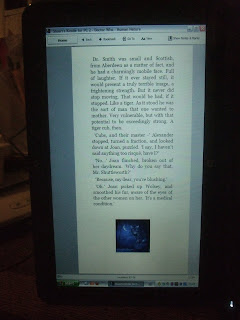
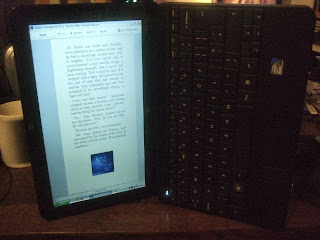
In case you're wondering, I'm not suddenly flush -- no real Kindle in my hands -- I've been reading them using the Kindle for PC desktop application on the netbook I bought with my Christmas present money, using the EeeRotate software to turn the screen image around and make it more book like:
Mobipocket's own website has 11653 free books available, many of which Amazon is charge two to five dollars for.
One byproduct of that is that Kindle users will be able to read four of the eBooks which turned up at the BBC's Doctor Who website earlier in the past decade 'reprinting' some of the old Virgin & BBC novels. Here's a list of what's available, followed by a direct link to Mobipocket file:
The Empire of Glass by Andy Lane [mobipocket]
The Sands of Time by Justin Richards [mobipocket]
Human Nature By Paul Cornell [mobipocket]
Nightshade by Mark Gatiss [mobipocket]
The other four, Scales of Injustice by Gary Russell, Well-Mannered War by Gareth Roberts, Lingbarrow by Marc Platt and The Dying Days by Lance Parkin haven't been converted sadly, but there are printable versions which you might be able to save as a text (.txt) file.
In case you're wondering, I'm not suddenly flush -- no real Kindle in my hands -- I've been reading them using the Kindle for PC desktop application on the netbook I bought with my Christmas present money, using the EeeRotate software to turn the screen image around and make it more book like:


Mobipocket's own website has 11653 free books available, many of which Amazon is charge two to five dollars for.
lifetimes
History With the sad death over the weekend of Harry Patch, the last surviving ‘Great’ War veteran, a vital link to that conflict has been lost. In November, for the first time there’ll no living survivors to remember their colleagues so it’s vitally important that we should be there for them, just as we should pay attention to the contribution made historically to any man or woman who has set their own safety aside to defend ours (and especially in wars which we might consider to be unjust because they were and are also brave enough to do their duty).
It’s through the longevity of these veterans that up until today we could still consider World War I as being within living memory. Patch was 111 when he died. Henry Allingham, who died last week, was 113. The oldest living person is Gertrude Baines of the United States, who was born on 6 April 1894 at 115 years old. She was born in the year Manchester City Football Club was formed, Blackpool Tower was opened, the International Olympic Committee was founded and William Kennedy Dickson received a patent for motion picture film.
As I wrote yesterday of how Elizabethan times can seem like a fictional realm and how seeing Robert Dudley’s tomb brought the period to life, I thought too about how, if you were to take people of great longevity into account, there aren’t that many lifetimes between now and then; that in her early life Gertrude would have been on the planet with someone who was born during the Napoleonic Wars and they in turn the Anglo-Spanish War. Today, with the aid of the Wikipedia, I think I’ve worked out that there are only five lives between us and somebody who could recall the Spanish Armada.
Gertrude Baines was born in was born April 6, 1894. Two months later Karl Eduard Zachariae von Lingenthal the eminent German jurist died, he was born on December 24, 1812 which was the death day of George Beck, American artist and poet. Beck was born in 1749 the year that Handel gave his first performance of Music for the Royal Fireworks. The Italian painter Giovanni Maria Galli da Bibiena died in that year. In 1656, the year of de Bibiena’s birth, Thomas Fincke the Danish mathematician and physicist perished. He was born in 1561.
Five lifetimes between us and someone who, if they’d left Denmark, could have watched a play at the Globe and for whom Shakespeare was a contemporary. Wow. Of course, though facts become murkier, you can continue even further backwards:
In the year that Finke was born, we find the funeral of Claude Garamond, the French publisher and designer of the famous typeface. He was born a whole twelve years before Christopher Columbus set sail for the Americas in 1480. Tristão Vaz Teixeira explorer (‘discovered’ the Madeira Islands) died that year and assuming he was born in 1395 (the wikipedia isn’t sure), it was at the same time John Barbour the Scottish poet left us. He originally joined us in 1320 when Ricold of Monte Croce, Italian Dominican missionary died. To close out the millennium:
Hōjō Yasutoki, regent of Japan (1183-1242)
William Fitz Robert, 2nd Earl of Gloucester (1116-1183)
Robert of Arbrissel, preacher (1045-1116)
Emperor Go-Suzaku of Japan (1009-1045)
Emperor Go-Suzaku born one thousand years ago. Thirteen lifetimes. There could even be less. The wikipedia only lists royals, artists, scientists and celebrities – for all we know there were people who simply worked hard and survive all of their lives whose births and deaths weren’t recorded. And, I’ve only created linkages through hatches and dispatches in the same year. With more time, a more complex hunt using a wider range of sources could narrow the gap even further too.
Thirteen lifetimes. A thousand years. Like I said, wow.
It’s through the longevity of these veterans that up until today we could still consider World War I as being within living memory. Patch was 111 when he died. Henry Allingham, who died last week, was 113. The oldest living person is Gertrude Baines of the United States, who was born on 6 April 1894 at 115 years old. She was born in the year Manchester City Football Club was formed, Blackpool Tower was opened, the International Olympic Committee was founded and William Kennedy Dickson received a patent for motion picture film.
As I wrote yesterday of how Elizabethan times can seem like a fictional realm and how seeing Robert Dudley’s tomb brought the period to life, I thought too about how, if you were to take people of great longevity into account, there aren’t that many lifetimes between now and then; that in her early life Gertrude would have been on the planet with someone who was born during the Napoleonic Wars and they in turn the Anglo-Spanish War. Today, with the aid of the Wikipedia, I think I’ve worked out that there are only five lives between us and somebody who could recall the Spanish Armada.
Gertrude Baines was born in was born April 6, 1894. Two months later Karl Eduard Zachariae von Lingenthal the eminent German jurist died, he was born on December 24, 1812 which was the death day of George Beck, American artist and poet. Beck was born in 1749 the year that Handel gave his first performance of Music for the Royal Fireworks. The Italian painter Giovanni Maria Galli da Bibiena died in that year. In 1656, the year of de Bibiena’s birth, Thomas Fincke the Danish mathematician and physicist perished. He was born in 1561.
Five lifetimes between us and someone who, if they’d left Denmark, could have watched a play at the Globe and for whom Shakespeare was a contemporary. Wow. Of course, though facts become murkier, you can continue even further backwards:
In the year that Finke was born, we find the funeral of Claude Garamond, the French publisher and designer of the famous typeface. He was born a whole twelve years before Christopher Columbus set sail for the Americas in 1480. Tristão Vaz Teixeira explorer (‘discovered’ the Madeira Islands) died that year and assuming he was born in 1395 (the wikipedia isn’t sure), it was at the same time John Barbour the Scottish poet left us. He originally joined us in 1320 when Ricold of Monte Croce, Italian Dominican missionary died. To close out the millennium:
Hōjō Yasutoki, regent of Japan (1183-1242)
William Fitz Robert, 2nd Earl of Gloucester (1116-1183)
Robert of Arbrissel, preacher (1045-1116)
Emperor Go-Suzaku of Japan (1009-1045)
Emperor Go-Suzaku born one thousand years ago. Thirteen lifetimes. There could even be less. The wikipedia only lists royals, artists, scientists and celebrities – for all we know there were people who simply worked hard and survive all of their lives whose births and deaths weren’t recorded. And, I’ve only created linkages through hatches and dispatches in the same year. With more time, a more complex hunt using a wider range of sources could narrow the gap even further too.
Thirteen lifetimes. A thousand years. Like I said, wow.
Some Spotify tips.
Music Spotify isn't very good at suggesting new music listening ideas yet. There are playlists and what have you but they only really tease out variations on the kind of thing you like, which doesn't really work if you tend to like everything. Here are some of the methods I've been using to find the surprising and unusual. Some Spotify tips.
Subscribe to music blogs and news feeds. As I said in my original article, Spotify adds an interactive option to reading about music on and off line -- you can now listen to it at the same time and unlike many of the services I talk about below, you're more likely to find ideas related to genres other than rock.
At lunch time today, The Guardian published this article about The Black Keys. Sure enough, here they are on Spotify. In the past I would have seen a post like that but might not have gone out of my way to hear the work itself. But I was listening to their new album in seconds. It's really rather good, even if or because the lead singer sounds a bit like Bono. It doesn't always work -- there's often a delay before new albums appear, so no The Airborne Toxic Event yet.
The Spotify Blog is much the same thing, but indicates when new music has definitely been uploaded and links directly to the album using a Spotify URL. Also, has links to other useful sources including Add To Spotify, a Digg-style suggestion engine reminding the creators of the application about omissions to their database and has a 'fixed page' for when a gap has been filled. Hello, the Sugababes's first and best album, One Touch, which has finally appeared.
This Twitter search for 'spotify' is often filled with people looking for invites and mentioning they've discovered the application. But keep an eye on the page and after a while you begin to notice users recommending music that they like and sometimes, musicians with Twitter feeds pointing to their albums, which is how I discovered Sofia Talvik's beautiful Blue Moon.
If you have a Twitter client, this becomes even easier and more social.

Tweetdeck has an option to set up a column based on a particular keyword search which then updates whenever it's mentioned somewhere in the network. This afternoon I added a search column for Spotify and watched the reviews and links flow upwards, even helping a new user to get to grips with the in-application recommendation engine. If it hadn't been for this I would never have heard Go Go Ninja Dinosaur and my day would have been a fraction less joyful.
As for playlists, Topsify generates links to various music charts which is like listening to a commercial radio station without the distraction of DJs. Listiply, Spotify Lists, Spotify Playlists and Spotylist collect user generated playlists which is about as hit and miss as you'd expect but there's often something good. Google Blog Search is similarly useful.
And don't forget the feeling listless soundtrack, my own playlist which I'm still constantly updating with new discoveries.
Subscribe to music blogs and news feeds. As I said in my original article, Spotify adds an interactive option to reading about music on and off line -- you can now listen to it at the same time and unlike many of the services I talk about below, you're more likely to find ideas related to genres other than rock.
At lunch time today, The Guardian published this article about The Black Keys. Sure enough, here they are on Spotify. In the past I would have seen a post like that but might not have gone out of my way to hear the work itself. But I was listening to their new album in seconds. It's really rather good, even if or because the lead singer sounds a bit like Bono. It doesn't always work -- there's often a delay before new albums appear, so no The Airborne Toxic Event yet.
The Spotify Blog is much the same thing, but indicates when new music has definitely been uploaded and links directly to the album using a Spotify URL. Also, has links to other useful sources including Add To Spotify, a Digg-style suggestion engine reminding the creators of the application about omissions to their database and has a 'fixed page' for when a gap has been filled. Hello, the Sugababes's first and best album, One Touch, which has finally appeared.
This Twitter search for 'spotify' is often filled with people looking for invites and mentioning they've discovered the application. But keep an eye on the page and after a while you begin to notice users recommending music that they like and sometimes, musicians with Twitter feeds pointing to their albums, which is how I discovered Sofia Talvik's beautiful Blue Moon.
If you have a Twitter client, this becomes even easier and more social.

Tweetdeck has an option to set up a column based on a particular keyword search which then updates whenever it's mentioned somewhere in the network. This afternoon I added a search column for Spotify and watched the reviews and links flow upwards, even helping a new user to get to grips with the in-application recommendation engine. If it hadn't been for this I would never have heard Go Go Ninja Dinosaur and my day would have been a fraction less joyful.
As for playlists, Topsify generates links to various music charts which is like listening to a commercial radio station without the distraction of DJs. Listiply, Spotify Lists, Spotify Playlists and Spotylist collect user generated playlists which is about as hit and miss as you'd expect but there's often something good. Google Blog Search is similarly useful.
And don't forget the feeling listless soundtrack, my own playlist which I'm still constantly updating with new discoveries.
Review 2008: George Lucas

Suggested by my friend Chris.
Dear George,
It’s been quite a year for the Star Wars franchise. Between Robot Chicken and Family Guy and YouTube, the parodies have come thick and fast. There was also The Clone Wars film and series which look very exciting though I’ve not watched neither, since it seemed a bit pointless seeing a pilot for a tv show on the big screen only to not be able to watch rest of it since Sky as usual have sewn up the domestic rights. I await the probable fifteen or so dvd releases with great interest.
The live action series seems to be moving on apace, as scripts are written, sets designed and not a public clue of what they’re going to be about, other than bridging the chronological gap between the two trilogies. Thinking big in terms of talent and asking the likes of Russell T Davies to write episodes is smart (even if he turned you down) and I’d like to think you’ve already also had Kevin Smith or Joss Whedon on the phone (even though they too may be busy).
This is all very exciting of course, but some of us Star Wars fans, the ones whose appreciation of the franchise begins and ends with the films would like something else. Something new. Something which completes the story you began in 1976, rather than filling in the gaps best covered by our imagination.
We want episodes VII, VIII and IX.
 As early as 1983 you were talking about seeing the Star Wars saga as three trilogies. A Time Magazine article describes the narrative road map for the prequels which you followed very closely (though there’s funnily enough, no mention of Jar-Jar) and a vague notion for these films. Time paraphrases what you must have said to them thus:
“Their main theme will be the necessity for moral choices and the wisdom needed to distinguish right from wrong. There was never any doubt in the films already made; in those the lines were sharply drawn, comic-book-style. Luke, who will then be the age Obi-Wan Kenobi is now, some place in his 60s, will reappear, and so will his friends, assuming that the creator decides to carry the epic further.”
Now I know that in May this year you told the LA Times that you now didn’t have any intention to extend the story, because “(the) movies were the story of Anakin Skywalker and Luke Skywalker, and when Luke saves the galaxy and redeems his father, that's where that story ends” but that doesn’t really explain the so called Expanded Universe, which does exactly that and which you’re so in favour of you’ve hired a guy to make sure that it’s all consistent and which began with Timothy Zahn’s trilogy of books which at the time were sold as the official trilogy to the films, even though ironically bits of them have become inconsistent (I read).
The Expanded Universe and your adherence to it could be a millstone. It’s certainly proving as much with this new animated series I hear, with the talk of setting up of various levels of canonicity and whatnot so that you can still make some things up as you go along, even if it doesn’t quite match a sentence written by an author on a deadline at three in the morning six years ago. With the films about as canon as Star Wars can be (even though you effectively changed the plot during the Darth calls the Emperor scene dvd version of Empire) there’s nothing to stop you making up some new story.
It’d be a narrative apocalypse of course and you’d certain piss off your base, who would suddenly discover that all those books and comics they’ve invested in have nothing to do with the film series. Talk about dividing loyalties. It’d be like a macrocosm of the Splinter Of The Mind’s Eye controversy after you’d decided that Luke and Leia were siblings, despite the palpable if a bit inappropriate sexual tension. No wonder you hired a guy. Then again, speaking as someone who’s fairly monogamous when it comes to sci-fi fandom, reading the online discussion would be fairly entertaining as the likes of MaceWindu421 finds themselves trying to get their head around hating a new big screen addition to their favourite franchise. It certainly was in 1999.
Such was the sigh of relief amongst Trekk(ers/ies) when the new writers of the new Star Trek prequel are explaining away the differences by creating an alternative timeline even though there’s been about five different first mission stories for the Enterprise across the books and comics. Transformers just keeps remaking itself, becoming consistently more rubbish as it goes along. Of course, the best model is Doctor Who were everything is canon no matter how inconsistent or rubbish it is, explained away by a pick and mix of the Time War, timey-wimey, or if you’re really old school the Faction Paradox (who eat continuity for lunch). Even when the new series destroyed Gallifrey for a second time having only just brought it back into existence in the books, some of us decided it was the same event viewed from different points of view.
Except none of that has to matter (pointless previous paragraph really) because the above quote from Time Magazine is consistent with what’s happening in that Expanded Universe as described in the Legacy of the Force books. My impression, based on a glance through a rather scary timeline at the Wookiepedia, is that having beaten the empire, the rebels, now a New Republic are put in the position of ruling the galaxy and find themselves in much the same position as their old enemy, having to make difficult choices which from a certain point of view could be considered evil and of the dark side, which ultimately becomes conceptually divisive as members of the Skywalker-Solo clan begin infighting.
In other words, it’s still about the warring family played out against an intergalactic backdrop. It’s not an appalling model. There’s a frightening amount of continuity to pull back, yet there’s still room for the original favourites to reappear and nothing to stop you reconfiguring the tale to their point of view. You’d keep your base happy with first official live action appearances for the likes of Mara Jade and the Solo-Skywalker clan and more importantly, with these progeny in the frame, you can keep the story at least as entertaining for teenagers or kids, with loads of action sequences and story beats for them to identify with as siblings go to war.
About the only potential Toydarian in the metachlorian is whether the original cast would even be interested, but that’s looked better than it has in years. Time said: “Hamill and the others will get first crack at the roles—if they look old enough.” And now they really do. You managed to talk Harrison into being Indiana Jones again, something which seemed highly unlikely for years. I think Mark would be up for it having consistently appeared in genre series since the original series and voice Luke in Robot Chicken and done Wing Commander in the past. You might even get Carrie – she’s still acting and has been back in the world lately with a new biography. And I assume everyone else is available – certainly they were for the prequels.
So what’s stopping you?
Stuart.
[Why am I doing this?]
Potential story idea for future episode of Doctor Who.
TV Potential story idea for future episode of Doctor Who. The Tardis drops through a dimensional rift and materialises in a reality, ours in fact, where he's the only fantasy element and becomes the saviour and the problem both at the same time as he tries to work out how to go home. In other words it's an early 60s historical style story set in contemporary Earth without any of the trappings of the Whoniverse: UNIT or Torchwood or the constant threat of alien invasion.
Subscribe to:
Posts (Atom)