Film The Bafta Nominations were announced a couple of days ago and as ever I've seen about two of the films on offer; as ever I offer no excuse for this other than the usual about how going t'cinema isn't what it used to be; and as ever I'm going to try and predict the winners sight unseen.
Best Film
Avatar
An Education
The Hurt Locker
Precious
Up in the Air
Avatar is receiving this year's innovation nomination and will probably win, but I think An Education may be a stalking horse -- only British film on the list and lots of good will.
Outstanding British Film
An Education
Fish Tank
In the Loop
Moon
Nowhere Boy
While Nowhere Boy had its moments, not least the near perfect rendition of the first handshake between John and Paul, as poisonous and cynical as it should have been, it didn't quite hold together for, though that could have been because it was depicting the places where I was born and brought up. In The Loop on the other hand didn't have that problem and was just about perfect. Perhaps I'll change my mind when Amazon send the copy of Moon I've just ordered.
Director
Kathryn Bigelow, The Hurt Locker
Neill Blomkamp, District 9
James Cameron, Avatar
Lone Scherfig, An Education
Quentin Tarantino, Inglourious Basterds
Probably James Cameron because in the back of the heads of the voters will be the fear that he's the new David Lean.
Actor
Jeff Bridges, Crazy Heart
George Clooney, Up in the Air
Colin Firth, A Single Man
Jeremy Renner, The Hurt Locker
Andy Serkis, Sex & Drugs & Rock & Roll
It'd be nice for Serkis to win an award for acting, even though his best work will never receive recognition because it's obscured by animation.
Actress
Carey Mulligan, An Education
Saoirse Ronan, The Lovely Bones
Gabourey Sidibe, Precious
Meryl Streep, Julie & Julia
Audrey Tautou, Coco Before Chanel
Carey Mulligan because I'm biased. This is the "Who's in it from Doctor Who?" category.
Supporting Actor
Alec Baldwin, It's Complicated
Christian McKay, Me and Orson Welles
Alfred Molina, An Education
Stanley Tucci, The Lovely Bones
Christoph Waltz, Inglourious Basterds
Christian McKay. His Welles is eerie.
Supporting Actress
Anne-Marie Duff, Nowhere Boy
Vera Farmiga, Up in the Air
Anna Kendrick, Up in the Air
Mo'Nique, Precious
Kristin Scott Thomas, Nowhere Boy
Presumably Mo'Nique will win this due to split voting. But my votes with Scott Thomas. Duff was spectacular as John's mother, but Kristen had to simultaneously be a dragon and also show that it's because she believes she's doing the best for her nephew. That's not easy but she carries it off with ease.
Original Screenplay
The Hangover
The Hurt Locker
Inglourious Basterds
A Serious Man
Up
It would be nice to see PiXAR win something for writing, confirming that the scripts above all others elements are what set their films apart from some other digimations (Monsters Vs Aliens).
Adapted Screenplay
District 9
An Education
In the Loop
Precious
Up in the Air
Well that's interesting. Presumably In The Loop is in there because it's the film version of The Thick Of It, which isn't the same as turning out a version of a novel, it's still an all new narrative and it was mostly new characters.
Film not in the English Language
Broken Embraces
Coco Before Chanel
Let the Right One In
A Prophet
The White Ribbon
"Clearly Let the Right One In" as Mark Kermode might say.
Animated Film
Coraline
Fantastic Mr Fox
Up
Up will win this presumably.
Cinematography
Avatar
District 9
The Hurt Locker
Inglourious Basterds
The Road
As you know I recently finished reading a book on film style in which David Bordwell spends pages describing the meticulous processes of directors and cinematographers in creating shots which combine storytelling and giving the actor room to work. I do wonder about the validity of this category when its nominating films were the shot length is less than a nanosecond. The Road on the basis that its bound to have lots of long shots.
Costume Design
Bright Star
Coco Before Chanel
An Education
A Single Man
The Young Victoria
I've always thought that like screenplays, the costume design category should be split into two, encompassing work that is truly new designs -- fantasy and sci-fi -- and adapted fashions of the kind we see here.
Editing
Avatar
District 9
The Hurt Locker
Inglourious Basterds
Up in the Air
Why does Up in the Air merit an editing nomination and not The Road. I'm intrigued.
Make-Up & Hair
Coco Before Chanel
An Education
The Imaginarium of Doctor Parnassus
Nine
The Young Victoria
I refer you to my comments on costume, although I suppose in both cases the award is also being given for the accuracy of the recreations.
Music
Avatar
Crazy Heart
Fantastic Mr Fox
Sex & Drugs & Rock & Roll
Up
Is this original music?
Production Design
Avatar
District 9
Harry Potter and the Half-Blood Prince
The Imaginarium of Doctor Parnassus
Inglourious Basterds
Avatar's going to romp through the technical categories; The Imaginarium of Doctor Parnassus doesn't really compare -- budget cuts led to the effects looking charmingly unfinished.
Sound
Avatar
District 9
The Hurt Locker
Star Trek
Up
Just for recreating then developing the soundscape of my youth.
Visual Effects
Avatar
District 9
Harry Potter and the Half-Blood Prince
The Hurt Locker
Star Trek
Obviously.
Short Animation
The Gruffalo
The Happy Duckling
Mother of Many
... because of the infectious excitement from Polly Hill, the Head of Independent Drama for BBC England, at the panel yesterday. This was her commission and she was very proud of it.
Short Film
14
I Do Air
Jade
Mixtape
Off Season
Outstanding Debut by a British Writer, Director or Producer
Lucy Bailey, Andrew Thompson, Elizabeth Morgan Hemlock, David Pearson (directors/producers, Mugabe and the White African)
Eran Creevy (writer-director, Shifty)
Stuart Hazeldine (writer-director, Exam)
Duncan Jones (director, Moon)
Sam Taylor-Wood (director, Nowhere Boy)
Duncan Jones and Sam Taylor-Wood are already known for other things and that might count against them.
Orange Rising Star Award
Jesse Eisenberg
Nicholas Hoult
Carey Mulligan
Tahar Rahim
Kristen Stewart
Remember the collective audible sigh in the auditorium when Shia LaBeouf won this in 2008? Since this is a public vote and Twiglet is still huge, Kristen Stewart would seem like the equivalent this year. But it should be Carey Mulligan. Vote here, vote now.

Review: BBC Drama panel at FACT Liverpool

TV Regular readers to this blog will know that I have a couple of running, not so much, themes, but subjects which I keep returning to, one of which is the lack of theatre on television. The epicentre of my argument is this post from the bottom end of last year in which I took the BBC’s controller of Drama Commissioning, Ben Stephenson, to task regarding his attitude to the presentation of theatre on television. My argument was that there’s a certain double standards at play in that classical music and opera and range of other art forms are given space to present their wares on television, but theatre and more specifically classical theatre is ghettoised to radio.
Despite having written this blog for nearly nine years, it’s not often I’ve been able to put any of this rubbish to the person I’m addressing. But that’s exactly what happened this lunch time as Stephenson appeared with members of BBC Drama commissioning at a Northwest Vision & Media panel in The Box at FACT Liverpool. Also turning out were Polly Hill the Head of Independent Drama for BBC England, Hilary Martin the Executive Producer for Drama North and the event was chaired by Kate Rowland, the BBC’s Creative Director of New Writing, and yes, for what seemed like an age I was able to ask Stephenson directly about his attitude to theatre on television. But more on that in a moment.
I wanted to attend because these kinds of events usually seem to happen elsewhere in the North and it was quite novel to see something available locally. Pitching up at FACT I was given a label with my name on it and a delegate list. During sign up I was asked to give a job title; I couldn't very well give my real one because it's not particularly relevant so I put 'blogger' and sure enough there it was at the bottom of the list below all the producers, writers, investment co-ordinators, costume assistants and heads of film. Sadly, they neglected to also put 'feeling listless' as my company name. Probably wise.
I’m also very passionate about the BBC and genuinely believe that they do produce some of the best television in the world and I’m excited by the drama which is appearing in the upcoming season that appears in the following showreel, which was shown at the top of Stephenson’s presentation.
It’s very easy to reduce the BBC to its returning dramas, and become annoyed because it seems like they’re not taking risks, but as Stephenson pointed out, none of the other channels are coming close to trying anything on the scale of what BBC Drama accomplishes. ITV1's all about crime drama, Channel 4 is concentrating on returning titles (Shameless) and youth dramas with some success (Skins, Misfits), Sky are doing bits and pieces mostly fantasy (Discworld, Skellig). The BBC does all of that and more, much more.
Stephenson began by offering a few statistics. BBC Drama has a budget of around two hundred million pounds, seventy percent of which is spent on post-watershed content. Last year they produced four hundred and fifty hours of television including thirty nine new titles and twenty-two returning series (twenty eight from independent producers, the rest in house from Manchester, Wales, Scotland and Northern Island) employing over three hundred writers. His pitch is that he aims to offer a creative environment that attracts the best writers, the best work with no commercial pressures and to offer a schedule of range and diversity for a number of different audiences which won’t necessarily like everything which is produced.
He then defined their perception of the kind of drama which should be appearing on each of the channels. BBC One aims to offer "stories for and about the audience" stretching from high concept populist fare (Ashes to Ashes, Doctor Who) to social conscience (Small Island, Occupation). He recognises that they had “taken (their) eye of the ball” with BBC Two but cope to make it the “drama connoisseur’s destination” with “intelligent, compulsive serial drama”. BBC Three should have grown-up, singularly imaginative work and BBC Four is reduced to “stories of the past from an acute angle” through single dramas at 9pm. In terms of serials, BBC Drama focuses on hours, with BBC Comedy on half hours though they are considering some half hour shows for the 10pm pre-Newsnight slot.
The overall impression I got, from the presentation and subsequent question and answer session, was that after a few years in which drama commission was fairly wishy-washy about what it was trying to do, Stephenson has attempted to snap the focus back into place. Essentially BBC Drama has found itself in a paradoxical situation. On the one hand it does not have a commercial imperative and so can and should spread out and speak to a range of audiences and create challenging drama. But it has to do that on an ever decreasing budget (apparently they have to reduce the cost of an hour’s programming by ten percent over the next five years) with “content” which attracts as large an audience as possible. Challenging drama and big audiences are not a natural fit.
The approach they’re taking, and this is particular demonstrated in the show real, is to take a well established genre (soaps, the detective drama, fantasy, the bio-pic) and then almost smuggle in the “challenging” material – go at it from an unusual angle. The examples Stephenson offered were the gay muslim wedding storyline in Eastenders or the recent dramas about prominent women in BBC Four which looked at a particular aspect of their lives rather than just offering a straight bio-pic structure. Then on top of that take definite risks just to see what happens, the exampled I'd suggest (of course) being Torchwood: Children of Earth, a five part sci-fi drama stripped across a week which turned out to be one of the best dramas of last year (for the six million of us who watched it every night).
As a result, those in the room who in the past had clearly had very negative experiences in attempting to get work commissioned at the BBC gradually sounded more hopeful and agreeable about this new regime. Polly Hill said that all of the work she’d had in development that she subsequently offered to Ben was commissioned. Stephenson admitted that he didn’t care whose name was on the script so long as it was good and that he was less interested in whether someone had a track record, rather that they had the ability to complete and turn in whatever they’d been commissioned to write. A couple of the delegates still registered a bit of cynicism about that (one using an increasing esoteric art gallery metaphor) suggesting that Paul Abbot or Jimmy McGovern (Picasso and that crowd) would automatically be looked at above some just starting out but as the whole panel noted, the reason that happens is because they’re consistently producing high quality material and ideas that people want to watch.
I suppose there are some who look back at the so-called “golden age” when work was commissioned for predertimed timeslots by producers within the BBC and to an extent whatever Dennis Potter or Alan Bennett wrote would be produced and, especially on BBC Two, there seemed to be more latitude for presenting avant-gardist material effectively on a whim. But that was a different market; with less channels people were more likely to try something new because there wasn’t much of an alternative. Now, with multi-channel television and the other entertainment streams, people have a much greater choice and it’s questionable whether even someone who has less mainstream tastes would want to spend half an hour watching someone hurl a cat around a room or whatever else Arena was doing that week. There are too many hours in the day.
With all of that ringing in my ears I half put my hand up then realised I was being called upon. I genuinely hadn’t gone with an agenda, and wasn’t going to ask anything if the conversation wasn’t going that direction. But they’d talked about adaptations and commissioning existing properties so it seemed in keeping with the flow of the session. I essentially asked why with the rich history that television has with theatre and considering that classical music and opera are given a big shop window why more theatre isn’t shown on television. I even paraphrased back to him what he’d said at the NFT [reported here] about theatre not being visually interesting and that he it would have to be abbreviated considerably in order to work on television. After I’d begun, I was surprisingly lacking in nerves and gained in confidence as our conversation continued.
What he said was very surprising. He said that the problem was that theatre wasn't being pitched properly to them. They only received four theatre related pitches last year and he commissioned three of them – Tennant in Hamlet, Patrick Stewart in Macbeth and A Passionate Woman (Kay Mellor’s 90s play). He said that if people want to pitch theatre, it isn’t a closed shop, the idea just has to be good. He said he was just concerned that the kind of theatre he knew I was talking about wouldn’t get a large audience. He mentioned that the NFT is filming productions, which I seized upon and wondered why they couldn’t just buy those in, and he said, and I hadn’t heard this before, “we’ve had a conversation” but that the problem as ever was about money, should they buy in five of the NFT’s productions or make a drama about Enid Blyton?
And you know what I thought, after all my windbagging here when faced with that stark choice? Fair enough. The Blyton drama brought BBC Four its biggest audience in a good long while, it shifted the channel to even greater mainstream attention and I would suspect was one of the reasons that Mark Thompson has had a bit of u-turn in his decision to drop the channel or merge it with BBC Two after digital switch over. But it’s entirely apparent that two hundred million pounds in today’s production market isn’t a lot of money. Much as I think BBC Four would benefit from a weekly or monthly Sunday night slot showing the best of west end or regional theatre, it’s worth asking whether the potential audience in cost terms would justify it.
Plus, I don’t know what kind of money is involved. It’s all very well for Helen Mirren to appear in Phedre at the NT, but her salary is bound to be less than she might receive for some television or film work. The extent to which she and the other actors would be compensated if that production passed to television is something of a grey area; wouldn’t her agent, quite rightly expect her to have an increase and could the BBC justify that if it was for something which may only attract half a million viewers? If sorting this out retrospectively is a mess, adding it to the initial theatre contract makes that whole process even more complex and enters the realm of creating film like contracts for theatre productions which include the secondary rights and residuals which weren’t necessarily considered before.
So really, looking at this from a business rather than artistic point of view the non-appearance of theatre makes perfect sense and in fact it’s not necessarily Ben Stephenson and BBC Drama’s fault; it’s just that they’re caught in the centre of the previously discussed paradox, challenging tv attracting as large an audience as possible. Plus there is room for some hope. Stephenson said that he’ll more often than not commission something even if it isn’t to his taste because a producer is very passionate about it which suggests that although he doesn’t seem to be a fan of classical theatre he will look at a proposal if it's interesting enough. That two Shakespeares have been commissioned in the middle of these circumstances (however populist the choices and casting) demonstrates that quite rightly this isn’t a definite no (we may yet see Dr Faustus).
“I’d like to say yes to everything. I hate saying no.” He said, and I believed him.
None of which excuses or explains the commissioning and production of Paradox. But as he reminded us over and over again, you really can't always please everyone. Or in that case anyone.
Film Trailer: Necrosis
Film
Oh Tiffany. Oh Ando. Oh that bald actor who played an Admiral in the Star Trek: The Next Generation episode Conspiracy ...
Oh Tiffany. Oh Ando. Oh that bald actor who played an Admiral in the Star Trek: The Next Generation episode Conspiracy ...
miniblog archive
The Wire.
TV Much the same as everyone else, I rarely manage to keep to new year’s resolutions mainly because they’re general, unachievable challenges that in retrospect looked entirely foolhardy. So this year I decided to set myself a goal that wasn’t just achievable but which circumstance made easy.
Watch The Wire.
Which with the aid of the big freeze/cold snap, prolonged break from work over Christmas (and the usual media led order not to go out unless it’s completely necessary), meant that once I’d started on the 1st January, I was (to paraphrase the lyrics in the title music) in the hole of Baltimore non-stop for sixteen days, averaging 3.75 episodes a day. Which on reflection looks positively leisurely.
This seems to be the best way to experience the series. Watching week to week, year to year, the power of some of writer/creator David Simon’s thematic interconnections and the point he’s making about the cyclical nature of the broken society couldn’t be quite as strong. It's might also why I've felt depressed and despondent since Christmas -- so admittedly I always feel depressed and despondent after Christmas.
Reducing the show to these brief comments seems like an exercise in futility, not least because so much has been written about the programme in the past decade. I’m oddly muted in fact, in that way that usually happens when I’ve found something so profoundly moving, interesting and, well, perfect that talking about it has the potential to diminish it somehow. See also my reviews of an average Steven Moffat episode of Doctor Who (not that there is such a thing).
So I’m going to simply focus on a single character in the final series and this where you have to stop reading if you don’t want to be spoiled. Right here.
The Wire isn't a typical police series -- it's not even a typical television series. It's a soap opera for people who don't like soap operas, but unlike soap operas, the story is bigger than the characters, Simon's thematic concerns scrawled in big letters across his scripts rather than smuggled in between a diet of arguments, disaster and sex (though there's plenty of that too).
McNulty is the character who best demonstrates that Simon isn’t interested in making a traditional series. As written in the first few series, McNulty is a fairly standard “lead” character, the loveable anti-establishment rogue who breaks all the rules. Some of the most memorable scenes feature McNulty swearing or getting drunk or both, along with his homicide partner Bunk. Example:
Then in the fourth season, having cleaned up his act, he all but disappears from the story, having shifted departments to become a uniformed foot soldier. As far as I can tell it’s not because Dominic West was particularly busy, it’s simply because Simon had other interests, wanting to focus on Balitimore politics and the school system instead.
There can’t be many series that would sideline its audience connection character quite so readily and so well and indeed there’s no chance that this would have happened on US network television. 24’s Jack Bauer doesn't sod off for episodes at a time, even if he’s travelling halfway across the country. But in the environs of HBO, Simon had the latitude for this.
And when McNulty returns as a leading character for the final season, he’s back to his old ways, drinking and swearing. but the system has forced him to do unspeakable acts - fabricating evidence in order to manufacture a serial killer, which has ramifications that effect all of the other characters. The elements which made the character so likeable in the first three years are twisted slightly so that they become repellent.
Initially it’s an emotional wrench, and feels like betrayal of the character. The fifth season is often criticised as the moment when The Wire went off the boil and I initially compared it to the fifth season of The West Wing and Season Six of Buffy: The Vampire Slayer. In those series, well loved characters were clearly being misunderstood by new writers (John Wells & Marti Noxon), the magic of each series falling into a hole.
Except with the novelistic nature of the series it becomes apparent that McNulty has been pushed into a corner by the system and that he’s doing some very bad things for the best of reasons, manipulating the media’s obsession with sensationalism for his own ends. Simon engages Lester, the wise “father figure” as the partner in crime which somehow makes the unconscionable palatable and eventually bloody heroic.
At that point we can step out of the story and notice that Simon’s demonstrating that dozens and dozens of people die in the city every day because of systemic problems but the media doesn’t care – to them there is such a thing as mundane homicide; when multiple murderer Omar, a major figure in the community and the show is finally offed, his death doesn’t even merit a couple of sentences in the local paper, not deemed newsworthy enough by the editor.
Which means that somehow, even though we know that what McNulty’s doing is erroneous, we don’t want him to be discovered, we want his subterfuge to continue, eventually we’re even, like Lester, trying to think of new ways he can develop bogus evidence – or is that just me? We’re even desperate for his colleague Kima not to rat him out before the illegal wire taps reveal their evidence.
Reading back through those paragraphs I can tell that I’ve failed to really capture the complexity of what Simon’s achieved, perhaps because of the speed with which I watched the series, perhaps because it really is a series to be experienced rather than written about, infinitely complex and dead simple at the same time.
I'll get back to you after I've watched it again.
Watch The Wire.
Which with the aid of the big freeze/cold snap, prolonged break from work over Christmas (and the usual media led order not to go out unless it’s completely necessary), meant that once I’d started on the 1st January, I was (to paraphrase the lyrics in the title music) in the hole of Baltimore non-stop for sixteen days, averaging 3.75 episodes a day. Which on reflection looks positively leisurely.
This seems to be the best way to experience the series. Watching week to week, year to year, the power of some of writer/creator David Simon’s thematic interconnections and the point he’s making about the cyclical nature of the broken society couldn’t be quite as strong. It's might also why I've felt depressed and despondent since Christmas -- so admittedly I always feel depressed and despondent after Christmas.
Reducing the show to these brief comments seems like an exercise in futility, not least because so much has been written about the programme in the past decade. I’m oddly muted in fact, in that way that usually happens when I’ve found something so profoundly moving, interesting and, well, perfect that talking about it has the potential to diminish it somehow. See also my reviews of an average Steven Moffat episode of Doctor Who (not that there is such a thing).
So I’m going to simply focus on a single character in the final series and this where you have to stop reading if you don’t want to be spoiled. Right here.
The Wire isn't a typical police series -- it's not even a typical television series. It's a soap opera for people who don't like soap operas, but unlike soap operas, the story is bigger than the characters, Simon's thematic concerns scrawled in big letters across his scripts rather than smuggled in between a diet of arguments, disaster and sex (though there's plenty of that too).
McNulty is the character who best demonstrates that Simon isn’t interested in making a traditional series. As written in the first few series, McNulty is a fairly standard “lead” character, the loveable anti-establishment rogue who breaks all the rules. Some of the most memorable scenes feature McNulty swearing or getting drunk or both, along with his homicide partner Bunk. Example:
Then in the fourth season, having cleaned up his act, he all but disappears from the story, having shifted departments to become a uniformed foot soldier. As far as I can tell it’s not because Dominic West was particularly busy, it’s simply because Simon had other interests, wanting to focus on Balitimore politics and the school system instead.
There can’t be many series that would sideline its audience connection character quite so readily and so well and indeed there’s no chance that this would have happened on US network television. 24’s Jack Bauer doesn't sod off for episodes at a time, even if he’s travelling halfway across the country. But in the environs of HBO, Simon had the latitude for this.
And when McNulty returns as a leading character for the final season, he’s back to his old ways, drinking and swearing. but the system has forced him to do unspeakable acts - fabricating evidence in order to manufacture a serial killer, which has ramifications that effect all of the other characters. The elements which made the character so likeable in the first three years are twisted slightly so that they become repellent.
Initially it’s an emotional wrench, and feels like betrayal of the character. The fifth season is often criticised as the moment when The Wire went off the boil and I initially compared it to the fifth season of The West Wing and Season Six of Buffy: The Vampire Slayer. In those series, well loved characters were clearly being misunderstood by new writers (John Wells & Marti Noxon), the magic of each series falling into a hole.
Except with the novelistic nature of the series it becomes apparent that McNulty has been pushed into a corner by the system and that he’s doing some very bad things for the best of reasons, manipulating the media’s obsession with sensationalism for his own ends. Simon engages Lester, the wise “father figure” as the partner in crime which somehow makes the unconscionable palatable and eventually bloody heroic.
At that point we can step out of the story and notice that Simon’s demonstrating that dozens and dozens of people die in the city every day because of systemic problems but the media doesn’t care – to them there is such a thing as mundane homicide; when multiple murderer Omar, a major figure in the community and the show is finally offed, his death doesn’t even merit a couple of sentences in the local paper, not deemed newsworthy enough by the editor.
Which means that somehow, even though we know that what McNulty’s doing is erroneous, we don’t want him to be discovered, we want his subterfuge to continue, eventually we’re even, like Lester, trying to think of new ways he can develop bogus evidence – or is that just me? We’re even desperate for his colleague Kima not to rat him out before the illegal wire taps reveal their evidence.
Reading back through those paragraphs I can tell that I’ve failed to really capture the complexity of what Simon’s achieved, perhaps because of the speed with which I watched the series, perhaps because it really is a series to be experienced rather than written about, infinitely complex and dead simple at the same time.
I'll get back to you after I've watched it again.
Torchwood USA.
TV I meant to write about The Wire tonight but there’s a Who fanpocalypse happening online prompted by a post at the Hollywood Reporter about a US BBC/Fox co-production version of Torchwood (with some random speculation at the bottom about a Doctor Who remake).
The article (which has been digitally remumbled at The Guardian) is unsourced. There are lots of “are”s and “will”s but nothing in the way of “says” or “has announced”. The writer doesn’t say where he got the story from and there isn’t a quote from anyone involved to verify or deny anything. How does he know the original production team are involved?
Which isn’t to say it isn’t happening. Last November, John Barrowman said that there was going to be a fourth series with a full thirteen episodes. At the time, there was some scepticism as to whether the BBC could even afford to fund that these days, and there were a few non-denial denials, thrown about by the corporation’s press office.
Barrowman could have been referring to this which would suggest this isn’t a remake but a US-backed continuation. Since the lead time on this would have had to have been fairly long it would explain why Russell T Davies, Julie Gardener et al up sticks to work out of the US. And why there was a certain semi-colon nature to the storytelling at the close of Children of Earth, with Ianto dead, Gwen pregnant and Jack put back in a sulk.
A continuation could play the nuWho game of being a remake & continuation. Captain Jack returns to Earth but having burnt his bridges in the UK decides to give the US a try and opens up Torchwood: Chicago or Miami or LA or New York or whatever. Perfect jumping in point for new viewers – who is this mysterious indestructible man? That’s the version I’d prefer. RTD doesn’t strike me as someone who’d want to do the same thing over again. Why start again when you can build on what you’ve already accomplished albeit in a new setting with a different set of characters.
Especially since you then have to consider exactly what Torchwood is. Davies had the original idea for the series long before he brought Doctor Who back. Then it was called Excalibur and was roughly the same show – Who simply gave him a predetermined canvas to work in. He could simply go back to those original notes and create something which isn’t saddled with Doctor Who’s continuity. Though clearly there’s an element of wondering what the point of that would be.
As for Doctor Who USA: it’s been mooted before. It’s happened before. It’s not a horrible idea. The trick would be to replicate the methodology of the first 2005 series of keeping the mythology on the back burner until the character has bedded in and been accepted. The mistake the TV movie made was not to telling the whole story from Grace’s point of view and essentially remaking the film Star Man. It would be another new continuation and not simply a remake of that first series – it’d be up to fans to decide where it fits within the mythology.
The article (which has been digitally remumbled at The Guardian) is unsourced. There are lots of “are”s and “will”s but nothing in the way of “says” or “has announced”. The writer doesn’t say where he got the story from and there isn’t a quote from anyone involved to verify or deny anything. How does he know the original production team are involved?
Which isn’t to say it isn’t happening. Last November, John Barrowman said that there was going to be a fourth series with a full thirteen episodes. At the time, there was some scepticism as to whether the BBC could even afford to fund that these days, and there were a few non-denial denials, thrown about by the corporation’s press office.
Barrowman could have been referring to this which would suggest this isn’t a remake but a US-backed continuation. Since the lead time on this would have had to have been fairly long it would explain why Russell T Davies, Julie Gardener et al up sticks to work out of the US. And why there was a certain semi-colon nature to the storytelling at the close of Children of Earth, with Ianto dead, Gwen pregnant and Jack put back in a sulk.
A continuation could play the nuWho game of being a remake & continuation. Captain Jack returns to Earth but having burnt his bridges in the UK decides to give the US a try and opens up Torchwood: Chicago or Miami or LA or New York or whatever. Perfect jumping in point for new viewers – who is this mysterious indestructible man? That’s the version I’d prefer. RTD doesn’t strike me as someone who’d want to do the same thing over again. Why start again when you can build on what you’ve already accomplished albeit in a new setting with a different set of characters.
Especially since you then have to consider exactly what Torchwood is. Davies had the original idea for the series long before he brought Doctor Who back. Then it was called Excalibur and was roughly the same show – Who simply gave him a predetermined canvas to work in. He could simply go back to those original notes and create something which isn’t saddled with Doctor Who’s continuity. Though clearly there’s an element of wondering what the point of that would be.
As for Doctor Who USA: it’s been mooted before. It’s happened before. It’s not a horrible idea. The trick would be to replicate the methodology of the first 2005 series of keeping the mythology on the back burner until the character has bedded in and been accepted. The mistake the TV movie made was not to telling the whole story from Grace’s point of view and essentially remaking the film Star Man. It would be another new continuation and not simply a remake of that first series – it’d be up to fans to decide where it fits within the mythology.
miniblog archive
'reprinting' some of the old Virgin & BBC novels
Books A comment in this post about marketing for the Amazon Kindle has led me to discovery that might be useful to someone who shares my lifestyle. It transpires that the Kindle isn't just locked into Kindlese and will quite happily cater for the MobiPocket format.
One byproduct of that is that Kindle users will be able to read four of the eBooks which turned up at the BBC's Doctor Who website earlier in the past decade 'reprinting' some of the old Virgin & BBC novels. Here's a list of what's available, followed by a direct link to Mobipocket file:
The Empire of Glass by Andy Lane [mobipocket]
The Sands of Time by Justin Richards [mobipocket]
Human Nature By Paul Cornell [mobipocket]
Nightshade by Mark Gatiss [mobipocket]
The other four, Scales of Injustice by Gary Russell, Well-Mannered War by Gareth Roberts, Lingbarrow by Marc Platt and The Dying Days by Lance Parkin haven't been converted sadly, but there are printable versions which you might be able to save as a text (.txt) file.
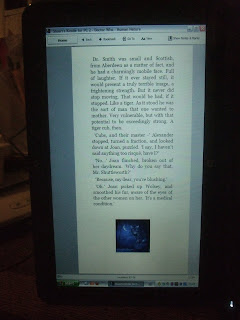
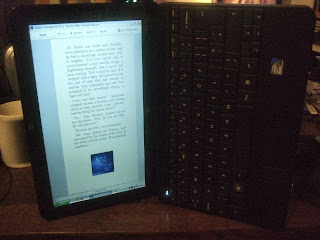
In case you're wondering, I'm not suddenly flush -- no real Kindle in my hands -- I've been reading them using the Kindle for PC desktop application on the netbook I bought with my Christmas present money, using the EeeRotate software to turn the screen image around and make it more book like:
Mobipocket's own website has 11653 free books available, many of which Amazon is charge two to five dollars for.
One byproduct of that is that Kindle users will be able to read four of the eBooks which turned up at the BBC's Doctor Who website earlier in the past decade 'reprinting' some of the old Virgin & BBC novels. Here's a list of what's available, followed by a direct link to Mobipocket file:
The Empire of Glass by Andy Lane [mobipocket]
The Sands of Time by Justin Richards [mobipocket]
Human Nature By Paul Cornell [mobipocket]
Nightshade by Mark Gatiss [mobipocket]
The other four, Scales of Injustice by Gary Russell, Well-Mannered War by Gareth Roberts, Lingbarrow by Marc Platt and The Dying Days by Lance Parkin haven't been converted sadly, but there are printable versions which you might be able to save as a text (.txt) file.
In case you're wondering, I'm not suddenly flush -- no real Kindle in my hands -- I've been reading them using the Kindle for PC desktop application on the netbook I bought with my Christmas present money, using the EeeRotate software to turn the screen image around and make it more book like:


Mobipocket's own website has 11653 free books available, many of which Amazon is charge two to five dollars for.
fallen into obscurity
Music Bach's Cello Suites had fallen into obscurity until a teenager stumbled upon an early printing in a second hand shop:
"For those musicians who knew of them, the Cello Suites were considered dry, technical exercises, of some pedagogical value, but not fit for the concert hall. When Casals started figuring out the music he didn't have a model. He had to reinvent the music, because the autograph manuscript had gone missing and the few copies that survived differ in details. We still don't know what Bach had in mind for tempo, dynamics, bowing or styles of play. The sheet music, as a result, comes with poetic licence attached."The recordings that Casals finally made of the suites in the mid-30s (mentioned in the article) are available on Spotify.
a modern Dickensian fable

Books I’m currently reading John Grisham’s 2001 novel(la?) Skipping Christmas. It’s a modern Dickensian fable about a couple who decide, since their daughter is away for the first time, to save the money they would have spent on the festive season and go on a cruise instead. No tree, no parties, no presents, nothing. Their friends and neighbours are incredulous. Christmas in this community is like an eco-system. Because the Kranks aren’t celebrating, it just isn't the same. They won’t be putting a competition snowman on their roof, they won’t be buying the charity calendars and cards and … I’ve reached page eighty so far so can’t tell you what happens next, though it can’t be good. Thematically it’s similar to an education drama from the 90s about tenants in a Liverpool terrace who refused to paint their house pink and they were run out of town.
The problem is, and if the surname of the protagonists in that paragraph hasn’t tipped you off, Grisham’s novel(la?) has been adapted into a film, the slightly more obviously titled Christmas With The Kranks, which since it’s a Christmas movie featuring Tim Allen I’d avoided like an office party. But as soon as I saw that surname, I realised the connection and suddenly my enjoyment was diminished because despite only having seen the poster and the shots which appeared in the advert which was playing on Channel Five for the past two months, the embryonic version of those characters I had in my head have now been replaced by Tim Allen and Jamie Lee Curtis and there’s an ever present nagging calculation of how each scene appeared in the film (which given the cast and pedigree couldn’t have been subtle).
This was one of the reasons I stopped reading fiction. Most best selling books have been turned into films and from experience unless they're significantly different entities it's almost impossible to psychologically divorce the two. No matter how vivid an author’s characterisation, actor who last portayed the character on-screen becomes the avatar within the imagination. Reading High Fidelity, despite the change in location from book to film, it was almost impossible not to see John Cusack walking about in those pages. Similarly for quite some time, until I watched the film again much later on dvd, there were scenes from the book which I’d somehow decided were also in Stephen Friers’ adaptation. Eventually I decided to simply just wait for the film to come out, over and over again, so that I wouldn’t be shackled with making a comparison between the two.
When you picked up Pride & Prejudice did you find yourself casting Lizzie Bennet? Was she played by Gemma Arterton, Keira Knightly, Jennifer Ehle, Elizabeth Garvie or Greer Garson or another actress who’s yet to swoon over Mr Darcy? Or were you able to set aside the images and let your imagination and Jane Austen’s words take control? I do think this matters. Unlike films and television, books have a singular authorial voice. True, arguably it becomes a collaboration when the words reach our imagination and there will have been interventions at some point in the process from agents, editors and publishers and in some cases franchise collaborators, but most literature offers a world that should exist outside in and of itself. When it hits another medium it’s changed, especially if we see that first (or in the case of Skipping Christmas, a shard of it), the author's intention irrevocably interfered with.
I’d welcome the advise of people who are much more widely read than I am on how they cope with returning the communication to one that's just between them and the author.
Interview: Louise Ferguson of the Crystal Palace Picture Palace Campaign

Film From the early to mid part of last century, every main street it seems, in city centres and suburbs, had a cinema, huge, beautiful edifaces, where people loved and lost off screen and on. Then television became the cheaper alternative with life's challenges played out in the living room instead.
By the sixties and seventies most picture houses closed and had either fallen derelict or been converted to clubs, bars or bingo halls, leaving many areas without a local cinema. Crystal Palace is such an area and The Rialto is just such a building.
After many years as a bingo hall could potentially become a cinema again. City Screen, the company that also owns Picturehouse at FACT, are interested but were recently outbid by the Kingsway International Christian Centre who want to transform it into a church.
The Picture Palace Campaign doesn't want that to happen. Crystal Palace is without a cinema, and this site offers the perfect opportunity for that to happen. I was contacted recently to ask if I'd offer my support, which I'm pleased to, and I thought the best way for you to hear about it was through the words of the campaigners.
Me: Tell us about the campaign.
Louise: This campaign has some history. It’s not just about providing a cinema now, or opposing a church.
A few years ago, a property developer attempted get a complex built on the local green space Crystal Palace Park; the proposal included a chain multiplex, and the plan was opposed by the local community, who clearly wanted a cinema, but not some antiseptic warehouse-style venue built on our local green lung. Who wants their lovely local park covered in concrete and car parks?
City Screen – which owns the PictureHouse cinemas – had in the meantime been trying to acquire the old Rialto cinema on the Crystal Palace Triangle for some five years, but each time the licence came up for renewal with the council, Gala Bingo said they were going to continue with their operation. And so things continued until summer 2009, when Gala suddenly decided to call it a day, owing to financial problems at the company, and put this and other cinemas up for sale. There were sealed bids, not all bidders had access to the building to assess its value, and suddenly the building belonged to a prosperity gospel church planning on bringing its televangelist-style ministry to our neighbourhood.
The former cinema – which opened in 1928 with Dolores Del Rio in Ramona and operated as a cinema until 1968, with Marlon Brando in Reflections in a Golden Eye and Patrick O’Neill in Assignment to Kill - maybe doesn’t have the architectural merit of some of those early picture palaces, but it is in reasonable condition, while cinema and the moving image do have a considerable history here in Crystal Palace. I was astonished to find out that there had been at various times been four cinemas in different parts of the Palace Triangle.
There’s a history of film-making here too: John Logie Baird had a long connection with the area, living nearby at Sydenham Hill while he set up and operated the world's first major broadcasting complex at Crystal Palace; and there was a local movie studio run by J Arthur Rank. And in the not so distant past, film director Ken Russell lived just a few doors down from the Rialto building on Church Road… and the Palace transmitter features in films such as The Italian Job. So you could say there has been a close and productive relationship between film and Crystal Palace for decades.
The campaign is really about restoring some of what we had. The Cinema Theatres Association agrees with us that there’s a lack of cinemas in this part of London: South London as a whole has a very low ratio of screens to people, and cinema provision in London Borough of Bromley is particularly low.
At the same time we want to see the area regenerated. The Triangle is awash with bars and restaurants, as well as many independently-owned shops and creative enterprises. A cinema would provide an economic and social anchor for the neighbourhood, encouraging people to visit and to hang around and absorb some of what’s happening around here.
What prompted you to take action?
Quite a few people in the area were flabbergasted to discover that the cinema had changed hands so quickly. It was sold from under the feet of the bingo hall employees in June, who had no idea what was going on as they ran bingo sessions. And we were then faced with the likely consequence that we would lose our only leisure building in the area, for good. The way that the chance of a decent venue was whisked away just as it was presented was a little too much to stomach. We had seen a very similar thing happen in nearby Catford, where the last cinema in the borough – the ABC – was turned into a ‘prosperity gospel’ church against the wishes of Lewisham Council and its mayor.
We already knew there were many churches in the immediate vicinity, but we didn’t realise just how many. We discovered there were 18. So there’s definitely no shortage of churches around here.
And yet despite years of discussion, and interest by independent cinema operators, we still had no cinema while the last remaining cinema building was destined to become yet another church. You could say there were a lot of upset people around.
We organised a meeting, launched a public campaign, put together a website
http://www.campaign.picture-palace.org/
and a Facebook group, signed up with twitter and generally started getting people mobilised. We put together a technical committee to deal with the detailed work of opposing the planning application, tee-shirts were printed and sold to raise funds for printing, and we delivered tens of thousands of postcards door-to-door. A fair few celebrities supported the campaign, including Spike Jonze, Ken Russell, Mark Thomas and local residents Speech Debelle, Kathy Lette and Pixie Lott, which certainly helped with press coverage and volunteer morale. In October, we organised a public meeting at a local hotel that attracted around 1,000 people – there was standing-room only – and petition signatories soon rose over 10,000.
Bear in mind that local residents had mobilised in recent years over the future of Crystal Palace Park, another key community resource, so you could says that the community was already in third gear, ready and able to quickly launch another campaign.
By the time we needed to send in objections to the Council, there were thousands of people ready and willing to make their views known, and hundreds prepared to do research and leg-work and attend council meetings. Bromley said this was the biggest response they’d ever had to a planning case, ever.
We got the result that we wanted - the church’s plan was rejected just before Christmas – but the vote was close and we’re expecting the church to appeal. We are fully prepared to do everything it takes, such as carrying on to a public inquiry, finding a pro bono barrister or even QC...
We do think that a cinema in Crystal Palace is a viable proposition. Otherwise we wouldn’t be doing this. Cinemas did go through a difficult time in the 80s and 90s, but attendances are on the rise again, and many people are looking for a different kind of cinema experience, exemplified by the Ritzy in Brixton or the Rio in Dalston: a neighbourhood place to meet, with good food and a bar, and showing a wide range of films appealing to many different audiences.
Have there been any similar campaigns?
As soon as we started our own campaign, we found others. Perhaps the longest-running one is the EMD cinema campaign in Walthamstow. The EMD is a lovely Grade II* listed building, with an incredible history and fabulous interiors.
http://www.flickr.com/photos/oldcinemaphotos/sets/72157603376844379/
The EMD was the victim of the film distribution business itself, with the previous purchaser prevented from showing mainstream films as a condition of purchase. It’s amazing – or perhaps shocking – how often this kind of condition is attached to such property sales. But when the EMD was purchased in 2003 by the Universal Church of the Kingdom of God (UCKG) it was still a functioning cinema, showing Asian films. The local pro-cinema campaign, run by the McGuffin Film Society, has fought hard for several years to re-open this gem of a picture palace, and is currently battling yet another planning application from the church for change of use. A hearing is due in February 2010.
In Hailsham in Sussex, we came across the heart-warming story of the former mayor June Bourne, who launched a cinema rescue fund with just £1,400. The Hailsham Pavilion cinema reopened fully restored some 15 years after it had shut its doors as a bingo hall.
http://www.hailshampavilion.co.uk/
In Hackney, there’s a campaign to keep the old Clapton Cinematograph as a cinema.
And just a few weeks ago I came across a new small campaign very nearby, in Hither Green (South East London), where local residents are hoping to preserve an old cinema as a cultural centre.
What has the success rate been like?
The Hailsham campaign can definitely be classed a success, with a grade II listed building rescued and reopened, and a community benefiting from this fantastic resource. A different kind of success I think was achieved in Henley, where the old cinema came down, but a new one was constructed, which is now operated by Picture Houses.
The Coliseum Cinema in Porthmadog is another success story.
http://www.porthmadogcoliseum.co.uk/
But elsewhere there are plans to tear down old cinemas, such as the Odeon in Portsmouth.
http://www.portsmouth.co.uk/456/Anger-greets-plan-to-bulldoze.4868496.jp
http://www.portsmouth.co.uk/newshome/Sadness-as-Odeon39s-tower-is.5141636.jp
Unless a building is listed it is very vulnerable, and the dice seem to be loaded in favour of larger developers and organisations and against local communities and their needs and wishes.
Is this simply about the fact that the cinema could be changing use or because it's changing use to become a church?
The West End is choc-a-bloc with excellent cinemas providing a wide choice of films to local residents, but in outer London the distribution of cinemas is patchy. There are now two London boroughs without any cinemas at all, Lewisham and Waltham Forest. In both cases, a church has removed the last remaining cinema from the borough – and in the case of Lewisham, this was against the express wishes of both the Council and the Mayor of Lewisham.
In several other boroughs there is only one cinema. A huge swath of London falls well below the national average for cinema provision. Even the Greater London Authority proposed addressing this cinema and screen shortage by bringing old cinema buildings back into use as cinemas. So the Crystal Palace campaign to reinstate the cinema is not exactly revolutionary on this score.
In Crystal Palace itself, local residents and City Screen (Picture Houses) have been trying to find a solution to the lack of a local cinema for at least five years, so long before this church came along. At the same time, there has been ongoing local concern about the viability of some shops in the same street as the cinema, owing to the lack of footfall, with some of them either shutting or moving on. So when Gala Bingo put this building up for sale, the local community was suddenly presented with an opportunity to return the cinema building to its original purpose, and to reinvigorate, regenerate this rather run-down part of the Triangle.
The church has landed, perhaps unwittingly, in a pre-existing battle for the cultural and economic future of the area. Had it or its advisors done their homework before buying this building, they would have quickly discovered they were about to enter a snake pit and might well have backed off.
But we are concerned that the church has failed to engage with the local community – it did send two representatives to the recent public meeting but they refused to speak – despite making repeated claims of being a ‘community organisation’. If the church were to emerge victorious, we’d have serious concerns about the church’s relationship with this area. Crystal Palace is a bohemian part of town with a large lesbian and gay community and a bit of an artsy-fartsy vibe, while the church’s leader Pastor Ashimolowo has gone on record as being against equal treatment of gays, even signing a petition to the Government against gay rights. It takes a fairly fundamentalist position.
The behaviour of Gala Bingo in this affair could be described as irresponsible, both towards its own staff and towards the local community. This really was not a good way to conduct a sale of an important community resource.
I’m also surprised that the Charity Commission can permit a registered charity to enter what is in effect a rather expensive lottery, subsidised by all of us through substantial Gift Aid cheques from the taxman. The church has taken a considerable punt on being able to gain planning permission after it has acquired property, and without this planning permission the church cannot use the building.
KICC, and other similar churches such as UCKG, have some ‘previous’ on such local planning issues. It was UCKG that removed the ABC cinema in Catford, and that ended the concert life of Rainbow Theatre, which I attended as a teenager. Some of us are becoming peeved at the number of such venues being taken away from communities by religious charities that claim to be ‘community organisations’ but which display clearly community-hostile behaviours. And it is pretty outrageous that the UCKG, a registered charity, can let a grade II* listed cinema decay drastically over a period of six years as it battles against the wishes of the local community. The building is now on the English Heritage at risk “A” list owing to the church’s failure to maintain it. KICC itself has engaged in a number of costly planning battles in the London area in recent years.
[Some of the concerns raised by local councils and residents have been about traffic and transport. This building – which is to be the KICC regional church for the SE of England – will be the largest capacity building the church has. A similar but smaller KICC operation in Walthamstow attracts 6,000 every Sunday, mostly arriving by car, and the people of Crystal Palace are concerned about their small bohemian centre of independent shops and eateries being swamped by a stadium-like influx of all-comers in their cars from across South of England; there’s no Tube in Crystal Palace, and fairly poor public transport on a Sunday.]
What do you like from a cinema?
I’ve always been a fan of the independents and small chains: The Duke of York’s in Brighton and the Ritzy in Brixton have both been my local cinemas at different times, and for a brief time I was a client of the Filmhouse in Edinburgh. I like to see a wide array of films on show, and for there to be activities going on around film itself. These cinemas also support new film-makers, showing shorts and so on.
Cinema needs to come back into our town centres and high streets, and cinemas need to be buildings that contribute to the local community. It’s a dispiriting thing when a visit to a cinema entails a drive to some out-of-town shopping development, where the cinema is a soulless shoebox showing nothing but Hollywood blockbusters.
Recently, I went to the opening night of Amenábar’s new film Agora in Spain at just such a venue. The town of Las Arenas has lost its old and charming red-plush cinema in the town centre – which in my mum’s day changed programme three times a week – to a housing development, so now all they have is a warehouse box in the middle of nowhere, far even from a metro stop. The place is dominated by cars and car parks. It’s a cinema underpinned by the idea of a factory, a building that processes visitors in a single direction, with no interaction. These people really know how to destroy the magic of cinema. It’s just not a place I’d want to go.
What's the next step?
We’ve won round one, a refusal of the church’s application for planning permission. This is a great first step.
But KICC is highly likely to appeal. The church has a history of pursuing unlikely planning cases in the face of local opposition and the recommendations of planners. For instance, it recently spent £2.75m on planning consultants in an attempt to get permission to build an 8,000-seater mega-church in Havering, on the east side of London. KICC seems to be awash with money – some of it from us – to fritter away on such ventures.
Letters released to us – under the Freedom of Information Act – from the church’s agent to the Council make not-so-veiled threats about KICC leaving the building to rot if the church does not get its way. We’re going to be following up this not-very-charitable stance with the Charity Commission. After all, charity trustees do have legal - and charitable – obligations.
In the meantime there is a tremendous amount of energy in the area. Thousands are wearing their Crystal Palace campaign t-shirts with pride, and we are already informally planning the most appropriate first screenings – Passport to Pimlico perhaps, or movies featuring the Crystal Palace Transmitter. An international film festival is being planned for 2010.
Thank you Louise. Good luck!
miniblog archive
fast on the back of
TV Off The Telly is closing, which is tragic. It was the first place that let me write online outside of this blog including the article about Clerks Animated which was the evidence I sent to Manchester University that helped me get into my MA course:
"As of today – and fast on the back of Ian’s excellent and final chart of the decade - there will be no more updates on offthetelly.co.uk. However, it will remain online, as is, until its HTML rusts into pixel dust… or someone pulls the plug. I will, though, be switching off the comments in due course.As a wise old man said recently, to slightly paraphrase, "I don't want you to go." Thanks to Graham, Jack, Ian, Steve, TJ and everyone else. The web won't be the same without you. Thank god sister site TV Cream is still going to be there.
my impression of the history of film-style

Books Even before film school, my impression of the history of film-style, most specifically cinematography was built on a very solid progression of ‘classic’ films and directors, which Bordwell outlines as “running from A Trip to the Moon and The Great Train Robbery through The Battleship Potemkin and Citizen Kane to Breathless and beyond”. Even during introduction to theory classes these were, more or less, the baseline "texts", the pinnacles that every other film had to be compared to. It’s in these films, the history of the subject tells us, we learn how the classical forms were created and broken, continuity editing and montage, close-ups, deep focus, the symbolic mise-en-scene.
Except that over time, as the availability of other "texts" has increased and from across the world, and so called lost films have become rediscovered, it’s become apparent that all of these creations fit within a far richer corpus of work and rather than pioneering these techniques, reconstitute them in a more innovative form. But, as David Bordwell explains in On The History of Film Style, the critical approach has had difficult keeping in step with these changes and spends an awful lot of time disregarding other work because it doesn’t fit their expectations or else unable to see the development of film as a multistranded affair rather than the single evolutionary path they’re used to.
A typical example Bordwell identifies is in early silent film which was generally considered by critics as flat and lacking in nuance until Griffiths came along, when in fact in some feature films, very complex staging is taking place so that the viewers eye is drawn towards props, character and action. The entrance of a character might be signalled by an unrelated character moving to reveal a doorway, or action may be still other than a hand movement which signals the most important element of the scene a kind of editing of the eye rather than in frame, taking advantage of the audience’s still current experience of theatre.
Like all of Bordwell's work, it's a fascinating read despite its academic density and the second half which offers a rough history of this kind of deep-focus staging is the most accessible as it demonstrates what’s been lost in the move from black and white to colour, from a square frame to widescreen, the decrease in the length of a typical shot. A foreshortening of focal length from feet to mere inches led films to shift from being able to show in detail the background and foreground of a scene with the visual richness that allows to one or the other, and as a result there are more cuts so that the director can show all of the important elements of a scene.
Much has changes since the 1998 publication of the book, the increased use of digital-video camera that have a filmic quality, polarised 3D and the sheer availability of the last century in film for study purposes. Though as Bordwell notes in the latter stages, and this continues to be true, the new directors perceived to be innovators are actually just resurrecting old techniques for new audience. As he demonstrates in this later blog post, the reason Paul Thomas Anderson’s There Will Be Blood seems so fresh is because it was resurrecting staging techniques which haven’t seen the inside of a movie theatre in decades, the history of film style presently narratively within a few hours.
miniblog archive
Sam Rockwell appeal. Sam needs your help. The children needed your help. http://bit.ly/732OwX (YouTube)
linking to the clip
TV In a recent blog post, Marina Hyde took the BBC to task over their Lyndsey Lohan documentary, linking to the clip which looks like a Funny or Die? parody rather than serious programming. In the comments, a reader took her to task by trotting out the usual excuse about celebrities bringing serious issues to the attention of the public. To which Hyde offered the following, which I think perfectly indicates what's gone wrong with society in this century:
"focusing on these celebrity crowds expert voices out of the discourse, replacing them with infinitely less informed voices of entertainers; it can shut many people off the message completely as celebrities often lead lifestyles which undermine the moral seriousness of their mission; it excludes radical arguments from the debate as celebrities tend to be drawn to overseas causes that will not alienate their paying public back"Apologies in retrospect for another Guardian link. Other newspapers are available, even if most of them aren't worth reading.
a kick in the face for people
Film The announced reboot of the Spiderman film franchise may be a surprise -- and to an extent a kick in the face for people who've invested in the imagining of the characters that have appeared in this version of the story over the past decade. But to an extent, much as Spider-man 2 is a classic comic book film, narratively the series was broken from the beginning by trying to rush through too much story (decades worth of comics) in the first film (which left him with nowhere to go in the third).
Perhaps if he'd been gifted the three films from the start, Lord of the Rings-style, the first film would have been what is being proposed this time around -- all about Peter getting his powers and dealing with high school (which was all mushed into the first hour of the first film). Flash Thompson and Gwen Stacy with elements like Mary Jane Watson and the Daily Bugle foreshadowed, perhaps with one of the subplots being Pete's attempts to get his photos in the paper, to get JJJ to take him seriously (paid off with the first Spiderman photos). Uncle dies half way through, Gwen at the close at the hands of the Green Goblin to cement his need to become a superhero.
The second film should have been about him moving to the city, working for The Bugle, Mary Jane Watson, Jean De Wolff, Black Cat and if Daredevil hadn't stolen him away The Kingpin at the head of a crime syndicate. Loads of different villains in cameos, Mysterio, Sandman, the Sinister Six essentially, the key being that we don't mess about with seeing their origins (which is what led to SM3 becoming overlong). At the close, he proposes to Mary Jane, who by then has discovered his secret identity and she accepts.
The third film. Married life. But it's not going too well. Pete's never home, between his superheroing and job. Plus the Black Cat is still around. Pete loves being a superhero but knows it's changing him -- the mundanity of MJ's life isn't satisfying. The Cat's exciting and brave and they connect. Eventually Pete's put in a position where he has to choose -- normal life or Spider-life? Threat from the sky -- something alien. Galactus is too big, Venom is too small. The Skrulls? Something goofy and overblown enough that we understand why Pete's attracted to the life.
Perhaps if he'd been gifted the three films from the start, Lord of the Rings-style, the first film would have been what is being proposed this time around -- all about Peter getting his powers and dealing with high school (which was all mushed into the first hour of the first film). Flash Thompson and Gwen Stacy with elements like Mary Jane Watson and the Daily Bugle foreshadowed, perhaps with one of the subplots being Pete's attempts to get his photos in the paper, to get JJJ to take him seriously (paid off with the first Spiderman photos). Uncle dies half way through, Gwen at the close at the hands of the Green Goblin to cement his need to become a superhero.
The second film should have been about him moving to the city, working for The Bugle, Mary Jane Watson, Jean De Wolff, Black Cat and if Daredevil hadn't stolen him away The Kingpin at the head of a crime syndicate. Loads of different villains in cameos, Mysterio, Sandman, the Sinister Six essentially, the key being that we don't mess about with seeing their origins (which is what led to SM3 becoming overlong). At the close, he proposes to Mary Jane, who by then has discovered his secret identity and she accepts.
The third film. Married life. But it's not going too well. Pete's never home, between his superheroing and job. Plus the Black Cat is still around. Pete loves being a superhero but knows it's changing him -- the mundanity of MJ's life isn't satisfying. The Cat's exciting and brave and they connect. Eventually Pete's put in a position where he has to choose -- normal life or Spider-life? Threat from the sky -- something alien. Galactus is too big, Venom is too small. The Skrulls? Something goofy and overblown enough that we understand why Pete's attracted to the life.
the subtle mirroring of the drugs trade
Film My intellectual absence from the blog (in the sense that there haven't been too many blocks of text since the new year) can be attributable to me fulfilling my New Year's Resolution pledge of watching The Wire. It's enthralling, as addictive as the drugs that it dramatises (almost). Sit down to watch the odd episode and I'll find myself watching three. The cold snap helps. Why go outside and freeze when I can watch McNulty drunkenly chatting up another "broad" or the subtle mirroring of the drugs trade with the police department which is supposed to be stamping it out.
We'll talk some more about this in the future. Beyond that, I have a feeling that I'll (as a sequel to the Hitchcock thing) be watching all of Woody Allen's films in order. I think I've promised this to myself before, but for some reason lately I've been bumping into plenty of articles about his work online and looked across to the dvd cases (arranged carefully in chronological order on a bookshelf) with some nostalgia. A typical article is this retrospective from Emily Gould which magnifies the charms of Manhattan:
We'll talk some more about this in the future. Beyond that, I have a feeling that I'll (as a sequel to the Hitchcock thing) be watching all of Woody Allen's films in order. I think I've promised this to myself before, but for some reason lately I've been bumping into plenty of articles about his work online and looked across to the dvd cases (arranged carefully in chronological order on a bookshelf) with some nostalgia. A typical article is this retrospective from Emily Gould which magnifies the charms of Manhattan:
Regardless, the depth of identification you (fine okay I) feel watching jerks fall in love can be so intense it’s jarring. And when those love affairs fail to end happily — and no matter how many times you’ve seen the movies, those failures somehow have the power to surprise again and again — it is possible to become super bummed out."What's new pussycat?" "Don't drink the water..."
miniblog archive
Subscribe to:
Posts (Atom)