Review 2013: Not The Doctor: Public Art Collections in North West England:
Tabley House.

Art Some projects continue. As I suspected, Knutsford’s Tabley House wasn’t one of the easiest of the venues in Edward Morris’s survey of Public Art Collections in North-West England. Actually getting to Knutsford was easy, change at Chester, about two and half hours on trains. But having failed to the bare minimum of research about how to get to Tabley House once in the area, beyond tweeting to make sure they were open, I did of course get lost in the town ending up in front of the entrance to Tatton Park (which I still have to visit so will be going back to Knutsford again). After visiting the tourist information centre and quite rightly corrected on my pronunciation of Tabley (rhymes with tablet rather than table), I was told that there wasn’t a bus service and pointed in the direction of Knutsford Road and a subsequent forty-five minute walk (which in Liverpool terms would be twice around Sefton Park, I think), not including the grounds themselves which probably added another ten or fifteen minutes. Thank goodness we had a relatively mild October.


Hello, Tabley House. As both Edward’s book and the available souvenir catalogue explain, Tabley House and grounds have a relatively complicated ownership history, but the most important figure in its history is Sir John Leicester (1762-1827) who inherited the house from his father and from the small acorns of a few family portraits and paintings of the surrounding landscapes became one of the first and arguably most important patron of British art in that period, Saachi of his time, if you will. As Edward describes, it’s his influence which meant many museums and art galleries were ultimately set up, his example leading local merchants into developing their collections, albeit most often for more philanthropically public reasons. Only after many years and decades did some of the work Leicester amassed become available for public viewing but I’m getting ahead of things a bit. But suffice to say, Leicester is by some degree, one of the reasons I’m writing this paragraph and still doing this project.

Lancaster’s key decision from which everything else flowed was that after doing the much in vogue grand tour of Europe, rather than following the lead of his contemporaries buying in lots of foreign art, he decided to promote British art instead. His entire collection of, as Edward lists “landscapes, history paintings and scenes from history and everyday life” was by British painters and on top of that he built on the existing collection of landscapes and family portraits by engaging artists like Reynolds, Gainsborough, Romney and others to produce some more of those. One of the paintings on display right now is Turner’s image of Tabley’s grounds on a Windy Day. Listening to the volunteer invigilators describing the period, it’s almost as though the house was constantly filled with visiting artists, like some pre-Victorian version of Andy Warhol’s Warehouse. Except with rolling countryside and architecture attractive enough to appear in the remake of The Forsyte Saga (which this did).

Unfortunately what's still in the house is a shadow of what this collection must have been like. As well as Tabley, Leicester owned a house in London and other properties and as it was described to me, he’d spent so much money amassing the collection, the estate in so much debt, that the whole lot ended up being sold on to cover costs. Then a couple of centuries later, in 1975, when Colonel John Leicester Warren, the final person in the Leicester line died, ownership was passed to Manchester University when it became a school and when that closed to a Health Care Trust on the understand that the first floor would be preserved for public visitors and that’s essentially where it is now. Much of the house is a nursing home apart from a suite of rooms which have been restored to reflect what they may have been like when Leicester lived there, but thanks to a series of buy backs and academic research by the university, with all of the original furniture and original paintings.

But the quest is the quest, and so like Edward, my interest in the place was mainly in the collection on public display, and, well, it is what it is. It’s mainly a collection of landscapes and family portraits, a couple painted by notable names, the aforementioned Turner, some by followers of those notable names and others by schools and unknown painters. The point, I suppose, is that like other such properties, this isn’t an art gallery, to some extent it’s a way of visiting history and seeing how the peoples of the past, or at the wealthy peoples of the past perceived themselves and captured their own history. Now, through the magic of Your Paintings, you can browse the collection yourself and as you can see, the best examples are when the artist has stepped out of the expected genres, norms and expectations produced something which has an aesthetic transferability outside of its function of capturing the likeness of a relative or building, of simply adding to a scrapbook in architectural form.

Yet it’s a measure of Leicester as a collector that he strove to find the best representations of his relatives. Having commissioned this full length portrait of his wife Georgina from Thomas Lawrence, he was reportedly disappointed with the formulaic nature of the composition, which is indeed pretty artificial and so instead went to William Owen to produce this much more naturalistic and fresh image that’s full of life. What the digital image can’t quite capture is the translucence of the fabric and how Georgina seems to almost float against the landscape which depicts the grounds of Tabley rather than simply some clouds as was the case in the earlier picture. That’s generally the case across the collection, that it’s the more contemporary images rather than classical recreations that stand out and I’m sure if you were to put the collection in chronological order you could see how tastes have changed over time, how the symbolism of the past gave way to the realism, with Leicester at the tipping point.

Which isn’t to say fantasy doesn’t have its place. There’s John Martin’s startling epic The Destruction of Herculaneum and Pompeii in which horrific fire of the gods rains down on a humanity which was ill prepared. There’s Thomas Danby’s The Raft featuring nameless souls exhausted by whichever calamity has befallen then looking towards an uncertain future. There’s Charles Robert Leslie’s scene from The Merry Wives of Windsor and Henry Fuseli dynamic portrayal of Friar Puck from A Midsummer Night’s Dream, which Leicester apparently bought back into his collection because it had originally been in his family when he was a youngster and reminded him of his childhood, though he spent much of his time in Ireland when it was on display in this house.  But from personal experience I can say that it’s not unusual to prize a possession for its sentimental value even if its almost impossible to look at because of all the memories it evokes or captures. Plus this particular Friar Puck is pretty sinister, with his hood and little bell.

Ultimately I came away from the house with the impression of Leicester as a relatively ambiguous figure though as the curator on duty explained when I brought this up, he was really just a product of his time, he was nothing unusual in his treatment of debtors, employees or servants, some of whom were only allowed into the house in The Octagon room with its forbidding reliefs of farm implements on the ceiling. He might well be an art collector and lover but that didn’t stop him from having his personal portrait painted, overpainted and repainted as he gained honours and increased his rank and station. But there’s one display in the house which is scary. It’s of the security measures he had in place to deter trespassers. I’ll leave you with the accompanying notice (which I wrote out in long hand due to the no photography rule and I hope is accurate as I attempt to read my own handwriting in typing it up) and believe me when I tell you that the implements mentioned in block capitals are just as a horrific as they sound:
A CAUTION

Whereas fish of various kinds have been latterly poached and stolen by evil disposed persons, from the waters in Tabley Park, and such evil practices are still continued. This is there for to give notice STRONG MAN TRAPS to be constantly set on the edges of the waters and on the shallows. And also for the protection of his GAME, which was latterly much poached and destroyed, to direct SPRING GUNS to be constantly set in his woods and (undecipherable) within and near the park; and he hereby offers a reward of Ten Guineas to be immediately to any person apprehending or giving information that such poachers or evil disposed persons, or any one of more of them may be brought to justice. – Tabley Park, July 3rd 1818.

Review 2013: Not The Doctor: Katy Perry: Part of Me.

Music During my hernia recovery I gave into temptation and began a Netflix subscription and quickly decided that I'd end up watching the kinds of things I wouldn't dream of adding to my Lovefilm dvd list.  Katy Perry: Part of Me fitted the bill and was I pleasantly surprised. No, fascinated. Not having much enjoyed anything to do with Katy Perry for ages other than her similarity to Zooey Deschanel, earlier in the year for cultural studies reasons watch her videography via YouTube stretching right back into her Katy Hudson years and boggled at how someone who began as a promising Alanis Morissette type singer ended up diving headlong into pop, how the earlier material wasn't deemed commercial enough even though there was an obvious through line. Katy Perry: Part of Me filled in some of the blanks, and how, in what seems, for all the fact that it's ninety minute advert for Team Perry, a surprisingly raw, surprisingly revealing documentary that doesn't stint on the horrors of the entertainment industry and attempting to be continue being a real human being in the middle of all the demands that exist in taking on a persona that isn't you and having to perform that all day, every day.  By all accounts she seemed to work hard right from the beginning, tossed around like the proverbial hot potato between record companies that didn't know what to do with her even though they knew that she was well worth doing something with, then having to essentially start again and going with something else which luckily caught on.  But then, with each album release and diving straight into the tour which the film documents she continues to not seem to have much time for herself or indeed her staff for themselves, as the tour circles the globe and she's flying here there and everywhere every week to be with her then husband, who's not really shown doing the reverse (it's fair to say if this is a propaganda piece for Team Perry, it throws Team Brand's image under a bus).  There's also a certain amount of hero building as Katy, amid breezy greetings with fans in greenrooms, is shown in the middle of her marriage break up, entirely unable to even contemplate going on stage, pulling herself together and then heading out to greet the biggest crowd of her career before having to pretend to enjoy the chants of them venerating her lost marriage.  As a friend of mine said on Twitter, "That bit where she's in the pit and crying..." Gosh, yes.  Plus when she helps her sister to choose a wedding dress.  There's also less of her music in the piece than expected, few of her songs shown from beginning to end, the preference being to explain the literal nuts and bolts of constructing the sets and choreography.  One of the reviewers on Netflix says the film made her a Katy Perry fan.  I'm more cautious.  Some of her songs (which the documentary stresses she has a hand in) are lyrically ambiguous (you know the one in particular) and some of her non-singles lack originality and depth.  But damn if kids or any of us can find something empowering even if that something is Perry's Fireworks, that has to be good thing.  Certainly helped me to recover.


Review 2013: Not The Doctor: The BBC's Witness.

Radio The BBC's Witness, broadcast daily on the World Service and weekly on Radio 4, is a ten minute interview or documentary slot which investigates an event in the news from a historical perspective or commemorates some anniversary utilising an eyewitness's account and archive audio.  Similar in style to The Reunion but with a much broader scope, a typical set of episodes can cover topics as diverse as far eastern revolutions, technological advances, media events or obituaries and are one of those programmes where it's impossible to do anything else during broadcast because you know it'll be one of the most enriching moments in the day.  Because it is one of my favourite radio programmes and because I'm also fascinated by historical juxtapositions, I'm currently in the process of compiling a list of all the programmes available on the BBC's website, which I think is all of them, and then putting them into chronological order (using a similar process to my dvds) (shiver).  The overall intention is then to post this list, either as a single post or most like a series of posts on this blog, in a similar style to the BBC 1963 series which inspired me to take this next step.  Work is monotonous because there's no automatic way of expunging the date data from the website or than raw text from the podcast pages on the show all setting (unless you know better), so I'm taking it slowly, but I think in the end it'll be a worthwhile and extremely useful was of accessing this material.  Find below one of the years I've already covered chosen not all at random because it's when I began senior school.

1986

The Challenger disaster
In January 1986 a space shuttle launch went tragically wrong.

People Power in the Philippines
How four days of protests swept President Ferdinand Marcos from power in 1986.

The death of Olof Palme
On February 28 1986 the Swedish Prime Minister died.

Air attacks on Libya
It is almost 25 years since the US bombed Libya. Amongst those killed was Colonel Gaddafi's adopted daughter. But did the attacks strengthen his hold on power?  April 1986.

Pollard Spy Case
An American spy admits selling secrets to Israel. June 1986.

Chilean students set on fire
How soldiers attacked and set fire to two students during an anti government protest in Chile.  July 1986.

Cameroon's Lake Nyos Disaster
In August 1986 villagers in a remote region of Cameroon, near the Nigerian border, awoke to find hundreds of their friends and neighbours had died in the night. What had happened?

Ladysmith Black Mambazo
How working on Paul Simon's Graceland album turned the South African choir into global superstars.

Israel's Nuclear Secrets
In October 1986, Mordechai Vanunu revealed Israel's secret nuclear weapons programme to a British newspaper.

Andrei Sakharov
On December 23 1986 the Soviet dissident Andrei Sakharov was allowed to return home from internal exile. He was greeted by a huge crowd at a Moscow railway station.

Review 2013: Not The Doctor: Tatiana Maslany.

TV Orphan Black was my favourite new returning series of 2013, the BBC America/Three drama about the subjects of a cloning experiment attempting to deal with the who, what, when, where and how of their existence whilst dodging the police and shadowy organisation that made them. Created by John Fawcett and Graeme Manson, previous credited on the likes of Flash Forward and The Bridge, it's one of those series which doesn't seem to care at all about burning through story elements that other shows would have stretched out across a year and comedy at the expense of its own premise.  Its killer app (if it's possible to describe a person that way) is Tatiana Maslany. There have been plenty of other examples of actors playing multiple characters, notably recently the Cylons in Battlestar Galactica, but the glory of Maslany's lead performance is that at a certain moment, some way into the second episode (aided in no small measure by the technical marvels outlined below and Kathryn Alexandre, her acting double), you forget that it isn't just one actress in all of these roles, the runaway, the soccer mom and the science student (and others) even when they're in the same room.  For each character, not just her voice, but her physicality changes and as the series continues you realise that you're watching what's become a ensemble show in which half the cast is one actor.  She's written a blog post about her process (and this spoilery video put out after the end of the first season) but it's probably not easily put into words.  What she demonstrates is that some actors are chameleons.


Review 2013: Not The Doctor: Sir William Cornwallis's On Resolution.

Books Sir William Cornwallis (ca. 1579 – 1614) was an early English essayist, the son of Sir Charles Cornwallis (died 1629) the courtier and diplomat and often confused with his uncle also Sir William Cornwallis Sr who was a sometime cohort of the playwright Ben Jonson. As the Oxford Dictionary of National Biography describes, Sir William Jr served in the earl of Essex's Irish campaign for which he was knighted on 5 August 1599. "Whether or not he was involved in Essex's rebellion" the dictionary notes, "he lived quietly for the rest of Queen Elizabeth's reign and was for a time in Edinburgh, where he introduced Sir Thomas Overbury to Robert Carr" (who then scandalously went on to become a favourite of James I).  My first encounter with Cornwallis was reading James Shapiro's superb biography of a year, 1599, which is when Shakespeare is thought by him to have written Julius Caesar, Much Ado About Nothing, As You Like It and Hamlet. In his discussion of this latter play, Shapiro reproduces excerpts of Cornwallis's essays as part of a thesis that Hamlet's soliloquies aren't simply designed as psychological expositions, but as poetic versions of the trend at the time for paradoxical essays, also pioneered by John Donne and Sir Francis Bacon, the praising of misfortunes, that sort of thing. Cornwallis himself was heavily influenced by Montaigne in his methodology and Seneca in his ethics, though I admit that as I tumble towards the middle of this paragraph I'm reaching the end of my ability to sound knowledgable.  What I do know is that they're also exceedingly difficult to access so I thought I'd begin making them available in a version with modern spelling at least.  We begin with On Resolution, whose opening paragraph is difficult not to consider its words terms of the history of writing and reproduction, especially now and online and how we communicate with each other.  Plus there's the As You Like It resonance.  Jacques says "All the world's a stage..."  No, says Cornwallis, "The world is a book..."  The rest is quite difficult to follow but has some wonderful language in relation to how he feels about his fellows in court.  In content, I'm reminded of what Jeff Goldblum's character says in The Big Chill.
.


On Resolution.

The world is a book: the words and actions of men, commentaries, up that volume: The former like manuscripts, private: the latter common, like things printed.

None rightly understand this author: most go contrary: Some few according to probability: but the world of all is, the unsettled opinion, whole continual alteration makes him unprofitable to himself, and to others. So much have I, hated this giddy unconstantness, as I have been content to take knowledge of mean resolutions to prefer them before the other; yea to pity and admire them both together, and to end the viewing of that object with allowing the virtue of the level, if it had been well set. Truly I need no other example than mine own life, which endured continual troubles, while youth and folly governed my bark in the sea of changes. I still contradicted my own self, attempted nothing, but a languishing weariness possessed me before the end: but it was no matter, for unworthy were those thoughts, and intents, as they were unworthy of an untimely death, and to be interred in the mire of irresolution. In the end I found myself: I and my soul undertook to guide into a more wholesome air: I dare not say she hath kept promise really, but it was my own fault, yet in part she hath her motion, my own memory and books have done something: these last I am much bound to. Especially to Seneca and Plato, who have gotten this power over me (though they seldom make me do well), they oft time make me think well: they so wholly possess me, as I sometime resolve to mediate on nothing under Socrates Apologie.

Me thinks I am strong and able to encounter my affection, but hardly have my thoughts made an end of this gallant discourse, but in comes a wife, a friend, at whole sight my Armour of defence is broken, and I could weep with them, or be content to laugh at their trivial sports. After which I come again to see my promise broken, that challenge in cold blood makes me desperate, that were it not for the comfort of my youth, which gently gives me time, I should surely punish my inconsistency with great rigour.

Thus it is with me yet, and I am afraid of work, by comparing what there power these gentle disturbances have over me: I am afraid griefs and calamities would overthrow me: nay, I will not be afraid (since it is truth) to confess, that I am more troubled to think disasters should trouble me, then of themselves: yet I am sometimes persuaded not to mistrust myself, since I have already sated some store of crosses; but they are nothing; no not preparatives to that I may feel. Not leaving these thoughts thus, I begin to search into the inventory of my things esteemed and I find not that I have caused to love anything too preciously. I have a wife, and a very good one, I love her according to her deserts; but should she fall into anything except dishonesty (which her virtue and I know will defend her from) I would not weep if I could choose, not do anything more than stand the surer upon my guard to resist fortune: for wealth and her Appendices I know them not, not did I long for them veer, but I keep me from baseness, and to exercise Charity. For my parents, I owe them voluntarily that, which the laws of God and of Nature exact of all men, I do it without hypocrisy, or fear: yet should they loose their wealth, or their lives, I would neither tear me hair, nor melt into womanish exclamations. No, I know the revolutions of the world, they are no strange to be:

Omnia tempus edax depascitur, imnua carpit Nil infinit effe din.

I think nothing would more trouble me, then that they should loose their reputation: love that well, and it would grieve me sure to be prevented of that patrimony. For other friends (thanks be to God) I have but few, I would I could affirm the fame of my acquaintance. The cause, few have corrupted me; and out of my own choice, there are few that I hold worthy of that nearness. Some I have whom I hold so virtuous that they would be sorry to see me lament for any of their trials. Thus I have been content to hold you in mine own example the longer, as taking the opportunity of recording these honest thoughts whole, will I hope I shall better follow, since I have set my hand to their book: and I see no reason but I should be as careful of not breaking them, as common men are of a bond: the penalty is as much: the law to punish, and recover, lies open; the course of conscience with whom it is always term time.

To speak now of the contrary, it hath much moved me to see the strange alterations of men upon slight occasions, at the receipt of a letter, yea, before the reading, at a message, at news: I have been so charitable as to be sorry for them, for these intolerable bendings of theirs. There are others (but it is no matter, for they are commonly hawking, or dogging fellows) that hoping to return of some messenger employed before these worthy occasions have suffered great extremity between hope and feat and that time: at slight of the messenger, behold the height of disquietness and wherefore? Alas for a dog, or a hawke: believe me, a pitiful diseases, which in my opinion ought to be prayed for as earnestly, as one that is upon the point of taking his leave of his body. When Seneca writ the definition of hope, Spes nomen eft boni Incerti, I am sure he meant not that good this way.

Banish these gross perturbations, all noble spirits they are dangerous, and the enemies of resolution. I do not poetically deify resolve, neither do I set up a mark impossible to hit: no, it is in the power a low stature to wade hear without drowning: I speak of no impossibility, perhaps at the first some little difficulty: there belongs to the basket trades, and shall thy estimation be so tender hearted, as to refuse it so mean a price: beware of such covetousness, for it is worse than to love money. For misfortunes in general, methinks, should not be so near a kin to us, they are no part of us, we may stand without them. God hath given us bodies and souls separate from others, and hath tied neither lands nor treasures unto thee, they are no part of their building; we are worse than woman, if we cannot go without these habiliments and tricks: without question, it is a true sign of a maimed soul and a deformed body, to see lustre from these outward things. It is more base then to be out of countenance at a feast, if not graced by the hist. I am myself still, though the world were turned with the wrong side outward.

If I lose found in virtue, I will repent, not wash handkerchiefs in my tears. Man knows not himself until he hath tasted of both fortunes. Every milk-fop can endure to swim in hot baths; any man shows gloriously in pomp, and no marvel, for he feeds Flatterers, and they him: but to endure the most violent rides, and still swim aloft, he is the man. You shall find no man that dares go wet shod, but will protest in his ambition, how much he loves. Honour, what exploits, what famous acts he would do, if he had been born mighty: do you hear my friend? You are out of the way, if you think any other estate but your own capable, of true honour: the poorer, the better, the stronger your enemy, the more worthy your conquest: vanquish your own sick wishes, and desires, and the chariot of triumph belongs more truly to you, then to Caesar. I write thus, I think thus and I hope to do thus: but that blessed time is not yet come. Now to particularities.

In the outward habit, and in some act ions, I am not so precise. I like not to be bound to one, it becomes not secular men, it tastes of affectation and hypocrisy: it is taught, it comes too near singularity and a desire to be noted: for those things I would conform myself: I am not of their minds that tax Alexanders putting on the habit of the Persians. It was a politick intent, he joined them to him, by that yielding. For some actions, if they be not wholly vicious, humanity and good nature shall make me sociable. I will hawk with a falconer, hunt with hunters, talk of husbandry with the servants of thrift: be amorous with the Italian, and drink with Dutch man, Non ad Ebrietatem, fed as voluptatem: The fruit, you shall thereby win their loser, and you may that interest make them honest: A course neglected, but well-becoming a wife honest man. Your determination being not to put on their imperfections, but to make them perfect: So doth the grafter join good fuir to a crab slock: and this humility alters not the good, but makes whthat which is ill, good.

Some may wonder I have not yet touched the death of the chief. I though thinkest so, thou art a coward, for in my opinion all affections are more strong and though to some it is the chief instrument of fear, I think not so, though mistake it; it is past fear, for thou art sure of it. Thou art unreasonable, if thou wilt buy a thing and not pay for it: though boughtest life, and payest for it with death. The lapidary is not sorry when he hath gotten the rind, or bark of the jewel from what is precious. They boy is no otherwise, thou art never not, thou hast no virtue in thee, thou art not found until the cover of they perfection be withdrawn.

In truth at this time, though my face would hinder me from thought of Age, and so by course my lease might be long, yet I am not afraid to be put out of my farm: It is a dirty thing to dwell in, full of misty gross airs, and yet barren; I have been so vainglorious sometimes as to say so, when I have been answered by more year, that I would change that mind, when I grew older. I have searched into that speech, supposing there had bin some concealed mystery in it, but I could find none: then I thought they imagined my boldness, the effect of ignorance: if it be so, I shall love knowledge the worse while I live. To cure this disease in a woman, I would apply no other medicine but example: It is everybody’s case, the fortune of princes, as well as beggars, it is the fashion. To conclude, the first causer said it should be so: and if thou art not a heathen, thou wilt not mistrust his love. His wisdom ordained it, who is the fountain of understanding: Come then, Allons Alegrement. I have loved a creature that hath been the very picture of ignorance, for following the example of Socrates taking his poison. And Cicero whom I could never love, because he was a coward, won me at his death, with thrusting his neck out of the coach, to meet the sword of the executioner.

[With special thanks to James Smith and Matt Symonds for pointing me towards a transcribable copy online.]

Review 2013: Not The Doctor: Joss Whedon's Much Ado About Nothing.

Film The other reason I was pleased to complete my self-imposed Shakespeare embargo was seeing this utterly charming, entirely beautiful version of one of my favourite plays (which is I know a bit like saying coffee is one of my favourite drinks but nevertheless). As if you didn't already know the story, Joss shot Much Ado About Nothing in his two week holiday during the making of The Avengers in his own house and mostly cast friends from other projects, most of whom having attended his monthly play-reading parties. A passion project in other words, like a professional YouTube video with global release dates. As the director has said, he hasn't set out to make the "definitive" film of the play, just his interpretation of it in much the same way as hundreds of theatre companies each year. But it will no doubt be used in classes alongside the "Branagh version", the "BBC version" and the "one with Sam Waterston" so what does this bring to play the other might not? For one thing, as is so often the case with Whedon, it gives minor characters like Borachio and Conrade credible motivations and back stories (in the latter case by changing "his" gender and putting "him" in a relationship with Don John). Plus he's carefully thought through how to make the unfunny in the wrong hands Dogberry scenes hilarious by placing them in the recognisable contemporary environment of a cop tv show with actual Nathan Fillion.  There's also the matter of the leads, making us fan people happy by giving Fred and Wesley from Angel an artsy black and white afterlife (something he says he didn't realise until after the film was shot).  Even as I type I wish I was enjoying Amy Acker' and Alexis Denisof's sparring and also wishing that come The Avengers: Age of Ultron, Joss might consider filling his time with a Measure for Measure featuring these two as Isabella and Angelo (with Fillion as Lucio of course) (Clark Gregg as the Duke).


Review 2013: Not The Doctor: Karaoke Shower.

Music In an effort to remind youngsters that file sharing of copyrighted materials is illegal and means that musicians don't get paid, or at least that's how it was explained to me, the Intellectual Property Office currently has a "Karaoke Shower" on tour throughout the country, which looks a bit like a glorified photo-me booth, which allows us people to sing our favourite songs into a microphone shaped like a shower head in a small pocket of reality with a curved, tiled wall. When visiting Birmingham on Thursday to see the new library, I happened upon it in the library, just as a woman was inside working her way through Norah Jones's Come Away With Me. The assistant asked me if I'd like to have a go and I quite rightly said that I wouldn't. We chatted a bit about the aim of the Karaoke Shower (see earlier sentence) but then faux-Norah left looking entirely refreshed by the experience as though she'd had an actual shower and since this was the closest thing to a holiday I was having this year, I quite rightly changed my mind. The assistant brought up the popular suggestions on the selection screen on the side of the booth, the Rhianna, the Perry, the Justin Timberlake, but knowing I was in a library and knowing this would about the only time it would be permissible in a library, I asked if I could have a look for myself and found "What's Going On" by 4 Non Blondes. Stepping behind the curtain, I found myself within the aforementioned sound proof booth (we'd see about that), the microphone (the assistant popped her head in to explain which side of the head I should be holding to my mouth) and a screen with the words on it. The music started. Then I remembered, just as I did over ten years ago the last time I did karaoke in something approaching public, the version of the song I have in my head isn't the release version but the acoustic version that appeared on the b-side of the cassette single because I'd included it on a mixtape which I'd listened to incessantly at university which meant that I'd be out of sync and tuneless during verses. And I was. But the choruses? In the choruses I was fine. Because there are few things more musically therapeutic than bellowing the choruses to "What's Going On" by the 4 Non Blondes and here I was doing it in the middle of Birmingham's new library. I may have stood forward, head down, eyes closes, my gaping moor of a mouth almost consuming the shower head. I may have done that, entirely forgetting that there was a camera inside this pocket of reality broadcasting an image to a screen on the side of the booth.  As I completed Linda Perry b-side noodlings, I heard applause from outside the booth which died down before I emerged from behind the curtain.  The assistant thanked me.  "I should have done Avril Lavigne's Complicated."  I joked.  Then took a step away from the booth, turned around and asked, "Um, can I do Avril Lavigne's Complicated?"  And I did.


Review 2013: Not The Doctor: Theatre Jukebox.

Theatre On tour and currently stopping off at Birmingham Library is the Theatre Jukebox, an experiment in lo-fi audio visual non-linear narrative storytelling. As the creators, Stand + Stare Collective explain on their website, "Theatre Jukebox is an arcade-style cabinet that tells stories in a unique way. Take a seat, slip on some headphones, and watch as each photograph comes to life." As you can see from the photographs and the video below, you sit in a wooden contraption (constructed by artist Jo Lathwood), select a postcard from those provided and then listen to a snatch of story through some headphones. The version in Birmingham takes its inspiration from the The Wingate Bett Transport Ticket Collection, which "houses over one million tickets used on railways, buses, ships, airlines, ski-lifts and trams worldwide, dating from 1840 to 1977" weaving a story about a lovelorn lady visiting far flung places across three decades.  In theory, the viewer/listener is supposed to choose the cards at random, but because they are travel tickets, they're date stamped and this is the order I listened and found a story with a beginning, middle and rather poignant end (though I think the final card is missing).  If you do visit, I'd advise you not to read the accompanying information board too closely and simply dive in, allowing the visuals as they sweep across the table and the voice of actress Zara Ramm (whose best known for playing Mum in Grandpa in my Pocket) carry you away to far off places and times.  Superb.


Theatre Jukebox from Stand + Stare on Vimeo.


Theatre Jukebox presents A World Elsewhere from Stand + Stare on Vimeo.


Theatre Jukebox prototype from Stand + Stare on Vimeo.

Review 2013: Not The Doctor: Mutya/Keisha/Siobhan's Flatline.

Music One of the greatest disappointments of the year wasn't Flatline itself, which is a tremendous single, but the fumble over its marketing. Initially announced on the 4th June, a one minute preview was posted on Soundcloud on the 13th June with the whole song posted on the 4th July to much rejoicing, because it is a tremendous single. Then nothing. The girls continued giving interviews including a Google+ hang-out, tentative performances but no word on when the single would be released. A very good lyric video was posted to YouTube within a few weeks and a month later a pretty terrible video that worked against the sound and message of the single and was actually worse than said lyric video. In the meantime, online music emporiums (iTunes, Amazon and Spotify) were flooded with inferior copies or "tributes" and karaoke versions. Presumably because of the lack of sense of anyone knowing what they were doing, despite a few broadcasts, the single wasn't playlisted in any kind of meaningful way.  Eventually announced for release on the 1st September, Flatline was then delayed again to 15th September, then brought forward to the 6th September, a Friday and a non-traditional release day because of its proximity to chart day and only on iTunes.  It inevitably tanked, peaking at 50 in the UK.  To make matters worse, it's sort of happening again.  The girls are out there, touring, playing old and new songs but the release of the album, essentially the album which under normal circumstances would be the point of touring, hasn't been mentioned.  Perhaps it'll be released next year.  Maybe.


Review 2013: Not The Doctor: This American Life's The Seven Things You're Not Supposed to Talk About.

Radio After last year hick-up with the retraction of Mike Daisey's story about the manufacture of Apple products, This American Life has quickly bounced back with another series of compulsive episodes with a two parter about Chicago's Harper High School, the scene of a mass shooting, an investigation into the federal disability payments system and of course its five hundredth episode. There's also been a noticeable shift back towards a higher proportion of less newsier, more whimsical episodes of which this recent episode is an example. As the synopsis describes, "producer Sarah Koenig's mother lives by a set of rules about conversation. She has an actual list of off-limits topics, including how you slept, your period, your health, your diet and more. You don't talk about these things, she says, "because nobody cares", and the programme sets about finding interesting stories which disprove the items on the list.  As ever, it's the thing of This American Life which makes this entertaining, the deference of the producers to Sarah's mother calling her Mrs. Matthiessen and Mrs. Metthiessen herself who sounds like a stereotypical upper middle-class parent from a Disney film.  Incidentally, I pretty much agree with everything she says.  I hate small talk, mostly because never very good at it.

Review 2013: Not The Doctor: Charlie Brooker: Videogames Changed The World

TV Videogames Changed The World is an intelligent, chronological attempt to describe the history of computer and video gaming from the early seventies through to now, selecting twenty-five of the most significant texts beginning with Pong, utilising a mix of Wipean presentation and knowledgable and well chosen talking heads in a way which seemed designed to demonstrate that it is possible to do this sort of thing without employing the likes of Barry Shitpeas and Philomena Cunk. While you could argue that ignoring the much earlier Spacewar! is a strange choice, Brooker has in mind a through line about human interaction and games as an example of inclusivity, and it was indeed Pong-clones which first appeared in people's living room's hooked up to a television, or as was the case in our house a beige Hanimax wired into the spare black and white portable in the spare room, which was the front lounge. Our council house had two downstairs lounges which we used depending on the season.  In Speke.  As well as reminding me of how I was somehow born at just the right time to experience all of this innovation, it was also reminder of how little of this innovation I did experience first hand, standing in WH Smith enviously watching the games chart on a  ceiling mounted portable television, listening to Pat Sharp or whoever the narrator was extolling the virtues of The Eidolon while I was still playing Snapper on the Acorn Electron my Mum and Dad were still paying off on hire-purchase from Bits & Bytes or wherever.  Gaming always seemed like a pursuit for the relatively well off.  Still does to some extent.  Yet visiting the relatively well off I was still able to try an Amstrad CPC or play Gauntlet both of which were omitted from the documentary.  But what is here is still neverless somewhat definitive and a demonstration that outside of BBC's Click, gaming rarely gets the in-depth television coverage it probably deserves.

Watch:

On YouTube.
On the 4od website.

Interviews:

With Digital Spy: "Why are there no computer game TV shows?"

With The Guardian: "... why video game television is so hard to make."


Obligatory photography with satirical buffering circle:

Review 2013: Not The Doctor: The trailers for Gravity.

Film Though there's still nearly a month left, I think I'll be right in pronouncing Gravity my favourite film of the year, the best film of the year and the most important film of this decade so far. Even without the extra dimensions, Alfonso Cuaron's sci-fi epic is entirely involving and I spent most of its duration an emotion wreck either sobbing at astronaut Ryan Stone's plight, Sandra Bullock offering a potentially a career best performance, or clutching myself, my body experiencing the sensation of spinning in space with her.  The pre-publicity for the film, which had otherwise been kept relatively secret in terms of its story did much of the work in driving audience in with their astonishing visuals and economical use of editing. The initial teaser went viral immediately with its moments of calm before a concentration of chaos, and Warner Bros then followed these up with jaw-dropping slivers of the film that revealed what was being achieved in single shots before offering a more standard trailer that combined the four. As Forbes notices they're a clever example of how it's entirely possible to sell a blockbuster without giving away its secrets and allow the audience to have a shared experience. Variety has interview with Warners marketing guru Sue Kroll about her plan.


Review 2013: Not The Doctor: Shakespeare's Globe's Henry VI battlefield performances.

Theatre After spending all of last year watching and listening to Shakespeare, after completing a run through of what was, then, the complete canon, I imposed a self-inflicted embargo on his plays which ended in October when I viewed the recordings of The Globe's battlefield presentation of Henry VI at Monken Hadley Common in Barnet which were within days of being pulled along with the rest of The Space, the arts experiment run by the Arts Council and the BBC (which has now indeed gone).  Recorded in August at the height of Summer, it nonetheless rained all day, but as is The Globe's way, all of the actors fought through the conditions, their faces sodden, costumes drenched, to offer a superb rendering of these underrated plays in one afternoon and evening in the very place where one of the key battles is set.  If it was an endurance test for the viewers at the home, it's inescapable in viewing just how difficult conditions must have been for those performing, and the audience, an anonymous mass of macs and umbrellas.  The proceedings were compared brilliantly by actor Jamie Parker, who having played Henry V on tour and at the Globe the previous year now had to see the existentially complex spectacle of seeing his character's coffin being brought on stage for the opening act.

Follow Shakespeare's Globe Henry VI battlefield performances on Pinterest

Review 2013: Not The Doctor: Palle Nielsen's The Model.

Art At Tate Liverpool until 2 February 2014 and running concurrently with the Art Turning Left exhibition is this ground floor display commemorating Palle Nielson's 1968 experiment in which the Moderna Museet in Stockholm was transformed into an adventure playground with children playing, largely unsupervised, with jungle gyms, climbing ropes, water chute, foam rubber ‘diving pool’, theatrical costumes, carnival masks, LPs, turntables and swings. The aim was to observe how the children interacted and how their behaviour reflected on social structures, a kind of live action Lord of the Flies without quite the same amount of isolation. Or murder. Although the Tate did investigate recreating the experiment, modern health and safety implications, logistics and insurance led them to focusing on the presentation of archive materials which includes a reconstruction of "the model" based on slides and the artist's memory, a slide show of images, advertising and magazine articles, tv coverage, the actual LPs whose sound is available to listen to digitally and a mass of archive material from Nielson's own collection.  At the press view, curator Stephanie Straine explained to me that most of the injuries sustained were the likes of sprained ankles.  Watching young children playing with real saws or swinging across unsupported frames, there's a clear sense of what's been lost as fear has led society to isolate youngster from minor danger or from this kind of activity at all.  Doesn't it look like it was tremendous fun?

Images


Texts

Child’s Play: Toying with the White Cube. Frieze Magazine. Issue 51. March-April 2000.

Lars Bang Larsen "The Mass Utopia of art activism" from the publication "Palle Nielsen. The model. A model for a qualitative society" (.pdf)

A model for a qualitative society Text written by Palle Nielsen for the catalogue Modellen. En modell för ett kvalitativt samhälle, Moderna Museet, Stockholm, 1968.

Video


Music

The International Shakuhachi Society: Musical Anthology of the Orient, Unesco Collection Vol 4


The Last Day.


TV This was the other prequel released just before The Day of the Doctor and bit of a cock up as releases go, originally put up on iTunes accidentally with a charge in the UK which didn’t exist in the US, then without a charge leading to refunds and then ultimately put up on YouTube, it was an example of the BBC experimenting with distribution streams before ultimately ending up with the one which has otherwise worked up until now. Now a few people will no doubt view this as that thing they nearly paid £2.50 for.

Which is a shame because it’s rather fun. Doctor Who dabbling with the found footage genre, The Last Day offers a glimpse into what it’s like amongst the Gallifreyan guard for the first time since the classic series. The influence seems to be Starship Troopers, especially the underrated straight to shiny-disc sequels with single cast members from the original film that aren't Denise Richards.  This is Doctor Who's Clone Wars.  Perhaps "our" own equivalent of the 501st Legion will be turning up at conventions soon.

It’ll no doubt be considered the poor cousin to The Night of the Doctor, but whereas that was stroking the gene of older fans, The Last Day is aimed squarely at kids and especially young gamers, utilising the grammar of a first person shooter, especially in training mode when a virtual colleague has been pressed into action to offer a tutorial. There’ll be a fair few kids who see this and wish they could be off shooting Daleks not that the BBC would be brave enough to ever license something like that.

The reveal that we’re watching the fall of Arcadia, a piece of nuWho, Time War lore first mentioned in Doomsday is chilling, especially if you’re the kind of fan who's been holding onto such scraps of information across the years. In no way what we might have had in our heads, it probably couldn’t be anything else, which is also fittingly exactly what it was like watching The Day of the Doctor itself. But I’m still not reviewing that so I won’t.

Romola on Legacy.

TV Last night, in what's becoming a surprising routine in my dotage (I'm 39), I actually watched something while it was being broadcast on purpose, which was Legacy, BBC Two's cold war thriller based on Alan Judd’s novel of the same name, adapted by Paula Milne (White Heat, The Politician's Husband) and directed by Pete Travis (Vantage Point, Dredd). They worked together previously on Endgame the rather good apartheid film with William Hurt and Chiwetel Ejiofor.

 This came across like an episode of Spooks in which Harry had entered a coma and woken up in 1974 ala Life on Mars. Excellent performances from the cast and gorgeous candlelit photography (the contemporary blackouts creating a noirish feel) made it entirely watchable as an example of the kinds of single dramas which used to be the cornerstone of the schedules rather than rare experiments. Well worth catching on the iPlayer is you have ninety minutes to fill.

Romola Garai played one of the spies who was married to one of the other spies (Christian McKay in another one of his "I can't believe it's not Orson" roles on this occasion channeling Harry Lime) and has been around giving publicity interview. Here she is on BBC News talking about why she took the part:
"I want to play women with jobs, basically," Garai says of her own career criteria.

"It sounds like a very trite thing, but it's very easy to play female leads where the only thing you know about her is how she relates to the male. Whether or not she is pretty, or good in bed - she has no world of her own.

"If a writer is invested in a character enough to talk about what they do for a living, I think that's a good sign," the actress continues.
She told Digital Spy that during filming she met a real spy who gave her advise on how they make sure they aren't followed:
"There's a very easy way to do that, which is to constantly get to a road crossing, a natural place where you would look for cars," she said. "So you have to constantly cross the road as much as possible. It must be quite weird if you're crossing the road but you're looking behind you, and he said that as if it was an obvious thing.

"There were quite a few times afterwards where I went up to a road and looked left and right for traffic, but was also looking behind me. I thought, actually, it's very hard to do that in a natural way. And I'm not very observant!"
Oh there's wonderful quote at the Radio Times about her approach to acting. In general:
"It’s absolutely hilarious that I would be cast in a role like this. I’m really indiscreet and incredibly stupid and I can’t understand the plot of anything – even this script I was reading, saying, “I don’t understand”. I spend my whole life pretending so the idea of doing something where you'd have to pretend all the time is not appealing to me. We do enough made up stuff anyway. "
Doctor Who's going to be really fun in four years time...

The Battle of Demons Run: Two Days Later, The Inforarium, Clara and the TARDIS & Rain Gods.


TV As with the previous boxed set extras, the minisodes on Doctor Who’s season seven boxed set generally attempt to fill in narrative gaps from elsewhere in the series, either because there wasn’t enough time to relevantly enunciate them within a story or because the content was somewhat implied anyway. Unlike previous releases these aren’t all set in the TARDIS console room and presumably for budgetary reasons whilst they're consequently much more visually spectacular, they're also rather shorter.  But it’s surprising just how much narrative can be fitted into a couple of minutes even though as ever there’s a sense that in a way these are just the kinds of stories the series itself might have benefited from telling.

The Battle of Demons Run: Two Days Later was previously only available on iTunes I think, and explains just why Sontaran Strax is walking around, breathing and in the employ of Madam Vastra in The Snowmen despite the events of A Good Man Goes To War. Like the other two prequels, it’s more of a piece of sketch comedy demonstrating that the BBC need to commission a spin-off featuring the characters as quickly as possible even though they never will and we’ll be eternally disappointed. Does it make much sense?  No. Does it spoil his rather good death scene? A bit. Should we be pleased that unlike so many other great characters who’ve met horrible deaths in Doctor Who that aren’t villains that he was resurrected? Yes, yes indeed.

Set just before the series begins, perhaps, The Inforarium explains one of the ways in which the Doctor manages to wipes the memory of himself from half the known universe and the other half. The density of the writing is such that I missed the Doctor’s justification for keeping the librarian in the timeloop right at the beginning the first time around, but it still seems amazingly cruel recalling his treatment of The Family of Blood (or perhaps its my general solidarity with information scientists). It’s end of a project begun in World War Three when the Ninth Doctor hands Mickey the cd-rom, though it’s worth asking how successful it is if UNIT are still capable of having gathering all of that information about him in The Day of the Doctor.

Functionally, Clara and the TARDIS is doing similar things to the Meanwhile In The TARDIS scenes from season five’s boxed set, with on this occasion Amy being given the once over by her successor. But again this ties into the season as the TARDIS, which has gained a more obvious sentience post The Doctor’s Wife, makes fun of this young woman living within her innards. There’s a dreamlike quality to those closing moments which recall the multiple Worfs in the Trek episode Parallells, or for that matter the multiple Amys in Time/Space and we’re not quite sure if what we’re seeing is Sexy messing about with her internal chronology ala Journey to the Centre of the TARDIS.

Credited to Moffat but written by Neil Gaiman, Rain Gods is the scene which was left out of The Doctor’s Wife, reworked to feature River Song instead of her parents and a rare chance to see another one of those adventures with those two which presumably fill up their diaries. “Have we done the planet of the rain gods yet?” That sort of thing. Of all these stories, it’s the one which suggests the road not travelled which would have been River Song taking over as the companion rather than Clara for the final eight, the possibility of seeing the two of them in adventures which are simple romps and not about some ruddy great plot point, in other words, him taking her with him as teased in The Angels Take Manhattan.

A viewing. reading and listening order for the Eighth Doctor.


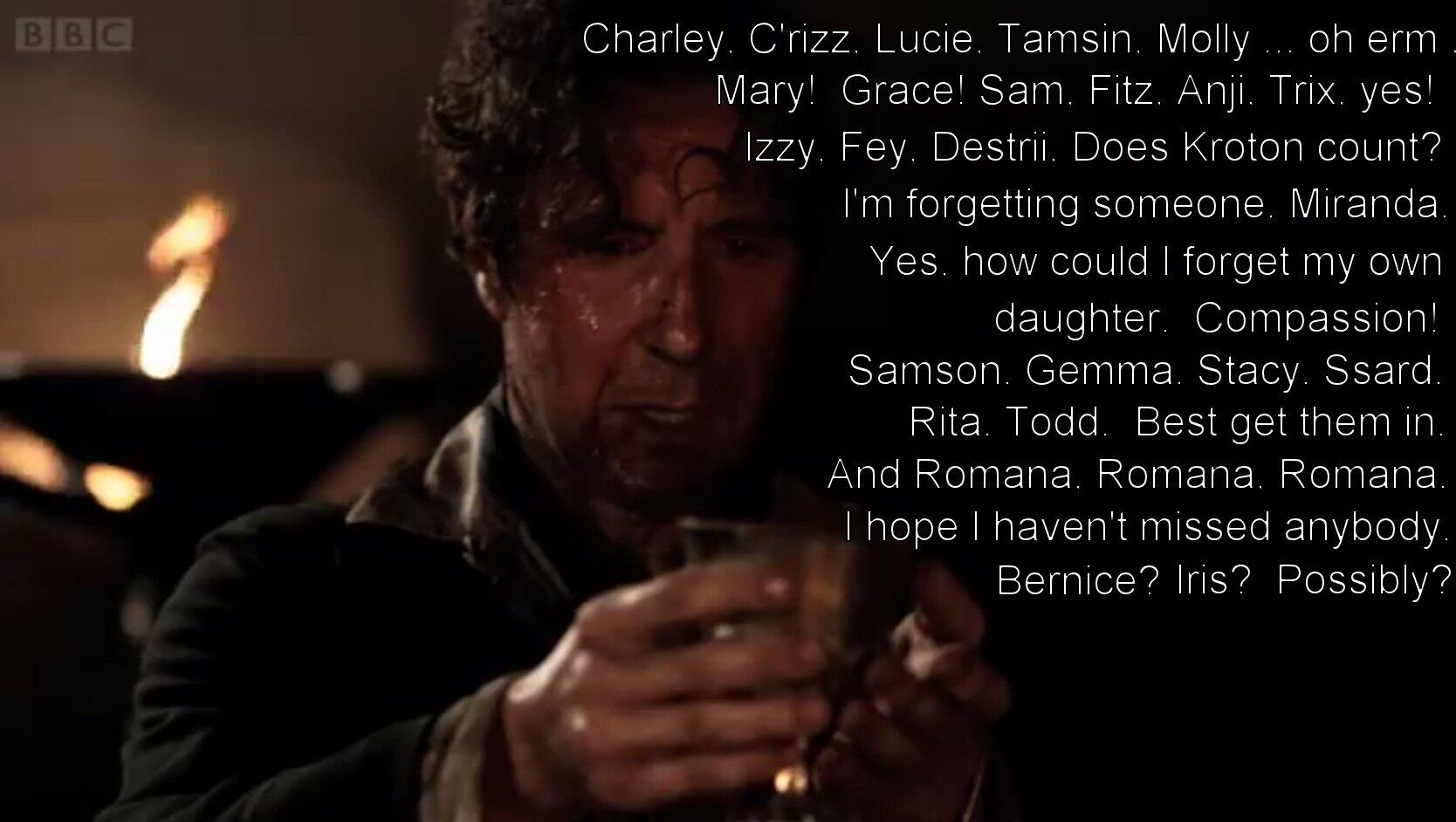
TV(ish) Renewed interest in the 8.0 model of the Doctor played by Paul McGann fuelled by The Night of the Doctor - see above - three million views - have led some to look at his appearances, in the comics, in the books, in the audio adventures and wonder. "Which order? Which?" Possibly.

A search online leads to a range of opinions and chronologies, many chronologies.

Glance through those and you'll find many ingenious ways they've found for the various often contradictory series to intersect, entirely ignoring such things as character development and that any shared-universe fiction will contradict itself no matter what happens (I'm looking at you Lucas).

But really it's all terribly simple, especially since all three media have pretty much their own internal continuities.

1 The TV Movie

Which is inevitable. Can't be helped.

2 The Eight Doctors by Terrance Dicks

The first of the BBC Books which follows on directly from the TV Movie.

3 The Dying Days by Lance Parkin

Bit of a controversial one this. The last novel published by Virgin Books before the BBC revoked their license, it's also the only one to star the Eighth Doctor. Has to go here, but because it's from a different publishing company and it's retrospectively explained that his new companion Sam has been left at a Greenpeace rally. He's gone for three years part of which is spent on ...

4 The Radio Times comic strips

Usually forgotten but important since his companions return in one of the ...

5 The rest of the BBC Books

All of them in order.

6 The Doctor Who Magazine comics

All of them in order.

7 The Big Finish Audios

All of them in order, which is Shada, then Mary's Story from A Company of Friends (see below), then her trilogy, then all of the original series with Charley Pollard as the companion, then the follow on series with Lucie Miller then Tamsin as the companion, then these new Dark Eyes boxed sets.

8  The Night of the Doctor

See above.

Which seems simple enough.

Except, for various reasons some fans like to think that the comics and audios happen in the three year gap we've just discussed. Not least because the version of his home planet Gallifrey which appears in both is rather different to the one which develops in the books.

Except, coincidentally both the books and comics ended in similar circumstances in the wake of the new series with most of their plotlines resolved and the Doctor and his companions heading off into an unknown future.

Plus The Name of the Doctor, in which Eighth makes a point of mentioning the audio companions suggests that they're very recent for him. If The Gallifrey Chronicles or The Flood had just "happened"? Wouldn't it have looked a bit like this?


Which means that there's nothing to say that at some point between the close of the books and the start of the comics, and the close of the comics and the start of the books some event or other might have caused the changes to be rolled back, the Doctor left travelling alone again ready for the next set of adventures to start.  Not everything will quite make sense but as I've said before, Doctor Who's continuity ebbs and flows.  None of it really makes sense or is internally consistent.

Nevertheless, thank goodness DWM didn't follow through with the original plan of showing the regeneration.

And having the audios last, from the first, Shada, through to the latest season means that we fans of 8.0 can enjoy a series of ongoing adventures which are edging ever closer to another time war (there are several) and the events of the new series, still filling in a gap, but one which ends in the story which was once only in our heads and is now available on Youtube, the iPlayer and a forthcoming home release.  For goodness sake.

Oh and the various short stories and comic flashbacks, including the rest of the audio anthology The Company of Friends, fitted in whenever it seems like they should be. There's not the room here for that.

Now, wasn't that interesting?

[A version of this post was originally published here on the occasion of Paul unveiling his Dark Eyes costume.  It seems even more relevant now that the audios at least have become noticed.  No one would blame you for skipping most of the novels.  There are hundreds and it took me nearly eight years to read through them.]

BBC 1963: December.


The Chink in the Wall, 31 December 1963
"Two years after the construction of the barrier between East and West Berlin, special permission was granted for visits by Westerners to the East for a period of five days over Christmas. In this programme, people - some of whom hadn't seen their loved-ones since the rapid construction of the wall in 1961 - describe what these visits mean to them, what life was like before the wall went up and the arduous process they had to go through to obtain visitors' permits."

Six Days to Saturday
"... a film made in 1963 about Swindon Town F.C. by the legendary film director John Boorman." (viewable via a Realplayer link at the bottom of the page)

Tonight: Moslem University
"BBC clip 'Moslem University' from Tonight tx 02.12.1963"

The birth of African Kenya
"People in Britain had begun to question whether conflict in the Empire was worthwhile when the whole idea of Empire seemed so out of step with world opinion. Kenya gained independence on 12 December 1963 and African Kenya was born. Little by little the rest of the Empire peeled away, leaving Britain to be just another country on the map."

The Reith Lectures: The Fulfilment of Lives: Albert Sloman: A University in the Making: 1963
"This year's Reith lecturer is Dr Albert E Sloman, Vice-Chancellor of the University of Essex. He was previously Gilmour Professor of Spanish at Liverpool University and Dean of the Faculty of Arts. Dr Sloman explores what is needed to make an institute for higher education in Essex in his series entitled 'A University in the Making'."

BBC 1963: November.


BBC News: Rare footage of JFK's arrival in Dallas emerges
"A rare, high-quality colour film of US President John F Kennedy on the day of his assassination has been released to the public for the first time. The film shows the president and First Lady Jacqueline Kennedy arriving on Air Force One at Love Field airport in Dallas, Texas on 22 November, 1963. It was shot on 8mm film by William Ward Warren, then a 15-year-old student, who recalls his memories of President Kennedy's arrival."

Letter From America: Assassination of J F Kennedy, Sun 24 Nov 1963
"The assassination of John F Kennedy, the first president of the television age, and the style, grace and fun he brought to the White House."

The Reunion: The Kennedy Assassination
"In this special 100th edition of The Reunion recorded in Dallas, Sue MacGregor reunites five people who were intimately connected to the events surrounding the Kennedy assassination: Clint Hill, the former Secret Service agent who frantically climbed up the back of the presidential limousine as the shots rang out; Gayle Newman, who stood with her young family in Dealey Plaza and became one of the closest eyewitnesses; Hugh Aynesworth, then of the Dallas Morning News, who reported on the events in November 1963, Kenneth Salyer, who was part of the medical team at Parkland Hospital, desperately trying to revive the President; and James Leavelle, retired Dallas Homicide Detective, who was famously handcuffed to Lee Harvey Oswald when he was shot by Jack Ruby."

Outlook: I Should Have Taken JFK's Bullet
"Clint Hill was assigned bodyguard to American First Lady Jackie Kennedy from 1960 to 1964. On the day that President John F Kennedy was shot, Clint was riding in the car immediately behind the President and his wife. He leapt onto the car to try to protect the President from the bullets but was unable to save him. In an amazing and moving interview, Clint tells Matthew Bannister how his inability to save President Kennedy has haunted him for fifty years. "

Witness: Lee Harvey Oswald and the USSR
"Lee Harvey Oswald, the man accused of killing President John F Kennedy in November 1963 had spent more than two years living in the USSR. He had defected there after serving as a US Marine. He got a job in Minsk, and got married but was then welcomed back to the USA."

Woman's Hour: JFK
"Everyone can remember where they where when they heard the news. For two sisters, Clare and Mairead O'Connor, from County Laoise in the Republic of Ireland, the fascination with Kennedy began when he visited their country just months before he died and it has remained a life long ambition to visit the sites associated with the first Irish Catholic President. After much soul searching they decided not to cancel their trip after the terrorist bombings and accompanied by reporter Mary Harte started their journey in Boston."

Talking Movies: Shooting history: Parkland's untold stories of JFK's assassination
"Almost 50 years since the assassination of US President John F Kennedy in Texas, a new film is exploring the shooting through the eyes of ordinary people. Parkland examines the events of November 22 1963 from the perspective of the medical staff who treated the president, the detectives who sought his killer, and the man who filmed that dramatic moment in history."

Desert Island Discs: Gordon Pirie
"Roy Plomley's castaway is athlete Gordon Pirie."

The Public Ear: The Beatles
"In February 1961, John Lennon, Paul McCartney, George Harrison and Pete Best played their first gig at the Cavern Club as The Beatles. Just two years later, and after a change of drummer, they were the biggest band in the UK and global domination was just a few months away. Allan Scott meets friends and relatives of The Beatles to discover the roots of the band and learn more about their early years. Contributors include former drummer Pete Best and Millie Sutcliffe, mother of original band member Stuart Sutcliffe. Note: this recording has been edited for copyright reasons."