Thanks to the invention of Letterboxd and all of its benevolence, this is much easier than it used to be with my activity available to take a gander at on my profile.
At time of writing I've watched 344 films, although I hope to squeak that up to my annual goal of 350 in the next couple of days. Of this year's releases, here are the titles for which I gave five stars. So far.
Spider-Man: Now Way Home No Sudden Move
The Summit of the Gods
tick, tick...BOOM!
Shang-Chi and the Legend of the Ten Rings
In the Heights
No Time To Die
Till Death
Summer of Soul
Annette
David Attenborough: A Life on Our Planet
Gunpowder Milkshake
Raya and the Last Dragon
Locked Down
Shiva Baby
Nomadland
The Mitchells vs. The Machines
Promising Young Woman
Malmkrog
Palm Springs
Can't Get You Out of my Head
Greenland
Which feels like a massively contrarian list and for some reason doesn't include The Eternals which I'm looking forward to having another look at when it's uploaded to Disney+ to see if it deserves higher than its current four.
There have been a few films this year, notably Dune, in which I've been on the other side of the critical corpus in finding them pretty tedious and lacking invention but absolutely adoring stuff which has been largely dumped on like Gunpowder Milkshake.
If I had to choose ten, in no particular order so let's list them alphabetically, it would be:
Annette
Locked Down
Malmkrog
No Sudden Move
Palm Springs
Promising Young Woman
Shiva Baby
Spider-Man: No Way Home
The Mitchells vs The Machines
tick, tick...BOOM!
Of that lot, I'd propose Malmkrog as my favourite of the year, simply for the no fucks old school approach of producing a three and a half hour film about a group of bourgeois elite debating political philosophy against a backdrop of revolution at a chateau in turn of the last century Transylvania. But that doesn't really capture the nuance of the exchanges and the sense of danger which surrounds the discussions or just how funny it can be. Here's the gorgeous trailer.
For the record, there was a single one star review for Jim Carey starring oldie The Number 13. Here are the two stars. A lot of disappointment in this wreckage:
Last Train to Christmas
The Trouble with Being Born
Prisoners of the Ghostland
Demonic
Mortal
Hitman's Wife's Bodyguard
The Informer
Army of the Dead
Barb & Star Go to Vista Del Mar
Possessor
Like a Boss
Black Water: Abyss
Yes, I know some of you like Barb & Star Go to Vista Del Mar, but it's a casualty of my sense of humour short circuit when if comes to inverted comma comedies that aren't grounded in some sort of reality. That's really just a matter of taste. Having seen and enjoyed Army of Thieves, I'm tempted to go back and revisit Army of the Dead, if only to marvel again at how they managed to comp Tig Notaro into so many scenes having conversations with actors she didn't meet until months later. If at all.
Anyway, I'm off to watch Encanto. Let's see if it'll force me to edit any of the above.
Film Lately due to not having to be at work, I've been watching lots of documentaries from streaming services, mainly about making films, with this and that. Most of these are about disastrous projects, attempting to turning a project which didn't ultimately find fruition into something tangible.
This morning over breakfast, I found The Best Worst Thing That Ever Could Have Happened, the story of Stephen Sondheim's rare Broadway failure, 1981's Merrily We Roll Along, directed by Lonny Prince one of the key cast member who is now a successful stage director in his own right.
Profoundly moving in a number of ways, it takes the key element of the musical, contrasting the positivity of youth with the cynicism of middle age and through archive documentary footage applies it to the members of the original cast showing what happened to them after their dream turned to disaster.
The trailer is at the official website, but I'd suggest you see the film with as little preparation as possible. Few documentaries I've seen have captured what it must have been like on Broadway in that era and a cautionary tale of how you can't let one event define your entire life (which is something I need to keep reminding myself too).
Film Last night after watching Pitch Perfect 2 and tweeting that I'd watched Pitch Perfect 2, a friend asked if I'd posted a review anywhere because she wanted to know what I thought and having yet not had the time but not wanting to disappoint her, I spent the next half hour having an opinion. Given that it's a good four or five paragraphs of words and sentences, it seems a waste not to put it here in some form and so here it is, my insta-reaction to Pitch Perfect 2, cleaned up somewhat for grammar and sense. It's a bit rough, and the Sixth Doctor wouldn't like the number of times the word 'I' is used. It's also full of spoilers for this and Rocky so don't venture below if you haven't seen either films yet. If you haven't seen the film yet, I'd recommend it. There aren't many female led films of this kind and there are moments of pure joy amid the obvious cash grab of making a sequel to a film which was already perfectly fine.
Anyway:
On Pitch Perfect 2: I enjoyed it. I love musicals anyway and will tolerate all kinds of shenanigans in relation to weak storylines and gaps in logic if the songs and dance numbers are good enough which they are here despite the contemporary propensity for shots lasting nano-seconds so that its nearly impossible to take in what are clearly highly choreographed and highly rehearsal sequences. I even cried at the end when the legacy of the Bellas appeared on stage even though it defies all logic that they’d all pitch up in Stockholm and also be the finale if the German group were supposed to be the returning champions.
I tend to prefer films with female protagonists, especially if they’re about friendships (cf, Frozen). At a certain point I grew tired of films by men about men doing men things. This was directed by Elizabeth Banks and although the credits indicate a fair amount of men in the crew everything about the music was also female led. Plus the male characters, despite the odd moment of agency, are very much secondary characters and every shift in a relationship in a scene is presented from the female POV and there's no desperation to shoe-horn in a male figure designed to relax why-exes. These are humans and that's quite enough.
There are plenty of moments of pure cinematic joy, like the slow motion shots of the Bellas in the water park and the routines of Das Sound Machine with their wall of verbal sound and extraordinary dexterity (which actually makes the Bellas's win at the end somewhat ludicrous. I was half expecting the Rocky approach especially since the film also ditches the sports-films structure of the first. Some of the running jokes work really well, like Kendrick's inability to say horrible things to the lead singer of this rival band played by Birgitte Hjort Sørensen. It's also clever to have Hailee Steinfeld's character effectively filling in Kendrick's role from the first film and making her distinctive enough that it doesn't feel like a retread.
Nevertheless half way through I realised it doesn't quite cure its unexpected sequelitis in that the first film was a pretty complete story in and of itself and with no real narrative to speak of going forward doesn't quote manage to find its characters something convincing to do or a decent enough challenge. Most unplanned follow-ups have to deal with this if the source material isn't already inherently serialised and it's rare that they manage to produce something cohesive especially if it doesn't have a specific lead character. City Slickers 2 definitely can't deal with the fact that the whole first film was about trying to make Billy Crystal's character smile again and has to then create a spurious reason for him to be sad again instead.
PP2 also suffers from the problem of one or two of its actors becoming more famous in the meantime / because of the success of the first film and so Rebel Wilson’s given a romantic subplot bits of which are genuinely funny (the moment with car) but would have worked better, just as it did in the first film as part of the crowd. Kendrick’s story feels entirely “manufactured” and in parts feels like it was written in such a way as to deal with her schedule clashing with a different production rather than the needs of the story. In a couple of her scene it’s almost as though she’s not interacting with the other characters on screen having been shot against a green screen and CSOed in later. I have no idea if this is true, but there are some weird shots at the car show were the lighting on her face doesn’t seem to match and she doesn't touch anyone.
But most "importantly" some of the elements which seemed sweet and campy in the first film have become forced. At times, it’s difficult to know if the off-colour jokes are being pushed for irony or whether they’re actually are the thing you’re apparently supposed to assume are parodying the propensity for that sort of thing. Is it ok to have so many “fat” jokes if they’re about Rebel Wilson and if her character’s name is Fat Amy? Is having a character whose only dialogue is about having a grim South American past ok? Homophobic undertones? The flat out racism and notable sexism of the hosts? The CinemaSins video above is recommended for its survey of the key issues. It's noticeable that the host Jeremy and his writers have become increasingly intolerant of sexism in films over time and embarrassed of their own early running jokes in that vein. They really hate this.
I don’t know and I'm not sure the filmmakers do either. I didn’t laugh in these places mainly because I wasn’t sure what I was laughing at. Having the whole story kickstarted by the shame of Fat Amy ripping her leotard in front of the President and the world doesn’t seem in keeping with the first film and a push towards a wider audience. Except it's confusing because the film was notably popular with and made for a predominantly female audience and did huge business, so either I'm not in on the irony, or understand the irony and it's just not my sort of humour or that it's just simply problematic and everyone should take a long hard luck at themselves. I tend to have similar issues with Seth MacFarlane films, especially when he's making rape jokes.
I see that they’re making a Pitch Perfect 3 even though again, there is not story especially since they’re core gang is supposed to have graduated by now. My guess is it’ll be about Kendrick trying to get the group to make it in the music business which will probably lead to more cameos and some of the product placement that weighed this down. What I’d like to see is more characterisation of the rest of the group, giving them more to do than be punchline machines although I understand that that to an extent the series is supposed to be about Kendrick’s character. All of which said I like most of the these actors well enough to turn up for it – or at least watch it when it's added to a streaming service.
Film Unsurprisingly there have been few romantic comedies about grief. The tonal shift from the utter-devistation of the loss of one's loved one to the sharing of romantic witty banter with a potential partner near impossible to achieve. The most prominent example, Sleepless in Seattle managed the switch by having Hanks’s character externalising his the loss through a radio show, with Meg Ryan vocalising our reaction, and keeping the two separate for the duration. Most often, when this most tragic of events is brought in proximity with comedy it's in the horror genre but during Scream or Shaun of the Dead there’s little time to dwell before the next action set piece.
Delicacy dwells. When Parisian office worker Natalie (Audrey Tautou) loses her husband in the most brutally unexpected way, she’s unable to cope with the change in perspective that the rest of the world has of her. She just wants people to treat her the same, but none of them know quite what to say, and that awkwardness leads to loneliness and much like Hanks in Sleepless, Natalie finds herself consumed with work, desperately wanting to Vulcanise her emotions in case she lets the grief in. The wandering eyes of her boss don’t help and it's only until she unconsciously senses a similar emptiness in a co-worker that she’s able to articulate her feelings.
But for Markus (Francois Damiens), it’s the emptiness of the life not led, of a person overlooked by society and so whose overlooked his own potential, marinating in the juices of self-doubt and politeness. Having moved to Paris fifteen years before with hopes of becoming absorbed in a new culture, he finds himself continuing to be defined by his Swedish heritage, working for a company based in his homeland, living among IKEA furniture and still looked upon as an outsider. When Natalie gives him some attention, he’s brimming with excitement but having (we assume) spent so much of his life alone, how can he possibly trust that she’ll love him back?
Adapted with his brother Stephane from his own best selling novel, David Foenkinos’s film somehow manages to transform these melancholic nuances into something incredibly funny. Even before Amelie put her on the international map, Tautou was already enjoying some success in these tonally unusual stories and part of the fun, surprisingly, is watching her friends unable to cope with her emotional resilience, and that she’s best placed to decide on her emotional arc. It’s a part she was destined to play. Literally. In the book, a chapter was apparently written in the form of a screenplay with Tautou cast as Natalie in a fantasy version of her life.
But it's in the sequences in which Markus has to cope with her interest that the film really finds its comic heart. Perhaps it's the laughter of recognition from those of us introverts who’ve been in a similar situation, but Damiens impressively observes the constant state of worry inherent in being even friends with a beautiful woman, not knowing what to say or even when to speak, of hesitating throughout each encounter and finally reasoning that since this person is far too good for you and at some point will probably become bored, there’s little point in trying, even in the most obviously romantic of situations.
Like Sleepless, your tolerance for Delicacy ultimately depends on how willing you are to wallow in all this and allow yourself to drown in the overflow of sentiment. But not all of those emotions are explained. Natalie’s best friend is also “enjoying” her own emotional arc, but the Foenkinoses demonstrate the necessary self-absorption of grief by never quite explaining her moments of desolation. That ambiguity gives the film a weight missing from most modern romcoms and shows that this first time director is able to leave the requirements of his natural medium to one side and trust his audience’s imagination to fill the empty space.
Film One of the best sketches to emanate from 80s comedy show The Mary Whitehouse Experience featured Rob Newman dolled up as Robert Smith from The Cure singing nursery rhymes or upbeat songs like Tie Me Kangeroo Down Sport attempting to parody the bands sudden lurch into happy material with Friday I'm Love. In on the joke, Smith himself later appeared to sing "The Sun Has Got His Hat On" but I always wondered what would happen if they'd stretched the joke to show the otherwise depressive Smith in more mundane settings, such as on a date or at the bank.
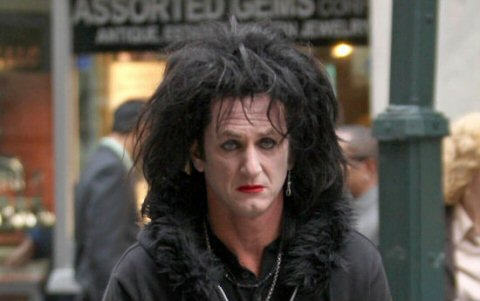
Paolo Sorrentino’s This Must Be The Place initially seems as though it’s going to be a big screen version of that very idea. Cheyenne (Sean Penn) is a washed up 80s rock star who the director says is heavily influence by Smith who stumbles about Dublin seemingly without purpose. Dressed all in black, alabaster make-up contrasted by rouge lipstick, his fringe annoyingly falling across his face so that he has to blow it away from his eyes every few seconds, his eyes fixed ahead when they’re not covered by sun-glassed, he looks like an animated cut-out from Smash Hits Magazine, attracting stares from the locals, even those who don’t recognise him from his pop career.
With deadpan wit, Sorrentino places this figure in the antiseptic surroundings of shopping malls and suburban streets, approaching each action like an alien whose never had to buy pizza in a supermarket before, his monotone whisper just clear enough for him to function in a world that his childlike nature keeps him at odds with. It’s only in the company of people he’s familiar with like Mary, the daughter of a band mate (Eve Hewson) and his wife Jane (Frances McDormand) that he comes out of his shell a bit, largely because they force him to, the latter challenging him to ball games in the empty swimming pool in the grounds of him mansion.
As deliberately entertaining as this opening half hour is, there’s always a nagging sense that like his title character, writer and director Sorrentino isn’t entirely sure what to do next and the material won’t stretch much beyond showing us the incongruous sight of Cheyenne playing the stock market or nibbling through a pizza in a dining room below a neon sign that says “cuisine”. But then the film makes a magnificent leap which takes Cheyenne and us on a surprising and rather poignant journey which works best if the viewer knows as little about beforehand as possible. Ignore the synopses if you can. You’ll thank me.
What we can say is that this is strangely a comedy drama about guilt. Cheyenne’s guilt about a fan’s reaction turned sour, astonishingly enunciated by Penn in one of the film's key scenes, the guilt of not living up to his parent’s expectations, of finding oneself at odds with society’s expectations. But also for various reasons, the guilt of history and the extent to which humiliations inflicted and carried should be experienced and re-experienced across a life and whether it’s ever possible to let go. Cheyenne’s own baggage is given physical manifestation throughout, first as a shopping trolly then as a case on wheels, forever dragged along behind.
Sean Penn dissolves into personality of Cheyenne, and the funniest moments are when he allows this porcelain visage to shatter into more human expressions. In Thomas Vinterberg’s underrated futuristic meditation It’s All About Love, Penn plays a man who is medically incapable of living on land, spending his entire life orbiting the planet by plane. Cheyenne’s feet are on terra firm but his mind is elsewhere and it’s to Penn’s credit that it never becomes the exaggerated parody of Newman’s Smith. He remains grounded enough and likeable enough for people to strangely warm to him, in spite of his appearance.
In a role which was written for her, McDormand catches the tone that’s required for the kind of woman who’d logically be wife to this kind of man, part groupie, part mother figure. How they became involved is never quite explained, but it’s clear she treats life with him as kind of fantasy adventure, her supplementary career as a fire fighter providing a much needed dose of reality. Another of my favourite but generally underused actors, Kerry Condon, appears in a small but pivotal role and provides some of the best screen tears I’ve seen a long time, her entire body distended and shaking.
As the title suggests, the other remarkable element of This Must Be The Place is the music of David Byrne and the Talking Heads which pulses from radios, televisions and in shopping malls throughout both in their original form and covered by other bands. Byrne himself wanders in at the halfway point playing a version of himself who’s an old friend and mentor to Cheyanne in a unforgettable incident in an old theatre, whose interior is crumbling in tandem with Penn's pop star’s personality. Unsurprisingly its Byrne’s music which aids in his psychological recovery and listening again to Little Creatures as I write, I can absolutely understand why.
I was lucky enough to be invited to a preview screening of This Must Be The Place at FACT Liverpool this morning.
They'll be screening it as part of the Slackers Club at 9pm on Wednesday 28th March.
Then they will be showing the film on general release from Friday 13th April.
Film In recent days I’ve been plagued by phone calls from an unrecognisable telephone number. Or at least a telephone I didn't recognise. At random times of the day I’ve heared my ringtone, and because I don’t keep my mobile with me all the time, I’ve been dashing to retrieve it from wherever I’ve left it, only for it stop before I could answer. My usual strategy in these situations has been to ignore it, but it has been persistent enough that I eventually called it back and a recorded message revealed it to be the Daily Telegraph’s promotions line. They rang again today while I was out shopping. Luckily the phone was in my pocket.
“Hello” said the call centre advisor. “Is that Stuart Barnes?”
“It’s Burns. Hello. Are you from the Daily Telegraph?”
”Yes, I am, I …”
“You’ve been plaguing me with phone calls. Could you take me off your list please?"
“Oh, um, yes, I …” He was going to hang up.
“Hold on. Can I just say this is the third time I’ve asked you.” Which it was.
“I’m doing it now.” He replied sharply and hung up.
All of which means I can sympathise with Mary Kee, the divorcee whose equally inundated with phone calls in Matthew Parkhill’s thriller The Caller even if our stories diverge somewhat. For one thing, she has to deal with the hammering ring of the old black telephone left in the new singleton apartment she’s rushed to rent in the wake of her separation, whereas mine’s now a soothing snatch of Kevin Shield’s soundtrack to Lost In Translation. The Daily Telegraph was just uppity with my attitude, although I am concerned that the Telegraph still have my
address from the animated Shakespeare dvd promotion of a few years ago
which led to my predicament. When Mary’s rude with her apparent wrong number it leads, as should be the case in the thriller genre, to murderous consequences.
Beyond that, there’s not much more I’d want to give away about The Caller. Even the press release which was sent with this review copy I think says too much and offering genre details beyond “thriller” spoils at least three of the best surprises. As does this webpage, which you really shouldn’t look at either. I've even just deleted another reference and replaced it with this sentence, just in case. What I can say is that although this is a film with small ambitions and judging by its few locations, a slender budget, Parkhill recreating the kind of 90s psychological fare top-lined by Julia Roberts or Diane Lane (Sleeping With The Enemy, that sort of thing), Sergio Casci’s screenplay succeeds in utilising the premise to turn some of their tropes upside down, not least the other abusive caller her ex-husband (played with pantomime creepiness by Ed Quin).
Perhaps we’re on safer territory talking about the cast. The press release also makes much of this being a bringing together casting from Twilight and True Blood, though I will say it has nothing to do with vampires. Twiglet’s Rachelle Lefevre is quite excellent as Mary, if looking disconcertingly like a tall Michelle Trachtenberg in a pre-Raphaelite wig. True to the film’s exploitation roots, she spends portions of the film in daisy-dukes thanks to the air conditioning in the apartment, but when the plot hits the fan she eventually fills her kitchen with to bring a much needed breeze, she’s capable of projecting both vulnerability and strength. Stephen Moyer (From True Blood (or NY-LON)) does what’s expected of the love interested especially during a longer than is possibly required softcore love making scene.
Some of the other reviews online I have been remarkably unforgiving to a piece which understands its genre and has few ambitions beyond it. Admittedly there is one glaring issue later in the film which means that the antagonistic telephone couldn’t and shouldn’t work. The deleted scenes do address why Mary’s stuck using this ancient beast when newer technology is available, cut presumably because there’s already one entertainingly pedantic exposition scene in the middle utilising the budding boyfriend’s convenient profession, If you did look at that spoilery webpage (or even just the link), you’ll know this kind of story risks such questions anyway and that even the master of this kind of material writes himself into a hole. At least Casci takes a crack at offering a justification and it’s certainly no less ludicrous.
The Caller is available now from Universal Pictures on blu-ray and dvd.
Film Part of the entertainment in the run up to the release of Chis Nolan’s Inception has been watching reviewers attempting to write numerous paragraphs and offer well formed opinions but without giving anything away about the plot, even those who didn’t enjoy the film understanding that it’s best seen without any prior information. The apogee of this approach is in this month’s Empire Magazine, where Nev Pierce’s five star opus spends three pages making comparisons, talking about influences, mentioning legacy but trying desperately not to say very much about the story, but still I think inevitably manages to say too much.
Inception is a film which has to be approached cold. If you’ve seen any of the trailers, heard any interviews, you’ve probably seen and heard too much already. The enterprise was shrouded in mystery during shooting, like well, Cloverfield, only really becoming known when a very early teaser appeared online and baffled everybody. My own adventure began with that tease and from a glimpse of something in a corridor whilst flicking through the channels, my only exposure has been Mark Kermode’s review which again revealed just a little bit too much, but only enough to wet my appetite. Not until this morning did I really decide to attend, but only because I knew that my forced obliviousness would not survive until the dvd release.
With all of that in mind and before I launch into the mainstream of this symposium, imagine my utter surprise when, before the film began, we were treated to an advert for an entertainment website which included footage from the red carpet premieres of the new Twiglet film and Inception, with Leo being asked a facile question about the quality of the script and which included loads of footage of said film and him describing the plot. Luckily I managed to shut my eyes and put my fingers in ears before too much seeped out and in, but it’s almost as though the marketers are desperate to spoil a film no matter what.
Which is why I’m not going to join them and put the rest of this “review” behind one of those link things. Other than to say that all the self evident truths are in place. It's well acted, intelligently directed and is photographed beautifully, visually a masterpiece. And that it’s probably going to be one of the ten best films of the year and has various elements that have the potential to change the way mainstreams films are made, or at least what’s permissible in a mainstream film, in a number of ways, and that if you're a film fan of any description and don’t see it now, at the cinema, you’ll later regret it.
Film Tomorrow sees the launch of the IMAX 3D experience at Odeon Liverpool One and this morning I was invited to see a preview by the publicity company stage managing the opening few days. The email came via my Liverpool Blogs blog, which happens sometimes because of its proximity to the search terms "liverpool" and "blogs". It’s good that they’re reaching out to the social network, and quite exciting to be treated like a proper journalist, joined in the process by a Merseyside radio personality and someone from the local press, both of whom rushed off to talk about and write up what they saw.
I came home and finished painting the living room, which isn’t quite as glamorous.
If the idea was for me to offer some good word of mouth, it worked. As a film presentation and projection system this is amazing. A refit of one of the third floor auditoriums, the screen size has been increased to 9.7 high by 17.8 wide with stadium seating so that it’s almost impossible to be blocked by someone sitting in front of you (unless they have a very big head). The half hour spent in there were comfortable, with only the aisle based, under seat lighting providing a slight irritation, always twinkling brightly at the edge of vision.
The sound and picture quality are magnificent. We were presented with a showreel of some old and new content, mostly trailers for the likes of Batman Begins and 300 complete with the green band US MPAA ratings at the top. The clarity of the image is sometimes astounding, especially in the promo for Chris Nolan’s latest Inception, were the grain from the 35mm negative was perfectly visible, removing that slight stumbling block I’ve always had with digital projection experiences in the past (cf, Cornerhouse Manchester) which have always retained the slightly artificial quality of dvd.
The most astounding examples were of course in 3D; excerpts from a documentary about the Hubble telescope in which the edge of the satellite are at eye level, the train in Polar Express flying past your face in a way that makes you understand quite why that first audience that saw a similar locomotive projected by the Lumiere Brothers over a hundred years ago in L'Arrivée d'un train à La Ciotat. The sound quality is extraordinary, very detailed and realistic; the press release speaks of being able to hear a pin drop and I can believe it.
We were treated to a preview of Tron Legacy in which it seems the “real” world will be presented in 2D only entering the third dimension as Kevin Flynn’s son materialises within the game world, in much the same way as the Wizard of Oz flips from monochrome to colour when Dorothy and Toto aren’t in Kansas any more. I’ve always thought that 3D will only shift from gimmick or enhancement to art form when filmmakers begin to somehow produce stories that only work in that format and this could be the first indication of a shift in that direction.
After the screening whilst my journalistic colleagues were interviewing the Odeon’s manager, I inevitably asked instead to see the projection room. I met the technician/projectionist who spearheaded project to bring the system to Liverpool and he was positively evangelical, patiently answering my questions about how the films are stored (giant removable hard disks) and how the system works (two giant projectors that look like the kind of equipment Galactus might use for his holiday slides). His glee was infectious and only increased my excitement for seeing a complete “film” projected this way.
But, and this is a big but, and after being treated so well this morning I take no pleasure in saying this, it’s not IMAX, or at least it’s not the traditional projection IMAX format. As I surmised in my bonkers unsurprisingly unanswered email to the Odeon last week, no matter how large the screen, it doesn’t have the wrap around experience of the classic IMAX aspect ratio reaching to the ceiling and floor and filling the field of vision on either side as seen at the Manchester Filmworks, the BFI and the National Media Museum in Bradford.
Before the preview I put this to a gentleman who was introduced to me as knowing more about the technical side. As the projectionist would later, he talked about how IMAX was about the immersive experience and that was what they were interested in. I suggested that in fact that meant they were reconfiguring the IMAX name but that there would be people who knew (what I kept calling) “proper IMAX” but would be disappointed to discover that’s not what they were getting here and that perhaps they needed to make that clearer in the publicity.
I tried not to sound overwhelmingly negative since I was still looking forward to investigating this other system (always interjecting with “I don’t want to be a cynical sausage...", "I'm honestly trying not to be a cynical sausage..."), but having seen the new IMAX logo which had been added to the Odeon signs in the foyer, as a passionate film fan, I’m genuinely concerned that when the people of Liverpool greet this new way of seeing movies, that they’ll think they’re finally seeing a range of film made in the IMAX format (assuming they’ve heard of it before). They’re not. They’re seeing a range of films which in the main are made for an ordinary projection system that are being transferred to this other format.
That difference is also covered by the media fact sheet, which says “a major change of aspect ratio from the traditional ‘full-height’ 1.33 of 15 perforations 70mm film, to the 1.78 of their DMR system, which is more consistent with the general framing of Hollywood films.” Except, since “DMR” is Digital Media Remastering system that upscales a 35mm film, that change in format means that the image quality, however detailed, could actually still be inferior to the original IMAX which has more information in the original print, unless like some sections of Inception they're shot in at least 65mm.
The FAQ also asks itself about the key difference between this IMAX auditorium and the one in Manchester, and answers by talking about crystal clear imagines and the special audio system when in fact its that watching a film here involves looking at a giant rectangle but there it's feeling as though your about to fall out of a helicopter into the Grand Canyon or whatever. I think about my own first jaw dropping experiences in Bradford in the 90s in which I felt like Jodie Foster in Contact ("they should have sent a poet"), my eyes agog at this strange new world, as penguins swam beneath the glaciers above my head.
Imagine this trailer projected on a screen the size of a three up, two down:
I brought up the problems last year in the US when people turned up for IMAX showings to find this system in place (which led to the Destroy Fake IMAX campaign), all he could offer was that yes, there had been criticism on some technical blogs. But journalists also wrote like this one which I’ve linked to before and lists the key differences. At length. With pictures. Roger Ebert also went over the topic in much greater detail and I’d direct you to his article too. As he says, “(IMAX CEO Richard Gelfond)’s problem appears to be that most people do foolishly persist in thinking of IMAX as the giant screen” when they’ve branched out further in the battle against home formats.
So Liverpool is still waiting for its first IMAX film projection system, but what it does have is a truly excellent new option for seeing Hollywood film releases, which admittedly has been well received in other areas. The first week will see Shrek Forever After and coming soon are Inception, Toy Story 3, Resident Evil: Afterlife, Legends of the Guardians: The Owls of Ga’Hoole (partly voiced by Bernard Cribbins), Harry Potter and the Deathly Hallows (Part One) and the film which could be the game changer, Tron Legacy. I’m really looking forward to seeing most of those (yes, even Resident Evil, it’s a guilty pleasure) with only the price a potential barrier (£11.75 for adults).
Because, let’s be honest, despite my reservations about calling a spade a spade, it’s probably just all about some pupils from a local school in a photo which was sent to me this afternoon by the PR company (because they were the first to see the system), on the edges of their seats and the rapt expression on their faces. The boy on the left looks like he's going to be a film fan for life.
UPDATED 14/7/2010:For all my huffing and puffing above about screen areas, I've just discovered that the Odeon aren't using the proper IMAX screen they inherited (when they bought out UCI) at the Filmworks in Manchester to show proper IMAX films anyway. Boo. (see below)
Updated 02/08/2010 Haylay has been in touch with the Odeon regarding all of this and has sent me their response. She's agreed to let me publish her email to me below. All I've done is break up the central quote into small paragraphs for ease of reading (FYI we swapped emails after I saw a comment from her on Twitter):
"Hi Stuart
Thanks for the email (sorry its taken me so long to reply!)
Glad to hear that I'm not the only one who felt this way.
I emailed Odeon after I had been and thought you might be interested to read their response:
"I'm sorry to hear you feel you are disappointed with our new IMAX installation. I would like to assure you that the IMAX we have had fitted is a 'True IMAX' and was installed and tested by IMAX technicians from Canada.
Unfortunately Liverpool ONE was not designed for IMAX when built so we were limited on how large we could make the screen.
The IMAX we have is Digital IMAX which historically has a smaller screen than traditional IMAX as it is more difficult to enlarge a digital image to the size of older IMAX screens. With the digital age of cinema becoming more apparent you will find newer IMAX installations to be of similar size.
The IMAX experience is not just the screen size and the laser aligned sound it is the full process from filming on special IMAX cameras to enlarging each frame of film.
I do agree however that if you are sitting close to the front or far out on one of the sides the Immersive wrap effect is some what lost. We are current working hard with IMAX to see if there is any solution we can come to."
I'm guessing they have probably had a fair few emails about this!
As you had said in your email, the thing that's bad is that they are selling it as IMAX, and people expect IMAX to be the giant screen and wrap around shape.
Interestingly our nearest proper IMAX screen at the Manchester Odeon in the Printworks has Ghost Protocol and the Batman preview which indicates that although they've installed Digital, they can still show floor to ceiling when necessary (Chris Nolan has indicated the preview could not be shown on faux-IMAX screens).
Film Terry Gilliam’s The Imaginarium of Dr Parnassus has just opened to huge numbers in Italy with one journalist describing him as having rock star status (whatever that means). Since the film has struggled almost everywhere else, one could wonder why the Italians are lapping it up. Except, with its army of grotesques, a subplot about a man ruined by his own fallibilities and a stream of extraordinary, surreal images, perhaps Italians have noticed the similarities with the work of their most famous film export Frederico Fellini.
Like his 8½, Parnassus is about the struggles of the creative process and dealing with the under appreciative audience with the central figure a potential fictionalisation of the director. And like 8½ the more self indulgent elements are what hold the viewer at arms length because at times its as though the director is talking to himself but using his cinematic voice to do it.
The story is a mess. Parnassus is an immortal storyteller who has made a pact with the devil regarding his daughter and Satan has turned up to accept his payment. His tax is five souls, which are captured through a flimsy mirror at the centre of their circus/performance piece which is hooked into a dreamland which exists within the Doctor’s meditative subconscious. Except their show is such an anachronism that it’s out of step with the modern world which is smelly and full of drunks and it’s not until a scandal ridden businessman joins the group that their luck changes.
Breath. In typical Gilliam fashion, the film is less interested in telling a coherent story with strong characterisation than delivering a series of jaw-dropping images and funny business and how the membrane between horrible reality and magical worlds is slimmer than we imagine. Like Baron Munchassen, which shares many of its ideas and themes, it’s probably a flawed masterpiece and will be described as such just as soon as people decide what a masterpiece actually means in this context.
Famously this is the film that was half completed when Heath Ledger left us with Johnny Depp, Jude Law and Colin Farrell filling in the gaps when his character enters The Imaginarium. Together they aptly portray a fractured personality but unlike some have suggested, I’m not sure that the tragedy helped the film, for a significant reason I can’t mention because it’s a massive spoiler.
But the revelation is clearly Lily Cole as Parnassus’s daughter Valentina, who gives a funny, romantic, luminous turn that suggests she’s been working in film for years and has none of the forced approach to acting that other models have betrayed. If anything, it's a pity that Gilliam wasn't more disciplined with his writing and didn't put her at the centre of the story, perhaps as an Alice figure. Valentina is by far the most sympathetic character here.
Outside of the fantasy world, Gilliam's camera is restless, almost headache inducing as his (or rather his cinematographer Nicola Pecorini’s) hands shaking as the fragility of reality forever seems close to shattering. The best shots are those in which The Imaginarium pitches up in a thuddingly mundane location like a Homebase car park or middle class shopping mall, its Victorian styling incongruous against the cars and concrete. I was reminded of the tv adaptation of Neil Gaiman’s Neverwhere and those moments when the Carabass or Door left the underworld to walk amongst us.
The inside of The Imaginarium is almost totally computer generated and oscillates between aspects of a Bosch painting and Disney as Gilliam almost recreates his Python animations but as part of a plot point with protagonists rather than just as a sight gag. If you’re not careful you could imagine that Gilliam would have been happier, budget allowing, simply to have produced a film set totally within The Imaginarium. Except the final caption shows that he still interested in reality and humanity: "'A Film by Heath Ledger and Friends...'"
But ultimately it's a frustrating experience because you desperately want to like the film more, but can't ever quite put your finger on why you're not as engrossed as you should be. Sometimes it's because clearly improvised scenes go on beyond their natural end because Gilliam likes some bit of business, sometimes the story isn't going anywhere or loses cohesion enough to wonder if a reel has been dropped out somewhere but mostly it's because Gilliam never quite seems to know what kind of film he's trying to make.
But at least he's tried and we thank him for that. Always.
FilmUnder The Mud is a rather good low budget comedy drama filmed in and around the Garston and Speke areas of Liverpool. It’s a little girl’s holy communion day but the rest of her family have their own preoccupations. Her mum and dad are having marital problems, her big sister Paula’s boyfriend is heading off to Spain without telling her and her older brother lacks a sense of direction. Plus there’s Magic, our narrator, who’s nearly been adopted by this “family from hell” (as the publicity would have it) after the death of his mother and is besotted with Paula but just can’t seem to work out how to get her to notice him.
Shot on digital video and written over a three year period in conjunction with young writers, the film should have the whiff of a community project, but nothing could be further from the truth. Directed with flare by Sol Papadopoulos (who was also a producer on Terrance Davies’s transcendental Of Time and the City), the film wins through a combination of razor sharp comic timing from the cast and a willingness to give the same kind of magical realism Steve Martin layered on his home town in LA Story. There are scenes around Liverpool airport that are simultaneously hilarious and visually quite, quite beautiful stretching the film out from the initially fairly televisual and Hollyoaks-like, into the truly cinematic.
The emotional core of the film is provided by local theatre and tv veteran Andrew Schofield playing the father figure whose so wrapped up in guilt over the jailing of the gangsterish best friend (whose released as the film opens) that his relationship with the children’s mother is failing. But this is a collection of superb performances, even from the very young kids who are able to carry whole scenes by themselves, a very rare quality. My favourite storyline is Magic’s fight to get noticed by Paula and her dawning recognition that there’s more to men than their ability to play records. Oh and she spends most of the film talking to her imaginary friend (who everyone else also pretends is real just to humour her).
That kind of quirky humour is just one of the things that warms me to Under The Mud. Another is that there’s something quite extraordinary about seeing the place you were raised so vividly brought to screen, absolutely catching the atmosphere of the place and its people but without resorting to layering in artificial grittiness or stereotyping. I imagine my experience of watching this was much the same as the population of Austin Texas seeing Richard Linklater’s Slacker or New Jersey watching Kevin Smith’s Clerks, the amazement that anyone would want to make a film here and that it would turn out so good. I don’t imagine I’ll see a car chase around the retail park or emotional devastation playing out inside The Krazy House again any time soon.
Film Reading through the professional reviews of Joshua Michael Stern’s political satire Swing Vote, it’s fairly remarkable how little Frank Capra’s name is mentioned. I’d expected nearly every writer to have used the word Capresque somewhere, particularly since, if you’ve seen half of the director’s films (as they should have), you’d very clearly recognise the formula being deployed here of an everyman suddenly thrust into the position of mattering on a national scale and essaying how they cope when they’re being taken advantage of by those who’ve enjoyed the privileges they haven’t. It’s Meet John Doe, it’s Mr. Deeds Goes to Town, it’s Mr Smith Goes To Washington, it’s the populist hope that the ordinary bloke can still mean something, can make a difference.
Swing Vote’s ordinary bloke is deadbeat dad Kevin Costner (miscast in a role which would have been played by Adam Sandler five years ago), who through a narrative slight of hand becomes the only voter in the country who can decide the presidency (the circumstances through which this occurs go virtually unexplained at least on a national scale). He’s an independent, a disaffected voter who doesn’t care one way or other who leads the country, and the film largely concerns itself with the process the candidates go through in order to secure his support, the Washington circus pitching up outside his trailer as like Doe and Smith he goes on the j-word towards political awareness.
For a film about such big choices, it’s a shame that Stern and fellow screenwriter Jason Richman are unable to decide what their film should be. Is it a straight down the line bit of Capracorn or a knowing send-up? On the one hand, the scenes featuring Costner’s domestic life in which he’s largely taken care of by his hyperintelligent tweenie daughter are perfectly judged and have the ring of modern Capraeque master Gary Ross (Dave, Pleasantville, Seabiscuit) in their expression of the loss of innocence and the American dream. The daughter is played by the fabulous Madeline Carroll who steals most of her scenes including a rather good moment in which she faces down POTUS’s political advisor Stanley Tucci across a conference table.
Sadly the politico material looks like it’s drifted in from another film and unfortunately it’s more Wag The Dog or W than The American President or The West Wing. The intention seems to be to make both candidates look fairly stupid – Grammer is in full Frasier mode – and pliable as their respective political advisors Tucci and Nathan Lane lead them to toss out their ideological concerns in a desperate attempt to grab Costner’s vote. But none of this ever rings true and has an artificiality which undercuts whatever humour might be evident in seeing the Democrats making pro-choice ads or the Republicans supporting the environment.
And if all of that sounds a bit old hat anyway, it’s because it’s also the thematic underpinning of the great old 70s film The Candidate in which Robert Redford’s empty suit succeeded in swaying the electorate despite having few specific policies. It’s all image not ideas these days, y’know? Well, yes. Except that film and Capra’s work also took a polemical point of view (arguably on either side of the political divide) whereas Swing Vote is desperate not to choose. If Stern is attempting to show that there’s not much between the candidates as a way of demonstrating Costner’s independent perspective then he succeeds and manages not to alienate many audience members in the process. Hail the blanding out of modern filmmaking.
As the film grinds predictably onward and the circus absorbs Costner and his daughter’s life, it becomes clearer that the filmmakers aren’t interested in breaking from the Capra formula and just about every scene you’d expect to see is here, right down to the local reporter (Jean Arthur then, Paula Patton now) undergoing an ethical crisis and Costner’s big speech in which he demonstrates a hitherto unseen verbal dexterity. So closely is the template followed in fact that the final end is exactly how the great old director might have completed one of his films, on what seems like a moment of uncertainty. Except, nothing is uncertain in a Capra film, whereas once again in Swing Vote it looks as though the filmmakers have copped-out, saving themselves from making yet another choice.
Film I have a not list, or more accurately, a "not yet" list, of films which I know to be classics but which I'm deliberately ignoring so that I'll always have something good to watch. This week it was the turn of Ken Russell's crazy Altered States (which I'll talk about another time) and Poltergeist a funny, clever, scary, atmospheric, surprising piece of work that I now know has been imitated dozens of times.
I also now understand the question of authorship which has dogged the production since its release. Texas Chainsaw Massacre's Tobe Hooper is credited as director on the film, but sight unseen it has all of the hallmarks of a Steven Spielberg production, from the small child as point of view figure (especially in the opening sequence which apes Close Encounters) to the overlapping, easygoing dialogue between the leads and the camera work and shock editing.
Seeking confirmation online, I've stumbled across this page at a Poltergeist fan site which collects together raw quotes from contemporary and retrospective interviews, online postings from anonymous sources who claim to have been on the set, describing the working relationship between producer and director during shooting and post-production. It's a fascinating read, if only to see how some people dance about the subject whilst other jive right in.
From a journalistic perspective you could use these quotes to sway the argument either way, but even from the words of official sources, the process of clearly exceedingly collaborative. Paul Thomas Anderson aided Robert Altman on the set of his final film, A Prairie Home Companion, because otherwise the insurers wouldn't under-right the production otherwise. Similar measures occured during the making of Return of the Jedi with George Lucas helping Richard Marquand along with the special effects (as the special features on one of the many hundred dvd reissues explained).
Much the same working relationship can be inferred from this page, with both Steven and Tobe offering direction, shouting action and cut. Neither comes off well, and indeed it sounds like there was a fair amount of infighting with the cast and crew siding with one or other of the men. Here's Spielberg himself:
"Tobe isn't what you'd call a take-charge sort of guy. He's just not a strong presence on a movie set. If a question was asked and an answer wasn't immediately forthcoming, I'd jump up and say what we could do. Tobe would nod agreement, and that became the process of the collaboration. I did not want to direct the movie-I had to do 'E.T.' five weeks after principal photography on 'Poltergeist.'"
"My enthusiasm for wanting to make 'Poltergeist' would have been difficult for any director I would have hired. It derived from my imagination and my experiences, and it came out of my typewriter [after re-writing the Grais/Victor draft]. I felt a proprietary interest in this project that was stronger than if I was just an executive producer. I thought I'd be able to turn 'Poltergeist' over to a director and walk away. I was wrong. [On future films] If I write it myself, I'll direct it myself. I won't put someone else through what I put Tobe through, and I'll be more honest in my contributions to a film."
And he has, though his methodology if the imdb is to be believed has been to simply stop writing (with the exception of a story credit on The Goonies and a rewrite on AI). None of this really matters of course, not after twenty-five years. In classic old Hollywood all kinds of films had multiple directors for one reason or another. What matters is the quality of the work, and as far as I'm concerned Poltergeist is a classic, however it was created.
Film Wheels within wheels. The Guardian's My Media column today has (Adam &) Joe Cornish talking about the kinds of things he likes. Amongst the kinds of websites he likes he mentions Ultra Culture, a film website, he says he'd "highly recommend".
Charlie Lyne's Ultra Culture is indeed recommendable, a PopJustice for movies and exactly the kind of thing I couldn't write because I'm not funny enough and always seem to use forty words with three would do.
"It has the perfect runtime for a drama film - 120 minutes excluding credits. Incidentally, the perfect runtime for a comedy film is 95 minutes."
I've been attempting to compile a list of maxims we should be followed in order to make a good film. Nothing specific, nothing like "Don't employ Martin Lawrence." Structural suggestions, mistakes that are made time and again.
So far, it boils down to:
"Every film should have a duration that ends on the half hour."
In other words, if a film's duration is 1:40, it's ten minutes too long; if it's 1:50 it's ten minutes too short and if it's 2:10 it's ten minutes too long and, well, you get the idea. But I've never been able to work myself around 1:45 films. Which way to go? Which way? I think you can see what happened when I read this:
"It has the perfect runtime for a drama film - 120 minutes excluding credits. Incidentally, the perfect runtime for a comedy film is 95 minutes."
I feel like Crick & Watson when they realised what Rosalind Franklin had been up to, though I'm giving Lyne the credit here. Let's add the two together:
"Every film should have a duration that ends on the half hour. If it's a drama that should be two hours; if its a comedy, an hour and a half."
We can quibble about the other five minutes later. And it works. There are very few dramas that can justify being longer than two hours. The Dark Knight is 152 minutes and feels it and so does Spiderman 3 at 139 minutes and feel it.*
Except when it doesn't work. I was watching Hitchcock's Stage Freight earlier. It's wonderful, especially Alistair Sims performance. But I also think it is too long. It's 1:45. It would be perfect at an hour and a half with less of the running about in the middle. But isn't it a drama? Well yes, and no. Hitch injects an awful lot of comedy in there, especially in relation to Sim. And what about some action films? Let's modify things again:
"Every film should have a duration that ends on the half hour. A drama should be two hours, a comedy an hour and a half, but if it's a bit of both, it depends how funny it is."
I know there will be exceptions related to directors cuts, special editions, tv movies and Lord of the Rings. And possibly The Godfather. But it's lunch time and I'm in the mood for an omelette. I'll report back when I've thought some more about it.
* Another issue worth discussion is about how extra antagonists in these films always seem to add about ten minutes to the duration if they go over the two hour rule. The Dark Knight is too long because of all the messing about with Two Face and the bloke who threatens to reveal Bruce's identity. Spiderman 3 is too long because of all the set up and pay-off that goes on in relation to Venom. And as for Return of the Jedi...
Film At about 3:15 this afternoon, I finally pulled the coat that had been sitting in my lap for two hours over my head as the room swelled with jingly-jangly music and I sat in my own personal darkness trying to gather my thought processes back into a state which would allow me to stand up, put on said coat, pick up my back pack and make my way out of the cinema. The credits were rolling on Charlie Kaufman’s new(ish) film Synecdoche, New York and I simply didn’t know what to do with myself. I was elated, pleased, excited and knew two things. That I couldn’t wait to see it again and again and also that I was looking forward to reading the inevitable film theory spin-offs.
Reviewers have been desperate to label the film a ‘masterpiece’ but none of writing I’ve seen has noted the film’s debt to the great auteurs, giants like Tarkovsky, Bunuel, Resnais, Fellini and Tati, directors who treated their audience with intelligence and respect with work in which ideas took precedence over explaining the plot and offered a visual contract that asked us to use our own imagination and personal experience to explain the order of events and character motivations. Like Kaufman, they’ve also been accused of self-indulgence which isn’t necessarily incorrect; but everyone with a personal vision is self-indulgent and more often than not the really interesting, surprising work comes when that vision hasn’t been compromised.
Many of the films of those directors have moments in which the viewer finds their understanding being stretched, which probably require a pause to check some director’s notes. Synecdoche is replete with such incidents, though like those films too, the ideas and themes coalesce afterwards as they did for me on the train home. That if we’re not all careful we can all find ourselves in a state of recursion trying to recreate the times when we truly comfortable rather than creating something new, a constant state of discontentedness that leads us to miss the moments when we actually should be contented. I'm growing my hair longer again because I remember being happier when I had longer hair. That sort of thing. Or we become afraid of taking risks in case that contentedness is wrecked, leading to a kind of emotional paralysis.
Nothing appears at Google Scholar yet. There’s the fittingly titled, “Debating Inclusion in Synecdoche, New York: A Response to Gresham and MacMillan” which is about “the comparative development of socialization skills in children with disabilities placed in inclusive or non-inclusive educational programs” but these things take time, critical mass must build, the film is too new. In interviews, Kaufman has said that he only wants to create films which lead to at least one conversation afterwards and he must have succeeded; for years to come I suspect, people will be debating the meaning of the work, from its structure to themes to meaning and not just in film classes, but psychonalysis courses. And mathematics labs too.
Given that nearly everyone seems to have seen the film (if you haven’t yet I’d stop reading now, spoilers ahead) and a percentage of them have written reviews, it seems a bit pointless to trot out the usual stuff about how well cast everyone is, how well directed the action sequences are and how the only thing wrong with it is that we have to wait so long for the next adventure. It somehow manages to divine the magical essence of the original series and movies, oxidise them and create something new but completely within the spirit, a conical reboot. I laughed, I cried, I gasped, I spent most of the running time saying “I can’t believe they just did that…” under my breath.
What particularly interested me given my usual franchise predilection was how time travel would be dealt with by screenwriters Roberto Orci & Alex Kurtzman. Across the decades, Star Trek’s approach to time travel and parallel worlds has been fairly strict; in most of these kinds of episodes it’s accepted that we’re watching one particular timeline and such stories are mostly about the crew figuring out what disruption has been made and then go about the process of making right what once went wrong. So in City On The Edge of Forever, Kirk finds that he has to let Edith Keeler die; Yesterday’s Enterprise is about convincing the captain of the Enterprise-C to take her ship back to were it came from to end civil war; Star Trek: First Contact is about making sure the first warp ship launches on schedule. Enterprise’s main plot arc was about stopping the Xindi’s plans to make the future their own.
On initial inspection, the film would seem to conform to that idea; when Nero breaks into the past and kills Kirk’s father, it looks as though forty years worth of continuity has been chucked out of an airlock, ironically with the exception of the underrated Enterprise which is referenced in there somewhere. But I it isn’t that simple. Cleverly, in franchise terms, what Orci & Kurtman have done is change just slightly how time travel works in their universe by introducing a measure of one of the series little used reality benders, alternate realities. Star Trek hasn’t much dealt with parallel worlds, timelines running concurrently with our (their) own. Basically it’s the hokey old mirror universe or that Next Generation episode, Parallels, in which Worf does indeed travel between realities like the main character in the rubbish Jet Lee film The One, visiting a variety of different universes including one in which Wesley is the tactical officer of the Enterprise-D.
As they explain in this interview without naming names, the writers are essentially using the approach to time travel postulated by physicist David Deutsh to cope with the grandfather paradox. My understanding of what Deutsh suggests that if someone took the decision to travel back in time to kill their own grandfather, what they’d unconsciously succeed in doing is not only travelling in time but also creating an alternate reality in which such murder would be possible allowing for them to continue to exist afterwards. Here, when Nero and Spock pass through the temporal anomaly they’re not just travelling backwards in time, but also space, with the latter pitching up twenty-odd years after the former has set to work. What that would mean is that the Star Trek universe we’ve been watching for forty years still exists and carries on after the destruction of Romulus into the future that Daniels, the Xindi and the timeship Relativity missing one mining ship and a Vulcan Ambassador.
Some reviewers have been sniffy and said, well, it’s action packed but it doesn’t have the thematic depth of the Roddenberry sourced version. Rubbish. The film wrestles with the very theme which has been fundamental to the whole franchise; identity and what makes us human. On a more visible level there’s the eternal struggle between Spock’s Vulcan and human natures where his home planet is, but beneath that, the time travel elements allow us to see what of these characters changes when one of more elements of their biography are interfered with and what doesn’t. As say themselves, in changing history Nero has changed them and so can't predict what their choices will be. Kirk seems more reckless here than in the prime timeline – is that because of the death of his father; how does the death of his mother and home planet effect Spock’s approach to life and how come McCoy hasn’t change a bit (including the casual racism)? Does this mean that Uhura’s first name is finally officially Nyota not Penda or Samara or are they her middle names?
Film In the mid-90s during my second year at university I didn’t really get on with my housemates. We parted company on a great many things, primarily the proper way to treat people and attitudes to cleanliness and by the middle of the year relations had deteriorated to the point that I tried to spend as little time as possible in their company. On a rare occasion that I passed all four of them in the kitchen and only communal room in the house, I overheard them talking about a friend who’d used the “c-word” and how it was totally unacceptable and unnecessary. At no point during the couple of minutes it took for me to scrape together some lunch did they spell out the word or even say it under their breath which is a shame because I might have though better of them if they had at least tried.
This memory surfaced momentarily while I was watching Armando Iannucci’s In The Loop (the film version of BBC Four's The Thick of It) during one of spin doctor Malcolm Tucker’s artistically filthy tirades and I thought about what the girls’ reaction might have been. Presumably they’ve mellowed by now, so hopefully it would have been much the same as mine, their head aching and throat stinging from laughing so much, not just in that nervous schoolperson way from hearing so many naughty words in close proximity, but also wishing that we could get away with this level of profanity and insults in the real world, able to tell colleagues and friends what we really think of them without any apparent consequences other than some mild irritation (with an option for savage cumulative revenge somewhere down the line).
What’s clever about the director's approach that he doesn’t use the language just for shock value or simply to punctuate speech, but also as part of the wider political satire, as dividing line between the interested parties. I’d have to look at the film again, but I’ve a feeling that the cuss count amongst the American characters was far lower in comparison with the British, which ironically, at least in relation to the real world events Iannucci is referencing makes us Europeans look far more bloodthirsty than the US regime. It would be interesting to see how this plays in The States, but from a UK perspective this dividing line also could have the effect for some of making Tucker become a somewhat heroic figure even when he’s doing some very bad things indeed and worringly at the conclusion, our reaction could be one of satisfaction even though the fictional result will be much the same as what's happened in Iraq.
In The Loop has one of those stories in which these smaller, localised decisions have much larger, unforeseeable consequences. I’m trying not to spoil anything for people who’re waiting for the wider UK release in mid-May, but throughout there are instants in which an offhand comment or document passed between friends leads to chaos and mayhem seeping into these people’s lives and the other rich seam of humour is watching the reaction of the source as the world collapses about their feet. On some occasions even, because the writing is so dense and layered, I suspect you’d need Tony Robinson and the whole of the Time Team to dig in far enough to see the epicentre of the disaster as the consequences spiral out of control. Chris Addison (who’s older than he looks) and Anna Chlumsky (who’s older than you remember) are particularly good at desperation and the realisation that events have spun way out of their control.
Iannucci has predictably been very humble about his achievement here, and even though the release has fallen outside the normal awards nomination season, I’ll be very surprised if In The Loop doesn’t at least become listed as one of the classics, the kind that people bond over at the pub quoting lines at each other or discussed in university seminars (though I know in some places that can be much the same thing). This is a work that bridges the gap between complex political commentary and candid pugnacious comedy, which gives all of its performers memorable moments and offers the kind of thrilling but increasingly rare cinematic experience that doesn’t rely on explosions other than the popping veins on verbal force of nature Peter Capaldi’s forehead when he’s in full flow.
Film The Night They Raided Minsky's is one of those forgotten films, at least in the UK, from the late sixties which has fallen through the cracks of film criticism, little spoken of, little written of. Sure, google the title and there are plenty of reviews, but when an otherwise comprehensive film guide like Time Out ignores it and it’s rarely mentioned in retrospectives of the period it feels like a lost gem, the kind of piece, which like it did for me last night, creeps up on you and makes you wonder if, despite the many thousands of films you’ve already seen, you’re still looking in the wrong direction.
Despite its 1920s setting, this fictionalised account of the invention of the striptease during a midnight burlesque show at the titular theatre marinates in the style of late 60s Hollywood (shot in '67 and released in '68). It headlines Brit Ekland and Jason Robards as an Armish innocent who’s hoodwinked into starring in the show with her Bible dancing to embarass the police raid of the title and the comedian who falls for her and wants to save her from the humiliation. The manager of the show, one Billy Minsky is played by Elliot Gould, cigar permanently in hand, and it’s directed by William Friedkin who’d go on to own the early 70s with The Exorcist and The French Connection.
What makes it particularly special, though, is that dropped in the middle is Norman Wisdom as Robards’ pathetic sidekick. This was some time past his work at Rank (which used to turn up on BBC2 on a Saturday aftertoon, ‘Mr Grimsdale’ and all that) when he was working on Broadway. He was cast in Minsky’s after being nominated for Tony for the musical Walking Happy and he secretly steals the film from under Robards’s bowler hat, his emotional break recalling the likes of Chaplin and Keaton in evoking the likeable clown. Whenever he’s on screen it’s him your looking at, as every part of his body is moving and you’re wondering what have happened to his career if this film had been a hit – it was theatre and British tv all the way after this.
A latter day backstage musical set during one fatal night, large chunks of the three shows are reproduced in their entirety and authentically much of it is pretty awful. Most of these films disengage from reality when a dance number scrolls around, aping Busby Berkley, with scientifically precise choreography, outlandish dance manoeuvres and dancers who look like they’ve been developed and manufactured on a production line. Here, the Minsky’s grinding dancers are rarely in time, swishing and blundering about the dance floor and are real women, their figures popping out of too small dresses. It’s a spectacle, but for the wrong reasons, as the audience stoop forward trying to get glance at their flesh.
Similarly, the comic material on stage isn’t that funny and seems that way by design, tired old vaudeville sketches which you’re certain are sure to be eulogised by historians later as the routines give way to the legends of the comics, in which their backstage antics have blotted out the paucity of the material they presented to their audience (who to be fair lapped it up anyway). There’s a desperation to their performances, equivalent of our end of the pier comics in seaside towns at the twilight of their careers, desperately trying to cling on to what they once had, by giving the punters what they remember.
The film is shot in the kind of handheld style familiar of the period, few moments of stillness, plenty of whip-pans, a spirit of experimentation. In one complicated scene, the conversation between Minksy and an investor is played with Gould’s face emerging, when he’s talking, in a hand mirror on the wall behind the other actor’s left shoulder, the flow of the conversation at the whim of the focus puller. Much of the film takes place in the theatre and we’re up on the stage during the show, enjoying the intimate and often desperate communication of the performers which is hidden from the audience. It's clearly influenced by the French New Wave just as Bonnie and Clyde was, though even more complex somehow as the camera takes in far more characters, embraces even greater detail.
The film’s relative obscurity might be explained by its torturous trip to the screen. After an atrocious first cut, Friedkin reportedly disowned the film (from what I can gather he flew to London to shoot The Birthday Party, a Pinter adaptation) and we have cutter Ralph Rosenblum to thank for making the film as good as it is (though it took him ten months). Rosenblum’s contribution is to mimic the freewheeling shooting style in the editing, intercutting, for example, footage from the period with new material whenever a character enters New York’s streets, and offering illustrative snap shots to punctuate the lengthier speeches, such as Denholm Elliot’s decency inspector when Gould is describing to his father (who owns the theatre) the pressures he’s working under.
It’s far from perfect. The treatment of women is deeply suspect, mostly to be ogled at and though there’s some attempt to bolster the girls who work in the theatre by suggesting that they’re well aware of the exploitation and ‘boys will be boys’ the old Hollywood Barbara Stanwyck vehicle Lady of Burlesque probably presents a more realistic view of women’s role in these kinds of operations. The doe-eyed inert Ekland’s a weak link too; clearly the motive for her cute overload is to make her later embracing of the erotic form of dancing all the more shocking, but despite her luminance she's generally the less impressive addition to a scene. There's no denying that her swan like emergence in the finale is ... imaginative, yet uncomfortable because as the assembled males are clawing to see her naked curves even as oddly, some of their wives look on disapprovingly.
Yet, you’re basically willing to forgive all of that because it’s so damn entertaining. A fight scene in which Wisdom and Robards have gone to a speakeasy to find Eckland is reduced simply to the results of the punches as both actors are flung about the place. When Robards has finally managed to talk Eckland to his room, she says she’ll only sleep with him if God offers a sign just as his fold up bed falls backwards from the wall. The shots of the Amish stereotype which constitutes her father drifting through New York, a disapproving look fixed on his bearded face. Norman Wisdom’s constant prat falls and general brilliance, even in character on stage, his drunken act. He’s the ‘discovery’ and the film’s worth watching just for that.
Film “Cassandra's Dream, Woody's next film is slated for a UK release in the new year. Fingers crossed it's a massive success (yeah, right) and then there's a chance that Scoop might yet be seen here and you'll be able to enjoy it for yourself without having to import it from Sweden, like I did.” – From my review of Scoop
It’s difficult to know where to start, so we’ll go skip straight to the end. As the usual cast list appeared at the close of Cassandra’s Dream, even though I was in the comfort of my own freezing bedroom having ironically waited for the dvd release even though this is a Woody Allen film that actually saw a UK cinema release for once, I found myself booing. Boo, I shouted. Boo. Booooo.
I like Woody Allen’s later films. I’m one of the few people who’ll defend Anything Else and thinks that Melinda and Melinda is one of the few watchable Will Ferrell films (other being Jay and Silent Bob Strike Back, because he's hardly in it). I know that both Scoop and Match Point have their flaws, but you can at least understand what he was trying to do and it’s fun to watch members of the British acting establishment enjoying the chance to work with the bloke who directed Annie Hall.
But Cassandra’s Dream is rubbish. It might even be offensively bad.
It’s a morality tale, asking whether you would kill a stranger if it meant you could secure your future happiness. Two brothers, Colin Farrell and Ewan McGregor are propositioned by their Uncle to do just that when he needs a key witness in a criminal action against him to disappear. Colin’s a gambler, Ewan’s trying to scale the class wall with the beautifully angular Hayley Atwell looking down upon him from the top so both have loads to gain. So when they’re made the offer they wish they could refuse at about minute fifty you can guess what happens, especially if you’ve also seen Crimes and Misdemeanors. And Match Point for that matter.
The story idea isn’t the problem; Allen’s used Greek and Shakespearean tragedy as sources before and both are referenced somewhere in the dialogue. It’s the execution. At no point are you astonished by the turn of events; though individual scenes might surprise and there’s a rather touching moment involving a phone call from the mother of the condemned man, you already know how everything is going to turn out. Woody might be wanting to show that human nature is entirely predictable and I supposed you can’t criticise a tragedy for presenting an expected outcome. Yet that always works within a framework characters you can at least empathise if not necessarily identify with. We love Hamlet.
But Woodyalso does everything he can to stop the audience from understanding. Firstly, he puts us on the back foot by offering a group of South Londoners speaking dialogue that no human person would say. Having covered the London middle class, Woody’s trying his hand with the mockney, but his grasp of the local cutcha seems based on a few viewings of Snatch and the odd Mike Leigh film. Not that this stops him employing his recent interest in stylised contraction-free banter so that in places this sounds like the cast of Eastenders putting on a production of George Bernard Shaw, which at best is interestingly jarring and at worst patronising, since it suggests that equal poetry can’t be found in more realistic speech.
Plus he fails to direct his actors. Atwell’s reliably good as an social climbing actress but given little to do as is Sally Hawkins as the concerned girlfriend. But Colin Farrell offers what could be a career worst and that includes his mumbling Bullseye in Daredevil. Once the deed is done, he’s called upon to show the mental breakdown of his character as booze and drugs and psychosis take hold. Much of this is shown through crumpled shirt, doubled up, smoking acting, and he just doesn’t seem to be able to get a grip on whatever emotion he's trying to portray in each scene. He also somehow looks physically younger, more like the young chap who liked horses and Emma in Ballykissangel.
Woody’s notorious for not giving much direction in terms of his actors. He says, much like George Lucas in fact, that most of that part of the job is done if he selects the right face. But I fear that Farrell was desperate for some guidance here and probably just did his best when none was forthcoming. He’s probably at the epicentre of the film’s issues. It almost becomes half watchable when McGregor story takes precedence; Ewan underplays everything which helps to balance things out a little bit, though even he gets to sweat and sit still in an attempt to depict inner turmoil.
There are some good elements. When he’s allowed to point his camera at more than a two shot of Colin looking deranged and Ewan looking disappointed, some of Vilmos Zsigmond’s photography is amazing, including some absolutely gorgeous shots of the titular boat, bought by the two brothers as a gift to themselves then largely ignored through the rest of the film. The costume design is also conspicuously good but it is a bit worrying that I was marvelling at the fashions instead of wanting to follow the story.
The best scenes are those which have nothing to do with the suspense plot, but are about family – McGregor's guilt at wanting to move on and leave the family business, his Dad's eatery is in some financial difficulties, how they’re all beholden to Wilkinson’s slippery rich uncle. Allen's serious films in the 70s and 80s (Interiors, Another Woman) worked because real human foibles were being discussed in the kind of state of heightened tension which didn't require one of these plot devices we've seen recently, dragged in (presumably wrapped in a carpet) from a suspense thriller.
So my reaction was cumulative. Having read the reviews, including the positive quote on the cover from Jason Solomons (who, let's just say I'm not a fan of), I was prepared for the worst. By minute ten I’d realised it wasn’t great. Philip Glass’s ponderous score dundered on. By minute sixty I was getting angry and wanted to turn if off entirely but soldiered on for old times sake. That only gave way to simple clock watching by ten minutes before the end.
Some films are unwatchable because of a lack of creativity, or conviction, or because it’s a commercial undertaking. Cassandra’s Dream is even more insidious because you know that Woody can be insanely creative, you know that he really means this and that making a commercial film is probably the last thing on his mind. Booo. Booo. Booo.
Still, the benefit of popping out one of these a year means that even though Cassandra's Dream is in fact a nightmare, there's another more critically favoured film, Vicky Cristina Barcelona already waiting for release in the UK again at the actual cinema on 6th February and beyond that his New York return with Whatever Works featuring Larry David this time as his avatar. Perhaps that's what was missing here. I couldn't work out which character would have been played by Woody.