TV When I was a little boy I dreamt of ... Well, I don't think you want to know what I dreamt of ...
The trailer and clips are coming thick and fast. This offers far more visual information about the new series. As well as a surprise monster return and the tantalising glimpse of the back of someone running towards Stonehenge in a sheepskin coat the general feel is more daylight, less gel lighting, old school look for the Daleks and lots and lots of space. Incidentally, that little girl from the clip. Having read farther than I should have into this spoilery review from Scott at The Stage blog, I think I've fallen into a very large me shaped trap.

New nu-Who.
TV There are people in the world now who aren't in the production team who've seen the first episode of the new series of Doctor Who due to the press launch tonight. They're talking about it on twitter or tossing about huge spoilers in reviews. The overall opinion is very positive, generally saying it's different but still brilliant.
I feel much as I did at about this time five years ago, unbelievably excited and desperately nervous at the same time (insert my usual football analogy here). It's a clean slate, albeit with some of the original chalk markings still apparent here and there. Luckily, this time, in interviews, the star isn't curiously talking about his role in the past tense ...
... and look at that a whole few seconds of the new episode. Isn't he great? Abrupt and charming and not talking down to the small girl. Reminds me somewhat of the relationship Eccleston had with the kids in The Empty Child. My guess about who the small child is? That it's Amy and the five minute jump will turn out to be fifteen years like Renette in The Girl In The Fireplace.
For the next ten days those precious few minutes will equal the Zapruder film for being poured over looking for clues ...
I feel much as I did at about this time five years ago, unbelievably excited and desperately nervous at the same time (insert my usual football analogy here). It's a clean slate, albeit with some of the original chalk markings still apparent here and there. Luckily, this time, in interviews, the star isn't curiously talking about his role in the past tense ...
... and look at that a whole few seconds of the new episode. Isn't he great? Abrupt and charming and not talking down to the small girl. Reminds me somewhat of the relationship Eccleston had with the kids in The Empty Child. My guess about who the small child is? That it's Amy and the five minute jump will turn out to be fifteen years like Renette in The Girl In The Fireplace.
For the next ten days those precious few minutes will equal the Zapruder film for being poured over looking for clues ...
New nu-Who.
TV There are people in the world now who aren't in the production team who've seen the first episode of the new series of Doctor Who due to the press launch tonight. They're talking about it on twitter or tossing about huge spoilers in reviews. The overall opinion is very positive, generally saying it's different but still brilliant.
I feel much as I did at about this time five years ago, unbelievably excited and desperately nervous at the same time (insert my usual football analogy here). It's a clean slate, albeit with some of the original chalk markings still apparent here and there. Luckily, this time, in interviews, the star isn't curiously talking about his role in the past tense ...
... and look at that a whole few seconds of the new episode. Isn't he great? Abrupt and charming and not talking down to the small girl. Reminds me somewhat of the relationship Eccleston had with the kids in The Empty Child. My guess about who the small child is? That it's Amy and the five minute jump will turn out to be fifteen years like Renette in The Girl In The Fireplace. For the next ten days those precious few minutes will equal the Zapruder film for being poured over looking for clues ...
I feel much as I did at about this time five years ago, unbelievably excited and desperately nervous at the same time (insert my usual football analogy here). It's a clean slate, albeit with some of the original chalk markings still apparent here and there. Luckily, this time, in interviews, the star isn't curiously talking about his role in the past tense ...
... and look at that a whole few seconds of the new episode. Isn't he great? Abrupt and charming and not talking down to the small girl. Reminds me somewhat of the relationship Eccleston had with the kids in The Empty Child. My guess about who the small child is? That it's Amy and the five minute jump will turn out to be fifteen years like Renette in The Girl In The Fireplace. For the next ten days those precious few minutes will equal the Zapruder film for being poured over looking for clues ...
Watching (almost) all (as it turns out now) of Woody Allen's films in order: King Lear (1987)

Then Or rather not then. Not now even, not really. Surprisingly for such a renowned director, Jean-Luc Godard’s King Lear is a rarity on home formats. But in attempting to track down a copy I found some sources …
- Amazon.com has ex-rental VHS copies from secondary sellers, the cheapest of which is $87.99 US.
- A company called LearMedia in Canada offers what look like bootlegs of this VHS on sale for $27.99 US.
- The film was released on proper dvd. In Italy. Someone in the US is selling a copy at £23.99 plus postage. Which looked like the most obvious option until I saw …
- A video website called Veoh with a free to watch but poor quality version provided you have their proprietorial video player, then …
- … this BardFilm blogpost which has a clip from the film and Woody’s entire contribution which lasts for about two minutes and …
… decided to watch that instead. Which I did about fifteen minutes ago. But obviously as a Molly Ringwald completest I will have to get around to the whole thing, presumably when I’m watching all of Molly Ringwald’s films in order and when the process is more cost effective. Shot in the same year as Pretty In Pink. Amazing.
Now The main draw of that clip is hearing Woody speaking Shakespeare’s real verse after he mangled it so entertainingly in Sex*. Interesting that in both projects he played the fool. His delivery is quite dry and somewhat like his voiceover for Radio Days. But it is profoundly disappointing after all of these years since first reading about the film at university in the 90s to discover that it is just a cameo and there are no shots of him crouching meaningfully with a Lear figure in the wilderness.
For his part, Woody had this to say to Stig Bjorkman on the experience:
“That was a unique experience, because I love Godard’s work. I never saw that movie. But he asked me, he was here, came into this room and asked me if I would like to be in his King Lear. For him I would have done anything because he’s one of the really great masters. And he said it would only take a few hours in the morning. So I went over to the place where they were filming, and he was in his bathrobe, with his cigar, directing. He had a very small crew, like three people or something. One cameraman, one sound person and somebody else. It couldn’t be more sparse. And I felt while was doing it, this is going to be a very silly movie. A very foolish movie. But I thought, this is for Godard. And I got a chance to meet him. Then I left and I’ve never heard about the movie since. I never saw it.”Apparently Godard only read the first and last few pages of the play and went from there which rather explains things. Only The Cinema has a longer review.
Emergency: Liverpool Twestival seeks venue
Liverpool Life The Liverpool Twestival is happening next Thursday 25th but as was announced earlier on their twitter feed, the venue (who shall remain nameless) has dropped out.
If you are a venue that has a window next Thursday night and you think you can accommodate about a hundred Tweeters, a band, a raffle and other fun and games, please contact the Twestival organisers via their website.
Or their twitter feed. Or email me feelinglistless@btopenworld.com and I'll pass you on to the organisers. Thanks.
If you are a venue that has a window next Thursday night and you think you can accommodate about a hundred Tweeters, a band, a raffle and other fun and games, please contact the Twestival organisers via their website.
Or their twitter feed. Or email me feelinglistless@btopenworld.com and I'll pass you on to the organisers. Thanks.
Watching all of Woody Allen's films in order: Interlude.
Now I do hope you're enjoying the latest mini-blogbuster. I appreciate that some of you might not be Woody Allen fans and the kind of not Woody Allen fans who'll remain unconvinced by my meanderings. Now that I've built up some momentum I'll try to offer some variety. But I do tend to write about the kinds of things which are happening to me at a given moment and at the given moment I'm watching Woody Allen films. A lot. Though I don't think I'm going to make my artificial Easter deadline.
For those of you who are trying to follow along, there are a couple of things I wanted to mention which may be getting away from me but wouldn't fit into one of the review posts.
(1) These aren't reviews in the traditional sense. They're reactions, the first thing which comes into my head moments after I finish watching one of the films and sit at the keyboard. I'm never entirely happy with what I've written, but I'm slowly coming to realise that like the Hitchcock posts there seems little point in simply replicating the volumes of material and excellent reviews already online. If you want something more coherent, can I recommend Roger Ebert? Try search under in the advanced options.
(2) Somehow they always seem to average at about seven hundred and fifty words. I have no idea why. And like a Woody Allen film that goes over ninety minutes, anything longer always feels slightly ponderous.
(3) I was inspired by this article from Joe Queenan about watching everything Ingmar Bergman directed. The original plan was to watch everything then write a parody of Queenan's article, the joke being that I'd been inspired by someone watching Bergman's films to watch Allen's films just as Woody was inspired by watching Ingmar's films to make his films more like Ingmar's. But then I thought, why write one blog post when I can write sixty?
(4) For those of you reading through RSS: I've updated the title bar on the blog for the first time in half a decade. See if you can guess who it is.
(5) I mentioned them in the Stardust Memories post, but my main guides on this j-word are:
Woody Allen on Woody Allen: In conversation with Stig Bjorkman
and
The Woody Allen Companion by Stephen Spignesi
Both are early nineties editions, horrendously out of date, but often very insightful which is why they're forever cropping up in this text. I am looking at Conversations with Woody Allen: His Films, the Movies, and Moviemaking by Eric Lax to help cover the nineties and noughties.
I'll certainly need the moral support.
Watching all of Woody Allen's films in order: Radio Days (1987)
Then Aptly, after thinking about this for days, I can’t remember when I first saw Radio Days, but that’s because for a period in the early nineties I’d watch it practically every weekend, one of a group of films which included The Big Chill (“What are you watching?” “Don’t know.” “What's it about?” “The man in the hat did something bad …”) and Adventures In Babysitting (“Nobody leave this place without singin’ the blues…”). Imagine my surprise, years later, noticing William H Macy as an extra.
Now In this period in the UK when the very nature of what radio should be doing is open to discussion, Radio Days is a reminder that at its heart it's about information and entertainment, aspiration and connectivity. Obviously since the 1930s and 40s other media have taken hold and provided those things, but radio still exists and arguably the one communication form which provides a feeling of community. That’s why the crushing of 6Music and the Asian Network has created such passion – for a group of people, millions, they’re their meeting spaces, the points of similarity and familiarity between them.
It’s also a reminder that sometimes, media ends. Television programmes are cancelled. Newspapers close. DJs retire. And whole radio stations are dismantled. At some point in the future even if it’s saved now, 6Music will go, gone to join our collective memory. Perhaps some future film maker will work a fictionalised version of it into their story including Lauren Laverne as a Sally White figure though presumably with slightly more mundane stories connected to her (“Remember when she accidentally egged that group on to swear on the radio? God, I miss Kenickie …”) but she will endure. It all will. Even bloody George Lamb.
Radio Days is the subject of the volumous book, Woody Allen On Location. Author Thierry de Navacelle was on set every day from the November 1985 to May 1986 and like a court stenographer catalogues seemingly everything which happened in minute detail from the weather to the mood Woody was in that day to the content of every take. It’s fascinating and demystifying in equal measure. I’ve never been able to read it cover to cover because I don’t really want to know exactly how films are made, I like to have some of the magic retained. It’s one thing to hear an anecdote on a dvd commentary, quite another to be able to list all the days when shooting had to stop because of bad light.
A brief word on casting. Robert Altman is the director who was usually renowned for being able to marshal huge range of recognisable faces, but the cast of Radio Days is volumous and features representatives from nearly all of his previous films. Even Jeff Daniels, in the same year that Something Wild smashed, turns up in a tiny role as a radio adventurer. It’s the only film to feature both Mia and Diane Keaton, luminously lit from the front singing the closing song like a ghost from Christmas past. It should be distracting, but each of them is so perfectly cast between Allen and Juliet Taylor that it instead has the effect of adding to the nostalgic reverie as we think back, but just to radio days, but to Woody’s earlier work.
Watching all of Woody Allen's films in order: Meetin' WA (1986)
Then For quite some time before starting this project, I wonder abut the extent to which I should include television credits or projects in which Woody appeared as himself. There are a multitude listed at the Imdb, including contributions to documentaries with subjects as diverse as Sigmund Freud and Stanley Kubrick to sitcom appearances and publicity interviews. Ultimately I decided to arbitrarily stick to anything listed in the sections were he’s credited as a writer, director or actor thereby including anything in which he’s made a major artistic contribution.
Now Woody has a writing credit on Jean-Luc Godard’s Meetin WA and as a rare treat, here is the whole thing. It’s about half an hour long:
Filmed from what we can gather just after the release of Hannah and Her Sisters, Woody talks about the differences in shoot style between Gordon Willis and Carlo Di Palma, the effects of television and video tape on the audience and film technique and the two directors compare their attitudes to their back catalogue. Woody seems constantly perturbed by the approach to questioning, not quite sure whether to address Godard or his translator, usually plumbing with whoever spoke the most English on that occasion.
As a piece of art it doesn’t quite work, mostly coming across as a fairly good interview constantly under attack by Godard’s directorial ticks, as though his later film Éloge de l'amour has invaded an old episode of The South Bank Show. Godard constantly removes the context of whatever Allen is saying and cuts him off mid-sentence for an inter-title and some jazz music apparently as a homage to the similar approach used in Hannah, which Woody confirms was influenced by novels and not cinema as Godard suggests.
But nonetheless it’s worth half an hour of your time because it offers Allen at his most articulate and he is right that something about cinema as a kind of portal has been lost and how disappointing it is that most “kids” will see the cinema greats for the first time on television, constantly distracted by process. I’ve already suggested it’s that which spoiled A Midsummer Night’s Sex Comedy for me. I (we?) just watched Meetin WA streamed online; how different would my (our?) experience have been if we'd seen it in a cinema?
Now Woody has a writing credit on Jean-Luc Godard’s Meetin WA and as a rare treat, here is the whole thing. It’s about half an hour long:
Filmed from what we can gather just after the release of Hannah and Her Sisters, Woody talks about the differences in shoot style between Gordon Willis and Carlo Di Palma, the effects of television and video tape on the audience and film technique and the two directors compare their attitudes to their back catalogue. Woody seems constantly perturbed by the approach to questioning, not quite sure whether to address Godard or his translator, usually plumbing with whoever spoke the most English on that occasion.
As a piece of art it doesn’t quite work, mostly coming across as a fairly good interview constantly under attack by Godard’s directorial ticks, as though his later film Éloge de l'amour has invaded an old episode of The South Bank Show. Godard constantly removes the context of whatever Allen is saying and cuts him off mid-sentence for an inter-title and some jazz music apparently as a homage to the similar approach used in Hannah, which Woody confirms was influenced by novels and not cinema as Godard suggests.
But nonetheless it’s worth half an hour of your time because it offers Allen at his most articulate and he is right that something about cinema as a kind of portal has been lost and how disappointing it is that most “kids” will see the cinema greats for the first time on television, constantly distracted by process. I’ve already suggested it’s that which spoiled A Midsummer Night’s Sex Comedy for me. I (we?) just watched Meetin WA streamed online; how different would my (our?) experience have been if we'd seen it in a cinema?
Watching all of Woody Allen's films in order: Hannah and Her Sisters (1986)
Then For ages, the only copy of Hannah and Her Sisters I owned was a scuzzy ex-rental VHS which I bought at a car boot sale at the multi-story car park in St. Helens. I have a vivid memory of watching the film on my 14” portable raised way about the ground on a chest of drawers in an attempt to recreate the impression of being in the cinema. The dvd I watched tonight is the third copy I’ve since owned. In other words I love this film.
From the opening shot. She is beautiful.
Spoilers ahead. Again.
Now The memorable quotes page for Hannah and Her Sisters at the IMDb says everything you need to know about the film. I can quote Star Wars. I can quote Adventures in Babysitting. I can also quote Hannah and Her Sisters. At various points in life I’ve actually been able to work into conversation: “The heart is a resilient little muscle.” “Can you imagine the level of a mind that watches wrestling?” “I have my answer, I have my answer, I’m walking on air.” “How the hell do I know why there were Nazis? I don't know how the can opener works!” Yes, really, even that last line. I didn't say there was anything fluid about it.
Is there anything more life affirming in Eighties film (setting aside the dance in The Breakfast Club and Ferris Bueller’s Twist and Shout) than the flashback near the climax when Woody’s character at the apogee of his hypochondria and religious confusion attempts to take his own life then regains his balance by watching Duck Soup? During my teenage years, and later during those low ebbs in life, I always think back to his final remarks. I’m sure they’re why I can quite honestly say I’ve never been suicidal:
What if there is no God and you only go around once and that's it. Well, ya know, don't you wanna be part of the experience? You know, what the hell it's not all a drag. And I'm thinking to myself, Jeez, I should stop ruining my life searching for answers I'm never gonna get, and just enjoy it while it lasts. And after who knows, I mean, maybe there is something, nobody really knows. I know maybe is a very slim reed to hang your whole life on, but that's the best we have. And then I started to sit back, and I actually began to enjoy myself.Simplistic perhaps, and the very ill might disagree with the sentiment that there is always something to live for, but if you’re not here, think of all the things you’re going to miss and all that you could potentially contribute to the world. That’s not something you can just throw away on a whim. Sometimes I might think that I’m wasting my life, but at least there are enough other things to keep me entertained. Not least, Hannah and Her Sisters.
Woody’s aim was to ape the structure of English classical novels, the likes of Dickens or Fielding, various storylines running in parallel. Inevitably that meant the film fell under consideration when I was writing about hyperlink films for a dissertation and ultimately helped me to crystalise the difference between those and ensemble films. In ensemble films there is always some very direct connection between the characters, a work place, or in this case the spine of the family and the three sisters, whereas in the hyperlink or multi-stranded film, the connections are far vaguer or synchronous and all of the characters rarely meet in the same room at a party as happens here, for thanksgiving.
They’re also rarely tied up in story terms at the end; reflecting on the final scenes, Allen says that the conclusion of Hannah is too satisfactory, and that he wished he’d had the confidence to be vaguer. But there are some loose ends, not least the emotional time-bomb of Elliot’s infidelity which is unlikely to be kept secret and is likely to crush Hannah, especially since this is the second time that she’s turned a man away from herself and (eventually) into the arms of one of her sisters. How is she to react when she finds out Holly is pregnant with Mickey’s child demonstrating once again her impatience? And what of Federick the intellectual painter? I like to think that he now spends his days watching cage fighting on television and muttering to himself about the degradation of society.
Having not seen the film for a few years and certainly not on a screen this huge I was rather stunned by Woody’s manic first scene were he appears at the epicentre of a television comedy show. In quick succession, there are young versions of John Turturro, J.T. Walsh, Julia Louis-Dreyfus (who’d just finished her spell on Saturday Night Live), Julie Kavner and Christian Clemenson who wouldn’t arguably become a household name until he played Jerry in Boston Legal. Such talent montages would become more prevalent later in Woody's career, but in most cases – Deconstructing Harry or Celebrity – they feature actors who are already proper household names you are desperate to work with the director. Here he captures a group of actors at the dawn of their long careers. He would eventually work with most of them again.
Finally, here are some students from Syracuse University recreating one of the scenes for a class project. It's a very good measure of the brilliance of the script in that you can remove everything but the text and still find a compelling piece of storytelling. Hollywood films rarely seem to be this literate any more:
Photographic Exhibition at The Gallery Liverpool.

Liverpool Life Last night, at the behest of Pete and Sam (see above) I attended a private view for the latest group photographic exhibition at The Gallery on Stanhope Street in Liverpool (just near Novas and the Cains Brewery). I know, two in the same week. At this rate I’ll have a social life. It’s rather an exclusive venue a bit like the studio apartments that feature in New York films, with a nondescript façade whose doors opened to reveal a party happening in a brightly lit interior. During the week, you must ring a bell in order to gain entry.
It’s always nearly impossible to give thoughtful consideration to work in a private view setting, all the bumping and sorrys and oh I haven’t seen you in ages and trying not to spill your drink whilst eating too many of the snacks because you haven’t eaten for a while and you don’t want anyone to hear your tummy rumbling. But as well as Mr Carr's pictures (of course), I very much liked Claire Freeman’s sepia coloured pinhole photographs of silhouetted flora and fauna and Jen Allanson’s architectural lights reducing buildings to shapes and lights and colours.
Watching all of Woody Allen's films in order: The Purple Rose of Cairo (1985)
Then I have a strong suspicion that the first time I watched Tom Baxter step from the screen was at my friend Tris’s flat in the early nineties. It’s funny, I thought I could remember how I've seen nearly every film. I know that Strange Days was at Screen 3 at the old ABC in Leeds. Shakespeare In Love at the Showcase Cinema on the East Lancs Road. But it’s not until now that I’m in the thick of this project that I’m learning quite how ‘nearly’ my memory is. Incidentally I’m about the give away the ending. If you’ve not seen the film yet, look away now …
Now One of the results of my MA Screen Studies dissertation about the esoteric film genre of hyperlink cinema is that I’ve become quite attuned to spotting esoteric film genres in general, outside of the likes of westerns or romantic comedies. One of these days, I’ll get around to writing the great series for this blog in which I list the many that I’ve noticed and The Purple Rose of Cairo offers the opportunity for a pilot.
The Purple Rose of Cairo belongs to a genre of film and television about the “real” and “fictional” worlds colliding, often literary (Star Trek: The Next Generation’s Ship In A Bottle springs to mind in which Moriarty steps onto the Enterprise) but mainly cinematic. I don’t have a name for it yet – it’s not metafictional because most often the so-called “real world” characters internally still aren’t aware that they’re in a film.
There are essentially two subgenres. The rarest examples are those in which the so-called “real world” characters enter the fictional universe – Pleasantville or Star Tuned. The most common feature the fictional character stepping from one reality to another; Last Action Hero and Cairo are the key examples; sadly Enchanted doesn’t count since Giselle views her world as a fairy tale kingdom – it’s the audience that have to deal with the fact that kingdom happens to be animated.
As with all “syntactic” genres (that is genres defined by narrative structure rather than visual clues, which would be semantic), the stories generally follow the same trajectory:
I: Character bridges the gap between realities, one fictional
II: Interacts with the new reality and it has an impact, either on themselves or the new reality, or both.
III: The loss of innocence
IV: Film climax with a cataclysm of the two realities clashing with one another.
I realise that this fits Enchanted too. It’s a grey area. To an extent this structure fits any film with a fish out of water scenario. Capra’s films, especially. But the “loss of innocence” element is important because it shows the fictional characters being irrevocably changed by the experience, shaken from the narrow moorings of their creator into a wider consciousness.
It certainly fits The Purple Rose of Cairo:
I: Tom Baxter leaves the screen
II: Sweeps Cecilia off her feet, causes Gil to visit.
III: The brothel scene mostly. Arguably it’s what leads Tom to take Celia back into the picture, something he swore he’d never do as though he’s returning to the world he knows.
IV: The final confrontation between Tom and Gil over the affections of Cecilia.
It’s less dramatic than The Last Action Hero and Pleasantville and the film ends without anything really changing – Tom returns to the film, Cecilia to her mundane life, Gil to Hollywood – but the tropes are still the same. Of course without dozens more examples it doesn’t really add greater meaning to the films themselves other than to provide an element of verisimilitude in which we wait to see how this film will tackle each part of the story, which is one of the reasons we find some rom coms entertaining.
The film is also an example of Woody’s creative will. Famously as close to the favourite of his films (he rarely thinks that any of his films are any good and he never watches them once they’re completed) this text didn’t happen without something of a struggle Originally Michael Keaton was cast as Tom Baxter but after ten days filming – which on a film of this scale and with the rapidity of Woody’s shooting style is a lot – Woody decided he wasn’t right (too contemporary apparently though Jeff suggests something else in the below video) and recast the character.
Daniels is so perfect in the duel roles of actor and acted, both wide eyed innocents, it’s impossible to work out how Keaton might have played it, two years out from Mr Mom. But it’s impressive that Woody managed to convince the studio that he needed to junk what had already been shot and start again. But it’s not a film in which the wrong actor can be cut around, Daniels is in nearly every scene. Sadly, as with all of Woody’s films, the dvd’s a vanilla so we’re left to imagine what the Keaton scenes were like.
The evocation of the depression era is simple but not simplistic. Unlike Capra who was reflecting back his contemporary society in a hopeful way, Woody is reflecting on an ultimately hopeless landscape. As the unemployed clog the streets and fairgrounds sit silent, the movies are the escape from the trials of the real world and the film within a film is pure escapism of the kind churned out by old Hollywood. The climax is heartbreaking because Gil offered a golden opportunity for Cecilia to escape but she’s stuck with her abusive husband because society offers few opportunities.
In terms of career milestones, this is the first of his films to feature Diane Weist who would become a key member of ensemble in a small but significant role as a prostitute. It’s also arguably a rare occasion when there isn’t an avatar for Allen, a character not unlike him, even though he’s not in the film himself. And it was also the last of his films to be shot by Gordon Willis who had given all of his films their stylistic look since Annie Hall. Willis’s contribution cannot be overlooked and indeed though Carlo Di Palma would photograph almost all of Woody’s films through to Deconstructing Harry my impression is that the visual continuity is seamless.
I expect I’ll be set right on that very, very soon.
Watching all of Woody Allen's films in order: Broadway Danny Rose (1984)
Then Another addition to the list of films watched in the Leeds Metropolitan University library. I remember being very impressed with the structure and it was one of the films which began the expansion of my understanding of what film was capable of and on reflection how generic the kinds of films I’d been a fan of actually were in terms of story.
Now And that structure is a useful reminder of how static some forms of filmmaking can be, especially the documentary. Though Broadway Danny Rose features a coterie of old school comedian’s chatting about a fictional “colleague”, it’s very surprising that this format hasn’t been used to tell a real life story as a variation of the talking heads employed in the likes of Man on Wire or Touching The Void.
Obviously it’s impossible sometimes to gather the participants together easily either because of geography or estrangement and as anyone who’s listened to some dvd commentaries gathering together old friends after many years will attest its difficult to keep old friends gathered together after many years on point. But it would be an interesting exercise to structure the reconstruction of an event with testimony offered from around a table.
We all know a Danny Rose, someone who almost only seems to exist in stories and might as well since he never seems to be invited to the kinds of gatherings where such stories are told. The presence of these comedians helps to authenticate him, as does the appearance of Milton Berle, Mr. Television, someone I was aware of enough to say, “Ooh, Milton Berle!” when he was first mentioned on screen. Not that I was able to then recognise Berle when he wandered onto the screen until someone pointed him out.
The director really enjoys revelling in the absurdist elements, the acts that Rose manages, like the glass player or the performing birds, and the sudden appearance of a superhero in the apparent wilderness. It’s very Fellini-like visually, with photographer Gordon Willis often filling the frame with the caricature-like faces of the mobster that are on Rose’s trail. New York is also once again shot in a very different, matter of fact, way, like The Front, not wanting to draw attention to itself.
Woody’s essentially playing an aggressively vivid version of his usual on-screen persona which at times strays very close to Mark Kermode’s impression of him, all nebbish gesturing and opening mouthed gaping. Mia’s an excellent foil and strikes a startling pose with her long legs and giant shades which cover half of her face transforming her into something of a vamp. We’re now well into the period when Allen was writing directly for her, challenging her, but the pixyish manifestation from Rosemary’s Baby has all but dissipated.

Video: German Girl Can Tell Star Wars Lego Figures Apart with Her Mouth
TV Apart from the obvious, it's quite comforting to know that somewhere in the world, You Bet is still being broadcast and presented by a timelord who's regenerated into Rod Hull dressed as Willy Wonka.
Anyone else think as the last one went in, "Oh that's easy..." then realise how specific her answer was?
Anyone else think as the last one went in, "Oh that's easy..." then realise how specific her answer was?
The List:
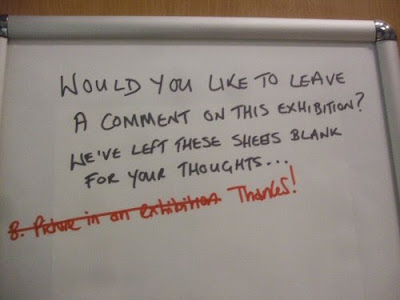
8. Picture In An Exhibition.
Life In the middle of all the excitement last week, I received word that one of my photographs had been selected to appear in an exhibition for the Liverpool Echo's flickr group. The private view was this evening. Well private(ish). It's in the atrium at the Echo building, a huge glass and metal structure that resembles habitation areas in the underrated Michael Bay actioner The Island. Here is my picture as presented by the Echo's design team:

We were given badges to wear, which helped to identify who else was part of the group. Unlike Twitter, flickrers tend to use their own photos to identify themselves or other bits and bobs rather than their faces so there was less of the "Oh it's you factor" from simply regarding someone in the eye as happens at other web based gatherings like the Twestival. I still felt like a bit of a charlatan. The rest of the show is filled with amazing images of the city by people for whom this is a hobby and a love. I'm really just a happy snapper.
It is an unexpected pleasure to have a picture in an exhibition. Even though I know this blog is available for anyone to read, it feels less exposed than that photograph open to scrutiny by anyone passing through. I expect if you're a full time artist or photographer it's something you get used to very quickly. Like most people I do have a kind of imaginary list of things to do in life. Mine has two columns, the likely and the unlikely. It's always nice to be able to cross something off the unlikely column.

We were given badges to wear, which helped to identify who else was part of the group. Unlike Twitter, flickrers tend to use their own photos to identify themselves or other bits and bobs rather than their faces so there was less of the "Oh it's you factor" from simply regarding someone in the eye as happens at other web based gatherings like the Twestival. I still felt like a bit of a charlatan. The rest of the show is filled with amazing images of the city by people for whom this is a hobby and a love. I'm really just a happy snapper.

It is an unexpected pleasure to have a picture in an exhibition. Even though I know this blog is available for anyone to read, it feels less exposed than that photograph open to scrutiny by anyone passing through. I expect if you're a full time artist or photographer it's something you get used to very quickly. Like most people I do have a kind of imaginary list of things to do in life. Mine has two columns, the likely and the unlikely. It's always nice to be able to cross something off the unlikely column.

Watching all of Woody Allen's films in order: Zelig (1983)
Then Bought as part of the great HMV dvd splurge of 2004.
Now Though Woody frequently makes films with universal themes, few have quite the rolling pertinence of Zelig. The story of a man who lacks his own individuality, apparently appropriating the psychological and genetic make-up of the person standing next to him because he feels as though he needs to fit in, it speaks directly to everyone from the child in the playground who subsumes themselves in a chosen subculture in order to make friends to the office worker who doesn’t miss soap operas or watches the football so that they have something to talk with their colleagues about (even though they lack an interest in either). The film’s direct example of this is the indoctrination of the German people into fascism.
In the modern age, as I enunciated in my fearful essay about Things White People Like, we’re all Zeligs intellectually hoovering up different areas of culture, assuming trendy political tastes or dressing alike. The process isn’t as extreme as Leonard; if we stand next to a hipster on the bus we don’t automatically grow two day old stubble (or cropped hair if you’re a girl), start drinking lattes and reading MAKE on our iPad. It’s a more gradual process, and unlike the human chameleon’s malady, it’s contagious and we give it euphemisms like “being fashionable” or “ahead of the curve” (even though someone will have been at the front of that long chain, usually Ann Wintour or an advertising executive – assuming they’re different things).
It’s something Woody was very aware of. In the Bjorkman intervuiew he’s far more interested in this philosophical layer than the technical achievement of producing this entirely convincing mock documentary whose authenticity has grown with age. He briskly bats aside questions about what he and Gordon Willis did to the footage to make it look as broken and “re-discovered” (20s lenses, deliberate negative scratches) but then offers this long paragraph on his inspiration:
”I think it’s a personal train in everybody’s life. It began in Zelig’s life when he said that he read Moby Dick. And you often find this with many people. Somebody asks, “Have you read this or that?” and the other one says, “Yeah, yes, of course,” even if he hasn’t. Because they want to be liked and be part of the group. I wanted to make a comment with the film on the specific danger of abandoning one’s own true self, in an effort to be liked, not to make trouble, to fit in and where that leads one in life with every aspect and where that leads on a political level. It leads to utter conformity and utter submission to the will and requirements and needs of a strong personality.”Shot simultaneously with A Midsummer Night’s Sex Comedy it’s another expression of Mia’s range this closeted psychologist far removed from the corseted temptress who managed to seduce three different men in the country. But her presence is much stronger than Allen’s – Zelig exists largely through exposition and photographs and it’s a quiet victory that the director is able to create such a sympathetic fictional character without any of the usual fictional narrative tricks. He even employs a third person narrator. Imagine Forrest Gump without the framing bench device. This is risky stuff.
What increases legitimacy of the fiction is the participation of real figures mixed with amateur actors playing the older versions of Zelig et al in contemporary colour footage reflecting backwards. Lilian Gish was apparently shot but not used for some reason, but Susan Sontag is there, the feminist giant gamefully and convincingly offering some pop psychology about this fictional figure. But it was fifteen years after perhaps her most famous quote (every intellectual has one): "Mozart, Pascal, Boolean algebra, Shakespeare, parliamentary government, baroque churches, Newton, the emancipation of women, Kant, Balanchine ballets, et al. don't redeem what this particular civilization has wrought upon the world. The white race is the cancer of human history." If ever there was a sentence requiring an update …
Oscars 2010 Results.
Film Here are the ratified results as confirmed by our adjudicator:
Actor in a supporting role6/23 or 38% Significantly the Avatar sweep I was predicting didn't take place. Congratulations to Kathryn Bigelow.
I said: Matt Damon in Invictus
Oscar said: Christoph Waltz in Inglourious Basterds
Animated feature film
I said: The Princess and the Frog
Oscar said: Up
Music (original song)
I said: Take it All, from Nine by Maury Yeston
Oscar said: The Weary Kind, from Crazy Heart, by Ryan Bingham and T Bone Burnett
Writing (original screenplay)
I said: Inglourious Basterds (Quentin Tarantino)
Oscar said: The Hurt Locker (Mark Boal)
Short film (animated)
I said: A Matter of Loaf and Death
Oscar said: Logorama (Nicolas Schmerkin)
Documentary (short subject)
I said: The Last Truck: Closing of a GM Plant (Steven Bognar and Julia Reichert)
Oscar said: Music by Prudence (Roger Ross Williams and Elinor Burkett)
Short film (live action)
I said: Miracle Fish
Oscar said: The New Tenants (Joachim Back and Tivi Magnusson)
Makeup
I said: Star Trek (Barney Burman, Mindy Hall and Joel Harlow)
Oscar said: Star Trek (Barney Burman, Mindy Hall and Joel Harlow)
Actress in a supporting role
I said: Maggie Gyllenhaal in Crazy Heart
Oscar said: Mo'Nique in Precious
Art direction
I said: Avatar (art direction: Rick Carter and Robert Stromberg; set decoration: Kim Sinclair)
Oscar said: Avatar (art direction: Rick Carter and Robert Stromberg; set decoration: Kim Sinclair)
Costume design
I said: Coco Before Chanel (Catherine Leterrier)
Oscar said: The Young Victoria (Sandy Powell)
Sound editing
I said: Avatar
Oscar said: The Hurt Locker
Sound mixing
I said: Avatar
Oscar said: The Hurt Locker
Cinematography
I said: Avatar (Mauro Fiore)
Oscar said: Avatar (Mauro Fiore)
Music (original score)
I said: Avatar (James Horner)
Oscar said: Up (Michael Giacchino)
Visual effects
I said: Avatar
Oscar said: Avatar
Documentary (feature)
I said: Burma VJ (Anders Østergaard and Lise Lense-Møller)
Oscar said: The Cove (Louie Psihoyos and Fisher Stevens)
Film editing
I said: Avatar (Stephen Rivkin, John Refoua and James Cameron)
Oscar said: The Hurt Locker (Bob Murawski and Chris Innis)
Foreign language film
I said: The Milk of Sorrow (Claudia Llosa, Peru)
Oscar said: The Secret in Their Eyes (Juan Jose Campanella, Argentina)
Actor in a leading role
I said: Morgan Freeman in Invictus
Oscar said: Jeff Bridges in Crazy Heart
Actress in a leading role
I said: Carey Mulligan in An Education
Oscar said: Sandra Bullock in The Blind Side
Directing
I said: The Hurt Locker (Kathryn Bigelow)
Oscar said: The Hurt Locker (Kathryn Bigelow)
Best picture
I said: The Hurt Locker
Oscar said: The Hurt Locker
Irony Again.
Life The saga/soap opera/something that happened of my televisions has moved on again. The 32” Toshiba, the one which I bought at Richer Sound last Monday, developed a fault. Several faults in fact:
- On the night I bought it, I switched between an AV channel and ordinary television. The sound from the first played over the other. Which was a bit disconcerting if thematically interesting because one was broadcasting a documentary about Africa and the other Deal of No Deal. But I assumed it was just first night jitters until ...
- A weird creaking noise whenever the television was turned over twenty on the volume control.
- The television visibly vibrated whenever anything bassy happened which was almost all the time because my parents watch acronym drama a lot (CSI, NCIS).
- It took ages to changing channels, sometimes waiting ten seconds before providing a new picture.
- The EPG failed pretty much all of the time, often only suggesting programmes on other channels.
- By the end of the week the signal would cut out altogether for long stretches, notably last night for ten minutes.
I decided to cut my losses. I took the television back to the shop this morning. I explained all of this to the gentleman behind the counter and asked for a refund.
I received the refund.
My parents are again watching their 26” Grundig television. They’re very happy. Mum said: “That other one was just too big ...”
- On the night I bought it, I switched between an AV channel and ordinary television. The sound from the first played over the other. Which was a bit disconcerting if thematically interesting because one was broadcasting a documentary about Africa and the other Deal of No Deal. But I assumed it was just first night jitters until ...
- A weird creaking noise whenever the television was turned over twenty on the volume control.
- The television visibly vibrated whenever anything bassy happened which was almost all the time because my parents watch acronym drama a lot (CSI, NCIS).
- It took ages to changing channels, sometimes waiting ten seconds before providing a new picture.
- The EPG failed pretty much all of the time, often only suggesting programmes on other channels.
- By the end of the week the signal would cut out altogether for long stretches, notably last night for ten minutes.
I decided to cut my losses. I took the television back to the shop this morning. I explained all of this to the gentleman behind the counter and asked for a refund.
I received the refund.
My parents are again watching their 26” Grundig television. They’re very happy. Mum said: “That other one was just too big ...”
Trigger's Broom Again.
Music We haven't docked at this port for quite some time, but it's late and I'm keeping myself distracted from the Oscars not being on terrestrial television again.
(1) Sweet 7 has been greeted by predictably lukewarm reviews, most noting the fact that there's a massive variance between having the "Sugababes" name plastered on the front in comparison to the content and the prevalence of Autotune. Sadly (at least for my anti-Murdoch stance) The Time's one-star opus best captures the mood:
(2) Rich Pelley interviewed 4.0 for The Guardian's Guide's One Last Thing ... page and asked them that question:
(3) And of course, there's Mutya's application to gain copyright on the band name. 4.0 for their part are saying that it's unlikely to succeed because Universal have ownership of the name but CMU Music say they've done some legwork and found no copyright record in the UK or European trademark offices.
The wikipedia has this to say on the subject of where the name came from in the first place:
Here's the application at the intellectual property office. It ties up everything that's been done in the name of the Sugababes on any media ever and it looks to me as though Mutya or her management or someone connected has bothered to go and check up on the copyright of the name, noticed that there wasn't one and put the papers in, naming Siobhan and Keisha too. Good show.
Finally, here's Czechoslovakian singer Tereza Kerndlová-Zhášíš rendering Run For Cover in her native language:
(1) Sweet 7 has been greeted by predictably lukewarm reviews, most noting the fact that there's a massive variance between having the "Sugababes" name plastered on the front in comparison to the content and the prevalence of Autotune. Sadly (at least for my anti-Murdoch stance) The Time's one-star opus best captures the mood:
"Sugababes in 2010 are a pale, karaoke imitation of the glory days. Regrettably, if miraculously, the latest line-up remained the same as we went to press."Youch. 4.0 have apparently been seen singing One Touch material on tour which offers a curious fascination though I can't imagine it's much more authentic than No Way Sis covering I'd Like To Teach The World To Sing.
(2) Rich Pelley interviewed 4.0 for The Guardian's Guide's One Last Thing ... page and asked them that question:
If you buy a broom, then you replace the handle, then you replace the brush, is it the same broom?As Geoffrey Wheeler might say on Winner Takes All, "We have a difference of opinion here, Jimmy", with Heidi and Amelle falling into the trap and Jade cottoning on slightly but ultimately failing to grasp the poignancy that in this case, the broom isn't doing the same job.
All: No!
Heidi: Cos it's got a different handle and a different head!
Amelle: So it's definitely a different broom!
Jade: You might change the handle and brush, but it's still a broom! It does the same job!
(3) And of course, there's Mutya's application to gain copyright on the band name. 4.0 for their part are saying that it's unlikely to succeed because Universal have ownership of the name but CMU Music say they've done some legwork and found no copyright record in the UK or European trademark offices.
The wikipedia has this to say on the subject of where the name came from in the first place:
"Their name originates from Buchanan and Buena's school nickname, Sugar baby, dubbed by Tom as The Sugababies during the recording of the album. When the group members were aged fourteen, London Records offered them a record contract, and their name was tweaked to the more mature Sugababes."Which I'd imagine will all be mentioned in court, though I'm surprised also that London Records didn't list the name either when they were promoting the band. Just before they dropped them.
Here's the application at the intellectual property office. It ties up everything that's been done in the name of the Sugababes on any media ever and it looks to me as though Mutya or her management or someone connected has bothered to go and check up on the copyright of the name, noticed that there wasn't one and put the papers in, naming Siobhan and Keisha too. Good show.
Finally, here's Czechoslovakian singer Tereza Kerndlová-Zhášíš rendering Run For Cover in her native language:
Watching all of Woody Allen's films in order: A Midsummer Night's Sex Comedy (1982)
Then Back before Lovefilm entered my life to show me the light, I was terribly excited when a Blockbuster Video opened on Edge Lane in Liverpool in the late nineties, so much so that I’d catch a bus from the city centre after work to hire a couple of videos and thence another bus from there home, a trip of at least an hour and a half. The selection seemed wider than the little shop on Allerton Road, far more “World” and “Independent” cinema, bigger back catalogue. It’s from this august selection I procured A Midsummer Night’s Sex Comedy on VHS overnight.
Now Not one of my favourite Woody Allen films, I’d never quite been able to put my finger on exactly why A Midsummer Night’s Sex Comedy doesn’t quite work. All of the elements are available. A Shakespearean connection. The music of Mendelssohn beguilingly drifting across honey hewed settings. Mia at her most attractive, her angular face resembling a Klimpt painting, before she spent much of the rest of the decade playing doudy housewives and the put-upon. Woody, with his funny inventions. The downfall of an intellectual because despite his brain he’s still ruled by his pants. Some farce.
Watching the film again on dvd, even on my relatively large screen in a darkened room, one reason suggested itself to me. There is a certain group of films, not as many as you’d think, that don’t work on television, in the home, even on dvd. One3 example is Pulp Fiction. The best experience I had with Tarantino’s postmodern throwback was on the opening night in a Hyde Park Picture House in Leeds packed with students laughing along with the film. Every occasion since then has felt slightly stale somehow. Similarly the best experience I had with Tarkovsky’s film Stalker was sitting on the floor of a seminar room at university with my classmates watching it from under coats and duvets.
A Midsummer Night’s Sex Comedy must be one of those films. It’s nothing to do with the technology; it’s to do with the atmosphere of cinema. This is the sort of film that works best projected onto a giant screen, hopefully in one of those dilapidated old independent cinemas with the smell of a thousand similar night captured in the chairs and carpet, and with an audience of like minded people laughing at the jokes, falling silent for the moments of magic realism as the dream-catcher or whatever it is, does its work. Laughing together when Tony Roberts and José Ferrer bump into each other as they wait for each other’s partner by the brook. I missed that.
Subscribe to:
Posts (Atom)