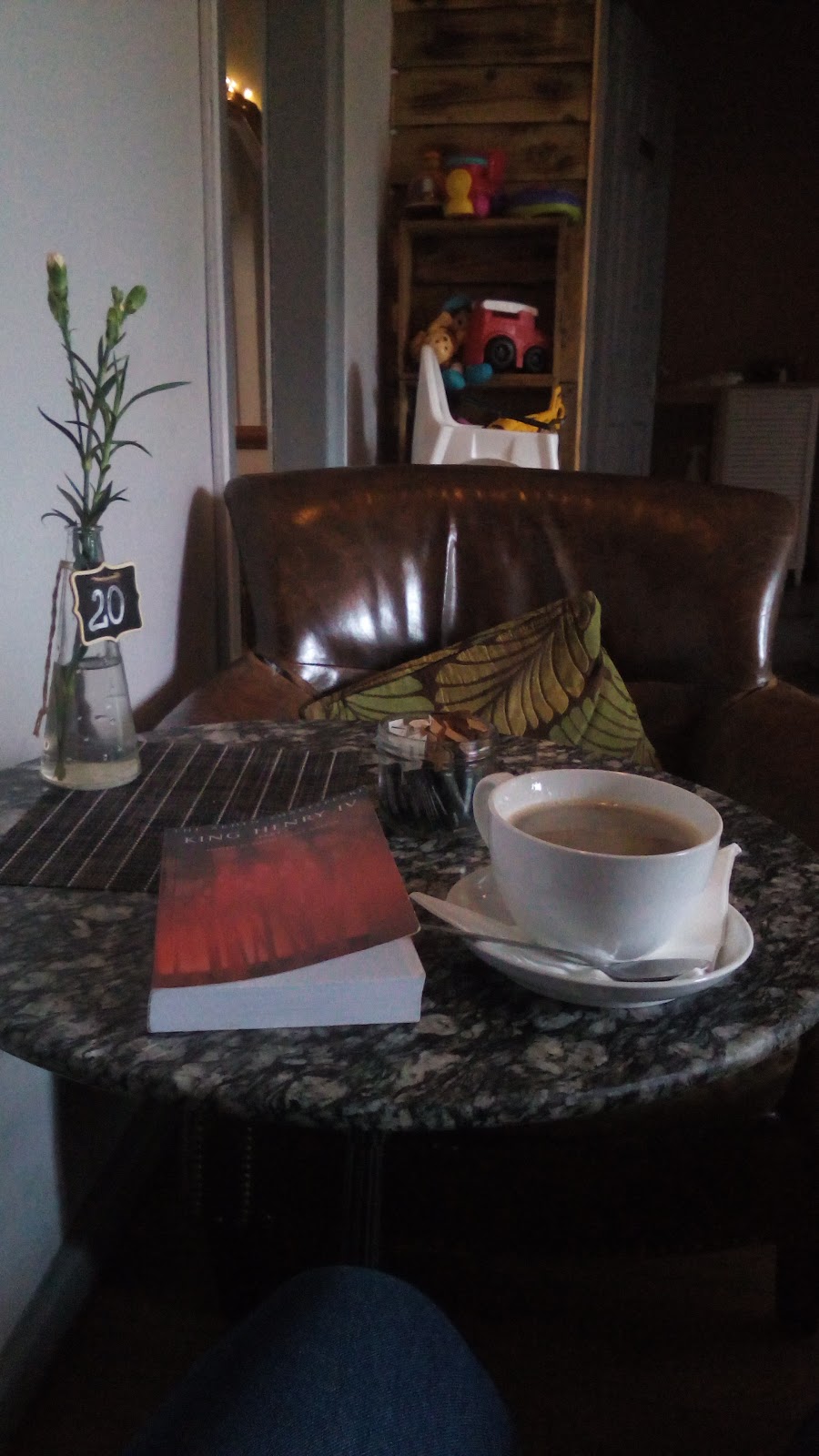
Books Sometimes the editors in these Arden Shakespeare either rebel against the typical format or at least offer an alternative to orthodoxy. In the appendix bout sources, David Scott Kastan notices "many serious editions of Shakespeare, like the Arden series, have lengthy discussions devoted to the sources of the plays, and often reprint substantial sections of Plutarch or Holinshed or other texts that Shakespeare clearly read and transformed into drama" before heading off into a few pages of essentially saying there's actually little point because no one can be really sure beyond the obvious examples.
The editor could as well be commenting on this volume's narrative predecessor Richard II which does all those things. Kastan on the other hand, assumes that we know these other books exist and will probably already have access if we're studying the play. So rather than simply regurgitating their arguments at length instead investigates the topics he's most interested in. That makes this one of the more readable Ardens as it keeps the purer lit-crit to a minimum and instead delves into the history of the play and how it fits within the context of theatrical and literary history.
He notes, for example, how the focus of the play has developed over time, from Henry Percy as the heroic figure, to Falstaff as the comedic headliner to the present moment when, thanks to the play usually being presented with the various other sections of this Henriad it's about the tortured relationship between father and son and the fight for legitimacy of both Henrys after the deposition of Richard. Which is one of the things I love about Shakespeare. Historically, for the most part, the texts haven't changed and yet they have the capacity to fuel our current interest in having drama with an emotional and intellectual depth.
How I deal with anxiety.
Life It's been a while. Yes, I still have anxiety but at the moment it isn't running my life. Lord knows, I have enough things to be worried about but between the drugs and other things, I'm feeling pretty solid. I've been added to the waiting list for a therapist so there's that to look forward to.
Earlier this evening, someone who isn't, a complete stranger who suffered an attack last night was asking mental health author Matt Haig for help and he threw the question open to his followers. In a dash, I sent her a flurry of tweets of the things which have helped me, so I thought I'd memorialize them here for my own future memory and in case you need some help too.
- Go see a Doctor, get drugs. I began in Sertraline about three years ago and while I do still have attacks, they're rarely with the impact or regularity.
- When an attack is happening talk to someone you love even if just by phone. Tell them. Take the sympathy and don't be too proud about it.
- Get a gravity/weighted blanket and sleep under it every night preferable on top of a sprung mattress. It's like sleeping in a hug. I used to have terrible anxiety dreams and wake up each morning with a pain in my chest. Not any more.
- Drink decaf, remove caffeine from your life. It's hard at first and you will get depressed about how limited the choice is, but eventually you'll accept that your mental health is more important.
- Exercise even if it's just walk places as much as possible. Depending on you mood, listen to a podcast or some music, but sometimes its good to do without and just go with the sounds of the life around you and pay attention to your environment. Try not to get inside your own head.
- Anxiety attacks rarely have a reason and although you might think that trying to rationalise them helps, you're probably just going to end up thinking about reasons why you should be having an attack which only increases the intensity.
The Ninth Book I've Read in 2020.
Books The above image isn't quite accurate. The Arden imprint has passed through numerous publishers over the years and my copy is from the Thomson days with their ultra conspicuous blue box on the spine. It's also a demonstration of how the third series has developed since they began publication in the 90s. The introductions generally complete within about a hundred or so pages and often don't bother with appendices. This begins with a hundred and seventy page introduction with a thirty five page textual discussion. The footnotes in the main text are often so extensive there's only room for a couple of lines of the actual text at the top of the page with another twenty pages of "longer notes" afterwards.
Is it possible to say I've read these books if I'm skipping the more overt literary criticism? My key interests are in the production and publication history, dating of the play and textual notes, so in this case the section on language went unread as did the pages about characterisation which seemed to head way off point. In the introduction, the author almost apologises for being an expert in their field having studied Richard II for decades but it's good that all of that knowledge has a place somewhere for those who're following in his footsteps. But I'm reading for pleasure as an adjunct to listening to the plays so perhaps I shouldn't feel too guilting about not wanting to read the line-by-line description of Shakespeare's deviations from Holinshead.
Who is the new Doctor and where does she come from?
TV As both Russell T Davies and Steven Moffat illustrated, the best way to get people talking about Doctor Who is to present the viewer with a huge mystery then leave them hanging. It's a version of the JJ Abrams mystery box, except with a pretty good idea that there's a plan which will result in something debouching towards an explanation.
The reception for the Chibnall era so far within the wider discourse once everyone became used to the idea of someone from Skelmanthorpe playing the Doctor has been pretty lukewarm. But this year has offered the one-two punch of the return of the Master and now a whole new Doctor, the first who's also played a neurosurgeon on Holby City.
Since Sunday night, there's been a definite shift back to the Bad Wolf days. We've all become Vroomfondel and Majikthise, the philosophers awaiting Deep Thought's ultimate answer in The Hitchhikers Guide to the Galaxy but with just a few weeks or months to wait rather than seven and half million years. Many, many websites are however cleaning up in the prediction business.
Ahem. Well, here my fan theory. Having already posted this on the bird based social media account, it's probably worth immortalizing here (depending on how your definition of "worth" goes). I should mention that this is based partially on versions of theories I've heard from a few people now (including @JayStringer). So this is an embellishment.
Where did the Jo Martin incarnation come from?
The Doctor was loomed/born and happily living on Gallifrey, regenerating now and then when a body is wearing a bit thin. But eventually the Doctor is called up for service to do a mission, possibly go back in time and decimate the Cybermen.
It goes badly, or at least so badly that the Time Lords want to cover it up. Post-mission he or she is at the end of a regenerative cycle, or indeed not but the Time Lords force the issue by getting he or she there artificially and the Doctor is given and starts a whole new regenerative cycle ("!").
As part of the process, he's regenerated into a Time Tot and his memory is either wiped or suppressed. So as far as he can tell and indeed anyone else, he's a fresh new Gallifreyan, his first life (which includes Jo Martin) completely forgotten. A timeless child.
All of which could explain why the Doctor loses her memory or senses after each regeneration even though most other Time Lords take it in their stride. It's a side effect of what was done to her - her mind and body has to recover its sense of self.
It's also why various interventions like the Watcher have been used along the way. Extra support is often needed to aid the regenerative process and even then, something often goes wrong and a mental cascade ensues (The Twin Dilemma, Pudsey Cutaway).
Why does she seem so different?
As for why the Jo Martin Doctor seems a bit more ambiguous and chippy, it's because unlike Hartnell and Capaldi who's connection to humanity eventually domesticates them, this Doctor only spends her time around Time Lords. You could almost say that she's more ruthless. Which in her case is literally true because she's gone from being Ruth to Ruth-less.
But why her TARDIS already a police box?
Assuming this wasn't a glaring continuity error, the earlier Doctor could already have been to London in the 50s or 60s so the TARDIS already has that shape embedded in its memory. It's confiscated and reconditioned when The Doctor is rebooted. The Clara fragment on Gallifrey somehow knows that which is why she points him towards it. Either that of the TARDIS's telepathic circuits subconsciously suggest it to her and she suggests it to the Doctor.
The box then eventually returns him to London via Quinnis so that it can inconspicuously turn back into a Police Box perhaps in an attempt to jog his memory - the telepathic connection indicate that there is something wrong with her thief. It then remains a police box not because the chameleon circuit is broken but because the TARDIS keeps that shape in constant hope that the Doctor will eventually remember their earlier life together.
Why doesn't she remember all this come The Doctor's Wife? Well, the TARDIS has been through a fair few traumas by then and so she's "forgotten" that he had a whole earlier history with the Doctor so as far as she can remember, Hartnell was the first.
But what about?
Yes, I know. If the earlier Doctor's been travelling somewhat too, how come "our" Doctor hasn't bumped into them before? Why isn't it The Eighteen Doctors? Well how about, what if the earlier regenerative cycle is "time locked" like the Time War to stop that happening, but when the Master destroyed Gallifrey he unpicked this time lock, causing these these two Doctors to meet.
The Eighth Book I've Read in 2020.
Books King John has been a favourite of mine since listening to ArkAngel's blistering audio recording which runs with the embryonic farce elements in the text and the satirical nature of the melodrama. Act four in particular surrounding the execution of the child and John's reaction thereof are pure Blackadder, as the confluences of coincidences work against him.
This Arden 3 ignores all of that (which to be fair could all be in my mind) and concentrates on the play's sources, linguists, varying fortunes in production and textual state. The text is incredibly readable, not least because acknowledges pop culture exists with references to Darth Vader and Stephen Colbert among others as points of comparison.
Generally thought of as one of Shakespeare's obscurities along with the likes of Timon of Athens, it nevertheless has the distinction of being the first to be put on film. The surviving minute and a quarter can be watched here. But it's a shame that the production analysis doesn't stretch to the BBC Shakespeare version. Casting Leonard Rossiter in the title role feels like a statement of intent.
This Arden 3 ignores all of that (which to be fair could all be in my mind) and concentrates on the play's sources, linguists, varying fortunes in production and textual state. The text is incredibly readable, not least because acknowledges pop culture exists with references to Darth Vader and Stephen Colbert among others as points of comparison.
Generally thought of as one of Shakespeare's obscurities along with the likes of Timon of Athens, it nevertheless has the distinction of being the first to be put on film. The surviving minute and a quarter can be watched here. But it's a shame that the production analysis doesn't stretch to the BBC Shakespeare version. Casting Leonard Rossiter in the title role feels like a statement of intent.
Fugitive of the Judoon.

TV For the past week I've been fiddling around with a Spotify playlist of hit songs in their original iterations, most of which aren't typically known for being the cover version that they are. So we have Bonnie Tyler's If I Could Turn Back Time, I-Ten's Alone and Isley, Jasper, Isley's Caravan of Love. Some of them are theoretically better than their successors, others found their proper muse in the rerecord. While World Party's She's The One became Robbie Williams's passionless clone, Labi Siffr's It Must Be Love is fine but Madness made it a stellar undertaking for the ears.
Which brings us to tonight's Doctor Who and the revelation that the Doctor is the Doctor but that there was an earlier Doctor who might be from her past who is also the Doctor. The Doctor's reaction to this was rather the same as when we discovered that Torn by Natalie Imbruglia wasn't just a cover version, it was a cover version of about three different songs one of which is Danish and called Burned instead. It's The Grudge or Ringu of Scandipop. Confused? Imagine how my brain was as it parsed through the possibilities of who this new incarnation of the Doctor is and why she exists.
The franchise has toyed with the notion of pre-Hartnell Whos before. On television, greet all of the production team faces pulled from Baker T's consciousness in The Brain of Morbius, most often rationalised as being the previous lives of the antagonist, when what Robert Holmes et al were getting at is pretty clear. The Wilderness years promoted the idea of the Other who along with Rassilon and Omega founded Time Lord society and eventually became the Doctor after being "re-loomed". The Wilderness Years were a strange place. Even the Doctor seems to have forgotten she destroyed Gallifrey herself back then.
What if it's more complicated than that? What if we're entering Unbound territory and she's actually from an alternate reality? What if Jo Martin's incarnation is from a different dimension, or else that the Doctor herself and her family have entered that alternative reality at some point, perhaps in the aftermath of an earlier story, but just haven't noticed. Which would explain the dissolution of UNIT and Torchwood being a revelation to her and why this version of the Master seemed to run counter to what we know about the person and their fate at the close of Capaldi's final season.
But it's that kind of episode and how great that we've finally landed here with a story which finds the sweet spot of Daviesy Moffat revelation and question, stuffed with continuity references and a general sense of finally feeling like its part of the same show we've enjoyed since at least 2005, rather than the nervy disjointed stranger taking a fag break in the alleyway round back. A continuity dump chock full of more back references than a Big Finish McGann boxset perhaps, but it's entirely pleasurable to see Jodie actually being the protagonist of her own show again and more's the point being that Time Lord with its past.
Although the social media publicity beforehand said enough that we knew the Judoon would be a sideshow in tonight's story and that someone would be returning, to then offer up Captain Jack Harkness as a secondary red herring is really ballsy. Barrowman bloody loves this stuff so it's also a pleasure to see that he didn't do or say anything to invalidate James Goss's intricate audio continuity so it's entirely open as to whether this is happening during any of his sojourns off-Earth. I'll leave it to costume nerds to work their magic on any clues there. But Captain Jack's back and will no doubt be back again. Squee.
This is in danger of becoming a proper review of the kind I said I wouldn't write any more instead of a fangasm so I'd better stop in the next paragraph. There's dishes to wash and I need to get ready for visiting Lichfield tomorrow (which amounts to making sure my phone and iPod are charging and remembering to put my Arden 3 copy of King John in my bag to read on the train). I booked this trip during a atmospherically mild moment last November, little thinking that January would be this horrible. The only good news from the BBC Weather page is a 15% chance of precipitation. But the wind chill is 3 degrees centigrade. Brrr.
Anyway, it's just a pleasure to be able to sit in front of Doctor Who for once and it not feel like the franchise's equivalent of the liquid dispensed by Nutrimatic Drink Dispenser to Arthur Dent on the Heart of Gold. On the one hand it could be seen as a retreat from the grand experiment in Jodie's first season but on the other it's the sort of thing which brings in the punters. There's a reason Shakespeare's arguably most derivative play is called As You Like It. Enjoy the rest of the evening. Let me end on one final revelation. Young at Heart by The Bluebells was originally recorded by Banarama. The walls of reality are truly crumbling.
The Seventh Book I've Read in 2020.
Books A fine summation of the play. Julius Caesar is textually uncontroversial - it only exists in the First Folio and any Quartos are later printings based on that single text. The text itself is printed well in F1 in comparison to some others which suggests it was based on the prompt book.
But the editor still finds something to write about as he stabs into the bonkers traditions introduced by the earliest editors like Rowe, Pope and Theobald all of whom brought "corrections" to perfectly reasonable elements of the play because they literally assumed Shakespeare must have been in error due to ignorance.
Perhaps the most fascinating of these is in relation to the sleepy Brutus on the eve of the assassination asks his servant if the following day is the "first of March?". Lewis Theobald when preparing his version of the play in 1733 amended this to "Ides of March" and it stuck.
But this isn't a mistake, Shakespeare knew exactly what he was doing. On the one hand he's showing how Brutus has other things on his mind and literally needs to be reminded of the actual date (wall planners not having been invented yet), and it's quickly confirmed to him that the 15th is the following the day, the Ides.
The writer is also commenting on a contemporary issues. This was around the time that the Julian calendar, initiated by Caesar himself was being replaced by the one we know from Pope Gregory XIII and with different religions following different calendars, such confusion would also be on the minds of the viewer.
But the editor still finds something to write about as he stabs into the bonkers traditions introduced by the earliest editors like Rowe, Pope and Theobald all of whom brought "corrections" to perfectly reasonable elements of the play because they literally assumed Shakespeare must have been in error due to ignorance.
Perhaps the most fascinating of these is in relation to the sleepy Brutus on the eve of the assassination asks his servant if the following day is the "first of March?". Lewis Theobald when preparing his version of the play in 1733 amended this to "Ides of March" and it stuck.
But this isn't a mistake, Shakespeare knew exactly what he was doing. On the one hand he's showing how Brutus has other things on his mind and literally needs to be reminded of the actual date (wall planners not having been invented yet), and it's quickly confirmed to him that the 15th is the following the day, the Ides.
The writer is also commenting on a contemporary issues. This was around the time that the Julian calendar, initiated by Caesar himself was being replaced by the one we know from Pope Gregory XIII and with different religions following different calendars, such confusion would also be on the minds of the viewer.
The Sixth Book I've Read in 2020.
Books Not a play I'm that familiar because it's also not a play I particularly like so I skimmed the lit crit section and went straight for the production history and textual examination both of which were as fascinating as these things tend to be. Was the play produced in Shakespeare's lifetime or meant to simply exist as a reader's addition? The length of the speeches and the more ponderous approach to scene structure would suggest so. But why so many difference between the Quarto and Folio with the addition stage directions and revisions of language? Did it in fact receive an appearance at the Inns of Court? Onward to Julius Caesar.
The Fifth Book I've Read in 2020.
Books With the The CW's tv adaptation in the air, and in the wake of finishing Doomsday Clock, I decided it was about time to read the original comic. Whereas the Watchmen sequel was designed to acknowledge the existence and validity of all the various universes and timelines across DC's history making all of it "canonical", it's quite stark to find a comic designed to do the exact opposite, to dump out decades of continuity in order to streamline what was being published. Inevitably, I prefer the former which implies that every universe, across media, is valid, the various multiverses part of a metaverse which contains all of fiction, or at least that's how I interpret it.
The scope is incredible, breathless and for all the suggestion that this was a self-contained story, it's sure to be a comics fan who'll get the most out of the references. Nevertheless, I can appreciate the import of having the various incarnations of Superman working together and characters who've previously only had a minor focus in the various comics being thrust to centre stage. Are there too many characters? Probably and often the chaotic storytelling is difficult to follow. Yet it is still incredibly exciting to see all of the various villains teaming up and enjoy the immensity of the battles. It'll be interesting to see how the cee-dub interprets all of this.
Orphan 55.
TV OK, fuck it. On Sunday afternoon I offered a few tweets suggesting I wasn't going to review that night's episode of Doctor Who. That it would be good just to sit and watch it without having one eye on the ensuing review. Well, friends, I've tried. I have. Look, it's even the middle of the week. But damnit, the problem with being handed an episode as ruddy awful as Orphan 55, is that it generates opinions and they sit rattle around in your brain desperate to get out. So here we all are. It's Tuesday night and I'm typing away at 10:15pm while Google Photos syncs with my phone. As Mark Kermode says on the Friday film programme he contributes to when some listener writes in to talk about the spiritual journey which resulted from them seeing some turd he had a good rant about the week before, "I'm very pleased that you enjoyed it but I disagree." If you liked Orphan 55, good for you. My first review of Fear Her was positive too.
It's not just that Orphan 55 doesn't work as an episode. It's a comprehensive thesis on what's gone wrong with television Doctor Who in general. Spyfall suggested an upswing in quality. with the current producers having some sense in what wasn't working after their first season. But this almost felt like they'd read my year end survey and done the exact opposite. We're back to the gossamer version of the Thirteenth Doctor with generic Doctor dialogue including insults which seem more suited to her predecessor, her only true emotional beat when her friends notice she's slightly out of sorts after last week's episode. Once again we have a handful of underwritten characters because the script has to also service an overcrowded TARDIS in a limited episode duration and the Doctor also spends a lot of the episode reacting and offering explanations for stuff. Plus some hopelessly generic rubber monsters lumbering around, their lighting trolling Mat Irvine with its illumination.
When he infamously appeared on Open Air, Chibbers said, "“It doesn’t seem to have much to it, it hasn’t improved that much since it went off the air. It could have been a lot better; it could have been slightly better written, especially the last story. [...] It was also very clichéd, it was very routine running up and down corridors and silly monsters.” When he took over Doctor Who, one hope amongst many was that these words were like the drums inside Mr Saxon's head, throbbing along at the back of his mind so that he wouldn't and couldn't be capable of creating anything like that. Yet here's an episode which is exactly that, very cliched, very routine with lots of running up and down corridors and as I said, some very silly monsters. This third paragraph could be seen as belabouring the point already made in the second, but if he's happy to sign off on a script as repetitious as Orphan 55, then I'm confident enough to follow his direction.
Accusing Doctor Who of cliche, as we've discussed before, is a bit of a non-starter. Like most long running sci-fi franchises, it's forever eating its own narrative tails. But jesus, another one about the Doctor going on holiday by mistake? In an oasis-like resort on an otherwise desolate planet? Where everything goes wrong? And everyone on the TARDIS crew is surprised including the Doctor. Part of the artifice of the show to be sure, but having sat through the equally subpar Nightmare in Silver, another episode which has its fans (mostly fans of its author) but is equally bobbins, I have to wonder, has the Doctor ever had a vacation when everything went right? True, we wouldn't necessarily want to sit through fifty odd minutes of the Doctor and her fam on sun loungers flirting with each other, but given what ranks as a ratings success on ITV these days, it would at least look like part of the zeitgeist.
The show's second crime - the underutilisation of Laura Fraser. Regular readers will know that for years I've been desperate for the star of Virtual Sexuality to appear on Doctor Who. Way back, given her association with RTD following luminous turn on Casanova, that she might have been Billie or Freema's replacement or turned up as a one off companion in 2009, but then time took over and always looked doubtful and now here she is playing generic security officer with a secret, mostly called upon to frown or look guilty for the half hour she's in the episode. Fraser does this very well, but she's so much better than this material, as are all of the guest cast. I was never a fan of The Inbetweeners, but it's pretty clear that James Buckley is a pretty big hire and yet he spends most of the thing being a rubbish mechanic who doesn't listen to his son. In a green wig.
The problem is, like I said, the duration of the story isn't long enough to develop the characters beyond the thinnest of stock elements because so much time is spent with the regular companions. Back in the old plus one days, remember how even what should be a fairly bland character like Father Octavian in Flesh and Stone received the incredibly poignant death scene because somehow amid the many dispirit elements we understood where he was coming from? That's because between the Doctor, Amy and River we spent time with him amid the shouting. Granted thumb sucking Bella resonates more here because of her interactions with Ryan, but do we truly care when she dies having been handed the hoariest of old family familiarity twists? Apart from anything else, do we need another Ryan-centric story like this when Yaz is still right there? Having three extras was fine in the Hartnell and Davison eras because of story duration. Now it squeezes everything else out.
But it doesn't help that the supporting characters aren't especially well written. One of the most fondly remembered characters since 2005 is Raffalo, the blue maintenance engineer in The End of the World and she only appeared in one scene which was only included because the episode was underunning. Like Rose, she came from the service industry end of the workforce and illustrated to the companion that such social issues still existed in the far future. It's unfair perhaps to compare Russell T Davies to someone who's only previous screen credits were a couple of episodes of Skins and otherwise mostly in theatre were he seems to have directed more than written but It Takes You Away was my favourite episode of last year so it's a shame to see Ed Hime lose it so conclusively here. Luthor writer Neil Cross gave us both The Rings of Arkanoid and Hide so no one's perfect, but the character work feels like a first draft which has been rushed into production before anyone has had a proper thought about how they fit and reflect the overall story.
An example of how poorly this develops is in the couple of Vilma and her husband Benni. You know what I'm going to say here. In a scene which glances towards and RTD script, Yaz cluelessly interrupts Benni's proposal but beyond that we barely have much time with him before he's offed off screen after a death plea. Despite the best efforts of Vilma actress Julia Foster (who I know best from playing Margaret of Anjou in Jane Howell's stunning BBC Television Shakespeare version of the Second Henriad back in the 80s) because we don't know (a) what exactly has been happening with the very much not aliens and (b) haven't seen him for most of the story, the moment doesn't land. There's plenty here and elsewhere to suggest that the episode overran considerably and plenty of connecting tissue in character terms went missing in the cut in favour of the often poorly structured action sequences (it's getting late).
But back to (what there is of) the story. It's probably unfortunate that Trial of a Time Lord was re-released just a few months ago and it's probably pretty ambitious to assume that a lot of the kids watching will have seen The Mysterious Planet and made the connection between Ravalox and this hunk of dirt but surely a few more of them will have been working their way through the rest of nuWho now its available perpetually on the iPlayer and Netflix and wondered whether humanity develops into these dregs (gettit?) before or after they've become the Toclafane. Like the destruction of Atlantis, the fate of humanity is one of Doctor Who's returning story ideas, but to go back there in such a perfunctory manner doesn't do us or the message of the episode any favours. Tellingly the TARDIS Databank episode for Humans hasn't been updated with this new data yet and but does find room for the Faction Paradox spin-offs.
Then, oh god, the final speech. Now, I've seen this called the Thirteenth's iconic moment and its true, Doctor Who has had its spade naming orations when the subtext becomes text. But the reason the likes of "When you've killed all the bad buys ..." speech from The Zygon Inversion work is because they're usually addressing an antagonist and are part of the Doctor's own battle. After an episode when the environmentalist themes have already been enunciated as best they can under the circumstances, this Gallifreyan TEDx talk felt about as natural as Tasha Yar's drugs are bad PSA to Wesley in TNG's Symbiosis. As Paul Whitelaw tweeted yesterday, "The problem with last night's Doctor Who wasn't that it made a political statement - Doctor Who has done that numerous times since the early '70s. The problem was this: an inarguably sound message about climate change was crudely tacked on to an absolute shambles of an episode." Rosa feels a universe away.
Weirdly the one element of the speech I have less of a problem is how this global catastrophe can be averted. As we heard over and again in the Moffat era, time can be rewritten. There have been divergent moments like Cold Blood which almost cause global repercussions not to mention "Doesn't she look tired" wiping out a golden age for UK politics and heralding in Saxon as well as the wasteland the Doctor presents to Sarah Jane in Pyramids of Mars before they brazen their way into winning. We know the planet blows up anyway some time after it becomes Ravalox. I've been arguing for years that the universe reboots itself every time a TARDIS lands and the Doctor opens the door so what we saw in Orphan 55 is one possible future, although I'm not sure what the Doctor's three friends can specifically do themselves. Perhaps Jodie should have just broken the fourth wall and been done with it. Night, night.
The Fourth Book I've Read in 2020.
Books Via internet purchases and library lending, I now have complete set of Arden 3s so that's me set for reading material for the next few months. Already patterns are emerging at least in terms of my interest. The sections of these books I'm finding easier to approach investigate the textual origins and editing of the plays, sources, production histories and dating. The pure literary criticism is hard to take, although this edition resourcefully reflects it by providing performance examples.
This edition's editor Juliet Dusinberre offers a very persuasive argument that As You Like It was originally performed at court on Shrove Tuesday in 1599 based, amongst other things, on Touchstone's line about pancakes and mustard which she argues would only have been even half funny if the crowd were eating exactly that and a contemporaneous epilogue jotted down by an audience member which offers a logical replacement for the usual if they were addressing the Queen.
There's also a fascinating discussion in the appendices about which actor in the original company played each role. Shakespeare was writing them with a particular actor n mind so it's possible to extrapolate casting based on external evidence from other play texts and role calls in other publications. Depending on where you fall with the dating, Touchstone was either played by Will Kemp or Robert Armin. The former was more clownish and slapstick, the latter droll.
It's still sobering to reflect that Rosalind, who has the largest number of lines in the play and more than most female roles across Shakespeare was played by a fifteen year old boy. The introduction also reflects on how they would have had to cope with the complexity of being a boy actor playing a woman or pretends to be a man who then pretends to be a woman. Whoever that was must have been very gifted indeed.
This edition's editor Juliet Dusinberre offers a very persuasive argument that As You Like It was originally performed at court on Shrove Tuesday in 1599 based, amongst other things, on Touchstone's line about pancakes and mustard which she argues would only have been even half funny if the crowd were eating exactly that and a contemporaneous epilogue jotted down by an audience member which offers a logical replacement for the usual if they were addressing the Queen.
There's also a fascinating discussion in the appendices about which actor in the original company played each role. Shakespeare was writing them with a particular actor n mind so it's possible to extrapolate casting based on external evidence from other play texts and role calls in other publications. Depending on where you fall with the dating, Touchstone was either played by Will Kemp or Robert Armin. The former was more clownish and slapstick, the latter droll.
It's still sobering to reflect that Rosalind, who has the largest number of lines in the play and more than most female roles across Shakespeare was played by a fifteen year old boy. The introduction also reflects on how they would have had to cope with the complexity of being a boy actor playing a woman or pretends to be a man who then pretends to be a woman. Whoever that was must have been very gifted indeed.
Elizabeth Wurtzel has died.

Life The Guardian has a lengthy news story. As does Above The Law. NPR too.
As you can imagine I'm pretty crushed. The short version of how I'm feeling now:
Fuck cancer.
Elizabeth Wurtzel was someone who loomed very large for me, in my life and writing. Her fearless, raw openness and bravery in pushing the barrier in expressing the inexpressible, which often got her into trouble.
She was a constant reminder that it's ok to admire someone while not agreeing with everything they say, which continues to be especially true in this time of polarised and polarising opinions.
I'll take me a few days to some to terms with all of this, but since she has been such an important person to me, I thought I should write something, so here's my Elizabeth Wurtzel story. Nothing earth shattering but an important moment for me.
For some unknown reason, I was one of the three hundred and twelve people she followed on Twitter. She began sometime in the late oughts when the social network still felt like a nightclub with a few million punters, possibly when I included her in a #followfriday.
We chatted a few of times over the following couple of years and given how much of a fan I already was of her work, it was always a bit of a jolt when I saw her replying to one of my tweets, especially in 2009 when she asked, "Grew up watching Doctor Who on Saturday mornings with my dad, who happens to also be a Trekkie. Is there some UK revival?" after I'd posted a link to a review.
Around that time Starbucks has announced their new instant Via coffee. It had been in development for a while and as this short piece of The Seattle Time explains, its inventor Don Valencia died of cancer a few years before it was rolled out, "Via" being a play on his surname as a tribute.
Like I said, fuck cancer.
Anyway at some point during its launch, after seeing it mentioned on Starbucks Gossip, I lamented on Twitter that it was only going to be available in the US and wondered when and if it would migrate over here.
Within moments, I received a DM from Elizabeth Wurtzel saying that if I gave her my address, she'd see if they had any in the Starbucks near her work and she'd send me some.
I did and evidently she did, because a week later an envelope arrived from Boies Schiller Flexner, the law firm she worked for as, eventually, Director Of Special Projects. Inside was a compliments slip and three or four Via sachets in the bottom (they were being sold singly at the time).
Which meant I was able to try Via a few months ahead of the rest of the UK.
I still have the envelope and slip somewhere, because when you receive correspondence from people you admire, that's just the sort of thing you do.
She probably would have thought it was a bit silly.
Like I said, this isn't anything earth shattering but it's this little kindness I thought of when I heard the news.
In the decade since I've diligently collected links to her writing which you might find useful.
There's not much more I can say now, so I'll leave the last word with her. It's from a Reddit AMA she gave in 2013 in which she talks about how difficult it is to become a professional writer:
"Being a writer is extremely hard. This has always been true. It was true for Chaucer. It was true for Shakespeare, who wrote plays to please the queen. No one cares if you write. It has to matter to you so enormously much that you visit your ego upon the world and give it no choice except to care. I agree that this is harder now, not just because there are all these outlets that don't pay, but also because there are ALL THESE OUTLETS. Because of the Internet, there is too much content and not enough audience. It is so hard to distinguish oneself. Here is the trick, I think: You have to be brave as a writer. You have to write in a pure voice that is distinct and rare. It really is not hard. That does not require facility with words so much as it requires lack of fear. Of course, that is hard. Fear is the thing that gets in the way of everything: love, happiness, success.
"I happen to think there were many more opportunities twenty years ago to get a job as an editorial assistant at a magazine and write little articles until you could get assigned bigger pieces. But in terms of becoming an author of a book, the odds are as stacked against you or for you as ever. It is really difficult. But I think if you are sure this is what you must do, you need to be fearless and proceed. It really only works if it is a matter of no other choice."
Spyfall, Part 2.

TV AHistory: An Unauthorised History of the Doctor Who Universe 4th Edition Volume 2 has this to say on the subject of the origin of the Time Lords. It says, "The history of the Time Lords and their homeworld of Gallifrey was shrouded in mystery. The Time Lords knew little of their own past, and much of what was known was cloaked in uncertainty and self-contradiction. It is extremely difficult to reconcile the various accounts of the origins of the Time Lords. The authorities suppressed politically inconvenient facts, although few Time Lords were very interested in politics anyway." From there it offers a few pointers about how simple hard working Gallifreyans became time travellers, much of it sourced from The Deadly Assassin, The Five Doctors, Lungbarrow what seems like some pretty wild storytelling in the Titan Tenth Doctor comics, none of which really says anything which isn't common sense or knowledge.
So when the Master tells the Doctor everything she knows was a lie what he means is whatever fairy tale the Time Lords passed along to Time Tots to explain their existence, the Celestial Intervention Agency or whoever having classified the secret origins. Whatever it these are apparently has apparently been enough for the Master to destroy Gallifrey again ("Gallifrey falls no more." "Weeeelll....") so that's a lot for the writers to live up to by the end of this series, whatever "the timeless child" is. Given the pretty gonzo stuff threaded through the spin-off material, your guess is as good as mine. But after a pretty vanilla approach to the mythology last year, here we are slap bang in the middle Gallifreyan politics again and the Doctor not even knowing her own origin and although this became a bit tiresome in the Eighth Doctor audios, frankly some of the revivals best stories have revolved around this nonsense so that's all to the good.
The continuing course correction on display in the second half of Spyfall is pretty crazy. Separating the Doctor from the fam allows both groups to breath. Finally we see the Fifteenth version (if you use the metric system) in full flow with lashings of agency discovering the horrors of the Master's plan and experiencing her first post-regenerative existential crisis, the audience just allowed to be with her alone in the TARDIS (for the most part) as she considers her immediate future and the fact that she will indeed have to somewhat explain who she is to her friends. The TARDIS crew also flourish in their own mini-adventure, redolent of episodes when Jamie and Zoe or Amy and Rory would find themselves sans a Time Lord and still commit to whatever mission has been initiated. Perhaps between her experiences in the other realm and the Grahan and Ryan storyline last year, Yaz will get more of the spotlight this time.
This continues to be an iteration of the show on a grand scale, the Doctor buzzing around in time investigating the mystery of the spies-unlike-us offering us two celebrity historicals for the price of one. Already online (well alright Twitter) I've seen a complaint about Ada being introduced as Lord Byron's progeny, but that was just context, the Doctor spending the rest of the episode underscoring the future Lovelace's achievements, the direction and writing of her introductory scenes redressing the heinous historical crime which put Babbage front and centre, anonymising her achievements. His sexist attitude draws withering looks from the two female scientists. Throughout I thought about friend of the blog Suw Charman-Anderson, who has done much to telegraph Lovelace's contribution and women in STEM in general through Ada Lovelace Day which was ten years old last year. If anything, this episode is also a tribute to Suw and her colleagues.
A few years into the future and we greet Noor Inayat Khan, Codename Madeline, sometimes Nora Baker someone I hadn't come across, demonstrating the show's continued willingness to be a source of education as well as excitement. The script perhaps has less time to underscore her historical importance, but fortunately the Extradential wing of the party have published a video detailing both of her biography (along with "Lovelace"). In these fractious times, it's just so right that this silly Sunday night sci-fi series should be front and centre in reminding public the contribution that people of colour have made to our country's history especially at times which have become steeped in nationalistic jingoism. What the episode doesn't tell us for understandable reasons given the timeslot, is beyond her legacy and posthumous George Cross, Khan personally had no future. A year after her part of the episode is set, she and three other agents were taken to Dachau and executed.
Would the Doctor have known this? Probably. But this is an occasion when the often sunnier disposition of this incarnation is finally eclipsed by the darkness that's usually at her hearts. Noor seemed to accept the removal of her memories, but Ada's protestations remind us of Donna's pleading, the Time Lord removing these glorious memories for the protection of the time stream. Again, this is the writer embracing the rich history of the show returning the Doctor to the context which felt missing in the last season and alienated some fans. If anything its really a shift from the classical approach of last season when the Doctor was an enigma to some degree and barely talked about her feelings to the revival approach of making her loneliness a defining characteristic. Both are somewhat valid approaches, but the latter provides a connection to those watching, gives us something to latch onto emotionally across shorter episode and season lengths.
In the middle of all that, the resolution of the alien invasion plot is the least interesting element, a reiteration of The Sarah Jane Adventures's Invasion of the Bane and a dozen other stories. Lenny Henry's Barton really has little do here other than murder his own mother (which is a pretty big step admittedly) and give a TED Talk on the dangers of sharing personal information online for kids not yet old enough to watch films like Antitrust, The Circle, The Social Network or Carole Cadwalladr's actual TED Talk. Don't do it or you're likely to get a push notification that will try to rewrite your DNA or as is the case in the re-world your political biases. Plus there's a huge amount of Moffaty sleight of hand utilised by the Doctor to save her friends and end the invasion. Blinovitch would have if fit if he saw this. There's a reason why the Doctor doesn't visit the future, discover how the aliens won then drop back in time again to use it against them. It's anti-dramatic.
And did Sacha Dhawan's Master live up to his initial promise? Yes, very much so. Impetuous and devious with a fine line in monologuing, we're back to the old scheme of tantalising the Doctor only to Lucy the American football away at the last moment every ... single ... time. Dhawan so far seems slightly more comfortable with the larger character based scenes than the cogs and springs of the plot, but there are definitely shades of Ainley as his betrayal of the extra-dimensional spies catches up with him. Fans of my vintage will have been hanging on every word during the Eiffel Tower sequence, although it was odd that they slipped in a Logopolis reference rather than something from City of Death (especially since it was taking place in a period when Paris was literally just that). Neither of them mention the events experienced by their immediate previous incarnations, but perhaps that is the Time Lord way, times change and so do they, different people all through their lives.
Much as I enjoyed Jodie's first season, it never did quite gel and in that respect both parts of Spyfall indicate a dramatic return to form. The deep dive back into the mythology of the show will concern some and probably doesn't have same impact as it perhaps did in 2005 for those of us still knee deep in the wilderness years and requiring RTD in DWM to explain that that in fact his destruction of Gallifrey isn't the same as the one from the The Ancestor Cell novel, even if AHistory later acknowledges this but offers numerous reasons why they might be the same event from different points of view and doesn't the Grandfather Paradox look like the War Doctor (Ninth in earlier editions), he's is wearing a leather jacket, isn't he? God, I loved this story and somehow I've got to the end of nine paragraphs before mentioning Graham's shoes. So here's a mention for Graham's shoes. Graham's shoes are very funny. See you next week.
Subscribe to:
Posts (Atom)