The Truth of Peladon (Peladon)

Audio  Ah Peladon!  One time allegory for the UK flirting with the Common Market now in this new boxed set a thematic soup about the exploitation of a country's wealth while the ruling classes stand idly by and watch it happen, and specifically the effects it has on the local water supply.  As is mentioned in the extras, despite only appearing in two stories on screen, Peladon has evoked a curiosity from fans, I think partly because it has the Doctor visit a planet other than Earth on a couple of occasions and offers window on its generational changes.

It's that idea these four stories exploit as we see Peladon at various points in its history, between the two television stories, then at three other undated points in its future history with River Song, then Sixy and Doctor Number Eigth making gradual then huge inroads in turning the planet from an absolute monarchy towards socialism, with the various Time Lords gradually becoming wary of the Royal chamber and more interested in what's happening on the fringes of Pel society, the parts which largely go undepicted in the Curse and the Monster.

Of the first three stories, The Poison of Peladon is probably the easily consumed due to the stunning decision to give River and Alpha Centuri the on-audio pairing we didn't know we needed but should now be very pleased that we have.  Alpha's a far stronger character here than on screen, and River becomes very protective of her during this hour, rightly correcting others on their pronouns.  The Ordeal of Peladon is perhaps an attempt at what a Peladon series might look like without a Time Lord present and The Death of Peladon shows how far the Doctor has shifted from the man who bowed to royalty on TV.

The Truth of Peladon

But it's the final episode which makes the boxed set essential, with an Eighth Doctor classic by Tim Foley.  The Doctor introduces himself to the seamstress, Arla Decanto, who will be making the cloak for an upcoming coronation, wins her confidence, shatters it, then wins it back using a Dickensian approach of showing the three tiers of Peladon society we've already witnessed in the previous three stories which are also subtly part of her own past, present and potential future.  Meera Syal's multi-layered performance as Decanto also takes us on a journey through the various layers of apathy and self-delusion through which the seamstress has justified her own actions or indeed inactions.

The big narrative swing is that Eighth comes and goes in her story.  We're offered hints of the Time Lord's wider plans along the way, with behaviour not unlike the Scottish manipulator who came before.  He has friends and collaborators but their participation is largely only hinted at.  It's refreshing to "see" what it's like when the Doctor liberates a people from the point of view of someone who's right at the heart of the problem and part of the solution.  This is aided by Jason Watkins as the villainous Peladonian Chancellor, a man fooled into thinking he can gain his planet's independence by inviting another in as an "ally" who just wants to take control.

Placement:  The cover suggests that this story takes place during the “Dark Eyes” era of the Eighth Doctor, but there is no clear gap for it. Since Time Lord Victorious has him in his Time War outfit, I’m placing this just before Echoes of Extinction, assuming that there are other stories in between that explain his change of appearance.

All The Doom's Day stories And Where To Buy Them.


TV  With this being an anniversary year for Doctor Who but without an actual television programme until November, much as they did in 2020, BBC Studios are co-ordinating another multi-merchandising platform storyline.  Doom's Day is somewhat less expansive (and expensive!) than Time Lord Victorious and has a much clearer chronology in that we follow Doom, a single protagonist across a whole day on the trail of the Doctor.

The official website is here and has a few problems.  For one thing, whoever created it ironically doesn't know how the 24 hour clock works, so when faced with a list of times like 1600, 1700, 1800 and 1900 (each is the given start time for a particular adventure from BBC Audio) says that the story "takes place between 1600 and 1900 in Doom's Day" which would mean the final chapter has zero duration (it does this a couple of times).

But there also isn't a simply way of seeing all of the adventures in a simple chronological list so that you can see how all the comics, the novel and various audios slot together.  Find below a simple chronological list so that you can see how all the comics, the novel and various audios slot together.  They've kept this pretty simply in comparison to last time with the various types media clustered together, the DWM comic into Titan comics, BBC Audio into Big Finish (which is where the story ends obviously).


Where possible I've offered to the cheapest options.  The main site links to the BBC Audio story on vinyl (£29.99) but it will be available on a much cheaper CD release (£13) and I've also included the Kindle editions of the Titan comics.  Anything linked to Amazon has an affiliate link too, which should not be taken in any way as the reason for this exercise, at all.  Anyway, congratulations Sooz on all of this.  I'm really looking forward to it.

If I Should Die Before I Wake (Classic Doctors, New Monsters: The Stuff of Nightmares)

Audio  Marvellous, just marvellous, as good as an Eighth and Charley has ever been.  John Dorney's script (from a story by Jac Rayner) runs with Big Finish current tagline "for the love of stories" as the cue for a meditation on myths, narrative structure and the connection between dreams and imagination.  The Doctor's reading a series of Greek myths to Charley which she's apparently experiencing in the first person and frustrates him by giving her "character" easy ways to survive.  But there are other random elements in the console room and it slowly becomes apparent that the Dream Crabs from TV's Last Christmas have their claws into one or both of them.

As I said about The End of the Beginning recently, it's incredible that after all these years as soon as Paul and India are interacting with one another again, twenty odd years disappear from both their voices and we're right back in that first exciting week when most of the first series was recorded and the chemistry between them returns.  In the extras, both are clearly delighted to be working together again, albeit in lockdown in bedrooms and cupboards unable to even see each other.  There's an electricity which you just don't get when one or the other isn't present (although to be fair that was the case for large sections of the 8th+Lucie stories and I didn't notice.

Although he's not mentioned, I wonder how much of this was influenced by Lionel Fanthorpe.  Although I knew him best for Fortean TV back in the 90s, my science fiction writing tutor spoke warmly of his many hundreds of novels in which he'd often write an abrupt ending because he'd reached his word count, "one leap and he was free".  That's often how Doctor Who stories end, plenty of build up then a quick squeeze of the sonic screwdriver or whatever.  Fanthorpe also incorporated ancient mythology including Greece into his stories as he crafted a novel based on a cover which had already been selected, kind of like the "shopping lists" which Who writers often have to work from.

It's also a companion piece to Rob Shearman's Scherzo, which was also a two hander and which also featured a fair amount of body horror.  Like that story the Doctor and Charley are trying to escape a place were the laws of time and reality no longer exist but whereas there they had to overcome a fractured friendship, here its their closeness which is almost their undoing.  Although the Doctor becomes increasingly frustrated with Charley's attempts at preserving her own life, for various reasons, its so that she can save him.  In Scherzo, they were forced into working together as their bodies literally began to merge.

Placement: After Solitaire.

Bounty (Earth and Beyond)

Audio 
Bounty has many firsts.  Beyond the TV Movie and The Eight Doctors, here's his first trip in the TARDIS with Sam Jones, a side step to the Seychelles and an encounter with some alien bounty hunters.  It's also his first original audio adventure nestling alongside two recordings of previously published Short Trips.  It's also the first original story read by Paul McGann, the first time we would have heard him say new dialogue in character (he'd previous read an abridged audiobook of the TV Movie).  This was published so long ago, it was a cassette release.  The version I listened to was from the re-re-release of the MP3-CD anthology Tales from the TARDIS, downloaded from Audible.  Eighth Doctor stories don't get much earlier than this.

Is it a taste of paradise?  Oh God yes.  It's taken me (does maths) twenty-five years to get around to listening to this  (although to be fair I didn't become a fan until a couple of years after its publication date) and it's a nostalgic delight to hear Paul reading a story about Sam Jones, with writer Peter Anghelides (who offers some background on this website) managing to fit in some of Eighth's early signature elements like the way he repeats his new companion's name "Sam, Sam, Sam ...", his purple Volkswagen Beetle, waistcoat business and how he somehow (telepathically?) knows facts about the people he encounters not long after he's encountered them.  How much did he know about where these tales came from?  Did he expect to be reading more or was this a one off?

The story itself is pretty straightforward but that in and of itself is refreshing.  The tendency with Short Trips and Short Trips about the Eighth Doctor in particular is to take a more experimental approach but there's also something to be said for a well executed adventure with a couple of character through lines and an explosive conclusion.  Bounty isn't long, just over half an hour in mp3 duration, but there's enough here to explain how this TARDIS team bonded between The Eight Doctors and Vampire Science, even if the Doctor dropped Sam off at a Greenpeace Rally soon afterwards and spent three years mentally getting his shit together before scooping her up again.

Placement:  Just after The Eight Doctors.

One Fateful Knight (Short Trips: The Quality of Leadership)

Prose  In his introduction, anthology editor Keith R A Candido offers some amazement at the names he's been able to coax into writing their first Doctor Who stories for his book.  One Fateful Knight written by Peter Freaking David, who's writing has touched on almost all of the major and minor franchises across comics and novels, not to mention his own IP.  In his single (so far) entry for the Whoniverse, David (presumably on the assumption it would be his only chance) decides to do nothing less than provide a prequel and sequel to Battlefield, attempting to explain the references to the Doctor being Merlin.

Was he aware of what's come before?  It's been pretty well established via numerous other spin-off sources that the Merlin in Battlefield is a future incarnation of the Doctor, although given the number of different explanations offered elsewhere over the years, having him be both the eighth Doctor and another Monkish renegade pretending to be the eighth Doctor, popping in and out of Arthur's life is as good as any especially since as late as 2021, Jac Raynor wrote a novel in which the Tenth Doctor inherited the mantle.

What does matter is that this is a thrilling entertaining story which packs a lot into its twenty or so pages as the author also offers his own take on what a post regeneration Eighth Doctor would be like - he even refers to still relearning how to fly the TARDIS.    Was this simply so he didn't have to deal with over a decades continuity?  Did he choose to write for the Eight?  Either way. his face offs with "Merlin" and Morgaine are as amusing as they should be and there's plenty of fun to be had seeing how David ties it into the television adventure.  

He's still experiencing ongoing health issues amid the US system, so if you want to contribute, the GoFundMe is here.

Placement:  After all these years this is the last of the Big Finish Short Trips anthologies I've had to catch-up on, so its a wild coincidence that it should be the first chronologically.  Much like Model Train Set and Totem, this is Eighth dealing with some of the more questionable choices of his previous incarnation, so lets drop it just after them.  Onwards to the rest of the audios.

From Little Acorns/Epilogue (Short Trips: The Quality of Leadership)

Prose  The Quality of Leadership's theme is baked into the title, the Time Lord interacts with numerous heads of state in his various incarnations.  From Little Acorns and the Epilogue offer a framing device in which Eighth, having successfully helped the rightful heir to the throne fight off a coup, spends and even recounting these tales in order to offer some insight into successful governance and bolster a new King who is unsure of his experience or talent.  In the epilogue he returns to see how the premiership went and if his guidance helped as we discover that to some extent the Doctor is salving his own conscience having somewhat failed in similar efforts before.  Eighth gets a few rare sonic screwdriver moments in here and after recently reading so many small scale stories recently, it's fun to have something on a more epic scale with higher stakes.

Placement:  As with so many of these Short Trips, early.  But not as early as the other story in this anthology.

The End (Life Sciences)

Prose  As the title suggest, this is supposed to portray the Eighth Doctor sensing the end of his current incarnation and thinking about unfinished business and legacy.  Along with some fellow time travellers, he's set up a kind of waystation out of time in the event horizon of a black hole, where they can meet, exchange ideas and feel a kinship, the Doctor motivated by his estrangement from the other Time Lords.  As you might expect, it does not go well.  Although this was written in 2004, this version of Eighth feels akin to the broken mess who bothered River and Bernice in The Legacy of Time's Lies in Ruins and the "future" version we heard in the Mary Shelley portion of A Company of Friends (if slightly more coherent), the living embodiment of chronological existentialism.

Placement:  This old chronology puts it just before The Night of the Doctor and I can't disagree.

Jonah (Life Sciences).

Prose  Who knows (other than the author) how the Doctor stumbles into stories like this?  Did he just happen to be in the area and stumble upon young Jonah randomly or was he already on the trail of some medical malfeasance?  Either way, this the kind of "low key" adventure about the Doctor taking an "ethical and moral" stand and choosing to save one life over another even though, given that he has access to "all of time and space, everywhere and anywhere, every star that ever was" he could probably find a way to medically save both (justice for Abigail).  Of course, if the Doctor would be breaking some kind of temporal prime directive if he went around curing all diseases,  but at least he'd be living up to his name.  A framing device tries to explain his choice is justified but there's still something inherently unDoctorish about his solution.

Placement:  Let's give him the benefit of the doubt and put it early, in the moments when he's still trying to work what kind of man he is. 

Syntax (Short Trips: Life Sciences)

Prose  Another "with Izzy" exploit from David Bailey and like his later Illumination from Christmas Around The World, he captures this particular Doctor/companion relationship perfectly.  There's a moment when Izzy recounts one of the Doctor's lectures back to him and you can imagine a couple of frames in the comic in which the speech bubble almost crowds out her head.  The story itself, about a sentient pheromone which enslaves the population of a planet would work as a two or three part strip with plenty of scope for outlandish artwork, especially when Izzy is under the influence of the atmosphere.  Unless something changes, this will be last of the stories I'll be reading featuring this most important of characters and I'm really going to miss her adventures.  I'll certainly be having another look at the comics once I'm all caught up with the Eighth Doctor's other adventures.

Placement: Tucked in between TV Action! and Illumination.

DS Al Fine (Time Signature)

Prose  Thematically, the Time Signature anthology seems akin to the Ashildr from the television series, in which one of the Doctor's choices has ramifications which on and on.  Unlike that story, here the Doctor is able to have do-over and large sections of his own personal history are re-established so that a decision he made in good faith doesn't destroy half the universe after all.  Of all Short Trips books, this seems to be one which works best when read cover to cover, which I'm sure you'll be unsurprised to hear, I haven't done (yet).  So not a lot of this story made much sense without a glance at the TDC.  So consider this paragraph a placeholder until I've had a chance to experience the whole story.

Placement: Between Shada and Mary, I guess.

Second Contact (Time Signature)

Prose  To what extent has any Doctor Who story "happened"?  If time can be rewritten and the whole timeline is changes anyway every time a TARDIS lands and someone steps out of the doors, any continuity errors or Time Lord memory lapses across the franchise can be excused because fixed points in time only exist when the Doctor (or whoever) knows or remembers what was supposed to "happen" and his big alien brain can't really keep everything on track.  Thanks to Genesis of the Daleks, the first Doctor's encounters with Davros's creations become malleable to such a degree that some versions of AHistory have to account for there being two different continuities before and after.

Although it appears earlier in the anthology, the events of Second Contact are rewritten by something which happens in a later story, so does that mean the Doctor was never in place to mediate this encounter between the native peoples of a continent and a doomed Viking colony and was there even greater loss of life as a consequence?  The TARDIS Datacore suggests this story happens in an "alternative timeline" but Doctor Who has rarely gone in for that sort of thing.  But its also undeniable that the Doctor shouldn't be in this place because his future self changes his past.  Honestly, Blinovitch would have a fit.

Placement:  Given the mess this has made on the carpet, I'm banishing it to the "almost" section.

Companion (Short Trips: Christmas Around the World)

Prose
A cautionary tale about AI told with the voice of an eleven year old girl in Brazil. Set in 2672 (although it feels like it could be happening much sooner than that), Yarah's gifted a robot dog by her Dad at Christmas programmed to protect his little one.  Inevitably it goes on a rampage while it attempts to follow its instructions and it's up to the Doctor, who drops in towards the end, to fix the situation.  It is not a sophisticated story, but James Moran's writing is rich, amusing and poignant as the Brazilian teen navigates a situation just on the edge of her understanding.

Placement:  Another one for the pre-Dying Days slot. 

Venus (Short Trips: The Solar System)

Prose
  If World Distributors had still been publishing Doctor Who annuals in the Eighth Doctor era, this is just the kind of prose story you'd expect to find, probably with illustrations using Stephen McGann and Titanic era Kate Winslet as reference for Eighth and Charley (and later read on audio by Dan Starkey).  While the Time Lord gives the Edwardian Adventuress a science lesson about terrible and toxic surface of Venus, they become aware of a nearby anomaly and decide to investigate.  They land in a forest and meet a group of Golgafrinchan B-Arkers with a single, terrible purpose that should probably have come with a trigger warning.  But once the Doctor's asked sufficient questions to help explain the mystery from their leader and Charley's been suitably horrified, they decide that it's fair enough, no one's being coerced into anything and that he should leave these people be, and the TARDIS team wander off back to their time ship.  The two leads are pretty well characterised and there is some dialogue which India Fisher would probably adore saying but like a lot of these shorts, there's nothing in here which couldn't be told with a different TARDIS crew in exactly the same way.  Perhaps some illustrations might have helped.

Placement:  The incident on the R101 is described as happening some time previously, so lets drop it in the second season of the first run.

Far From Home (Short Trips: Past Tense)

Prose  Some of the themes in Big Finish's anthologies are looser than others.  Past Tense collects short stories which are all set in Earth's past, which is a handy way of putting together disparate ideas from a range of writers.  Alison Lawson's piece has the Doctor follow a distress call to rural Wales in 1928 in the hopes of averting an early Roswell incident.  It's presented mostly from the point of view two local schoolboys and has the atmosphere of an Enid Blyton novel or or a 1980s schools literacy programme (some of the grizzlier material would have almost certainly be granted a section in Scarred For Life) as they encounter numerous male authority figures while they truant from school to help the Time Lord in his mission.

Placement:  Feels like an early "life's champion" tale in the period when he's making up for past mistakes, so let's put it arbitrarily pre-Dying Days.

The End of the Beginning (The Main Range)

Audio  The final end ... of the monthly range.  When these began in 1999, they were Big Finish, some of the original actors in new audio stories released on a monthly basis.  It's where I became a Doctor Who stan and a McGann fan in particular but by 2021 they were beginning to look like an odd one out in a release schedule which elsewhere had largely shifted over to boxed sets, with Fifth, Sixth and Seventh rather stuck taking turns here, still trying to find ways of telling stories within the few gaps left by their television eras.

Bringing the range full circle, The End of the Beginning follows the structure of the first release, with the Eighth Doctor rather than Seventh in the third part of the anthology.  But whereas The Sirens of Time was about trying to be as authentic to the television counterparts as possible, this is about commemorating and enunciating how far the range had developed in the intervening decades, of having taken the licence and created a legacy of stories of a quality which far exceeds their visual precursors.

The Fifth Doctor and Turlough were the stars of Big Finish's second release Phantasmagoria so its fitting that they should return together here after creating their own mini season of about four or five stories across the years.  The Sixth Doctor story highlights how that incarnation has been reimagined in the audios with bold new eras and a range of companions who simply wouldn't have existed on television, Constance and Flip in this case (although Lisa "Flip" Greenwood is absent for health reasons).

The Eighth Doctor's era couldn't be represented by anyone other than Charley, his main range companion and where it all began (on audio).  Presumably recorded around the time of Charlotte Pollard: The Further Adventuress (yes, yes, I'll get to it), I'm in awe at how Paul McGann keeps track of the different tones he and the creators have brought to this same incarnation between the early releases through to the Time War.

We're in Vampire Science territory as the eighth Doctor's stopped off to check in with an undead frenemy from an unseen adventure, a vampire taking the slow way through London who the Time Lord presumably stopped from killing back in the day.  There's another vampire on the loose and together they head off into the metropolis in a bid to stop the fledgling from killing and eating or turning half the population of the city.

Its at the end of all this we discover how this Doctor's story is connected to the others and how he'll meet his other selves in preparations to uncover the final mystery, with a clever reversal, a homage to The Day of the Doctor (surely?) and an explanation as to why the Seventh Doctor's largely been absent (is the cover art supposed to imply that we're finally discovering what one of the visual elements of his title sequence actually is?).

The four Doctors and companions apparently recorded their sections separately, not that you'd know it with a hilarious moment (intentional?  unintentional?) where Charley and Constance are introduced and don't seem to have anything to say to each other, and the Sixth Doctor knows who the former is but can't work out why (which means we're post their travels together).  Does this mean she already recognises him at the start of The Condemned?  That would explain how she's not completely banjaxed by him.

It's all very well written by Robert Valentine, a relative newcomer to Big Finish (the TARDIS Datacore has him listed as being active since 2020) he nevertheless captures the Eighth and Charley's voices perfectly (as he does everyone across the episodes) and although the final solution at the resolution is pretty basic multi-Doctor fare, there are some neat reversals in the run up which take advantage of audio and how one of the audience's senses is of no help whatsoever.

Placement: This feels like late era 8+C, entirely comfortable in each other's presence, the Doctor happy to let Charley wander off into late 90s London on her own, safe in the knowledge that she won't get herself into trouble (even though she undoubtedly will).  It's probably set some time between Embrace the Darkness and The Time of the Daleks; you can imagine this being the next adventure after Living Legend or Solitaire.

Cass.

Hello again, Cass.  The original four Time War boxes ended on something of a cliffhanger with the return of a version of Alex so there had be a lot more incidents between that and the cracked Doctor who Benny and River meet during Lies in Ruins (from The Legacy of Time).  Since it is a Time War, and history is in flux and with Rakhee Thakrar not returning as Bliss because her career's entering the next stage, why not a pre-meeting with the Eighth Doctor's final almost companion with the added mystery of how they can meet here and again in his future.  It's a variation on the theme of Charley Pollard, although without the companion knowing that the Time Lord will become such a big part of her future and trying to figure out her own solution.

Despite a couple of references in the dialogue we don't really receive an answer and its clear by the end that there are more stories to tell, probably with Cass 2, 3 & 4 in the production pipeline (which is why Big Finish have gone with a new title rather than simple called it The Time War Volume 5) (apart from when they do in the credits at the end of each episode) (I'll update the title of this post if necessary).  Will it be as simple as retconning The Time of the Doctor, so that he knows full well who Emma Campbell-Jones's Cass is even if she doesn't recognise him and he's pretending (which puts a new spin one her rejecting him outright).  Rule One: The Doctor Lies.  When he has to.

Meanwhile, Elsewhere

With very little to work from other than Time of the Doctor and the novelisation of Day of the Doctor (with which this is broadly consistent) Cass is the type of female friend the Eighth Doctor tends to swan through the universe with; independent, capable and well prepared to call him out when he's clearly bullshitting.  But it doesn't feel perfunctory when she's invited onto the TARDIS at the end - she fits right into the time paradox shenanigans.  The theme of the boxset seems to be stories which have resolved themselves before they've begun and I'll admit this took me two listens to really follow what happens and how.  The loquacious Hieronyma Friend feels like she was originally written to be River Song.  Perhaps Alex (Kingston not Campbell) was unavailable.

Vespertine

A never meet your heroes tale with a twist.  Once again, this took me a couple of goes to completely follow the action either because my inevitable cellular decay means I'm slower on the uptake than I used to be or jointless time is difficult to convey on audio where its difficult to have diagrams (or both).  It was a pleasure to go round again though.  The three leads have an easy chemistry especially Emma, and Sonny McGann who in the ten years since his last appearance has become a fine actor and the writers of these stories have really leaned into the enthusiasm for adventure this version of the Doctor's great-grandson has, every now and then even sounding like the younger version of his father who debut in these audios twenty years ago ("TARDIS manual, TARDIS manual ...").

Previously, Next Time

The inevitable Dalek story, although they're used in a much subtler way than in the previous Time War stories and although their plan has the ring of one of those earlier jargon soups, this looks at the effects of the scheme on a more human level, the Doctor faced with an impossible choice morally but not logically, of whether to wipe out an entire civilisation, no doubt foreshadowing the adventures of his successor.  I am slightly confused as to whether the effects of this retcon bomb's are only felt on this planet, the whole Whoniverse (explaining the incongruities in the Doctor's memory in the previous stories) or if there's some larger mystery which is yet to be explored.

The Palin Diaries: Pole To Pole

Travel   Pole To Pole was the 1992 follow up documentary to Around The World in 80 Days.  Having successfully circumnavigated the globe, in this journey Michael Palin would travel from the North Pole to the South Pole along the line of longitude at thirty degrees, chosen because its the point which has the most land and perhaps because it a large variety of different countries and cultures to visit unlike other choices like the Americas and what is to our perspective the Far East.  The series lasts eight episodes and resulted in a follow up book containing a diary of the trip.

The other day perusing the Roy Castle charity shop on Smithdown Road, I spotted a copy of the third in the series of Michael Palin's diaries, Travelling To Work, covering the period 1988-98.  Having managed to ignore the first two, or at least not got around to them amid not reading books in general, what intrigued me was how this set of diaries would fit around otherwise published travel books based on his various television series.  Could there be days when there'd be two entries, the public facing on the job version and then the record of how he was really feeling that day.

Turns out that's entirely possible with Around The World in Eighty Days because in that book he includes the dates for when his exploits occurred, probably due to the nature of the endeavour and the need for transparency.  But as I discovered on ordering a boxed set of the first five books in paperback (having completely forgotten the Palin's Travels website exists), Pole to Pole, Full Circle, Sahara and Himalaya do not, presumably because they weren't necessarily filmed all in one go or even in the order in which they're portrayed on screen or in print.  

Rather than letting process get in the way of artifice, Palin chose to write them as one single narrative, to the give the impression of them being a single journey.  As he says of Sahara:

"Sahara was filmed between February 2001 and February 2002. For various reasons, it was impossible to shoot it as one continuous journey. Summer heat and all-year-round bureaucracy forced a number of breaks upon us. The diary days in the text represent days at work, give or take the very rare day off, and not time spent travelling out to the desert."

That's especially acute in Pole to Pole were as we'll see, the beginning of the journey was filmed months after the end in two separate recording blocks.  

But, I wondered, how easy would it be to work out which calendar days each of the entries occurred and if it would be possible to read the travel diaries in production rather than narrative order and in conjunction with the personal diaries, navigating around the days and entries not included because he omits rest days.
"Not every day is described.  Rest days when nothing happened except laundry have been omitted out of consideration for the reader."
Unlike some of the later series, Pole to Pole offers a particular challenge because Michael's personal diary was lost by Zambian Airways which leaves a half year gap in Travelling To Work where the only record of his life is the travel diaries.  He says the notebook covered the period 20th July to 5th November and that he didn't keep a personal diary again until 11th December.  So what were the filming dates for Pole to Pole?

Palin himself will surely know this and it's only of the very mildest of interest in general, but wanting a challenge, I decided to read my way through the book looking for indications of events outside the journey which might suggest when various "days" happened.  Thirty years on and with access to the web, it's possible to chase down even the most obscure data and in the event I was able to triangulate a couple of dozen dates which you'll find below along with my workings out.

All quotations are from the book unless otherwise stated.


Day 15: Tromso ~ 21st July 1991

In Tromso during Episode One, Michael meets a group of football supporters lubricating themselves in preparation for a match between "Trondheim" and "Tromso".  The scarf which one of the supporters is carrying has the word Rosenborg printed across it which is the main football team in Trondheim.  They played Tromso on the 21st July 1991.  He mentions it’s a Sunday.  

The material with the supporters is included on Day 14 in the book so if I had to hazard a guess, the material between Day 14 and 15 has been reorganised to create a more seamless narrative between the two production periods.  Nevertheless we can say with some certainty that no matter what Michael says on screen, production on Pole to Pole began 21st July 1991.

It's strange that the book and programme don't match.  In Travelling to Work, he says he finished writing the book on the morning of the 17th April, just over a fortnight before the start of the second recording block and doesn't record the voiceover for (the presumably edited) first episode until 2nd July.  The next time the book is mentioned is when it goes to the printers the following August.  Some extra writing and manuscript editing will have been done in the meantime which might be when the discrepancy occurred.


Day 17: Hammerfest to Karasjok ~ 23rd July 1991

From Day 45:   "In one of the fields a group of white-veiled women are tossing turnips, or possibly watermelons, into a tall trailer. Behind them rises the first substantial patch of high ground since we left Hammerfest twenty-eight days ago." 

Counting back 28 days brings us here.  Which makes sense.  Day 15 spent in Tromso.  Tromso to Hammerfest on Day 16,  leaves Hammerfest on Day 17.


Day 25: Tallinn to Leningrad ~ 2nd August 1991

"The newspapers are full of the news that in Moscow yesterday President Bush demanded a measure of independence for the Baltic states as the price of 'most favoured nation' trading status for the USSR."  

This speech by Bush Snr happened on 1st August 1991.  You can watch it here.  I'm assuming a rest day in Karasjok or Helsinki.


Day 43: Istanbul ~ 17th August 1991

"Back in England, it's the first day of the football season and in my hotel the new BBC World Service Television is showing Episode five of Around the World in 80 Days." 

The first day of the football season in 1991 was 17th of August.


Day 44: Istanbul ~ 19th August 1991

"It is at breakfast at the Pera Palas Hotel that I hear the first news of modern history in the making. Those with short-wave radios have heard word from the Soviet Union that Gorbachev has been overthrown in a right-wing coup."  

The coup began on the 19th.  Let's assume the 18th was a rest day which doesn't have a diary entry.


Day 45: Istanbul to Selcuk ~ 20th August 1991

"Up at 6 a.m. to get down to Sirkeci station to buy a rail ticket for Izmir. Fraser is becoming more Cassandra-like each day. This morning he's heard news that a British businessman has been killed in Istanbul and British travellers are advised to be on their guard. Unfortunately no one's told us what to be on our guard against."

Andrew Blake, 33, deputy director of the British Commercial Union Insurance Co. was killed on 19th which an AP story says was a Monday so all of this tracks.  Day 43 was Saturday.  Rest day Sunday.  19th was a Monday.  Michael finds out about it Tuesday morning.


Day 46: Selcuk to Ephesus and Marmaris ~ 21st August 1991

"A Turkish voice chunters on from its radio. Sevim stops suddenly and listens, with a frown of concentration which gradually relaxes into a look of disbelief. She talks to us as she listens:  'The news from Moscow is that the coup is over . . . some generals are dead . . . ' She listens again. 'Gorbachev is coming back to Moscow.'  On this languid, lazy afternoon in southern Turkey, it seems unbelievable. History shouldn't happen as fast as this."

The coup ended on the 21st August.


Day 50: Limassol and Akrotiri ~ 25th August 1991 (?)

"There is a copy of the Sunday Times in the hotel - the first up-to-date English newspaper I've seen for two months. Gorbachev is to disband the Communist Party. The Ukraine and Estonia have declared independence."  

This is also seven days since last Sunday so assuming that it was possible to get the Sunday Times in Akrotiri on the day of publication than this seems about right.   The Act of Declaration of Independence of Ukraine was adopted on 24 August 1991 which would be reported on in the paper the next day.  Restoration of the Republic of Estonia, was proclaimed on 20 August 1991 but Michael's probably putting them together to emphasise the point about Europe changing.   Except according to sources who went abroad back then, newspapers were frequently a day or so out and there's the potential for a rest day in Rhodes, so this attribution is pretty shaky, hence the question mark.


Day 57: Luxor ~ 4th September 1991

"You don't know how Sheffield Wednesday went on last night?"  

They lost 2-1 to Notts County.  With a couple of rest days (mentioned in the text already) and Michael's mention of it being September at the opening of the day's entry, it's pretty safe to say that Day 57 was on the 4th September.


Day 66: Atbara to Khartoum ~ 21st September 1991

"It is Mohammed's birthday and there will be festivities tonight."

Mawlid (Birth) of the Prophet was celebrated on the 21 September in 1991.


Day 102: Dodoma to Kigoma ~ 21st September 1991

"Craig and Nigel have ears pressed to a radio at the window, trying, in the midst of this line-side cacophony, to pick up the sound from Edinburgh where England are playing Scotland in the Rugby Union World Cup semi-final. [...]  Nigel suddenly turns from the radio with a look of total disbelief. 'They've gone to the news! . . . They've gone to the news with two minutes left!'"  

Happened on this date.  England beat Scotland 9-6.


Day 103: Dodoma to Kigoma ~ 27th September 1991

"As if to further mock my dreams of solitariness and isolation, all I can hear as I unpack is a radio crackling out the last seconds of commentary from the Rugby Union World Cup followed by a roar from the darkness outside as Australia defeats New Zealand."

Happened on this date.


Day 107: Kigoma to Mpulungu ~ 30th September 1991 (?)

"Aboard the Liemba, Lake Tanganyika. The last day of October, 1991."  

Is it?  Later in the entry Michael reports:  "As we progress south, some Zambians come aboard. Tomorrow they are voting for a new government, and I am quite shocked to hear that Kenneth Kaunda is so unpopular that he may well be unseated after twenty-eight years in power. "

But the Zambian General Election happened on the 31st October so you'd think that Michael was wrong about it being the last day of October.  But if you count onward from Day 103, this would be Day 107 but I'm assuming a rest day in Kigoma.  Maybe.  It gets messier ...


Day 108: Kigoma to Mpulungu ~ 31st September 1991 (?)

"'It's the first day of spring,' I hear someone say as we crowd at the deck rail.  'Don't be stupid,' another retorts, 'It's November. Spring starts in September.'  Of course, they're Australians. Or New Zealanders. Looking around at them I do not see the faces of explorers but of pale, tired children."  

Which suggests that we're in November now at least.  But later in the same entry, Michael says "As waves of rain lash through the trees I talk to Paul about the problems of the country, it being election day in Zambia" and later mentions "plenty of evidence of the euphoria following Chiluba's victory over Kaunda, which appears to have been a landslide".   Given that these entries are based on notes and tape recordings, it's just possible that the timings of everything have become corrupted.  Who knows.


Day 109: Shiwa to Kasanka ~ 1st November 1991 (?)

"I can't help noticing that the lavatory on which I spend most of the night is called the Victory. A night of victory for myself and Mr Frederick Chiluba, the new President of Zambia. I only hope he feels better than I do."

If we're keeping to the "real world" timetable this would have happened on All Saint's Day morning.  But we're very much in give or take a day territory here.  The only other thing I can think of is Michael's keeping to British time and there's a time zone mismatch?


Day 112: Mpulungu to Shiwa ~ 2nd November 1991 (?)

"Nigel manages to pick up commentary of the England-Australia Rugby World Cup Final"

Honestly at this point anything is possible and no, there wasn't a replay.  The Rugby World Cup Final was on the 2/11/1991 but he mentions this in the entry for Day 112.    Was this a repeat of the commentary?  Did his notes get messed up?  Do his 2s look like 5s?  Was he writing this bit completely from memory?  I have checked the BBC Genome and the only radio mention is the domestic Radio 5 coverage and there doesn't seem to be a slot on BBC World Service for a simulcast.  There are too many variables here, question marks all round.


Day 114: Lusaka to Livingstone ~ 7th November 1991

"And the Times of Zambia carries barely believable evidence of the pace of the Soviet Union's Great Leap Backwards. The story, filed from St Petersburg (which was Leningrad to us, three months ago) reports that the Grand Duke Vladimir Romanov, heir to the throne of Russia, has arrived in the Soviet Union for the first time."

This happened on the 5/11/1991 but with time differences and deadlines, I'm willing to bet Michael read this on the 7th.


Day 116: Livingstone ~ 9th November 1991

"The morning paper reports that President Chiluba has lifted Zambia's twenty-seven-year State of Emergency. The police have been ordered to remove all road-blocks (still common in countries like Sudan, Ethiopia and Kenya) and various powers of search and detention have been curtailed."

This happened on 8/11/1991 so that fits - he probably had a rest day in Livingstone on the 7th or 8th.  

"For myself and the crew another day of new experiences. If it's Saturday it must be white-water rafting, and we assemble by the swimming-pool to sign in, absolve the company taking us of any culpability and generally try to look cheerful."

The 9/11/1991 was indeed a Saturday.  This date's also confirmed in Travelling to Work when he mentions the cracked rib incident as happening on 9th November during the trip up the Zambesi River.

Side note:  "At the hotel another bruise to add to the two already growing - one of my missing bags has arrived, the other has been lost by Zambian Airways and no one seems to hold out any hope of finding it."  As he mentions in the Day 117 entry and in Travelling to Work,  this is the moment he discovers his personal diary is lost.  I can't imagine how painful that must have been.


Day 125: Johannesburg ~ 18th November 1991

"A November Monday morning in Johannesburg."

"The last thing I hear from High Veld Stereo, '94.95 Eff-Em', is that Terry Waite has been released."

The 18/11/1991 was the next Monday of the month with enough days in between and it was also the date Terry Waite was released.


Day 133: Santiago, Chile ~ 26th November 1991

"A well-drilled changing of the guard takes place and then, with much preparation and flourish, the sixty-piece military band breaks into the unmistakable tones of 'Happy Birthday to You'. Not just one chorus, but a long symphonic variation which keeps a small crowd mystified for some five minutes. It's presumed that this is for the President, but no one seems at all sure."

The then President of Chile, Patricio Aylwin, was born on the 26 November 1918.


Day 134: Santiago, Chile ~ 27th November 1991

"I take a last look at the destination board. It's 27 November."

Holy shit.


Day 141: Santiago, Chile ~ 8th December 1991

Caption from photograph in Travelling To Work.  This would have been last the day of the first recording block.


Day 1: The North Pole ~ 9th May 1992

"It'a 3.45 on a Saturday afternoon and I'm seventeen miles away from the North Pole."

According to Travelling to Work, he's still in London on the Saturday 2nd so this has to be the 9th.  In the narration for Episode One, Michael says "Even if everything works we have almost half a year's travelling ahead of us."  No you don't.


Day 14: The Barents Sea to Tromso ~ 22nd May 1992

In Travelling to Work, Michael says that Pole to Pole filming extended to the 23rd May which should be Day 15.  But as we discussed in the 21st July 1991 entry (above), a lot of evidence points to Day 14 being the last day.  On screen we don't see him disembark at Tromso.  There's a cut to an establishing shot and a caption for "Day Fifteen" and an implication of it being the next day.  But as I said earlier, the book's more ambiguous.  I'm working on the assumption that everything before the lacunae on page 37 is from this later production period.  So let's say filming ended on Pole to Pole 22nd May 1992.

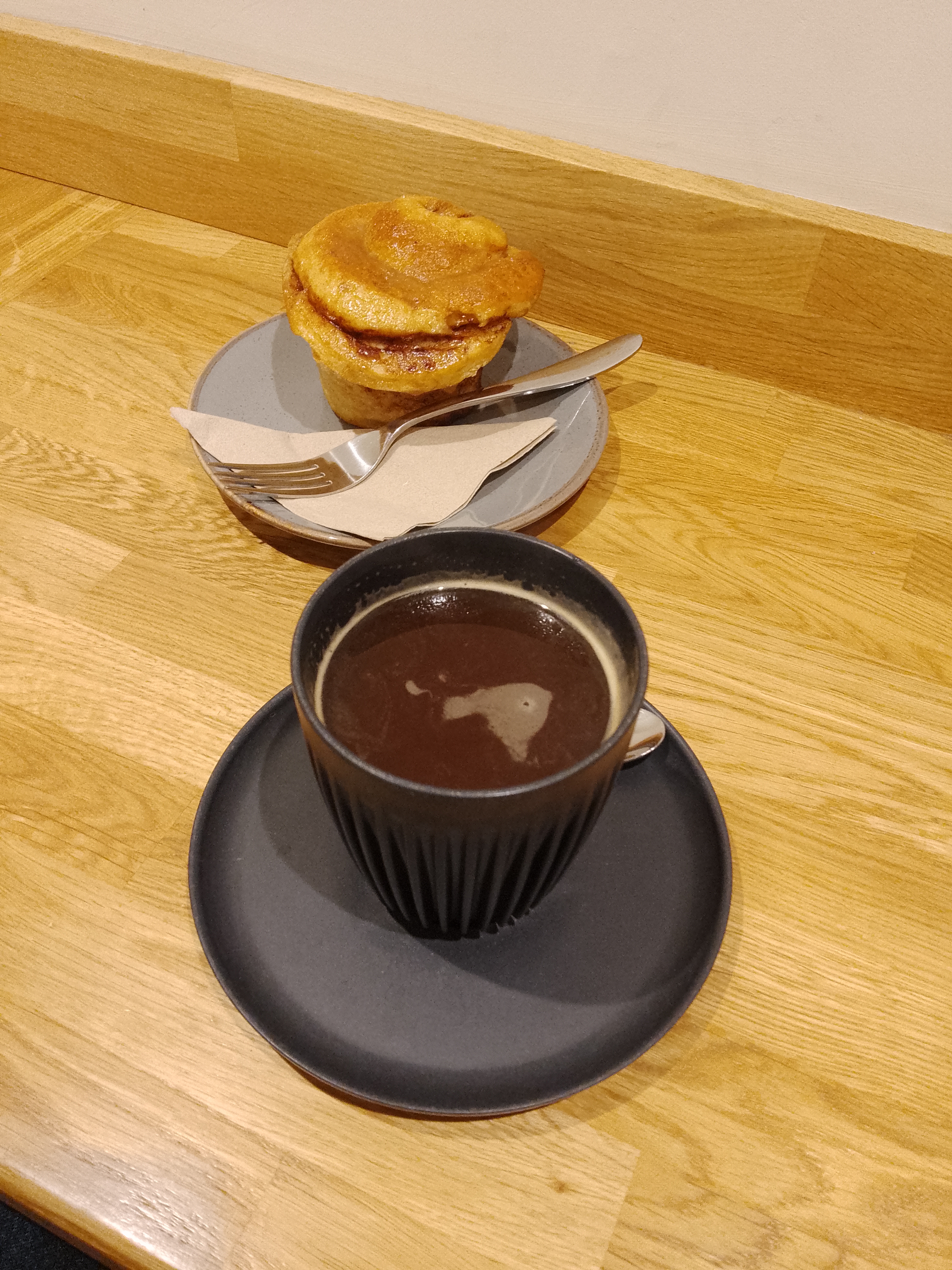
Soup Safari #82: Mushroom and Green Lentil at the Old School House.


Lunch.  £5.10.  40 Lark Lane, Liverpool L17 8UU.  Tel: 0151 727 2341.  Website.

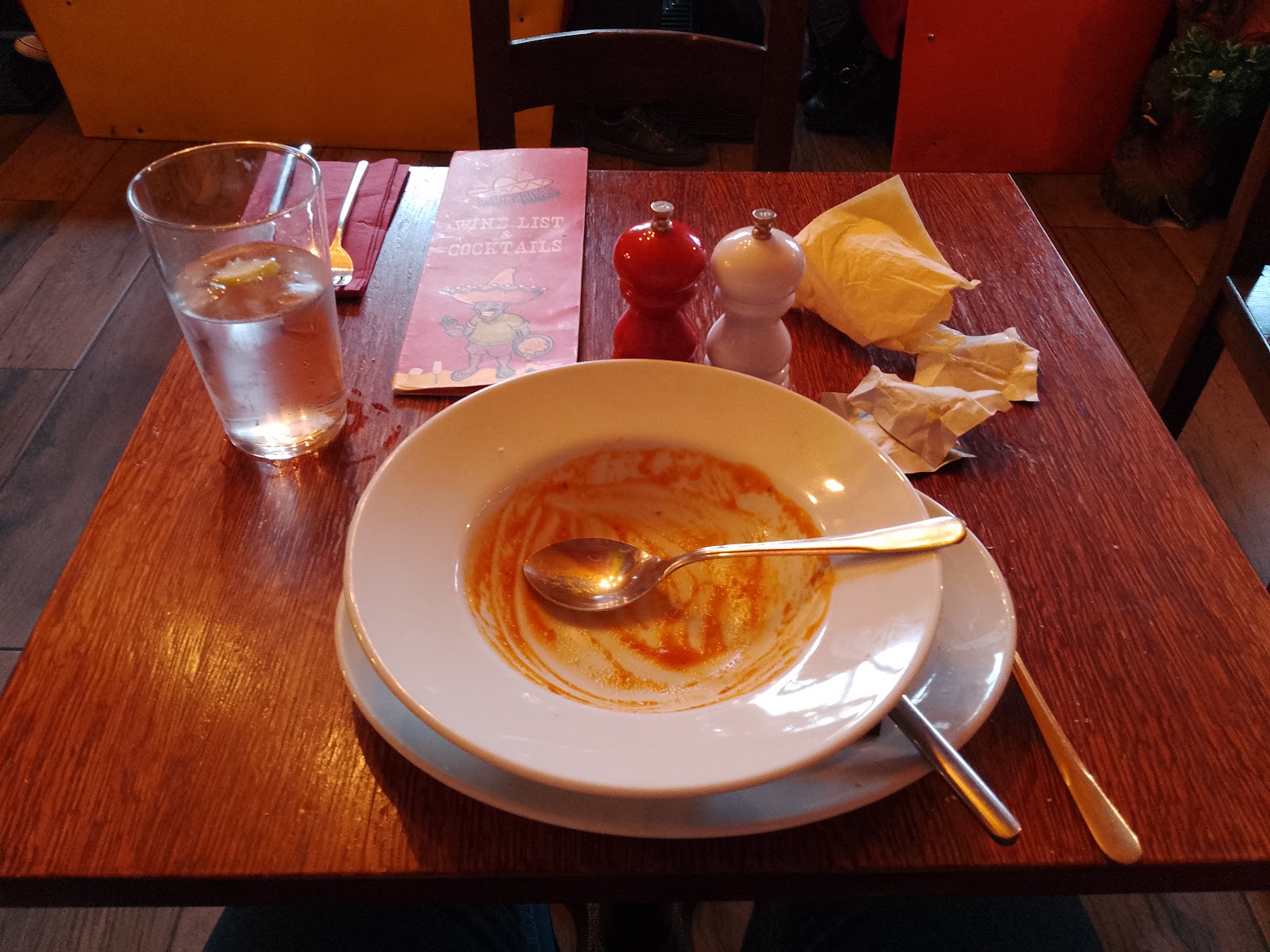
Soup Safari #81: Tomato and Lentil at La Parrilla Mexican Bar & Grill

Lunch. £5.50. La Parrilla Mexican Bar & Grill, 56-58 Lark Lane, Liverpool L17 8UU. Tel: 0151 306 8158.