Almost Doctor Who: Mr. Magorium's Wonder Emporium


Film This late noughties slice of post-Wonka wimsey wasn’t well received on released, largely by disappointed reviewers clutching their nostalgic memories of director Robert Stevenson’s bursts of Disney confection, the magical fantasy of Mary Poppins and Bednobs and Broomsticks. Despite that, this story of Dustin Hoffman’s titular ancient magician training his composer employee, Molly Mahoney, sparkly played by Natalie Portman, to take over the running of his toy shop is the kind of film that deserves to be rediscovered, not least because the script is one of the most literate and passionate of the noughties.

If you’ve not seen the film, I’d urge you to seek it out now then come back again because necessarily there will be spoilers. It’s best watched as I did without much foreknowledge, the series title for this new run of articles more than enough. Part of the problem some people have had is that writer/director Zach Helm (who also penned Stranger Than Fiction) is so determined not explain the origins of Mr. Magorium or his shop and the need for the unfolding circumstances, the viewer left to imagine whatever the back story might be. For some this was a distraction. But I had an easy answer.

Mr. Magorium is a Time Lord. As he says in the film he’s 243 years old, small fry in comparison to the Doctor perhaps, but not bad longevity. Like the Doctor he’s a kind of magician, absent minded and above all wants to please the children. Unlike the Doctor he doesn’t seem too concerned with getting messed up in the world’s problems, though the Doctor is quite unique in that regard. He adores humanity but doesn’t really understand us or our customs as we discover in the charming sequence when Molly takes him out into the world. His clothes are at once contemporary yet don’t quite fit, which is very nu-Who.

He says some very Doctorish things. Try:
“I fell so completely in love with these shoes, I bought enough pairs to last my whole lifetime. This is my last pair.”
Or:
“We Breathe. We Pulse. We Regenerate. Our hearts beat. Our minds create. Our souls ingest. Thirty-seven seconds, well used, is a lifetime.”
The Wonder Emporium is his TARDIS. Like Professor Chronotis’s TARDIS in the Douglas Adams penned story, Shada, it has transformed itself to mimic part of the architecture of its environment and though initially the external and internal size seem to reflect each other, there are sections, like the ball room, which inexplicably exist outside of normal space. He even talks about it changing location. When Mr. Magorium dies (presumably having reached the end of his regenerative cycle) the toy shop turns grey and fades too, the link between him and it having been broken.

Molly Mahoney is his companion, though more in the manic pixie dream girl realm of Susan or Amy Pond than Jo Grant. Magorium teaches her about the world and she’s the one he’s forever trying to impress. But like many of the Doctor’s companions she’s also the one who’s the public face on whatever madness and baggage he’s carrying around with him and the only one who can tell him off or tell him to stop. Jason Bateman’s accountant Henry Weston (nickname “the Mutant”) is the rarer third wheel figure, the Harry Sullivan, Mickey or Rory standing on the edge of this odd relationship, staying as detached as they can until they become caught up in the lunacy themselves.

Searching for confirmation online, I’ve found little in Zach Helm’s publicity interviews to suggest a direct connection. He mentions his influences in this piece at Movie Maker, saying that Magorium is based on a vaudeville joke though a bit more complex than that. Helm also says that he was fired as the writer on the film and someone else came in to rewrite the script he was directing, so perhaps some of this is from that mystery person. Either way, it’s certainly worth reassessment in this light. It’s impossible for me not to look this speech which might have been transcribed from a 90s Eighth Doctor novel and is one of my favourite comments on this particular play I’ve read anywhere:
"When King Lear dies in Act V, do you know what Shakespeare has written? He's written "He dies." That's all, nothing more. No fanfare, no metaphor, no brilliant final words. The culmination of the most influential work of dramatic literature is "He dies." It takes Shakespeare, a genius, to come up with "He dies." And yet every time I read those two words, I find myself overwhelmed with dysphoria. And I know it's only natural to be sad, but not because of the words "He dies." but because of the life we saw prior to the words."

like Morgan Freeman, Clint Eastwood, and Edward James Olmos

Museums How should you behave in an art museum. Apparently looking at the art isn't always at the top of the list of priorities:
"Basically, a covert class-mobility agenda. I knew my kids might cause problems, but when it comes to doing that hard-ass inspirational routine that people like Morgan Freeman, Clint Eastwood, and Edward James Olmos do in movies, I’m hopeless, so I told them to meet me in the lobby in two hours and not get into trouble. I wandered off to have my usual neurotic museum experience. Occasionally I’d see the kids dart by at a speed not really appropriate for a place that housed fragile, invaluable objects, and I’d think to myself: well, nobody knows that I brought them here."
People like this writer, Timothy Aubry, are the reason I have to spend every museum visit listening to classical music in an attempt to concentrate on what should be the main reason for being there [via].

the colour positioning

Film MovieBarCode appears to be a record of the just the colour information from a range of films. Some reflect the palette more than others.  But no one could mistake this for anything other than The Matrix and some of the best actually double as a synopsis for the plot. Witness the colour positioning in Pleasantville and Amelie [via].

the sale of the first page of Gibbons and Moore's Watchmen

Comics This post about the sale of the first page of Gibbons and Moore's Watchmen economically explains why their work was and still is a cut above:
"This tight choreography between seemingly unrelated visual and verbal elements is one the the primary sources of the book’s tremendous impact. It adds a crucial layer to the storytelling, one uniquely rooted in the format of comic books – the ability to directly interweave elements from one part of the story into another and thereby elicit new interpretations, resonances, and meanings. Watchmen established Moore as a virtuoso of this technique."
Some comic books try to replicate the cinematic experience. The best comic books take advantage of the fact that they are comic books.

no major chain book store in some markets

Commerce Something which hasn't been mentioned in the UK media as far as I can see. Borders USA has now gone into receivership too.  Our version went to the wall last year for reasons ably described in Paul Carr's article.  The paragraph which gave me pause is this:
Now, with (US) Borders out of the way, leaving absolutely no major chain book store in some markets (including San Francisco, which had three Borders but no Barnes and Noble), the independents have a real opportunity to push back.
Assuming there are independents left in the market place.  It occurs to me if Waterstones goes to the wall, apart from a couple of used book shops and charity shops, there aren't any independent book shops in Liverpool.  Unless I've been entirely oblivious News From Nowhere will be the only independent book shop in the city centre.

what makes someone “good” or “bad”

Film Noel Murray from the AV Club considers whether Natalie Portman can act. The short answer is, of course, that yes she can, but it's useful to see someone weighing up the facts:
"Well, at the risk of sounding wishy-washy, the real quandary here concerns “acting” itself, and what makes someone “good” or “bad” at it. It’s a question complicated every year by awards season, where the showiest performances often win, even though in some ways it’s easier for actors to play a role that requires a lot of scenery-chewing, physical transformations, and outrageous accents than it is for them to make an ordinary human being into someone audiences care about. Plus, actors rarely control what ends up on the screen. They can only deliver the lines the writers give them, while taking the guidance provided by the director and having their performance affected by the chemistry with their co-stars. Even then, the editor can still choose to leave their best takes on the cutting-room floor. Given all that, what are we actually weighing when we consider an actor’s skills?"
Exactly. That's why the argument against Andy Serkis not being considered for awards nominations for his work in Lord of the Rings because he was artificially enhanced in post-production to appear as Gollum was such a misnomer. All actors are artificially enhanced (or otherwise as Murray notes) in post-production.

The Brigadier lives on


Obituary I'm not sure there's much I can add to the many tributes which are being paid to the actor Nicholas Courtney, who was best known for playing The Brigadier on Doctor Who, whose death was announced last night.  Except to say that in the Doctor Who universe The Brigadier lives on, at least for a little while, thanks to writer Paul Cornell.

In his novel Happy Endings, The aging Lethbridge-Stewart discovers he has a terminal illness, but after a series of adventures, alien technology restores his youth back to him.  He returns to active duty looking much as he did in the 70s.  If you assume everything is canon, which I do, it's comforting to know Nicholas's alter ego is still out there somewhere defending the Earth.

the Nam June Paik retrospective at Tate Liverpool

Art Like the art forms they contain, some exhibitions offer an instant hit, a legible blast of culture but others require some thought, for you to spend time with them, work with them even, in that way that sometimes happens when you you’re placed in a awkward social situation with a stranger and have to seek some common ground. That’s how I felt this morning strolling about the first half of the Nam June Paik retrospective at Tate Liverpool. I’d originally been invited to the press showing but couldn’t make it after life intervened, but the press office were good enough to provide me with a ticket.

If strangers can be categorised, Paik is something of a friend of a friend. His influences and collaborators are very well known: John Cage, Joseph Beuys and Karl Stockhausen and later Yoko Ono, Laurie Anderson and Merce Cunningham. But though he was right at the centre of the New York scene in the 60s this is an example of the Tate using its prominant place within the art world, between obvious blockbusters (Magritte is next) to educate us on those figures who demand to be known too. Stretched across two spaces at Tate and completing at FACT on Bold Street, this collects together over ninety works, many appearing in the UK for the first time.

My first impressions were overwhelmingly negative, the brain splitting video wall of his Internet Dream (1994) with its confusion of clips from old Hollywood films, news items and general technicolour blah bearing down on me, a screen showing Korean adverts for western products and a massive projection of a Joseph Beuys concert skip edited so that eye isn’t given a moment to rest. I sighed. I felt like I was being screamed at and I’d not reached the fourth floor yet. Listening to the mp3 guide helped, with its short introduction to the artist, and eventually as I strolled about upstairs, I think we came to an understanding.

What eventually became my access point was that Paik really was, as this video shows, a technological innovator and experimenter. At a time when people were still coming to terms with television sets as an ordinary domestic items, he was already pulling them apart to see what else he could make them do other than show television broadcasts. In Magnet TV (1965), he was placing the giant hunk of polarised metal on top of a set to see what patterns the cathode ray tube might make. He co-created the Video Synthesizer (1969) which attempted to produced a visual equivalent of the sound instrument, which later gave rise to cellos built from sets whose images change with the stroke of the bow.

In other words he was pushing the available technology to do things which it really wasn’t designed to do yet. Like the BBC’s Radiophonic Workshop, who produced what sounded like electronic music using audio tape, Paik was looking ahead of his time and creating what he was using what was available to him. He said that in the future everyone would have their own television station and we children of the internet finally do on YouTube. But Paik even demonstrated what he meant. On the day he bought one of the earliest video camera, a Sony Portapak, with all of the world to shoot, he chose to record the most mundane thing he could think of - himself buttoning and unbuttoning his jacket.

So the exhibition is worth visiting for a trip back in time before flat screens when televisions were more present, when a call to the television repair man included the magic of a kingdom of glass and wires behind the screen, rather than, as happened to me yesterday when the man visited to look at my LG LCD, the disappointment of a couple of printed circuit boards. Most of Paik’s work isn’t just the film itself but the technology displaying them, or in the case of the Buddhas creating them, the original video cameras trained on their marble and bronze torsos, the results displayed in the space. Live.

When you do visit, I really would recommend you listen to the accompanying free mp3 guide. Intelligently written in the style of a Radio 4 programme, it features contributions from curator Sook-Kyung Lee and members of the artist’s family. Much of the work on display is an echo. It's documentation for a previous happening or once interactive works (like the Magnet TV) which are now too fragile to be touched. It’s in these sections that the mp3 guide so ably fills in the gaps, especially in relation to Paik’s collaboration with the cellist Charlotte Moorman with whom he created Opera Sextronique, a performance piece which led to her being arrested in New York.


I genuinely think we parted on good terms, Paik and me. The exhibition closes on a stroll through a TV Garden (1974), some Video Fish (1979) and with the chance for us meet members of Paik’s Robot Family (1986-93) and by then Paik definitely wasn’t the stranger he’d been at the start. I’d realised that Internet Dream was his attempt to come to terms with the inevitable information overload which the web would bring and had brought and that if we’re uncomfortable when confronted with that he achieved his aim. He was a visionary.

Nam June Paik is at Tate Liverpool and FACT Liverpool until 13 March 2011. Admission details available here.

Sir Derek Jacobi on npr

Jacobi talks about directing Ken Branagh and what makes for a good Hamlet:
"Hamlet, to me, is the big personality part in the canon. He can be played any which way - tall, short, fat, thin, male, female - there have been very successful actresses who've played at Hamlet. It all depends on the personality, the sound, the charisma, the look of whoever's being Hamlet. The great thing about Hamlet is that you don't play his character, you play the situations in which he finds himself. You put yourself into those situations with those words, with those lines in the situations and that becomes your Hamlet."
Audio and transcript available.

Vanishing Point.

Books After Nick Wallace’s brilliant evocation of an era in Fear Itself, we’re now back in the actual era he was trying to recreate. It’s to his credit that the transition is seamless. There’s nothing in Stephen Cole’s novel to indicate that the Doctor and his friends haven’t just been in and around Jupiter, and indeed the suggestion is that this doesn’t follow on directly from Earthworld, like Peri in Caves of Androzani, Anji’s well embedded into the TARDIS life and has the connection and trust with the Doctor which most companions develop, of the kind which can only be a consequence of the three of them having been in each other’s company for a bit.

To a large extent, Vanishing Point is archetypal Doctor Who. The Doctor and his companions become split up and embroiled within the status quo of a human colony, investigate the oppression which is being wrought on the people and lead them to overthrow the dictator. It’s precisely the kind of thing that the more post-modern authors use as shorthand when they’re trying to define precisely who the Doctor is and his mission. In this case, the local colour is that gives it shades of other franchises, as the back cover explains, this is “a world where death has meaning, where God exits and faith is untested”

Or as Anji jokes herein like “some bad Star Trek episode”. Actually as the story unfolds it’s far closer to Lost a few years early though to explain the detail of that would be far too big a spoiler for these brief milestones/reviews. If we were to play the Trek game, we’d see bits of The Masterpiece Society, Miri and one of those DS9 episodes when Odo thinks Garak has done something sneaky. This allows Cole to offer some meditation on religion and blind faith and through the character of Dark, a kind of lapsed monk, to investigate if it’s possible for someone to have a strong belief system even if the come to understand that the religion they once respected is bunk.

Unlike Star Trek, in which such things tended to be hashed out in a primitive villiage or a space station, Cole throws all of this up against a major metropolitan area filled with hundreds of thousands of people.  They have jobs, they're clearly human.  At one point the characters are so wrapped up in their adventure, they shocked when they realise that the quickest way for them to journey into danger would be to call a taxi which duly arrives.  Unlike some stories were it seems the entire population of a planet is involved, most of these colonists go about blissfully unaware that their world could end, or for that matter the level of control which has been placed upon them.  The Matrix was released very close to when this book was written and that can't be a coindidence.

All of the characters are nicely written and for once in a Doctor Who story all ultimately have a part to play in the climax other than simply cannon/jeopardy fodder. Of the day players, Etty is the standout, a farmer with a fair few secrets hiding in her barn is strong willed and clever I imagined the author had cast Samantha Morton in the role in his head. Nathaniel Dark is that other rare thing in Doctor Who – an alpha male who isn’t either stupid or a villain and someone the timelord can talk to on a level basis and debate as the Doctor uses him as a sounding board during the investigation towards discovering the truth of the society.

Amongst the regulars, Anji’s settling in nicely though as in Earthworld, I’m still finding it difficult to picture Amita Dhiri in her role. This website favours Konnie Huq, which is fine (can she act?) but perhaps I should just be relying on my imagination. It’s not helped by her not really being that clearly defined as a character, we don’t really know what she “would” or “wouldn’t” do in the same way that we might Martha (which probably just indicates the variance from how classic characters were still being developed even ten years ago). Fitz is very much back to being the ladies man, though after his revelation in Earthworld that he’s not the original, but a memory of the original, it’s still not clear if he’s motion going.

Speaking of which, once again we can detect that this amnesiac Doctor is rather acting the role of himself, an eternity old but unable to remember any of it. It’s entirely possible I’m just applying that interpretation after the fact because Cole largely writes him as a generic Eighth Doctor, though without the usual historical reference points. He’s funny, smart, a bit dopey and have Paul McGann’s speech patterns all over them. Except when he brandishes a pistol or just plain violent, and we know it’s because he’s not in control of his faculties, he doesn’t realise it’s something the Doctor wouldn’t do (unlike Revolution Man which was just poor characterisation).

It’s these moments too which remind the reader this is an Eighth Doctor novel, that this isn’t a story which could be quickly rewritten for the Fifth Doctor or could be pulled out a drawer for Matt Smith’s face to be stuck on the cover. It’s been quite some time since I finished Fear Itself and after enjoying the slightly more juvenile fairy tale flavour of more recent spin-off fiction, quite a surprise to be reminded just how “for mature readers” the franchise had become in this form which explains why the BBC seems less than keen to promote and reprint its old back catalogue (though I know some of these novels are being reproduced independently) despite interest from new fans keen to look at all of the show’s history.

inchoate threat

Books Another great piece from The Paris Review uncovers some unsettling truths about what might otherwise seem a fairly inocuous fairy tale:
"Sleeping Beauty is laced throughout with inchoate threat, which is why it feels so bottomless. Most obviously, there is an outrageous fact that the story passes over and that most children do not consciously note: Beauty is a century older than the prince who kisses her and ends her sleep. When he enters her dusty room she is one hundred and fifteen years old. As the reader bends with him over her inert form, adoration is tinged with something else entirely—the apprehension of death."
Which surely puts it firmly on the fringes of myths related to vampirism. It's a cultural theory essay waiting to happen.

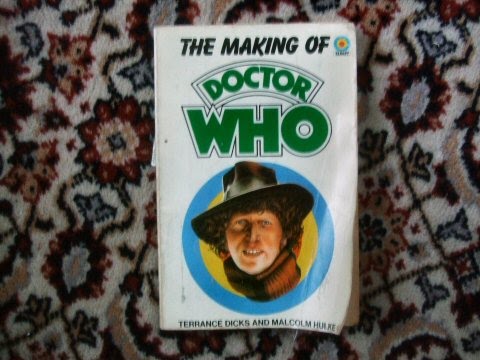
Terrance Dicks and Malcolm Hulke’s The Making of Doctor Who


TV  The first non-fiction book published about the series, Terrance Dicks and Malcolm Hulke’s The Making of Doctor Who is mythologised by fans of a certain age as the moment when they properly realised the breadth of the history of the series, thanks to a thorough episode guide and biographies of the all the Doctors and companions who had appeared on the show prior to the then current incumbent Tom Baker. How they must have trembled, suddenly desperate to read the Target novelisation of The Ark with the horrific sounding Monoids and coming to terms with their newly acquired deep knowledge of Mike Yates and Anneke Wills.  All of which I missed because I was only two years old.  Time to catch up.

Reading the book, written by the outgoing at this late stage is a strange business, especially after twenty odd years of Doctor Who Magazine and another overlapping decade of dvd releases. Most of the anecdotes herein have been worked over dozens of times since by franchise archivist Andrew Pixley with increasing accuracy, yet it’s impossible not to be swept away by Dicks and Hulke’s interpretation of events which desperately strikes a balance between offering some insight into television production but without losing any of the magic of what’s on screen, a world were Tom isn’t difficult to work with, script editing is a relatively easy business and the technical unions don’t turn the lights off at inopportune moments.

Both authors are well chosen.  Hulke wrote many of the most popular Doctor Who stories, including The War Games, Doctor Who and the Silurians and The Sea Devils.  Dicks was a producer on the show right through the Pertwee era and continued to be a writer not just of the scripts for television but also, as he notes within The Making of ... enough Target novelisations that he could give up the programme to concentrate on those.  Eventually Dicks would go on to write most of the Target books, the former covering most of the eras of the show in his trademark style.  "Teeth and curls" "Open face" that sort of thing.  It's a testament to their legacy that these novelisations are still being turned into audio books.

The first section traces the inception of the series, introduces all of the characters and the actors who played them and lists the monsters who’ve left an impression of the show in the previous decade (sorry Rills). Much of this still serves as the blue print for Doctor Who Magazine’s approach all of these years later, even taking time to debunk the myth of where the Dalek name came from (even though Trivial Pursuit were still using the encyclopedia explanation as a question years later). Each of the companion actors is gives a quote about their time working on the show, including Frazer Hines who informs us that he’d wear football shorts under his kilt so he could get a game directly afterwards.

This was for years the main the source of the collective fan knowledge about how the show started. It’s impossible not read the section about the meeting between Sydney Newman (initial creator) and Donald Wilson (head of series) without thinking of the notorious Doctor Who night sketch with all the swearing, isn’t it about time they finally grant its author Mark Gatiss his wish to bring this chapter properly to television in dramatic form? Certainly there’s enough here for a fiftieth anniversary special in which a brave female producer Verity Lambert battles with the resources available to her then watching as the limelight shines on Terry Nation for creating the Daleks, the moment when the show really took off?

The middle chunk is appropriated by the aforementioned episode guide, which was also the first time many of the stories were collected under single story names for the first time – for the first couple of years individual episodes had often wildly inaccurate titles all to themselves. Culled, I believe, from BBC documents, many of these collective nouns have stuck until the present day appearing on dvd spines but there are still some surprises. The Daleks is given the title of its first episode “The Dead Planet” and it’s “The French Revolution” instead of “The Reign of Terror”. The first story is listed as “An Unearthly Child” the ramifications of which would drag on for many years with fandom fracturing between the "100,000 BC" believers and The "Tribe of Gum".

Like the pagination of the Target novelisations, there’s little consistency as to the length of accompanying synopsii in relation to story length. The Moonbase (4 episodes) nearly fills a page while all twelve episodes of The Dalek Masterplan fill about seven lines which might well be a comment on the amount of padding which would appear in some of these stories. Galaxy Four (4 episodes) is gifted five lines and shockingly it doesn’t seem to miss anything out including the race relations subtext. Brilliantly, one of the previous owners of my copy has gone on to scrawl in pencil all of stories from after “The Hand of Fear” up to and including “Shada” which suggests it was before that story failed to be completed. They’ve also numbered them all, and added crosses, presumably next to the ones they’ve seen. We've all done it.

The final section covers the production of ROBOT, Tom Baker’s first story. This is major rewrite from the first edition of the book which covered The Sea Devils (and had a constipated looking John Pertwee on the cover) forcing some fans to buy this twice because of new material, a technique which is still being employed on the dvd range even today. In this version, there’s much talk throughout of how this is a show in transition with a new production team, new lead actor and a shift towards telling stories in time and space away from Earth. Which is quite refreshing considering that now, David Tennant was barely off-screen before his incarnation was assigned to merchandising history (with the approach to Christopher Eccleston genuinely Stalinist).

This is the ur-text for Doctor Who Confidential. After the subsequent commentary revelations this is pretty tame stuff, it’s not The Writer’s Tale (or The Devil’s Candy for that matter), there are no stories of Dicks, who also wrote Robot, face pressed against a typewriter at 3 o'clock in the morning handwriting a telegram to fanzine editor Jan Vincent-Rudzki revealing his inspiration for turning the story into a King Kong homage or why he took his name of The Brain of Morbius.  The most we discover about the writing process is how it would be an interesting choice to make "the power-mad leader behind the whole scheme" a woman "in these days of women's lib" (which as you can see isn't to say these passages don't sound like Dicks speaking out loud).

Curiously most of the production team are referred to by their job title not their name and there are precious few proper anecdotes about the production itself, other than the decision to shoot the whole thing on video though the authors do mention how a producer thought one actor was overplaying the comedy at the expense of the drama, something the director agreed to do something about. I’m assuming that was Tom and I’m assuming he didn’t take any notice.  Some of the episodes overran, some underran but generally the shoot appears to come off without a hitch.  My favourite part is the opening paragraph which prosaically sets about explaining production codes "no one had allowed for the show's amazingly long life".  You're not kidding.  Now we've reached proper numbers and no one can agree exactly how many stories there have been.


The book almost ends on a fairly downbeat note. Under the hopeful sounding chapter title “A New Life for the Doctor” we’re told that new producer Philip Hinchcliffe and Script Editor Robert Holmes are “confident that in the dangerous and disturbing world of today there is a real need for a show like Doctor Who”. Then Dicks and Hulke stick the knife in by informing us that “many of the Doctor’s early adventures are lost for ever. Enormous pressure on storage space forces the BBC to “wipe the tapes” "which means that many of the stories they’ve previously listed in the middle of the book, with the exception of those preserved for the Television Archives, “are gone for good”.  Notice the present tense in the word “forces”.  It was still going o.

I believe this was also the first inclining that even the clued up fans had that any of these stories had gone never mind that whoever was making the selection lacked the ability to discriminate between a stone cold classic like Marco Polo and The Senor-bloody-rites. The authors try to cushion the blow by adding a sales pitch that suggests it’s ok because the adventures were being “preserved in more permanent form” as Target novelisations. As many would discover later when some of these stories were found and the secondary market opened up, the Target novelisations often wildly rewrote what had been on screen. 

The book ends on a three page glossary which has room for “ratings” but not “budget”.

So the history of Doctor Who was formed.

Olde English Comedy ruin both a film and a song for you.

Breakfast at Tiffany's from Olde English Comedy on Vimeo.

the in-joke which has now been turned into a film

Film Fans of Mark Kermode and Simon Mayo's film review podcast will already be aware of Benjamin Sniddlegrass And The Cauldron Of Penguins, the in-joke which has now been turned into a film. The rest of you can catch us as director Jeremy Dylan talks to Den of Geek about the indie project which includes a voiceover from Stephen Fry:
"But yeah, we sat down, just the two of us in there and his performance was just pitch-perfect, exactly as I had imagined it when I wrote it, down to every inflection. He was exactly as you would think Stephen Fry would be in real life. He complimented me on the script, which he thought was very funny, which was, of course, huge for me.

He asked me how I was paying for it and he was like, "But you're a young person! Surely you don't have any money?"
The film is available here.

“Well ... like ... yeah.”

Language Speaking of like, like, vageness has crept into the language. We are do it. We've all kind of like slipped into a way of speaking in which it's almost impossible not to, y'know, um, aha, use twice as many words than is required to get our point across, much of it linguistic noise.

According to this piece by Clark Whelton in City Journal, it's because over time teachers have stopped correcting us at a vital age which means that our then juvenile ways of speaking continue well into adulthood. He first became aware of it in the 80s during job interviews:
"The first applicant was a young man from NYU. During the interview, he spiked his replies so heavily with “like” that I mentioned his frequent use of the word. He seemed confused by my comment and replied, “Well . . . like . . . yeah.” Now, nobody likes a grammar prig. All’s fair in love and language, and the American lingo is in constant motion. “You should,” for example, has been replaced by “you need to.” “No” has faded into “not really.” “I said” is now “I went.” As for “you’re welcome,” that’s long since become “no problem.” Even nasal passages are affected by fashion. Quack-talking, the rasping tones preferred by many young women today, used to be considered a misfortune."
Of course there is at least one good use for "I'm like..."


(1) Muppets!
(2) Gwyneth!
(3) Cee Lo navigating the cleaned up radio version of his song whilst dressed as 70s Elton!
(4) Annoying banner advert on the YouTube embed because the rubbish The Grammys channel doesn't include performances which leaves other miscreants to helpfully enter the market!

her rotting, squishy, dead ancestors

Shakespeare OMG! OMG! Jezebel is branching out into literary criticism. Witness, "Why Romeo And Juliet Is Shakespeare’s Worst Play." Best part? The rebuttle in the comments:
"It can be read as a critique of conventional romantical poeticizing (aka making fun of cliched dudes who are more into homoerotic brotherhood and their own narcissistic views of themselves as lovers than their professed beloved object). Also Juliet's soliloquy right before she takes the medicine is wicked macabre and grotesque. She imagines being entombed with all her rotting, squishy, dead ancestors including the recently dead (and therefore freshly corpsified) Tybalt, who would also be really angry at her.
IMHO they're both wrong. There is no, like, bad Shakespeare. Just bad productions.

was a horrifying bore

Film This year's Baftas was a horrifying bore with three predictable high spots (Helena Bonham Carters acceptance speech Colin Firth's acceptance speech and Christopher Lee) and the entertainment that was Rosamund Pike's flight of intellectual fancy which I'm pinning here so that I know where to find it:


What I love about this is it proves that all of us have a high capacity for inadvertant failure.

The Merchant of Venice (The Arden Shakespeare). Edited by John Drakakis.


Few quotes better encapsulate the post-war attitude to The Merchant of Venice than this marvel from Dennis Kennedy: “Since 1945 we have been in possession of a new text of the play, one which bears relationships to the earlier text but is also significantly different from it.” Placed at the centre of the introduction to John Drakakis’s third Arden edition of the play, it marks the historical moment when the play stopped being a “comedy” and became something rather more uncomfortable and in the shift away from obvious stereotyping into a work which has become very difficult to perform.

Most of the plays have probably undergone this kind of transformation, not least Hamlet which now exists in a kind of post-Freudian state. Certainly I’ve never seen a production that has been able to turn Shylock into the complex figure our sensibilities demand and also make Portia sympathetic enough after her treatment of him so that the more traditional romantic comedy elements don’t stick in the throat. Presumably that’s why it’s one of the few plays I simply can’t watch or listen to for pleasure but instead to see if the company have cracked this almost impossible code.

Drakakis, a professor of English Studies at the University of Sterling, tries his best to convince us, by offering a detailed overview of the influences underpinning Shakespeare’s characterisation, from the real life position of Jews within Venetian society to their theatrical tradition, notably in Marlowe’s The Jew of Malta and the sources for that tricky romance story, with its caskets and rings. Along with the editing of the play itself and the accompanying notes, this is the work of a couple of decades which is ably demonstrated by the breadth of quotations on display and intertextuality.

If I’m confused as to how Drakakis seeks to position Shylock and the Christians, it’s perhaps because his introduction isn’t quite as accessible as similar efforts in other Ardens and expects a certain level of background knowledge of the reader. Certainly this feels like more of a straight academic text than Keir Elam’s efforts on Twelfth Night or Charles Forker’s Richard II though I should admit that I’m far more familiar with both of those plays than The Merchant of Venice which could account for the disconnect. Even so, I learnt more here about The Jew of Malta than when it was forced on me during A-Level English Literature.

The theatrical history offers steadier ground. Drakakis emphasises how revivals through the 18th and 19th centuries edited and rewrote the text to make Shylock a much more central figure often losing Portia altogether and either increasing his pantomime villainy or in a few cases shaving his darker excesses. It isn’t really until recently that the language of the play was returned to anything Shakespeare intended, but with directors employing the play to reflect the Jewish experience in a range of historical periods. In that context, the new Globe’s unreconstructed ’98 production in which the audience was actively encouraged to hiss Shylock as he came on stage in the pantomime tradition is especially daring.

The Merchant of Venice (The Arden Shakespeare). Edited by John Drakakis is published by Methuen Drama. £9.99. ISBN: 9781903436813.  Review copy supplied.

Julie Salamon’s record of the production, The Devil’s Candy

Books In hindsight, you can understand why Brian De Palma’s film Bonfire of the Vanities received the critical mauling that greeted it on release. Tom Wolfe had written a much loved book that captured the pulse of 80s New York and if the talent involved could capture a tenth of that on-screen then there was a chance, just a chance that a classic for the ages could be created. Except as Julie Salamon’s record of the production, The Devil’s Candy, wickedly demonstrates, 90s Hollywood simply didn’t have the sensibilities, taste or courage to properly reflect the darkness inherent in the material.

Writing in novelistic style from material culled during set visits and interviews, Salamon writes in neutral tones but carefully demonstrates the decisions which led to the film’s artistic failure all flowed from the decision to make a prestigious high budget cinematic production in the first place rather than the tv mini-series that had been expected. From that flowed the need to cast hot actors in the main roles compromising characterisation, employ convincing location shoots in the New York itself and a general sense of swagger that this was an important film from an important book and no expense would be spared.

A typical example is the casting of Bruce Willis in the key role of the journalist who uncovers the accident that leads Tom Hanks’s stockbroker to court. In the book, Peter Fallow is a British caricature bringing in with him the eye of the outside. In the film, Fallow becomes essentially the kind of wise-guy figure Willis was used to playing and the script was in constant flux as it made allowances for the actors then limited acting style. Then having hired Willis essentially as narrator, he’s off screen for much of the film and in any case unbalances the story which should rightly be in the shaky hands of Tom Hank’s stock-broker.

Willis comes across as a bit of an a-hole and in truth few of the main figures a painted in glowing terms. De Palma, who actually gave his blessing to the book even after the film’s release, is an introverted figure fighting personal demons in his personal life. Salamon suggests Melanie Griffiths was a emotionally fragile person who’s aware that her the aging process will mean she’ll soon give way to the ingénues rising behind her (and indeed her role in the film was almost given to a young Uma Thurman). Other crewmembers thread through the narrative; second unit director Eric Schwab who spends the shoot creating mesmerising shots in a bid to step out of De Palma’s shadow. Only Tom Hanks retains much of his dignity.

With so much detail, so many “characters” to keep on top of, the book can at times be an exhausting read. What saves it is Salamon’s decision not to simply run off a “production diary” in the style of Thierry de Navacelle’s Woody Allen On Location which offered the minutae of the daily routine in making Radio Days. Instead this is a string of incidents, anecdotes, the battles with the studio over budget. For those of us less interested in gossip and more interested in the process itself, the final section on post-production is perhaps most interesting as we see De Palma’s desperate attempt to make a film which ultimately can only appeal to those within ten miles of Manhattan work with an audience in Boston.

He ultimately shaves two major scenes off the end (including a swordfight that took five nights to shoot), asking himself if he’s only making the film shorter but not necessarily better. The irony of the whole affair is that with hindsight, Bonfire of the Vanities, whilst perhaps a disappointment to fans of Wolfe’s book now stands as a fairly enjoyable example of 90s film making with a fine performance from Tom Hanks that hints at his later range and some very funny scenes. I'd also agree with Steven Spielberg that opening five minute shot which follows a sozzled Fallow out of a car and onto the stage of a book launch is one of the best in film. It's just a shame that the reputation of the rest has overshadowed it.

I always had a little primitive story with a twist

TV It's something of a pity that "culture" secretary Jeremy ... Hunt's local television proposal will essentially recreate early ITV on the cheap when something along the lines of the US's cable access service would be far less corporate and potentially far more enter. Example? Manhattan's Un-TV:
"On Anton Perich Presents, I took the soap opera format literally, except there was no soap, only dirt. It was always a simple and primitive story, minimal and contemporary. There was often topless woman, gay guy, straight guy, straight woman, a lesbian, a father, a daughter, a total stranger. I was making these movies with my friends. They were mostly veterans of Warhol's films, great talents, trained in improvisation: Taylor Mead, Candy Darling, Tinkerbelle, Cyrinda Foxe, Susan Blond, Danny Fields, Wayne County, Sami Melange, Darsea DeWilde. I always had a little primitive story with a twist that I would convey to the actors moments before shooting. They would act it out immediately, absolutely exaggerating every aspect of it. Not really playing anybody but themselves. Narcissism was a key drive here, narcissism and weekly feedback from the cable audience..."
Who wouldn't want to see that broadcast from a community centre in Stockport?