Another Doctor Who Trailer.


TV With the ComCon model (which has subsequently received some broadcast play on television) being a bit, yeah, nice, oh he's playing the guitar, here's another one with more guitar playing and a general sense of the Doctor being more traditionally heroic this time. Clara seems far more enamored at least. A few new things:

This:


Which brings to mind the best moment in the whole of Torchwood's Miracle Day:


This:


"Tale as old as time..." Doctor Who does Beauty and the Beast? Animal Kwackers? King of the Cheetah People? The Garm?  Also they're really selling the Maisie stuff.  Notice how she's not wearing the Civvies from the TARDIS publicity shoot here.  Is she in more than one episode?

Overall with the viking helmets and such it feels more like the Matt Smith era in tone and look since its a return to blues and yellows over the autumnal colours of the previous series. It's noticeable there are no killer lines, no jokes and the Doctor's generally very isolated, doesn't really interact with Clara much, apart from that bloody lovely backwards hug towards the end. My expectations are still magnificently low, but this at least looks more like someone trying to make Doctor Who again.

My favourite film of 1986.


Film One of the great joys of the MARVEL cinematic universe is the post-credit sequence not just because of the added value but also because they're a way for cinema goers to note exactly who else lives in their head space. At each performance of one of these films there will always be people who leave just after the given director's name disappears and they'll always but always survey the auditorium, a questioning look in their eye wondering, "Why are you all still here? Why haven't you left yet?" before turning and leaving us to see either the actual end of the story (Thor: The Dark World) or a preview of what looks like footage from the next release (Ant-Man). The most ironic example of this was the screening of Avengers: Age of Ultron I attended, a film where the producers and director had warned that there wasn't going to be anything after the credits but the entire audience, some thirty of us, stayed in our seats anyway. Just in case.

Unlike most of those, the post-credits sequence on Ferris Bueller's Day Off is pretty difficult to miss, with the duration of the credits absorbed with Ferris's headmaster having to take the school bus and a first floor corridor in Ferris's house appearing just after said vehicle has rolled into the distance.  That makes what he says, "You're still here?  It's over.  Go home.  Go."  Well, yes, Ferris, it's over now, you scamp.  For a while I thought this was the first, but as this Wikipedia page explains, it might have been The Rutles: All You Need Is Cash or The Muppets (depending on your attitude to the former being a theatrical release).  The one for Adventures in Babysitting is especially fun because it ties up one of the film's bits of plot.  But was Ferris the first to speak to the audience directly?  What must that have been like at the time?  Did people just laugh?  Were some of them freaked out?

On video, it was a particularly useful moment because it signalled the end of the Yello track if you didn't happen to be watching the screen.  Ferris is a rare example of an 80s film which doesn't have a soundtrack album because John Hughes didn't think it constituted a coherent collection of songs and didn't think anyone would want to buy them and so the only way to listen to some of the songs back in the VHS age was the simply watch the film.  The Dream Academy's cover of Please, Please, Please Let Me Get What I Want has only just become widely available on their best of album this year and the version at this Spotify link isn't even the instrumental from the film.  So for a while I'd simply have the video on in the background and let the sounds fill the room and when Ferris's voice appeared it reminded me to rewind the tape so I could start all over again.

We need to talk about Fantastic Four. Now that I've seen it.

Film Absolutely fucking horrendous, genuinely one of the worst films ever made, misconceived in almost every way, feeling on all levels as though it was thrown together and made worse by the impression, and don't let anyone tell you otherwise, that there isn't a better film hidden underneath somewhere.

Now I appreciate that I'd set myself up to hate it and to an extent a lot of that had to do with lowering my expectations, a process which has actually helped me enjoy other films in the past, notably the Resident Evil and Underworld series which tend to be universally slated by critics but I enjoy on almost every level and not secretly.

I had hoped that I'd come away from Fan Four Stick with a certain admiration for a noble failure in the realm of Catwoman, seeing someone remove a concept from its origins and then turn out something which has its good points or least justifies not being the thing it's supposed to be an adaption of.  It's not.

Despite that, let's try to find some positives.

Well, for a start I didn't have to pay to see it.

Having tried to find a showing at the Odeon with the least potential audience toxicity, so 10:15 on a Monday morning, I pretty quickly noticed an odd noise coming from somewhere in the auditorium.  Sitting on the front row I could hear it pretty clearly as the pre-show advertising slides appeared and then during the quiet bits between adverts.  I stepped out to tell an usher and the two of us sat back on the front row listening out for it.  I think he was half convinced there was something as he left before the trailers but nothing changed.

So I spent the whole film also trying to work out what the noise was until a particularly silent bit during an amazingly quiet narrative for something in the comic book genre and realised it was the sound of the air conditioning unit and so on top of everything else I had that whooshing along in the background.

After the film finished I met a manager in the foyer, told him about the distraction and was issued with a full refund without any quibbles and it's important to note without actually having asked for one (it's cheaper on a Monday anyway).  I was simply letting them know so that it didn't effect other patrons enjoyment of the film should they have wandered in by mistake.

Otherwise the film was well projected across a massive screen with proper luminance and excellent sound quality.  There we about seven of us in the audience with the two families sat towards the back and silent throughout.  Ironically this was the perfect environment to watch a movie.

In relation to the actual film and this is where the spoilers really beginning;

Opening with the class project material isn't horrible and essentially the opening of Big Hero 6 filmed in the style of Super 8.  As a way of establishing Reed Richards as a kind of scientist outside the mainstream this would have worked in a more orthodox adaptation of the comic though it is derivative of other super hero films, notably the first X-Men and Superman before it.

The actors all work well with the material that they're given or at least the selected footage of their performances shows that for at least part of the project, the initial photography, they had some notion of how the material should be played.

The rest of it is a failure.

Professional critics and the rest of us all have our theories as to why that is, and since you can go glance through the hundred odd reviews on Rotten Tomatoes (currently metascore 8%) or people ranting into their iPhones on YouTube if you want to, I don't know if there's much point in me trying to reiterate their many points.

Except ...

Things didn't start well when I approached the box office and asked for a ticket to see "Jurassic... no I mean Fantastic Four.  God, I wish I was going to see Jurassic World again.  I don't even know what I'm..." "So you'd like a ticket for Fantastic Four?" "Sorry, yes." "The 10:15 showing." "Yes, sorry."  It was almost as though my mouth was making a last ditch effort to spare my brain from what was to come.

Then, glancing through the Odeon's in house magazine I noticed a massive factual error in the synopsis for the film...


"this latest adventure from the Marvel Cinematic Universe".  If only.

In any case, just to limit myself, here are five things which stood out to me:

(1)  Sexism.  Trank takes time to properly introduce Reed, Ben, Johnny and Victor to varying degrees with their own scenes which to some extent demonstrate how they tick.  Sue on the other hand is simply introduced to Reed and has absolutely no narrative agency, the scene which is supposed to highlight who she is entirely played through Reed's POV as he reacts to her.

She's also the only female main character.

Granted there's only a small main cast, but given how much if the piece has been re-engineered by Trank et al, there would still have been a lot of space to give Sue a friend or (and I hesitate to say this believe me) female friends to some of the other guys.  But since no one has a life outside the requirements of what plot there is or indeed seems to leave a lab much, here, based on the IMDb are the character names of the those played by female cast members:

Sue Storm
Mrs. Grimm
Mrs. Richards
Science Fair Judge #2
Girl Classmate
Street Race Girl
Reed's Scientist #1 (Area 57)
Sue's Doctor (Area 57)
Johnny's Doctor (Area 57)
Computer Military Tech (Area 57)
Emergency Announcer (Area 57)
Baxter Board Member (uncredited)
Lawyer (uncredited)
Ben Scientist #2 (uncredited)
NYC Passerby / Scientist (uncredited)
Sibling (uncredited)
Science Fair Judge (uncredited)
Sibling (uncredited)
Hospital Patient (uncredited)
Lab Tech (uncredited)
Baxter Institute Professor (uncredited)
NYC Passerby (uncredited)
Extra (uncredited)

Incidentally, the IMDb lists about a hundred and thirty cast members of which only twenty-three are female.

The only character here with a substantial speaking role is Sue and that's just barely.  She's also the only female character who's granted a full name (though admittedly few of the male characters actually do either for some reason).  It's Rachel Grimm and Evelyn Richards in the comics by the way.  Looking at this list, I'm reminded of what Russell T Davies said about writing scripts and how he always gives characters names because it means that when the actor puts the role on their CV it looks more substantial than it actually is. "Reed's Scientist #1 (Area 57)" is nonsense.  A lot of the uncrediteds on this list look like must have appeared in the excised Trank footage (a lot of which is in the trailer - the shot of Ben with the baseball bat certainly isn't).

Also, setting aside the fact that we're not really watching a Fantastic Four film, note how the actual experimental flight which leads to the characters getting the powers is taken by the four blokes none of whom think to phone Sue and invite her.  Reed calls his best friend instead, a character who is only being invited along because he has to become the Thing.  Effectively it's Hot Tub Time Machine 2.  Sorry, 3.  Whatever.  The set designers could have produced a machine with five capsules or six but instead Sue gains her powers through absorbed the after burn of the capsule returning to Earth.  Even the Tim Story film had Sue take part in her own origin story.

(2)  "It's Clobbering Time!"  I parted company with the Transformers films when Bumblebee's original shell, the Beetle, was disrespected and nudged aside in favour of some non-descript sports car, this being the moment when I realised the production put commerce and product placement above respecting the original source material.  In Fantastic Four, Ben's catchphrase is first used when his older brother bullies him which makes its eventual callback later in the film nonsensical in character terms.  Trank puts the reference in for fan service, just as Bay does with the Beetle in Transformers but also in such a way that it disrespects it.

(3)  Who's the protagonist?  A more orthodox approach would have made all four of the characters joint protagonists, but in Trank's rendering its notionally Reed Richards.  It's his prologue and we see the Baxter Building through his eyes and his goal is to visit the other universe.  Except after the set up, he's gone for much of the film and although a sort of secondary goal is set up about him trying to find a way back through the dimensional portal to cure himself and his friends it's not really developed and there's no real pay off to the beginning other than being handed a giant research facility as a step up from the garage.

One of Joss Whedon's slight of hands in the Avengers screenplay is making Nick Fury the protagonist.  He has a clear goal, creating the Avengers, and that goal's satisfied at the end.  Weirdly, the F4 script almost does the same thing by accident with Tim Blake Nelson's nefarious Dr. Allen (a reimagining of the Mole Man apparently though this was changed in post) exploiting the new powers of the characters and he certainly has the most agency in the final half during the reshoots.  A Fantastic Four film is horribly misconceived if something like this is the case.

(4)  Now what?  One of the fundamental problems is once the story enters the lab, the notion of world building ends.  There's some glances towards what this version of the world is like during the section when The Thing is sent into conflict, but overall we're not given much information at all about the place where these characters exist.  When Doom threatens the planet at the end, for all the minor set-up near the start about him being a misanthrope, mainly we ask why?  It's because he's Doom, but apart from that?  Rather like Ben going on the mission, it's motivated by the need to recreate a character from the comics rather than anything particularly developed in the film itself.  Eventually, what this ends up with is a superhero team with no one to fight, an origin story with nowhere to go.

Much of this has to do with hedge betting, just in case the world turns out to be the same as X-Men (presumably post Days of Future Past) (and apparently a Deadpool mask appears at the back of one the scenes) but my feeling is that they knew they were onto a non-starter during production.  This doesn't feel like a film which is expecting a sequel or anything else - instead it's as though the studio really has cut its losses and decided to film an ending so they have something to release because to dump the project altogether would be even more expensive.  No one could look at the last quarter of the film and be proud of what they've accomplished, which would explain to some extent too why the cast apparently weren't shown it before going out to publicise it.  It feels unreleasably unfinished like a film school project knocked together at the last minute to hit a deadline, which since the release date for it was agreed months in advance it actually was.  At a certain point everyone involved must have (I guess) entered a period of filling a contractual obligation and that rarely ends with something coherent appearing on screen.  Ambersons.

(5)  The reshoot footage is hilariously poor in places.  Apart from the obvious changes in Kate Mara's wig there's also the moments when the actors are entirely unengaged by the material or worse actively don't even seem to know what to do with it.  Notice Miles (Reed) Teller as he explains what Doom is doing, all character drained from his voice.  The shots of Kate (Sue) Mara on the Planet Zero (a place which until that point she hadn't already visited herself so you'd think would have some reaction to that) her face scrunched, her hands gesturing less convincingly than Josie Lawrence improvising after a  Panto suggestion during the Film & Theatre Styles on Whose Line Is It Anyway?  Who really shot these scenes and what support did they get and how long before we get a version of the Street Fighter article for this debacle?

Overall, as I suspected, the moment the project was sunk was as soon as Trank or whoever decided to throw the source material out of the window and do something new because that's the moment this stopped being a Fantastic Four film.  Yes, it's supposed to be a version of the Ultimates FF but it doesn't even manage that.  Partly their hand was forced by the Tim Story films which were just close enough that anything produced now would be compared to them (and one of the amusing results of this is watching people re-evaluate Rise of the Silver Surfer) but that doesn't excuse the poor execution of even the so-called better earlier half of the film when we're forced to endure the endless montages and exposition about the creation of what's essentially and ersatz TARDIS when we should be finding out who these characters are and enjoying their company ...

... which is probably when I should stop writing or I'll be here for another hour.  I've spent longer writing this than it took to watch the film.  That's another thing,  A hundred minutes is in no way long enough to tell the origin story of four chara ...

... enough.  Enough now.

"Just one damn thing after another..."


Theatre He really shouldn't have to do this. If you're geographically in the right place and can afford to see Benedict Cumberbatch in Hamlet, why would you spend the whole sodding thing recording it through a camera phone in a form which you probably won't then ever go and bother watching again and with the ignorance of how distracting it is for the actors. The fact that they had to stop the performance twice because of this and that they're soon to be having to install detectors is abominable and shows an utter lack of respect for the process from the audience.  Never has a post tag been more appropriate.

"Been spending most of our lives..."

Film Rolling Stone Magazine has an oral history of Coolio's Gangsta's Paradise including the filming of the promo:
"Michelle was kind of nervous, because I don't think that, up to that point, she'd ever been around that many black people in her life [laughs]. And, you know, my boys were 'hood! But we had a good time. She came out and did her thing, and she killed it; it took her two takes to do her parts, and she was outta there. When I got the first edit back, I was like, "Wow, this could be big!" But let me tell you something — I had no idea that it was gonna take on the kind of life that it took. I totally was still thinking, in my mind, that it was gonna be a 'hood song. I was thinking to myself, "Man, with what's going on in the video and what I'm saying, there's no way white people are gonna get into this song. No way." But I was wrong.
There's also some interesting material about the preview process for Dangerous Minds, and how the film's numbers were incredibly low until the introduction of the song which presumably changed people's perceptions of the film before seeing it.

We don't need to talk about Fantastic Four. Not least because I haven't seen it yet.

Film For someone who is super sensitive to spoilers to the point of ignoring trailers, pre-publicity interviews and often chooses whether to watch a film based on the poster, I've become quite addicted to reading reviews of the new Fantastic Four film. I have been very much spoilt but nevertheless hope to see it next week even if it does mean traipsing into an Odeon.  This then isn't a review.  It's a commentary on the concept of making a Fantastic Four based on watching Rotten Tomatoes like a hawk.

For all I know, the current 9% score is unbelievably harsh and unwarranted but every single review is essentially saying the same things.  That a decent cast, trying their best, is working up against a poorly thought through concept based on a misunderstanding of the original comic book then made worse by clear studio interference leading to reshoots that lead a narratively nonsensical chronological time jump into a finale which is poorly set up.  That exposition replaces convincing interpersonal relationships and that key characters barely have a conversation.

All of which is terribly weird and sad.  Josh Trank the director seems to be under the impression that his own brilliant concept has been destroyed by the studio, but if reports are correct, he'd already fundamentally misunderstood what the characters are about anyway, starting with the cast and working sideways, so there wasn't anything much anyone could do.  To an extent I have some sympathy with the studio who were presumably expecting one film, he delivered something else and they've tried to fix it in post.

Trank's idea is sound.  But it seems a shame to bend an existing property into something it isn't rather than try something new.  Or as seems to be the case, Chronicle again.  The reason the MCU has been such a success is that its not embarrassed about these characters as they appear in the comics and embraces them and when it knows its a fairly hard sell it puts that on-screen as per Ant-Man, in which Paul Rudd character voices the audiences's concerns about the ridiculousness of the whole then embraces that ridiculousness, so we do too.

But I don't believe the Fantastic Four is hard.  The various versions which have appeared on Saturday morning television all seemed to get their head around the concept of a famous family of superheroes fighting the weird and surreal and even the Tim Story films, for all their weaknesses, got some of that.  The Incredibles did too as it shamelessly borrowed the concept and even most of the super powers.  Yet Trank, with his "superpowers as disability/body horror" concept simply doesn't.

Here's how you structure a Fantastic Four film:

Prologue:  Doom and Richards.  In the style of Sneakers.  Reed and Victor at the moment during the first science project, shit happens, Doom's scarred.  Reed goes on to graduate.  Cut to:

Titles.

First half hour:  Introduce the characters.  About the only change I'd make is having Reed and Sue married already thereby underscoring the concept of family early.  As for the rest of it I wouldn't vary the origin too much.  Reed's research project is in financial difficulties which is what leads him to ...

First turning point - the experimental test flight.  Do the rocket thing.  Rockets are exciting.

Second half hour: The four discover their powers and what they can do with them with Ben dealing with his deformity.  Leading to ...

Second turning point: They very visibly use their powers for good and I wouldn't go for a conventional disaster.  I'd have the Mole Man.  I'd have a recreation of the cover of the first issue.  The whole media is there so cut to ...

Doom watching the whole business in his castle in Latveria.  He's a bit cross about the whole thing.

Third half hour:  The fame.  All of that business.  Basically they're the Ghostbusters so we have a montage sequence in here too of them fighting various foes.  In the midst of this we have Doom plotting, plotting.  But he doesn't want to take over the world, he already rules his own kingdom.  He just wants revenge.

Third turning point:  This is where it gets tricky.  In the comics he kidnaps Sue which in today's terms is a bit rubbish.  Or drops a rocket on the Baxter Building.  I suspect it would be more interesting if he kidnaps Reed and it's up to the rest of the team to save him with a geopolitical issue in relation to them invading another sovereign nation.

Fourth half hour:

They go in and save Reed.  Huge battle sequences of the Fantastic Four fighting armies, the twist being that they won't hurt anyone.  Perhaps, just to cover all the classic 60s bases, Doom's somehow in an alliance with the Skrulls (a previous experiment having attracted their attention) and Reed's been replaced by one of them?

All of which looks predictable and cliched but as I discovered during my film studies degree, people tend to like the repetition of genre films, that it's the variation in formula they like and although you can dump that formula, you have to be very smart about how you do it or you can get it terribly wrong and things can go badly.

Of course the ideal scenario would be for Fox to now do a Sony and lease the right to the F4 back to MARVEL so they can appear in the MCU.

But the problem is, much as they're in the process of re-conceiving the Inhumans to act as their version of the mutants, large chunks of the FF concept have already turned up in The Avengers films, notably the idea of having famous superheroes who're idolised by the populace and who don't really have secret identities.

Not to mention the alien invasion idea which would be perfect with the Skrulls has been done too.

Plus if they can just about get away with not having the whole team turn up in the individual films when the shit hitteth at the end, having a Fantastic Four in the verse not helping Thor fight Loki really begins to stretch credulity.

None of which is to say I wouldn't wish them not to at least try.  SHIELD still has its problems but that's heading into a third series.

Since we're taking this to its natural conclusion, some casting suggestions for the MCU Fantastic Four:

Matt Smith is Reed Richards
Kristen Bell is Sue Storm Richards
Zac Efron is Johnny Storm
Woody Harrelson is Ben Grimm
Sam Riley is Victor Von Doom

Sigh.  If only.

Updated: If only FOX and Trank and everyone involved with this debacle had been able to watch this first:

The St. George's Hall Floor.

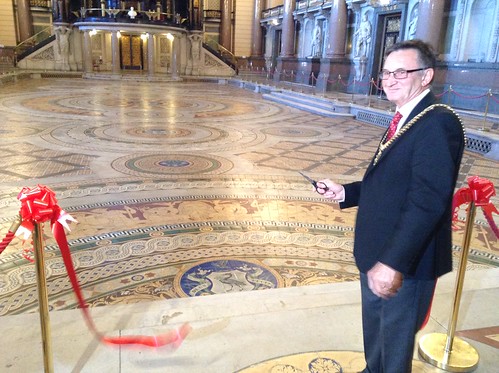
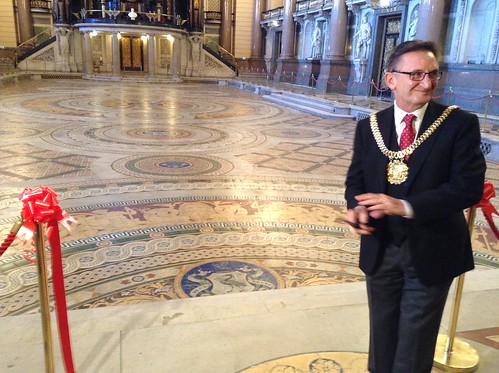
Architecture This morning I attended the formal opening of the floor of St George's Hall by our Lord Mayor Councillor Tony Concepcion, or rather the tape cutting since the wooden covering which usually obscures the Minton tiles for safety and preservation purposes were removed before the event. As the press release describes,
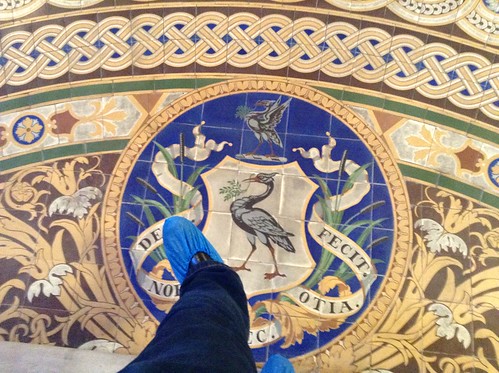
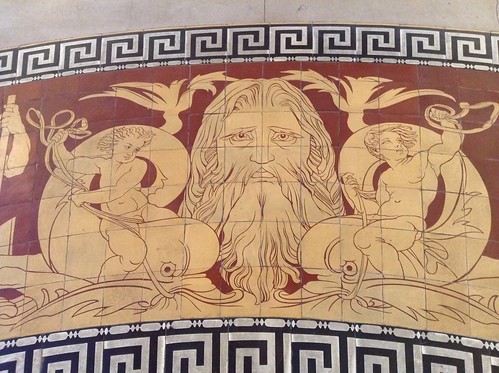
"Amongst the world’s finest examples of an encaustic tiled floor, the handcrafted mosaic of more than 30,000 tiles were concealed in the 1860s to allow dancing and events at the prestigious venue.  The intricate and exquisite patterned tiled flooring depict the Liver Birds, the Roman god Neptune, sea nymphs, dolphins and tridents in what was the largest Minton pavement in the world when reconstructed."
The Hall is used for so many events it's simply impractical to have the floor open all of the time and keep it preserved, which is ironic considering its inherent utility.  So for much of the time the only glimpse visitors have is through small windows through the usual wooden cover.  There's a decent history of the hall here.

The floor has only recently become a more viewable object, with seven appearance in the past nine years.  As local historian Steve Binns explained, when it was initially built the hall was mainly used for court purposes so not seen publically and then when the hall was used for events the floor was closed up pretty quickly.

As such it's not that much different in style to most municipal mosaics or what you might find in a church.  The difference is both its scale and also how it appears unfettered by supporting columns, the Hall itself being a great architectural feat and expression at the time construction of Liverpool's national and geographical importance.

In case you want to visit, here are some details:
"The Hall will be open daily to the public from 10am-5pm (last entry 4pm) where visitors will be able to view Liverpool’s hidden gem and gaze again at the site of the Great Hall in all its original grandeur. There will also be Walk the Floor Tours available each day at 10am-11am and 4pm-5pm and A Night on the Tiles; each evening from 6pm-9pm where guests will be able to enjoy the rare privilege of being able to “walk” on the world heritage site floor."
The floor is open until the 16th August.

I've uploaded some photographs of the event and floor to flickr but here are some of the highlights:

I now declare the floor open.

I now declare ...

I now declare the floor open.

... the St George's Hall floor ...

I now declare the floor open.

... open ....

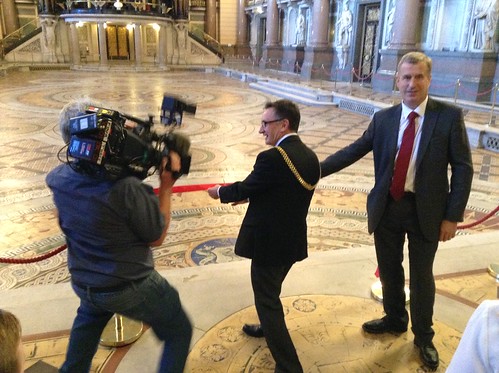
Now for the camera.

... and again for the cameras.

Stepping onto the floor.

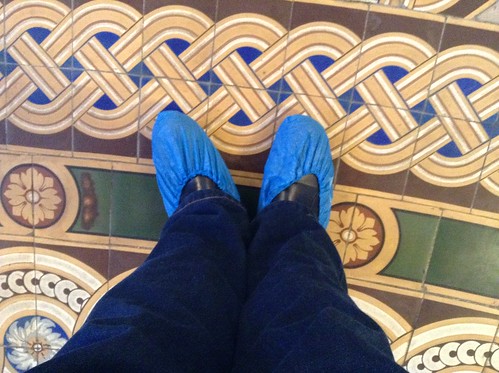
Visitors to the hall to see the floor will be given plastic shoe bags to wear if they want to step onto the floor.  Here I am taking my first step.

Blue Shoes.

On the floor.

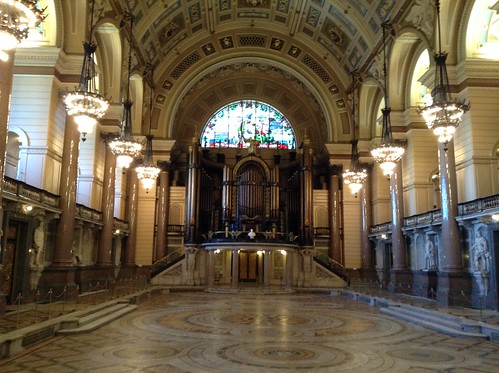
St George's Hall

Into the Hall.

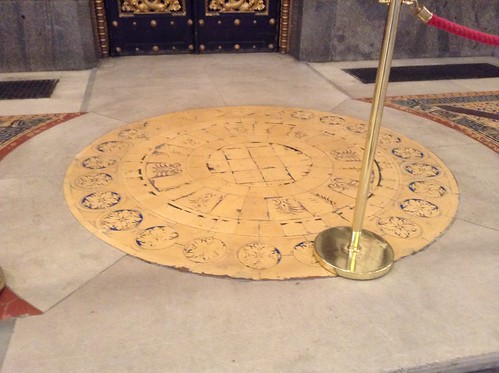
Detail of usually closed floor.

Here's why the wooden cover is important. Find above part of the floor which has just been unveiled.

Detail of open floor.

Here's the same pattern on one of the edges where the public is allowed to walk all of the time. The pattern has worn away.

IMG_0560

That's especially acute here were the pattern has almost completely gone.

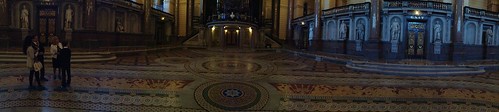
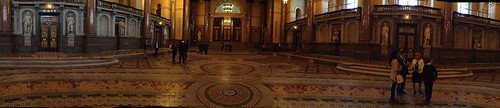
Panoramic view of St George's Hall

Today of all days I also discovered the panorama option on my iPod and decided to give it a try for the first time whilst standing on the organ platform also for the first time. Click to make bigger.

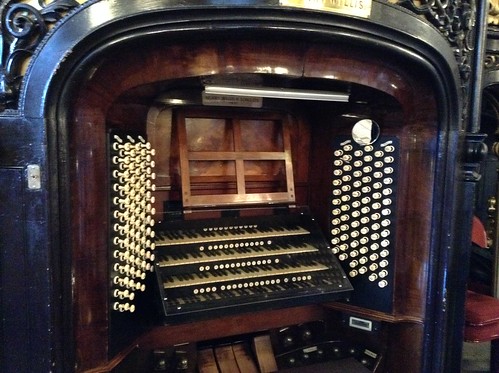
The Organ of St George's Hall

The organ.

Panoramic view of St George's Hall.

Panoramic view of St George's Hall.

Here are a couple more panoramas from standing in the centre of the hall. Sorry about the slight lean. I'm still learning.

St George's Hall Floor.

St George's Hall Floor.

St George's Hall Floor.

Finally, here are some shots of the floor itself.

Elastica.

Art For completion sake, here's the back of my head as it appears on the Echo's website in conjunction with the piece about the ... well, see above. That's the Elastica t-shirt I bought at the V96 festival in Warrington which is one of vintage garments I can now fit into again having lost all of the weight due to my hernia operation of a couple of years ago. Look at that line-up and all in one day.

My Favourite Film of 1987.


Film What was the last film you watched more than once? Not just more than once, on a regular basis, because you had to, because you were addicted to it? Now that the availability of material has signalled the death of cinema, I don't tend to watch much of anything more than once. The MARVEL films certainly, at an auditorium then subsequently on the home release. If I've some kind of viewing project on, like #garaiwatch last year which led me to sit through One Day for a second time.  But as a friend commented on social media, seeing something again feels like a luxury with so many other options available.

During the commentary for X-Men: Days of Future Past, composer and editor John Ottman laments that for the audience who turned up for the world premiere, their only experience of seeing all the hard work of himself and his colleagues will be at Jacob K. Javits Convention Center in New York with its crappy acoustics and distracting airport nearby, hoping against hope that they'll get the chance to see it in a better environment.  He'll be pleased to know I've now seen his film three times, twice in the superior Rogue Cut, albeit with the commentary turned on for two thirds of those.  Yes, that would the other reason I might repeat watching a film now.

But there are films which I've seen over and over and over again and most of them are on this list:  the Star Wars films (obviously), When Harry Met Sally,  All The President's Men, The Last Starfighter, It's a Wonderful Life, the Three Colours trilogy, Starcrossed, In The Bleak Midwinter (most christmases), Love and Other Catastrophes and Citizen Kane.  There are others but these are the films which have wracked up at least ten viewings, some of them over twenty, most from the days before you could watch the latest disappointing Simon Pegg vehicle at the click of a button.  We'll cover the film you wish you hadn't even watched the once some other time.

Towering above them all is Adventures in Babysitting.  I may have seen Adventures in Babysitting over fifty times.  For a period in the early 90s, it's the only film I would watch on Saturday night and because I didn't go out much on a Saturday night I spent a lot of time watching Elizabeth Shue take little kids into the city alone.  Within a few months I knew the film backwards and forwards and could quote along with the actors, knew where all the music queues would be and eventually the actual film probably became beside the point.  Yet we carried on, every Saturday night, Chris Parker, Brad, Straydog, Sara and me.

During my Art A-Level we were encouraged to do as much homework as possible.  As we've discussed before I couldn't draw so my main form of expression was in collage and the giant home project I worked on was a paper and paste mosaic of  a woman who I knew to be Deanna Troi from Star Trek, though I don't think ever told my teacher that.  This consisted of thousands of tiny squares cut from fashion magazines, of black and red from adverts and flesh colour which across the months I painstaking pasted to a piece of card.  When I have an image of it to hand I'll add it here so you can see what I mean.

It's during these evenings that I'd watch Adventures in Babysitting too.  Now I can't even do monotonous tasks with a film on in the background.  Complain about disappointing Simon Pegg vehicles on Twitter perhaps but not tasks.  But on those nights I'd be just as absorbed with Bradley Whitford lying about being contagious as making sure all the squares were lined up properly on Deanna's nose or singing along to Babysitting Blues as matching the various reds in her blouse.  Eventually I completed the picture and I like to think it was what upped my grade to a B and enough to go to university.

Except I carried on watching.  As Hadley Freeman rightly details in her book, some of the socio-economic and racial politics in the film are borderline.  But at the age of sixteen I didn't understand any of that.  I was too busy seeing myself in Brad with his crush on Chris and indeed having my own crush on her too.  My sexual awakening had come much earlier (at around the time of the original release of the film) with Kylie Minogue as Charlene in Neighbours and those dungarees but my eyes didn't leave the 14" portable screen in my bedroom when Shue mimed to The Crystals's Then He Kissed Me, inconsolable when she utilises the bedpost as an imaginary microphone.

For all that, and this seems crucial as Hollywood goes through a process of remembering how to tell stories with female protagonists, I also identified with Chris, even wanted to be her, going on this big adventure in Chicago (not know then that it was largely filmed in Toronto), albeit with the kids in tow.  She's smart, ingenious, brave and funny.  In an ideal world, Shue would have been able to leverage this performance into a career as a leading actress.  Instead she'd spend the next couple of decades playing wives and girlfriends and even though Leaving Las Vegas reminded everyone she could act, it's not until CSI that she'd really become valued.

All of this mostly before I had a decent copy.  After renting the film one night and adoring it, I was later in in receipt of a satellite recording which turned out to be a television melon-farmer version with all of the swearing either dubbed over or removed, sometimes with characters reacting to lines which no longer existed, rather like the daytime cuts of Friends which ran on E4 for years.  This was later replaced with an ITV broadcast, but that had adverts and the British title of the film, A Night On The Town at the beginning.  It wasn't until WH Smiths on Church Street in Liverpool had a sale that I could afford to buy the sell-through release, swearing intact.

Of course the knock on effect of that was I had to learning all the lines over again.  Where Darryl had said, "Watch my mouth? You gotta be kiddin’ me" it was now "Watch my mouth? You gotta be shittin’ me" and even now, with the film available on Netflix and owning dvds in two different regions this jars.  When Chris says, "Don't fuck with the babysitter!" it sits badly, even though its a more coherent line than "Don't mess with the babysitter!" especially in the context of the train carriage stuck between two warring gangs.  But eventually, I was as profane as the characters and in any case when you're the kind of teenager I was, this was all quite liberating.

Watching it again recently on Netflix, giving myself that luxury, I can now see the influence of Scorsese's After Hours, a series of misadventures in the city at night.  If only Chris Columbus could scale its heights again, though I have a great affection for his adaptation of Rent, especially the "Light My Candle" sequence.  Yet was still impossible for me to watch it as a "film".  Even after ten years, even with the freshness of seeing it in high definition in the correct aspect ratio, I could still anticipate every scene, every music cue, every line of dialogue and talked along with it again.  Nobody leaves this place without singing the blues.

The Embed.

DLA Piper: Constellations at Tate Liverpool.


Art Sinister computers.  Although it would be misleading to say that nothing frightens me, because frankly I'm scared of everything, sinister computers and indeed computers in general would be pretty high on the list along with my own face in the wrong light, biting into biscuits and the future.  For a computer to be especially sinister it has to be running but without a particular reason for existence or at least no obvious sense of purpose, even for a limited time.  Passing a closed university teaching room filled with computers at night is terrifying, dozens of identical machines with monitor and standby lights flashing in unison.  The laptop I'm typing this on is perfect fine right now because it has a working screen, a keyboard and I'm generally master of it, although given that it's a Windows 8.1 machine, "master" tends to be interchangeable with "the things I can get to work".  But there are moments, especially when I've closed the lid and my room's dark and the small blue light of the hard disk (pictured) continues flashing when I wonder, "What is it doing?  What is it thinking?"

There's a very sinister computer reposing at the new edition of the DLA Piper series Constellations exhibition at Tate Liverpool (for which I attended the press view this afternoon), a Diab DS-101 computer, the exterior for which was designed by the artist Richard Hamilton.  Constellations is the semi-permanent display show which fills the first and second floors at Tate Liverpool displaying sections of the gallery's own collection.  A particular artwork is explored through a series of pieces by other artists which may be connected either thematically or technically.  Elsewhere Louise Bourgeois's wall hanging, Mamelles, which features a three dimensional collage of female breasts in rubber, fibreglass and wood is reflected in a series of piece bringing together ideas of gender and the body including Marcel Duchamp's Female Fig Leaf (the casting of a vagina from another of his mannequins) and Rachel Whiteread's Untitled, one of her customary castings, on this occasion showing the interior of an air bed.  The Tate's own website has a better explanation.

The Richard Hamilton constellation is actually "triggered" by a different piece, Towards a definitive statement on the coming trends in menswear and accessories (a) Together let us explore the stars (which as you can see from the image on the Tate's own website) is a collage inspired by JFK's moon speech produced in 1962 at the interstitial point between when the the President said these words and was shot.  The rest of the display includes art works which evoke the space age, like Liliane Lijn's kinetic spinning cone Space Displace Koan, with its sleek white surface and lit circular lines which make it seems like the kind of artwork you'd find in the inevitable gallery on the Galaxy-class Starship Enterprise.  Artworks about the space race like Pierre Huyghe's video One Million Kingdoms in which an electronic version of Neil Armstrong's voice reads a passage from Jules Verne's Rocket To The Moon computer generating a digital lunar landscape which is explored by a wireframe girl not unlike Rod Lord's animations for the TV version of Hitchhikers.  Artworks about the Cold War such as the photographs by Don McCullin of Berlin citizens on either side of the wall.

Then sitting patiently the middle of all that is the Diab DS-101, a short pile of four metal boxes in various shades of grey, the topper most of which has a logo "Diab Data", a cassette drive, a 5.25" floppy drive and another space I can't identity but others have tried.  As the accompanying label explains, Hamilton was interested in how the boundaries between art and high end design sometimes merged and was asked by a Swedish computer manufacturer, Dataindustrier AB, in 1983 to design this (what was then) "minicomputer" with a simple three-box design (actually a version of their DS90-3, a UNIX computer with a dual Motorola 68030 processor).  So it's a potentially practical object which is also an art object.  In the Tate's own image, it looks relatively benign even when you use the little button at the bottom of the photo to rotate it and turn it upside down) and I imagine now that we live in an age when the average microwave has better processing power than this box most people would probably overlook it, or perhaps stop and marvel and how the phone they're using to take its image (since this is an exhibition when such things are allowed) would seem like magic to both the artist and the scientists who designed the innards (though they probably went on to design the phone too).

Except it's actually ghastly, clearly the scariest object the Tate has ever displayed and that includes the faceless infant mannequins in their recent Cathy Wilkes retrospective.  I noticed the Diab almost as soon as I entered the exhibition and the fact that it was turned on, the small green and red lights on the front illuminated.  There's a cliche about how the eyes on some portraits follow a visitor around the room in stately homes and haunted houses in Scooby-Doo cartoons and these two lights have just that effect, impassive, unchanging and always in my peripheral vision as I wandered the gallery and chatted with friends and even when I couldn't see them, I knew they were there.  The reason the Diab DS-101 is sinister is because although it still has utility as an art object, its primary function is obscured and so like the laptop in my room or those university computers at night I can't help wondering what it's thinking.  We can find out.  There's an array of twenty DVI sockets on the back waiting to output but instead the only form of communication it has is those two lights, one red, one green, both always on somehow, simultaneously reminding us that it exists and is working but also, in my imagination, watching like the circular eye of a HAL-9000.

Which is all, of course, entirely irrational.  For a start the processor isn't powerful enough to have artificial intelligence, let alone magically network with the desktop and tablet computer which are surely otherwise in the Tate's ancient building creating a kind of rudimentary Skynet with the potential to overthrow the curatorial direction of the gallery replacing it with some sort of mechanised brain repetitiously scheduling Futurist retrospectives (though it's worth noting - ish - that the WOPR in War Games almost brought nuclear armageddon and that was surely even less powerful than the Diab).  Plus there are admittedly far scarier objects in the exhibition, not least the Paul McCarthy video, Painter, a satire on the heroic artist, which is in places so disgustingly scattalogical children aren't allowed to watch it (and here's a shot of me from the Liverpool Echo website doing just that).  Yet I am wondering right now if it's turned off when the gallery is closed or is left to sit overnight in the solitary exhibition space plotting our downfall.  Perhaps I'd simply be happier if it wasn't turned on at all, if Pinocchio was broken, its strings cut.

DLA Piper: Constellations at Tate Liverpool is free to visit.

"the BBC make-up department in the Doctor Who studios."

TV Recently repeated and so currently in the iPlayer is George Carey's Storyville documentary about KGB agent George Blake who doubled in MI6 sending details of agents to the Soviets during the cold war.

 Eventually he was caught and jailed at Wormwood Scrubs but pretty quickly escaped, in October 1966 and was aided in the getaway by two peace activists, Dr Michael Randle and his wife Anne.

Their interview begins about an hour and ten minutes into the piece as they describe how they were contacted by journalists and assumed the police would be on to them pretty quickly. They never were.

During the conversation the following narrative bomb is dropped.  My italics for effect:
Anne Randle:
"He'd actually knocked himself out.  He had a cut about here and he'd not slept all night because of the pain.  So he did look rather gruesome."

George Carey (narration):
"His fall had broken his wrist. So, they found a sympathetic doctor and something to fix it with."

Anne Randle:
"We knew someone who knew how to get hold of plaster of Paris bandages from the BBC make-up department in the Doctor Who studios."
Well and indeed then. She doesn't say that it is someone who worked in the BBC make-up department in the Doctor Who studios just someone who has access but it's still an occasion when the last place you think you'll hear about a link to the franchise is usually the place when you hear about a link to the franchise.

Doctor Who in the Associated Press Archive.

TV Just as they updated the YouTube offering for British Movietone, AP also massed over a hundred thousand more recent clips from the past few decades. Let's have a look shall we?


Sci fi clcassic celebrates 45th anniversary - typos are a feature of this upload. The metadata on this clip says "Peter Davidson" whoever he is. Barnaby Edwards is our spokesman here in a tour of the exhibition in Cardiff in 2008.


UK Prince William meets the stars of Middle Earth at UK premiere - including Sylv.


Entertainment Weekly: The Biographer - post-TVM, pre-Big Finish Paul on the set of a film about Diana in which he plays Andrew Motion featuring Captain Henry Avery and Elder Ood. Yes really. Only ever released in the USA and Japan according the IMDb. There's a longer making of here.


Entertainment Daily: My Kingdom - released on Who's 36th anniversary, a short piece about the gangster remake of King Lear shot in Liverpool starring Richard Harris (and very good it is too).


Entertainment Daily: Invisible Circus - Chris at around the same time. With hair and oh so young. Bless.

There are also lots of clips of John Hurt.

Natural Regression (The Scientific Secrets of Doctor Who)

Books Given its content, a very short story within an anthology threaded through a fact based look at the television series approach to science, Natural Regression is a nonetheless fairly momentous entry within the franchise. The first new piece of Eighth Doctor prose published by the BBC Books imprint since Fear Itself in 2005 (Spore was a Puffin eBook), it's also the opening salvo in a coincidental multi-platform reveal of what happened him between the end of the Big Finish audios and his regeneration (including a comic series and audio) refreshing the character again.  As one of the architects who helped establish the character, despite the slender pagination, Justin Richards instantly captures Eighth in his usual status quo, planets and galaxies exploding all around and just him and his small blue box trying to do their best against insurmountable odds.  The motivation for this small adventure fits within the scientific theme of the book (as well as poignantly paying homage to the educational roots of the series) and the only criticism I have is that it ends at just the moment when you want to read about him going off on further adventures with a potential new companion.  After nearly twenty years, this version of the character continues to surprise.

Soup Safari #52: Chicken and Sweetcorn at Bramley's Coffee House.


Brunch. £4.95. Bramley's Coffee House, 6 Church St, Ormskirk L39 3QS. Phone: 01695 578801. Website.

Identity Loss.

People The Guardian has a useful piece about memory loss or more specifically identity loss and how it's not uncommon:
"For some, amnesia is specific to a situation: being in car crash or witnessing a murder. In others, it is not a solitary personal experience that drifts away in time but your identity, your self. “Who am I, what have I been doing all my life?”

"Jason Bournes in the real world are usually found by police on street corners and led, in an often dishevelled and confused state, to emergency rooms. No name and no memories. Some have travelled hundreds of miles from home as part of their psychogenic fugue (fugue is Latin for flight). It is a departure from a distant physical location, but a remote place of the mind, too."

My Favourite Film of 1988.


Film Still on air now in a different form and long after I stopped listening to commercial radio on purpose, the "peaceful hour" on Liverpool's Radio City was how I went to sleep during my school years, broadcast between midnight and one.  I can't remember who the DJ was, though YouTube suggests it might have been Paul Leckie, but I do have two vivid memories.  One that every night someone would request Minnie Riperton's Loving You and there was a brief moment when my tweenie soprano voice could actually reach some of those high notes and the adverts repeated at what seemed like ten minute intervals for the latest film releases at the Video City chain of which our local was in Garston.

These adverts, which included clips of dialogue from the films and what must have been a pithy synopsis supplied by the film company were repeated so often that after a while I could quote them verbatim.  Now there's only three films which pierce the fog: The Pick-Up Artist ("Hi, I'm Jack Jericho." "Did anyone ever tell you that you have the face of a Botticelli and the body of a Degas?"), The Boy Who Could Fly ("You told your mother something about a boy who rescued you." "What are you, a shrink?") and Working Girl ("I have a head for business and a bod for sin.").  Every night these same adverts.  But for some reason I never did actually see any of these films, on rental from Video City, which was odd because we were in there all the time.

As a family we were lent our first video player in the mid-80s.  We ventured out that night to buy a blank tape from the Asda at Hunts Cross which would eventually be the permanent home for a recording of the James Spader starring Starcrossed which was broadcast as part of a sci-fi season on Channel 4 (with, if I can complete the memory, a purple sticker across the top which had been given away free with the 2000 AD spin-off "magazine" Crisis).  But that evening it allowed us to finally experience the magic of recording something from live television and then playing it back.  Pretty soon afterwards we decided to try renting some films and the nearest shop which wasn't also an off license was Video City in Garston.

As I mentioned a couple of weeks ago, this is where I first hired Star Trek: The Next Generation, but before that, one summer holiday, I remember working through the whole of the available Police Academy series, loads of Disney and oddly one Sunday afternoon Robocop, which would have been my first 18 certificate film.  Not a bad place to start.  The decor is about what you'd imagine a mid-80s video shop to be, with woodchip wallpaper and those red plastic display boxes for new released and wall shelves for the back catalogue (with its often lurid box art).  There might even have been a small, walled off section for adult selections.  The place seems huge in my memory, but was still relatively small, so it could have been about the size of an average off license.

Yet despite all of the advertising efforts I would eventually see these three films through other means.  The Pick-Up Artist, starring Robert Downey Jr in his notorious phase opposite Molly Ringwald just after she'd fallen out with John Hughes and was seeking more adult material was broadcast in the middle of the night on ITV back when they didn't simply rerun Loose Women and posh teletext, The Boy Who Could Fly was I think shown one morning on Channel 4 and I think I eventually saw Working Girl on a recording the same relative made of it from Sky for us.  Even as I type this, I still can't believe that all these archaic means of accessing film were only thirty odd years ago.  Though given that I'm forty, that is actually a very long time.  Let the river run.

BBC Genome adds links to actual programmes.

TV The BBC Genome is a massive database of everything broadcast on the BBC from 1923 to 2009 created by scanning in back copies of the Radio Times. Since it went public it's been an invaluable source of information as to what was transmitted when, providing the useful ability to remind us when memories of various shows actually happened.

Now it's even better.  Now they're going through and linking entries to actual programmes available on the BBC website across television and radio:
"When I started the work to find the programmes, we weren't sure how many published programmes, which are available outside the 30 day catch-up period for programmes available on BBC iPlayer — we would find on the BBC website. Over the years, different departments have uploaded select broadcast programmes, and they sit under different collections on bbc.co.uk – sometimes categorised and alphabetised, sometimes not. We knew about the large and well-documented collections, and estimated there would be many more obscure, single programmes too.

"Our guess when we started was that we might able to link about 3,000 videos or radio programmes – so far, we have found about 8,500 (282 television and 8,200 radio). And we're still working on more."
They're asking for user submissions, so of course ...

Are you MARVEL or DC?

Film At a certain point, I began to think of the MARVEL cinematic universe, which I favour because it's good, and the WB/DC projects a bit like political parties or at least with the sort of tribalism with which kids used to defend their favourite 8-bit computer with (a debate I was largely on the fringes of even then with my Acorn Electron during the Spectrum/C64 years and then owning a C64 while people were throwing STs and Amigas in each others faces).

Partly this is because the creatives, or actors at least, are almost choosing which of the big comic book franchises to join to the point and there's little or no crossover between them.  As far as I can see, none of the cast of the Suicide Squad or Batman vs. Superman films has previous appeared in the MCU or vis-versa so it's entirely possible for us, or at least me to think of them as either being, "MARVEL" or "DC" and be otherwise disappointed if they've chosen the latter.

Rachel McAdams is a favourite actress, so when she says she might be in the Doctor Strange film, it's a relief because it means she's MARVEL.  Finding Amy Adams in the Man of Steel was a shame because I like her too but she's hitched herself to DC (even if she was a predictably good Lois in an otherwise bad Superman film).  It should be noted that anything pre-Iron Man or pre-MoS doesn't count so I'm still in hope that Anne Hathaway might play one of the Inhumans or some such.

Is it possible to guess if an actor will turn out to be MARVEL or DC?  Maybe, maybe.  When the cast list for Suicide Squad was released, I wasn't surprised by most of the names.  Looking at other franchises for inspiration, Emma Watson feels very MARVEL, but Rupert Grint is clearly DC.  Daniel Radcliffe could go either way.  Greta Gerwig, MARVEL.  Brad Pitt, DC.  Cary Grant, MARVEL.  Gary Cooper, DC.  No idea why.

Tongue Restraint.

History In Britain's Forgotten Slave Owners, David Olusoga describes the legacy of cruelty which underpins our wealth. In one sequence during the first episode whilst visiting Jamaica he's confronted with the instruments of torture utilised to subjugate slaves. There's a clip of this sequence here and amongst the objects is this tongue restraint utilised to subjugate slaves who challenged authority.


The apparatus looked familiar and for the rest of the sequence I asked myself where I'd seen it before. Then I remembered.


In Suffragettes Forever! The Story of Women and Power, Amanda Vickery describes the history of the women's suffrage movement. In one sequence during the first episode whilst visiting the Lancaster Castle Museum she's confronted by this tongue restraint utilised to subjugate women who challenged authority.