Cinematic Shakespeare.


Film  Recently, in the lead-up to the 400th anniversary of the publication of the First Folio, the BBC has broadcast a series of archive Shakespeare productions including a Hamlet double bill on one Sunday night, which would have tested the metal of even his biggest fan (and I speak as someone who once listened to three full-text audio versions in a day).  

Sadly it hasn't been the complete canon - showing versions of all 36 plays was probably a big ask in 2023.  But this will have been the first opportunity some viewers will have had to see Peter Hall's The Wars of the Roses or Hamlet at Elsinore (incorrectly labelled as part of "The BBC Television Shakespeare" on the iPlayer which was at least a decade and a half later).

Nevertheless, this has provoked me to finally get around to a series of occasional blog posts I've been thinking about for a few years of putting together various Shakespeare collections or "festivals" with productions which share a format or media.  Until now, that's always felt pretty tricky because not all of the plays have been available in all the formats or media I've wanted to cover.  

We're in a time when most of the plays are at the most accessible they've ever been, between physical formats and streaming services and so I thought it would be fun to finally create such lists in case anyone is interested in watching their way through the plays and would quite like some recommendations.  Up first, Cinematic Shakespeare or how I'm going to spend December.

*    *    *    *    *


Of all the plays you would think might be the first to survive on film, it wouldn't be King John.  But there he is, actor-manager Herbert Beerbohm Tree playing the doomed monarch in poisonous, fearful death, silently intoning Shakespeare's words back in 1899.  The Folger Shakespeare Library has a lengthy article about this which explains that it was shot on stage at the Palace Theatre on September 20th, the same night Tree's own stage production began its sun at Her Majesty's Theatre.  

Shakespeare has flourished in film since with hundreds of productions across most of the rest of the canon.  What we're concerning ourselves with here are those which as projects were originated and shot on film (so no direct stage transfers) or HD in a so-called "classical Hollywood" style with all the visual tricks that entail.  The text could be cut or rearranged, but the words coming out of the actor's mouths are Shakespeare's.  

Here is my curated list in First Folio order.  As you'll see I've tried to pay respect to both theatrical and cinematic history (Ken, Larry, Orson etc).  It's also fair to say that some of the choices are by default because they're the only version of the play to fit the criteria.  We still await the retro-noir version of Measure for Measure I've had in my head for decades (and just turning the colour off on the BBC 1994 Performance version isn't quite the same).  Anyway, I hope you enjoy it.


THE COMEDIES

Propero's Books (1991)  After numerous attempts with various directors, John Gielgud finally played the title character of The Tempest in Peter Greenaway's eclectic, avant-garde visually stunning treatment.  Greenaway plays with the notion of Prospero as Shakespeare's avatar and the popular belief that in writing the text and the sorcerer's words he was bidding farewell to his life's work.  If you are treating this as the opening film of a festival, it's a great introduction.

Two Gentlemen of Verona  There have been no cinematic versions.

The Merry Wives of Windsor  There have (mostly) been no cinematic versions.  See Chimes at Midnight.

Measure for Measure   There have been no cinematic versions.

The Comedy of Errors  There have been no cinematic versions.

Much Ado About Nothing (1991)  There's not much of a contest here, this has Ken and Em at their zenith shot beneath the golden Tuscan sky in a rendering of the play which makes sense of the comedic scenes as well as the tragic.  More than most of Branagh's films, this has him clashing Hollywood and UK theatrical royalty together, with Denzel meeting Briersley and BRIAN BLESSED and Ben Elton playing sidekick to Michael Keaton.  Also the first major screen role for Kate Beckinsale.

Love's Labour's Lost (2000)  Ken's version of this prequel to a lost play drew criticism from some for cutting almost three-quarters of the play and turning the whole thing into a 1930s musical (especially with this being the only film version of the play available) but the result is so adorable I'll forgive everything.  The cuts are also immensely clever.  In its complete form, LLL can be difficult to follow in places, but through production design and costume, everything here is perfectly clear.

A Midsummer Night's Dream (1999)  The apogee of the 90s Shakespeare film cycle, this Branagh-influenced version returns to a Tuscan setting (still referred to as Greece in the text) and has John Sessions as Philostrate.  The magic of the forest is given the full special effects treatment and the whole of the cast is just so gosh-darn adorable, with Michelle Pfeiffer at her imperious best as Titannia and Kevin Kline offering his thoroughly cute Bottom.

The Merchant of Venice (2004)  The casting of the Sicilian Italian-American Al Pacino as Shylock looks pretty dated in retrospect, but Michael Radford's production does at least notice that this isn't a particularly funny play, cutting most of the box-checking scenes and highlighting the animosity between the ethnic and religious groups in Venice.  It's also notable for its location shooting in Venice and doesn't downplay the homo-erotic aspects of some relationships.

As You Like It (2006)  Back to Branagh for his final Shakespeare production on film (so far) which transposes the play to a late 19th-century European colony in Japan after the Meiji Restoration amongst the English traders who were fascinated by the local culture.  Future Doctor Who Romola Garai plays Celia, with most of his usual repertory appearing and Kevin Kline joining as Jaques.  Theatrically released in the UK, it was produced for HBO back when they did this sort of thing.

The Taming of the Shrew (1967)  Taylor and Burton bouncing off the walls of Cineceta and each other.  Unlike her husband, Liz hadn't acted Shakespeare before and after much persistence, she was able to lobby director Franco Zeffrelli to redo the first week's shooting at the end once she'd got the hang of the iambic pentameter.  Cuts include the induction with Christopher Sly and most of the Lucentio and Bianca subplot.  Michael Hordern is delightful as Kate's father  

All's Well That Ends Well   There have been no cinematic versions.

Twelfth Night (1996)  Considering its popularity, it's surprising that Adrian Noble's country house take is the only version of the play on film.  It's perfectly fine with a strong cast led by Imogen Stubbs and Helena Bonham Carter with Ben Kingsley as Feste, REG as Aguecheek, Mel Smith as Toby Belch and Nigel Hawthorne as Malvolio.  Once again it feels of a piece with Ken's style but he'd already produced a TV version for Channel 4 in 1988 with Briesley in the yellow britches.

The Winter's Tale   There have been no cinematic versions (in 1968, Frank Dunlop adapted his Edinburgh Festival stage production but even that isn't available).


THE HISTORIES

King John  There have been no cinematic versions (apart from the 1899 version which wouldn't count anyway).

The Hollow Crown (2012-2016)  For the tetralogies, you've two choices.  The Hollow Crown allows you to follow the whole damn story with shared casts, all of the best actors of the period reading Shakespeare's words in a style which is essentially Game of Thrones without the dragons, with Henry VI is heavily cut and runs across two episodes.  Or you can treat some of the plays individually and take a more eclectic approach.  See below:

Richard II  There have been no other cinematic versions.

Chimes at Midnight (1966)  Out of circulation until recently due to licensing issues, Orson Welles's labour of love essentially pulls all of the Falstaff scenes from the various plays including The Merry Wives of Windsor and spins them into a relatively coherent screenplay.  The director makes for a rambunctious lead character and the eclectic cast includes Gielgud and Jeane Moreau as Doll Tearsheet.  

Henry V (1944)  To ease us out of the Welles, it's back to one of the grandparents of Shakespeare on film.  Opening in a recreation of an Elizabethan theatre to underscore the artifice of what's ahead, like a backstage musical the stage becomes a near-infinite space across which the battle of Agincourt and everything else in Larry's interpretation takes place.  Sacred enough that when Ken wanted to make his version, the effort was branded as precocious.

Richard III (1955)  Olivier played Richard on stage, but his film version is a different entity with a new cast and production design.  Apparently, it wasn't well received by critics at the time but the opening monologue has become iconic and it's said many actors work hard not to play it like Olivier (Ken parodies this during the audition scene of In The Bleak Midwinter).  The late, lamented Network released a wonderfully crisp restoration of this which is worth tracking down.

Henry VIII (1979)  Director Kevin Billington, in an effort to shift the play away from its usual presentation as a pageant, shot this on location at Leeds Castle, Penshurst Place and Hever Castle, often in the rooms where the historical action is presumed to take place.  As a result, it looks more "cinematic" than a lot of the films on this list not least because everyone looks absolutely freezing, their breath steaming throughout.  The DVD transfer is pin-sharp.


THE TRAGEDIES

Troilus and Cressida (1981)   There have been no cinematic versions.

Coriolanus (2011)  In this modern dress adaptation, director Ralph Feinnes transfers ancient Rome to the Balkans during a pseudo-Yugoslave war, with the actual Jon Snow offering backstory at the beginning in the style of a newscast.  Rattles through a cut text in a couple of hours, Fiennes cuts a commanding, bloodthirsty figure as the title character, nevertheless crumbling in the face of Vanessa Redgrave's Volumnia.  Mother knows best.

Titus (1999)  Like Coriolanus, Julie Taymor's film refuses to accept the play's original setting, instead clashing together designs from various periods of history, from ancient Rome to Mussolini's Italy through the eyes of the contemporary small boy introduced at the beginning who enters the production as young Lucius is really just messing about with toy soldiers.  Which doesn't make it any less gruesome, Tony Hopkins serving revenge with Lectorish glee.

William Shakespeare's Romeo + Juliet (1996)  Could it be anything other than Baz Luhrmann?  Few productions have convincingly suggested these two could fall in love overnight, but when Leo and Claire furtively gaze at one another through the fish tank you're sold.  Also manages to make you forget this is a play you've seen a dozen times before, with the various contrivances absolutely heart-sucking.  One for the ages.

Timon of Athens (1981)   There have been no cinematic versions.

Julius Caesar (1953)  Developed in reaction to Olivier's Henry V, this full-tilt classical Hollywood production re-uses sets from Quo Vadis and was shot in black and white so as not to draw comparison and to suggest contemporary film reels reflecting the still evident fascist movements in Europe.  Features James Mason and Gielgud as Brutus and Cassius, Marlon Brando as Mark Anthony and a host of recognisable character actors from that period.  

Macbeth (1948) Orson Welles: "I thought I was making what might be a good film, and what, if the 23-day shoot schedule came off, might encourage other filmmakers to tackle difficult subjects at greater speed. Unfortunately, not one critic in any part of the world chose to compliment me on the speed. They thought it was a scandal that it should only take 23 days. Of course, they were right, but I could not write to every one of them and explain that no one would give me any money for a further day's shooting . . . However, I am not ashamed of the limitations of the picture."

Hamlet (1996)  Branagh's magnum opus, a four-hour production of a conflated text collecting as much Hamlet as Shakespeare wrote, including some odds and sods from Q1.  As with 99% of productions, Ken and his cohorts are too old for their parts (is everyone in court a mature student?) but this is Shakespeare rendered in 70mm with more stars than a Record Breakers Christmas Special.  Briersley's spymaster Polonius steals the show.

King Lear (1970)  Pitch dark Bergmanesque production from Peter Brook with Paul Schofield's Lear against a blasted wilderness, shot in the wintery dune country of Denmark's Jutland Peninsula.  Visually it's absolutely extraordinary, the grain of the 16mm creating the impression that we're watching action filmed in a documentary style in the deep past.  Probably in my top three favourite Lears, along with Kurosawa's Ran and the RSC production with Romola Garai amongst others.

Othello (1995)  Although there had been earlier indie productions starring Ted Lange and Yaphet Kotto, this was the first mainstream production to feature a black actor in the lead role, the fantastic Laurence Fishburne.  It's adapted and directed by Oliver Parker and Ken only plays Iago, but manages to feature some of his usual ensembles, Michael Maloney and Nicholas Farrell.  Shot on location in Venice and Cyprus, David Johnson's cinematography gives it an erotic thriller feel.

Antony and Cleopatra (1972)  Having yet to have the chance to see this, here's a take from the BFI's old ScreenOnline website:  "Emphasising spectacle at the expense of subtlety (even to the point of recycling shots from the 1959 Ben-Hur, in which Heston had starred some thirteen years earlier!), this adaptation shows little feeling for the emotions at the core of the story, and is torpedoed by the lack of chemistry between Heston and South African actress Hildegard Neil, who is arguably miscast as Cleopatra."

Cymbeline   There have been no cinematic versions.


Up next:
Shakespeare Adaptations.

13 British Library


Books  A couple of weeks ago I had the privilege of being in the audience for a live recording of Greg Jenner's Radio 4 podcast You're Dead To Me at the Shakespeare North Playhouse in Prescot.  Not having listened before I didn't really know what to expect and it was mostly a chance to see the new theatre without the distraction of having to watch a play and acting.  The guests were Professor Farah Karim-Cooper, Professor of Shakespeare Studies at King’s College London and Co-Director of Education & Research at Shakespeare’s Globe, and the comedian Richard Herring.

The podcast, which you can listen to here, offered the bare bones of Shakespeare's biography and some of the publishing history of the First Folio and there wasn't much about either that didn't already know.  But I did find out that Richard Herring only has one testicle, which was funny when he mentioned it on stage but is of course very serious because his other ball was removed because of testicular cancer, which he talked about in an interview around this time last year which is posted on his website.  Richard also talks about the podcast on his blog and some of the retakes that were needed to make it clean for radio broadcast.

After the show, a queue quickly built up towards the theatre's exhibition area because on tour and on display is the Grenville First Folio.  Usually on display in the British Library, where I originally saw it back in 2016, I'd completely forgotten it was going to be in Prescot (my memory is terrible these days).  So after a pretty decent coffee in the on-site cafe and a visit to the shop to let the crowds dissipate, I wandered down into the now nearly empty display space to have another look.  It's pretty sparse, mostly information boards offering some background and an introductory video projected on the wall.

It's commonly called the Grenville Folio because the long-time Member of Parliament and First Lord of the Admiralty Thomas Grenville bequeathed it to the library on his death. Still, he wasn't the first known owner of the volume.  As Eric Rasmussen's The Shakespeare First Folios: A Descriptive Catalogue describes, that would be Dr John Monroe a physician at Bethlehem Hospital who sold it to James Midgely, Jr at a Sotheby's sale for £13 13s who then sold it in 1818 to Grenville via a bookseller for what was then the record price of 116 guineas, around £10,000 in today's money.  

The Folio was amongst 20,000 books that were passed to the British Library almost all of which had been rebound by Grenville as they entered his collection much to the annoyance of later scholars who wonder what information they might have gleaned from the discarded pieces.  Presented on a transparent display lectern, the binding which Rasmussen describes as "sumptuous full goatskin stamped with a coat of arms" does stand out from some of the more sombre bindings I've seen but also doesn't quite fit the pages it contains.

As is customary in these kinds of displays, there isn't much to see, it's about being the presence of the book.  Just as it is in the British Library, it's open on the frontispiece and the Droeshout engraving of Shakespeare's portrait with Ben Jonson's To The Reader opposite which ironically means that none of the playwright's own words are being shown.  Neither is the note with Grenville left on the first leaf which says "This first edition of Shakespeare is an original and perfect copy, and was purchased by me in it’s first binding & in it’s original state. T.G.".  Grenville wanted to leave no doubt about his ownership.

Further sightings:


This copy has appeared on television back in 2009 as part of From Page To Screen: Hamlet, a BBC Learning Zone schools programme about the making of the RSC production starring David Tennant.  It's very easy to identify thanks to the distinctive binding also it also helped that there are also shots of a Q1 copy with the British Museum stamp on them and I assumed the crew filming b-roll would have gathered all of this coverage on the same day.


They appear in a sequence in which the play's director Gregory Doran is explaining the different versions of the play and how the production used Q1's alternative structure, notably the placement of the To Be Or Not To Be speech (see my review).

Three years later, this edition would emerge again, in the Shakespeare Uncovered episode about Hamlet fronted by David Tennant, who is shown the three different versions of the play in a Q1, Q2 and this First Folio from the British Library collection.  We see the same page from Q1 again:


Here's the traditional shot of it being opened to the title page.  Note again the distinctive binding.


There's also a shot of the binding with Grenville's coat of arms stamped in gold in the middle.


Tales of the TARDIS.


TV  When The Whoniverse was announced just a few short weeks ago the magnitude of it didn't quite land with me.  All of the big numbers, 800 episodes of Doctor Who all in one place, most of the surviving episodes of the franchise on the iPlayer permanently.  How?  Now it's here and oh my.  No need to reach for a DVD on the off chance you want to watch The Space Museum, there it is in a special section of the BBC's streaming service between the two extant episodes of The Crusade and the version of The Chase without The Beatles.  The programme pages on the BBC website we used to look at longingly with their episode guides but nothing to watch are now largely full with The TV Movie with the Pertwee logo representing them on the landing page.  By the way the clips page for 2005-2013 is still there, but hidden.  Link here.

Partly as a way of introducing viewers to some of the classics and to give fans something new to watch on launch day, Tales of the TARDIS reunites various combinations of Doctors and companions to reminisce about their time in the travelling machine and introduce stories from their eras.  You've probably seen them already, but just in case, they're here.  Coming back afterwards.  Am I disappointed there isn't an instalment with Paul McGann snogging Daphne Ashbrook again around the The Enemy Within?  Of course, but there isn't one for Tom either perhaps because he's 89 years old now and with him still alive it would have been odd for Lalla and Louise wrap around Genesis of the Daleks (because it's always Genesis of the Daleks), a story within which neither of them appeared.

Mostly written by Phil Ford with a couple of episodes by RTD2 and Pete McTighe, they're almost review proof for anyone emotionally invested in these characters.  They're an opportunity to complete some emotional beats which the classic series wasn't designed for and/or haven't been covered by Big Finish.  So we finally see the emotional toll the Time Lord's removal of Jamie and Zoe's memories of their time with the Doctor had going forward with them apparently returning as an anniversary gift.  More hints as to how the Seventh Doctor and Ace parted continuing the thread from The Power of the Doctor (perhaps one of the multiple options presented in the novel At Childhood's End.  Steven and Vicki wondering if they were right to leave the TARDIS when they did.

Perhaps the strongest are those which flirt with the para and intertextuality of the show.  The Sixth Doctor we meet is the much more approachable, avuncular reimaging from Big Finish showing Peri much more warmth than he did previously on-screen (and vis-versa) whilst also making their cutaway a prequel to The Eternal Mystery by having them fly off together at the end.  When the Fifth Doctor and Tegan reunite, RTD2's script cheekily eludes to the lack of hanky-panky in the TARDIS whilst simultaneously throwing us Nygan shippers a bone ("I was fast asleep, in bed, I said goodbye to Nyssa and ...").  Their story is about finally dealing with the death of Adric, but it's the decades of friendship between Davison and Fielding which shine through.  

Perhaps the most moving is Phil Ford's return to The Sarah Jane Adventures era in his wrap around for The Three Doctors featuring Daniel Anthony and Katy Manning.  There's a version of this with Jo and one of her ex-UNIT colleagues but by drawing in Clyde, younger viewers with an affection for the 00s era are allowed the Proustian punch some of us with an aging physiognomy might have found elsewhere.  Like the Pete and Janet instalment, it's about grief, the loss of Sarah Jane (and Lis), the recent death of Cliff (and Stewart) but also moving forward, with Jo imploring Clyde to tell Rani about his feelings for her (in a way I'm reliably informed doesn't contradict anything at Big Finish).  As with all these vignettes, the performances are impeccable.

What of the nature of these encounters?  Some have interpreted it as the TARDIS having a nap and remembering these former inhabitants in her dreams.  But too many of them have memories of where their life is up until that point, many years of experiences and this TARDIS interior with its many consoles stacked on top of one another and knick-knacks from across the era like some time/space equivalent of Brian Cant's Bric-a-Brac shop are too tangible for none of it to be real (and a bit of a cheat if they aren't).  Not to mention a couple of the crews decide to borrow this TARDIS at the end for more adventures.  The ambiguity is the point, like some of the best stories, especially Doctor Who stories, it's up to the audience's imagination to complete the poetry.

The impression we're left with is just how respectful all of this is, to the characters, the writers who created them and the cast themselves.  This is in sharp contrast to most of their main appearance on television ten years ago in The Afterparty mostly there as background dressing to interviews with the current stars, a disastrous delayed interview with 1D, being referred to by their character names when they weren't otherwise being knocked almost out of their chair.  The Five(ish) Doctors Reboot (still online folks) is very funny and Tom's emergence as The Curator a gut-wrenching surprise, but the history of the show felt relegated to something for the older fans, hidden behind paywalls.  Now everyone has access to (almost) all of TV's tales of the TARDIS.

Once and Future: The Union

Audio  During the fiftieth anniversary, the lead character in Doctor Who had a convenient number of incarnations for releasing a celebratory story a month.  Across IDW Comics, Puffin and BBC Audio/Big Finish that's exactly what happened with each version of the Doctor celebrated across the first eleven with the twelfth slot given over to some kind overall story resolution were necessary.  August was a big month for us Eighth Doctor completists, even if the audio, Enemy Aliens, was the only decent attempt of the three.

Since then the numbers have become a bit complicated and so licensees have gone for more of a general celebratory approach with Titan Comics largely keeping to participating in the Doom's Day crossover and a Tenth Doctor graphic novel by Dan Slott, BBC Children's Book rolling out three short hard covers featuring revival incarnation in stories set across the past three decades and Big Finish offering this seven parts and a coda, Once and Future.

Multi-Doctor stories are fine and Big Finish has produced some immensely entertaining versions over the years, but they're also aware of the stove hattedness of them so instead have gone for stories which feature a lot of different versions of the Doctor mostly not directly interacting with themselves.  At some point during the Time War, the Time Lord has been hit by a "degeneration" weapon which causes a shift backwards and forwards between different faces.  Who did this and how can it be stopped?

It's been a fun journey.  Some stories have worked better than others, shifting tonally wildly between average romp and curate's egg but it's mostly just been a good excuse to bring together combinations of Doctor, companions and antagonists which might not otherwise meet.  As "degeneration" suggests, this is some future version of the Doctor who happens to sounds like the 4th or 10th Doctor during that adventure with only the memories necessary for the plot.  So we see what happens when Sixth runs into Lady Christina and Jackie Tyler, that sort of thing.


Once and Future: The Union

Its with some trepidation I visited The Union because one of the key mysteries running through the series was in which incarnation the Doctor was originally zapped.  Depending on when it happened, I was either going to have to review the whole lot for the chronology or a few paragraphs to fit in the "Almost, but not quite, entirely unlike the Eighth Doctor ..." section at the bottom and not having to worry about whether the third Doctor suddenly knows who Charley Pollard is.

Big Finish themselves rather gave the game away with their news page on the release with the line, "But which Doctor was shot with it? Was it the War Doctor? The Eighth Doctor? The Fourth?"  Given that the War Doctor isn't on the box art, it's clearly something they wanted to keep secret up until recently so it was clearly going to be him.  Big Finish may love stories but sometimes they're not big on surprises (which is why you should also ignore the cast list for this one until after you've listened to the end).

What we have here is the old "Trill" theory of the Doctor writ large, that there's a core being that calls itself the Doctor which is then hosted by the various incarnations and personalities like a biological desktop theme.  When there's a regeneration that host dies and another emerges who like the Trill in Star Trek is a new individual that is connected to the metaphysical creature whatever and wherever that is, a creature which sometimes communicates with the out shell more directly by choosing a particular face.

In The Union, the Eighth version of the Doctor effectively becomes the spokesperson for the other faces.  He's the one who gets to do the big speeches about how no matter what they look like the core elements of what make the Doctor remain, that he is a good man.  You can tell McGann loves this mythologizing of Doctor Who.  Quite rightly he's inarguably become a relevant and vital part of the franchise despite a shaky beginning in 1996 and being the connoisseur's choice in successive years.

There are some surprises especially in the b-plot which offers some squinty homages to a numerous elements from the history of the franchise.  But this is mostly about explaining mysteries set up earlier in the overall story mostly, it has to be said due to the interventions of River Song who due to the Doctor's condition is more of an active participant, which as you know is fine by me especially hearing this blazing invocation of the revived series interacting with Susan, the one who started it all.

Elsewhere, The Union is a marvellous creation and Maureen O'Brien's performance really sells the batshit insanity locked within her character.  There's also a lovely moment when this version of the Eighth Doctor and Susan finally make amends over the events in To The Death (Cass was recorded at least two years after this) and other cameos have similar notes but they're for other completists to cover (although its implied that no one will remember any of this anyway but they're nice sentiments).

Placement:  "Almost, but not quite, entirely unlike the Eighth Doctor ..." unless something unusual happens in Coda and I have to rethink all of this again.

Even Richard Curtis Thinks Love Actually Is Rubbish

Film  Hello.  I know that apart from the all too obviously auto-posting BBC Mondays I haven't been around here much, but with Doctor Who's anniversary cranking up, the Sugababes glow-up, the Empire Magazine project which I've been writing about on BlueSky (@feelinglistless.bsky.social) having abandoned Twixxer and having finally reached 100% on Star Wars Lego: The Skywalker Saga, I expect there'll be the odd thing.  Not that I'm making any kind of promises; I shall not be entering the existential void of every post being about how I should post more.

But I couldn't not return for the news made pretty obvious from the headline to this post.  Richard Curtis thinks Love Actually is rubbish as well now.  It's even made the cover of the Daily Star:


It's been reported in a lot of places, but let's link the Chortle version which is where I first heard the news.  Curtis was at the Cheltenham Literary Festival being interviewed on stage by his daughter Charlotte, how put to him many of the points I made in the sixth most popular post on this blog about the treatment of women, particularly the "multiple accounts of inappropriate boss behaviour [...] and how in the general the women are visions of unattainable loveliness".

The writer who should never have been his own directors said:

  • "I think I was unobservant and not as clever as I should have been."

  • On diversity:  "I think because I came from a very undiverse school and bunch of university friends, I think that I hung on to the feeling that I wouldn’t know how to write those parts.  I think I was just stupid and wrong about that. I felt as though me, my casting director, my producers just didn’t look outwards."

  • On fatphobia: "I remember how shocked I was five years ago when Scarlett said to me, "You can never use the word fat again". And, wow, you were right. In my generation, calling someone "chubby" ... in Love, Actually, there are endless jokes about that. I think I was behind the curve and those jokes aren’t any longer funny."

They weren't funny then, especially because you were describing the character played by Martine McCutcheon and how that reflects back on younger viewers who may be struggling with their own body image.  The only reason I didn't mention that in my dissertation is because I was making a comparison with the treatment of gender and race in two other films, Happy Ending and Short Cuts.

Of course, Love Actually is over twenty years old now and edging ever closer to "vintage" and "of its time" labelling.  There are humans walking around on this planet who're in their twenties who were born after it was originally released.  It was released the same year Russell T Davies was commissioned to write and producer the Doctor Who revival.  

Does this mean I'm willing to relax a little, perhaps admit that it isn't the worst film of all time?  No, not a bit because that would require me to choose a different film and although About Time, The Boat That Rocked (or Pirate Radio if you're outside the UK) and Yesterday are waiting in the wings, I'm too vintage myself now to go through that mental hardship.

When the Rain Comes.

Music  Hello. Listen to that! Just listen to it! Twenty-three years on from the release of One Touch, ten years since the release of anything by this line-up and here they are with more new music released near the time of its recording and it's amazing

Their voices have matured and deepened but that harmony which slowly ebbed away with each line-up change across the ensuing decade is back and just as glorious and unique as ever. Not to mention it sounds like a Sugababes song that meld of pop and R'n'B which other bands attempted but couldn't recreate the alchemy. This sound is steadfast. 

But so are the people. In 2009, Sioghan gave a semi-notorious interview in which she talked about her time with the Sugababes in less than glorious terms.  I'm putting this here to just to demonstrate just how broken everything was in the late-00s:

Was it your decision to leave?
SD: Hell, yes. Though there was no doubt that I was pushed out. It was clear that there was someone in that band who never wanted me in it and that’s Keisha. She never wanted me in that band and made my life a living hell. It’s funny... all these years on, I’ve grown up and I’ve left it all behind me and I’m not bothered by it. I think a lot of the memories, I have just blocked out because I don’t really like to think of the nasty stuff. I like to think about the good things in life, always focus on the positive, and Zen and all that shit. But I’ll never forgive her. Though no-one forgives that first bully in their lives, do they? No-one does. Even when you’re fifty. Though, on the other hand, it doesn’t matter. You meet so many people in the world. Why would I need to reconcile with that person? I don’t even know if she would want to.
Well, Siobhan did forgive her and as she's since said, it was a situation in which they were all manipulated by their management and whoever. Perhaps Keisha saw this and reached out?  Nevertheless, they're back it is indeed about time and again in a Doctor Who anniversary year.  Let me put it this way.  If Flatline was the TV Movie, this song and apparent album are the 2005 revival.  Hopefully they won't regenerate this time.

What about Breakfast At Tiffany's?

Film  Tonight I had the privilege of watching the version of Breakfast at Tiffany's broadcast on Boxing Day last year on Channel 5 at 9:05 in the morning. Yes, 5 broadcast a PG rated romance between a call girl and gigolo at breakfast time with these sponsorship buffers no less:


But what was interesting about this broadcast was that Channel 5 took the decision to remove all the scenes featuring Mickey Rooney's yellow faced turn as Holly's neighbour Yunioshi. As expected, the usual people were quite cross about this.  Apologies for this Daily Mail link.

In the thorough retelling of the making of the film, "Fifth Avenue, 5 A.M.: Audrey Hepburn, Breakfast at Tiffany's, and the Dawn of the Modern Woman", author Sam Wasson interviews the producers of the film who talk about how they pleased with director Blake Edwards to remove the scenes.

But they were in New York, he was in LA and the director who'd been friends with Rooney for years was adamant that they stay in, despite test screenings indicating that audiences found those scenes uncomfortable and didn't laugh at all. 

The producers did get Edwards to shoot two versions of the one scene in which Holly and Yunioshi properly interact, one with Rooney, one without with a view to cutting him out completely from the finished film. He was not, which Edwards later regretted. 

Rooney for his part said just before he died that he shouldn't have done it. 

So what's Tiffany's like without the yellow face? Blissful and if you were showing this version of the film to someone as their first go around they would not have known that anything was missing. Whoever prepared this was immensely sympathetic. 

Mostly the removals are achieved through dissolves as in the opening scenes when Yunioshi complains about Holly pushing his buzzer to let him in and she's followed by one of her clients from the evening. Instead of her placating him, it dissolves to Paul arriving in the taxi. 

Of course, this does have the knock on effect of removing Holly's first proper appearance so the first chance we really get to see her is when Paul calls on her as he arrives in the building to use the telephone. He's much more of a viewpoint character into her world. 

Yunoshi is still a ghostly presence. He's mentioned a few times, notably when he calls the police at the party. When Paul goes to answer the phone, we see him hear the ring, cut to eyepatch joke, then cut back to him putting the phone down. No information is lost. 

In the drunk staircase scene, we cut directly from the moment Holly falls onto Paul's shoulders to her complaining about being interrupted and it simply looks like she means by herself rather than the cutaway to her upstairs neighbour from above. It works just as well. 

Tiffany's has always been an uncomfortable watch for me because of these scenes. Much as I loved the film, and I do love the film, I've said before I would give anything to be Holly Golightly in those opening scenes, I haven't gone back to it because of them. 

So what you lose from some of Holly's jokes, you gain from not having to deal with this racist stereotype stinking up the place, whose presence disrupting the tone of the film, outweighs actually how much screen time he has. Removing him matters not a jot. 

Ethically, of course, all of this is quite dodgy. Few of the original creators are still around to sign off on it and if should never replace the theatrical cut, which is an artefact of its time and beloved by many as is. 

But as an alternative version for those of us who're pulled out of the atmosphere of the story whenever Rooney's bucktooth caricature blunders through, it's dynamite. 

And if this was how some kids were introduced to the film that Boxing Day morning, well fine. 

Barbenheimer logistics.

Life  Usually I'm not one to not avoid taking part in a collective meme, but having an excuse to see two films by a pair of our greatest filmmakers isn't something to not be embraced.  Spending the day at the cinema was something I used to do a lot but as the cost of tickets rose, even for day showings, and the variety of films at multiplexes reduced, I got out of the habit.  Having had too many bad audience and/or projection experiences, I just stopped going to the cinema except for spoiler-sensitive franchise features.

Lately, my cinemas of choice have been the Vue in Birkenhead, Picturehouse at FACT and the Cineworld in Speke.  My calculation for where to see a film is usually based on screen size and price and although the largest screen at FACT is big enough, I've been travelling out to Cineworld when a new release has been relegated to the smaller screens, which also has the benefit of being pretty quiet during the day, especially in the morning.  The downside is it's also pretty expensive even during the day, and I have free member tickets for the cinema on Wood Street.

For Barbenheimer, I immediately looked at the logistics for Cineworld and sure enough they were very good, especially for Monday - 10:30am for Barbie (10:50 after adverts) then a 13:15 for Oppenheimer (more like 13:30) - so plenty for time for a sandwich in the middle.  But the price - £9.99 (during the day) still feels steep to someone who used to see three movies for that price at the Showcase on the East Lancs Road (admittedly when he used to have a student card).  I'd have to nibble the fission bomb if I wanted to take part in a cultural moment (TM) which already has a thoroughly referenced Wikipedia page.

Then I took a step back, a longer look at the Cineworld website, did some sums and signed up for one of their Unlimited cards.  £16.99 a month for a minimum of three months and as they say for the price of less than two tickets.  I quicky booked for Monday and last Thursday to sneak in a showing of M:I Dead Reckoning Part One, something which would otherwise have waited until the BD or streaming upload which ever was the quickest.  It is a film which should be seen on a big screen, although I don't know that it needs to be that long (unlike Oppenheimer).

Of course, £16.99 per month is incredible value if you plan to see everything which turns up at the multiplex in comparison to the price of a single ticket and much quicker than a home release which you won't see in nearly the quality of presentation (which has so far been excellent at this particular place).  But unlike streaming services which charge a lot less than this, it has a much smaller selection of films available in a geographically less convenient place than a chair in the house in front of a screen (or as has been the case here for about six months a projection on a wall).

But what this means I have to take advantage of the offer, I need to visit the cinema more and so at least once a week for the foreseeable, I'll be travelling out to my original home of Speke to see one or two films (maybe three), which makes it a homecoming in numerous ways.  Next week I have Indiana Jones and the Dial of Destiny pencilled in (which would be good to see before it disappears from cinemas) and perhaps the film about the actually teenaged mutant ninja turtles.  Not everything will be good but it'll be fun not having to wait three months to see what everyone has been talking about.

18 Dulwich College Library


Literature  Folio 400 is a series of events and exhibitions to mark the four hundredth anniversary of the first Folio of Shakespeare's play.  The majority of the displays were on the weekend of his birthday and pretty difficult to get to from Liverpool in a day (even if I hadn't been working), but the book owned by the Dulwich College Library is on display at the National Maritime Museum in Greenwich until the 24th September and having already booked a day trip last Friday because the tickets were surprisingly cheap (£60 all in), I decided it was the ideal opportunity to cross an otherwise pretty inaccessible copy off the list.  

The Folio's on show in the Maritime London section of the museum, an intimate exhibition space on the ground floor of an outer atrium which is otherwise spacious and on that day busy with school groups on the usual end of term visits making memories.  As you can see from the photograph, there's the usual hushed lighting and contextual text which creates the impression that the visitor is seeing something extra-special.  No matter how many of these items I've seen and even touched over the years, it's almost always with a sense of awe.

The Dulwich is also unusual because Eric Rasmussen says in his concordance The Shakespeare First Folio, "the fragmented copy exists in two bound volumes, Comedies and Histories".  The comedies aren't even complete with only nine of the fourteen plays and six pages from Romeo and Juliet grafted on.  If there was also a volume for the tragedies, it's become lost somewhere along the way, presumably before it became part of the library's collection.  This is a rare occasion when its possible for a display to include two sets of pages from a Folio.

The accompanying text does a good job of summarising the provenance from the Rasmussen book, describing how Dulwich College was founded by 1619 by Edward Alleyn, the Elizabethan tragedian portrayed by Ben Affleck in Shakespeare in Love, son-in-law of Philip Henslowe, the owner of the Rose Theatre (Geoffrey Rush).  This copy was owned by William Cartwright the son of a friend of Alleyn who seems to have bequeathed it to the library on his death in 1686.  This is not a Folio which has travelled much., although the damage listed in Rasmussen indicates it has been well used.

One volume is open on the title page of The Tempest the other on Richard III, Act 1, Scene 4 in which Clarence dreams of falling from a ship bound for Burgundy witnessing the wrecks of other ships have gone before:

Methought I saw a thousand fearful wrecks;
Ten thousand men that fishes gnaw'd upon;
Wedges of gold, great anchors, heaps of pearl,
Inestimable stones, unvalued jewels,
All scatter'd in the bottom of the sea:
Some lay in dead men's skulls; and, in those holes
Where eyes did once inhabit, there were crept,
As 'twere in scorn of eyes, reflecting gems,
Which woo'd the slimy bottom of the deep,
And mock'd the dead bones that lay scatter'd by.

As the text label suggests, this captures "the contradictory attitudes of the time towards the sea - on the one hand they represent economic opportunity, on the other a vast, wild and dangerous space."  Later in the scene he talks of "the tempest in my soul".

You can read more about the Folio 400 celebrations here.

The Little Book of Fate (Warriors' Gate and Beyond).

Books  It would be quite disagreeable for the anniversary year to pass by without some new Eighth Doctor prose but it is a surprise to find it at the back of Stephen Gallagher's expanded TARGET novelisation of Warrior's Gate.  The Doctor is called to Cumbria by an interstellar distress call which leads him to a travelling carnival (not that one) and some familiar faces which bring the story of Warrior's Gate full circle (sorry) (I'll leave the spoilers in the "Placement" section below).  We're in the territory of a Brief Encounter or Short Trip in which a later Doctor becomes embroiled in elements from an early tv adventure.  Gallagher captures this Doctor very well in the tiny wordage within which he's working and the final few lines have a big emotional punch.  In an ideal timeline, Gallagher would already have a commission for a full Eighth Doctor novel that follows on from this.

Placement:  Hoo-kay.  The Doctor's travelling alone and with the mention of where he'd found his frock coat and despite its shabbiness we could assume its in during the Greenpeace gap.  But then we find that this is supposed to be Romana's first encounter with the Doctor in this incarnation and also that she's recently regenerated.  Even taking into account the idea that they're meeting in the wrong order, I'm having a braingasm as to how this fits with Shadows of Avalon, Happy Endings, The Apocalypse Element, the Shada rerun and a whole bunch of other things, especially since the description suggests she's now in the Trey incarnation played by Juliet Landau (berets are cool).  

In the end none of this matters, probably.  As with anything related to continuity in Doctor Who there'll be a perfectly logical explanation which happens off page/speaker/screen.  As the TARDIS wikia says, "there were multiple contradictory accounts of how Romana became the President" and that's true of most of the key moments established outside the television series (and indeed within the television series).  It's heavily suggested here that it's also supposed to be this Doctor's first encounter with the results of the Time War and implies at the end that he's going to be become involved (helping out where he can) even though he's wearing the wrong clothes.  So let's just squint and put it at the start of the Time War section on the checklist and assume that has something to do with it (unless I hear otherwise!).

Navigating Glastonbury 2023.


Music  Hope you're all enjoying Glastonbury this weekend, even from your armchair.  After a similar post proved popular last year, I've decided to repeat the exercise for 2023.  As I explained last year, the navigation of the various stages and sets isn't particularly ideal.  Unlike previous years when the line-up was structured around stages, this year, there are some murky "genre" headings like "pop perfection" and "Glasto Dance Party".

There is a line-up page on the BBC Glastonbury site which does break the acts down into stages but it requires at least a couple of clicks to get anywhere and even then, it's not to the iPlayer, it's to an extended clip which is embedded into the BBC Music website rather than the iPlayer, which doesn't matter exactly, but it's still a lot of effort.  Plus it's sometimes difficult on the iPlayer to see the difference between a broadcast highlights show and a full set.

So  I've created a breakdown of Glastonbury by stage with links to the full sets - most of Friday is already there and I'll keep updating this over the weekend.  Most stages it's every act apart from the first few (sorry fans of Beth Orton).  The links below should be valid for a month so you have until near the end of July to catch up.  Obviously this is only helpful if you're watching things on a tablet or PC.  You could always try casting them I suppose.  Anyway, on with the show.


Pyramid Stage


Other Stage


Friday
The Hives
Ben Howard

Saturday
Lana Del Rey
The Unthanks

Sunday
Japanese Breakfast
The Joy


West Holts Stage


Woodsies


Friday

Warner Brothers are destroying film history.


Film  It's Warner Brothers 100th anniversary so I decided to celebrate by watching a selection of films from this grand old studio.  Except with over three thousand titles to choose from, or at least a quarter of that available on home media or streaming, I needed to find a limit.  I needed to find a list.  

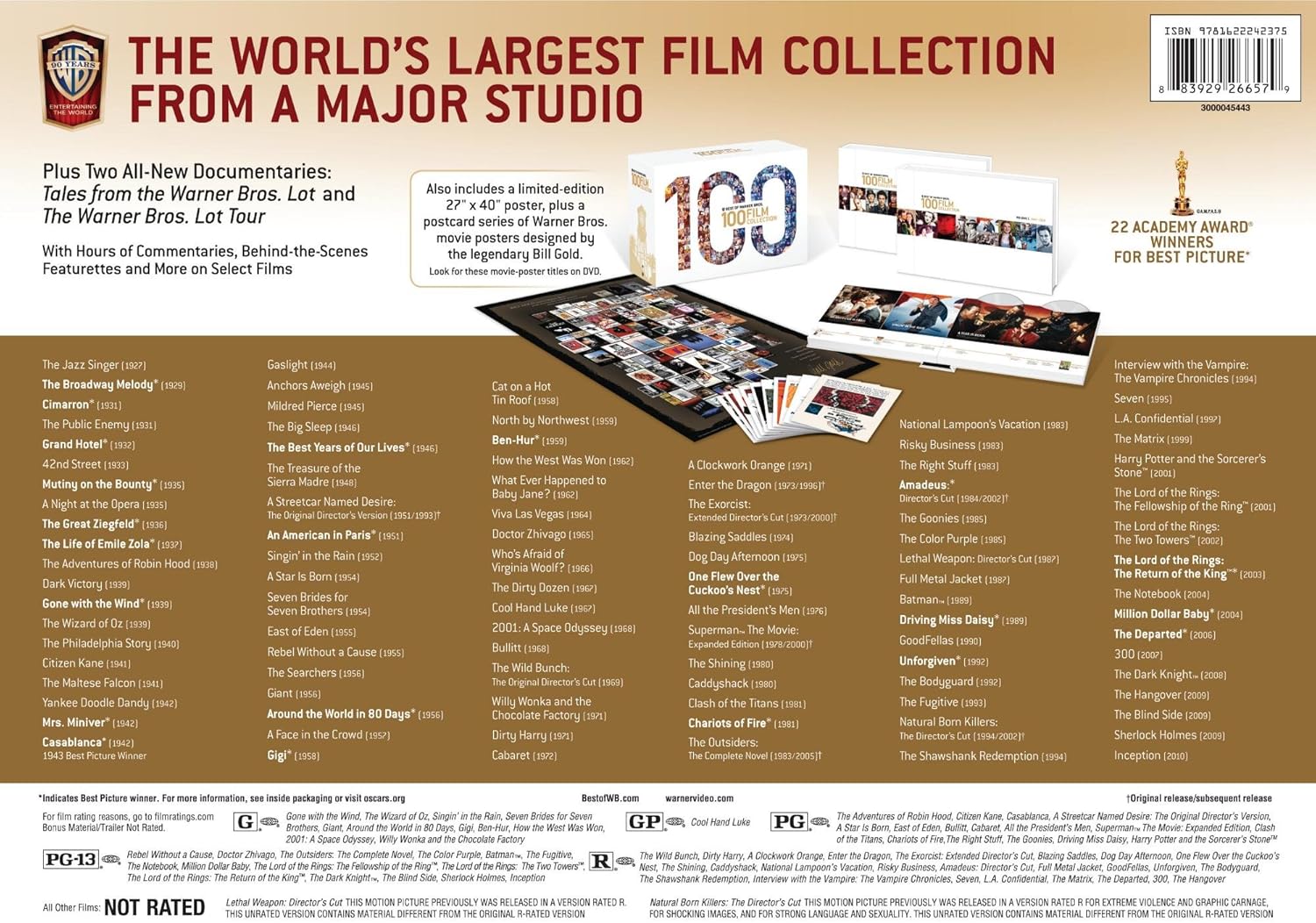
In 2013, Warner Home Video released the "Best of Warner Bros 100 Film Collection" which looks suitably impressive from the list available on Amazon and although I've seen a few of them recently would offer enough ideas to work through over the next couple of months.

Except, I very quickly began to notice some discrepancies in that Gone With The Wind,  Citizen Kane and Seven certainly weren't originally Warner Bros films, hailing from MGM, RKO and New Line respectively.  What's going on?

Over the years, through a series of complicated purchases, mergers and licensing deals, Warners has acquired the film libraries of those studios plus dozens more including the pre-1982 Orion Pictures library, Lorimar productions, United Artists and post-1987 Cannon films.

In other words what they claim on the box to be the "Best of Warner Bros" is actually the "best" of Warners, MGM, RKO and a few others.  Here is a break down of the films in the set by the originating film studio:

Best of Warner Bros
Warner Bros. Pictures (59) 300, 42nd Street, A Clockwork Orange, A Face in the Crowd, A Star is Born, All the President's Men, Batman, Blazing Saddles, Bullitt, Caddyshack, Casablanca, Cool Hand Luke, Dark Victory, Dirty Harry, Dog Day Afternoon, Driving Miss Daisy, East of Eden, Enter the Dragon, Full Metal Jacket, Giant, Goodfellas, Harry Potter and the Sorcerer's Stone, Interview With the Vampire, L.A. Confidential, Lethal Weapon, Mildred Pierce, Million Dollar Baby, National Lampoon's Vacation, Natural Born Killers, Rebel Without a Cause, Risky Business, Sherlock Holmes, Superman: The Movie, The Adventures of Robin Hood, The Big Sleep, The Blind Side, The Bodyguard, The Color Purple, The Dark Knight, The Departed, The Exorcist, The Fugitive, The Goonies, The Hangover, The Jazz Singer, The Life of Emile Zola, The Maltese Falcon, The Matrix, The Outsiders, The Public Enemy, The Right Stuff, The Searchers, The Shining, The Treasure of the Sierra Madre, The Wild Bunch, Unforgiven, What Ever Happened to Baby Jane?, Who's Afraid of Virginia Woolf? and Yankee Doodle Dandy.

Metro-Goldwyn-Mayer (24) Broadway Melody of 1929, Grand Hotel, Mutiny on the Bounty, A Night at the Opera, The Great Ziegfeld, Gone With the Wind, Wizard of Oz, The Philadelphia Story, Mrs. Miniver, Gaslight, Anchors Aweigh, An American in Paris, A Streetcar Named Desire, Singin' in the Rain, Seven Brides for Seven Brothers, Cat on a Hot Tin Roof, Gigi, North by Northwest, How the West Was Won, Viva Las Vegas, Doctor Zhivago, The Dirty Dozen, 2001: a Space Odyssey and Clash of the Titans.

New Line Cinema (4) Lord of the Rings: the Fellowship of the Ring, Lord of the Rings: the Two Towers, Lord of the Rings: the Return of the King and Seven.

RKO Pictures (3) Best Years of Our Lives, Cimarron and Citizen Kane.

United Artists  Around the World in 80 Days and One Flew Over the Cuckoo's Nest.

Paramount Pictures Willy Wonka & the Chocolate Factory

Allied Artists Cabaret

Allied Stars Ltd / 20th Century Fox Chariots of Fire (Note: Distributed in the US by WB through The Ladd Company)

Orion Pictures   Amadeus

Columbia Pictures The Shawshank Redemption

A few notes.  The studio now owns New Line but when those films were produced it was a separate company.  Warners acquired Willa Wonka and Shawshank when the distribution rights lapsed at those originating financing companies.  

Nevertheless, of the 100 films in the set, only 59 are full blood Warner Brothers films.  The rest originated with other studios.  If you were someone who's not really interested in such things, this was excellent value with a great number of canonical films included.

Why does this matter?  Because it erases film history.  Warner Bros now owns the film libraries of two of its rivals in the original "big five", MGM and RKO and in this set are acting like the victors in many similar conflicts and passing those assets off as their own.

It would be like Disney producing a boxed set celebrating their hundred years and including the Fox musicals from the 1950s, Planet of the Apes, The French Connection and Independence Day.  Except they keep everything separate.  When Heat was released on 4K last year, the Fox logo was on the spine.

That was at the 90th anniversary.  What about ten years later?  Warners have release a number of boxed sets in various configurations and I've itemised those too.  Although the results are somewhat better - different Warner titles have been introduced, some are still hanging around.

There are fifteen films included the three "5 film collection" released in the UK.  Here they are amalgamated together:


5 Film Collection
Warner Brothers (10) Casablanca, Rebel Without A Cause, The Goonies, Gremlins, Enter The Dragon, The Lost Boys, Goodfellas, Unforgiven, Elvis and Training Day.

MGM The Wizard of Oz and Singin in the Rain.

RKO Citizen Kane

Paramount Willy Wonka & the Chocolate Factory

Columbia The Shawshank Redemption (Columbia)

There is also a 30 film collection, "100th Anniversary Studio Collection" which promotes itself as being the first time many of these titles have appeared in 4K


100th Anniversary Studio Collection
Warner Bros. Pictures (23)  A Star is Born, Argo, Batman, Beetlejuice, Blade Runner, Casablanca, Cool Hand Luke, East of Eden, Elvis, Enter the Dragon, Goodfellas, IT, Mad Max: Fury Road, Rebel Without a Cause, Rio Bravo, Superman: The Movie, The Exorcist, The Goonies, The Maltese Falcon, The Matrix, The Shining, Training Day, Unforgiven,

Metro-Goldwyn-Mayer (4) 2001: A Space Odyssey, A Clockwork Orange, Singin’ in the Rain and The Wizard of Oz.

RKO Pictures Citizen Kane

Paramount Willy Wonka & The Chocolate Factory

Columbia Pictures The Shawshank Redemption

Now the big kahoona, this anniversary's equivalent of the 100 DVD boxset, four sets of 25 films separated across "genres" - Award Winners, Comedies, Dramas & Musicals, Fantasy, Action & Adventure and Thrillers, Sci-Fi & Horror.


WB 100th 25-Film Collection
Warner Bros (74) 300, A Clockwork Orange, A Star is Born, A Streetcar Named Desire (the Original Restored Version), All the President's Men, Annabelle, Aquaman, Argo, Batman, Birds of Prey, Black Adam, Blade Runner: the Final Cut, Bonnie and Clyde, Bullitt, Casablanca, Constantine, Cool Hand Luke, Crazy Rich Asians, Dune, Empire of the Sun, Fantastic Beasts and Where to Find Them, Full Metal Jacket, Goodfellas, Gravity, Gremlins, Harry Potter and the Sorcerer's Stone, Her, Inception, Interview With the Vampire, Invictus, It, Joker, Judas and the Black Messiah, Justice League, Key Largo, Lethal Weapon, Little Shop of Horrors, Man of Steel, Million Dollar Baby, Mystic River, Natural Born Killers (the Director’s Cut), Ocean's Eleven, Pan's Labyrinth, Practical Magic, Purple Rain, Rebel Without a Cause, Risky Business, Selena, Shazam!, Supergirl *, Superman: The Movie, The Adventures of Robin Hood, The Bodyguard, The Color Purple, The Conjuring, The Dark Knight, The Departed, The Exorcist (Extended Director’s Cut), The Goonies, The Green Mile, The Hangover, The Iron Giant, The Maltese Falcon, The Matrix, The Neverending Story, The Outsiders (the Complete Novel), The Shining, The Suicide Squad, Twister, Unforgiven, V for Vendetta, What Ever Happened to Baby Jane?, Who's Afraid of Virginia Woolf? and Wonder Woman.

MGM (11)  2001: A Space Odyssey, 42nd Street, A Star is Born, Ben-Hur, Children of the Damned, Doctor Zhivago, Grand Hotel, Mrs. Miniver, Mutiny on the Bounty, Singin' in the Rain and The Wizard of Oz.

United Artists  One Flew Over the Cuckoo's Nest

New Line Cinema (10)  A Nightmare on Elm Street, Boogie Nights, Dumb and Dumber, Elf, Friday, Hairspray, The Lord of the Rings: Fellowship of the Ring, The Lord of the Rings: the Two Towers, The Lord of the Rings: the Return of the King and Seven.

RKO  Citizen Kane and King Kong

Columbia Pictures  The Shawshank Redemption

* Although Supergirl was produced by Warner Bros, the Salkinds fell out with them after the underperformance of Superman III and they ultimately gave the distribution rights to Tri-Star.

As you can see, this isn't as negligent as 2013 list,  although it leans heavily on recent releases, particularly from the DCU.  Including Dune in there, which is effectively half a film is pretty ridiculous and either of the Justice Leagues are noticeable by their absence. 

But they're still pretending they originated the Lord of the Ring films, and King Kong now too.  The whole thing seems based on the premise of having a bunch of good films even if it doesn't accurately represent the history of the Warner Brothers studio.

None of which would matter if the text on the box didn't include the phrase "join us in celebrating 100 years of Warner Bros" which should more accurately says "join us in celebrating 100 years of Warner Bros along with the other film libraries we've acquired".

With everything which is happening at the company right now, film history seems like its the least of their worries.  I'd be fascinated to know how the accompanying booklet squares all of this, although I'm not prepared to shell out the hundreds of pounds to find out.

Steven Soderbergh on the MCU

Film  Steven Soderbergh sidesteps a landmine with all the grace you'd expect from him at Variety.  My guess is if MARVEL offered him something, the Richard Lester fan in him would probably take a second look:

There’s an interesting article in the New Yorker that argues that the Marvel Cinematic Universe ate the movie business. Do you agree?

If that’s true, it’s not really relevant to me. The bottom line is people go see what they want to go to see. I’ve got to figure out how to integrate that reality into how I work. I have two choices. I either find something that I love and that has enough in it to potentially attract an audience at a scale that would make the prospect worthwhile to a studio, or I stick to a medium in which those concerns aren’t primary like television or streaming. I’ve got two movie projects that I’m preparing that I’m very excited about that have enough in them to justify coming out theatrically in a normal wide release and not as an arthouse film.

Whenever this question comes up, rather than asking if the MCU has been the death of cinema, the more interesting question would be if the director/actor/whoever would consider making a film if the right project came along. 

Dear god, I'm glad Soderbergh's retirement didn't stick.  He continues to be one of those directors who can make films which say important things and are also great genre pieces.  Hopefully he'll take a crack at the western soon.  

Incidentally The New Yorker piece is more even handed than the title or the interviewer above suggests: its an in-depth history of the studio with plenty nuggets about the Sony deal.  I had no idea that the third Garfield film was going to be a desperate time travel adventure featuring dinosaurs.

Also, there's no point blaming a studio which turns out two-four films a year for "ruining cinema" as though the audience is a sheep like mass.  Hollywood has had its own hand in this by producing so many average films which strain for mass appeal to the extent they don't appeal to anyone.