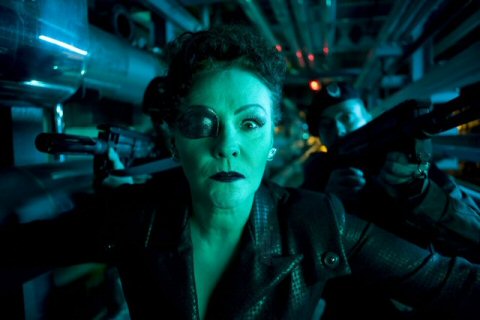
TV Here's where we're up to:
The BBC have commissioned the usual thirteen episodes of Doctor Who for next year, plus a Christmas special. They will star Matt Smith. John Fay is writing one of them.
But the BBC have said: "The new commission is a big commitment, not many other shows have such a commitment so far in advance. We do not know yet how many will air in 2012."
I have no idea what to make of that. Unless they're falling into a Sarah Jane Adventures style production schedule (the reason why we still three more stories to watch) in which more episodes than required for a particular season are being produced so they'll run eight then have another six banked or what have you.
Either that or the BBC press office person is being deliberately abstruse.
What none of this does confirm is whether either Karen or Arthur are returning although with various projects having been announced for them, it does look rather like they'll be leaving us at the end of this series.
Which means they'd already have to be thinking about what to do next.
Do we think Alex Kingston would commit to a whole series?
anonymous complaint
Film This unit and lack of policing of her kind of behaviour is one of the reasons I hardly go to the cinema these days and wait three months for a shiny disc release:
Congratulations to the relevant world of cine chain for kicking her out and once again for posting her abundantly oblivious anonymous complaint to the web with such good humour.
That she says she's going to tell all of her friends not to visit said world of cine is all to the good for the other patrons.
And now the obligatory link to the Wittertainment Code of Conduct [via]
Congratulations to the relevant world of cine chain for kicking her out and once again for posting her abundantly oblivious anonymous complaint to the web with such good humour.
That she says she's going to tell all of her friends not to visit said world of cine is all to the good for the other patrons.
And now the obligatory link to the Wittertainment Code of Conduct [via]
"I’m not claiming that all films have four acts"
Film Let me ruin films for you. Here's an old blog post from Kristen Thompson on the subject of turning points in film narrative, in which she outlines the kinds of action involved and when.
Here are the two paragraphs to focus on. Once you've read them, it'll be almost impossible for you not to see any Hollywood (and some so-called world cinema) without looking to see if the film maker is following a well-worn process and know when the first turning point will be:
In storytelling terms, A Good Man Goes To War is pretty eccentric. The Doctor, the protagonist isn't seen physically on-screen for twenty minutes, his presence instead implied by Rory and the iconic presence of the TARDIS. That's the sort of thing you might expect in an Alain Resnais or late Tarkovsky film, perhaps even Passolini and when he does appear he's still a relatively distant figure.
Spin-off fiction was sometimes just as post-modern. If you have the chance I'd urge you to pick up a copy of The Blue Angel by Paul Magrs which reads more like a Virginia Wolf novel than anything else in places. Similarly the audios Jim Mortimore's The Natural History of Fear and Scherzo by Robert Shearman shatter the expectations of what should even be in a Doctor Who story.
It's good to see the television series is willing to take these risks and judging by the audience appreciation figures (AI of 88 this week), most viewers continue to be entertained. As with the surprise box office for Inception and the audiences for Sherlock last year, it's an example of the audience wanting to see challenging drama. As for light entertainment, well ...
Here are the two paragraphs to focus on. Once you've read them, it'll be almost impossible for you not to see any Hollywood (and some so-called world cinema) without looking to see if the film maker is following a well-worn process and know when the first turning point will be:
"Most screenplay manuals treat turning points as the major events or changes that mark the end of an “act” of a movie. Syd Field, perhaps the most influential of all how-to manual authors, declared that all films, not just classical ones, have three acts. In a two-hour film, the first act will be about 30 minutes long, the second 60 minutes, and the third 30 minutes. The illustration at the top shows a graphic depiction of his model, which includes a midpoint, though Field doesn’t consider that midpoint to be a turning point.To drag this bag to the mainstream of this blog's symposium lately, I think one of the reasons some viewers of this latest series of Doctor Who have been less than pleased is because even in the more traditionalist stories, Moffat and co have been subverting many of the expected narrative storytelling norms -- in effect ignoring a version of the above and importing instead the art house structure in Saturday night genre television.
I argued against this model in Storytelling, suggesting that upon analysis, most Hollywood films in fact have four large-scale parts of roughly equal length. The “three-act structure” has become so ingrained in thinking about film narratives that my claim is somewhat controversial. What has been overlooked is that I’m not claiming that all films have four acts. Rather, my claim is that in classical films large-scale parts tend to fall within the same average length range, roughly 25 to 35 minutes. If a film is two and a half hours rather than two hours, it will tend to have five parts, if three hours long, then six, and so on. And it’s not that I think films must have this structure. From observation, I think they usually do. Apparently filmmakers figured out early on, back in the mid-1910s when features were becoming standard, that the action should optimally run for at most about half an hour without some really major change occurring."
In storytelling terms, A Good Man Goes To War is pretty eccentric. The Doctor, the protagonist isn't seen physically on-screen for twenty minutes, his presence instead implied by Rory and the iconic presence of the TARDIS. That's the sort of thing you might expect in an Alain Resnais or late Tarkovsky film, perhaps even Passolini and when he does appear he's still a relatively distant figure.
Spin-off fiction was sometimes just as post-modern. If you have the chance I'd urge you to pick up a copy of The Blue Angel by Paul Magrs which reads more like a Virginia Wolf novel than anything else in places. Similarly the audios Jim Mortimore's The Natural History of Fear and Scherzo by Robert Shearman shatter the expectations of what should even be in a Doctor Who story.
It's good to see the television series is willing to take these risks and judging by the audience appreciation figures (AI of 88 this week), most viewers continue to be entertained. As with the surprise box office for Inception and the audiences for Sherlock last year, it's an example of the audience wanting to see challenging drama. As for light entertainment, well ...
a 50-year-old "opinionated Everyman"
Books Lost Conan Doyle book to be published:
"The Narrative of John Smith was written when Conan Doyle was 23, and just a few years before the author published his first Sherlock Holmes story, A Study in Scarlet. It tells the story of a 50-year-old "opinionated Everyman" confined to his room by gout, laying out his thoughts and views on subjects from religion to war and literature through the conversations he has with his visitors, from a retired army major to a curate."Excellent. But is it canon?
based on a Singer sewing machine

Museums Ian visits Kew Bridge Steam Museum and finds a Steam Punk exhibition which includes this rather amazing Edwardian K9 based on a Singer sewing machine. His post on the visit also contains a shot of a Dalek which Mr. Moffat really should pay attention.
an ensemble that would later underpin the BBC’s prime time schedule
Later in the same interview, the actor suggests he was, even at thirty, a bit too young for the part and that it works better slightly older actors, not quite in their first flush, perhaps best if they’re well into their second or even third. Whilst that’s true, his youthful voice still contains much maturity and as Benedick lists his many qualms about the fairer sex, particularly in the shape of Beatrice, he lends the words much experience as well as a touch if nostalgia.
Tennant was still years away from becoming a household name when this was recorded, still known within the industry as a reliable presence on radio and stage and as a character actor on screen. He plays the role in full Scotch brogue, verbally punching the syllables with superb comic timing, and it’s a unique occasion when his description of Claudio “I have known when there was no music / with him but the drum and the fife” gains a geographic resonance.
He contrasts perfectly with Spiro’s RP delivery who because of the timing of this release may well be unfairly compared to Tate. She’s repeated Beatrice too, in 2009 at Regent’s Park and garnered some excellent notices which suggest that Tennant she was unafraid of stressing her maturity and like Tennant, the first seeds of that late blooming approach are planted here. She’s smart, fearless and with a requisite obstinacy which suggests that their war of word will continue into marriage.
But it’s perhaps unfair to focus too much on that duo, when this is the kind of “all star cast” the phrase “all star cast” was designed for, an ensemble that would later underpin the BBC’s prime time schedule. Yes, that is Emilia Fox as an aristocratic Hero, a soft spoken Chiwetel Ejiofor as her beloved Claudio and Silk’s Maxine Peake in the relatively minor role of Margaret, her broad accent introducing a useful class element which is usually only reserved for the interminable Dogberry scenes.
Julian Rhind-Tutt also makes for an especially menacing Don John. On stage the character can become lost amongst the revere, a function of the misunderstandings rather than the trickster he really should be. Rhind-Tutt’s deep voice, has a cold resonance that’s barely human as though the devil himself is stalking what should otherwise be a merry comedy. When he speaks to those outside of his circle, there’s no chemistry, no sense of camaraderie.
Director Sally Avens, perhaps sensing the value of the cast, presents a simple soundscape short on gimmicks, preferring to project the language without too radical an interpretation, no 80s version of Hey Nonny Nonny here. Which isn’t to say the music doesn’t have a vital part to play in unifying the action and the orchestral score provided by composer/performers Simon Oakes and Adam Wolters has a surprisingly melancholic quality.
A final word about the excellent sound design which unlike too much audio theatre gives these characters a physical presence (rather than the disembodied voices which sometimes pull the audience out of the action). When Benedick and Beatrice hide in the arbour and listen to their friend’s subterfuge, the point of view shifts between their harrumphing and the false words they’re listening to, the change in volume suggesting almost magically that most visual of devices, the close-up.
Much Ado About Nothing (Classic Radio Theatre) is published by AudioGo. RRP: £13.25 ISBN: 978 1408 470015. Review copy supplied.
that other co-dependant, emotionally stunted, dysfunctional group dynamic

“Lord knows what Amy’s giving birth to, if it’s River or the Time Lord child or something else (assuming they're not the same thing). Welcome to my thought processes for the next seven days…”
TV Well of course she is. If the synonymtastic name connection didn’t at least make it a possibility before A Good Man Goes To War, as soon as Amy decided to designate her daughter Melody, the jig was up (good job she didn't name the baby after her Auntie Sharon). Except, I didn’t notice. Because as we’ve discussed before, if an episode is as entertaining as this the higher functions of my brain, the inquisitive ones which only once clicked in half way through as I wondered of Steven Moffat, “Where is he going with this?” take back seat to my emotional responses. This franchise is a love affair, and like the hottest of love affairs, when you’re in the same room as the person for whom you’ve pledged your heart and the whole rest of your being, you’re hanging on their every word even if you’re missing the detail of what they’re saying. Oh and you’ll forgive them everything, until you can’t.
Indeed right up until River said the words, I briefly thought she might even be the Doctor’s mother, Moffat becoming a good man going to war against the Cartmel Masterplan. But then he instead offered an Empire Strikes Back-style revelation for a new generation of kids and I was screaming: “I knew it! I knew it!”, pointing at the screen and roaring in that way that only Doctor Who seems capable of (allowing for the likes of All Along The Watchtower and the murder of Francie elsewhere). Because apart from the name game, she could plug herself into the mainframe in Forest of the Dead, something the Doctor explicitly suggested only his Time Lord brain was capable of because of all the empty space (the empty space which had previously contained a copy of Gallifrey let us novel readers not forget).
Moffat has seeded has also seeded plenty of other mysteries to fuel the engines of stories to come. We know she’s a Time Lady and the implication, judging by the flashbacks, is that she’s the little Time Lady from the opening couple of episodes. Which would mean that she hasn’t simply grown up from the baby in Kovarian’s possession. She’s regenerated in the meantime. That’s after she’s presumably been turned into a weapon, the weapon in the space suit which we’ve seen kill the future Doctor. Perhaps that’s why he’s so relaxed on seeing her. Perhaps the moment when River murders “a good man” and whoever brought her to justice, placed her in the leaky Storm Cage has a very long memory (or she was very good at evading capture all of those years).
The point is, as Moffat explains in Confidential, this might seem like the close of a story but it's, as kick-ass Rose Tyler might lisp, “only just beginning” and I’ve already written five hundred odd words without addressing much of the content of the episode. Is this a good episode? Yes, yes, I believe it is. It’s an atypical episode as Moffat’s stories tend to be, his “finales” in particular, no simple TARDIS landing at the beginning, sniffing about for adventure, then back inside for tea. It’s also superficially a fourth generation copy of a mis-remembered Kurosawa film, the Doctor leading his motley band of very noble outlaws into a hidden fortress to save a princess and her child. It’s also about, in a similar way to The Doctor’s Wife, making the audience as gullible as the last of the Time Lords.
The opening of the episode underscores the Doctor’s mythic status, reminding the viewer of all the previous moments, from Forest of the Dead through The Pandorica Opens, when he’s defeated an enemy simply by reminding them who he is, building him up to be the figure that River has previously suggested he will become or even has been during the time war, the oncoming storm. This is classic hero building, and Colonel Manton even sounds like he’s contradicting one of my old film studies essays about the Doctor where I quoted from Howard Bloch who describes this kind of wizard as ‘a shifter, trickster, joker, arbiter of value and of meaning’ (Bloch, 1983: 2) and Judith Kellogg who proposes they can be ‘a military strategist and master manipulator and yet a mediator and peacemaker – a paradox’ (Kellogg, 1993: 57). As River Song says later, his nom de plume has been subverted somewhat.
Moffat asks for our patience during these scenes as he subverts the traditional storytelling set up of the show. Like so many Doctor Who stories we’re introduced to a base, Demon’s Run, and some random humans who’ll become acquaintances to the Doctor later on, in this case the Anglican gay twins who cheekily seem to have wandered in from a Russell T Davies page one rewrite, one of which is viciously killed by the local alien regime in a moment which would ordinarily herald the opening credits and be followed by the TARDIS landing depositing the one man who can save them (replace the Character Options baiting Headless Monks with the Ood, the Smilers or Tractators if it helps). Except in this story, from their point of view, the Doctor’s the monster who’s going to put the base under siege, after he’s rounded up some rowdy old friends who aim to misbehave.
It is a disappointment that having introduced the Cybermen, they’re ultimately there for just for a good sight gag and don’t join this merry band – albeit a sight gag which underscores just how angry the Doctor is, wiping out a whole fleet as a negotiating tool. As a side note, what is the genus of these metal men? They look like the old parallel universe Cybus Industries model without the logo on their chest plate. Is this supposed to be the first appearance of the Mondasian Cybes in the nu-series bar a severed head in Dalek. Have they taken on this design and temperament through some kind of parallel development? Oh the joys of amortising old costumes. If only one of them had given us a good old David Banks style “Excellent…” Perhaps next time.
These scenes glance towards a view of the franchise which is closest to the spin-off universe as its ever been. The adventures which led to Vastra becoming a Victorian adventuress or Strax a nurse have yet to be written but sound like something from one of the novels or audios or comics and once again we’re reminded that these few television episodes are just a glimpse of a far wider narrative, tapping into the one magical moment in Timelash, the reveal that the Third Doctor and Jo had visited Karfel before in some unseen story, not to mention his inveterate name dropping when it comes to historical figures, helping Shakespeare to write Hamlet and the like. Someone’s presumably trying to fit these sidesteps into a chronology as you read and I type.
What we’re effectively seeing is the aftermath of the kinds of meanderings mentioned in The End of Time and seen in The Impossible Astronaut and I’d be interested to know how the casual viewer takes to all of this. I’ve already noticed one professional reviewer suggest that these new characters barely register, which is rubbish since by essentially tapping into what we already know about these particular races but introducing some new ironic quirks, she’s a lesbian who fancies humans just as much as she likes to eat them (and eat them out apparently judging by Catrin Stewart comic timing) and he’s been genetically modified to produce milk and still thinks himself masculine enough to go into battle. Beautifully realised by returning actors Neve McIntosh and Dan Starkey, I adored both of them, and blubbed when the latter died.
This was a large cast for, even with a five minute bump in the running time, a relatively short duration. But Moffat knows that the revelation that Amy’s baby is part Time Lord can’t be talked through with any of the existing ensemble so part of his rational in designing this “army” is to give the Doctor someone familiar to chat with. As ever I marvel at the ability of actors who are relative strangers to create prior relationships out of thin air. Apart from Dorium we’ve never seen these characters before (and even him only briefly) and yet we might as well be watching an episode of Friends from deep into season Eight in which one member of that other co-dependant, emotionally stunted, dysfunctional group dynamic is revealing to another his feelings for Rachel.
After keeping the Doctor off-screen for over twenty minutes we’re in position of the enemy, surprised as old friend and after old friend joins the skirmish and however outrageous it is to call Bonneville and co in for a single shot, Mark Gattis providing the voice for the spitfires in space again, it’s the myth going into action, with even people the Doctor’s only briefly met in the past and didn’t even know were in the vicinity, willing to give their lives for him. This is similar territory to Journey’s End and Davros’s big speech again, and its in these moments when the Doctor’s arrogance is being fed and simultaneously the audience’s gullibility. Because after all of the build up and as far as we can see, little Melody Pond having been rescued, Moffat does the unthinkable and hangs us with the same plot twist, then has Kovarian say so!
Much of this is because Matt Smith underplays the Doctor’s fury. When the Time Lord says that he’s angry and “that’s new”, it’s all under the surface, his body shaking slightly as though he wants to have a good old fashioned rant (cf, Dalek and The Waters of Mars) but he’s keeping it contained because he understands the power of not letting his foe discover in actuality what he’s capable of, nourishing that myth instead. It’s one of those occasions when Smith’s unusual face is able project the kind of unpredictability that hid behind Heath Ledger’s make-up as the Joker in The Dark Knight. He could stab Manton through the eye at any second and he’s so good, we somewhat believe that he’s won as Kovarian ushers herself and entourage away (see one paragraph ago for the terrible consequences).
Instead he reserves his shouting for River. Where was she? Who is SHE? Well, indeed. Doctor Song’s function in the episode is largely simply to reappear at the end and tell the Doctor who she is, knowing the moment would come all of her life, perhaps even remembering the details having already been there which is a typical Moffat trick usually deployed in charity specials (just how conscious are Time Lords at baby age? The little girl in the alleyway seemed precociously self aware). It’s perhaps unfair to suggest Alex Kingston didn’t need to do much acting in this scene, but Moffat presumably knew that having forced the actress to hold them close to her chest all of these years, the relief of finally being able to say the words would aid her performance.
This isn’t the first time that Frances Barber and Alex Kingston have been on the same casting sheet together – she essayed the role of Agrippina in Boudica. It’s also not the first time she’s played this kind of role, having stalked half of Europe chasing a young girl in the little known but highly recommended Eurosouper La sirène rouge, even if there, as I recall, the campery was with a cockerney accent. Apparently she didn’t know that she would be appearing in nearly every episode of the season; I wondering if she’s called her agent about the extra fees? We still barely know who this woman is or her beef with the Doctor beyond some loose threats about wanting to destroy him and requiring another Time Lord in order to accomplish this.
Meanwhile, Rory mans up in order to save Amy. Someone suggested to me in the week that Arthur only really projects three emotions, angry, bewildered and sad. That's probably as many as I'm capable of, but I argued and will again now, that there's a fair complexity to what Darvill is doing and that in A Good Man Goes To War, he's filling the shoes of the rational Doctor, the one we usually see who isn't trying to essay some higher state of godliness asking for guns to be put in his face. Watch how in the initial Storm Cage scenes he plays the mixture of familiarity and politeness with a somewhat distant River, not really knowing how to approach someone who in the previous story had been so familiar with him in talking about what she believes her fate will be.
I’m going to go out on not much of a limb admittedly and suggest Karen’s never been as good as she was in that scene with Lorna Bucket. Of all the emotions, Karen’s not had to play deliberate cruelty before and when she jokily asks for a gun so she can end Bucket’s sympathy it’s genuinely shocking, even as it’s undercut by her realisation that she’s gone too far and this soldier, this woman may well be useful once the Doctor returns. As I type this, I realise that the reason the sewing hasn’t already been translated is because the TARDIS hasn’t landed yet along with its translation circuit and that the River can read the Gallifreyan script on the side of the cot because her advanced brain is capable of it. That may have been explained in the episode. U've been writing this for five hours. Um, moving on.
But moving on to what? The cause of this cliffhanger was mystery and revelation, the mystery of where the Doctor’s buggered off to and the revelation that prompted him and that episode title. Where once we were teased with The Next Doctor, now we’re smacked around the face by the oldest time travel chestnut of them all and the reason a Nazi scene was cut from The Impossible Astronaut, “Let’s Kill Hitler”. Does this mean A Good Man Goes To War is the first half of a two parter or a single with a cliffhanger? Are we going to be having debates to rival the SOD U LOTT debarkle? As we watch, and rewatch these seven episodes looking for clues, one thing’s for sure. Doctor Who as a franchise continues to be in safe hands and those hands really know how to caress this fan's erogenous zones.
Bibliography
Bloch, R. Howard. 1983. Etymologies and Genealogies: A Literary Anthropology of the French Middle Ages. The University of Chicago Press, Chicago.
Kellogg, Judith L., 1993. The Dynamics of Dumbing: The Case of Merlin In Lion and the Unicorn 17:1 June
"I wonder if the seats come with a sick bag."
Film Forever the soothsayer for the cinematic end of days, Roger Ebert brings news of the D-Box, an auditorium seat on a hydrolics so that the image won't just come at you in 3-fucking-D, you'll feel it hit you too:
"The dismemberment of the traditional movie going experience continues. Can you imagine enduring this atrocity in addition to the horrors of 3D? Not only are pandas flying out of the screen at you, but you're pitching, rolling and heaving. I wonder if the seats come with a sick bag. I also wonder what it would be like to watch a movie while seated next to bored kids entertaining themselves with their joy sticks."Horrible as this sounds -- and some of the comments beneath the post suggest this is horrible -- I can't help but think whistfully back towards the halcyon days to Space Harrier and other coin-ops which employed similar technology and the bonkers proposition that such things could come to the home via the Power Chair add-on for the doomed Konix Multisystem.
"Not really."
Film Bleeding Cool asks "Who Really Wrote X-Men: First Class?". Never has a group of writers arguing in public over a screen credit for a script been quite so entertaining:
Ben: There were other writers who had established parts of the script…The primary source text on these things (as is so often the case) William Goldman's Adventures in the Screentrade which demonstrates over and over again that just because someone's name is on the screenplay, they didn't necessarily write it. Goldman's written more scripts than you'd imagine and is credited for things he ultimately had nothing to do with.
Matthew Vaughn: Not really.
Ben Mortimer: So it was you and Jane then?
Matthew Vaughn: The WGA don’t think that, but they’re fuckwits.
it stringently ignores everything else
TV We've talked before, and often, about how somewhere along the line television became bored with theatre or at least filming classical theatre. If it's not school Shakespeare, it doesn't exist. So while it's pleasing to see The Henriad given the period drama treatment and with a great cast, a whole panoply of other plays are relegated to radio if recorded at all.
Perhaps in response to this, in an attempt to demonstrate the long legacy of theatre on television which isn't being respected, John Wyver (mentioned before and often as a producer at Illuminations Media) and Dr Amanda Wrigley at the School of Media, Arts and Design, University of Westminster have begun a research project to ... well, see the contents of this email ...
Friends and colleagues,Now, then. I'm very excited. The British Universities Film & Video Council already have a Shakespeare database in place, it stringently ignores everything else. No Middleton, no Fletcher, certainly no Marlowe unless in something directly connected to the bard. The BFI has a database too, but it's difficult to use. There are probably others but this is filling a much needed gap in the "market".
Forgive this round-robin mail, but we are delighted to inform you of the start today of our research project Screen Plays; Theatre Plays on British Television.
Screen Plays is a three-year AHRC-funded project from the School of Media, Arts and Design at the University of Westminster. We aim to document and explore the history of theatre plays on British television since 1930, and our deliverables will include a freely accessible online database of information about all of the productions.
We will also organise screenings and conferences, co-ordinate publications and contribute regularly to our Screen Plays blog which can now be found here:
http://screenplaystv.wordpress.com/
Further details about the project are included in the post, The adventure begins...
http://screenplaystv.wordpress.com/2011/06/01/the-adventure-begins/
We very much hope that the blog, and the project as a whole, will be a focus for lively discussion -- and we look forward to exchanging thoughts and ideas.
[admin related material then ...]
Also, if there are colleagues who you think might be interested in the project, please forward this mail -- and of course we would be delighted to include them in future mailings.
With thanks for your interest, and with best wishes,
John Wyver
Dr Amanda Wrigley
School of Media, Arts and Design
University of Westminster
"colour, sound, architecture and display"
Commerce For the past six months, we've slowly watched a chunk of the view from our window become blotted out by a giant man made ediface, the new Tesco on Park Road. Looking out across the landscape, from its gleaming roof to the Welsh mountains beyond, we have an even greater sense of mankind purposefully destroying the awe of nature. Robin from Seven Streets has visited:
"It’s common to hear the term Ballardian applied to nightmarish urban landscapes, but really Ballard was as much about the effects of these gleaming, artificial, brightly-lit edifices of society. JG would have loved this new Tesco: its enormous underground car-park; its overpowering use of colour, sound, architecture and display; its order and routine. There’s a sense that people are here to service this great building, rather than the other way around; acting out a comforting familiar ritual among fonts and colours and noises that they recognise."As the streets surrounding us fill with desperate advertising for Sefton Park Asda (on Smithdown Road but nevertheless) covered with the beaming faces of the shop staff in a desperate bid to give them a kind of artificial humanity in comparison to this Tesco Star Destroyer, it's clear that the war to protect consumer choice has been lost.
"I’ve done Pinter and stuff like that"
Film Danny Dyer's enmity for Mark Kermode has turned violent:
"I’ve seen it, yeah. He’s such a prick. I don’t even talk like that, you know what I mean?! I actually watched it and I found it quite funny, because I couldn’t believe that this is the way he perceives me. He’s the only one that sees me like that, I believe. It’s very odd. He’s just a got a bit of a problem with me, and what it is I really don’t know. But I think he does tend to forget that I’ve done Pinter and stuff like that. I don’t think he takes me seriously as an actor."Well, no, because even suggesting that rather fulfills the very stereotype Kermode is parodying and which you say you're trying to escape.
"But our paths will meet, one day, and there won’t be no talking. It’ll probably just be a headbutt straight to the fucking nose, and then he can go off and do his impressions with a broken nose…that’d be good, wouldn’t it?"
Subscribe to:
Posts (Atom)
