
Dating Hamlet (2002)

Far from being an academic study considering which side of 1600 Shakespeare’s play was written, Lisa Fiedler’s Dating Hamlet is another rewriting of the action putting Ophelia front and centre. But unlike Lisa Klein's academic or Bergmanesque approach (which I reviewed on Monday), Fiedler (as the cover suggests) turns the character into a kind of Disney princess, albeit of the kind seen in more recent films, more Giselle from Enchanted or Tangled’s Rapunzal than Snow White or Cinders. I’ve had problems in the past with Shakespeare being interpreted as panto, but there’s something about Fielder’s attempt that really engages.
Partly it’s because Fiedler has no truck with Hamlet as a sacred text. She’s clearly a fan of the play and although their aren’t as many literary allusions as the Klein book, Fiedler obviously has the same sense that Ophelia has become displaced in time, has had a "raw deal" and deserves a new destiny. Comparing Dating Hamlet with Klein’s book is probably a tad unfair. They’re tonally chalk and cheese, one tragic, the other comic. But they’re also both written for teenagers and many of the choices of how Ophelia threads through the story are similar.
The main difference is in the treatment of Ophelia herself. Klein very carefully keeps fidelity with whatever’s in Shakespeare’s text, seeking to underpin the characters based on the evidence in their speech, and in that case Polonius’s daughter is washed along by events. In Fiedler’s version, Ophelia drives events and steals the protagonist doublets from her love, putting the indecisive Hamlet very much in the supporting position with the besting of Claudius resting on her slender rather more motivated shoulders. In other words it’s the Maid Marian and her Merry Men approach.
It also keeps within the time scheme of the play but creates a few extra characters. She is friends with Anna, a kitchen maid who it’s quickly apparent is her Horatio, a useful expositional thinking board but there are also plenty of girly chats about boys. It’s that kind of novel. Other characters, like the Gravedigger have their parts built up in surprising ways largely to help the mechanism of the plot. All of Shakespeare’s scenes appear but not every deed done or word said is necessarily in the spirit the playwright intended.
With just a couple of hundred pages, Fiedler hasn’t much time to conjure a very detailed version of Elsinore but what’s sketched in does point towards a Hollywood fairy tale world rather than a realistic geographical place, albeit with more bawdy attitudes. Ophelia’s seen as something of a prize amongst the men in court and spends much of the novel fending off their advances her heart focused on Denmark’s prince. Some of the best scenes are those in which she gives the men folk a piece of her mind or her knee in their groin. It’s that kind of novel too.
Dating Hamlet by Lisa Fiedler was published by Collins in 2002. RRP: £4.99. ISBN: 0007161867
"In that studio was a table."
Radio This week's BBC Ariel letter's page is a vintage especially the first letter from Pete Bestwick, GNS on the subject of tables:
"Once upon a time there was a radio studio in TVC used daily by guests talking to the BBC's finest radio stations. In that studio was a table.You'll have to read the rest yourself but needless to say it ends ... predictably ...
One day, something very heavy was dropped on the table and it broke. Guests were left with an apology and many spilt drinks on the un-even surface."
The BBC's Drama on 3 does A Midsummer Night's Dream.
The BBC's Drama on 3 radio slot has returned after its Proms enforced hiatus and next Sunday (September 11th) they're offering a new production of A Midsummer Night's Dream recorded on location in Sussex woodland with a brilliant cast that includes Lesley Sharp, Toby Stephens, Emma Fielding and Nicholas Farrell.
Pier Productions has a short documentary with footage of the recording though it might demystify the experience if you watch it beforehand, especially after they've gone to trouble of capturing the natural sounds of the forest. Roger Allam as Bottom does not act in a donkey head.
It should be on the iPlayer too for the following week.
Pier Productions has a short documentary with footage of the recording though it might demystify the experience if you watch it beforehand, especially after they've gone to trouble of capturing the natural sounds of the forest. Roger Allam as Bottom does not act in a donkey head.
It should be on the iPlayer too for the following week.
a donkey head
Shakespeare The BBC's Drama on 3 radio slot has returned after its Proms enforced hiatus and next Sunday (September 11th) they're offering a new production of A Midsummer Night's Dream recorded on location in Sussex woodland with a brilliant cast that includes Lesley Sharp, Toby Stephens, Emma Fielding and Nicholas Farrell.
Pier Productions has a short documentary with footage of the recording though it might demystify the experience if you watch it beforehand, especially after they've gone to trouble of capturing the natural sounds of the forest. Roger Allam as Bottom does not act in a donkey head.
It should be on the iPlayer too for the following week.
Pier Productions has a short documentary with footage of the recording though it might demystify the experience if you watch it beforehand, especially after they've gone to trouble of capturing the natural sounds of the forest. Roger Allam as Bottom does not act in a donkey head.
It should be on the iPlayer too for the following week.
It’s not the most complex of plots
Books While we're on the subject of stuff noticed whilst watching Doctor Who, you won't remember but three years ago I read the single example of published erotic fiction that tangentially fits within the Doctor Who universe. Reviewing the review for various satirical reasons related to a twitter conversation (again) I stumbled upon one small detail I bothered to mention in the plot synopsis:
"Claudia, a recent widow is surprised one day when she discovers a buff young man taking a skinny-dip in the lake on her land. She prays that he’ll find his way to her big house, which he unsurprisingly does, bedecked in an Edwardian frock coat, covered in bruises and claiming to have lost his memory. His only point of identity is a small note which says his name is Paul. She takes him in, and after a doctor friend, Beatrice, gives him an examination, ‘Paul’ moves in with her. Not long afterwards, her best friend Melody, leaves her husband and she moves in too. Then there’s a fancy dress party and the truth of who this male house guest might be is stunningly revealed on television. It’s not the most complex of plots, I’m sure you’ll agree and there’s a fairly obvious reason for that."Steven's magpie mind couldn't really be referencing The Stranger. Could he?
33 Innokenty Smoktunovsky

Hamlet played by Innokenty Smoktunovsky.
Directed by Grigori Kozintsev.
When I began counting Hamlets, I took the decision that a production only counted, as per the about page, if “I've seen or heard it from start to finish through a whole production”. The other more secret rule was that it had to be based on Shakespeare’s text and follow the same plot, which led to the offshoot list “Almost Hamlet” as a place to put The Lion King or The Banquet and also films that followed translations of Shakespeare’s text, which didn’t matter much with Aki Kaurismaki’s Hamlet liikemaailmassa (Hamlet Goes Business) or Akira Kurosawa’s Warui yatsu hodo yoku nemuru (The Bad Sleep Well) since both deviate quite considerably from Shakespeare’s version of the story.
Not so, Grigori Kozintsev’s 1964 film which offers a direct, albeit heavily truncated Russian translation by Boris “Zhivago” Pasternak of the text that goes from “ghost to jest to death” and is probably “more” Hamlet than some of the other versions which I’ve nodded through without controversy (the Meyer twins). It even has the whole of Fortinbras tucked within. So without much consideration I’m nodding Innokenty Smoktunovsky through too as my thirty-third Hamlet. If Peter Brooks says it’s of special interest and “it has one gigantic merit - everything in it is related to the director's search for the sense of the play - his structure is inseparable from his meaning”, that’s good enough for me.
Perhaps the film's most famous element is the score by Shostakovich which has developed something of an afterlife through orchestral suite versions. Having heard the pieces in isolation (notably during the BBC Proms in 2007 which themed themselves around music inspired by Shakespeare), I’m quite surprised by how brazenly they particularly underscore the expected “moments of charm” (for want of a better phrase), bursting in from apparent silence during a soliloquy or Yorrick, booming and bombast and melodramatic sometimes working against the on-screen action. It's most effective in the appearance of Hamlet Snr on the battlements who’s dark moonlight silhouette is greeted by a maelstrom.
From the opening shots, Kozintsev bases his letterbox imagery on Hamlet’s line that Denmark’s a prison. We see first the crashing waves surrounding Elsinore, then shots of Hamlet riding back to into the palace before a drawbridge is pulled, portcullis drop and windows shut. Throughout the film, characters are shown behind wooden slats and balastrades, Hamlet especially shown speaking from behind bars which only disappear from view when he’s taking action rather than brooding. During “To Be Or Not To Be” which like all the other soliloquy’s is given as voice-overed internal monologue, he broods on the rocks looking out towards sea, suggesting that he’s contemplating two forms of escape from this Alcatraz.
The director is clearly influenced by the Olivier version though as the usefully thorough Wikipedia article notes that influence was negative, Kozintsev going out of his way to do the opposite of Sir Larry not least in emphasising the political over the domestic. He portrays Laertes as a kind of revolutionary seeking to overthrow Claudius even though as I’ve finally noticed after watching this production, even if he’d succeeded he’s still have Fortinbras to contend with. You could almost imagine that in agreeing to carry out Claudius’s plan (a decision made off screen here) he’s still eyeing the crown and once Hamlet is gone he’ll still have the king in his sights.
Not that this Hamlet is easily killed. Kozintsev works hard to make him less of a procrastinator. This prince has few reservations about following his father’s spirit, is cut from Claudius’s confessional so he doesn’t lose his single easy chance of killing his enemy and most remarkably a whole new scene is inserted showing him taking action against Rosencrantz and Guildenstern on board ship, something I’ve only ever seen before in Tom Stoppard’s play. He even dies mutely, simply, with "the rest is silence". Arguably Smoktunovsky carries all of this rather too subtly and because he’s rarely shown in close-up, it’s sometimes difficult to gauge the extent of his inner turmoil, only now and then given to outbursts of emotional energy which quickly dissipate.
Strengthening Hamlet’s protagonist credentials does have the effect of weakening the rest of the cast. You could argue that Kozintsev is trying to reflect Hamlet’s own slackening awareness of his family, but it’s almost impossible for me to say anything illuminating about any of the rest of the characters, other than that Gertrude’s attitude does definitively change once Hamlet has exposed her husband’s murderous actions and that Claudius seems to be modelled after Holbein’s portrait of Henry VIII (or Charles Laughton for that matter). Anastasiya Vertinskaya’s Ophelia is especially wan though she does have one of the best introductory scenes I’ve seen, practicing her ballet moves like a doll in a music box.
Grigori Kozintsev's Hamlet is out now from Mr Bongo Films. Review copy supplied.
Elsewhere I've reviewed Lisa Klein's quiet good Hamlet novelisation, Ophelia, which is far more impressive than its cover suggests.
Ophelia (2006)

Of all Shakespeare’s female roles, Ophelia is one the most misunderstood. Too often a director and actress portray her as something of a wet blanket, torn by the machinations of the men in her life, her father, brother, Claudius and Hamlet, no more than the forerunner of the kinds of later female roles in both theatre and film that just exist to reflect the masculine uncertainties of the male lead. It’s true that the brevity of her role does lend itself to that reading, and she does spend the bottom half of the play out her wits.
But a careful scrutiny of Shakespeare’s text reveals her to be much more subtly intelligent figure, well read and educated, assuming you take the more contemporary view that the content of a character’s speech reflects their intellect as well as the playwrights. I've only rarely seen this reflected in performance. It’s there in both of the Branagh productions in Winslet and Thomson and most pronounced in the Naxos audio starring Lesser with Emma Fielding as a very modern Ophelia. It’s also the Ophelia who tells her story in Lisa Klein’s fictional autobiographical interpretation of the play.
Klein’s book opens with a ten-year-old Ophelia joining Hamlet Snr’s court and becoming a maid in Gertrude’s household, moving up the ranks as a lady in waiting. From a young age she’s desperate to read Ovid and though she’s informed that she won’t get anywhere with men if they think she’s more intelligent than they are, it’s precisely her wit which leads to her gaining Hamlet’s attraction, the one thing which sets her apart from her bitchy court rival Cristina. Slowly events edge towards the action of Shakespeare’s play but it's quickly apparent that not everything will be as it seems.
There’s a danger in these first person retellings that a Mary-Sue element will encroach on proper storytelling and though the book (as the cover might suggest) does employ some of the idioms of the bodice-ripper, hearts beating in chests and an undercurrent of emotional desolation, Klein works hard to make Ophelia a credible figure. Written for teens but at no point lacking in sophistication, the language is of cod-poetic style which in the wrong hands could have come across as parodic but much of the time has such commitment it's easy to imagine that this is exactly how the character would have communicated her adventures.
The world of Elsinore, Klein through Ophelia conjures is very much in the mood, thanks to the thorough descriptions of fashions and furnishings of the late-Victorian or early Edwardian painters and the author has even included an image from W.G. Simmonds's The Drowning of Ophelia on her website. But time captions sets the play in and around the turn of the 17th century and it's possible to recognise the machinations of the court of that period following the hints in Shakespeare's text that he's writing as much about the English monarchy in his own lifetime as a far off place he's reputedly never visited.
Klein steers a steady course between adapting that play and as she suggests in the acknowledgements making sure that “Ophelia now has her due”. Unlike Stoppard who worked with the irony of two peripheral characters with little idea of the events they’ve tumbled into, Klein sometimes does have to strain to keep Ophelia aware of the darkness in court which is shaping her life. She’ll be hiding behind furniture and doors snatching glimpses and phrases, wedging them with rumours and gossip in an attempt to piece together how safe she remains in court, even resorting to some of Hamlet’s tactics in order to survive.
That means that Klein rarely simply novelises the play by-rote and even when we are in the midst of one of Ophelia's big scenes, we're more pre-occupied by Ophelia's thought processes than the action. Similarly, the author uses our hindsight knowledge of the plot to create a Hitchcockian tension even in those moments of high explostion as we await Ophelia's reaction. But the book is at its best when it's making its own course, as in those moments when Ophelia finds herself in some fairly deep philosophical discussions that seek to extrapolate the themes of the play in another form.
Ophelia also isn't the only character to gain weight in Klein's treatment. Horatio becomes her confident as much as Hamlets and Gertrude too is given a mountain of rational for her actions, of the kind which an actress would usually employ to underscore her performance in the hopes that the audience will see behind the her general silence in places. That's probably the best way to view the novel; like any theatre production Klein isn't attempting to piece together a definitive version of the story, just her interpretation of what's there already.
What also makes this a richer read than some Shakespeare prose adaptations is that it refuses to treat the his text in isolation. There are veiled references to plenty of other plays, most specifically Romeo & Juliet. As well as Ovid, Ophelia’s knowledge of botany is from the same sources Shakespeare is presumed to have read and it’s clear that this was much a scholarly exercise as an act of fiction. But it’s also a very imaginative reading especially in the surprising final third which sends Ophelia on an even greater emotional journey than the play allows.
Ophelia by Lisa Klein was published by Bloomsbury in 2006. RRP: £5.99. ISBN: 978-0747587330
the Doctor shouldn't die when he's supposed to die.
TV I should probably be saving this for next Thursday but well, hum. Updating the ever popular contemporary Who chronology with Night Terrors (reviewed here and below), I realised I needed to work out if it went before or after Torchwood's Miracle Day. Finally bothering to look in the TARDIS Index File at the dates when these fictional events in a fictional universe occur I stumbled on this:
Torchwood's Miracle Day is set in and around 22nd March 2011 and knocks on for a good few months.
The astronaut parts of The Impossible Astronaut are set in Utah, USA, 22nd April 2011.
WTF? FFS! etc etc etc
Davies and Moffat apparently have chatted about how the two shows effect one another in which case how could something like this occur? From a suspension of disbelief point of view, it would mean the Doctor wilfully ignored the world going to the wall and neither Amy or Rory bothered to tell him. Or River. Or Canton Delaware.
But, as a few people noted on Twitter when I posted this information there, it would also logically mean the Doctor shouldn't die when he's supposed to die. Ish. Arguably he does become a category one, and they did burn the body.
But we don't know how Miracle Day's going to end. For all we know all the category ones could miraculously be re-constituted from the ashes, in which case so could the Doctor.
I suppose it's one thing for the many decades of spin-off media to be contradicted by the television series, it's the mechanism under which Doctor Who has always worked. It's something else for the two television shows to contradict each other quite this much, especially after all the hoopla in Torchwood's first couple of series enmeshing itself with the parent series.
Assuming it is a contradiction and Miracle Day isn't indeed going to be used to resolve all of this. Either way, we can probably now add, "ruining Doctor Who" to the list of its crimes.
Updated! As has been pointed out, the headline to this post is potentially misleading since the Doctor isn't human and its been established that Miracle Day only effects humans. Unless, I suppose he wasn't joking in the TV movie. But the point still stands. This means the Doctor et al are on Earth during Miracle Day when everything is going to pot and do nothing about it ...
Updated! Showing the kind of determination only a fan would have, I've sat through the thing again and found the on-screen proof. It's Rex's text message towards the end:

The only potential contradictory bit of info is that the text was sent at 6:13pm, but the on-screen caption just before says they landed at 5pm:

Though that can be explained away through the complexity of international time zones. Obviously.
/
Update! 06/09/2011 Another possibility. Perhaps this part of the episode was being shot this March and no one bothered to change the date and time when they sent the text message to the prop assuming no one would be paying attention this or bother to freeze frame.
They obviously don't know us very well.
Assuming that is the screen from the prop and not a CGI replacement. If it is a CGI replacement, that makes it deliberate. In which case we're back where we started. More along, move along ...
Update! 11/09/2011 This post has been featured at SFX Magazine's blog. Here's a new blog post about that.
Torchwood's Miracle Day is set in and around 22nd March 2011 and knocks on for a good few months.
The astronaut parts of The Impossible Astronaut are set in Utah, USA, 22nd April 2011.
WTF? FFS! etc etc etc
Davies and Moffat apparently have chatted about how the two shows effect one another in which case how could something like this occur? From a suspension of disbelief point of view, it would mean the Doctor wilfully ignored the world going to the wall and neither Amy or Rory bothered to tell him. Or River. Or Canton Delaware.
But, as a few people noted on Twitter when I posted this information there, it would also logically mean the Doctor shouldn't die when he's supposed to die. Ish. Arguably he does become a category one, and they did burn the body.
But we don't know how Miracle Day's going to end. For all we know all the category ones could miraculously be re-constituted from the ashes, in which case so could the Doctor.
I suppose it's one thing for the many decades of spin-off media to be contradicted by the television series, it's the mechanism under which Doctor Who has always worked. It's something else for the two television shows to contradict each other quite this much, especially after all the hoopla in Torchwood's first couple of series enmeshing itself with the parent series.
Assuming it is a contradiction and Miracle Day isn't indeed going to be used to resolve all of this. Either way, we can probably now add, "ruining Doctor Who" to the list of its crimes.
Updated! As has been pointed out, the headline to this post is potentially misleading since the Doctor isn't human and its been established that Miracle Day only effects humans. Unless, I suppose he wasn't joking in the TV movie. But the point still stands. This means the Doctor et al are on Earth during Miracle Day when everything is going to pot and do nothing about it ...
Updated! Showing the kind of determination only a fan would have, I've sat through the thing again and found the on-screen proof. It's Rex's text message towards the end:
The only potential contradictory bit of info is that the text was sent at 6:13pm, but the on-screen caption just before says they landed at 5pm:
Though that can be explained away through the complexity of international time zones. Obviously.
/
Update! 06/09/2011 Another possibility. Perhaps this part of the episode was being shot this March and no one bothered to change the date and time when they sent the text message to the prop assuming no one would be paying attention this or bother to freeze frame.
They obviously don't know us very well.
Assuming that is the screen from the prop and not a CGI replacement. If it is a CGI replacement, that makes it deliberate. In which case we're back where we started. More along, move along ...
Update! 11/09/2011 This post has been featured at SFX Magazine's blog. Here's a new blog post about that.
the distorted Modigliani faces of the dolls
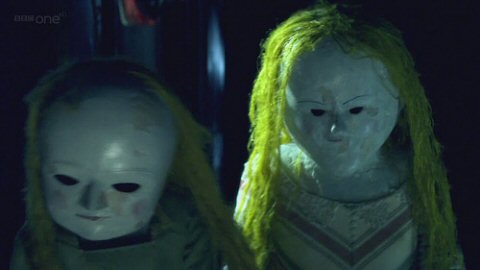
TV As you may have gathered if you’ve been reading this blog for long enough I live in a high rise. Not the kind of monolithic Soviet edifice which the Doctor investigates in Mark Gatiss’s Night Terrors, just four corner flats per floor, but similar enough to be able to relate to the experiences of this family and little George. At night, when everyone has gone to bed and the only sound which should be heard is the gentle hum of the freezers, there’ll always be odd, unreal noises in the distance. They’re probably perfectly domestic, the closing of a door, an argument, a television. But in the dark, especially if you’re a fair-weather insomniac like me with a wandering imagination, in my mind’s eye they can become all manner of phantasmorica.
Fear Her done properly, Night Terrors taps into these qualms and returns to one of the pre-occupations of Moffat, those things which scare children. Perhaps he has them scrawled on a list taped to his writing desk and even if he can’t write it himself, he puts them in the season plan so that he can cross them off like a narrative chasing Earl Hickey. Before broadcast he apologised to parents for turning one of the child’s few refuges against them and in truth however us adults might have been unnerved by the distorted Modigliani faces of the dolls, this is an episode designed especially to give children nightmares. In their own bedroom. There’ll be a lot of parents doing the thingy with the lights tonight.
Everything Matthew Graham’s rushed second season script failed at, Gatiss’s manages with style. Whereas, as was the vogue back then, the situation was needlessly escalated to put the 2012 Olympics, the world and Huw Edwards’ career in jeopardy, the only jeopardy here was a few residents in the block, the Doctor and his friends. Having the monster in the cupboard Chloe Webber’s abusive father made it too specific, whereas the general bric-a-brac of a wardrobe can contain all kinds of dark secrets. When the Doctor was zapped into the drawing he disappeared from the episode, whereas trapping Amy and Rory in the doll’s house kept them very much in the adventure and a guide to the mystery in the first half.
Plus as I said the other day, the Eleventh Doctor is even more of a children’s storybook magician that his earlier incarnation who as we’ve seen time and again is able to relate to children which we saw here in his efforts to cheer George up, playing with a Rubik’s Cube, making his toys come to life. Tenth was most often seen in teaching roles, an authority figure, whereas Eleventh is much more adolescent (presumably because he’s played by an actor who’s closer to the child’s age himself by a few years). He’s closer in that sense to Fourth, and like we’ve seen in some of the dvd outtakes, you could imagine Matt keeping little Jamie Oram amused between takes just as Tom did.
Which means that to an extent in order to communicate with the parent, as we saw with Alex, he tends to have to return to their innocence by describing the universe to them, bigger and more fantastical that they can comprehend so that they will understand and won’t try and throw him out of the house before he can make the tea. Daniel Mays gives a very brave performance here. Usually seen in cocky roles, leaders, he’s called upon to pull all of that back and just be an ordinary bloke thrown into extraordinary circumstances and like James Corden in The Lodger, his scenes with Matt were a highlight. Such behaviour doesn’t come out of the blue, as we see with the landlord he has a natural fear of authority. The Doctor just tweaks that a bit.
Such analytical talk usually indicates when I’ve enjoyed an episode and I did not least because it also risked making the real world seem sinister from the moment the TARDIS landed. Director Richard Clark and photographer Owen McPolin perfectly recreated the eerie artificiality of a near deserted housing estate bathed in yellow street light, and the sense that anyone could be living behind these anonymous doors (not least the girls from The Shining). Notice that for all the accents which point in the direction of the south east and imagery towards the south-west (the episode was shot in Bristol), no location was given rendering the story fairly locationless as though it could have been happening in your city.
The ensuing exploration is of the kind which is always my favourite bits of the longer spin-off stories, allowing the characters to interact more than they’re usually allowed to in the plot-based format of the Moffat era. We’ve had few scenes like the one in The Impossible Planet in which Rose and the Doctor mulled over the implications of the lost TARDIS and although this wasn’t quite the same, it was refreshing to see Amy and Rory just together, existing, albeit whilst searching for a frightened small child or making their way through a darkened house armed only with a wooden pan. Like I’ve said before, I could quite happily just have forty-five minutes of these three chatting in the TARDIS console room or some such.
But for all of that, Amy and Rory’s drift through the doll’s house wasn’t as chilling as it might be. At a certain point I became very pre-occupied with the windows which throughout had light streaming through them. I wondered why neither of the companions thought to open the slats especially in the kitchen once used for The Unicorn and the Wasp. To do so would have given the game away too soon of course, but it's an example of wilful obliviousness of the kind we usually see in the T-word. Later, when Amy became the doll, it was treated in a strangely offhand manner, not the end of the world scenario that similar transformations wrought on Peri, Rose, Donna or even the Doctor were.
Perhaps this is partially a side effect of the episode’s change in series position. Night Terrors was filmed earlier then later exchanged for The Curse of the Black Spot. Perhaps it was switched because an element of the resolution was so close to The Rebel Flesh, albeit with a human father coming to terms with a non-human child rather than the other way around. But the episode ran short (only about forty-minutes) and ended somewhat abruptly suggesting that all the team did was to reshoot the closing scene. When originally shot this was supposed to be the Ganger-Amy, who would have become a doll. As Arthur might say, "Not sure how that'd work. Um. Err."
As the previous thousand odd words probably illustrated this was an episode better watched than written about, unless you're Kim Newman or indeed Gatiss and can draw upon the history of horror as your reference point. That's unusual in this continuity heavy future with its plots and arcs. It's also an episode which unlike Let’s Kill Hitler doesn't demand an immediate rewatch so that every angle can be dissected and chewed over. Like Black Spot, this is old school Who but unlike Black Spot, there was a confidence to the storytelling, a clear understanding of the pacing and none of the characters disappeared mid-episode without an explanation. Perhaps next year, Moffat will surprise us and produce a season with a few more of these. As it stands this was just the thing for a rainy night in a high rise, as winter closes in.

"Amidala discovering her own dark side"
Dance Watching the excellent Tournée not too long ago, the low budget comedy about a French impresario managing an American Neo-Burlesque troupe, it didn't take too long for me to wonder whether burlesque dancers ever themed their show, most specifically with sci-fi reference, injecting one of the more obvious sub-cultures. Well, some of them do:
"And what better narrative to bring than the rabidly beloved interstellar adventures of Star Trek and Star Wars? While they do play up the rivalry between the two, there’s plenty of room in the show’s dozen or more acts for both franchises to bare all—so for every Amidala discovering her own dark side (performer Keela Watts) there’s an aerial Borg dancer navigating her way around a suspended cube (Miranda Tempest). And taking the award for “Best Ever Use of William Shatner’s cover of ‘Common People’” is BoylesqueTO’s Patastrophic Sexapeel, whose cheeky turn as Captain Kirk brings the show to a triumphant close."The pictures are here and well worth a look, if not safe for work. Of course, Doctor Who was already pioneering the effort on television in the 1980s ...
the pseudonymous Robin Bland would do
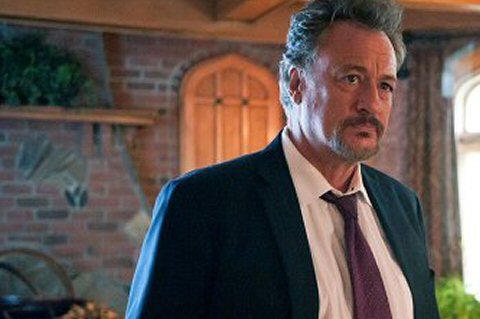
TV It’s the fucking resurrection gauntlet isn’t it? Eight whole episodes and I’ve finally cottoned on to the idea that Torchwood’s Miracle Day is the Owen arc from series two spread across the world like a rash. These families (which at this point might as well be the Slitheen with better compression technology) have the gauntlet, rescued from the wreckage of hub one, connected up to one of Russell T Davies’s patented pieces of made-up magical technology to create the global morphic field Jack keeps knocking on about. Either that or they got the Immortality Gate from The End of Time to work properly. Or a mixture of the two.
But let’s face it, who cares? At this point I’m tapped out. As expected in the week when its parent series gave us one of its most confident episodes ever, Torchwood hasn’t looked more like an illegitimate child so that the most exciting moment is when two actors from a completely different franchise say a few words to one another making the whole thing look like the boringly titled Official Star Trek Convention has staged an invasion of Gallifrey One. About the only thing which made Jane Espenson & Ryan Scott fittingly titled End of the Road watchable was the sight of John De Lancie swaggering around frantically waving his Q-schtick.
At least with Star Trek, because the episodes came at you on mass, even if there was the odd duff episode, an admittedly liquid ratio depending on the particular series, there was at least the knowledge that there were another twenty-odd which might be ok. We’re at episode eight of this and every single revelation across the weeks has proved to be worth as much as the in-universe economy with Colonel Kira’s at the close of the last one a prime example, and we’ve even reached a stage were the characters themselves (Gwen) are throwing their hands in the air wordlessly frustrated at the implacable engineered plotting running on a filler-based fuel.
I imagine the professional reviewers (I tend not to look before giving my "opinion") are digging around repetitious looking from something interesting to say, about how touching individual scenes like Jack’s remembrance of Ianto or Esther speaking to her sister are touchingly well played. Just touching. Gwen’s teary flight home. Again. They’ll be addressing the scene in which Oswald Danes tries to cosy up to a prostitute and show a capacity for change only for it to be spit back in his face, the hitherto unknown category ‘0’ for those people who were supposed to be executed already anyway suggesting the whole Danes strand has been a waste of screen time just like so many other dead ends this series has thrown up along with the expected bits of carrot.
But they’re wasting their time. We all are. RTD and the gang have somehow conspired to produce a piece of drama that inspires nothing but grim determination from its viewers or at least those viewers with high enough standards than the commenter at The Guardian who says “TV is not supposed to be high art, nor life lived, it's just some escapist thing to relax to. So chill out, haters.” The rest of that thread, under an column in which blogger Dan Martin hitherto generally quite balanced in his reviews shows signs of fatigue, has next to no other positive comments and that’s from a fairly general public. Gallifrey Base is reaching for the category one volunteer papers.
Even the revelation that anonymous blonde at the CIA is one of them didn’t illicit so much as a gurgle. Jack’s been shot? Yeah, he’ll be fixed next week. The null-field revelation which should have been cool was rendered with all the style of a sub-Sarah Jane Adventures attic scene, Mekhi Phifer suddenly turning into Clyde Langer rather than a professional member of the security services. About the most surprising moment was that Jilly Kitzinger wasn’t already part of the family, something which her behaviour in the first few episodes might indicate and betrays an element of late rewrite to make her viewpoint character when something else fell through.
When the episode ended, I decided this was going to be a six paragraph review. Here we are in paragraph seven but there’s not going to be another one. Like I said, I’m tapped out. There’s only so many times one can say the same things in different ways about a series which itself doesn’t seem to know what it’s doing. And to make matters worse episode nine looks like its going to be about Gwen defending her father from a man from the local council and knocking over the local chemist, and Frances Fisher quoting from The Eleventh Hour which only goes to remind us that what this series need is a Doctor, though a writer like the pseudonymous Robin Bland would do. Same time next week then?
Subscribe to:
Posts (Atom)