The Invasion of the Bane.


TV When the only thing that grates in a piece of drama is the judicious use of the word 'muffin' something must have gone right. Really, you'd have to be a cynical sausage not to come away from the first story of The Sarah Jane Adventures, The Invasion of the Bane thinking that it was a Doctor Who spin-off too far. As promised, this was a full bloodied piece of drama, skewed only slightly younger than it's parent series, full of heart and fun and madness. Unlike Torchwood I can't really compare this to anything else because the last real kids show I watched was probably Box of Delights on dvd last year, but I think the key to the show's success is that you didn't actually feel like you needed to make any allowances for the fact that its not supposed to be directed your target audience. It had as much fizz bang and wizzle as anything else in the franchise and was far superior to most episodes of the show set in Cardiff.

Sure the story was simple and not completely original, dealing as it did with an alien compound in a foodstuff brainwashing the populace into becoming zombies, with a ceiling dwelling alien at its nexus. And it was all very Pertwee era really with a factory, despite the day-glo orange fixtures, that wouldn't have looked out of place in The Green Death and the alien leader, Mrs. Wormwood, the kind of theatrical megalomaniac currently missing from the main show - Samantha Bond's steely eyes and cold delivery being perfectly alarming in a Delgado Master way. And with all the shapeshifting they were all from the same genus as School Reunion's Krillatines, except I would say far more repulsive in their non-human form. Unlike those Pertwee stories, the allegory here was at the kid-friendly level of extolling the nastiness of junk food, with the clever kids, not drinking the sugary stuff, not being possessed. Still I'm sure theres a merchandising opportunity should Barrs want to rebrand Irn-Bru for a younger audience.

But as I wrote of The Blood of the Daleks last night, the key here was execution. This seemed to be directed better than any of Colin Teague's Torchwood episodes and it was quite shock to actually be able to see anything other than HD-downmix blur. The music was unmemorable alth0ugh that's actually a good thing in this case because it didn't drown out whatever the drama was and I didn't detect any of the annoying repetition that's dogged some episodes of the other spin-off -- this seemed to be the work of someone else, someone with a better sense of pacing, flow and storytelling. I hope that these sensibilities will continue into the main series in this case.

I was really worried that despite having her name in the title, Sarah-Jane would recede into the background, simply advising the kids as they went off on their own adventures. Perhaps predictably they took the Rose/Everything Changes route of introducing the Rose/Gwen character Marie up front and then presented Sarah-Jane as the slightly distant figure, but then, cleverly, and with some relief they took advantage of the fact that most kids will know who she is from School Reunion and ran their stories in parallel. So as the kids got lost in the factory in true Children's Film Foundation fashion, Sarah-Jane was confronting the villain.

Unlike K9 and Company, this showed a real respect for Sarah-Jane as a character; unlike the tin dog, the younger cast members weren't allowed to overshadow her, still keeping her front and centre in the drama. So even though the kids had a hand in the solution at the end, she still had that powerful moment when she realised how to get back into the factory, perhaps remembering Mickey's approach from School Reunion.

To a degree, quite properly, she's become something of an ersatz Doctor with all of the gadgets. You can see items such as the sonic lipstick (I mean really) and Mr Smith as useful narrative devices in the half hour format to get to the nub of the problem. It's a shame K9 won't be around too much, but that scene in which in floated in space was really quite touching and it's nice that they at least acknowledged his contractual absence. It's nice too that she is working outside the government, but unlike the buffoons in Torchwood, not always taking the military option (unless you count that bottle of defensive spray) and diplomatically making friends with aliens even if they happen to look like they want to possess your body for centuries and go on a shagging spree.

What about that room, a love letter to her days traveling with the Doctor and working with UNIT? The picture of Alistair? The photo of her and K-9 and was that Tom? All of those continuity references were perfect, there for the long terms fans but ignorable by the target audience. I mean Artron Energy, how cool is that? It's a shame that the anthology/amalgam/whatever he was ended up with a Star Wars reference for a name. Although Alistair and Harry are quite old fashioned names now I suppose, but I was really hedging for John. Plus Sarah wasn't afraid to use the D word in front of the children.

What with all this and the Gallifrey mention in The Runaway Bride, the franchise is becoming increasingly free and easy with the mythology and I for one whole heartedly approve so long it's done as sympathetically as here. Given that this story was set at least a year and a half after School Reunion (as per the K9 (sniff) conversation) that puts this in late 2008 perhaps even 2009 (consults Lance Parkin's Ahistory) I wonder how the Butler Institutes's environmental clean up operation is proceeding and if the reconstruction of San Francisco has begun yet.

Some might bristle at the contemporary references though. Does 'muffin' have currency amongst the play-ground set now? Don't I sound like I'm a hundred years old? But at the least the Jeremy Kyle and Hollyoaks references seemed ok and how funny to hear them in a BBC show. Nice to see the welcome return of Blue Peter although I wonder what Konnie Huq would say if she knew that in the Whoniverse she'll still be in the job two years hence?

The key success is casting. Yasmin Paige playing Maria is a fine actress and Liz Sladen is obviously having great fun working with her. There was a real depth and warmth and naturalness to her performance topped off with bags of good humour. As Luke, Tommy Knight had a perfect Brent Spiner-like stillness that didn't spill off into Haley Joel Osment AI territory. I'd say the only weak link amongst the kids was Porsha Lawrence Mavour who has that straight out of stage school sheen the other two lacked. Given that Kelsey was sidelined in finale, it looks like that character's job will be to get into the trouble that the other three will sort out, the Shaggy/Cordelia of this Scooby-gang. Rounding out what appears to be the guest cast was Joseph Millson as Marie's father -- good sense of irony and likeability.

And there is the middle of it all was Liz Sladen. I'd like to finally get around to listening to those Big Finish stories to see if this is a different version of the character, but her work here was absolutely in keeping with the past of the character and her appearance in School Reunion. Sure enough, she is like the eccentric aunt and she seemed far more relaxed than in K9 and Company. Then she seemed have a kind of authoritarian attitude thrust up on her but here she'd still retained that slightly goofy sense of fun and also managed somehow not to look silly holding up, and I'll say this again, a sonic lipstick.

This has the potential to be a really great, really fun series. The way is open for all kinds of different types of stories and I'd imagine much of the time it'll be in the territory of Round The Twist or Erie , Indiana, general weirdness working its way through in twenty-five minutes, with Luke discovering this world he's been born into, Marie discovering the new side the world she thought she once knew and Sarah-Jane finally finding her place in that world. Unlike Torchwood, it feels like a genuine Doctor Who spin-off rather than something that's been bolted onto the 'verse and apparently the return of many old favourites is promised. Perhaps this will be the true place for the reintroduction of Lord Lethbridge-Stewart with the kids being scared by a Yeti sitting on a toilet in Tooting-Beck.

The Blood of the Daleks.

Radio A figure, an intruder, appears in the Tardis. The Doctor doesn't know who she is and for now doesn't know where she's come from but as time passes it becomes apparent that she doesn't particularly want to be there and with her behaviour, he doesn't want her to be there either. She's from England in the early twenty-first century so he sets the co-ordinates of his ship as close to home as possible and dropping out of the time vortex materialises and ... mysteriously bounces back into the time stream.

Whether by coincidence or design, the first story of this brand new series of Big Finish made adventures for digital radio BBC7, The Blood of the Daleks, began in much the same way as The Runaway Bride except over and over it flouted expectations and Steve Lyon's script appeared to be a reaction to all of the excepted norms of the television set-up. The reason the ship doesn't appear in the contemporary Northern England is because of a forcefield bounces them off it (nice); the timelords are alive and well; The Doctor is far less huggable and as Paul McGann pointed out in the pre-publicity a bit cantankerous; the companion Lucie Miller really doesn't want to be there, and she and the Doctor spend most of their time bickering, but unlike Donna the Bride neither are really in much of a position to do anything about it. And unlike Sixth and Peri, the bickering is funny. For the first time in ages I've wanted to re-listen to an audio adventure simply to enjoy the dialogue.

Even the story is somewhat darker than the current television series might attempt. A human colony on the alien world of Red Rocket Rising is in its death throws after a devastating impact from an unknown object from space. A random selection of humans have been sent into space looking for help; the remainder have worked through their remaining resources and are about to start turning on each other when a rescue ship arrives flown by the Daleks. As usual the Doctor is in the middle of it, no one is listening to him and the colony's deadly secret is slowly revealed. Far from being two standard, twenty-five minute episodes rammed together in the middle, this revealed the story slowly over its running time and even with an initial 'action sequence' it's quite a shock to be back in the territory of hearing quite length scenes and time being spent to create a world. But at no point did it feel as though Lyons had stopped the action to describe the scenery, which is quite rare.

If this had been made for television it would been in the seventies in the cold war and would have looked like the tv adaptation of John Wyndham's Day of the Triffids, the scorched landscape, the acid rain, the hopelessness. The only levity is in the brilliant charactersation of the Doctor and Lucie. Elsewhere, everyone is dying and things can only get worse with the arrival of the pepperpots. And these are the Daleks at their most sinister, absolutely passionless and deadly and with a dribble of cunning. Nick Briggs has a wail of a time here and when he says 'Dok-tor' for the first time and I actually sat up in my chair wide eyed (although that could also have been all the caffeine I'm drinking to keep me awake this New Year's Eve).

Perhaps understandably, there's no real indication of when chronologically this Eighth Doctor story is set to keep it independent of the other strands, the novels, the comic strips and the other Big Finish stories in particular; as far as some listeners know it could be directly after the television movie. That's good, I like that none of the McGann stories are fixed although it's a shame he didn't have a grander re-introduction, Storm Warning style, working his way through the TARDIS library. That's the only concession to the new way of things. Bang and they're into the story, landing the Tardis is really the wrong place. Pleasingly, the David Arnold mechanical mix of the theme tune was all present and correct when I'd expected the Murray Gold special.

It features Paul's most effervescent performance in years. For some time, the Eighth Doctor has been a bit subdued, lacking the passion that was so enjoyable in the first couple of seasons of the audio stories - which seemed to be a mix of new writers not being able to get a fix on who he is and the actor looking for the darkness. The magic really does return here, and although some of the Byronic romance is missing (perhaps because of something that may yet be revealed or just his age) the bluff is all there.

Spot the amazing, slightly Pythonesque scene when he agrees with everything rebel leader Lowell is saying in order to gain more insight into the situation or the chilling moment when he tells the acting President that the question she should be asking is 'How am I going to save you from the worst mistake you're made in your lives?' That's a very Eighth Doctor line and McGann plays it beautifully. But really I think he's just loving the challenge of playing opposite Sheridan Smith who is on fine form. Lucie is a really, really promising companion even though she's exactly what a contestant on a timelord only episode of Whose Line Is It Anyway? might suggest as the world's worst person to be sharing a type-40 with.

She might be cut from much the same jib as Sam, Izzy and Rose, she really doesn't want to be there and says so, a lot. But unlike Donna she know who the Doctor is, what he is, and what she's doing there and that makes a difference because it also means she can undercut his authority at every turn telling him really, really amusingly what she thinks of him. The most polite description is 'frock coated ponce' - which as you can see also makes her a great audio description device. It's quite fun to have the image of this Doctor, threadbare after all these years being made fun of in this way (and apparently, according to Beyond The Vortex, the short Confidential-style making-of programme that closes out the hour slot, McGann really loved these sections having had to wear the stupid wig during the filming of the movie).

Smith's delivery is excellent and there's a real chemistry with Paul. Don't expect any declarations of love between these two though -- this is going to be a union born of grudging respect. I'd imagine that some will be slightly annoyed by her constant quipping and sarcasm, but I thought it was refreshing. It's just a shame that just sometimes Lyon's writing loses the shock of the real for family purposes. It just doesn't seem right to me that a northern lass from 2006 would be saying Blimey. My other reservation is the confusing spelling of her name - what is wrong with simply 'Lucy'?

It's just really refreshing to have a Doctor and companion team were you're not entirely sure what the next move will be but you know it won't be what you expect. Lucie and the Doctor don't yet have that connection yet in which they each know what the other is thinking. At one crucial moment, she makes a particularly wrong decision, and although it is with the best of intentions it's the kind of rookie mistake the Doctor simply doesn't expect.

For once, the shoe is on the other foot because Lucie is the one with the big secret and the pretty potent potential plot arc - why she's been put in the 'witness protection programme'. I like that there will always be the nagging feeling that not everything is being revealed and that at some point in the future something really big is going to happen. Especially since she thinks, as she shouts to the Time Lords 'This Doctor of yours is a bit rubbish.'

The episode was a textbook example of how well a story can be told with very few characters and cast members. Anita Dobson's Klint and Hayley Atwell's Asha spend most of the episode in their own two handed story naively misunderstanding the Dalek's intentions; both are very good with Atwell (who played Rosa in the BBC's recent adaptation of The Ruby and the Smoke) in particular showing an authority that'll become really important across the story. The other major character is skeptic Tom Cardwell, played dependably by Kenneth Cranham, whose guttural tones provided the sad background to the colony's problems.

It's with some relief that I can report that this is a good an opening for a new incarnation of Doctor Who the franchise as you'd want and even if, and I hope this doesn't give too much away for those who are listening again or waiting for the cd, the story isn't as original as it could be, for me the familiarity works in its favour since for much of the time it works against expectations. Even with its slightly generic music, like The Runaway Bride, this has been put together with real heart and an ambition to push the franchise forward, and I'm really looking forward to the rest of the series.

Oh and look - a real old fashioned cliffhanger!

Review 2006: Finale

Lisa asks:
Which famous 5 people, dead or alive, would you invite to a dinner party. What would you eat/drink ? What entertainment would you lay on for the 6 of you afterwards?

That's a bit of poisoned chalice isn't it? I mean there I am trying to think my way through everyone whose ever lived ever and whoever I pick there's sure to be someone saying: 'What? You'd rather spend an evening with Alexander Graham Bell and Debbie Harry when you could have had dinner with Gershwin and Donna Summer? There are also the smart answers like all of my friends, the cast of Friends, The Beatles plus one (not Yoko) or The Comedy Store Players.

In an attempt to finally drag this Review 2006 back into the realm of being a Review of 2006 and to put some limits on my choices, I'm going to pick five people, a meal and entertainment that have had some relevance to my life in the past twelve months with the added restriction of not including anyone I actually know, and that includes email correspondence (just so that no one and everybody feels left out). Here's then who'll be at my imaginary New Year's Eve party.

First to arrive might be old school Hollywood screenwriter Robert Riskin. Earlier in the year during my film course I selected an essay question which at its heart talked about auteur theory and particularly the extent to which director Frank Capra's style was defined through his own personal choices, by the types of stories he was making or his collaborators - actors, producers, production designers and in this case screenwriters. His main collaborator throughout the majority of his career was Riskin and although it was Capra's name was above the title in such works as Mr. Deeds Goes To Town and American Madness it was Riskin who was the engine and looking over the printed versions of his scripts, very often the stylistic devices and storytelling quirks were Riskin through and through, the populist small everyperson making it big being the primary example, but also the repeated device of what looks like a downer ending becoming somewhat good by the end, but with not necessarily every character issue being resolved.

The complication lies in the fact that once Capra and Riskin parted, those same devices still cropped up to the extent that one of Riskin's first films with a different director Magic Town feels like a Capra film even though it was directed by a jobbing studio director without the same cache (William Wendell). It's a reverse of the Mr. Smith Goes To Washington model, with Jimmy Stewart as a city slicker and pollster going into and falling for a small town that is apparently statistically perfect. The authorship of the film is . . . obscured but what I would want to ask Riskin is how close their collaboration was and if in fact he should, like I presume many screenwriters, have taken more of the glory at the time than he did.

But Riskin, despite what you would expect, was a bit of a party animal and although he almost always got the job done he had something of a reputation for the booze. The man had a personality too. Apparently, after the falling out over the nightmare that became Meet John Doe (for which Capra could never decide on an ending) he waved a blank piece of paper in Capra's face and said: "Put the famous Capra touch on that!". He was also, let's not forget, married to Fay Wray for thirteen years and also worked on Broadway during one of the golden periods so he had some kind of an exciting life.

Assuming she can find the time, I'd next invite singer Madeleine Peyroux in from the cold. I was given her 2004 album Careless Love last Christmas and it kept me company during the long wintry university commuting. I mentioned on the blog that some of the tracks sound like Christmas morning and they still do and express that feeling of excitement then melancholy that its all over for another year. I bought her first album 'Dreamland' recently and although its stylistically different, her voice still had that well worn quality, the haunting sound of a life lived. She was like the gateway drug to other jazz and blues music and here I am months later listening to Diana Krall, Stacy Kent and Nina Simone.

Even through we're the same age, her life couldn't have been any more different. Born in Athens to what she once described as hippy parents. After moving to New York with them, after they divorced her Mother took her to Paris were she was discovered at the age of fifteen, joined a band and was touring Europe at about the time I was trying to get my head around quadratic equations in Mr Singer's GCSE maths class. In 1996, the year I graduated from university first time around her brilliant first album Dreamland was released to such critical acclaim and was apparently a massive hit at the time but she didn't want to deal with any of that. So she returned to Paris and went busking again, giving the odd café gig under an assumed name.

Another album came in 2003, a collaboration with her ex-boyfriend that went sour, the results of which are is still going through the courts and in 2005 she disappeared again - that was my introduction to her - seeing a report on BBC News in which her record company were essentially putting an appeal out for her whereabouts. She turned up not that long afterwards hiding back in New York and of late she's been on tour in the UK. I missed her concert at The Phil after a range of calamities related to me not knowing in time, so it would be nice to see her at the table next to Riskin so that I could pull a Christmas cracker with her and suggest a few ideas for her next album. I'd love to hear what she'd do with Daniel Johnson's Come See Me Tonight.

A few minutes later, Tim Berners-Leecredited inventor of the World Wide Web should arrive. It seems only right that I should be able to give a drink to the man who created the medium through which I'm posting this, especially since having designed it, he made the technology and methods freely available for other people to make lots of money. It's funny to think that I began my undergraduate degree at university just two years after the first web page went online and by the third year I was already writing my first report about how search engines work (the original Webcrawler and Excite!)

He also developed the first hypertext systems (the term was coined by Ted Nelson who I've already met), which is the other reason for his invite because he indirectly led to my dissertation topic over the summer, defining Hyperlink cinema as a genre. After watching many, many films and reading many, many books I eventually came to the conclusion that actually there might be a genre, but that it was big enough a topic that it could never be resolved in the fifteen thousand or so words I was given to attempt an answer so for me it remains unresolved. For the uninitiated, you can usually tell a hyperlink film if there are multiple storylines in multiple locations about a diverse set of characters. So Short Cuts is but Parenthood isn't and neither is 21 Grams if you actually bother to pay attention to the story being told.

When Elizabeth I steps across the threshold, she's not what I expect although I didn't know what I was expecting. The problem with historical figures is that our image of them is developed from numerous books, documentaries, paintings and films. It's difficult for me not to think of Elizabeth I as being like Glenda Jackson or Cate Blanchett or Mary Anne Duff or even Helen Mirren when those were all interpretations of a real figure who is nothing like any of them or somewhere in between. The version visiting is still so young though and the Spanish Armada is a few years in the future so she's yet to really prove her worth to a people who it is my impression venerate her as the Gloriana but still have their doubts.

Of all the historical figures I've encountered this year, it's Bess whose made the biggest impression both through catching up on various films and dramas and Simon Schama's summary of her life in A History of Britain. It's probably a weird comparison, but like Madeleine she was an independent woman but had to make many, many sacrifices in the name of her country. Although history has cast doubt on whether she was truly a Virgin Queen, more than many monarchs of the period she had to make so many decisions in relation to state and family that the emotional toll would be enormous.

I supposed I would want to invite her in order to see through the pop culture references to see what the real woman was like. You can never imagine royalty as people like us even when they're doing fallible things. Would she enter with the regality intact and impeccable behavior or take the opportunity to relax at least for this one night? Perhaps I've got Miranda Richardson in mind when I imagine her waking up on New Years Day with a splitting headache in a Shakespeare's Globe t-shirt having spilt red wine down the front of her dress, moaning that she's got to go back to court and can't face the look on Burley's face when he realises what she's been up to.

If Douglas Adams arrives late I can't blame him. In a terrific piece of bad timing, he's writing The Hitchhiker's Guide To The Galaxy at the same time as script editing Doctor Who. He looks harished and could probably do with a night off. I saw Adams for the first time this year giving one of the best pissed night out stories ever in which he and a friend went to Paris uninvited during the filming of my favour classic Who story City of Death. They drank their way around the city until everywhere had closed and then tried catch a flight to Berlin because they knew of another bar that might still be open there. I'd invite him just hear that story again, and also so that this younger version of him can hear Tim describe what'll be happening with the internet in his future.

Frankly, Douglas is still missed and it's such a shame that he wasn't here to see the Wikipedia which is probably exactly what he expected the h2g2 website to become even though that never gained the same currency globally. It would seem strange if a proportion of the contributors to the Wikipedia didn't have Hitchhikers at the back of their minds, this opportunity to create store of knowledge, usable by anyone, telling the story of everything. The media spends far too much time criticizing its accuracy when really it should be praising the fact that its now possible to find a reasonably comprehensible description of most subjects, which, and this is important, can be corrected instantly if needed. It's proved invaluable during the writing of this article, if only to get a sense of the people.

My big food discoveries this year were musaka and jambalaya and I'd definitely serve these for dinner, along with choices of Caesar salad, chicken in breadcrumbs and chili con carne (calling ahead before hand to check if anyone was a vegetarian or didn't like spicy food). For starters I'd have tomato soup made from scratch with real tomatoes and close with a choice of mince pies or Christmas pud. I'd do my usual with the wine - visit OddBins and pick something with a colourful looking label (which even though I know nothing about wine seems to work most of the time) but I'd also offer choices of water and fruit juices. Unless anyone wants a beer (in which case, oh yes, again, I'd call ahead).

For the closing entertainment, I'd ask my guests to all pick some songs and cds, bank them up on an ipod and we'd play Trivial Pursuit to the small hours or until we got bored with not being able to answer the questions. Bob and I should be good with the film questions, Tim and Douglas with the technology, Madeleine with the music and Liz with the history questions (since miraculously none of them would be about anything before the 1580s). I suspect it would be a great leveler and like Glenn Gould once said (I'm paraphrasing) you can really get to know more about a person by asking them about subject for which they're not famous.

And as the dawn came we'd sit on the balcony of my flat and wait for the new day.


Happy New Year!

Schott's Results.

TV You might remember this time last year in a fit of holiday sadness I emailed Schott's Almanac about the errors in their 2006 edition. For the three people who care, I thought I'd post this from the Errata to the 2007 edition which may suggest I wasn't the only one ... kind of comforting in a way ...

Review 2006


Billy asks:
Would you stop writing your blog if your stats told you there were 0 readers?

Of course I would.

When I began writing the blog, five and a half years ago now, I didn't have any readers. I don't think anyone was looking in for months and if they were it was from Google. It's a shame because I still think that was when the blog was its best, when I seemed to have much more to write about and the cynicism hadn't really set in yet.

I was a much more promiscuous linker back then, with a feature in which I highlighted another blog each day, the backlinks for which I'm sure drew some readers and I think you just gain them through search engines because people find you and like what you're doing. But I don't think that at any point have I really gone after a particular audience. Primarily this is like a textual scrapbook, a place to keep a record of who I am each day or week and I'm not sure I could give it up even if no one was reading.

I love that I can look at some random week, say in mid-July 2003, when I was mostly kvetching about Big Brother and the government, both subjects I've given up worrying about. I wish I was able to do that with my whole life, seeing what the version of me at fourteen really had on his mind. I would have probably been talking about Kylie Minogue, getting annoyed with the sheer badness of the first season of Star Trek: The Next Generation, studying Shakespeare's Julius Caesar and complaining about how poor the films were that year. Things haven't changed that much then.

That said, although I'd like to say that none of this was about you, plainly it is. I do wonder who is reading and find it quite bizarre that I'm not sure exactly what my circulation is. Although site meter says that this week the blog had over a thousand hits, all the referrer logs seems to list are google searches. Bloglines shows thirty-one subscribers but how many of them read the blog and just haven't gotten around to deleting it? Just how many readers do I have?

Review 2006


Neil from Behind The Sofa asks:
Why is Doctor Who so disappointing all of a sudden? Is it down to age?

In two thousand and two when the prospect of a new television series looked completely impossible, I decided that someone needed to do something and after watching the film Jerry Maguire late one night sat down to write a mission statement, what I thought would be the model to follow if ever anyone decided to produce a new series. I looked at the kinds of drama series that were in production but also wanted to reflect somewhat the novels I'd been reading and the audios I'd been listening to. From April 2002 then:
A vision for the future of television Doctor Who:

Main Characters: The Doctor; Female companion; The TARDIS
Familiarity. Turn on your average post-Troughton story this is your set up. The companion explores the problem at hand, The Doctor explains and solves it. The average viewer isn't expecting three 'teenagers' and a robot. Better to give depth to one companion than to have two or three ciphers.

Six one hour episodes.
Clarity, attention span, budget. With judicious and careful editing most tv Who stories could be told in an hour - the audio version of Genesis of the Daleks which crams six episodes onto long play record proves this. Yes, it's nice to see Tom and Lalla running around Paris in City of Death but it doesn't exactly drive the plot forward does it? If Buffy can do it, so can 'Who'.

First episode - Cybermen. Last episode - Daleks (with cliffhanger ending)
Nice and familiar. Monsters, and monsters the public have heard of. Could redesign the Cybermen a bit, but keep the Daleks as pepper pots (that's half their appeal). Daleks in last episode not first so as not to show all your good cards.

In between, The Doctor takes his companion to see the first civilisations (Stonehenge, Ancient Egypt, even earlier) and the end of time (last surviving human, aliens trading the last human DNA remains). Episode set on a strange alien planet, episode on a starship.
The Hartnell era might be a good pattern to follow. So two sci-fi, one quasi-historical, one pure historical. Random order. I'd have the historical as episode two, sci-fi three, then follow in The Time Meddlers footsteps and sell the quasi-historical initially as a historical. Then Sci-Fi, then that Dalek story. Returns the show to unpredictability; the TARDIS guidance circuits have malfunctioned so he doesn't know (and therefore we don't know) where he'll end up next (that's real adventure isn't it?). Historicals potentially an easier sell now alongside the monster stories because the BBC are still so good at them.

Ignore continuity references, but don't contradict anything too much.
Base everything on what the general public probably knows - yes, we know The Doctor is a Timelord, but do we need some boring old episode on Gallifrey to prove the point? Only exposition relating to plot at hand then, and make the stories self contained. No need to keep referring back to 'the canon' all the time, but don't contract it. That way the old fans will be content that this isn't a re-boot, but the new fans won't start turning off in their droves when it becomes clear that they should have seen half a dozen old stories and read four novels to make the present story at all comprehensible (Attack of the Cybermen - aaaaaaaaaah!)

No romance, but lots of flirting.
See Pertwee and Jo Grant; Tom Baker and everyone (apart from Harry); whilst I personally had no problem with 'that kiss' this is a family show.

Family show, but scary enough to need a sofa
Everyone says they hid behind the sofa. Nothing wrong here - scary monsters and cartoon violence. But keep to the model of The Doctor using his mind to outwit his opponents.
Most that is common sense stuff but I'm still amazed, excited and pleased at how closely the new series matches my expectations. But for some reason during the second series, I began to find faults and cracks and although I was mostly loving some of the episodes I kept having a nagging feeling that I wasn't enjoying the series as much as I could be.

Before listing what these reservations are I do want to drop in some caveats. In no way is this supposed to be a 'the problem with Doctor Who article in the same vein as the Torchwood analysis I recently published. In relation to performances and production and direction it's as good as we could possibly have expected and it's amazing that you can now see kids in Forbidden Planet getting excited over a copy of Murray Gold's soundtrack, attempting to convince their parents to invest because it comes with a free badge. I loved the latest special The Runaway Bride and watching the special documentary on Christmas Day I had a lump in my throat.

I love the Tenth Doctor. David Tennant, being a fan himself, his performance is a believable amalgam of the previous nine and yet has still brought his own indefinable magic, which is backed up with writing that makes him thoroughly likeable. Author Paul Magrs has said: 'I was always pleased when the Doctor was content to blunder into things, let himself meet fabulous characters in that sweetly picaresque eighteenth century way of his' - he was describing the Eighth Doctor (the Paul McGann incarnation) but that's entirely true of Tenth, that carefree attitude that can switch to seriousness at a moments notice. Some have criticized the pop culture references, the Ghostbusters moment being particular dislikes, and some of the smugness, but above all the man is heroic and precisely what the drama needs.

The treatment of the companion has improved too and that's definitely a legacy of the spin-off culture. Rose Tyler had a life, a back story and a developing personality that effected her reaction to each adventure, changing more than just her costume across the seasons. This simply didn't happen before - Nyssa lost her family and home planet but this was hardly remarked upon again, at least not in an emotional way. Indeed companions would often join and leave in the most random of circumstances when the actors contract was up for renewal and often in stories that had little or nothing to do with their passing. The final episode of the last series, Doomsday was pinioned around the loss of Rose, written that way because the only way to split those two up convincingly was to stick them in different universes.

Like the first, that second series also brought some classic stories as good as anything the franchise has produced in any medium. No one saw The Girl In The Fireplace coming, distilling everything that's oddball and goofy about the concept whilst and the same time injecting passion and sadness. The story of the Doctor saving Madame de Pompadour, the French courtesan from clockwork men from the future using windows in time from a spaceship lacked the one line synopsis that most stories are dogged by but still managed to be exciting accessible entertainment. When the Doctor's heart was broken at the end, you felt it was because of the underplaying - he'd met someone who seemed to understand him but she was lost in time. It wasn't like the loss of Rose later in the series; they were friends but never equals in the same way that Reinette could be.

The problem with the second series is that these kinds of unresolved emotional arcs that cut the Doctor to the core were fewer than in the first series when the Ninth Doctor was at the centre. The Chris Eccleston model was still getting over the effects of the destruction of his home planet and as the season wore on it became apparent that a time war with the Daleks had led him to doing the deed himself. What this meant was that every story was personal; from trying to save the Gelth in The Unquiet Dead to fighting to save everyone in The Empty Child ('Just this time Rose, everybody lives!') each story had his struggle with guilt at the core and was about him dealing with being the only survivor of his race. In the second series, that guilt has lifted and so when he tries to deal with the problem at hand it's out of the goodness of his heart, his moral duty to protect the innocent.

But, and this is a big BUT, this has meant that there has been a move towards attempting to shoehorn in the sentiment to the extent that every story apparently needs to have an emotional crescendo. In some cases that really works - in Fireplace or School Reunion (and to a lesser extent The Runaway Bride), mainly because those are about the Doctor and his feelings. In the very worst cases, Fear Her for example, there are about three climaxes and there is a law of diminishing returns so that by the time the Doctor is lighting the Olympic flame it's just too much. Such climaxes are also drowned in music and in a Hollywood sense the chords are telling the audience how they should feel which can make some of us feel a bit disgruntled.

The other big problem is that given that the main characters have a time machine that can go anywhere in history or the cosmos, the broadcast adventures seem to spend a lot of time in London in the suburbs in the twentieth or twenty-first century, something that hadn't occurred to Davies until journalist Ben Cook mentioned it to him in an interview for Doctor Who Magazine. Much as I loved the latest Christmas episode, it's a shame they didn't take the opportunity to set it in some far future Christmas. Is (almost) present day Earth to be invaded every 25th December for as long as there are specials?

Elsewhere Davies has mentioned how impressed he is that at the dawn of the series, the Doctor and co would find themselves in a vast range of locations all of which were achieved on a very tiny budget, but for some reason, that hasn't been reflected in the new series, with the various comic strips and novels doing the really wacky experimental things instead (Love & Monsters a tale told from the point of view of a fan of the Doctor accepted). In short, why no pure historicals which are just about the Doctor plus one and the Police Box lost in history?

In 1999, Doctor Who Magazine asked a group of writers who were fans of Doctor Who what they thought the new series would be like. It's become a bit of a legend because they somehow managed to pick on Russell T Davies, Paul Cornell, Mark Gatiss, Steven Moffat and Gareth Roberts, all of whom would go on to write for the new series in some capacity (the other was Lance Parkin who hasn't yet been tapped despite having tv experience although it's rumoured he was asked but couldn't due to other commitments). At the end of the interview there are two telling quotes. When asked for final thoughts, Moffat says that 'the way you'd know you'd got it right would be if the 11-year-olds all jumped up and down and said it was the best show ever and all the sadder Doctor Who fans muttered that it was no longer serious adult drama like it was when they were 11.' Which is exactly what has happened. Seeing the kids at the Doctor Who Concert goggle eyed but genuinely happy to see all of the monsters and David and the clips from the episodes proves that actually so long as they're happy, that's ok.

All of these grumbles seem like small issues, all artistic choices reflecting the tastes of the current production team. That's always been the way of things with the franchise, each producer or editor having their own idea of what it should be and what it should be about and that's why we love it - none of it looks or sounds the same. The brief was about bringing the series back and making it as accessible by as wide an audience as possible and here we are looking forward to a third series, a rating success all round against stiff competition. The general audience expects a big emotional punch and the domesticity is born from a need to produce a series that reflects people's lives. They're never going to please everyone least of all us fans all of the time, but as the kid in Forbidden Planet being excited about the cd proves, it's not really about us. The final quote in that roundtable is actually from Davies himself and reflects actually how seriously he understood the undertaking: "God help anyone in charge of bringing it back - what a responsibility!"

Review 2006


Kate asks:
Do you think any of the cultural stereotypes about English people are true?

The Misterpoll website has a quiz which attempts to demonstrate how the stereotypes seen in popular culture differ from actuality. Within they actually list the expectations of the stereotype. It's quite shocking to see your entire culture reduced to nine bullet points, and perhaps even more shocking to see how many are actually true.

Drinking tea We do drink an awful lot of tea. Although Starbucks (bless them) and other coffee chains have run riot through all of our city centres making them all look like mini-Seattles, I don't think it's possible to go anywhere without being offered a tea and I'm even drinking a cup right now. I probably go through about three a day and I've never really known why - it doesn't taste that good. But it's warm and brown and it doesn't give you bad breath like coffee. I don't think many people take 'high tea' any more, but when I was working at an art gallery we did have a tea break in the morning and afternoon which felt very civilized and it was the first time I learnt the wonders of warming the mug or pot first.

Wearing bowler (derby) hats I have never seen anyone wearing a bowler hat in the wild. I don't even remember being in a shop that sells them. Most of anything I see around are woolen hats, caps and the kind of fisherman's friend my Dad favours.

Carrying umbrellas Oh yes, everyone carries umbrellas. I think. But not the big black ones you're expecting. Sometimes the golf umbrellas. Mostly they're the ones that fold up and you can keep in your bag. Every job I've had in my career has involved trying to avoid the umbrellas in a doorway, opened out and drying, which I was always told as a child was bad luck.

Talking about the weather Given that I somehow managed to spend a whole question during this obviously misdescribed Review 2006 talking about the weather somewhat proves that it's a national pastime and actually there isn't all that much wrong with that. It's an ice breaker, it's something total strangers have in common and everyone is an expert. And always remember that if it's a rainy day, people will complain but paradoxically they'll also complain if it's just too sunny. People like to talk and it gives them something to talk about. Perhaps Douglas Adams was right, if we do ever stop talking, our brains will seize up.

Speaking in rhyming slang I would say that's a cultural stereotype which is local to London but given that you never see people using it too often in documentaries about the place, I'd say it's only really perpetuated in Guy Ritchie films.

Crooking their little finger when drinking It happens. I think I even do it, although my little finger is slightly crooked and won't bend properly when I do anything. It just sort of hangs there when I type. I just thought everyone did this.

Drinking warm beer That's a stereotype? I don't drink much beer so I can't really comment, although I'd imagine that people go chilled if they can. There is a pub in Liverpool city centre whose chillers never work properly and their beer is always warm. Does that count?

Rioting over soccer Not as much as they used to but it's still prevalent, if not endemic. It does seem to be self perpetuating though. Often with British fans travel abroad, security is stepped up because of the reputation, which means that sometimes there is overkill which can lead to retaliation if too much booze has been drunk. Sometimes I suspect that if the police in these areas weren't expecting a fight, there wouldn't be one.

Queueing The British love to queue. In the January Sales there were massive queues within most stores and its amazing how patient people were being. I did notice that sometimes they were going out their way to queue. In HMV for example, people were simply going to the main bank and there were smaller satellite tills, in the classical music section for example, that were being completely ignored. I suppose the most exciting queue I ever saw happened with Jacqueline Wilson was signing at the WH Smiths and people stood all of the way up Church Street and nearly onto Bold Street.

Being spanked I've looked at this back and forth and I really can't decide on the context. I'm guessing it isn't a sexual thing, but that that pat on the behind that was memorably a plot point in an episode of Friends in which case, oh no. It would lead to much punching.

There were some items missing on that list which I was really expecting, but luckily the wikipedia has filled in the gap:

The English people are stereotyped as being extremely proper, prudish, and stiff with bad teeth. Running my tongue across my molars I can sadly concur with the final item, but given all of the rumpus about binge drinking amongst women and everything else, I think you can actually say the rest is true of British people anymore. It's a generational thing, and people my age and younger do appear to be a lot more . . . relaxed. But, I suppose, it also depends on the social class you're from. Sex and swearing are no longer taboos.

So most of these stereotypes are true, which about what you should expect. That's the point with stereotypes. There is always a ring of truth about them...

Ready for a fall

Meme Mp3 player on random, fill in the track details and ...

Waking Up: Pat Benetar - Love is a Battlefield
First Day at School: Loyko - Djelem
Falling In Love: Sarah McLachlan - Dirty Little Secret
Fight Song: John Martyn - Go Down Easy
Breaking Up: Rosemary Clooney - Me and My Teddy Bear
Prom: Tori Amos - Rattlesnakes
Life: PJ Olsson - Ready For A Fall
Mental Breakdown: Liberty X - No Clouds
Driving: Paula Cole - Carmen
Flashback: Wolfgang Amadeus Mozart - K621.1 Overture La Clemenza Di Tito
Wedding: Rainbow - I surrender
Birth of Child: The Beach Boys - Don't Talk (Put Your Head On My Shoulder)
Final Battle: Gavin Byars With Tom Waits - Jesus' Blood Never Failed Me Yet (Excerpt)
Death Scene: Martika - Temptation
Funeral Song: Crash Test Dummies - How Does A Duck Know?
End Credit: Fleetwood Mac - Albatross

[via]

Under Torch Wood

TV A parody for voices:

"FIRST VOICE The Rift is a kind of hellmouth that is sucking on a transcendental, transdimensional gobstopper. It is a double-egg MacGuffin served with large flies. It is

SECOND VOICE an easy way for lazy writers to generate indulgence-straining plots, without ever troubling to think up anything new, or plausible, or to know or look up any science."

Priceless stuff and unbelievably harsh. [via]

Silent

That Day Christmas was quiet which is the way I like it. After such a busy year (again) it's been nice just to let the festive season wash over me, the music, the smells, the happiness. I was spoiled again with a new scanner (hp scanjet 2400), an almost complete set of The Movie: Illustrated History of the Cinema (an old part magazine) and a remote controlled Dalek (cue The Go-Gos) - it's at times like this I wish I had a pet so that I could bother them with it. Mum and Dad liked their CrockPot Slow Cooker although the best reaction was from my mum for this cd which I think brought back memories from their time visting the Folk Clubs of Liverpool. As usual the day went far quickly than I'd like, The Queen's Speech arriving far too quickly and then the roll down to Doctor Who (which was particularly special this year -- wasn't Catherine Tate good?). Thanks for asking Suw, hope you had a good one too. Glad you've got your mobile back.

Review 2006


Neil of Tachyon TV asks:
BBC4 have just given you carte blanche to create your own TV evening from 7pm-2am. What do you show and why?

Click the picture to see a bigger version.

I've simply tried to create a schedule of programmes which I would really like to watch. There isn't a regular tv music strand covering a range of music from pop to classical and everything in between. I've never seen an in-depth documentary about my favourite Shakespeare play or anything that lists the lid on the tricks of science programme makers. The Spanish Apartment is a great film that no one has seen (largely because it was saddled with the even less interesting title Pot Luck in this country) and Northern Soul is a tv show I tried writing myself years ago. And why isn't After Dark still on the screen wrestling with these big issues? The other thing is self explanatory.

Review 2006


Suw from Strange Attractor asks:
Which bit of trivia about you would you like to be remembered by?

Given that I haven't reached legendary status (yet) it's hard to judge what can be classed as good trivia, especially the trivia my life. The 100 things about me is a good start and glancing through those entries, I'm sure one day I'll elaborate on number twenty-three, 'I haven't seen the girl I had my first kiss with since two minutes after it happened' but given the answer to the love question which still dare not speak its name I think I'm going to choose number ninety-four, 'I once walked through a Macdonalds drive-in to get a burger with the cars. I wasn't drunk' which I wrote about many, many moons ago, but I think bares repeating here because I think it makes me look more daring and crazy than I actually am.

Unless you include the fact that I hadn't my notice in at my job before I knew that I had been accepted to university.

It was 1998, I was in my early twenties and the sitcom Friends was in one of its good patches. My friend Tris had been away and missed much of season two, so I'd been to his then new house for a catch up night. We began at after dinner and by eleven we realised that there are only so many episodes of any programme you can watch in a single evening. As I'm leaving I realise I'm still hungry, and since the only place open at that time of night was Macdonalds, and this was in the years before the release of Super Size-Me, I decide to drop in there on the way home.

When I get to the retail park where the restaurant is (and still is), I find that actually the damn place is shut. This was a bit disappointing, especially since I'd walked in the pouring rain for nearly twenty minutes getting lost on the way. Then I noticed that the drive-thru is open. I look at the people in their warm cars all being served with the processed meat on sesame seed buns with cheese and it just doesn't seem fair that they would get food simply because they're sitting in a shelter on wheels. At the back of my mind, years of watching those tv commercial with the clown coalesced and even though as I've already stressed, I wasn't under the influence of alcohol, I decide that the best thing to do is join the queue. With the cars. Without a car.

The queue is not short - by the time I arrive there must be about twenty-five car. I'm standing there, in my long black woolen coat, which is just sponging up those raindrops, wondering what the personal number plate 'FO 1' means. The kid on the back seat of the car in front is staring at me, and the guy in the car that just pulled up behind me honks his horn. I glare at him and wish I had something to honk back at him.

I stand there for a good ten minutes. As with any good human queue, I move forward with the other bodies, bending the corners in the lane that twists around the building. Of course, I knew all this was vaguely -- unusual. But I kept saying to myself - pickled gerkins, cheese, lettuce, beef, all wrapped up in a sesame seed bun. A guy in a car a few ahead in the queue opens his window and asks me were I left my sun roof.

I first spotted the police as they were cruised up the carriageway. I thought nothing of it. Then they appeared around the corner in front and actually give me a drive by. We eyed each other as they passed-by, and I could tell that they are checking me out to see if I was alright, something which was probably debatable. Was I actually breaking the law doing this? I decide that if I run, or try and disappear, it will look even noe suspicious so I stand my ground. At the back of my mind all I can think of is that I'm about to be done for causing an obstruction or breaking one of the unspoken laws of the road.

The police disappear. I sigh and step forward determined to reach the front.

A window opens in the car in front and a girl drops her head out. She asks me what I'm doing. I tell her I'm waiting in the queue because of my burger craving and because the restaurant is closed. It is now, some twenty minutes after I'd stood there, that she decides to tell me that there is actually a window at the front for people like me (although not obviously people like me) who are on foot. At first I don't believe her. But she insists.

I shrug and approach her.
'Could you do me a favour?' I ask.
She shrugs.
'Could you keep my place?'
It takes a few moments for this to register with her. She nods and says quietly 'Well OK', and I charge off looking for the window, already deciding that I'll simply go home if the window doesn't exist, knowing I'd looked like a tart for quite long enough.

The window exists. I arrive and order a cheeseburger and fries. I'm bedraggled and feel like an idiot. But I tell the girl serving my story, hoping to break her obvious sullenness at having to serve people like me at one o'clock on a Saturday night. She has every right to be depressed. But it has the right effect. She laughs hard and loud though, and then tells me in her lovely Glaswegian accent that I've made her evening and it will come in really useful at 3 o'clock when she still has half of her shift to go. We chat for a moment while she works. She tells me that their computer keeps bollixing up and losing orders. Which is why there is a tailback of cars in a usually efficient system.

I hadn't worked for a while (alright years) and I asks her if it is worth joining that branch and after a moment's thought, she says yes, and tells me were to apply. Like all near-great real life stories, this one doesn't have a punch line, I didn't get her phone number, we did not go out, for issues probably related somewhat to why I never saw the girl I had my first kiss with again. But for now I'm happy with that as my memorable bit of trivia, at least because it proves number ninety-four on the list -- that I don't need to get drunk to do weird things.

The Runaway Bride.


TV Sometimes it's great to be a Doctor Who fan. With all of the disappointment surrounding Torchwood, here was an exciting, confident, dare I say magnificent bit of comedy drama that was just the thing you need on Christmas night. If it'll never be conferred the classic status that already enjoys it doesn't really need to. This was Who with the volume turned up to eleven, hilariously funny and with all the ramshackle trimmings you'd want. This was old school Doctor Who, boiling down, despite all the Tardis chases to the Doctor having a shouting match a grotesque alien intent on destroying the Earth - and for once this didn't mean Catherine Tate.

As far as I could tell, Donna the bride had been fed some kind of particles which when fed into a space ship at the centre of the earth would release the offspring of the surviving member of a spider race from the beginning of time. I'd say this was purposefully complicated so that the viewer would be in the same position as Donna - one step behind the Doctor at all times which is just right because it increases the mystery surrounding. Not malevolent in a Seventh Doctor sense, just more aware of what's happening and what he needs to do to stop it. But as usual, this was just a big prickly Christmas tree on which to hang all of those lovely moments in what was, bravely for the timeslot, essentially a two hander, a screwball comedy of errors.

Russell T has said that so long as he's making the Christmas specials they'll have the festive season at their heart. The robotic santas make a reappearance and were a far more effective foe this time around as did the killer Christmas tree with its exploding baubles. There's nothing wrong with any of this. There's always something a bit weird about watching some sitcom's feature length edition set in the midst of summer, pulling you out of the holiday season. Shame to see that Christmas 2007 won't be a white Christmas either unless there is a handy type 40 lying around.

With all of the looking for taxis and visit to ancient history this actually had a ring of City of Death about it. So now we know that the Earth was created by the Arachnoss ship and Scaroth created the life on the rock. The Whoniverse version of this planet was a crowded place in pre-history wasn't it? This was the series suddenly being aware of its own history, with all of the references to the invasion the previous Christmas and the Battle of Canary Warf and Torchwood using the locksmiths as a front company.

And did anyone expect the sudden appearance of Gallifrey which was surely the most exciting part of the episode. It's reappearance here as a term suggests that actually it's going to play some part in the next season - in the closing trailer, the Face of Boe had a glint in his eye. His last words will be 'You are not alone...' or some such, you mark, and I'll say this again, you mark my words.

As the Doctor and Donna watched the creation of the planet Earth, it felt like a return to the roots of the show, to educate as well as entertain. Granted this was busted somewhat by the appearance of she space ship, later when Lance spat the trivia of Donna's like all X-Factor and showbiz gossip this felt like sea change, championing science and thought and Reithian values ahead of reality tv and pop culture.

With the exception of Paul Cornell's short story, this was our first chance to see the Tenth Doctor really alone and unlike the previous series, his guard was up, is energies fixed on the problem at hand. Still hurting from the loss of Rose (nice use of crosscutting with New Earth at the non-reception) he seems have pulled away again from the domestic, showing once more the slightly darker figure glimpsed in School Reunion. All the ticks were there, his mouth running off ten to the dozen and the shouting but that smugness, so criticised in the past series was gone. This was helped somewhat by all the face slapping from Donna when he was going too far with the babble.

Tennant's superb performance had the customary robustness, but also a fragility - with the slightly non-committal ending I wonder if this will be carried over into the next series. Assuming there's a gap between adventures that means that the Doctor will be traveling alone for the first time in ages, a handy continuity gap for the Big Finish spin-off cds of the future.

I was a bit unkind about Ms. Tate in the opening paragraph, and although her performance was certainly pointedly one dimensional in the opening twenty-minutes as the episode continued she demonstrated that she's an actress as well as a comedienne and perfectly deserving of the credit in the titles (it's a shame we know that Freema will be taking - how much greater the impact if they'd misinformed that Tate was going to be the permanent companion?).

Watching her crumpled at the realization that the last six months of her life were sham was really heartbreaking and by the end as she disappeared into the snow, although I wouldn't say I would have like to have seen the Doctor carrying her around the galaxy, shouting at everything that moved, my heart had certainly softened to her. This was aided by Russell T Davies clever writing, which carefully layered in material adding depth as the episode went on.

Poor old Sarah Parish though. Unrecognisable under ten inches of latex, she had the hardest job of all and if the episode did have a weak link it was this scarlet empress, half of her dialogue lost in the sound mix. Like the Sycorax, the real development of the character came from the Doctor's exposition rather than anything that they might be saying, Neil Gorton's design's biggest moment being the reveal with all the scale. It's a shame that Parish, such a great actress otherwise, wasn't given much room to develop the character. It didn't help that, except in the outstanding shots of the ship, she seemed rooted to the floor. How exciting would it have been to see her chasing the Doctor through the streets of Cardiff, sorry, London?

With Tennant and Tate and Parish taking the lions share of the action, the fourth wheel, Don Gilet as Lance acquitted himself well - I was surprised when it transpired that he was a turncoat which is a job done. The flashbacks to the actuality of the courtship were hilarious, although I did wonder whether, if Lance actually wanted to be put in the position of marrying Donna, why he played quite so hard to get. The rest of the Bride's family were perfectly fine, largely in the background, the mum nicely echoing Jackie Tyler without being a clone.

Euros Lynn proved once more that he's one of the series best directors, able to handle character and action sequences with equal clarity. That Tardis chase, whatever your views on its validity within Whovian physics, was really exciting, the cutaways to the kids in the back of the car reacting to the ensuing adventure perfectly chosen. And let's face it there nothing more exciting than a giant tank throwing missiles at a ship like that.

The Mill's work too was largely top notch providing the movie like feel we've come to expect, the highlight once again being the ship over London, added to which this time was epic shot of the draining of the Thames (those council tax bills are going to be massive again in 2008). Murray Gold was given the use of an orchestra again to great effect, dropping in a whole range of new themes which I'm sure will become familiar in the coming months - a big score is just what you need to this kind of story and that's exactly what we got.

Time marches on and I'm about ready for another mince pie and play with my new Radio Controlled Dalek so I'll sign off for the night. This was a shot in the arm, showing that actually Russell T Davies knows how to judge a script and the audience and that this show at least continues to be in safe hands. I just love that they can drop in such brilliantly unexpected gifts like the first mainstream BBC One sighting of a sedgway, with The Doctor and Donna laughing giddily on the back just as they should. But look also at the trailer for the next series, Freema looks amazing and good lord, the Daleks are back again. Hooray!

In The Bleak Midwinter (1995)


Hamlet played by Joe Harper
Directed by Joe Harper


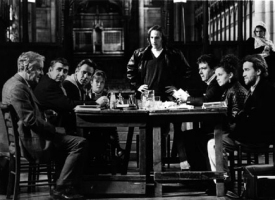
It's December 1995, I'm at university the first time around and I live very close to the one cinema I would say that I ever really loved, The Hyde Park Picture House in Leeds. In The Bleak Midwinter turned up pretty much unheralded but I'd read about it in Empire Magazine who gave it a sparkling review and having loved everything else Kenneth Branagh had directed (yes, even Dead Again) and being someway into a lifelong appreciation of Shakespeare I knew had to go and see it..

The Hyde Park was the kind of cinema in which any film could potentially be packed out because the audience tended to go see whatever was on. I took my tall friend Dave with me, even though he wasn't sure if it was his kind of thing - in black and white and about theatre - and we sat at the back of the balcony because there was more legroom.

I'd like to be able to give you a long flowing description of the experience of seeing it for the first time but I really can't. I remember being enchanted and laughing a lot and feeling very Christmassy afterwards and Dave saying that it wasn't what he was expecting and that he really enjoyed it but other than that I'd say that it just made me more excited about seeing Branagh's Hamlet the following year, this almost being a rehearsal for that.

It wasn't until the following Christmas, when I was given the video that I really fell for the film. There was certainly the nostalgia factor - I'd left university by then and it reminded me of a good night out at a place that I wouldn't necessarily be able to go back to with someone I hadn't seen in months. But it was also that it somehow managed to distill everything I felt about Shakespeare into an hour and a half and was also brilliantly funny and touching.

The following year, in 1997, I watched it around Christmas time again while I was wrapping my presents. And again in '98 and since then it's become part of the ritual. When I say that I watch it every Christmas, I really do. Which seems like the definition of a favourite film. Each viewing it means more or less to me than the year before depending on what else is happening in life. Last year I was at university again nd it just fitted into the many hundreds of other films I seemed to be watching. This year I noticed that the main character mentions in his opening monologue that he's thirty-three and I realised that I'd be the same age as him next time I see it.

Perhaps I should provide some background because I know that this isn't a film many people have heard of (it's not even available on dvd). In The Bleak Midwinter (or A Midwinter's Tale as it's called in the US) features Branagh and Shakespeare stalwart Michael Maloney as Joe an out of work actor who decides to produce Hamlet at Christmas time in a disused church in his sister's home village of Hope. With him are a group of actors, some in the offseason from seaside shows, all with their own neuroses and the film charts the rehearsal process and the production. It very much follows the structure and style of the Hollywood backstage films from the heyday of the studio system, except with obvious nods and influences from sources as diverse as Woody Allen, Ealing comedies and silent cinema.

Branagh says that it isn't autobiographical, but when Joe describes his passion for the play, that he saw it when he was fifteen and it changed his life that's exactly what the director has said about seeing Jacobi at the RSC all those years ago. His motivation for making the epic film version of the play later mirrors one of Joe's needs here - to try and make something which has a reputation for being musty and boring and making it exciting for a new generation, essentially dragging out of slow amateur schoolroom readings.

Having tried acting and been around a few actors I can absolutely say that the film captures the brilliance and pain of the art, the fact that it can boil down to bringing the deep seated emotional crap that you try to suppress up to the surface in order to entertain others. But what is really clever, is that having suggested from the opening that all of the characters are pretentious and affected and everything everyone expects actors to be - John Session's raving queen and Richard Briers grumpy old man, for example, in a series of carefully chosen two-handers he carefully peels away the surface and reveals them to be perfectly normal people like us, absolutely aware of the mask they're otherwise wearing to get by in the profession.

I think the film was derided at the time as another opportunity for Ken to give his chums something to do, but I thought it was unfair, particularly since it allows them to reproduce the fragile chemistry that any short term group dynamic has but also because many of them are producing what I think are career best performances. People like John Sessions or Celia Imrie, so often stuck playing grotesques and eccentrics are brilliant here when demonstrating the serious side of their all too camp exteriors. Gerard Horan, latterly typecast as policeman is beautifully touching as Carnforth the man with the drink problem. To be honest the only weak link is Jennifer Saunders with her mad American accent who looks like she's charged in from a Comic Strip skit, but there no doubt she's fulfilling the role of the big producer redolent of the genre.

The film is composed rather like a something from earlier in that century - most of the action plays out in medium or wide shots in deep focus with the actors moving into the foreground and back again creating the effect of seeing characters on a theatre stage - there are very few close ups and they only appear late in the film as the group is fractured and the infighting and arguments have begun in earnest. There are montage sequences, such as the audition process and the costuming but Branagh uses a series of jump cuts and juxtapositions to move the story forward.
Branagh employs lighting akin to film noir which fits the mood of the play in production and there are some lovely compositions as the actors walk in and out of silhouette.

Noir is also implied in the costumes that are finally selected for the production within the film which have a kind of 40s gangster style - and there's a spectacular use of a machine gun which accentuates that idea which I don't want to give away. There's also very little music. The film opens with Noel Coward singing 'Why Must The Show Go On' and ends with a plucked instrumental version of the titular Christmas carol. It's a brave stylistic choice but it gives room for the actor's performances to provide the emotional core and make the one musical moment from inside their story - when Nina (Julia Sawalha) sings Ophelia's lament - all the more heartbreaking.

It has dated slightly. One of the jokes hinges on Mighty Morphin Power Rangers which to be honest seemed out of the date at the time although the target audience will at least have heard of it - I'm not sure what the equivalent now would be - probably Xbox or Wii. Also, when Nicholas Farrell's Tom is auditioning for Laertes, he goes into a wild digression about how relevant Hamlet it and mentions that it's like Bosnia. That would be Iraq now I suppose. One element that hasn't aged is the crucial plot point of the filming of a giant sci-fi trilogy that could be the new Star Wars, especially since we've actually had a new Star Wars trilogy (coindentally featuring Celia Imrie as a fighter pilot) and since and everything seems to be about pre-planned franchises and series now.

Some other things I noticed watching it again the other night - the (uncredited) puppet theatre girl in the audition scene is Katy Carmichael who played Twist in the sitcom Spaced. The brilliance of the acronym LCA - Less Crap Acting. Joan Collins as Joe's agent gives probably her best performance since classic Star Trek's City of the Edge of Forever. That Maloney is the best Doctor Who we never had and is completely wasted playing the range of wackos always seems to now in tv dramas - this is the man who stole Juliet Stevenson from Alan Rickman in Truly Madly Deeply after all.

Stylistically different to anything else what Branagh has directed but still with that love of theatre and theatrics, it touches me each year and even with the darkness, somehow manages to put me in the Christmas mood. There is a scene in which people talk about what makes their life worth living and someone mentions Brief Encounter and offers to buy someone as a present. Do yourself a favour and hunt a copy of this down in time for next Christmas because if you're a reader of this blog I really think you'll enjoy it.

Review 2006: Life Props Christmas Special

Annette asks:
What is your favourite film and why?


In The Bleak Midwinter (1995)


It's December 1995, I'm at university the first time around and I live very close to the one cinema I would say that I ever really loved, The Hyde Park Picture House in Leeds. In The Bleak Midwinter turned up pretty much unheralded but I'd read about it in Empire Magazine who gave it a sparkling review and having loved everything else Kenneth Branagh had directed (yes, even Dead Again) and being someway into a lifelong appreciation of Shakespeare I knew had to go and see it..

The Hyde Park was the kind of cinema in which any film could potentially be packed out because the audience tended to go see whatever was on. I took my tall friend Dave with me, even though he wasn't sure if it was his kind of thing - in black and white and about theatre - and we sat at the back of the balcony because there was more legroom.

I'd like to be able to give you a long flowing description of the experience of seeing it for the first time but I really can't. I remember being enchanted and laughing a lot and feeling very Christmassy afterwards and Dave saying that it wasn't what he was expecting and that he really enjoyed it but other than that I'd say that it just made me more excited about seeing Branagh's Hamlet the following year, this almost being a rehearsal for that.

It wasn't until the following Christmas, when I was given the video that I really fell for the film. There was certainly the nostalgia factor - I'd left university by then and it reminded me of a good night out at a place that I wouldn't necessarily be able to go back to with someone I hadn't seen in months. But it was also that it somehow managed to distill everything I felt about Shakespeare into an hour and a half and was also brilliantly funny and touching.

The following year, in 1997, I watched it around Christmas time again while I was wrapping my presents. And again in '98 and since then it's become part of the ritual. When I say that I watch it every Christmas, I really do. Which seems like the definition of a favourite film. Each viewing it means more or less to me than the year before depending on what else is happening in life. Last year I was at university again nd it just fitted into the many hundreds of other films I seemed to be watching. This year I noticed that the main character mentions in his opening monologue that he's thirty-three and I realised that I'd be the same age as him next time I see it.

Perhaps I should provide some background because I know that this isn't a film many people have heard of (it's not even available on dvd). In The Bleak Midwinter (or A Midwinter's Tale as it's called in the US) features Branagh and Shakespeare stalwart Michael Maloney as Joe an out of work actor who decides to produce Hamlet at Christmas time in a disused church in his sister's home village of Hope. With him are a group of actors, some in the offseason from seaside shows, all with their own neuroses and the film charts the rehearsal process and the production. It very much follows the structure and style of the Hollywood backstage films from the heyday of the studio system, except with obvious nods and influences from sources as diverse as Woody Allen, Ealing comedies and silent cinema.

Branagh says that it isn't autobiographical, but when Joe describes his passion for the play, that he saw it when he was fifteen and it changed his life that's exactly what the director has said about seeing Jacobi at the RSC all those years ago. His motivation for making the epic film version of the play later mirrors one of Joe's needs here - to try and make something which has a reputation for being musty and boring and making it exciting for a new generation, essentially dragging out of slow amateur schoolroom readings.

Having tried acting and been around a few actors I can absolutely say that the film captures the brilliance and pain of the art, the fact that it can boil down to bringing the deep seated emotional crap that you try to suppress up to the surface in order to entertain others. But what is really clever, is that having suggested from the opening that all of the characters are pretentious and affected and everything everyone expects actors to be - John Session's raving queen and Richard Briers grumpy old man, for example, in a series of carefully chosen two-handers he carefully peels away the surface and reveals them to be perfectly normal people like us, absolutely aware of the mask they're otherwise wearing to get by in the profession.

I think the film was derided at the time as another opportunity for Ken to give his chums something to do, but I thought it was unfair, particularly since it allows them to reproduce the fragile chemistry that any short term group dynamic has but also because many of them are producing what I think are career best performances. People like John Sessions or Celia Imrie, so often stuck playing grotesques and eccentrics are brilliant here when demonstrating the serious side of their all too camp exteriors. Gerard Horan, latterly typecast as policeman is beautifully touching as Carnforth the man with the drink problem. To be honest the only weak link is Jennifer Saunders with her mad American accent who looks like she's charged in from a Comic Strip skit, but there no doubt she's fulfilling the role of the big producer redolent of the genre.

The film is composed rather like a something from earlier in that century - most of the action plays out in medium or wide shots in deep focus with the actors moving into the foreground and back again creating the effect of seeing characters on a theatre stage - there are very few close ups and they only appear late in the film as the group is fractured and the infighting and arguments have begun in earnest. There are montage sequences, such as the audition process and the costuming but Branagh uses a series of jump cuts and juxtapositions to move the story forward.
Branagh employs lighting akin to film noir which fits the mood of the play in production and there are some lovely compositions as the actors walk in and out of silhouette.

Noir is also implied in the costumes that are finally selected for the production within the film which have a kind of 40s gangster style - and there's a spectacular use of a machine gun which accentuates that idea which I don't want to give away. There's also very little music. The film opens with Noel Coward singing 'Why Must The Show Go On' and ends with a plucked instrumental version of the titular Christmas carol. It's a brave stylistic choice but it gives room for the actor's performances to provide the emotional core and make the one musical moment from inside their story - when Nina (Julia Sawalha) sings Ophelia's lament - all the more heartbreaking.

It has dated slightly. One of the jokes hinges on Mighty Morphin Power Rangers which to be honest seemed out of the date at the time although the target audience will at least have heard of it - I'm not sure what the equivalent now would be - probably Xbox or Wii. Also, when Nicholas Farrell's Tom is auditioning for Laertes, he goes into a wild digression about how relevant Hamlet it and mentions that it's like Bosnia. That would be Iraq now I suppose. One element that hasn't aged is the crucial plot point of the filming of a giant sci-fi trilogy that could be the new Star Wars, especially since we've actually had a new Star Wars trilogy (coindentally featuring Celia Imrie as a fighter pilot) and since and everything seems to be about pre-planned franchises and series now.

Some other things I noticed watching it again the other night - the (uncredited) puppet theatre girl in the audition scene is Katy Carmichael who played Twist in the sitcom Spaced. The brilliance of the acronym LCA - Less Crap Acting. Joan Collins as Joe's agent gives probably her best performance since classic Star Trek's City of the Edge of Forever. That Maloney is the best Doctor Who we never had and is completely wasted playing the range of wackos always seems to now in tv dramas - this is the man who stole Juliet Stevenson from Alan Rickman in Truly Madly Deeply after all.

Stylistically different to anything else what Branagh has directed but still with that love of theatre and theatrics it touches me each year and even with the darkness it somehow manages to put me in the Christmas mood. There is a scene within in which people talk about what makes their life worth living and someone mentions Brief Encounter and offers to buy someone a copy for Christmas. Do yourself a favour and hunt a copy of this down in time for next Christmas because if you're a reader of this blog I really think you'll enjoy it.


Which seems like the perfect moment to run through my ten favourite films of 2006. Something that happened this year is that I stopped getting too excited about release dates and being really quite disappointed with most of the films I've seen at the cinema. But anyway I've managed to hash together the following. Happy Christmas!

Clerks II
Somehow managed to be nostalgic about the original and also a development. Funny, touching and just as quotable. Won't be able to see The Lord of the Rings trilogy in the same light again.

Mission: Impossible III
One of, if not the best action film of the year cruelly overshadowed by its star's public activities. Never thought I'd ever see Simon Pegg and Tom Cruise in the same frame together. Actually enjoyed this more than Casino Royale which was too damn long.

The Prestige
Although it didn't quite manage to sustain its finely balanced storytelling into the final reel, it's still a magnificently atmospheric film with great performances. Yes, even David Bowie.

Superman Returns
About as good as you would want it to be, although I've since wondered if there was slightly too much stylization going on and not enough action - but as an iteration of an old myth it works brilliantly and seeing those credits and that music on the big screen again was gutwrenching.

An Inconvenient Truth
Save the debate about whether this is a real film, I saw it at the cinema which is good enough for me. Brilliantly presented the case for global warming and managed to turn the non-election of AlGore into the White House look like a very big mistake indeed.

The Russian Dolls
This ramshackle sequel to The Spanish Apartment has bags of heart and the moment when Kelly Reilly was left on the railway station platform was one of the saddest of the year. The perfect antidote to having to sit through Love Actually five times when writing my dissertation.(pictured)

A Cock and Bull Story
Somehow managed to make me laugh at two of my least favourite comedians. Another triumph from Michael Winterbottom, this managed to be slapstick and intelligent at the same time.

The Squid and the Whale
Demonstrated once again that shorter films are often the best. Direct and to the point, Noah Baumbach's film seemed to distill what Woody Allen has been trying to do shots and editing since the 90s and succeeds ahead of him.

Volver
The first Almodovar film I've really engaged with, and Penelope Cruz's best performance in years. Particularly worked because as well as being a relationship drama, it was a mystery.

Pan's Labyrinth
With a caveat. I don't think it's the Citizen Kane of fantasy Mr. Mark Kermode although it is still a great historical film about the civil war with one of the greatest devils on screen this year in the shape of that Captain.

The silent stars go by ...

For anyone who missed it, here is Paul Cornell's lovely Christmas short story, 'Deep and Dreamless Sleep' which was published in the Sunday Times this morning. I can't wait to see what his two parter is like next year.

If that's put you in the mood, Big Finish also have a range of short complete stories on their website as previews for their Short Trips anthologies and here is a list - they're in .PDF format and a download link is embedded on each book's information page. Look under the cover shot.

'The Eighth Wonder of the W0rld' by Simon Guerrier
'The Ruins of Time' by Philip Purser-Hallard
'The Prologue' by Joseph Lidster
'Father Figure' by Steve Lyons
'The Feast' by Stewart Sheargold
'Making History' by Trevor Baxendale
'Introduction' by Jacqueline Rayner
'Ships That Pass' by Karen Dunn
'The Nuclear Option' by Richard Salter
'Mortlake' by Mark Wright
'Long Term' by Andrew Campbell

Happy Christmas!

[Archived for ref purposes. All of the links to the original stories are now dead.]

Combat.


TV It's Christmas Eve, so let me keep this brief, and please understand that this isn't the spirit of the season talking, and really I can't believe I'm typing this .... but ... tonight's episode of Torchwood was quite good. From a perfectly written teaser that was both exciting in terms of setting up the mystery of the main story and important in reintroducing the issues related to Gwen neglecting her responsibilities at home to a perfectly paced script and story which gave everyone something to do and paid off well in its finale, this was the Torchwood I'd been expecting after the stonking first couple of episodes and somewhat suggests that this is a series that is only as good as its writers. Take a bow, Mr. Noel Clarke.

As usual, the concept was not exactly original but unlike usual the interpretation worked exceedingly well. For once, there was a real sense of an investigation in which the characters really looked under the belly of this fictional version of Cardiff to see the awfulness that is probably lurking there even if the truth was obvious to anyone paying attention to the brutality and whose read the Christmas Radio Times.

By holding off the secrets of the Weevil Club to the end, the audience was left in the state of imagining the worst which meant the reveal was bound to be disappointing, which in a sense it should have been -- more Robot Wars that Fight Club. In fact, most of the brutality in the episode on screen was committed my the testosterone filled men rather than the aliens, but unlike Countrycide, by placing both races in the same frame, the viewer was given a dreadful point of comparison.

It's very odd to be watching an episode of a series that for weeks you've had nothing good to say about and actually be enjoying yourself. Even the lurches between tragedy and humour seemed to work - for example the discovery of the body in the warehouse and the sudden deployment of the Crazy Frog ring tone which Jack actually had to explain wasn't his.

There was real sense to of an ongoing cross series story arc, something which has been missing for some weeks. Suddenly a thread can be seen through the whole series begun in the first episode with all the tech borrowing in which the job is having a corrupting influence on the main characters, slowly eating away at their souls - effectively they're all going Suzie. From Jack once again allowing a human to die through to Gwen employing the retcon on Rees it is almost as though each will have to reach the tipping point that both Ianto and Tosh have passed through before returning.

How refreshing to see an A-plot and B-plot running in parallel. Gwen's behaviour consciously recalled the opening episode, with her appearance in the hub with pizza and the aforementioned retcon of her boyfriend. It seems absolutely right that her attempt should fail, and the fact that he fell asleep so quickly demonstrates how strong her will was in those early days and how the job and chipped some of that away.

Even Owen's character began to look coherent, either through a natural viciousness or Weevil infection he's a very bad man and he knows it but he doesn't want to do anything about it. I might even watch last week's episode to see if what we were actually watching was temporary taming of a beast. Either this was all some grand plan, or one of Noel's tasks was to rationalise some of the wayward behaviour seen previously. When he chooses to actually enter the cage with the Weevil, although you're repulsed, it seems in keeping with previous behaviour. Suddenly lines like -- 'I was getting bored of your fuck-tricks anyway' look like characterization choices rather than simply poor writing.

Most of the performances were top notch, although guest Alex Hassell, even though he was supposed to be playing an asshole, hardly gave the subtlest of performances - though no doubt intentional he was a bit too Guy Ritchie mockney gangsta and it seemed to enhance Burn Gorman's various ticks when they shared scenes. But you had to be impressed by that ending when Gorman managed to contort his face to look exactly like a Weevil without any apparent prosthetics. I've seen gurning championships were he'd win first prize.

Unlike last week, I sat in silence for most of the episode my only murmur being 'Hold on - is it me or is this actually quite good. That can't be right..' to no one in particular. It's even put me in a positive mood for the season finale which looks excellent even though it does employ time travel which seems a bit redundant given the mother series. With the introduction of the other Captain Jack Harkness, it's only potential crime would be to ruin The Empty Child/The Doctor Dances by implying that Jack gained his current identity through nefarious means.

Review 2006


Jacob asks:
What are your views on the pedestrianisation of Norwich city centre?
" I'll be honest I'm dead against it. People forget that traders need access to [half moaning] Dixons! They do say it'll help people in [half-sighing] wheeeeelchairs?"
- I'm Alan Partridge Episode 2: Alan Gets It On.
Luckily, I have been to Norwich. An old school friend was living there some years ago and my friend Chris and I drove down from Liverpool to see him one weekend. For various reasons we came home early and got to 'enjoy' the seemingly endless stream of A-roads in and out of the town at day and night and in neither case were they very attractive. What I remember of the city centre is that the cathedral is very nice and that the rest is particularly modular - I remember having to walk through some very anonymous looking streets between the shops you'd actually want to go to.

Despite being a joke, Mr. Partridge isn't wrong about it not benefiting some traders and but improving access to some customers. The system in Liverpool seems to work quite well - although the main shopping areas are covered in block paving there is some access to vehicles earlier in the day and later at night. I should like pedestrianisation - in some cities it's quite thrilling (if that is the word) to be able to walk from one end to the other uninhibited by vehicles and their pollution, foot traffic being the only thing to avoid (particularly people who are walking front of you and just stop dead so you nearly fall over trying to avoid bumping into them - how annoying is that?). In Liverpool, you can stroll down Bold Street and all of the way up to the Victoria Monument at the top of Lord Street with only a crossing at Ranleigh Street.

The counter argument for me though is based on aesthetics. In some cities, pedestrianisation kills the look of the place lessening its impact as collective piece of architecture. One of the main roads in Birmingham, the one with the Odeon cinema used have traffic passing through it and had a lovely metropolitan feel - now there's a deadness to it - an emptiness no number of people can fill. I'd be extremely unhappy too if they ever paved The Headrow in Leeds which has the Boulevard effect even with its smaller dimensions. Some talk about these pedestrian areas leading to a European café culture. Not from what I've seen. It's far too cold, except for about three days during the summer.

The other problem is that pedestrianisation tends to add to the blanding out of city centres generally. Over the past couple of years I've visited both Nottingham and Shrewsbury and sometimes its difficult to remember which city was which and while I was there I was disappointed with how similar they are to every other city I know. Same shops, similar street fixtures and similar paving. In which case I would say that pedestrianisation is bad for Norwich because it'll ruin the individual character of the place.