Review 2007: All Roads Lead Home


Kat Herzog on Minnesota

About a week before a visit to my native Minnesota, the road fell into the river.

Most news outlets called it a bridge collapse, but nobody I know ever thought of that stretch of 35W as anything more than a bit of highway that happened to run over the Mississippi River. It's indistinguishable to me from any other part of the highway. It was one of those anonymous capillaries that are part of the vast roadway circulatory system that usually gets you where you need to go with a minimum of fuss.

Being a thousand miles away, it wasn't quite breaking news on network television, and even if it had been, I was at the computer. I read about it right after it was posted to Metafilter, which is, for better or worse, how big news usually finds it way to me. A sucker-punch, a minor black wave of nauseating anxiety washing over my vision, and then I was on the phone. My family was fine, my sister and brother-in-law in verklempt trances in front of the television. One friend was unaccounted for, and repeated hysterical messages ("Even if you are at the bottom of the Mississippi River... you've got to call me back!") to her voice mail were finally answered a few hours later when she checked her messages.

One of my sister's coworkers was among the missing and later -- weeks later -- confirmed dead.

I absorb trauma easily, and this blow so close to home added one more entry on my List Of Things To Daydream About In A Highly Paranoid Fashion. I play The Highway Collapse in my head as I drive along the roadways. The sight of even the most slightly shabby concrete will trigger it. My mind's eye sees the road shudder slightly, the asphalt rolling in an unlikely gentle wave, cracks open, steel girders groan as they buckle, the cars in front of mine fall in a cascade of rubble, airborne and silent for a moment before everything roars in a crunching crush.

I snap back fully to reality, to the reassuring pace of rush hour, to the present view of cars and streetlights, before my car slides off into nothing.

Kat writes Geeky Sweet Nothings.

Click here to find out more about this review of 2007, read previous posts and learn about contributing yourself.

"Sometimes I look in the mirror and I'm not sure it's me looking back." -- Niki, 'Heroes'

Elsewhere My review of Heroes has been posted at Off The Telly. No matter what everyone else has said, despite some slightly overripe dialogue it was a perfectly satisfying conclusion to the series. I'm really going to miss my weekly effort to guess the strength of Claire's lip gloss and why Niki is spelt with one K.

"The qualification piquing my interest, before Barrowman walked over and groped her tits."

TV [Spoilers if you're not careful, especially paragraphs two to four of linked article]

Graham from Off The Telly was at the now legendary Torchwood Season Two launch at the weekend and had a very candid interview with Mr. Barrowman about the fan reaction to the first series and how the production went during the second year. In particularly, see the quote at the bottom of the post. Eek.

Review 2007: Home


Andrea Dowling on Liverpool

I love my city, it has so much to offer and so much more than just the Beatles. Its 800 years old this year and its history is fascinating, and not just our dark history like the Slave Trade, which is a blot on our humanity.

It used to have a small pool running right through it and its own beach and lots of sand. Then as things progress it changed dramatically.

Massive Tall Ships came sailing down the blue ribbon of the Mersey, she was as clear as crystal then. The ships where wooden in structure and had huge white sails. Many a Naval Officer set out to sea from Liverpool, including the very famous William McMaster Murdoch First Officer of the Titanic.

Which brings us to that beautiful stripy sandstone building on the Dock Road, facing the magnificent Mersey Docks and Harbour Board Building. That is where White Star started its journey in that humble building that now stands waiting for someone to buy it and turn it into flats.

Liverpool was formed, developed and enriched by the Shipping Industry. It lived and breathed and pumped the heart of our City. My Grand father used to go down to the Docks every morning, very early to see if he could get work on a ship. If he couldn't he had to sign on at the dole office so that he could take food home to his wife and her many children.

The one thing I love about Liverpool is that so many historic buildings have been restored to their finer glory. St Georges Hall, our Museums, our Docks have been salvaged like old wrecked ships and brought back to their finer days.

Yet that's not all that Liverpool has to offer, that makes my home so unique, so rich in beauty. Its the people of Liverpool, the native scouser's the people who where either born and bred here or arrived from Ireland and made Liverpool their home. Through every hardship that Liverpool has thrown at these wonderful people, they always manage to smile. To band together in sorrow and tears, to unite as one as a public voice for the people who have been hurt in tragedy.

I saw it in peoples hearts and smiles and the team colours and the songs of Football Fans when we lost so many people in the Hillsborough tragedy. Liverton and Everpool they sang, and tears made the river rise up higher.

When little Jamie lost his life once again the City came together as a family. All supporting Jamies family. This summer they did it again, they united once more in grief. First we tied up yellow ribbons for the safe return of Madeline McCann and then we wore purple ribbons in memory and honour of Rhys Jones.

That's what is unique about my home, that's what makes me proud to say I live in Liverpool. Hearts as Golden as the Setting Sun on the Anglican Cathedral. Heads held high as Paddy's Wigwams Crown which you can see from Prescot Town.

God Bless Liverpool and all who sail to her and live under the protective wings of our Liver Birds, each one of us makes this City what it is a pool of life.

Andrea Dowling writes about Liverpool City.

Click here to find out more about this review of 2007, read previous posts and learn about contributing yourself.

"All right! They're spiders from Mars! You happy!" -- Chris, 'Eight Legged Freaks'

Art If think a giant race track in the middle of Wembley Stadium looks weird, how about a giant spider web across the Albert Dock?

"McRomance. Want some fries with that shake?" -- Frank, 'Eternal Sunshine of the Spotless Mind'

Film James MacDowell writes poignantly for Alternate Takes about happy endings in films and how actually they're all different and in some aren't as uplifting as they first seem. On Eternal Sunshine of the Spotless Mind: "This ending is, in the context of Hollywood cinema, rather extraordinary. The conclusion depicts a united romantic couple embarking on a relationship (as is usually considered the norm for a romantic ‘happy ending’), but it also explicitly states that its characters’ subsequent relationship will likely finally fail for the same reasons as it did the first time. Formally speaking, the ‘happy ending’ - as commonly defined - is certainly present: the couple have fallen in love, are about to begin a relationship, and are framed in a moment of shared bliss in the film’s final frames. Indeed, there is even a mini version of ‘the run’ - that familiar romantic comedy moment at which one half of the couple realises they are in love, and runs (or at least travels) to tell the other how (s)he feels. However, the list of things that will likely go wrong for the couple, and the following “okay”s that signal that they also accepts the likelihood of the affair’s eventual failure, makes this ending entirely unlike any other Hollywood ‘happy ending’ I have come across."

"We apologise to those guests who have waited patiently in past years to get protest leaflets signed..." -- Charles Thomson

Art It was somewhat inevitable that Mark Wallinger would win the Turner Prize even though Zarina Bhimji is clearly better. It's supposed to be for a career's work, his was the showiest of the pieces. Charles Thomson, co-founder of the Stuckists art group thinks we should have boycotted it altogether: "It is desperately necessary to upgrade the standards of the prize which has steadily degraded into increasing blandness. What is needed is someone whose manic personality is guaranteed to give some zest to proceedings by doing all the wrong things. We suggest possibly Billy Childish (Co-founder, now ex-, Stuckist), who is incapable of not speaking his mind, and Stella Vine (another former Stuckist) who is well known as the loosest cannon since the Battle of Trafalgar. However, we understand the natural reluctance of the Tate to nominate people who paint pictures for a prize named after a painter."

Review 2007: Home


Andrew Boyd on Canberra

I grew up in Canberra, capital city of Australia. In recent years I've not thought of myself as a Canberran - too many tourists with those distinctive blue and white ACT plates behaving badly to give us anything other than a bad name. Canberra drivers are aggressive (whereas I am assertive), they are small-minded and petty (whereas I have a keen eye for detail and expect fellow motorists to be courteous and respectful of the road rules). You get the picture.

I think that the time has come for me to embrace my Canberran-ness. I did spend nearly 15 years in government service, so I can't really see the shame in being part of a government town. I've lived in this town for at least 35 of my 42 years - and while I've tried living elsewhere, I always seem to come back here.

I helped to raise my children here and near here. I fell in love here for the first time as a young man, and have recently fallen in love again here. I've bought houses here, rented here. I have family here.

Coming back to Canberra is coming home (despite the best efforts of QANTAS to make air travel to or from here unbearable).

I love the vibrancy of Spring here and the many colours of Autumn here. The seasons are really in-your-face - when it is hot in Summer, it is really hot, and when it is cold in Winter, the breath catches in your chest - it is really cold.

The popular conception of Canberra outside the nation's capital is a bit negative - the rest of Australia is often slinging mud at us because federal parliament is here and the newsfolk invariably start bad political news with "...and in Canberra today...". The trick is, guys, that whoever you vote for, a politician gets in - and for the 11 years of the previous regime I was able to keep saying "whoever it is, we probably didn't vote for them" (because Canberra has been a fairly safe Labour seat for around 35 years).

I am Canberran.

Andrew Boyd writes On Blogging Australia.

Click here to find out more about this review of 2007, read previous posts and learn about contributing yourself.

Review 2007: Home


Kat Herzog on Baltimore

Good Morning, Baltimore!

It was big news when the latest incarnation of Hairspray was released this summer, with Baltimore fawning over their Pope Of Trash.

I love this about Baltimore, and about John Waters. He deftly skewers this city with such love, and while the bowdlerized Broadway and Hollywood Hairsprays don't quite have that loving touch of smut that all Waters films have, they at least wink at what they've hidden behind the family-friendly songs and scripts.

John Waters' Pecker was my Baltimore Orientation, prescribed a few months before I moved here. And that was a good thing, because I pictured a city of boarded-up drug dens and, more or less, every plot line from Homicide: Life On The Street. That's not to say that Baltimore isn't like that from time to time, neighborhood to neighborhood, but, for the most part, it's alright. The people were voted the ugliest in the country a couple years ago, but I see a lot of kindness and good humor beneath the shabbiness and trashiness. (Ask me if my car gets vandalized again, and I may have a colder perspective.) They call it Charm City, but it's probably not really the sort of charm you're thinking of. It's a little smellier than that:
What does the city of Baltimore mean to you and what sets it apart from the rest of the country?
John Waters: The city of Baltimore is home to me. I've always made movies about what the Chamber of Commerce tried to hide and I always joke that they should put out a bumper sticker saying, "Come to Baltimore and be shocked" and they did about five years ago. I guess they've given up and realized that we have to celebrate the weirdness of the city.
I think that Baltimore understands that. When he filmed A Dirty Shame in my neighborhood not too long after I moved in, people fought over the suggestively trimmed set-dressing topiaries. Fought over, as in: they wanted the penis-shaped shrubbery in their front yard. I can't think of a place that has as much of a sense of humor about itself.

One must have at least an abstract fondness for vermin to call Baltimore home. I don't know if I truly understood that before that afternoon in the cool dark theatre, with my popcorn and my Raisinets, the opening sequence capturing Baltimore through and through, filling my heart with warm pride, the same sort of buzzy, humming feeling usually achieved through greeting-card commercials and holiday songs. Except for the fact that my heart was joyfully bursting, tears welling in my eyes, at the sight of John Waters's split-second cameo as the flasher next door.

Kat writes Geeky Sweet Nothings.

Click here to find out more about this review of 2007, read previous posts and learn about contributing yourself.

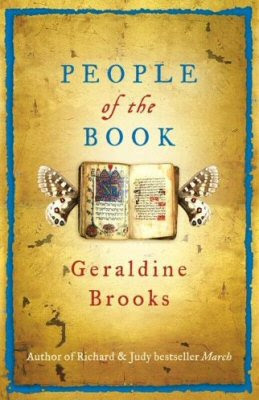
"I might as well say, right from the jump; it wasn't my usual kind of job" -- Hannah, Geraldine Brooks's 'People of the Book'


Books Geraldine Brooks's last book, March, was a Pulitzer prizewinner and found itself in Richard and Judy's Book Club reaching both ends of the critical spectrum. In that work, Brooks celebrated Louisa May Alcott's novel Little Women, a childhood favourite of hers, by presenting the parallel story of the March family's absent father fighting in the American Civil War. The historical evocation of literature continues in Brooks's new novel, People of the Book, which describes the investigations by Hannah, an Australian rare book expert into the Sarajevo Haggadah, a Jewish sacred text which has survived for just over five centuries through wars and inquisitions.

The structure of the book is somewhat similar to Vincent Ward's luminous film The Red Violin, in which the titular instrument's life from ancient creation to contemporary auction was described through an intricate flashback structure, with near short films presenting the various owners of the violin. As Hannah discovers items stuck between the leaves and in the binding of the book, the action changes to the period in history where the book enveloped them from a priest during the inquisition to a museum working in Bosnia during the second world war. Linking these stories is a sense of a work of art forever being saved for future generations even when its Jewish religious utility conflicts with the prevailing theology of the time.

At times, this is an extraordinarily detailed text, keeping the reader aware of the sounds, images and particularly smells in an environment. One of the best scenes in the book occurs when Hannah comes into contact with the Haggadah for the first time, as pages are given over to putting the reader in the position of this privileged expert forensically turning the pages making us understand what she's expecting and also surprises her; the sense of the scent and feel of the pages is so clear that to the extent that we could imagine the new book we're reading the description from has similar properties. The author is careful to modulate this however and it's frequently the case that when scenes are set against a modern backdrop, the dialogue is more fluid and expository.

The problem is that although the Haggadah is an intriguing object, the structure of the novel, which is essentially an anthology with Hannah's story, told in the first person, weaving in and out, leads to a certain lack of impetus which despite everything makes it quite an arduous read. There's a repetitiveness to the Australian's discover of a new property - an insect wing or a wine stain and then the appearance of a story which explains how it got there. The intent could have been to mirror these ancient manuscripts which would feature a range of stories and ideas, some which only tangentially tie together, and perhaps it does work on the level of a short story collection with a connecting tissue. But Hannah's character is so attractively drawn, and the novel so comfortable amidst her observations, that it's a pity Brooks couldn't have found a way to present the whole story of the people of the book in her words.

Melon Farmer

TV SFX Magazine's blog offers a couple of Torchwood related posts which suggest two slight change of direction for the series:

The first is that there's to be a pre-watershed version of the show with altered dialogue and the implication of things which you wouldn't want your kids seeing. Since it appears to have been decided before filming, it might be quite as obvious as when Channel 4 took their scissors to the likes of Angel and Alias, often leading to episodes becoming fairly incoherent.

The second change is that it might be quite good
. There's lots of talk about more humour and the team having more affection for one another and only failing because the foe is overwhelming not because they're incompetent which all sounds good. You can get away with a lot if what your doing is a bit funny.

Review 2007: Home


Jennyfer Star on Stockholm

I could easily give 2007 a really bad review, but I´m not going to. Even though my life has been turned upside down (yes, litterary) I have learned how to see things from the bright side and to finally make lemonade of all those damn lemons.

Let me tell you a story:

Once there was a girl, so young and restless, ready to take over the world. She was a singing bird, but no nightingale. More like a crow with her hoarse voice and rocking style. She loved every inch of the rock n roll life style, but after a few years she started to fall apart. The drugs, the booze and the touring seemed to tear her down even though she didn´t want it to. She wanted so badly to love it and keep doing it forever. But one day she realized that forever wouldn´t last that long if she didn´t stop makin mischief.

After being off drugs a few years, she thought she was safe. She could still do the rockin and rollin, but it wasn't the same anymore. With sobriety comes maturity and with maturity comes pressure and stress. And our young girl couldn´t take the press of being the leader, the mature teacher and the arranger of everything. So in the first couple of months in the year of 2007 she quit her band, left her boyfriend, quit her job and her therapy sessions and became a solo artist on a sick leave.


The young girl is me as you may have figured out. I am still pretty young and pretty restless, but I´m also pretty tired of the whole thing. In the beginning of the year my home became my shelter. I got hit by the worst depression of my life and I just couldn´t go outside the door. Just when I thought things were getting better and I started to go out to meet people, I got drugged in a bar and I was back on square one again. The anxiety and the panic attacks just hit me like a lightning from above. I felt awful. Every day I was cramping and vomiting of the anxiety. And yet again I was bound to be enslaved in my home. This time it didn´t feel like a shelter at all. It felt like a prison. I didn´t want to be in this downward spiral again.

Four months has passed now since that incident in a well known rock club in Stockholm. I feel so much better now. I´m starting to take care of myself and my home. I have to make it feel comfortable and cosy, not like a grey cell on death row. (Okey, I admit, my apartment has never looked grey, it´s all pink.. But anyhow, a metaphor).

So what has Jennyfer Star learned this year? I have learned that I´m better off doin what I want but in MY way. I have learned to see the beautiful things in my life, and focus on them instead of all the misery and pain. This has lead me to being a more positive person, something I never thought I even WANTED to be. I guess there is a hope for everyone. You just have to believe in it yourself, even if no one else does it.

Jennyfer Star's official website and myspace page including blog.

Click here to find out more about this review of 2007, read previous posts and learn about contributing yourself.

Review 2007: Home


Angshuman Das on Mumbai

Home is different from house. When we say home, it encompasses feeling and warmth; it is more than a mere house, which essentially means a shelter. Therefore, the word home is often used as an uncountable noun without any article or adjective.

When I look back at the year, I find that the most important development that has happened to my home and neighborhood is change of location: I moved in the middle of the year. I moved from a Calcutta neighborbood to a Mumbai suburb. This move has been a techtonic shift for me.

The overwhelming feeling has been of dislocation. I am not sure yet whether I have settled, whether I like my new dwelling, or whether I would like to make Mumbai my home for the rest of my life. I am listless and clueless. It's as though I have lost my mooring, yet I don't know my destination.

From a familiar environment, I moved to a new place. I had lived in Calcutta for several years. I had been born in Calcutta, known as a center of art and culture -- and squalor. Calcutta is also a breeding ground of Indian communist and Marxist thought, the capital of a state ruled by the Left Front government, an alliance of communist and Left-leaning parties.

Mumbai, on the other hand, is India's financial and glamor capital. The world's largest movie industry, Bollywood, thrives in Mumbai. It has a great seafront, the skyline from Marine Drive, the main boulevard along the sea, looking like New York's.

Incidentally, both cities are compared with New York -- Calcutta is similar to New York as a center of arts and culture; Mumbai is similar as a center of high finance, glamor, and round-the-clock activity. Mumbai has been called the city that never sleeps. (That's true. At 1'O clock on a Saturday morning, you will find bumper-to-bumper traffic.)

Mumbai has its charms, but, again, is it home? Is it my home? My life is peaceful in Navi Mumbai, a "satellite township" that one needs to cross a bridge over the sea to access. I commute by train -- Mumbai has a giant local rail network that ferries passengers by millions each day.

I am one of those millions, eking out a living from a job in a management consulting company that advises corporations how to make more money and grow their businesses. I should be happy, for Mumbai has been called the city of opportunities.

Yet, I don't know what I feel. Is it ambivalence? Is it incomprehension, or nostalgia for my ealier home? I have no idea. I am lost. This year my home itself has moved, unsettling me.

Angshuman's blog is Cooking in Calcutta.

Click here to find out more about this review of 2007, read previous posts and learn about contributing yourself.

The photo of Mumbai is from flickr and used via a Creative Commons License.

Review 2007: Home


Annette Arrigucci on El Paso

All of us live in bubbles. No matter how worldly we are or think we are, most of us don’t know how “the other half” lives, even in our own communities. Even if we know, even if we see, we don’t really know. But at least recognizing the fact that we do live sheltered lives is the first step in understanding.

My bubble is a very comfortable one, fortunately for me. I grew up on the Westside of El Paso, Texas, USA, a world of nice, quiet neighborhoods, with clean streets and a beautiful view of the Franklin Mountains in the background. My lovely red brick home had a pool in the backyard. I went to good schools, the best in the city, actually, where I learned perfect English and not a lick of Spanish. My parents had three cars in the driveway. We had two TVs and I grew up watching plenty of standard American cable programming (in English, of course)--Nickelodeon, MTV, HBO, etc.

In this world, things that make the news are medical schools and outlet malls being opened. A TV newscaster, who went to good American schools similar to the ones I went to, who speaks perfect American English, tells us all about what happens in this El Paso every night of the week. The latest car accident, perhaps, or possibly a parade. The all-American sportscaster relates UTEP, the local university’s, latest string of wins or losses. When I first thought about what to write this essay about, those things came to mind.

But there comes a point where you realize that yours is not the only bubble there is. Your bubble bursts, momentarily, and you realize that there are other people out there, people who didn’t grow up in a nice neighborhood, who don’t speak the way you do, who don’t have the options you do.

El Paso’s a border city, first and foremost. There’s no forgetting that as you drive along I-10 and see Mexico on one side and the United States on the other, or drive along the border highway and see barbed wire fence and bright lights designed to keep illegal border-crossers out. There’s another El Paso out there, and my first realization of that came when I was about four years old. I remember the maid my mother hired to help her take care of me and my sisters. Her name was Maria, and she was a Hispanic woman with very short black hair who came from Mexico. I always thought she looked a little bit like a mouse. She spoke broken English with a thick Mexican accent. As my sisters and I would wake up in the morning, she would sing to us in Spanish. After I got dressed, she would hand me my Velcro shoes. “Ah-net, put on your choos,” she would say. She was a wonderfully nice and positive person, and she treated us like we were her children. I was too young to know it at the time, but she had come to this country illegally.

One day my dad drove her home with the rest of the family in the car. Unlike most of the other adults I knew, Maria didn’t have her own car. We stopped at a dingy apartment building far away from our neighborhood. I asked, “Daddy, why does Maria live in a motel?” The “motel” was actually a government housing project. When Maria had gotten out of the car, my dad explained to me that Maria was poor.

According to the U.S. Census Bureau, about 26 percent of the people in El Paso live in poverty, and they estimate that 30 percent of the population is foreign-born, though it’s really anybody’s guess how many people work and/or live here illegally. I’m reminded of their presence just about every single day, in some way or another. I’ll drive to work behind a beat-up pickup truck with a wheelbarrow and a lawnmower in the back, three guys in baseball caps riding in the cab. I know which side of the border they’re from and what they’re here for. During the afternoon, I’ll see a middle-aged, brown-skinned woman with an umbrella walking down the street to the bus stop. I know she probably spent her morning dusting and scrubbing. These are the people who exist in the shadows of this city, those here from Mexico who cross the border trying to make better lives for themselves and their children. Some go back to Mexico daily. Others are here to stay, in various states of legality.

So, yes, I do know that these people exist. It would be hard not to. But I’ll be the first to admit, I don’t know the first thing about them, in my world of graduate degrees and English-language TV and Starbucks. The news, TV or print, certainly doesn’t tell us much about these people, and I think these people would probably prefer it that way. Stories about immigration appear, but the people in them never seem to have names or faces. Somehow it isn’t right not to know, though, to continue on in blissful ignorance….

Which is why this year, as part of a service learning course, I signed up to observe an English as a Second Language (ESL) class made up mostly of new immigrants. Partly out of curiosity, partly out of guilt, I guess. I still think about Maria, a woman my parents kept in touch with, a person who I know has struggled all her life in the depths of poverty, whose experience I’ve never really understood, even now that I’m older and know she doesn’t live in a motel.

I have observed the class since September, and it has gone a long way in making me think about this city in a different way.

The class I observe is made up of about 40 women and a couple of men who crowd into a classroom four days a week to learn English. My first day of class I participated with the class in a round robin game. In the game, each student would hold up an object (a book, a notebook, a pen) and shyly explain to me in thickly-accented English similar to Maria’s, “Dees eez my pen. De pen belong to me. Eet eez my pen.” There was Maribel, a very pretty woman with her long beautiful (dyed) blond hair. After that was Ana, a short, plump, dark-skinned woman who, I would soon see, is never shy about sharing her opinion. Then came Martha, a tall, broad-shouldered, woman with light brown hair, and Isabel, a very kind, tired-looking woman with short brown hair. A lady named Aurelia reminded me of my mom.

Some of the women in the class are about my age. Others are into their 30s and 40s. All of these women originally come from Mexico, and very few speak more than a few sentences of English fluently. None of them have their General Equivalency Diplomas (GEDs), required to get most jobs in the U.S., and few or none have U.S. citizenship. As their class is part of a parent education program, all have at least one child. I don’t see these women outside of class, but I imagine that their lives are difficult. Much more difficult than mine, at least. I imagine Isabel at the checkout line of a store, a clerk in a smock throwing up her hands saying, “I don’t speak Spanish.” I imagine what a nightmare it must be for them to fill out paperwork in English. I expect that most of them don’t have much money. Surely not three cars and a backyard pool.

I’m sure these women are tired and have plenty of responsibilities. But the thing I’ve noticed after observing this class for about eight weeks is how different the attitude of this class is from just about any class I’ve ever been in. The students eagerly participate in all activities, from reading out loud to writing to answering citizenship test questions. During class breaks, the women chat in loud and lively Spanish over coffee and sweets. There’s a great sense of community. The teacher is a very patient man with the enthusiasm and mannerisms of a children’s show host, and he keeps the class flowing as he teaches these women basic conversational skills and names for things like days of the week and months of the year, which they repeat in their thick accents.

It seems like if anyone had a right to be cynical in El Paso, these women do. Lacking skills in English and the rock-bottom minimum of education to get a job here, they are at an abysmal disadvantage in our society. We in the U.S. don’t exactly welcome them with open arms. Grudging acceptance is what we offer, at best.

But still these women are determined to be here and eager to acquire what is being offered, however meager it is. I offer to help the women with their writing and I’m deluged with raised hands. “Eez these right?” they ask me, or “Es correcto?” As I go around and correct prepositions and misspellings, I think about how maybe I shouldn’t be surprised at how hungry they are for this knowledge. After all, hunger is what brought them come to this country. They so badly wanted what this country has to offer them and their children that they left behind their lives elsewhere. I’ve never known what that’s like and probably never will.

And I wonder if immigrants are the only truly hungry people in America these days, and if they’re the only ones who take education seriously anymore, bombarded as we are with abundant food and information. I watch my own students in my English composition class as I lecture, where much of the class is half-asleep or staring at me with bored looks, chins in their hands. A couple of kids are text-messaging when they think I’m not looking. (I am.) In contrast, in the ten times I’ve observed the ESL class, I’ve rarely seen anything less than complete attention from the students as the teacher is talking. I have never seen a single pouty look, I have yet to see someone close to falling asleep, and I couldn’t even imagine a person text-messaging while the teacher was talking.

As part of my class project, I interviewed, Mayra, a bright student who looks about my age. I asked her what her goal was after she finished the class. “I want to be a nurse,” she answered, not a half-second after I asked the question. I think of the mountain she has in front of her—learn English, get a GED, go to college, all the while having a husband and son to care for. But from the look I saw on her face, I have no doubt she’ll be able to do it.

If middle-class Americans had anywhere near the determination of the women in this class, we could accomplish great things. Cancer might be cured. Wars would end. Global warming and world hunger? Not a problem. I’m serious.

My experience observing this class is nearing its end and I will be sad to leave it. But it has been an unforgettable experience. I’m troubled because I know I haven’t made even a tiny dent in the problems of poverty in this town. I wonder how many thousands of others there are in El Paso who come here knowing only Spanish and having no education, stuck at the bottom of society, at least for awhile. But I am glad I live in a city where immigrants are at least given a chance to live the American dream. This is the real “news” in El Paso; here are the stories that don’t make the news but should. After class, I often see the women eating lunch with their pre-school age children. I imagine how many more opportunities those children will have than their parents and I feel a little more hopeful. The stories of immigrants like these are the most significant in El Paso in this and every other year. I’m glad I was able to break out of the bubble and realize it this year.

Annette's Notebook can be read here.

Click here to find out more about this review of 2007, read previous posts and discover how you can contribute.

"Doctor Who, dreamed up by Newman himself with the writer Terry Nation..."

TV Just to show what goes in here, comes out there....

From an email sent Mon 26/11/2007:

To: Guardian Readers Editor (reader@guardian.co.uk)
From: Me

Hello,

It's really disappointing to see the myth that Terry Nation co-created Doctor Who repeated in the obituary for Verity Lambert. Sydney Newman created Doctor Who, although a lot of creative work on what the series would be like was shouldered by Lambert who was producer from the off and the first director Waris Hussein. Nation was a writer for Tony Hancock and didn't become involved with the series until he was sacked after falling out with the comedian and had recently called by his agent who suggested this children's programme would be a nice stop gap. Doctor Who fans groan every time they see this in print, particularly in the first edition of Trivial Pursuit where it was an answer to a question.

I do think it's something that could be corrected in the on-line version of the obituary since that's the kind of thing which is used by researchers, and as written it lessens Lambert's creative input which was considerable.

Take care,

Stuart Ian Burns.

From the on-line obituary as of 28/11/2007:

"The following correction was printed in the Guardian's Corrections and clarifications column, Wednesday November 28 2007:

"Verity Lambert was the producer of Doctor Who from the start of the series, rather than the second batch of episodes, as we said in the obituary below. Terry Nation played no part in creating the series, but began writing for it later."

I suspect that I wasn't the only one ....

"Wonder is from surprise, and surprise stops with experience." -- Bishop Robert South

Life This lunchtime I attended the final classical lunchtime concert at the Phil in which a quartet then quintet revealed to us a newly composed work by Ian Stephens called Dances Overhead and Brahms Clarinet Quintet. The former featured a nice rough provision on traditional folk dance themes and the latter slightly niggled because it sounded almost but not exactly like one of Mozart's Clarinet works in much the same way as I've discovered that most of anything John Williams has ever composed for films has been 'influenced' by something else in classical music. Even the Star Wars theme is basically something by Korngold for an old Ronald Reagan film sped up and with the ending knocked off.

At the back of the stage on the wall is a piece of kinetic art, some wavey lines and large round white balls which are supposed to denote a musical stathe and some crotchets. Its been there as long as I can remember -- might even be as old as the hall -- and I've always thought it should be moving, perhaps in time with the music. Sure enough today, it was moving, the balls up and down, the wavey lines left to right and vice-versa. I don't know if it was in time with the music -- I mean how would that work unless it was designed to be like those little plastic dancing flowers with the guitars -- but it was reassuring and something else to look at during the music (from where I was sitting I couldn't really see the players).

Between pieces there was the customary mini-interval, enough time for the players to go off stage, wash their hands, take some drink, whatever they have to. Someone from the hall dashed on stage to add an extra stand for the clarinetist in the second half, a surprisingly slow process as she tried to do it with the minimum noise. As she was about the step off stage, a human voice from the front shouted, piercing the silence: 'Will you turn that off!' This middle aged man. The someone from the hall looked at them for a moment and then realised they meant the sculpture and sure enough, seconds before the players returned, the sculpture stopped.

I'm left to ponder a few things.

(1) It's the first time I've heard anyone break the invisible barrier between the audience and stage in the Phil, at least at a classical concert. So it must have really been irritating. But really why? Was it that distracting? It wasn't as though

(2) Does he just hate art? In which case what's he doing at a classical music concert?

(3) No one else in the hall seemed to be bothered. Was it irritating them too but they left it up to this man to voice their concerns?

(4) Why didn't I ask for it to be left on if I was enjoying the up down/ left right so much? I burst out laughing and wanted to shout, 'No leave it on' but my ingrained repression stopped me from making a fuss. But I definitely whispered it out loud.

Since I'm without a psychology degree I'm without answers. I just wish that sometimes people would pipe down and just let the rest of us enjoy life's little surprises, like seeing sculptures moving for the first time in years.

"There are voice samples from Howie Mandel." -- Alex Navarro, 'Gamespot'

Games The Nintendo DS version of the US's version of Deal or No Deal has one or two problems: "It's a game about picking random numbers, but the numbers aren't random. It's hard to screw up much worse than that."

"Ooo my Desdemona, our lovin's been so good, you know I wanna hold you, I wonder if I could..." -- The Kids From Fame

Theatre This Guardian interview with one of my favourite actresses, Kelly Reilly, includes an interesting discussion about playing Shakespeare's Othello's Desdemona (which she's about to give us at the Donmar) in this day and age:
"The thing is, she's so loyal that she genuinely can't understand why Othello could convince himself that she has been unfaithful to him. She keeps asking him, 'What's wrong?' This is a woman who has betrayed convention to marry him - in Elizabethan times, to get married without your father's consent, as she does, was socially intolerable. She has defied convention, alienated her father, risked a great deal and then been utterly faithful to her husband, and this is what she gets?" Men, eh? But isn't Othello and Desdemona's relationship thoroughly weird, I ask? "Why do you say that?" Because, for all the passion she has for him and he for her, their marriage remains unconsummated. "That's how we're playing it. That way, the drama of Othello's jealousy becomes more intense. He thinks Roderigo is getting what he hasn't had and that fuels his rage even more, and for Desdemona, makes her husband even more incomprehensible."
I do like that interpretation. Othello has always been one of my problem plays, because although I understand the psychological games that Iago is playing, it does stretch the audience's suspension of disbelief rather far in relation to the fragility of relationships. That said, as we've discovered even more recently, the generals with the strongest public images can be utterly naive when it comes to their private life.

"Rose Tyler. Defender of the Earth." -- The Doctor, 'Doctor Who'

TV You will have read in the press about the return of Billie Piper to Doctor Who, something which has been quickly confirmed by the BBC, probably because with this photo floating around (which I initially thought was photoshopped -- oh well), it was hardly something which could be denied. Actually it could -- she might have 'just been visiting the set' -- but that's hardly convincing considering she has her Rose hair on. The other thing to notice about that shot is the man in the glasses, who fans like me will recognise as Graham Harper who's directed some of the best episodes of the past two years and the latest Children in Need special which is a very good thing indeed.

You'd think that the return of said actress would have universally excited fandom, but as is the way of things, everyone's split down the middle which is clearly, mad, strange and wrong since she was one of the best things about the first two series. Some don't like her, have never liked her, and gut wrenching performance on the beach at the close of series two isn't going to dissuade them. Other's are upset because it cheapens that story, where it took the wall between two dimensions to separate her and the Doctor which was rather more dramatic than the average classic series resignation; with the exception of Adric the reviled boy genius who met his end on a spaceship which wiped out the Daleks, they were variously married off, became tribal leaders and in one occasion felt a bit ill and was sent to the country to recuperate, never to return.

Silly things. I absolutely understand that argument, but really, it doesn't matter that much does it? With all the other rumours that are flying around about other returning companions it sounds as though the production team are putting together the new series version of an anniversary story (see also The Three Doctors, The Five Doctors, Silver Nemesis, Happy Endings, The Infinity Doctors, and um Zagreus) -- it being the show's 45th birthday year -- and a way of letting the last full set of episodes for a couple of years go out with a bang commemorating what's gone before. It all depends on the story and the script and there's nothing to suggest that something great isn't going to be delivered. Rumour has it that Rose is going to be at the centre of the Doctor-lite episode next year (the one in which he hardly appears for production purposes) which would be a good twist, especially if it was then tied directly in with the finale.

Well I'm excited.

The Lost Boy (Part Two)


TV “Daisy, daisy, give me your answer do…”

I found myself watching It’s A Boy Girl Thing last night. For the uninitiated, it’s one of those body swap comedies, this time in which a slightly nerdy girl and a jock change places just as she’s about to undergo an interview to get into Yale University and he’s about to play the most important American Football game of his life. By no stretch of the imagination is it a great film, but the central relationship is rather sweet, helped by some decent performances in which neither actor commits the Roy Scheider in The Hot Chick crime of assuming a woman in a man’s body would be camp and gay. Both in fact do a very good job of mimicking each other and the actress Samaire Armstrong coming across as a young Ellen Barkin.

The point is you could tell whilst it was on what was wrong. It features Saxon-supporter Sharon Osbourne of all people as the jock’s mother, randomly British in the midst of suburban America and giving a performance even worse than the one which she essayed in the Asda commercials, nervously bringing the film to a halt whenever she’s on screen. On top of that, her daughter Kelly sings live at the eventual Prom and the concluding get together at said party occurs to a soundtrack song supplied by Ozzy. Instead of playing to its strengths, the script and direction are all over the shop, sometimes wanting to be like an 80s teen film whilst at other time trying to channel American Pie, concentrating too much on its secondary characters at the expense of the electric central couple.

The problem with …

The Sarah Jane Adventures: The Lost Boy: Episode or Part (or whatever they’re calling them) Two

… is that it didn’t seem to be as brilliant as previous episodes, even though it featured most of the same elements and had many wonderful moments. The opening scene in which Sarah Jane broke into the Pharos project to steal the headset, Bond-style, was probably the most exciting of the series, Liz finally able to have some hero beats without the kids around to steal her limelight. The flashback, in which she appeared slightly dowdier than recently underlines her blossoming during this recent round of adventures. Alan Jackson probably has his episode of the series, as in one line about friends in high places, gains a few levels of character depth. Clyde too fulfills his potential with a cunning bit of ghosting within the machine. Plus K9! But throughout something niggled and only in hindsight and after thinking about it too much can you tell why.

For one thing, after last story’s meteor bounce, the threat of the moon hitting the Earth was all too derivative and despite the best efforts of a wind machine, digital shot judder and a Welshman in a mock-News 24 studio seemed to come too quickly to be really effective. Sure, there’s a certain old school brilliance to the movement of said waking satellite being portrayed through a window but it just lacked urgency and isn’t this weekly whole world jeopardy thing getting a bit tiresome? This being the final episode, despite the logical divide and conquer, why couldn't the whole gang participate in fighting the threat at the last minute. And, yes, K9!, we love you John Leeson, but isn’t it a shame that the sudden appearance of the hitherto nothing to do with this story tin dog provided the edge that was needed to kill Mr. Smith? Isn’t that the reason that JNT wanted nothing to do with him?

Plus – a power mad computer. Well why not? The show’s never really been about ignoring sci-fi clichés and it was a surprising twist that Mr. Smith would be the villain especially since he had been taken into Sarah Jane and our confidence via his cute jingle and chunky design. Except Alexander Armstrong didn't quite conclude how to play the sinister version of him, possibly because he didn’t have very many interesting things to say. Power mad computer are at their best when they’re being either witty and ironic (Zen in Blake’s 7) or cold and logical (Hal from 2001: A Space Odyssey). In addition, his vanquishing was too convenient, taking a cue from Independence Day as a computer virus from a completely different system had the desired effect. Oh and if she’s lived with that machine for so long, how come Sarah Jane didn’t know where to unplug him – and think of the electricity bill!

Also, the reason that something like Whatever Happened To Sarah Jane? worked is that the character arcs and themes from the opening episode continued, despite the change in focus. Having made Luke the focus of the opening episode, here he was largely reduced wobbling about in a headset, certainly the focus of the drama but not an active participant. It just seems very wrong that one of the classic double acts from the early part of the series – Clyde and Luke -- should be separated for the final episode – wouldn’t it have been more interesting for Clyde to try and interface with Luke somehow rather some random laptop in a neighbour’s house? At least Clyde got that heroic moment, albeit isolated from the rest of the cast.

Previous concluding episodes have on the whole managed to strike a decent balance between characterisation and plot, but in putting together this script, writer Phil Ford took the new high speed rail link to Exposition City with Sarah Jane as the driver. True, all too often in Doctor Who, the timelord would say something like ‘Of course, I should have remembered, the planet Quantick was rendered uninhabitable when the perfume factories exploded – that’s why the Perrywinkles want to steal our nitrogen!’ but here it seemed as though Ford had written himself into a corner and was trying to justify the unjustifiable with smoke and mirrors and it was too much. It's interesting that the two least satisfying stories of the series have been by this writer (the other being Eye of the Gorgon, no matter what SFX Magazine say) and both suffered from this kind of problem.
It didn’t help that after reintroducing the Slitheen, give or take a chase, they largely became bystanders, the predictable bluff being that they’d been duped as well. Bringing back the child was a good idea but seemed wasted here, the idea of his revenge being enough for a whole story. A leaner adventure would have jettisoned these green fools and their baggage in favour of simply focusing on the threat of Mr. Smith. At least they didn’t spend the episode farting and giggling and some of the mixing of body suit and CGI appeared more seamless than ever.

But the main problem is that because the previous nine episodes were proper family drama and you’re bound to view the climax on those terms, whereas at this final hurdle it seemed to so relentlessly play to kids, making all of the above criticisms entirely unfair. It did everything that modern children drama does – it was colourful and loud and pacy and had a bit with a dog. It managed to still to be funny in places, particularly the sight of Alan trying to menace a Slitheen with a vinegar bottle, and the action was well choreographed by director Charles Marton. Yet too often it lacked substance, largely preferring spectacle in favour of the warm character interaction and clean storytelling of much of the rest of the series, horribly rushed in place and with only the final quiet moments as the cast gathered to see the cosmos, and Sarah Jane’s closing Batty in Blade Runner bothering monologue recapturing the wonder of earlier weeks.

“I’ve seen things you people wouldn’t believe….”