
"Its taken a place I love and made it even more photogenic." -- Pete Carr
Liverpool Life Pete Carr's amazing image of the People's Opening taken from the top of the Radio City Tower, which formed the centre piece of souvenir sections in both of the local newspapers today.
Their names fit their jobs #2
Food Conde Naste food critic Tucker Shaw reviews fast food: "Wendy’s new go-big offering, the seductively named Baconator, slaps six strips of bacon, two patties, and two American-cheese slices onto a bun. Wendy's beef is coarsely ground, and its gimmicky square patties meaty but crumbly and sometimes underseasoned. The bacon was limp and the cheese unmelted—two deal-breakers."
“I thought it would get easier, but it seems to get harder the more you get ahead” -- Chad L. Coleman
TV Chad L. Coleman, star of The Wire still works a monthly shift at his local food co-op in New York and in this interview comes across as a very humble bloke: "“We all eat, sleep, breathe, and we all have lives to take care of, regardless of the celebrity or notoriety or whatnot,” he said the other day at Tea Lounge, across the street from the co-op, after dropping his 8-year-old daughter off at school. “ ‘What are you doing in the co-op?’ Well, my family’s in the co-op. My wife would kill me if she couldn’t get her organic food.”"
"For mature readers..." -- 'Behind The Sofa'
Elsewhere The new version of one of my other haunts, Behind The Sofa has gone live! For now it can be found at the subdomain, but the proper address should be working in the next couple of hours. Thanks and congratulations to Neil, Damon and John for all their hard work.
As part of the switch over we reviewers had to post a new biography, and you can read mine here: "The first thing you need to know about me is that I’m easily pleased. Waive something colourful and shiny or even your hand in front in my face and you’re sure to get a giggle."
As part of the switch over we reviewers had to post a new biography, and you can read mine here: "The first thing you need to know about me is that I’m easily pleased. Waive something colourful and shiny or even your hand in front in my face and you’re sure to get a giggle."
"People say God watches over the innocent." -- Farmer Daimon, 'In The Name Of The King: A Dungeon Siege Tale'
Film With a title like In The Name Of The King: A Dungeon Siege Tale it could only be directed by Uwe Boll. But look at that cast and some of the billings. 'Burt Reynolds ... King Konreid' But you were the Bandit, man.
Meet the Authors: Stuart Ian Burns

About The first thing you need to know about me is that I’m easily pleased. Waive something colourful and shiny or even your hand in front in my face and you’re sure to get a giggle. That’s photographic evidence to the right, the baby version of me and my Nin in our old back yard. I’d call it a skill and it’s been a blessing across the years as it’s also meant that something has to be really, really dull for me to be bored. Despite being an only child, I’ve always managed to find something to keep myself occupied. I tend to be able to talk to anyone about anything and always seem to know the right questions to ask to perpetuate the conversation, perhaps because I also seem to intensely interested in everything (see my own blog). Except country and western music. And football. When I’m at home, Radio Four argues against the silences and I can’t leave the house without a book.
Paradoxically, despite enjoying the simple things, I love Shakespeare -- because of the language, the poetry, the theatrical history. There’s nothing more exciting than watching an actor achieving perfection as one his characters. That’s probably why some of the best productions I’ve seen have been with college kids or amateurs, were passion hasn’t yet given way to the employment motive. My favourite play is Measure for Measure because it’s a bit of a rough diamond but I’m devoted to Hamlet – of all of His plays it’s the most flexible, potentially telling a different story with the same words depending on whether the director and actor playing him decide whether the dane is mad or just faking it (as so many men do).
I also like film. A bit. Actually, I worked in call centres for five years in order to save enough money to return to university and study the subject postgraduately. When I began my course and had to describe the kinds of films I like, I said I could forgive anything if its visually interesting which I think was just a more complex way of capturing what’s happening in the above photo. Being as I am then, easily pleased, work which some reject out of hand I’ll cherish and champion and something has to be truly awful and perhaps star the likes of Adam Sandler or Martin Lawrence or directed by Uwe Boll for me to be unimpressed. My favourite film is usually When Harry Met Sally. It’s perfectly structured and funnier than ever, particularly since I’m the same age as the characters now.
But I’m here to write about Doctor Who. As with everyone else on this fair-isle I watched Doctor Who as a child, beginning somewhere with Tom Baker and watching right through to McCoy’s desolate walk into the distance. I became interested again after a visit to the old exhibition in Llangollen and but my fan gene was really roasted when the series returned, at least for me, in Storm Warning, Paul McGann’s first audio adventure in early 2001. That did everything I’d want a Doctor Who story to do – witty, exciting, historical in a way, had a lovely companion in Charley and an incarnation of the timelord I wouldn’t mind sharing a cup of earl grey with should he stop off my way.
I gorged on the UK Gold repeats and novels and decided that actually it would be alright if the series never returned to television because there were so many other wonderful stories being written in other media, decades worth of tales to catch up with. I still haven’t seen or heard them all. That’s what I probably love most about the franchise – there’s so much of it, so my collector mentality is well served. I even wrote a partial film adaptation at university about Lance Parkin’s novel The Dying Days, perhaps the greatest story of them all. As with Shakespeare, I’m fascinated by the history of the production of the programme, what went wrong or right and the bruised egos, the rush to beat evening lights out, the drunken trips to Paris, the rewrites. Doctor Who is never less than entertaining even when we’re laughing at rather than along with it. When the programme’s good, it’s very, very good and when it’s bad it’s script edited by Eric Saward.
Then, against the odds, Doctor Who returned to television, and was fantastic. I began writing for and from Behind The Sofa then and I’m still here.
"You had to be there..." -- Jimmy Buffett
Liverpool If you’re in the UK it can’t have escaped your attention that the opening ceremony for Liverpool’s Capital of Culture year was tonight. I’d hummed and harred as usual about going but in the end, after hearing that there would be ‘full coverage’ on BBC News 24 decided to stay in and watch it with the family (who couldn’t easily get into town to see it themselves). The dvd recorder was set too.
Northwest Tonight was broadcast from St. George’s Hall plateau and it all looked very exciting with the colours and people being very happy about what was going on. At the end of the programme, again they highlighted the full coverage on BBC News 24 and after tea we sat down ready to see Ringo play his drums from the top of the building at 20:08 as has been talked about for days and weeks.
Eight o’clock came on BBC News 24 and as expected mid-headline, coverage cut to plateau were acrobats were flying about and a massive crowd were cheering. It was indeed exciting as the announcer talked about the city and all the good things that would be happening. Then at 20:06, the BBC cut back to the studio so that they could interview some politician about the Peter Hain thing.
So we missed Ringo and the sound of drums. I ran around the flat and found a radio. On Radio Merseyside, Claire Hamilton was trying her best to convey what she was seeing, the rock band spread across the buildings in the area, guitars from the Radio City Tower, from the Walker, the draining of the Mersey. On television, more news headlines, then a cut back for a brief flash of Ringo and then Louise Minchin, the presenter who’d been sent up here to cover the event standing in front of the action.
Everything sounded very exciting on the radio, but it had become apparent that although 300 million people throughout the world were able to watch the event on the television, the people in the country and city were it was taking place … couldn’t. We were disappointed. We were annoyed. An editor at the BBC had clearly decided to treat it as a news event rather than running proper live coverage somewhere, even though what pictures we could see looked spectacular.
The television went on and off standby as we tried to decide which was best --concentrate on the radio or hope for something else on screen. At some point, Ray Snoddy’s Newswatch was trailed as starting at 8:45 so clearly that was that for the ‘full coverage’.
‘I should have gone.’ I said dejectedly.
‘You should get in a taxi now and go and see the end.’ Mum said. She was joking. But …
I did.
My boots were on my feet in semi-seconds and within two minutes, said taxi was called and was waiting for me downstairs. I asked the driver to get me as close to the action as possible. London Road was closed, but assured me he’d try his best. In the cab we talked about the event and the tv coverage and he gave a very good sales pitch for the year.
‘It’s almost as though I’d rehearsed that.’ He said.
‘Are you an 08 Ambassador?’ I asked.
‘No.’
‘You should apply and get yourself a badge.’
‘I’ve already got one.’ (meaning his taxi one)
He managed to drop me near Lime Street Station. I ran as fast as I could in the direction of St George’s Hall, but people were already walking away from the scene. In the distance I could hear the final strains of Ringo’s song. I literally reached the event as the credits rolled, projected onto the massive screens.
I’d still missed it.
But now I didn’t really care, because at least I’d been there with St George’s Hall lit up and the final gasp of the atmosphere. Without thinking I began to walk in opposition the crowd, wanting to at least get close to the plateau, so I also now know what ten thousand people walking towards you looks like. Luckily I wasn’t the only one. I managed to hook onto the end of a column of about ten people and the crowd were shifting around us as we walked ever forward, hundreds of faces pushing past but not one with any force.
I reached the road outside the plateau and took in the sights. An announcer said that Lime Street underground station was closed that everyone should walk to James Street. I called home and let them know what had happened. That I didn’t mind that I’d missed the event entirely because this flash of spontaneity seemed more exciting. It had been adventure anyway and that seemed better somehow. Perhaps I was kidding myself, making those justifications that stop you from being disappointed but really, for no reason anyone else could understand I was happy.
I remembered that the Walker Art Gallery was open late, so rather than fighting my way home immediately I decided to go there. It's the first time I've seen people queuing to get inside. Inside that queue continued at the café so I edged upstairs. The gallery spaces were filled with people; apart from private views I don’t remember the Walker being this busy and with people largely looking at the paintings. It was exactly like tourist filled London galleries, the same hustle and bustle, and children walking around.
The trip into town was almost worth these visions. I stopped in front of the odd painting, some more familiar than other -- they've perhaps lately had a minor rehang -- but this seem to be what this culture year is about -- not just bringing events to the city but also highlighting the cultural heritage we already have and reminding we natives that its there. Some people were more interested than others, but just now and then I'd see some eyes widen, some surprise at the beauty that had been stumbled into.
Clearly then it’s been an educational evening for me too. As the Capital of Culture begins (I’ve bought the programme and everything) and the various events unravel what I’ve learned is -- you wouldn't believe this – that you really need to be there. Despite the crowds, despite the travel problems (and oh yes, getting home was as disastrous as I’d expected, good old Merseytravel) the random elements are part of the experience and that although getting there for the end was fine this time, it'd be difficult to justify in the future. So I might have missed Ringo, The Wombats and the poetry tonight, but I’ll try my best not to miss anything else...
"When Farmer Oak smiled, the corners of his mouth spread till they were within an unimportant distance of his ears..." -- Thomas Hardy
Life If I seem to be blogging light of late it's because I've been rediscovering the joy being offline. Some reasons:
Aren't films amazing? I'm mean I should know I've a post graduate qualification about them, but just lately I've got back into the rhythm of being able to sit still for two hours and being able to absorb whatever it is that's in front of me and at any time of day. Expect the filmlog to the right to flow again. And not just films; I might just get to the end of my BBC Shakespeare boxset before the end of the Winter. Oh and the first season of The X-Files. Aren't those early episodes superb? I'm giddy.
Isn't music astounding? I'm still on my music odyssey working my way through my old vinyl collection. Having just endured on cd Joss Stone's disappointing third album, which is overblown and bloated -- conductor Charles Hazlehurst calls her "an empty vessel to pour soul-like gestures into" (which seems a touch unfair the first two albums are still great), it's quite sobering to hear what Simon & Garfunkel or Bowie could do with what, in comparison to a shiny five incher, is a relatively short playing time. The classical music education continues too and I've a shattering feeling in my bones that come the Proms, last year's all concerts, all the time marathon might not be a one off. Finally:
Books, eh? On Sunday night an unique offer came through the Freecycling list. Every copy of the old part work magazine The Great Writers with their accompanying books. I took a taxi around the the offeree's house and came away with two giant boxes full of literature. These are Marshall-Cavendish part work which prediodically goes into publication, fifty-two fortnights of works from throughout the centuries, beginning with Thomas Hardy's Far From the Madding Crowd and onwards through Austen, Wells, Shakespeare, Dickens and Chaucer and I've decided to read the lot, and inevitably review them on here.
So there you have it. If I'm not here, I'll be in there somewhere ...
“It’s developing, I don’t necessarily think its developing into something different" -- Richard Stokes
TV SFX interviews Torchwood producer Richard Stokes. I think it's the frankest interview I've seen so far, talking around some of the production problems which have beset the first series:
Previously: What's the major problem with Torchwood and can Russell T Davies fix it or is it a lost cause?
"We extended the schedule very slightly but that was because we were massively under-scheduled last year, so we were filming two episodes at the same time for slightly longer than we wanted to last year. It worked, I mean I don’t think it showed on the screen at all, but it became a logistical nightmare. It’s been a very tough six and a half month shoot but we have had slightly less double-banking this year than last year. So in that way it’s been slightly more organised, slightly better scheduled in terms of the second series."Actually I think that the double banking was very obvious in the first series, with many episodes, particularly Random Shoes only featuring a single regular for much of the running time. What's been heartening about most of the interviews I've read so far with the cast and crew is a certain acknowledgment that some elements of the first year didn't quite work, such as the lack of a team element and the fact that everyone seemed to want to kill each other on a weekly basis. Now they apparently like each other.
Previously: What's the major problem with Torchwood and can Russell T Davies fix it or is it a lost cause?
"Go see it and see for yourself why you shouldn't go see it. " -- Samuel Goldwyn
Science It just seems in some ways that no matter how innovative some of us humans become, the more confused we are in other ways. Two examples:
Ananova: Bread bowl invented!
It's a naan-bread in the shape of a bowl so that if you have Chicken Korma, you can eat the receptacle afterwards so you only have to wash the fork. Amazing.
Download Squad: Sony may have the oddest plan ever for DRM-free music!
That's right. Instead of simply buying a cd in a nice box with a colourful inlay and has a potential resale value they want you to take a bit of plastic home instead to download some files to your computer yourself. Even though if you have broadband you could simply go somewhere online and download the files, without having to brave the weather and shelling out the bus fare to go to HMV or wherever. From the company that designed the Walkman back in the day. What happened there?
"I wanna partake in bake sales for the classroom." -- Nellie McKay
Music Rolling Stone reviews my favourite album of last year (that wasn't classical). Makes the same comparison I have about the similarity to Nellie McKay although ignores the Regina Spektor influences: "(Kate) Nash seems a little callow, but Bricks is the sound of an eager kid making unconventional pop that works despite — and, sometimes, because of — her overstuffed brain."
About It's the delurking time of the month again. I've just discovered that this blog has 103 subscribers via the feedburner. Who are you all? I also wanted to see if this works so that I can have another way of delivering everything to you in one place.
"Nice to see you, to see you nice." -- Bruce Forsyth
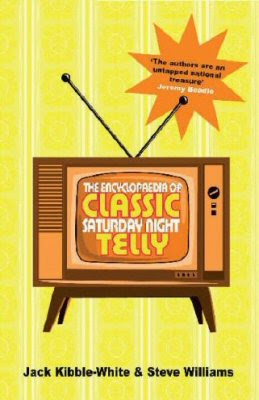

TV Saturday night television has had something of a resurgence in popularity in recent years. Some obsessives might put the reason for this down to the efforts of a certain timelord, but he’s only flying around the universe for thirteen weeks at a time, and yet there’s no doubt that it’s the one night in the week when, consistently during this past decade, throughout the year, a mass audience will still gather together in front of television and share a collective experience. Even more surprisingly, they’re watching formats which have been played and replayed in the same slots for decades in various configurations, the so-called innovations simply variations on the same themes.
As is demonstrated in this excellent book, The Encyclopedia of Classic Saturday Night Telly (whose authors Jack Kibble-White & Steve Williams I must explain write for that Off The Telly website I also frequent) Saturday night’s have always been the province of talent shows, variety shows and game shows with curious bits of drama thrown in for good measure, at least on the mainstream channels. The X Factor is really just one of a long line of opportunities for new talent back from what some called Operknockerty Tunes to New Faces and more recently Popstars* and Pop Idol. Strictly Come Dancing has its lineage burned into its title (say what you see), and all Ant & Dec have been doing is resurrecting Noel’s House Party and The Generation Game via The Wheeltappers and Shunters Club and Ultraquiz (ish).
All of these can be found in this brilliantly researched encyclopedia along with a range of other success and failures. Many of the pages in fact feature programmes which lasted just a series or two but still managed to leave a lasting impression either because they highlighted some new talent (Brian Connelly) or that longer does not necessarily mean better (Bruce Forsyth’s Big Night). The same names keep cropping up, the safe hands of Forsyth, Monkhouse, Edmunds and O’Connor appearing in a range of formats. There’s even room for those dramas beloved by some, hated by others. I rather liked both BUGS and Crime Traveller and they’re both in here with very fair entries for a change.
Amid the satirical yet critical entries you generally get a sense that like the movie industry, no one really knows anything. Hot from their success on The Big Breakfast, who would have thought that there would be anything quite so leaden as Johnny and Denise: Passport to Paradise or that Pet’s Win Prizes, at least in its first series would be quite so entertaining? That the ludicrously popular Gladiators, would knock on for eight years almost unchanged but its follow-up Ice Warriors, so similar in many ways would crash and melt? It’s almost impossible to view producers without some sympathy as their big ideas are slowly destroyed by poor production values, a bad choice of presenters or indifferent viewers.
Guiltily some of the most fun you can have with the book is seeing how many episodes your favourite and even not so favourite show racked up. In some cases the programmes which sit most clearly in the memory were only broadcast for a year. Surely Dempsey and Makepeace went on longer than that? But my favourite entry is for The Premiereship, which essentially notes that the reason the show failed was because it was a prime time show about football highlights and no matter how much you gussy it up no one but fans are going to want to watch that ...
"Whoever said money can't buy happiness simply didn't know where to go shopping." -- Bo Derek
Commerce The sales in the UK began before Christmas and as time goes by it's looking increasingly likely that what were once called the January sales will be renamed with more festive vocabulary. On the continent, however, it seems there are very strict laws as to when the sales can begin:
"ARE you glum about brashly commercial holiday seasons? Annoyed when winter sales start earlier every year? Then Charlemagne has the place for you. Pick the right European country, and no sales pitches need disrupt your festive cheer. Try France, where sales will by law begin only on January 9th. Or Belgium: not only are sales banned before January 3rd but, under “pre-sales” rules, for six weeks beforehand shops cannot announce price reductions, lest somebody jumps the gun."Which on the one hand means that it's not possible to wait until the last minute and (hopefully) buy all of your presents cheaper, but on the other, along with a range of other laws governing discounts has meant that many city centres have kept their own particular character with small shops, unlike here were they all pretty much look the same these days.
"Christmas, children, is not a date. It is a state of mind." -- Mary Ellen Chase
Life That's the worst part of Christmas over with. We took the decorations down this morning and dumped the Christmas tree on the park's recycling pile. When I was young I'd get so amusingly distraught about the process that my parents made sure it happened while I was out. But the adult version of me now understands that actually it's just one of life's processes and that if they didn't weren't removed and boxed up, there's be nothing special about the decorations going up in the first place.
This Daft Old Face
TV A couple of final links for old time's sake. Firstly:
Doctor Who: Revolutionary Or Tool Of The Man? [via]
Semi-satirical investigation into the Doctor's political leanings using statistical analysis, assuming that real world events are mirrored in the Whoniverse (the author clearly hasn't been within a dragon's breath of AHistory, either volume). Lawrence Miles addresses this very point at some length during the Interference epic in which the character is called upon to explain exactly why he's quite happy to fly about time and space knocking off abusive governments but when it comes to other regimes, particularly on Earth he's rather more circumspect.
I don't remember an answer really being forthcoming other than some deep dish anguish although my understanding has always been that if the Doctor is aware of a status quo before he gets there he can't change it without there being consequences (see Father's Day etc.) but if the situation's totally new to him he can rebel away. Which would explain why he's never specifically gone to meet a young Hitler and tried to persuade him to persevere with his painting (ala John Cusack in the film Max) or whatever. Plus it seems to have been established that Earth has a special place in the web of time, on one of the causal fault lines.
"for the New Year we transformed our coat closet into a time-traveling space ship" [via]
Which is very clever even if, as Steven Moffat would point out, the windows are the wrong size. If this was dimensionally transcendental it would be a neat way to store your entire wardrobe without having to build an extension on your house. After all, doesn't Tardis actually sound like the kind of product name IKEA would give their furniture lines? In fact most of the current real furniture names -- Pax, Hemnes, Aspelund and Mongstad -- all sound like characters from the new series.
Natalie Portman, neuroscientist
Which at first glance would seem to have nothing to do with Doctor Who (other than to say she'd make a smashing companion), except the paper that she co-wrote, "Frontal Lobe Activation during Object Permanence: Data from Near-Infrared Spectroscopy" is about looking into child's brains to find out how they work. Imagine the Fear Factor and the fear factor if in future the BBC simply recorded infant brain activity to discover how to scare the bejesus out of us...
"Quoteless."
Comics The marriage of Peter Parker and Mary Jane is no more. In a recent issue of The Amazing Spiderman, Pete made like Faustus and agreed to let Mephisto retcon his marriage out of existence in order to save Aunt May from which means that twenty year’s worth of comic book stories have been wiped from Marvel continuity including the recent reveal of his secret identity. It’s a bold move to be sure and like all of these things will probably be reversed in six months. But Marvel for now are saying that won’t be the case and this is the status quo from now onwards.
The only comics I’ve read in recent years have featured a timelord or been written by Joss Whedon so I shouldn’t be too outraged about this but really doesn’t it stink? Retcons are nothing new in comics and reformats at DC have been common enough that the writer's got in a real twist, dropping in and destroying alternate timelines left, right and centre. Marvel has tended to be more subtle and indeed have created a whole new Ultimates universe just for the purpose of wiping away continuity and starting again in a contemporary setting.
But the problem with this move is that it disrespects the emotional investment that fans have put into the characters over the years. The book’s current writer J. Michael Straczynski wasn’t too happy with the development (since it wipes out the work he’s invested in the book) and refused to rewrite the history, so Marvel’s president Joe Quesada apparently did the deed himself. Here’s some great commentary on that and all the other issues that it throws up, particularly to do with how it effects the whole Marvel universe since Spider-man is one of the linchpin characters and so his is not the only line that’s changed theoretically.
Unless they’re really smart and the life of Peter Parker is the only thing that’s been changed and everyone else still remembers what really happened. So Spidey still thinks his secret identity is intact but everyone else knows who he really is. [geek] I really suspect though that this whole thing is going to resemble the Star Trek episode Yesterday's Enterprise and everything'll be put back the way it was by the end of the year.[/geek]
"Did I regret it or do I regret it now? Not for a second." -- Gillian Anderson
Film Gillian Anderson's been keeping an irregularly updated blog for a few years. Last April she addressed the whole apparent love/hate relationship she had with co-star David Duchovny on The X-Files and what she says pretty much closes the book on it (at least for me) Oh and the new film is being shot back in Vancouver, which is where it was when the show was at its best. Can't wait.
Meanwhile, Vanity Fair go mad for the new Indiana Jones films, but I'm sure you've read that already. There are some on-line only interview with Steven and George (who's still clearly in denial about the Star Wars prequels). The Kingdom of the Crystal Skull is essentially an attempt to recreate the look, pacing and character of the first three movies which sounds like as much of an experiment in style as Todd Haynes' Far From Heaven and Steven Soderbergh's The Good German.
Meanwhile, Vanity Fair go mad for the new Indiana Jones films, but I'm sure you've read that already. There are some on-line only interview with Steven and George (who's still clearly in denial about the Star Wars prequels). The Kingdom of the Crystal Skull is essentially an attempt to recreate the look, pacing and character of the first three movies which sounds like as much of an experiment in style as Todd Haynes' Far From Heaven and Steven Soderbergh's The Good German.
"I'm flinching, now. Something bad's going to happen, I can just feel it." -- Anna Pickard
TV Anna live blogs the celebrity Big Brother hijack thing: "Jeremy's a cock. Sorry, sorry, Jeremy is a public schoolboy and a racing driver and a self-confessed arrogant, competitive young man. And I'm not allowed to call him a cock, because yes, yes, this is the children's edition and I know you're not allowed to call children things like that. Does seem a *bit* like he might be a bit of a cock when he grows up, though."
Subscribe to:
Posts (Atom)