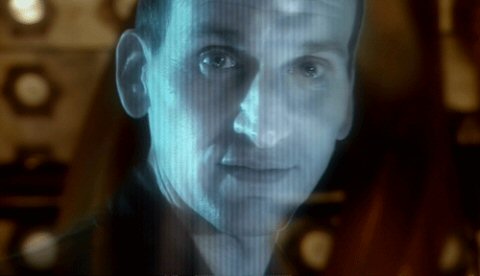
"Rabelaisian bowel movement"

TV Doctor Who Magazine journalist Benjamin Cook has a new website and he's uploaded some his best interviews and articles. Amongst the highlights are the notoriously abrasive Clive Swift interview (“I’m an actor. As soon as you switched that thing on, I’m performing. I think you’ll find that proper journalists know shorthand.”) and this suitably bonkers encounter with Tom Baker:
“The thing about being a Christian is, you’re never alone, because God is everywhere, so you have no privacy. Insane Christians, like the Roman Catholics, believe in angels as well. They walk in a special way – I won’t do it now, it might embarrass you – because they’re dying to go to the lavatory. They’re plucking up the courage, because not only is God in there, but also they’ve got a f***ing angel on their shoulder. It’s difficult to have a spontaneous, Rabelaisian bowel movement with God and an angel watching.”
Just before Doctor Who returned to television, the first official Ninth Doctor (not anymore) was an online animated incarnation with Richard E Grant (still watchable at the BBC website). Ben was there too for the recording:
Richard E Grant arrives. Jim introduces us. “Doctor Who Magazine?” Richard exclaims, as though such a thing is impossible. “A magazine? About Doctor Who?” That’ll be the one. “The show I know nothing about? I have never seen it. I know nothing about it.”

"In case you were under the impression that Richard E Grant is the new Doctor Who, rest assured, he isn’t. Not according to his agent. “He won’t even be wearing the scarf,” she insisted when we spoke on the phone. He just happens to be providing the voice, that’s all. Apparently, Richard doesn’t want to be associated too closely with the role."
It's all worth exploring and a reminder that if you watch Doctor Who, you really should be reading the official magazine.

Is this the same book?

Food Gwyneth has a new cookbook out soon. I know you're all probably rather bored with the whole thing, but:


In the US, the book is called My Father's Daughter and this nice audio interview at npr emphasises the autobiographical element of the enterprise, as she talks, for example, about how her reputation for having a macro-biotic diet, one of Alexis Petridis's comic props, came from an attempt to try and help cure her father's cancer through osmosis.


Now the UK edition, which is called Notes From My Kitchen Table.  Is this the same book?  A glance at the Amazon page suggests that sections have been rewritten and references to her father are nowhere to be seen.  But the cover art has been used to illustrate that npr thing.  They could be the same book.  I've asked Metafilter.

Clearly there's an element of marketing in all books, but I'd be interested to know from food bloggers and people in the industry if there really is that much difference between us and US, if we prefer our cookbooks with a cleaner approach which focuses on the recipes rather than human interest stories.

Which one should I buy?  No, really.

the habitat for so many memories has gone

Liverpool Life Where's this?


It's the crater where the Odeon London Road used to be. The photo was taken last Friday using my obstinate phone which renders everything in this gloomy shade of blue. Having already written a eulogy when the building closed there's little point in me saying much more. I just wanted to mark the moment when the habitat for so many memories has gone.

Elisabeth Sladen who played Sarah Jane Smith has died.


TV Well, this has thrown me for a loop. Rumour briefly then confirmed by Doctor Who Magazine. Elisabeth Sladen who played Sarah Jane Smith has died.

She was one of us. For a brief moment in the 70s, two Liverpudlians were travelling in the TARDIS and although my first memories of the series are from slightly afterwards, watching some of those adventures later was what led me to become the fan and man I am today.

Viewing Planet of the Spiders this afternoon, I was thinking how great it would be if she and Tom recorded adventures for Big Finish if the BBC agreed. Now, that can never happen.

Some episodes of The Sarah Jane Adventures have already been completed. Hopefully they'll be broadcast soon as a fitting tribute.

Liverpool Biennial 2010: Touched - the book.


Art The pavement outside the headquarters for Liverpool Biennial is an unlikely setting for an attack of the collywobbles and yet just before I stepped through the glass front in order to pick up a gratefully received review copy of Touched – the book, I had to take several deep nervous breaths. Regular readers will remember that I spent almost the whole of the 2010 festival visiting and writing about the experience on the blog and during that time I’d often wondered what was at the nucleus of all the activity.

I knew that it had to be just a plain, simple administrative office, yet it felt like I was crossing a cultural line of demarcation, revealing something which we’re not meant to see in case it punctures the enigmatic façade which is constructed in the years between the festival bursting out across the city’s venues, exciting and confounding the population. I needn’t have worried; because this is a plain, simple administrative office the enigma was retained.

The book (available online here) is similarly enigmatic, largely ignoring, give or take an interview, the creation of the festival and detailing too strongly the curatorial aims in favour of photographically recording the artwork and essays based on the series of Touched Talks held before and during the festival. If the Biennial catalogue was the introduction to an experiment outlining the aims and research methods, this explains the results and suggests areas for further study.

Like the visual arts section of the festival, the Touched Talks transcribed here are a heady mix of the accessible and the impenetrable. A Philosophy of Fidgets wouldn’t be out of place filling the interval of a live concert on Radio 3, as Steven Connor investigates in minute detail the various forms of fidgeting from hair twirling to doodling, with literary allusions when necessary. I’m an inveterate fidgeter participating in most of the displacement activities described.

Coco Fusco’s Defiant Abjection is a useful investigation into the growing protest movement in Cuba, a country which the writer correctly indicated tends to be viewed through an anglophile prism based on its relationship with the US. Bloggers have been branded cyberterrorists and it’s a much needed reminder that for all free health care and the political reforms announced by the other Catro brother in the past few days, it remains a dictatorship in which free expression is quelled.

Ziauddin Sarder suggests (I think) in his essay on art and religion in the twenty-first century that both are part of an eco-system of intellectual thought and that to marginalize either at the expense of the other, through the encroaching element of modernity in society, “limits our critical faculties”. He’s fighting against plurality of thought; if everyone had the same opinion we’d have nothing to argue about. The problem is, of course, when that argument descends into violence.

When you buy the book, my advice is to approach these essays in much the same way as you probably approached the festival, in short bursts, then consume, then contemplate. They perfectly capture the spirit of the Biennial and the hours I spent with them took me straight back to the golden days of exploring the venues never quite sure what I’d find behind the next corner, at the top of the next set of stairs. I wish now that sometimes the artworks also included as many useful footnotes.

Between the Touched Talks, photographer Mishka Henner has been asked, as Paul Domela explains in his introduction, “to focus on the responses of visitors the exhibition and give us glimpses of how art touched the city”. These are usually faces locked in concentration either on the artwork or their mobile phone photographing the artwork, human and digital memory capturing the installations and paintings for later recall which is apt considering the aims of the book.

Humanity still sneaks into the exhibition section which inhabits the larger proportion of the pagination usually in the public realm or to demonstrate the reaction to interactive elements. The experience of flicking through these photographs by Thierry Bal is rather like finding holiday photos from a distant holiday, a flood of memories with each turn of the page and because many have been taken at night there’s also a sense of still being an interloper into private moments.

The Biennial space at Rapid Hardware no longer exists in actuality and yet here it’s remembered and to some extent mourned now that it’s becoming integrated into the usual mass of urban renewal, a Sainsbury’s opening were once stood a garden shed containing a rather good café and shop. The A Foundation has also sadly gone now too of course, but if we close our eyes we can probably still hear the sound of scissors cutting which resonated between its echoing walls.

Even after visiting and writing about the experience on the blog for all of those weeks, I never did quite feel as though I’d completely taken advantage of everything that was on offer having missed most of the talks, and though they’re available on the Biennial website, these transcripts have allowed me to give them due attention with photographs which perfectly capture everything else. Touched – the book is a much needed full stop on the Liverpool Biennial 2010 experience.

Touched - the book is published by Liverpool Biennial of Contemporary Art.£22.50. ISBN: 978-0-9536761-9-4. Review copy supplied.

Presumably singing.

Radio Easily missable in the hinterland that is the back of the Radio Times is news of Easter Sunday's Drama on Radio 3:
Kafka the Musical
Sunday, 20:00 on BBC Radio 3


Murray Gold's new play starts from the suitably Kafkaesque premise that Franz Kafka finds he has to play himself in a musical about his own life. The play - or is it the musical? - introduces Kafka and the audience to some of the key characters in his life, Milena Jesenska, Dora Diamant and Felice Bauer.
Starring Mr. David Tennant as Mr. Franz Kafka.  Presumably singing. Which is you'll agree very exciting.  Except, what's this?
United
Sunday, 21:00 on BBC Two

Drama based on the true story of Manchester United's legendary Busby Babes, the youngest side ever to win the Football League, and the 1958 Munich air crash that claimed eight of their number. The film draws on first-hand interviews with the survivors and their families to tell the inspirational story of a team and community overcoming terrible tragedy.
Starring Mr. David Tennant as Mr. Jimmy Murphy. Written by Chris Chibnall. Directed by James Strong.

This is one of those occasions when the people who schedule the television need to talk to the people who schedule the radio so that the people who have the single tuner Freeview+ box don't have to make impossible decisions about which channel to record.  Kafka the Musical it is then ...

The final episode of the first series, The Parting of the Ways

TV The final episode of the first series, The Parting of the Ways and the final reposted review, well not so much a review but aptly as you'll read, something akin to religious fervour, a kind of affirmation of belief.  It's been quite poigniant for me to re-read this old reviews written whilst I was still working at Liverpool Direct and waiting to see if my application for university at Manchester had been accepted.  For all that learnin' my style hasn't changed that much, it's still a bit rangy, raggedy and unsctructured but I think I captured the essence of the story.  The subheadings are my typical stand-bye when it's eleven o'clock on a Saturday night and I've spent the past three hours just writing stuff.  I still do that sometimes.

Torchwood hadn't yet been announced so I assume Jack will be back for Season Two of the main series.  I'm also still bitter that the regeneration wasn't a proper surprise thanks to tabloid whose whole existence seems to be to spoil it for everyone.  The BBC Press Office is older and wiser now too.  It's been explained to us in the meantime that Eccleston didn't quit Doctor Who -- he only ever signed for a single series as a favour to Russell T Davies.  He did have second thoughts late into the shoot but it was too late.  David Tennant relates the rest in his Desert Island Discs episode, how he was asked about taking over before the series had even been broadcast, after watching a preview of an episode and how it wasn't something he could ever turn down.  Good for him.


"The fans are going to hate this ..."

I've said this a few times during the series and and I said it again tonight. It's an odd thing to say since it suggests I'm not a fan, but I really am. I have two shelving units filled with videos, dvds, cds and books graphically demonstrating this. But what I think it means is the hardcores. The ones who consider themselves the self appointed rulers of what's right and wrong in the series. Those who decried the brilliantly romantic moment at the end of the TV movie, the loss of the half hour episodic format, the casting of Billie Piper. What Russell T Davies has done throughout this series is largely and cleverly ignored what they think. To play to them would be to return to the series we were stuck with during the mid-Eighties when continuity was slowly throttling good story telling. Tonight's episode exemplified the Davies approach. Produced something which plays to the fans but also creates new fans. Tosses out the continuity without disregarding it.

But he also did something else. He gave it heart. I was always afraid that if you threw money at the premise it wouldn't work, that it wouldn't be the same. Thank god I was so wrong, and so right. The Parting of the Ways looked like a feature film, told an big epic global, galactic story but at its heart were themes of people, loyalty, morality and lord help us, religion. It didn't dump the essential elements while it was throwing thousands of Daleks at the screen. Davies did everything you'd want in the final episode (and in fact followed a clear model set down by new genre pioneer Joss Whedon). Produce it like it's your last, throw everything at it, but importantly underpin and underline the architypes of the series and underscore everything you've been trying to accomplish. Rose saves the world in the end, because that's what she's been doing all series, and yet The Doctor is still the saviour of the universe because he inspires it of her, just as he inspired everyone from Gwyneth to Cathica. Through selflessness in words and actions. The Doctor of old had the arrogance that no one but he could win the day - this Doctor believed that everyone had that capacity. It was just a case of giving them enough room to breath and showing them the way.

"Oh my god, they've killed off Jack ..."

Like the rest of the series this just kept hitting me at a gut level. Scene after scene mattered, contributing to the arc of the series, the plot of the episode, the story of the character. We found out what the Bad Wolf was (a time paradox and red herring rolled into one) and we saw The Doctor finally put his personal demons to rest. We got to see one of the best man vs. Dalek battles in the show's history and saw why they are the deadliest of foes. Taking the ideas of the Dalek episode -- the giving of an ounce of humanity to the pepperpot -- and then twisting it and darkening it. Not just loathing the universe but also loathing themselves. The design of Emperor Dalek was a great choice too, as this God created its race in its own image. We saw also that in fact it's not just The Doctor who had regenerated, Rose had too -- complete with that mess of amnesia afterwards -- she's seen too much to go back to her old life now.

But for all the writing (and this may have been Davies' best script of the series) I don't think the acting has ever been this good. In the Confidential documentary afterwards, Eccleston said that he couldn't internalise the character, that we were effectively seeing on screen was his reaction to the words and how they should be played -- it showed and it was exactly what the part called for, which sort of demonstrates what a great actor he is. Despite his epic lifespan, The Doctor has always been about how others see him and that's exactly how he appeared tonight. Is Rose Tyler the best companion we've had? It depends on your definition. But I tell you -- I don't know who else was up for the role but I can't imagine anyone else playing her. Billie Piper has simply been a dream throughout the series, funny and sad and tragic. And knowing. It's also to John Barrowman's credit that he's not felt like an interloper, although Captain Jack's been a good character -- it'll be interesting to see in Season Two if he feels discruntled about being left behinds and drifts off into his old ways.

I've written before about how it's difficult with some television to see the gaps between the director, the cameraman and the editor. It's a collaborative medium. Would this episode look and feel much different if James Hawes instead of Joe Ahearne had been the director? I don't think I'm clever enough to tell. What I will say is this. Of all the episodes this was the one which felt most consistently paced, visceral and deeply emotional. Characters seemed less like a bunch of words (cf, Aliens of London) and more like people. And again we saw the same values here as we'd seen throughout most of the series -- straight down the line drama and comedy without decending into camp. It believed in what it was doing and so we believed in it too.

"But ... he's regenerating. No. Noooo .... What! What! Hang on -- who's he going to be? Are we going to get to see it or is that the cliffhanger? We are going to see who it is ... fuck me, it's David Tennant ... Casanova's in the Tardis ..."


One of these days I'm going to build a time machine. Granted I took the arts stream at school so I did Fine Art GCSE when I could have been doing Physics, but hopefully I've got a good sixty years left on the planet so that should be just enough time to go back to school, do Physics and Chemistry and Biology as well, head off through A-Levels, get myself a degree in Quantum Physics, a PHd, a place in a great research institute, a team of mechanics and a billionare I can convince to finance a development project to build the first time machine. At the age of fifty (because I'm in this for the long game) I'm going to strap myself into that extraordinary machine, flip the switch and head back in time back to this year. I'm going to get a job in the press office of the BBC and make sure I'm on duty one night in early April, so that when I see that a tabloid is going to print a story saying that Christoper Eccleston is going to quit Doctor Who, the last thing we do is confirm the bloody story. That way, this younger version of me can be shouting the words above at the screen as the latest series comes to a close instead of wondering what the experience would have been like.

"I'm still buzzing..."

The fact that it's hours since the episode aired and I'm still buzzing shows the achievement of the piece. I'm a cynical sausage really, but this is something else. This is about piling all your hopes and dreams into something and for once it actually works. You don't have to be making allowances and rationalisations because something just isn't as good as you were expecting. Refreshingly I can actually say that this is a show I'm proud to be a fan of and have all this history with. That I haven't been wasting my time as I saw it grow to fulfil its ultimate potential. And it's not over yet -- we'll still be watching this into 2007. I've said this once before and I think I'll say it again.

"He's back. He's bloody back. Bless him ..."

"mere peace-keeping force"

TV TrekMovie has extracts from Bryan Singer's pitch document for his revival of Star Trek as a tv series in 2006. It's a continuation rather than a reboot, plunging the Federation into a rather bleak future:
"Earth’s Humans have become "fat and happy" but this has led to complacency where humans are "giving up exploration for incremental colonization and focusing more on the rightness of their own cultural view over all others"  Many younger members of the UFP have left, eschewing this "human-centric" Federation.

[...]

Starfleet has been reduced to a "mere peace-keeping force" protecting fringe worlds from aliens and from fighting each other, with starships that are old and spread out too thin."
The idea was to more specifically reference a latter day Roman Empire in a series which follows the new storytelling structures of nu-BSG and The West Wing. There are a few good ideas; one of the characters is called The 76th Distillation of Blue which has nu-Who written all over it and the ship's sentient computer is named M.A.J.E.L. which is a nice kiss to the past.

Mostly it's a horrible attempt at turning Star Trek into something it's not.  The portrayal of religious belief is heavy handed and the initial storylines lost me at "the obelisk". Star Trek's had its fair share of Big Dumb Objects in its time but in the best stories they've always been a mcguffin. In this version they are the story.  Luckily, it didn't reach the point of being looked at by anyone with the powers of decision making.

scoffed at the gameshows when Bad Wolf was broadcast


Oh how some of us scoffed at the gameshows when Bad Wolf was broadcast in 2005. There’s no way Big Brother and The Weakest Link would exist in the year 20,100 let alone next year! In five years isn’t all going to look horrendously twee and anachronistic? Well, we were wrong. Despite having offered what looked like a definitive full stop last year, Big Brother’s been signed by Channel Five for another spirit crushing few rounds of celebs and norms and the daily ritual of the AnnDroid insulting peroxides continues unabated every evening at 5:15. Only Trinny and Suzanna have been relegated to the satirising themselves on the web, though the thrust of their work has arguably migrated the Gok Wan, which probably wouldn’t matter one jot to Captain Jack. How did this happen? Perhaps it’s a reverse of the Blade Runner curse and having appeared on Doctor Who, the shows will now just run and run, the affectionate observations about each, still funny now, looking increasingly as hollow as the joke about Daleks not being able to go upstairs. Eventually one of Anne Robinson’s grandchildren will take over and within fifty years a rudimentary AnnDroid. On Big Brother channels will proliferate filled with live streams of rival households. Make over shows won’t just create a new look, they’ll create very new look, new face, new body, new gender, new surrealism. As a small group of academics huddle together on a desert island somewhere desperately maintaining storage of their collection of classical music, paintings and literature as the resource crisis hits, the rest of humanity will roughly split between those making television and those appearing on television, all fed intravenously lest the need to mingle some spices for a curry or source some produce to create the perfect pastry ignites their intellectual curiosity. And so it continues for millennia until the literal island of culture has fallen into the sea and the works of Shakespeare, Gormley and Dylan are lost to the oily waves which doesn’t matter because by then humanity has lost the capacity to properly construct anything leaving all of that complicated stuff to the machines, wondering instead if Brandon 45k will floup off with Marla 3 in Big Brother 234,000 and so the real world will reach parity with the dystopian horror presented in Bad Wolf. About the only thing we’d find worth watching will be Doctor Who itself, but even that’s gone off with a new incarnation who professes to be half clone on his uncle’s side and wears a toupee to cover up his bald patch, the stories themselves reaching their formulaic zenith as the Doctor once again travelling into a past when there were only a couple of hundred simultaneous Big Brothers to fight the Master who once again has a plan to disrupt the gameplay. So watchable in the very loosest of senses. If you think this is a very long paragraph, what you’re really seeing is my paranoia writ large, partly developing from the fact Doctor Who’s next opening episode has been shunting back once again to make way for a dancing programme but mostly from the recently announced arts cuts. About the only scintilla of hope we have is that Doctor Who’s still on at all and we’re able to look back affectionate nu-Who’s early beginnings. Russell’s ability to create sympathetic characters from just a few lines is illustrated throughout. Lynda with a Y might well be a walking contrast for how far Rose has developed, but she’s also a loveable character in her own right (Jo Joyner's sweet indeed), and it’s simply heartbreaking when she flat out asks the Doctor if he’ll take her with him and he promises to get her out alive because we know from experience that neither of those will be allowed to happen. But Martha Cope as the controller offers one of my favourite performance of the first year, communicating the desperation of having spent her whole life covered in USB plugs, her sense of self relegated to the infrequent sun spots and a rare occasion when extermination offers a blessed relief from life. That’s closely followed by the best cliffhanger of the series, simply because it’s not really a cliffhanger, it’s an ultimatum and a moment when the audience for once takes the Dalek’s POV as we watch Eccleston give the line that makes all of the Big Brother references worthwhile. How giddy must Davina McCall have been to see the Doctor says “Rose, I’m coming to get you …”

Updated 23/4/2011 Anne Robinson becomes the saviour of humanity and quits The Weakest Link. Kroll be praised.

Boomtown seemed like the nil plus ultra of filler episodes


TV “Filler” is often used disparagingly to describe those episodes in television series that bridge the gap between instalments that develop an arc story or offer major character development, episodes which the general viewer should be able to skip without missing anything important or at least anything which can’t easily be explained with a couple of lines of dialogue later. The very idea of "filler" is so feared that one of the reasons Steven Moffat gave for splitting up series six was that it would mean there’d be less “filler” more event episodes.

Once upon a time, Boomtown seemed like the nil plus ultra of filler episodes, interesting for all the moral discussions over the dinner table and tourist board massaging Cardiff scenery but not of great social import, especially when the next episode was reported to be the question answering Bad Wolf (weren't we naive). Russell T Davies even revealed in Doctor Who Magazine that it was a rush job, literally filling in a gap left by a cancelled early Pompeii episode and a Paul Abbot story revealing that Rose was originally constructed by the Doctor to be his perfect companion. Or something.

Yet Boomtown is different. Boomtown has become one of the franchises most important episodes the effects of which are still being dealt with. It’s a filler episode which has retrospectively, at least in franchise terms, became an instalment that develops an arc story or offers major character development. There’s at least one of these per series, I think, though as the “arc” stories have developed, increased in density, you could argue that there aren’t any real filler episodes, that Moffat needs to be more confident in his work.

It’s the episode in which Noel Clarke has a much better idea of how Mickey should be played, bewildered and love sick, if a bit inconsistent. It is a bit rich that having refused to travel with the Doctor, he’s pretending that Rose ran off and left him, but speaking as someone who’s been there, he perfectly captures the mixed emotions of being excited for a friend who’s been enjoying exciting adventures that you’ll never have. When he steps off into the night at the close of the episodes, he’s beginning the long road to The End of Time and a Mickey seeking his own excitement.

It's an episode that for the first time directly references one of the accompanying spin-off novels. When Rose says Justicia, as well as demonstrating how its supposed to be pronounced, she's also plunging the new series directly into the canonicity debate as she's clearly remembering the events of The Monster Inside, parts of which would also later be referenced in The Sarah Jane Adventures. In one of his columns for Doctor Who Magazine, Russell T Davies suggested their were BBC charter rules against this sort of thing, but obviously there's an exception for cheap tricks.

It's an episode that for the first time were for the fisrt time the Doctor and Rose consciously notice the appearance of the words Bad Wolf. Their dismissal is delicious, but I've never quite understood why Rose needs the Welsh translating. Should the TARDIS circuits be doing that for her, and in the conventions of the series, us as well? Shouldn't every bilingual sign in Wales have the same words written twice in English, from the notice board in the station to the banner on the wall of the town hall? Rwy'n gwybod pigo, pigo, pigo ...

But it’s also the episode which led to the first series of Torchwood. Not a secret pilot by any means, the T word wouldn’t be first used until Bad Wolf (an answer during The Weakest Link), but there are still loads of parallels, not least in structure. Like plenty of Torchwood episodes, Boomtown opens with the introduction of the visiting alien (Margaret) or technology (the extrapolator) or in this case both and after an initial burst of excitement the episode becomes a slow burn investigation into the ethical consequences before the alien or technology bites back for an exciting climax.

It’s impossible to watch Boomtown now without thinking about the Torchwood base beneath the floor, of Captain Jack and co keeping shtum inside lest damage be done to the timeline. No wonder the later Jack is grumpy, seeing his tiggerish younger version and the Doctor he’s waiting for at too early a moment. I always imagine the five of them emerging to the cracked decking and explosions with Suzie, Tosh and Owen not entirely sure why their leader trapped them in the cells while the rift opened and creating a major catastrophe. With Gwen and Andy elsewhere directing traffic.

Which isn’t to say it’s a great episode by any means. Like plenty of those early Torchwood’s the final jeopardy happens because of the avarice and stupidity of the main character, in this case the rush to employ some dodgy technology to speed up a process that would work just fine with a little bit of patience, the destruction of the world nearly brought about because the TARDIS team want to shave a few hours from the charging process. At the very least, the people of Cardiff are going to have to foot the bill for the clean up, their council tax skyrocketing during a credit crunch.

The resolution is opportunistic too. As Neil from Behind The Sofa argued back in the day, it’s about as convincing as the renewal nonsense at the climax of the TV movie which as he rightly predicted was used for much the same purpose at the close of the first series. It’s a cheat so that we don’t see Margaret being led to her execution which is odd since Jackie and Mickey have already slaughtered one of her kind this series, the latter still probably trying to clean the oily entrails from his jeans. Boomtown is influential then, but not always for the right reasons.

that appears in The Doctor Dances


TV But then, Doctor Who hasn’t really ever had a character like John Barrowman’s Captain Jack Harkness either, at least on television. Freelancers like Glitz and Lytton perhaps, but neither of them burned quite as brightly as Jack or were played by actors who inhabited their character to such a degree that it’s impossible to see were the joins are. Guest judging on So You Think You Can Dance last week, Barrowman’s comments were so constructive he not only made a contestant cry, John Lythgoe and Arlene Philips looked reasonable by comparison, the latter on stage within seconds theatrically giving the broken dancer a hug. The darkness of the later Harkness burned behind John’s eyes that night.

The younger, mortal version of the Captain that appears in The Doctor Dances is already a morally ambiguous figure; a self professed con artist, it’s his carelessness that leads to the whole sorry business and as we discover later he’s even stolen his identity from a dead pilot. He’s raffish and charming and the Doctor makes him a better person, but ultimately he was always going to relapse, become the kind of figure who could sacrifice some children to alien invaders or whatever other nastiness. Yes, the Doctor makes him a better person, but the Doctor isn’t always there keeping him check and is later, once the Captain’s been immortalised, scared of him a little bit. That’s one of conversations missing from Journey’s End, “So Rose, about that time you made me immortal …”

Imagine if the Doctor knew that just before the events of The Doctor Dances, assuming we follow the assumption that there’s a predestination element to time in the Whoniverse and it isn’t just some unfolding text, there were four version of the Captain on the planet at the same time. This one. The Harkness reliving the twentieth century thanks to a dodgy time ring and working for Torchwood. The Harkness who accidentally travelled back in time during the Torchwood episode Captain Jack Harkness and the one biding his time in the vaults of Torchwood Cardiff having been knocking around for a millennia. Never mind volcano day, it's a Sellafield of omni-sexual energy. He’s almost on a par with the Doctor for ramshackle character development and that’s even without the Boe thing.

Or those troubling two years stolen by the time agency. On the dvd commentary, Moffat says he add it in “just for the hell of it”, Davies telling him that he’ll get to it later. Steven chides him for forgetting and we’re still waiting. Perhaps the next Torchwood will have some answers but I doubt it. As Bad Wolf ultimately demonstrates, Russell’s the kind of writer who makes things up as he goes along, whereas Steven’s massive brain is layering in material which seems innocuous at first glance, or a continuity error, but then becomes massively important. We might speculate after the fact that when the Face of Boe offers You Are Not Alone, he’s hazily remembering his time with the Doctor fighting the Master. But we don’t know.

In other words, we’re left to speculate after the fact, attempting to make the stories work. In Moffat’s era, our speculation is an attempt to work out what our leader is thinking. At this point, I’m convinced there are two narratives running side by side in his era and that what we’re seeing is only half the story. At some point we’ll be able to sit and watch the River Song episodes in order from her point of view and a whole different story will emerge. The new enemy is called The Silence. The first episode River appeared in is called The Silence in the Library. This cannot be a coincidence. Or it might. I don’t know. No spoilers please.

Perhaps I’m being unfair about Russell’s planning abilities. Certainly he had clear idea of the arc of this particular Doctor, the emotional peaks and troughs, the despair of Dalek to the elation in the climax of The Doctor Dances. Like Father’s Day, it’s a hankie moment and one of the rare occasions in this first series when a beat is happening completely from the Doctor’s point of view. My suspicion has always been that when the Doctor says, “Just this once, Rose, everybody lives” he’s also talking to us fans (Moffat taking advantage of the companion as audience viewpoint character trope) and all the times we’ve reached the end of story were the timelord has succeeded but has a mass of corpses at his feet.

And there’s one of the best exchanges the franchise has ever produced for some secondary characters. Beautifully played by Richard Wilson and Vilma Hollingbery it’s right up there with anything Robert Holmes and Douglas Adams produced in their prime:
An old lady - Mrs Harcourt - hobbles towards Constantine.
MRS HARCOURT
Doctor Constantine.

DR CONSTANTINE
Mrs Harcourt - how much better you are looking!

MRS HARCOURT
(bewildered)
My leg's grown back! When I come to the hospital, I had ONE leg.

DR CONSTANTINE
(observing this)
Well - there is a war on. Is it possible you miscounted?
Marvellous.

“A mouse in front of a lion”


TV It’s probably quite difficult for those of us already in thrall to the spin-off fictions, to Edwardian Adventuresses and amnesiac Doctors living through a century of Earth’s history, to really appreciate how much of a departure an episode like The Empty Child must have been to an audience with memories of the earlier series, especially if they departed not long after The Twin Dilemma broadcast. The show had often steeped itself in period detail, albeit on a tight budget, but for all the alien technology, this is indistinguishable from the so-called more mainstream drama and with only slightly different content could happily exist in a nine o’clock slot on BBC Four.

But even for those of us who know our Faction Paradox from our divergent universe, Moffat brings something fresh to the series and by the end of this first episode I knew two things: (a) that he was clearly so busy with other things that we should enjoy this single story he’s giving to us while we can and (2) it’s so good that it falls into the category of story that is near impossible to review because there’s nothing to be funny about. Which was rather the pattern that weaved through all of the later Moffat episodes. Imagine my mix of elation and fear when we discovered that he turning down Spielberg and more Tin Tin so that he could to produce his favourite series.

I’ve heard The Empty Child is still being used in some schools to help teach kids about conditions during the blitz. When I was at juniors, we enjoyed ITV's How We Used To Live, which shows somewhat how Doctor Who has moved on because I can’t believe Mark of the Rani educated anyone much about the industrial revolution. There’s something especially nu-Who, which prides itself on providing a twist on expected formulas, about Moffat focusing not on the evacuees, but the experiences of the kids left behind or who returned because it was probably safer to risk being hit by a bomb than exist in the home they’d been sent to.

With the best will in the world and accepting the work of Ian Briggs and Ben Aaronovitch in the very later years, children were an overlooked "group" in the first thirty. For a show with a family audience the Cbeebies to BBC Three demographic made only infrequent appearances, generally as extras (cf, the Kinda) or annoyances (cf, The Twin Dillema). Across the years fairly stringent character types developed, scientists, army men, industrial workers, henchmen but very rarely young citizens simply getting by with what they have, never homeless and certainly not on screen for long enough not to be killed.

The Confidential which was broadcast after this episode went some way to demonstrating why that was the case with kids only allowed a limited time in front of the camera and difficult to direct in groups - so not ideal for the old rehearse/record production methods. Yet it’s not until we see so many of them crowded around that table (“Good eer init?”) that we notice what a huge omission they were. The only time even schools seemed to feature was in order to introduce companions of ambiguous ages played by older actors (Coal Hill from An Unearthly Child and Brendon in Mawdryn Undead) almost as though Who wanted to distinguish itself from Grange Hill (which is odd considered the many appearances from Michael Sheard).

"All" they would have needed was a figure like Florence Hoath’s Nancy, someone for the Doctor to communicate directly with rather than having to deal with the group dynamic. She's a figure head slash matriarch for these non-evacuees, a civilising influence, the kids keen to accept the parental order that she brings or at the very least her keen ability to sniff out a decent roast. But the faceting of Moffat’s writing doesn’t allow for her to simply doing it out of the goodness of her heart as a two dimensional character might; she’s fulfilling a psychological need in herself to fill the vacuum left by as we later discover her son. On second viewing can also we see how expertly Hoath is playing parental grief from the start.

The Doctor’s attitude to Nancy is important too. He doesn’t patronise her and perhaps even sees within her a kindred spirit having experienced such a loss too. When he talks about this “tiny, damp little island” saying no to Hitler, “A mouse in front of a lion” he could equally be talking about himself on oh so many other desperate situations, presumably even the one he’s just lived through, in which as we discover much later he wasn’t only fighting the Daleks but his own people as well. Sometimes Eccleston looks as though he’s glossing a bit, still getting a feel for the character. This isn’t one of those occasions.

[To be continued.]

"a love letter"

Film Woosh. Woody's already casting his next film which continuing his European grand tour is set in Rome. Penelope Cruz, Alec Baldwin, Ellen Page and Jesse Eisenberg. Well of course they are. Says Woody
"I love these sophisticated and civilized metropolises. Each time it's been like writing a love letter to these places and projecting my feelings for them on the screen. I hope to be able to do the same with Rome."
Berlin next? Prague? Reykjavik?

this revisit to Father’s Day


TV Sob. I’d expected to begin this revisit to Father’s Day with a thesis on the use of time travel in the episode, and that will come later, but it’s important first to remind ourselves of just how emotional the episode is, Paul Cornell’s tender writing spilling poignancy, heartbreak and tragedy across every minute. One of the key components of the spin-off fictions during the show’s television production break was the development of a much stronger emphasis on character over plot and how a companion's domesticity reflected on their time with the Doctor and even the Doctor's own past motivating his choices of destination.

When it came to writing this first season, Russell T Davies specifically asked his writers to create stories which tapped into the work they’d already been doing in the franchise which led Paul Cornell to produce an episode with a strong vibe of this spin-off trend in which the Doctor and especially Rose are the cause of the action, and in this case put us directly in the path of an emotional morris minor. We can absolutely understand why Rose couldn’t stand by and watch her daddy be run over but also, and this is a paradox as strong as any in the episode, take the Doctor’s view that she’s just another stupid ape for not considering the consequences.

Sob again. But what I’ve not noticed until this evening is how Cornell cunning shifts the timelord/companion relationship backwards in time slightly from making the Doctor a kind of love interest to the more traditional role of father figure. Which means that at the opening of the episode in saving, Pete, her own father, Rose loses her adopted father or at least his respect for her and despite their brief reconciliation the only way the proper order in her life can be repaired is if Pete sacrifices himself again. There’s a subliminal undercurrent, beneath this church under seige about Rose trying to regain the approval of her adopted father.

Blub. The scene which always hits me front and centre or at least was the beginning of the first wave tonight is when Stuart and Bev ask the Doctor if he can save them. Such incidents would become the hallmark of the Tenth Doctor’s era, and indeed an extended version appears on the bus during Planet of the Dead (“Chops and gravy”) but there’s something especially vivid yet absolutely mundane in series terms about how the couple first met, sharing a taxi home. Television, even in soap opera is inherently all about romances sparked through grand gestures, yet this is an experience we can all relate to.

Film director Richard Linklater (Slacker, Before Sunset) said once that he’s always tried to appreciate even small moments like a visit to the shop as being as important as perhaps those that could be considered life changing because there are more of the former than the latter and if we always seek the latter we’ll never be satisfied. Although there’s an element of “a pessimist is never disappointed” (cf, the audience), it pitches the Doctor as the exact opposite. If someone spends their life enjoying marvellous exciting adventures in marvellous exciting places with marvellous exciting people, they probably spend their life seeking small moments like a visit to the shop or sharing a taxi home.

We’re back to the role of the companion again, of course and their vicarious importance to the Doctor (“I can smell chips. I want chips…”) which I’ve already covered when talking about the non-deleted scenes from the fifth season box set. But you could speculate that one of the reasons the Doctor’s miffed with the Rose in this episode isn’t just that she destroyed the world, but that she broke out of her role of being his touchstone with the normal. But you could question why the Doctor so gleefully agrees to take her to such a sensitive point in time anyway. Was it perversely so that he could draw from her grief so that he didn’t feel quite so alone after destroying his own kind?

The wikipedia page for the episode ties itself in knots attempting to justify why the portrayal of this kind of reverse grandfather paradox and more specifically the appearance of the reapers contradicts similar time changing events seen before and later in the series. Despite being the one of the people who tweeted Blinovitch’s name in the aftermath of A Christmas Carol, I’ve never found Father’s Day that troubling because Cornell layers into the Doctor’s dialogue enough side notes to suggest this situation is simply different.

When Rose saves her Dad, the original version of her and the Doctor are obliterated from history, and since her action was as a result of her inaction the first time around, both she and the Doctor and the TARDIS became inexplicable, paradoxical occurrences. It’s that which makes this a sensitive point in history, why the Reapers appear to fix the wound, this already a paradox within a paradox. It’s also presumably why the TARDIS lost its extra-reality capabilities though it doesn’t explain the problems in audio and Mike Skinner making his first cameo in the series, though as we saw in The Big Bang, when the web of time is damaged, there also bits left over.

Plus and this looks backwards towards Aliens of London, as Philip Sandifer noted on his blog when reviewing Simon Guerrier's novel The Time Travellers (blog via Neil) each and every time the Doctor opens the doors of his TARDIS, he changes history and in doing so it means that the next time he lands its in a new and different version of the universe. Even after Pete introduces the concept of benevolent suicide to any kids watching, when the TARDIS team leave at the close of the episode, Rose has in fact got her original wish, her father doesn’t die alone. History has been changed, again, just in a more subtle, meaningful way and probably in a more subtle, meaningful way than usual.

“Bless The Long Game.”


TV In his exit interview for Doctor Who Magazine, Russell T Davies when asked about those episodes that didn’t quite work out said “Bless The Long Game”. Its always been considered something of a runt in the litter of the first season. Too traditional for some, too at variance from proper Doctor Who for others, it’s not the episode I’ve been particularly looking forward to viewing again despite the opportunity to see Anna Maxwell Martin dressed in combat fatigues long before she became the face of period drama at the BBC.

Detailed general production information was still fairly thin on the ground when the episode was originally broadcast. There wasn’t much talk of the need for “double banking” style episodes with minimal participation from the timelord or his plus one or both. So one of the main focuses for criticism was the basically minimal participation for the Doctor and Rose, who effectively, save for a visit to the information room thingy, hang around outside a diner for the first half of the episode then visit the top floor to face down the villain then letting someone else save the day.

Now of course we understand, that because of the horrid work schedule in Cardiff, some episodes are shot simultaneously. In later seasons, the production team took the opportunity to try something a bit special, leading to Love & Monsters, Midnight, Turn Left and of course the Blink, which ironically then went on to voted the second best episode ever in the most recent Doctor Who Magazine poll. Now that we’ve accepted that, we can see that though The Long Game is no classic, as an episode fulfilling a difficult brief, it’s perfectly acceptable piece of entertainment.

For a start, along with Maxell Martin it features a stonkly strong, eclectic cast what with Simon Pegg camping about as the albino controller, Christine Adams who subsequently went to America and became the guest artist de jure notably as Simone Hundin, Emerson’s love interest in Pushing Daisies and oddly, and it really is oddly considering the size of the role, Tamsin Grieg whose benign massage of Adam's ego and everlasting credit is my favourite of the episode, particularly her reaction to the frozen sick (which has a piece of carrot in it – nice touch prop pickers).

Russell at least uses the opportunity to demonstrate to new audiences why the Doctor is careful when choosing his companions (slightly undermined by the next episode Father’s Day but nonetheless), showing us what happens when an opportunist travels in the TARDIS rather than someone essentially benevolent in spirit. He very deliberately intercuts between Adam’s investigation of the station for his own ends and Rose helping the Doctor without a thought for herself or her own safety, the former asking what the future can do for him, the latter doing what she can for the future.

The episode is also a strong allegory for what happens when information stops being democratic, from multiple sources and when people stop questioning the veracity of it. This is the kind of top down conglomerated news control is slowly sapping plurality of thought and as we can already see in large parts of the world, having a drastic effect on our welfare simply because a subset of people don’t realise that they’re being controlled to the point that they think they still have free will even though they really don’t (not naming any particular beverage related movements).

Plus it’s a (not very much any more) secret prequel to the closing finale, with the piqûre dans le conte that despite stopping Max (phew) the course of history still isn’t repaired and in some respects the Doctor's made matters worse. It’s probably worth it for that nuanced moment from Eccleston in Bad Wolf when his character realises the consequences of his actions, something which I don’t think we received later when Tenth stopped the new Golden Age by stuffing up Harriet Jones’s historic premiership leaving room for the Master to tuck himself in (and later tuck into a turkey).

Yet The Long Game isn’t a winner. I used to think it was because of Brian Grant’s direction, but on review he captures nicely the bustle of the space outside the café with verite style shot choices, there are some rather good establishing shots and the moment when the Doctor persuades Cathica to save the day via the reflection is gorgeous. Perhaps it's simply because the rote predictability which is a feature of so much Doctor Who, but usually well hidden beneath the moments of charm and short skirts is too close to the surface in an episode pinioned around trying to get a lift to work. Bless it.

Ten pounds extra

Life Another Monday, another replacement piece of technology. The LG BD350 I won in that competition last year gave up the ghost last night, wouldn't you know just outside the warranty period, refusing to play most blu-rays at all, and dvds only with a kind of weird juddering sound from the player and in the picture.

It's not been the best player I've ever owned, weird and plasticy and unreliable even after accepting firmware updates so now it's in silicon heaven. Nevertheless there was a certain poigniancy as I scrapped it, remembering the excitement of the day we first met. Or rather met the original player for which this was already a replacement.

In its place is a Panasonic DMP-BD45K which like all "Pannys" is metal and has a robustness. It's also much quieter, has what seems like superior picture quality and actually plays discs, which is an improvement. We'll see how this new relationship develops.  Ten pounds extra at Richer Sound makes this five year commitment.

Sympathy for the Dalek


TV This episode could well be the best of the series so far. At no point during Dalek did you feel like you had to make allowances for moments designed y'know for kids. No farting or burping here. This was a story sleekly designed to frighten the bejesus out of everyone and was all the better for it. Arguably, for the first time, the series held its back story on its sleeve throwing references for long term viewers and fans all over the place, to Davros and Cybermen, without needing to name any names. But new mythology was created for new fans, with the adversaries in the Time War spelt out for the first time and The Doctor's part in it.

The scariest moments for me were the scenes in which this story was told as The Doctor confronted the Dalek. He just ranted at it, face red with anger, veins popping out all over. We've seen Eccleston do comedy in the series, but this was the first time we saw his out and out anger and I just sat clutching the armrests of my chair. I jumped as we saw The Doctor's face bending around the Dalek's line of sight. Hartnell smirked, McCoy underplayed, Eccleston boiled over. Billie Piper was at it again too bringing even more dimensions to her work. The moment when we were led to believe the Dalek had killed Rose, even though having seen spoilery clips of later episodes we know she'll still be around, was heart breaking because the histrionics and screams which could have greeted her end are replaced with a quiet seeya to The Doctor.

But it wouldn't have worked if Nick Briggs, in his voice work as the Dalek, hadn't been there giving as good as he got. I've been following Briggs' Daleks for years in the Big Finish audio dramas but I haven't witnessed anything like the performance he gave tonight. In the diary in this month's Doctor Who magazine, he talked about how he was asked to loosen his intonation slightly and he comments that he'd been wanting to do that for years (perhaps constrained before by expectation). It really showed. This Dalek had an emotional range which made it even creepier -- as it tricked Rose into caring for it to the extent that she would touch and reinvigorate -- with that quiet whisper. Terrifying.

Much like The Unquiet Dead the episode benefited from having a small number of humans. It's tricky for the main guest cast to make an impression in circumstances such as this, but Corey Johnson's Henry van Statten had just the right level of smarm, Anna-Louise Plowman (who was previously in the Stargate tv series) oozed charisma and Bruno Langley had to just the right amount of charm without you wanting to throttle him. I like that he'll be travelling to another adventure -- he's a good counterpoint to the now slightly darker Doctor. Also want to mention Jana Carpenter who I think was the guard on the stairs who stood her ground against the Dalek -- along with Beccy Armory who played Raffalo the plumber in the second episode its an example of someone really making you care in only a few moments of screen time.

But again, to demonstrate what an intricate jigsaw this episode was, none of their work might have been as good had Rob Shearman not produced another gem. I'd thought it would be a more traditional work than Big Finish's Chimes At Midnight and particularly Scherzo. So it was with all the action and chase sequences. But there was still something else going on. You have an episode with a Dalek. What to do with it. I mean you could just drop it in a city and letting it go on a killing spree, and that might be exciting and scary (and expensive) but what would be the point we'd need to do something new. And as has been the case with this new series and Shearman's past work it was bound to subvert expectations.

They've invaded Earth, the universe and time on countless occasions. We've seen their beginning and now and then their ultimate end. What next? Make us care for them. Actually make them the wounded and The Doctor the aggressor, wanting their ultimate destruction. No crouching on the floor with two wires debating whether they should be destroyed. They just needed to die at all costs, the hero standing almost over one with a giant gun hoping to finish the job of wiping out their race for the final time. And we didn't want him to. Actually the Daleks have been given feelings before, way back in the Troughton era in The Evil of the Daleks when they were infected with the human factor leading to them inploding in on themselves in a civil war. Then it was a cool way of ending the adventure in some excitement. We never heard of that faction again (give or take a comic strip).

The programme makers knew that if you gave them feelings it took away the one thing which made them different. That they just wanted to kill everything else. Watching tonight I was reminded of the Star Trek: The Next Generation episode I, Borg in which that series' version of the unstoppable killing machine was drawn away from its kind, spent time with humans and started to question its purpose. In that series it had the ultimate effect of weakening the foe for years afterward, because we knew that under their organo-metal exterior they still had the capacity to care. And even when it returned to its own kind there was that little wink at the end that it had taken the experience with it. They became too human.

Doctor Who didn't make that mistake. The Dalek might have absorbed some of Rose's DNA and was beginning to have new ideas, thoughts and feelings but it didn't know what to do with them. It could have gone either way and made it even better at its job. Instead it just wanted to die. And there it went, imploding in on itself. But we know its just that Dalek and no matter what The Doctor says it was the last of them, in our heart of hearts we know they'll back, and judging by all the flying, plungering and electricuting, deadlier and scarier than they've ever been.

Some will question whether its right that our hero would go on the offensive in that way -- all of the jellybabies and telling Leela to put away her knife out the window. But we've seen this kind of thing already this series from this incarnation with anti-plastic, withholding moisturizer, gas explosions and hunking great missiles. What people probably won't like is how direct it is, in a moment when the enemy is already effectively defeated. Which is an idea entirely inkeeping with Shearman's canon -- the deconstruction of what we know -- in previous cases through the restructuring of story, this time the audiences reaction to a Doctor who becomes an anti-hero bent on revenge.

The jigsaw continues with Joe Aherne's direction. His vampire series Ultraviolet was one of the best looking and written genre series of the past twenty years so I was delighted to hear he was directing some Who. In television series like this, it's less easy to see the individual contributions of the director, editor, photographer and producer. But for me this show seemed to flow much better than the rest. It had a fairly linear story, certainly, but the pacing seemed perfect, and it didn't throw in a camera angle to be flashy. Everything seemed in service of the story. I'd include in this Murray Gold's score which demonstrated what he is capable of, pulling back when he needed to in a very Howard Shore way.

But, finally what of the realisation of the Dalek? Considering the horror stories in the past of Spider-Daleks and humanoids I was amazed and overjoyed at actually how respectful this design is. There is something of the Battle-Dalek from their last tv appearance about it, all gleaming metal. The rationalising of the sink plunger as part of its killing armoury worked very well, as did it's new approach to the electronic keypad. The CG effects really demonstrated how far tv has come, especially as the exterminated not only went negative but also transparant, shocks flying through skeleton.

After the disappointment of the film version of The HitchHiker's Guide To The Galaxy, I feel blessed that my actual favourite franchise is being rendered so perfecting in the next century. It took that familiar jigsaw, all of the icons of the series, and cut its own pieces out to fit. Our perception of The Doctor and those Daleks will never be the same again, and that's an extraordinary thing.

[Originally written, as you can see, on the night of broadcast. I was giddy.]

disastrous in the context of World War Three


TV God, I hate the Slitheen. I hated them on first appearance and I’ve hated them in every single revisionist attempt to turn them into a decent foe for the Doctor and his friends, on The Sarah Jane Adventures, in novels, comic strips. Even revisionist efforts like bringing in different but similar families like the Blathereen hasn’t helped much either.  Each and every time, they’ve been about as menacing as the actor hired to play their skin suit is capable of, but at soon at the giant floppy puppet lumbers into view they become symbolic of the short hand that comedians of a nineties vintage used to disparage the franchise, that it’s just about cheap looking rubber green aliens. Especially since the Slitheen are basically killable through a variation of precisely the kind of method later parodied by Ricky Gervais.

They’re especially disastrous in the context of World War Three which is supposed to be the first big global alien invasion story, the nu-Who equivalent of Dalek Invasion of Earth. While there is an intellectual argument to be had about whether their ridiculousness and matter of fact approach to the destruction of the planet’s inhabitants adds to their evil, outside of the context of a human form they’re just not scary, icky perhaps, but not scary, mostly funny too whenever they explode.  The massive zip affair doesn’t help much, something Julie Gardener picked up on as a mistake as early as the dvd commentary (though trying be ever so diplomatic about it bless her) or the inter-cutting with the rather more agile CGI versions.

Otherwise the episode is a rather clever twist on the base under siege genre of story in that special forces don’t know that the base is under siege and the Doctor has to save the day from within a locked room. The situation is somewhat similar to the later Tooth & Claw, but whereas with a wolf slathering on the other side of the door their main weapon was books, a library, everything here is from the Doctor’s intellect and the deductive reasoning of his companions. If you were being unfair, you could unfavourably compare Euros Lyn’s kinetic shooting of Tenth’s thought processes with the side on shots and bits of steady-cam Keith Boak affords Ninth as he narrows things down, yet Boak does manage to drags things back a bit at the close with the iconic shot of Eccleston gleefully realising the planet of origin.

It’s in these scenes as Eccleston jumps from goofy comedy to poignancy to the horror of knowing that in smacking a missile at the room he’s standing in he could be allowing Rose’s mother to listen to the death of her daughter, that us Eighth Doctor fans should probably consider ourselves a bit spoilt in comparison to Ninethers. True, our hero only received an hour of screen time, but we’ve dozens of novels and comics to read and ongoing audio adventures. Once Ninth left the screen, the merchandising teat stopped giving. Beyond the thirteen television episodes, the Tardis Index Files lists just six novels, four short stories and five comic strips and few cameos here and there. Post-The Christmas Invasion, a different face was appearing on book covers.

Why aren’t we able to buy new adventures featuring the Ninth Doctor? The “classic” Doctors are more visible now than they’ve ever been, and there’s enough good Tenth merch around to still be catching up even though he too has been rested in The Eleventh Hour. Even Hartnell is being serviced by Big Finish when the Eccleston version is lost. Essentially, since Big Finish are only licensed to cover the classic series and AudioGo and BBC Books are always focused on the present incumbent anyone desperate for some Ninth/Rose action are stuck rereading The Clockwise Man for the umpteenth time, which is a shame considering he was the most innovative version of the character and there must surely be enough publicity shots knocking around.

Or rewatching World War Three. The closing scene, opening as the Doctor hands Mickey the virus and offers to take him away from the Powell Estate only to be rebuffed is one of my favourite in Ninth’s whole era. Noel Clarke has clearly realised the understated approach which works best for Mickey and the mutual understanding between the characters is beautifully played. It’s the kind of non-plot character based scenes which found itself cut out in the last season – reminds me of the infamous marriage chat that didn’t appear in The Hungry Earth. As this next series seems to be tilting towards the “big revelations” model of storytelling, I do hope they continue to remember that often the quietest moments are the most affecting.

" the drive was not working"

Technology Magical Hard-Drive:
"A couple of days ago a customer has brought a broken 500Gb USB-drive that he had bought in a Chinese store across the river, for an insanely low price. But the drive was not working: if you, say, save a movie onto the drive, playing the saved movie back resulted in replaying just the last 5 minutes of the film."
The reason why is ingenius, if also useless.

Sorry if you're one of the three million people who've already seen this ...