Review 2006


Suw from Strange Attractor asks:
Which bit of trivia about you would you like to be remembered by?

Given that I haven't reached legendary status (yet) it's hard to judge what can be classed as good trivia, especially the trivia my life. The 100 things about me is a good start and glancing through those entries, I'm sure one day I'll elaborate on number twenty-three, 'I haven't seen the girl I had my first kiss with since two minutes after it happened' but given the answer to the love question which still dare not speak its name I think I'm going to choose number ninety-four, 'I once walked through a Macdonalds drive-in to get a burger with the cars. I wasn't drunk' which I wrote about many, many moons ago, but I think bares repeating here because I think it makes me look more daring and crazy than I actually am.

Unless you include the fact that I hadn't my notice in at my job before I knew that I had been accepted to university.

It was 1998, I was in my early twenties and the sitcom Friends was in one of its good patches. My friend Tris had been away and missed much of season two, so I'd been to his then new house for a catch up night. We began at after dinner and by eleven we realised that there are only so many episodes of any programme you can watch in a single evening. As I'm leaving I realise I'm still hungry, and since the only place open at that time of night was Macdonalds, and this was in the years before the release of Super Size-Me, I decide to drop in there on the way home.

When I get to the retail park where the restaurant is (and still is), I find that actually the damn place is shut. This was a bit disappointing, especially since I'd walked in the pouring rain for nearly twenty minutes getting lost on the way. Then I noticed that the drive-thru is open. I look at the people in their warm cars all being served with the processed meat on sesame seed buns with cheese and it just doesn't seem fair that they would get food simply because they're sitting in a shelter on wheels. At the back of my mind, years of watching those tv commercial with the clown coalesced and even though as I've already stressed, I wasn't under the influence of alcohol, I decide that the best thing to do is join the queue. With the cars. Without a car.

The queue is not short - by the time I arrive there must be about twenty-five car. I'm standing there, in my long black woolen coat, which is just sponging up those raindrops, wondering what the personal number plate 'FO 1' means. The kid on the back seat of the car in front is staring at me, and the guy in the car that just pulled up behind me honks his horn. I glare at him and wish I had something to honk back at him.

I stand there for a good ten minutes. As with any good human queue, I move forward with the other bodies, bending the corners in the lane that twists around the building. Of course, I knew all this was vaguely -- unusual. But I kept saying to myself - pickled gerkins, cheese, lettuce, beef, all wrapped up in a sesame seed bun. A guy in a car a few ahead in the queue opens his window and asks me were I left my sun roof.

I first spotted the police as they were cruised up the carriageway. I thought nothing of it. Then they appeared around the corner in front and actually give me a drive by. We eyed each other as they passed-by, and I could tell that they are checking me out to see if I was alright, something which was probably debatable. Was I actually breaking the law doing this? I decide that if I run, or try and disappear, it will look even noe suspicious so I stand my ground. At the back of my mind all I can think of is that I'm about to be done for causing an obstruction or breaking one of the unspoken laws of the road.

The police disappear. I sigh and step forward determined to reach the front.

A window opens in the car in front and a girl drops her head out. She asks me what I'm doing. I tell her I'm waiting in the queue because of my burger craving and because the restaurant is closed. It is now, some twenty minutes after I'd stood there, that she decides to tell me that there is actually a window at the front for people like me (although not obviously people like me) who are on foot. At first I don't believe her. But she insists.

I shrug and approach her.
'Could you do me a favour?' I ask.
She shrugs.
'Could you keep my place?'
It takes a few moments for this to register with her. She nods and says quietly 'Well OK', and I charge off looking for the window, already deciding that I'll simply go home if the window doesn't exist, knowing I'd looked like a tart for quite long enough.

The window exists. I arrive and order a cheeseburger and fries. I'm bedraggled and feel like an idiot. But I tell the girl serving my story, hoping to break her obvious sullenness at having to serve people like me at one o'clock on a Saturday night. She has every right to be depressed. But it has the right effect. She laughs hard and loud though, and then tells me in her lovely Glaswegian accent that I've made her evening and it will come in really useful at 3 o'clock when she still has half of her shift to go. We chat for a moment while she works. She tells me that their computer keeps bollixing up and losing orders. Which is why there is a tailback of cars in a usually efficient system.

I hadn't worked for a while (alright years) and I asks her if it is worth joining that branch and after a moment's thought, she says yes, and tells me were to apply. Like all near-great real life stories, this one doesn't have a punch line, I didn't get her phone number, we did not go out, for issues probably related somewhat to why I never saw the girl I had my first kiss with again. But for now I'm happy with that as my memorable bit of trivia, at least because it proves number ninety-four on the list -- that I don't need to get drunk to do weird things.

The Runaway Bride.


TV Sometimes it's great to be a Doctor Who fan. With all of the disappointment surrounding Torchwood, here was an exciting, confident, dare I say magnificent bit of comedy drama that was just the thing you need on Christmas night. If it'll never be conferred the classic status that already enjoys it doesn't really need to. This was Who with the volume turned up to eleven, hilariously funny and with all the ramshackle trimmings you'd want. This was old school Doctor Who, boiling down, despite all the Tardis chases to the Doctor having a shouting match a grotesque alien intent on destroying the Earth - and for once this didn't mean Catherine Tate.

As far as I could tell, Donna the bride had been fed some kind of particles which when fed into a space ship at the centre of the earth would release the offspring of the surviving member of a spider race from the beginning of time. I'd say this was purposefully complicated so that the viewer would be in the same position as Donna - one step behind the Doctor at all times which is just right because it increases the mystery surrounding. Not malevolent in a Seventh Doctor sense, just more aware of what's happening and what he needs to do to stop it. But as usual, this was just a big prickly Christmas tree on which to hang all of those lovely moments in what was, bravely for the timeslot, essentially a two hander, a screwball comedy of errors.

Russell T has said that so long as he's making the Christmas specials they'll have the festive season at their heart. The robotic santas make a reappearance and were a far more effective foe this time around as did the killer Christmas tree with its exploding baubles. There's nothing wrong with any of this. There's always something a bit weird about watching some sitcom's feature length edition set in the midst of summer, pulling you out of the holiday season. Shame to see that Christmas 2007 won't be a white Christmas either unless there is a handy type 40 lying around.

With all of the looking for taxis and visit to ancient history this actually had a ring of City of Death about it. So now we know that the Earth was created by the Arachnoss ship and Scaroth created the life on the rock. The Whoniverse version of this planet was a crowded place in pre-history wasn't it? This was the series suddenly being aware of its own history, with all of the references to the invasion the previous Christmas and the Battle of Canary Warf and Torchwood using the locksmiths as a front company.

And did anyone expect the sudden appearance of Gallifrey which was surely the most exciting part of the episode. It's reappearance here as a term suggests that actually it's going to play some part in the next season - in the closing trailer, the Face of Boe had a glint in his eye. His last words will be 'You are not alone...' or some such, you mark, and I'll say this again, you mark my words.

As the Doctor and Donna watched the creation of the planet Earth, it felt like a return to the roots of the show, to educate as well as entertain. Granted this was busted somewhat by the appearance of she space ship, later when Lance spat the trivia of Donna's like all X-Factor and showbiz gossip this felt like sea change, championing science and thought and Reithian values ahead of reality tv and pop culture.

With the exception of Paul Cornell's short story, this was our first chance to see the Tenth Doctor really alone and unlike the previous series, his guard was up, is energies fixed on the problem at hand. Still hurting from the loss of Rose (nice use of crosscutting with New Earth at the non-reception) he seems have pulled away again from the domestic, showing once more the slightly darker figure glimpsed in School Reunion. All the ticks were there, his mouth running off ten to the dozen and the shouting but that smugness, so criticised in the past series was gone. This was helped somewhat by all the face slapping from Donna when he was going too far with the babble.

Tennant's superb performance had the customary robustness, but also a fragility - with the slightly non-committal ending I wonder if this will be carried over into the next series. Assuming there's a gap between adventures that means that the Doctor will be traveling alone for the first time in ages, a handy continuity gap for the Big Finish spin-off cds of the future.

I was a bit unkind about Ms. Tate in the opening paragraph, and although her performance was certainly pointedly one dimensional in the opening twenty-minutes as the episode continued she demonstrated that she's an actress as well as a comedienne and perfectly deserving of the credit in the titles (it's a shame we know that Freema will be taking - how much greater the impact if they'd misinformed that Tate was going to be the permanent companion?).

Watching her crumpled at the realization that the last six months of her life were sham was really heartbreaking and by the end as she disappeared into the snow, although I wouldn't say I would have like to have seen the Doctor carrying her around the galaxy, shouting at everything that moved, my heart had certainly softened to her. This was aided by Russell T Davies clever writing, which carefully layered in material adding depth as the episode went on.

Poor old Sarah Parish though. Unrecognisable under ten inches of latex, she had the hardest job of all and if the episode did have a weak link it was this scarlet empress, half of her dialogue lost in the sound mix. Like the Sycorax, the real development of the character came from the Doctor's exposition rather than anything that they might be saying, Neil Gorton's design's biggest moment being the reveal with all the scale. It's a shame that Parish, such a great actress otherwise, wasn't given much room to develop the character. It didn't help that, except in the outstanding shots of the ship, she seemed rooted to the floor. How exciting would it have been to see her chasing the Doctor through the streets of Cardiff, sorry, London?

With Tennant and Tate and Parish taking the lions share of the action, the fourth wheel, Don Gilet as Lance acquitted himself well - I was surprised when it transpired that he was a turncoat which is a job done. The flashbacks to the actuality of the courtship were hilarious, although I did wonder whether, if Lance actually wanted to be put in the position of marrying Donna, why he played quite so hard to get. The rest of the Bride's family were perfectly fine, largely in the background, the mum nicely echoing Jackie Tyler without being a clone.

Euros Lynn proved once more that he's one of the series best directors, able to handle character and action sequences with equal clarity. That Tardis chase, whatever your views on its validity within Whovian physics, was really exciting, the cutaways to the kids in the back of the car reacting to the ensuing adventure perfectly chosen. And let's face it there nothing more exciting than a giant tank throwing missiles at a ship like that.

The Mill's work too was largely top notch providing the movie like feel we've come to expect, the highlight once again being the ship over London, added to which this time was epic shot of the draining of the Thames (those council tax bills are going to be massive again in 2008). Murray Gold was given the use of an orchestra again to great effect, dropping in a whole range of new themes which I'm sure will become familiar in the coming months - a big score is just what you need to this kind of story and that's exactly what we got.

Time marches on and I'm about ready for another mince pie and play with my new Radio Controlled Dalek so I'll sign off for the night. This was a shot in the arm, showing that actually Russell T Davies knows how to judge a script and the audience and that this show at least continues to be in safe hands. I just love that they can drop in such brilliantly unexpected gifts like the first mainstream BBC One sighting of a sedgway, with The Doctor and Donna laughing giddily on the back just as they should. But look also at the trailer for the next series, Freema looks amazing and good lord, the Daleks are back again. Hooray!

In The Bleak Midwinter (1995)


Hamlet played by Joe Harper
Directed by Joe Harper


It's December 1995, I'm at university the first time around and I live very close to the one cinema I would say that I ever really loved, The Hyde Park Picture House in Leeds. In The Bleak Midwinter turned up pretty much unheralded but I'd read about it in Empire Magazine who gave it a sparkling review and having loved everything else Kenneth Branagh had directed (yes, even Dead Again) and being someway into a lifelong appreciation of Shakespeare I knew had to go and see it..

The Hyde Park was the kind of cinema in which any film could potentially be packed out because the audience tended to go see whatever was on. I took my tall friend Dave with me, even though he wasn't sure if it was his kind of thing - in black and white and about theatre - and we sat at the back of the balcony because there was more legroom.

I'd like to be able to give you a long flowing description of the experience of seeing it for the first time but I really can't. I remember being enchanted and laughing a lot and feeling very Christmassy afterwards and Dave saying that it wasn't what he was expecting and that he really enjoyed it but other than that I'd say that it just made me more excited about seeing Branagh's Hamlet the following year, this almost being a rehearsal for that.

It wasn't until the following Christmas, when I was given the video that I really fell for the film. There was certainly the nostalgia factor - I'd left university by then and it reminded me of a good night out at a place that I wouldn't necessarily be able to go back to with someone I hadn't seen in months. But it was also that it somehow managed to distill everything I felt about Shakespeare into an hour and a half and was also brilliantly funny and touching.

The following year, in 1997, I watched it around Christmas time again while I was wrapping my presents. And again in '98 and since then it's become part of the ritual. When I say that I watch it every Christmas, I really do. Which seems like the definition of a favourite film. Each viewing it means more or less to me than the year before depending on what else is happening in life. Last year I was at university again nd it just fitted into the many hundreds of other films I seemed to be watching. This year I noticed that the main character mentions in his opening monologue that he's thirty-three and I realised that I'd be the same age as him next time I see it.

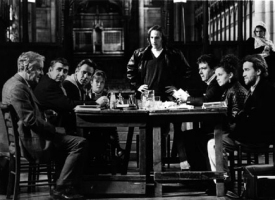
Perhaps I should provide some background because I know that this isn't a film many people have heard of (it's not even available on dvd). In The Bleak Midwinter (or A Midwinter's Tale as it's called in the US) features Branagh and Shakespeare stalwart Michael Maloney as Joe an out of work actor who decides to produce Hamlet at Christmas time in a disused church in his sister's home village of Hope. With him are a group of actors, some in the offseason from seaside shows, all with their own neuroses and the film charts the rehearsal process and the production. It very much follows the structure and style of the Hollywood backstage films from the heyday of the studio system, except with obvious nods and influences from sources as diverse as Woody Allen, Ealing comedies and silent cinema.

Branagh says that it isn't autobiographical, but when Joe describes his passion for the play, that he saw it when he was fifteen and it changed his life that's exactly what the director has said about seeing Jacobi at the RSC all those years ago. His motivation for making the epic film version of the play later mirrors one of Joe's needs here - to try and make something which has a reputation for being musty and boring and making it exciting for a new generation, essentially dragging out of slow amateur schoolroom readings.

Having tried acting and been around a few actors I can absolutely say that the film captures the brilliance and pain of the art, the fact that it can boil down to bringing the deep seated emotional crap that you try to suppress up to the surface in order to entertain others. But what is really clever, is that having suggested from the opening that all of the characters are pretentious and affected and everything everyone expects actors to be - John Session's raving queen and Richard Briers grumpy old man, for example, in a series of carefully chosen two-handers he carefully peels away the surface and reveals them to be perfectly normal people like us, absolutely aware of the mask they're otherwise wearing to get by in the profession.

I think the film was derided at the time as another opportunity for Ken to give his chums something to do, but I thought it was unfair, particularly since it allows them to reproduce the fragile chemistry that any short term group dynamic has but also because many of them are producing what I think are career best performances. People like John Sessions or Celia Imrie, so often stuck playing grotesques and eccentrics are brilliant here when demonstrating the serious side of their all too camp exteriors. Gerard Horan, latterly typecast as policeman is beautifully touching as Carnforth the man with the drink problem. To be honest the only weak link is Jennifer Saunders with her mad American accent who looks like she's charged in from a Comic Strip skit, but there no doubt she's fulfilling the role of the big producer redolent of the genre.

The film is composed rather like a something from earlier in that century - most of the action plays out in medium or wide shots in deep focus with the actors moving into the foreground and back again creating the effect of seeing characters on a theatre stage - there are very few close ups and they only appear late in the film as the group is fractured and the infighting and arguments have begun in earnest. There are montage sequences, such as the audition process and the costuming but Branagh uses a series of jump cuts and juxtapositions to move the story forward.
Branagh employs lighting akin to film noir which fits the mood of the play in production and there are some lovely compositions as the actors walk in and out of silhouette.

Noir is also implied in the costumes that are finally selected for the production within the film which have a kind of 40s gangster style - and there's a spectacular use of a machine gun which accentuates that idea which I don't want to give away. There's also very little music. The film opens with Noel Coward singing 'Why Must The Show Go On' and ends with a plucked instrumental version of the titular Christmas carol. It's a brave stylistic choice but it gives room for the actor's performances to provide the emotional core and make the one musical moment from inside their story - when Nina (Julia Sawalha) sings Ophelia's lament - all the more heartbreaking.

It has dated slightly. One of the jokes hinges on Mighty Morphin Power Rangers which to be honest seemed out of the date at the time although the target audience will at least have heard of it - I'm not sure what the equivalent now would be - probably Xbox or Wii. Also, when Nicholas Farrell's Tom is auditioning for Laertes, he goes into a wild digression about how relevant Hamlet it and mentions that it's like Bosnia. That would be Iraq now I suppose. One element that hasn't aged is the crucial plot point of the filming of a giant sci-fi trilogy that could be the new Star Wars, especially since we've actually had a new Star Wars trilogy (coindentally featuring Celia Imrie as a fighter pilot) and since and everything seems to be about pre-planned franchises and series now.

Some other things I noticed watching it again the other night - the (uncredited) puppet theatre girl in the audition scene is Katy Carmichael who played Twist in the sitcom Spaced. The brilliance of the acronym LCA - Less Crap Acting. Joan Collins as Joe's agent gives probably her best performance since classic Star Trek's City of the Edge of Forever. That Maloney is the best Doctor Who we never had and is completely wasted playing the range of wackos always seems to now in tv dramas - this is the man who stole Juliet Stevenson from Alan Rickman in Truly Madly Deeply after all.

Stylistically different to anything else what Branagh has directed but still with that love of theatre and theatrics, it touches me each year and even with the darkness, somehow manages to put me in the Christmas mood. There is a scene in which people talk about what makes their life worth living and someone mentions Brief Encounter and offers to buy someone as a present. Do yourself a favour and hunt a copy of this down in time for next Christmas because if you're a reader of this blog I really think you'll enjoy it.

Review 2006: Life Props Christmas Special

Annette asks:
What is your favourite film and why?


In The Bleak Midwinter (1995)


It's December 1995, I'm at university the first time around and I live very close to the one cinema I would say that I ever really loved, The Hyde Park Picture House in Leeds. In The Bleak Midwinter turned up pretty much unheralded but I'd read about it in Empire Magazine who gave it a sparkling review and having loved everything else Kenneth Branagh had directed (yes, even Dead Again) and being someway into a lifelong appreciation of Shakespeare I knew had to go and see it..

The Hyde Park was the kind of cinema in which any film could potentially be packed out because the audience tended to go see whatever was on. I took my tall friend Dave with me, even though he wasn't sure if it was his kind of thing - in black and white and about theatre - and we sat at the back of the balcony because there was more legroom.

I'd like to be able to give you a long flowing description of the experience of seeing it for the first time but I really can't. I remember being enchanted and laughing a lot and feeling very Christmassy afterwards and Dave saying that it wasn't what he was expecting and that he really enjoyed it but other than that I'd say that it just made me more excited about seeing Branagh's Hamlet the following year, this almost being a rehearsal for that.

It wasn't until the following Christmas, when I was given the video that I really fell for the film. There was certainly the nostalgia factor - I'd left university by then and it reminded me of a good night out at a place that I wouldn't necessarily be able to go back to with someone I hadn't seen in months. But it was also that it somehow managed to distill everything I felt about Shakespeare into an hour and a half and was also brilliantly funny and touching.

The following year, in 1997, I watched it around Christmas time again while I was wrapping my presents. And again in '98 and since then it's become part of the ritual. When I say that I watch it every Christmas, I really do. Which seems like the definition of a favourite film. Each viewing it means more or less to me than the year before depending on what else is happening in life. Last year I was at university again nd it just fitted into the many hundreds of other films I seemed to be watching. This year I noticed that the main character mentions in his opening monologue that he's thirty-three and I realised that I'd be the same age as him next time I see it.

Perhaps I should provide some background because I know that this isn't a film many people have heard of (it's not even available on dvd). In The Bleak Midwinter (or A Midwinter's Tale as it's called in the US) features Branagh and Shakespeare stalwart Michael Maloney as Joe an out of work actor who decides to produce Hamlet at Christmas time in a disused church in his sister's home village of Hope. With him are a group of actors, some in the offseason from seaside shows, all with their own neuroses and the film charts the rehearsal process and the production. It very much follows the structure and style of the Hollywood backstage films from the heyday of the studio system, except with obvious nods and influences from sources as diverse as Woody Allen, Ealing comedies and silent cinema.

Branagh says that it isn't autobiographical, but when Joe describes his passion for the play, that he saw it when he was fifteen and it changed his life that's exactly what the director has said about seeing Jacobi at the RSC all those years ago. His motivation for making the epic film version of the play later mirrors one of Joe's needs here - to try and make something which has a reputation for being musty and boring and making it exciting for a new generation, essentially dragging out of slow amateur schoolroom readings.

Having tried acting and been around a few actors I can absolutely say that the film captures the brilliance and pain of the art, the fact that it can boil down to bringing the deep seated emotional crap that you try to suppress up to the surface in order to entertain others. But what is really clever, is that having suggested from the opening that all of the characters are pretentious and affected and everything everyone expects actors to be - John Session's raving queen and Richard Briers grumpy old man, for example, in a series of carefully chosen two-handers he carefully peels away the surface and reveals them to be perfectly normal people like us, absolutely aware of the mask they're otherwise wearing to get by in the profession.

I think the film was derided at the time as another opportunity for Ken to give his chums something to do, but I thought it was unfair, particularly since it allows them to reproduce the fragile chemistry that any short term group dynamic has but also because many of them are producing what I think are career best performances. People like John Sessions or Celia Imrie, so often stuck playing grotesques and eccentrics are brilliant here when demonstrating the serious side of their all too camp exteriors. Gerard Horan, latterly typecast as policeman is beautifully touching as Carnforth the man with the drink problem. To be honest the only weak link is Jennifer Saunders with her mad American accent who looks like she's charged in from a Comic Strip skit, but there no doubt she's fulfilling the role of the big producer redolent of the genre.

The film is composed rather like a something from earlier in that century - most of the action plays out in medium or wide shots in deep focus with the actors moving into the foreground and back again creating the effect of seeing characters on a theatre stage - there are very few close ups and they only appear late in the film as the group is fractured and the infighting and arguments have begun in earnest. There are montage sequences, such as the audition process and the costuming but Branagh uses a series of jump cuts and juxtapositions to move the story forward.
Branagh employs lighting akin to film noir which fits the mood of the play in production and there are some lovely compositions as the actors walk in and out of silhouette.

Noir is also implied in the costumes that are finally selected for the production within the film which have a kind of 40s gangster style - and there's a spectacular use of a machine gun which accentuates that idea which I don't want to give away. There's also very little music. The film opens with Noel Coward singing 'Why Must The Show Go On' and ends with a plucked instrumental version of the titular Christmas carol. It's a brave stylistic choice but it gives room for the actor's performances to provide the emotional core and make the one musical moment from inside their story - when Nina (Julia Sawalha) sings Ophelia's lament - all the more heartbreaking.

It has dated slightly. One of the jokes hinges on Mighty Morphin Power Rangers which to be honest seemed out of the date at the time although the target audience will at least have heard of it - I'm not sure what the equivalent now would be - probably Xbox or Wii. Also, when Nicholas Farrell's Tom is auditioning for Laertes, he goes into a wild digression about how relevant Hamlet it and mentions that it's like Bosnia. That would be Iraq now I suppose. One element that hasn't aged is the crucial plot point of the filming of a giant sci-fi trilogy that could be the new Star Wars, especially since we've actually had a new Star Wars trilogy (coindentally featuring Celia Imrie as a fighter pilot) and since and everything seems to be about pre-planned franchises and series now.

Some other things I noticed watching it again the other night - the (uncredited) puppet theatre girl in the audition scene is Katy Carmichael who played Twist in the sitcom Spaced. The brilliance of the acronym LCA - Less Crap Acting. Joan Collins as Joe's agent gives probably her best performance since classic Star Trek's City of the Edge of Forever. That Maloney is the best Doctor Who we never had and is completely wasted playing the range of wackos always seems to now in tv dramas - this is the man who stole Juliet Stevenson from Alan Rickman in Truly Madly Deeply after all.

Stylistically different to anything else what Branagh has directed but still with that love of theatre and theatrics it touches me each year and even with the darkness it somehow manages to put me in the Christmas mood. There is a scene within in which people talk about what makes their life worth living and someone mentions Brief Encounter and offers to buy someone a copy for Christmas. Do yourself a favour and hunt a copy of this down in time for next Christmas because if you're a reader of this blog I really think you'll enjoy it.


Which seems like the perfect moment to run through my ten favourite films of 2006. Something that happened this year is that I stopped getting too excited about release dates and being really quite disappointed with most of the films I've seen at the cinema. But anyway I've managed to hash together the following. Happy Christmas!

Clerks II
Somehow managed to be nostalgic about the original and also a development. Funny, touching and just as quotable. Won't be able to see The Lord of the Rings trilogy in the same light again.

Mission: Impossible III
One of, if not the best action film of the year cruelly overshadowed by its star's public activities. Never thought I'd ever see Simon Pegg and Tom Cruise in the same frame together. Actually enjoyed this more than Casino Royale which was too damn long.

The Prestige
Although it didn't quite manage to sustain its finely balanced storytelling into the final reel, it's still a magnificently atmospheric film with great performances. Yes, even David Bowie.

Superman Returns
About as good as you would want it to be, although I've since wondered if there was slightly too much stylization going on and not enough action - but as an iteration of an old myth it works brilliantly and seeing those credits and that music on the big screen again was gutwrenching.

An Inconvenient Truth
Save the debate about whether this is a real film, I saw it at the cinema which is good enough for me. Brilliantly presented the case for global warming and managed to turn the non-election of AlGore into the White House look like a very big mistake indeed.

The Russian Dolls
This ramshackle sequel to The Spanish Apartment has bags of heart and the moment when Kelly Reilly was left on the railway station platform was one of the saddest of the year. The perfect antidote to having to sit through Love Actually five times when writing my dissertation.(pictured)

A Cock and Bull Story
Somehow managed to make me laugh at two of my least favourite comedians. Another triumph from Michael Winterbottom, this managed to be slapstick and intelligent at the same time.

The Squid and the Whale
Demonstrated once again that shorter films are often the best. Direct and to the point, Noah Baumbach's film seemed to distill what Woody Allen has been trying to do shots and editing since the 90s and succeeds ahead of him.

Volver
The first Almodovar film I've really engaged with, and Penelope Cruz's best performance in years. Particularly worked because as well as being a relationship drama, it was a mystery.

Pan's Labyrinth
With a caveat. I don't think it's the Citizen Kane of fantasy Mr. Mark Kermode although it is still a great historical film about the civil war with one of the greatest devils on screen this year in the shape of that Captain.

The silent stars go by ...

For anyone who missed it, here is Paul Cornell's lovely Christmas short story, 'Deep and Dreamless Sleep' which was published in the Sunday Times this morning. I can't wait to see what his two parter is like next year.

If that's put you in the mood, Big Finish also have a range of short complete stories on their website as previews for their Short Trips anthologies and here is a list - they're in .PDF format and a download link is embedded on each book's information page. Look under the cover shot.

'The Eighth Wonder of the W0rld' by Simon Guerrier
'The Ruins of Time' by Philip Purser-Hallard
'The Prologue' by Joseph Lidster
'Father Figure' by Steve Lyons
'The Feast' by Stewart Sheargold
'Making History' by Trevor Baxendale
'Introduction' by Jacqueline Rayner
'Ships That Pass' by Karen Dunn
'The Nuclear Option' by Richard Salter
'Mortlake' by Mark Wright
'Long Term' by Andrew Campbell

Happy Christmas!

[Archived for ref purposes. All of the links to the original stories are now dead.]

Combat.


TV It's Christmas Eve, so let me keep this brief, and please understand that this isn't the spirit of the season talking, and really I can't believe I'm typing this .... but ... tonight's episode of Torchwood was quite good. From a perfectly written teaser that was both exciting in terms of setting up the mystery of the main story and important in reintroducing the issues related to Gwen neglecting her responsibilities at home to a perfectly paced script and story which gave everyone something to do and paid off well in its finale, this was the Torchwood I'd been expecting after the stonking first couple of episodes and somewhat suggests that this is a series that is only as good as its writers. Take a bow, Mr. Noel Clarke.

As usual, the concept was not exactly original but unlike usual the interpretation worked exceedingly well. For once, there was a real sense of an investigation in which the characters really looked under the belly of this fictional version of Cardiff to see the awfulness that is probably lurking there even if the truth was obvious to anyone paying attention to the brutality and whose read the Christmas Radio Times.

By holding off the secrets of the Weevil Club to the end, the audience was left in the state of imagining the worst which meant the reveal was bound to be disappointing, which in a sense it should have been -- more Robot Wars that Fight Club. In fact, most of the brutality in the episode on screen was committed my the testosterone filled men rather than the aliens, but unlike Countrycide, by placing both races in the same frame, the viewer was given a dreadful point of comparison.

It's very odd to be watching an episode of a series that for weeks you've had nothing good to say about and actually be enjoying yourself. Even the lurches between tragedy and humour seemed to work - for example the discovery of the body in the warehouse and the sudden deployment of the Crazy Frog ring tone which Jack actually had to explain wasn't his.

There was real sense to of an ongoing cross series story arc, something which has been missing for some weeks. Suddenly a thread can be seen through the whole series begun in the first episode with all the tech borrowing in which the job is having a corrupting influence on the main characters, slowly eating away at their souls - effectively they're all going Suzie. From Jack once again allowing a human to die through to Gwen employing the retcon on Rees it is almost as though each will have to reach the tipping point that both Ianto and Tosh have passed through before returning.

How refreshing to see an A-plot and B-plot running in parallel. Gwen's behaviour consciously recalled the opening episode, with her appearance in the hub with pizza and the aforementioned retcon of her boyfriend. It seems absolutely right that her attempt should fail, and the fact that he fell asleep so quickly demonstrates how strong her will was in those early days and how the job and chipped some of that away.

Even Owen's character began to look coherent, either through a natural viciousness or Weevil infection he's a very bad man and he knows it but he doesn't want to do anything about it. I might even watch last week's episode to see if what we were actually watching was temporary taming of a beast. Either this was all some grand plan, or one of Noel's tasks was to rationalise some of the wayward behaviour seen previously. When he chooses to actually enter the cage with the Weevil, although you're repulsed, it seems in keeping with previous behaviour. Suddenly lines like -- 'I was getting bored of your fuck-tricks anyway' look like characterization choices rather than simply poor writing.

Most of the performances were top notch, although guest Alex Hassell, even though he was supposed to be playing an asshole, hardly gave the subtlest of performances - though no doubt intentional he was a bit too Guy Ritchie mockney gangsta and it seemed to enhance Burn Gorman's various ticks when they shared scenes. But you had to be impressed by that ending when Gorman managed to contort his face to look exactly like a Weevil without any apparent prosthetics. I've seen gurning championships were he'd win first prize.

Unlike last week, I sat in silence for most of the episode my only murmur being 'Hold on - is it me or is this actually quite good. That can't be right..' to no one in particular. It's even put me in a positive mood for the season finale which looks excellent even though it does employ time travel which seems a bit redundant given the mother series. With the introduction of the other Captain Jack Harkness, it's only potential crime would be to ruin The Empty Child/The Doctor Dances by implying that Jack gained his current identity through nefarious means.

Review 2006


Jacob asks:
What are your views on the pedestrianisation of Norwich city centre?
" I'll be honest I'm dead against it. People forget that traders need access to [half moaning] Dixons! They do say it'll help people in [half-sighing] wheeeeelchairs?"
- I'm Alan Partridge Episode 2: Alan Gets It On.
Luckily, I have been to Norwich. An old school friend was living there some years ago and my friend Chris and I drove down from Liverpool to see him one weekend. For various reasons we came home early and got to 'enjoy' the seemingly endless stream of A-roads in and out of the town at day and night and in neither case were they very attractive. What I remember of the city centre is that the cathedral is very nice and that the rest is particularly modular - I remember having to walk through some very anonymous looking streets between the shops you'd actually want to go to.

Despite being a joke, Mr. Partridge isn't wrong about it not benefiting some traders and but improving access to some customers. The system in Liverpool seems to work quite well - although the main shopping areas are covered in block paving there is some access to vehicles earlier in the day and later at night. I should like pedestrianisation - in some cities it's quite thrilling (if that is the word) to be able to walk from one end to the other uninhibited by vehicles and their pollution, foot traffic being the only thing to avoid (particularly people who are walking front of you and just stop dead so you nearly fall over trying to avoid bumping into them - how annoying is that?). In Liverpool, you can stroll down Bold Street and all of the way up to the Victoria Monument at the top of Lord Street with only a crossing at Ranleigh Street.

The counter argument for me though is based on aesthetics. In some cities, pedestrianisation kills the look of the place lessening its impact as collective piece of architecture. One of the main roads in Birmingham, the one with the Odeon cinema used have traffic passing through it and had a lovely metropolitan feel - now there's a deadness to it - an emptiness no number of people can fill. I'd be extremely unhappy too if they ever paved The Headrow in Leeds which has the Boulevard effect even with its smaller dimensions. Some talk about these pedestrian areas leading to a European café culture. Not from what I've seen. It's far too cold, except for about three days during the summer.

The other problem is that pedestrianisation tends to add to the blanding out of city centres generally. Over the past couple of years I've visited both Nottingham and Shrewsbury and sometimes its difficult to remember which city was which and while I was there I was disappointed with how similar they are to every other city I know. Same shops, similar street fixtures and similar paving. In which case I would say that pedestrianisation is bad for Norwich because it'll ruin the individual character of the place.

Review 2006


Alan asks:
What is the significance of the Wolf in American Indian teachings?

I had a job interview in Birmingham on Tuesday. Don't get too excited, I wasn't employed - they phoned me later in the day to let me know, and I received the feedback today and the interviewer listed everything I thought he would say was wrong. Although I'd researched the work I would have been doing, there was a killer question which I simply couldn't answer and which I hadn't predicted which is never a good thing. Some of my answers lacked structure too and as he said I 'bounced around a bit'. Even as I was leaving I was thinking of better things I could have said.

I'd had a bit of a nightmare getting there, with cancelled trains due to fog and having to change at Stafford and my focus drifted and I was over excited when I went in. But the interviewer said that wasn't really reflected and of the five whom they spoke to I was very high on the list. Oh and that they would welcome another application in the future which suggests to me that I'm not totally unemployable I just need to work on my interview style. It was my first in about four years though and it looks like I'm out of practice. But it was a good experience.

I think in the end two things might have done it in for me. Although the job was interesting and I would have loved to have joined the organization I don't think I reflected the passion enough - and the relevant experience I have is some years old now and that was pretty clear in the answers I gave. And at the very end, one of the interviewers told me she had gone to Leeds Metropolitan University and it rapidly became clear that we had been on the same course together and even, probably, shared some lectures and I was very 'Oh that's fantastic' and 'Imagine the odds' and 'This kind of thing happens to me all the time' which wasn't particularly professional probably.

All of which is also sure to disappoint Alan who was expecting a long flowing answer and to be honest I've tried to write an answer but I can't do any better than this website and since I'm really, really tired tonight after a busy week, I hope he'll forgive me if I'm a bad wolf and just offer the lovely picture above and a link to something I think answers his question perfectly and promise that I'll post something amazing tomorrow instead.

http://www.wolfsongalaska.org/wolves_and_native_menu.html

Incidentally, I just now need three more questions to take me through to New Years Eve so if you haven't yet, please do, while there's still time ...

Links for 2006-12-21 [del.icio.us]

  • Hilary Burrage::Sefton Park, Liverpool: Winter Solstice 2006
    Lovely post from Hilary about the place where I live.
  • elaine preece stanley artwork
    This page features the Christmas card I bought my parents this year -- it's the picture of the Liverpool waterfront although the exposure on this photograph is rather lighter than the image. The card which is more atmospheric.
  • Paul Cornell's House of Awkwardness: A Night Out with the Writers of Doctor Who
    A few months ago a charity auction was held, the prize being a night out with a few Doctor Who writers. In the event loads turned up and the pleasure in this blog post is seeing the likes of Terrance Dicks and Steven Moffat rubbing shoulders.
  • Review 2006


    A Lurker asks:
    People say money can't buy you happiness. I find this an over simplification of a complicated argument. What is your point of view?

    I forgot to buy a lottery ticket this week. It didn't dawn on me until the actually draw was taking place, as Jenni Falconer revealed the increasingly lower potential jackpot. This might not have been much a problem were it not that I play the same numbers every week and have done since the first time the balls popped out of the machine. Over the ensuing moments, I sighed with relief each time the voice of the balls confirmed that no, none my numbers were there and I had been reprieved. On the occasion, I was actually happy that my lottery numbers hadn't come up. I should note that a friend of mine was in the same situation a few Christmases ago and had missed out on a couple of hundred thousand because he'd been too ill to get the newsagents. That is depressing.

    The thing is I know that instant wealth wouldn't necessarily make me entirely happy. I know that my family would be comfortable and I would be able to do all of the things I wanted to do, my big plan being to travel the world, see the sights, visit the festivals, friends at home and abroad. From a young age I've wanted to do the grand tour, and I'd be able to do that too. But I'd be traveling alone and in a magnification of my increasingly distant Paris trip I'd be living in hotel rooms and probably dreaming of home. But, if I was to find somewhere to live in the UK, or New York or wherever, I couldn't simply stay in one place if I had the choice to travel and to do things. I'm that kind of person, I have the itch to be doing something, never content to just be content.

    In short, I think that if you're the kind of person who gets depressed easily, money isn't going to help. You'll fill your house with stuff, give your money away if you like, but you won't necessarily be happier and if you're someone who is born into wealth or has worked your way into it, you'll probably have even more demands so that you can keep yourself wealthy. You'll inevitably find something else to be depressed or angry about. If you're easily bored too, no matter how many new experiences you have it'll never be enough because you lack the get up and go - that why you were bored before. But if you're already a happy person, seeing light in everything, money will just become an extension of that, money will make you even happier. Although if you were to lose it all, that could make you depressed.

    Links for 2006-12-20 [del.icio.us]

  • Whedonesque: Buffy season 8 comic book writers announced!
    Joss is there obviously and great to see recognisable tv names like Jane Espenson, Drew Goddard and Doug Petrie in there too. It's essentially being written and run like the tv series and will be considered canon.
  • Andrew Collins: Review of 2006 Part 1
    But Robin Hood got *better*. The disappointment should be 'Torchwood' surely. But then I would say that. SFX Magazine gave the dvd release a fairly glowing review this month although it did seem to boil down to what everyone was saying -- I wasn't really expecting *that* ...
  • Natural History Museum: What's the most frustrating animal to film?
    The answer isn't quite what you would expect.
  • Review 2006


    Franchesca asks:
    Have you ever had any kind of casual/one of experience with a member of the same sex? Even if just a suppressed crush on an actor or musician etc?

    I was reading the other day that Anthony Rapp, star of the musical RENT and film actor with a career stretching back as far as Adventures In Babysitting identifies himself as bisexual. Apart from having to watch his performance in the aforementioned film in a new light, I'm also filled with admiration that anyone can look at their life, more importantly their life experience and realise that actually they do have room for both boys and girls in their heart. Makes the attitude of some straight and indeed gay people look a bit one-dimensional.

    Well, my life experience, everything that has happened to me and I'd identify myself as straight. To take the flippant attitude, lusting after Eliza Dushku and wanting to cuddle Ziyi Zhang (to pick two actresses) puts me somewhat in the area but also that I'm generally, always, crushing on someone female proves it to me. Not that there wasn't a period in my late twenties, when, if I'd had anyone to tell, that I did worry because I wasn't in love with anyone and genuinely wondered if I'd lost the capacity. Which is silly.

    Anyone expecting some great revelation will be disappointed. I haven't ever had a suppressed crush on an male actor or musician and the less said the better about a drunken night in the Egg Café, during an office party, when after many wines and hearing the top five female lesbian possibles of some work colleagues thought it only proper to return the favour. The non-revelation is that I'm a relatively shy person, appalling at flirting, and that my undergraduate days, with all my gibbering naivety, were hardly the Animal House style sex comedy that I'd been promised. Which is when the one occasion that could at all be considered a casual experience with someone of the same gender happened.

    It's my first year, possibly before Christmas when everything is still golden. It's a Friday evening and I'm at the Student Union with hallmates, in the city for the regular STOMP night, four hours of Brit pop and grunge. This is the early-mid-nineties so Oasis and Blur posters are on every student wall and Nirvana is filling speakers everywhere. I wasn't much of a drinker, if at all. But I was incredibly tired having been up early for a lecture (I think) and with so many other drinkers in the room it was almost as though I'd convinced myself I was drunk. I'm already dozy and drowsy, and the details of everything that's happening are already being fogged up ready for the revelatory morning 'I did what?'

    I'm standing at the bar, hoping it isn't going to collapse and hoping that they're still serving soft drinks. A man approaches. I don't remember what he looks like, but I have an impression of him being thin with short hair. Somehow we start talking about issues ? I can't remember, although it was probably the wait at the bar. I remember us swapping names, I think, and suddenly beginning to feeling very uncomfortable. Somewhere in the back of my brain I'm beginning to realise that he's chatting me up. I thought I was being chatted up. I wasn't sure.

    Not sure enough that I wasn't not suddenly, though slowly, given my condition, trying to size up if I should tell him I'm straight. It could be that he was just being friendly, passing the time, long wait at the bar, and might not like the idea that I was calling him gay in so many words. Even the early nineties weren't as enlightened as the metrosexual now, with it's Queer Eye For The Straight Guy (Victoria Woods' favourite television show apparently), The L Word and How Do You Solve a Problem Like Maria? But then why did he ask for my name? That didn't seem right. People who are just passing time at bars don't do that. Do they? Was this a university thing, perhaps? Were everyone is friends with everyone else?

    He was served first and bought many beers. And after succeeding in the human feat of being able to carry eight in two hands he walks away. Which should have been the end of the paranoia, but then I'm thinking. If he was chatting me up was it something I said? Did I put him off? Why is the first person to chat me up gay? What's that about? These are the kinds of things you only think when it's late at night and you think you're drunk I'm sure, and I was thinking them. I bought my coke, went and sat on the edge of the dance floor. And the following happened and it underlined for me what I knew already. I wrote the following the following day, I think, and although I know it's partly fictional and not great prose, the essence is true.
    He sweated everywhere. Jeans, t-shirt, jacket all wet with the salty liquid, soggy with no clear way of drying himself out in this atmosphere, humid and steamy. The bench at the edge of the makeshift dance floor was low and uncomfortable. His knees were in front him, higher than his waist, his hands resting on them, his feet tapping in time with the drum-ridden rubbish that was being played, rubbish which had been in the music chart at sometime. Although not a drink had passed his lips all night, he couldn't think straight. He was tired, excited and jealous all at the same time.

    Next to him, a weedy guy with national health glasses was comparing tongue length with a half- burned blonde. His eyes were close, as though he didn't want to realise that she was only kissing him between sips of lager and puffs of a half burnt cigarette, both of which she held with the hand that wasn't making the lonely dance under the t-Shirt of her 'stand' for the evening. It was a compelling sight. The other side, a woman a few years older than him, in a large, floppy maroon hat, seemed as bored as he was as she glanced at her watch. It was close to midnight. This was her celebration after graduation, but the friend she had come with had disappeared into the crowd with an ex- boyfriend. He thought better of striking up a conversation - the idea of screaming some half-hearted questions about courses over the loudspeaker which hovered above them, wasn't very appealing. He continued to sit and sweat.

    Cigarette smoke wafted through the air, mixing with the fibres of his clothing. He thought of the launderette visit which would follow on the Monday, and the owner, who sat strangely, in the shadows, making dribbling noises occasionally. Unknown to him, the graduate had also been there once and a faulty machine had eaten her favourite leggings. Which why she was wearing odd ones tonight - pink and black, green and yellow, they clashed desperately, but worked - somehow.

    She got up and disappeared into the dancing mass, as did the tonsil twins, still joined at the mouth. He waited hopefully for some rock. He could mosh very well, but anything would be better than this hell on vinyl which was making his heart beat irregularly. He crossed his legs, closed his eyes and placed his head on the wall of the stage. He was going to ride this out.

    When he opened them, time seemed to have stopped, all movement being held stationary, apart from one thing. Just in front of, glazed in blue light, danced an apparition. Her body seemed to become the source of the music, not just ebbing and flowing with it. Nothing about her was that different from her fellow dancers. She was quite short - shoulder length brown hair. A stripy-blue tank top extenuated a ... generous figure. Though he was all too aware of her, she was only aware of the music - her feet sliding her across the dance floor, until the world she lived in eclipsed a party light.

    It felt uncomfortable and excited. He knew he was staring, but his eyes would not leave her. What was she thinking? What memories were hidden under the hair which was hovering her hair and rapidly covering her whole face. He ran his fingers through his hair and she repeated the action, the strands disappearing behind her shoulders.

    The drums ended, the synthesizers died. Time began again. The small pocket of reality she occupied that he had invaded disappeared. She smiled at some at some friends at the other side of the hall and disappeared into the crowd. He smiled broadly and stood up to rejoin his friends, who were crashing into each other drunkenly on the other side of the hall. He tried to join in, but it was only half-heartedly. The reality he had just experienced, which he had not asked for was infinitely better than the reality had chosen.
    To this day I still don't know if I was being chatted up, but even if I was I wasn't confused by the outcome and what happened afterwards and what it meant to me. Some us are gay. Some of us are bi. And some of us are straight. That's the way we are. And if you're being chatted up by anyone you should probably be flattered even if there's no way you'd reciprocate.

    Review 2006


    Kate asks:
    Who's your favourite and least favourite doctor, and companion?

    When Doctor Who Magazine recently published the results of their periodical poll asking readers who their all time favourite Doctor was, David Tennant won by a fair margin, dislodging Tom Baker for the first time in years. Since he's the incumbent and a percentage of voters will be new fans who didn't grow up with the floppy haired one and already have that in built affection for him. Whoever takes over from Tennant has a fair chance in a few years time unless something extraordinary happens and they cast Jimmy Carr.

    I didn't remember to vote but if I had been there I would obviously have picked Tom Baker. The man was in the part for seven years and defined the role. That's why everyone who followed seemed blander somehow. But actually for me, naming Tom as the best is like saying The Beatles are your favourite rock band. Yes, and? We love Tom. Tom is our hero. Tom is the hero. But even then, there are some stories were he's acting his socks off, doing everything he can to keep things moving and it just sits there. Season Fifteen might start out well with Horror of Fang Rock but by the end you're watching Leela being chased by a Sontaran through what looks like a leisure centre after hours. If Douglas Adams hadn't shown up as script editor a year later, I really don't think we would have held Tom in such high regard.

    Which is why whenever anyone asks I tell them it's Paul McGann. It's the interesting choice. It's the one that raises eyebrows, especially with the people who think he got back into the TARDIS in 1996 and didn't come out again. But I don't think I've heard or read an Eighth Doctor story I haven't loved or at least liked. With the shortest TV screen time of them all, he became the experimental Doctor, a way for the many authors who'd written for him to play about with the format, of what a Doctor Who story is.

    For the uninitiated, since his short burst on screen the Eighth Doctor has appeared in a series of novels from BBC Books, in an ongoing comic strip in Doctor Who Magazine and on audio with McGann himself in a series of cd plays for a company set up by fans called Big Finish (there was also a brief comic strip moment in Radio Times and a few novellas too). Because many of the writers work across these formats, using the TV Movie and the actors previous film and tv appearances they hashed out a character for him, so that this one voice is heard no matter were he appears.

    He's brash and unpredictable, he's nervous but clever, curious yet all knowing. He'll bound into a situation, make mistakes and then relish dealing with the consequences. Unlike Tom you're never sure if he'll really win and sometimes he really doesn't. In the novels, he's literally lost one of his hearts, destroyed his home planet and been exiled on Earth for a century with amnesia. In the comics he took as his companions, a British teenager, a cyberman and a fish-like woman who'd tried to kill him on numerous occasions. On audio, he caused a rip in time, became his own mortal enemy and banished himself into another universe in which time as a concept doesn't exist.

    But what I really love is the sheer randomness of it all. Unlike the tv series were all the eras are carefully mapped out and you know were you are with whichever Doctor you're watching, you're never sure what the Eighth is going to do next. In a special moment at the end of The Next Life, this non-reality he's been exiled to is caving in on itself and his only escape route into his real universe is fading fast. But he stops for a moment or two to chide his two companions for not being able be friends along and gets them to grudgingly to bury the hatchet because he doesn't see the point of carrying on if they don't see eye to eye. Life's precious but so is quality of life.

    I'm happy the Doctor's back, but I'm sad to see the back of the Eighth. The fact the new men are being considered the Ninth and Tenth perfectly commemorates the work done by the various writers, authors and producers who've kept this multi-media incarnation alive as much more than an hour and half of Americanisms. It was exciting to see Chris stepping out of the TARDIS last March, but for me The Doctor had never been away. He'd just been traveling elsewhere for while.

    [One of the, if not the best Eighth Doctor novel, The Dying Days by Lance Parking is available to download at bbc.co.uk. They also have the audio version of Douglas Adam's Shada which is at least worth hearing for McGann's performance even if the dialogue was mostly written for Tom].

    Selecting a least favourite Doctor though is a bit like trying to choose the chocolate you don't like in a box of Milk Tray. There simply aren't any toffees. If I have to choose one, obviously it's going to be the Sixth, Colin Baker, although for reasons that will become clear that isn't as easy a choice as it might have been when he first appeared in the role in the Eighties. As I think I've already indicated, a Doctor is only as good as the production team and when Pete became Col, the late John Nathan Turner was the producer. Many fans don't really like John. The perceived wisdom is that he took what was an excellent show into the Eighties, turned it into a pantomime and sucked the pleasure out of it. Inevitably its not that simply because even the Peter Davison era is filled with gems, including Davison's final story The Caves of Androzani being an all-time classic.

    The problem with JNT was that his decisions were inconsistent. On paper, the selection of Baker as the Sixth Doctor wasn't that bizarre. He'd already appeared in a popular show called The Brothers and had given a nice little performance in Doctor Who already as Maxill of the Gallifreyan guard in The Arc of Infinity. But then they took the collective decision of sticking him in a brightly coloured patchwork coat and making him an arrogant, unlikeable, shouty little bastard.

    Post regeneration he was unstable and in the midst of everything attempted to strangle his current companion Peri, then proceeded to grump around for three episodes before regaining some sympathy at the end cradling a timelord mentor of his who is finally dying. The Twin Dilemma is an all time worst story for the series and coming after Androzani a catastrophic choice especially appearing at the end of the season. The summer gap is probably what did it for the fans as they wondered if they were just going to get another season of the same.

    Actually they got a season of the production team trying to deal with a new episode format (45 minutes instead of 25) and the Doctor and Peri bickering constantly. It was fairly obvious that this was supposed to be gentle banter, the annoyance that develops between people who spend their every waking hour together (see also Steptoe and Son but often it got in the way of the story and such scenes usually went on far too long because the stories were being so badly structured. Sometimes it would take whole episode of them standing around in the TARDIS or traipsing around a planet doing this before they would become involved in the main plot and in some cases they'd frequently have little or nothing to do in or with the climax.

    All of which has a knock on effect for the appreciation of Baker's Doctor who despite some moments of charm is often brash, conceited and egotistical. Whereas the majority of the other Doctor abhor fatal violence he'd often be in there with a gun or a punch, hardly ever solving problems with his mind. When the hiatus was announced I'm not sure that many people were surprised - even I wasn't at such a young age. If your main character is so unlikable, who's going to tune in.

    When the series returned with The Trial of a Timelord, a story spanning a season, some thought had obviously gone into softening the Doctor's personality. There was a new warmth in his interactions with Peri and some of his 'humanity' had returned. Although the bluster was still in evidence in the trial scenes (essentially the story was portmanteau - a metastory framing three others) it was tempered with the obvious defense of his life. It made sense in context.

    But by then, that was enough for me. I kept watching but I simply wasn't enjoying the show as before. It just didn't seem relevant, and as well as the production itself it was down the portrayal of the Doctor who'd become a distant figure and certainly not someone you could care too much about. It didn't help that the stories had become so esoteric with the Doctor once again going off the rails as the season progressed.

    But it's difficult to say that I completely hate the Sixth Doctor because now, in the Big Finish audios, he's gone into something of a renaissance. Through a general tweaking of the character, this Baker Doctor has gained something of the schoolmaster with all of the bluster and arrogance being part of the bluff rather than a defining character trait. Shorn of the distraction of the costume, Baker's performance too has taken a step up and across the audio is much more coherent. The introduction of a new companion too has, helped with historian Evelyn Smythe telling him off when he's going just too far. Actually their relationship is rather sweet - like too old retirees on a day trip to Brighton, were Brighton is all of time and space.

    [Brilliantly, BBCi have one of these stories, Real Time as a webcast.]

    Oddly enough this isn't a question which the non-fan usually asks - it's mostly favourite Doctor and Monster. Yet, as Rose in the new series has demonstrated the companion is as much a part of the show as either of those elements, and to a degree more so, but often they're forgotten even though time and again they can be the prime-movers of the plot even if that is getting captured or stumbling into said monster just in time for the cliffhanger ending.

    In the new series, Russell T Davies has gone for the iconic. The Doctor and his young female companion who he'll be teaching about the universe. It's the dynamic which has cropped up through all of the latter incarnations during the original series. The cliche is correct in this case, she will be asking him what's going on so that the audience can keep track. As with Chris and Neil, Billie Piper's performance and the writing of Rose Tyler have redefined the role of the companion for the television audience. Although Rose has still done all of the things you need a companion to do, it's been much more subtle and indeed often it's the Doctor who's been asking her for an explanation.

    A pattern I've always noticed is that the stories are weaker when this dynamic hasn't been thought through. I've read interviews with former producers, well alright John Nathan Turner, whose attitude was to introduce a companion based on some basic attributes and let the actor fill in the gaps. The problem with that is that it doesn't take into account how that will play with The Doctor of the day -- there needs to be some kind of chemistry and to be honest a good reason for the timelord to choose them as a companion. When this doesn't work is when the companion seems to have been plonked into the TARDIS at random with the hope that magic will happen.

    Which is why picking a favourite companion is difficult. The easiest way would be to choose the one you fancy. So either Romana on the beach thank you, with Sarah Jane Smith visiting later for drinks. As with Tennant, Billie Piper scored extraordinarily highly in the DWM poll and for much the same reasons. She was certainly the most clearly defined of the television companions, far more three dimension than most of the others.

    But she was standing on the shoulders of giant. Once again we're in the realm of the spin-offs were the Eighth Doctor's companions have all contributed to the new approach. In the BBC range, his first companion was Sam Jones, a teenager from the East End of London (Coal Hill School) with liberal politics and a sharp wit whose in love with the Doctor. Sound familiar? Reading some of those books its often quite easy to imagine that you're reading an adventure for the Tenth and Rose.

    But if I'm bring this to the realms of true appreciation, I'm going to have to go for the unusual decision again. Rose, Sarah-Jane and Romana aside, my favourite companion, for the purposes of the people who know what the hell I'm talking about is Charley Pollard. She's McGann's friend in the Big Finish Audio cds (also recently broadcast on BBC7) and over the course of five seasons, redefined the role of the companion to the extent that she's an equal with The Doctor (again sound familiar?).

    For the uninitiated, Charley's an Edwardian adventuress who stowed away on an airship, the R101, and rescued by The Doctor just before it blew up in flames. Unlike innumerable television companions who seemed to want to leave the TARDIS as quick as they could (see Tegan etc), Charley genuinely wants to see the universe, grab hold of this opportunity which has been put before her. Aided by India Fisher's superb performance, we heard her present a feeling of utter wonder at what was being shown to her, time and again. But even more unusually considering the job description she's saved The Doctor's life almost as many times as he's saved hers, a hand to hold when the universe is falling apart around him.

    The chemistry between Fisher and McGann is so potent that often you're happy just to listen to them chat as the plot passes by around them. One of the best stories of the era, Scherzo (written by Rob Sherman, who's contributed the Dalek episode in the new series) is just them, no other characters, stuck in blank universe where they just walk round and around and its utterly compelling. They were living through the fall out of a previous story, equally classic (for different reasons) Neverland in which Charley told The Doctor she loved him and for the first time we knew the feeling was mutual. Which was somehow less controversial than that kiss in San Francisco and just as touching if not more so than The Girl In The Fireplace and the close of Doomsday combined.

    But what's perfect about Charley is that despite the time differential she comes across as a real person. There is the aforementioned outburst, but also her constant irritation that The Doctor drops them in it time and again, and that the universe never quite works right, ever. In later seasons, a third companion was introduced, the chameleonic Cr'zz and although she was polite there was a definite irritation at having to jostle with someone else for the timelord's attention. Such jealousy, as she might say herself it was 'Silly, childish and very human...'

    In later stories, Charley has tended towards the generic although this is a side effect of being with the Doctor for so long having drifted beyond her Edwardian roots (which is precisely what Jackie warned Rose about in the last television series). Fisher's performance has still held up though which is why the rumour that her contract hasn't been renewed at Big Finish is a shame - it signals the end for Charlie soon, no doubt because of the introduction of Eighth's new companion Lucie, appearing in the new BBC7 series beginning on new year's eve and ensuing cd releases.

    Selecting a least favourite companion should be easy, because there have been so many. One of the reason the series drove itself into cancellation bay in the first place was that the writers fundamentally misunderstood the dynamic of the companion being the viewer's way into the series by making them so alien even when they were human. At no point is anyone going to sympathise with a Tegan or an Adric even if vast android hordes with big guns are massed just inches away. When Adric flew a ship into the Earth and wiped out the dinosaurs in his exit story Earthshock, the only reason it was shocking and sad was because it had taken so long to give him something dramatic to do.

    But if I was to give any of them the sharp end of a Dalek gun it would be Dodo Chaplet. Dodo was a companion of the first Doctor and literally stumbled into the TARDIS thinking it was a real Police Box when it landed at the end of a historical adventure when the Doctor's ship randomly landed in contemporary (for then) London. In her first story, The Ark she managed to pass a flu bug on to the last vestiges of the human race living in a space ark, giving room for their servants the Ood-like Monoids to take over. And that's about the most exciting thing to happen to her. From then on in she's a placeholder, someone for the other companion Steven to talk at, her only other high point being a song and dance routine in The Gunfighters. As an editor at the Wikipedia describes her: "Dodo's personality was a bright and happy one, but she was ultimately not very sophisticated."

    It was probably not actress Jackie Lane's fault. For much of the previous story, the Doctor has knocked about with Steven the space pilot and the cool but ill-fated Sara Kingdom and there was probably some directive that said that the Doctor couldn't just knock around with another man. But Dodo was simply ill thought out and lacked depth and she found herself stuck into a string of not great stories - the tedious The Celestial Toymaker and the dry The Savages. She was eventually inauspiciously replaced by the far more swinging Polly in her final adventure The War Machines but wasn't even granted a proper farewell. Feeling ill she was shipped off to the country for a rest and never heard from or mentioned again.

    Inevitably she gained an afterlife in the spin-offs and in David Bishop's Who Killed Kennedy by David Bishop is was revealed that Dodo had suffered a nervous breakdown and was unable to remember her adventures with the Doctor, drifting in and out of psychiatric institutions. She eventually became involved with a journalist that was investigating the truth behind UNIT and was ultimately murdered by the Master. Unless you're reading Daniel O'Mahony's The Man in the Velvet Mask in which case its inferred that she contracted a fatal dose of VD.

    The reason I've picked her as my least favourite that she's everything that people who know nothing about Doctor Who expect a companion to be - bland, lacking in characterization and a screamer. About the only good moment she has is in the beginning of The War Machines when the Doctor leaves an out of order sign on the TARDIS because they're in the 60s and its in its right era at least visually. She and the Doctor share a giggle and it feels right and finally there is chemistry. I can't remember a single thing that she did in the rest of her time on the show other than that she knocked Peter Purves's Steven, who was becoming one of the best ever companions, off his stride by stealing half of the material.

    Not long now until Martha Jones takes a bow and like Rose she's appearing with a family and back story already in place. Although there's a debate about whether she's the first non-white companion (What about Mickey? What about Anji and Ros or Alison in the spin-offs?) its another sign of the new version of the show wanting to do more with the Doctor/companion dynamic. To what extent will her ethnicity be an issue when they travel into a past when the colour of someone's skin was still a barrier - will they confront or avoid? Either way its got to be handled better than Dodo's cockney origins ...

    The Janus Conjunction.


    Books  In a bizarre moment of clarity during The Janus Conjunction I realised why some of these novels are taking several weeks (or even months to finish) whilst others can be licked in a few hours.  Font size and line spacing.  Most of these books run to roughly two hundred and seventy pages, but the text within is far denser in some cases than others. It also explains by the epic previous book can be followed by a romp that apparently has the same physical length.

    The titular phenomenon this time is a doomsday weapon born from the eclipse of three worlds, Janus Prime, Menda and their sun.  Once again, The Doctor is fighting against big cosmic forces and race histories, and y'know just for a change an evil meglomaniac.  The kind of pioneering colonists from Earth that Russell T Davies talks about all the time in interviews have crash landed and built a life on the planet Menda.  They were guarded by a group of mercenaries who in an apparent fit of boredom  used what appears to be a transmat to go to Janus Prime in an attempt to get back to Earth only to get stuck there, become infected with radiation sickness, inevitably go rogue.  Their leader Zemlar has gone mad and is attempting to kill everyone and everything, partly using the indigenous species - a race of spiders.  The Doctor and Sam drop into the middle of this situation and try and sort everything out whilst being captured and separated and all the things you'd expect.

    The opening paragraph in which a soldier is chased through a forest by a giant spider-cyborg thing recalls uncomfortably War of the Daleks and I thought it would be another slog, but in the event this is a straightforward but nonetheless engrossing read.  Baxendale's prose style is simple and mostly functional; this does however seem to be an adopted approach so that when he turns on his descriptive power the effect is all the more shocking or surprising.  There is an excellent moment when the true horror of Zemlar radiation deterioration is revealed, the flesh dripping off his face.  The book is filled with these moments of body horror, with none of the effects of radiation sickness whitewashed.  By the end, Sam's skin is coming off in strips and  I defy anyone to not skip through the yuckier parts.

    Zemlar is an enemy from the old school, a real Zaroff of a madman - Baxendale obviously had great fun writing his dialogue.  At one point, when it looks like all is lost he rants: 'I can't, Doctor.  I've already told you - it's too late. […] I make sure the spiderlings were used properly.  The control system is jammed.  Nothing, no one, can stop it now!' I added the exclamation mark.  He doesn't have any great aims - since he can't go back to Earth, he just wants to turn half the galaxy into a black hole.  Of the other guest characters the most vivid is Julya, the Mendan who becomes the Doctor's surrogate companion when Sam isn't around.  She reminded me somewhat of Ida from The Satan Pit, that kind of questioning wisdom and bravery.

    Throughout the book the dialogue crackles.  The Doctor and Sam are particularly well drawn, the bluff of the former and the passion of the latter.  They're very content and relaxed and there are some lovely moments when the human chides the timelord when he's being particularly technobabbly (not unlike all the Spock talk from Rose in The Empty Child).  Neither really develops although their mutual devotion does seem to be becoming progressively deeper which is never a good sign.  My favourite Doctor moment is someway into the novel when the Doctor and Julya have found themselves on Zemlar's base and becomes apparent they're going to be locked up.  The Doctor says 'It's about time we were locked up' and you just know that this exactly what he wanted to happen.  Baxendale obviously has great warmth for both of the characters and it is to his credit that when he announces something very rotten about one of them it comes as a complete shock.  I actually shouted out loud 'You can't do that' when I read it but rest assured its all ok in the end.

    If there's a tiny criticism, it's that the book doesn't really do much that couldn't be done on a television budget.  Well actually that's not totally fair -- when the giant spiders are attacking the action is cross between Eight Legged Freaks and Starship Troopers -- but very few actual locations are used and considering the number of colonists who are supposed to at risk we only meet a handful of them and they come across as a bit bland.  But some writers have come a cropper in the past with introducing too many characters with irrelevant stories and it's perhaps it's good that Baxendale has streamlined such things as much as possible.

    So all in all a very pleasant surprise.  Unlike Kursaal which appeared directly after Alien Bodies and somehow through its sheer dullness managed to undo some of the magic, The Janus Conjunction is exactly what you need after the mind bending frolics of The Scarlett Empress.  It's quite jarring in the arc infested waters of nu-Who for the events of the previous book not to get a mention, but these were still the days when the BBC were trying to attract a wide audience for the books and they needed to be as stand-alone as possible.  I'm already glancing through the next book, Beltempest, and the line spacing is even wider, the text even larger and the pagination even shorter.  See you in a couple of hours ...

    Links for 2006-12-18 [del.icio.us]

  • New York Times: Before He Got So Serious, Dr. House Was a Hoot -
    The NYT review 'A Bit of Fry and Laurie' which is as bizarre as it sounds. “Hold the newsreader’s nose squarely, waiter, or friendly milk will countermand my trousers.”
  • Review 2006


    Adrian asks:
    Next Saturday, I'll be back in Liverpool for the day, with my girlfriend. One of the reasons for the visit is so that she can get a better feel for the city because we're thinking of moving there. So, can you tell me where the hidden cool and interesting bits of Liverpool are?

    It really depends on what you're looking for - sightseeing, eating or drinking and also I'm not sure if anything is really hidden anymore. So I'll try my best but forgive me if this isn't what you're looking for.

    Liverpool Museum Planetarium It's a free show taking in both an explanation of some new astronomical phenomena and a tour of the night sky at this time of year. There's a silhouette of the Liverpool skyline painted on the circumference. Watch for the great moment when all of the lights are out and you're shown what the sky would look like if the light of the city wasn't blocking everything out. Check for opening times though and be wary of teenagers - last time I went some little annoyance was playing with a torch and it somewhat ruined the effect.

    The Picton Library which is part of the Central Library, on the second floor. It's worth just going in to stand underneath the dome and take in the scale which is an utter surprise and not what you would expect from the street.

    Liverpool's Anglican Cathedral If you like big humbling buildings, this is excellent too. Built over a hundred years, it's fairly modern in comparison to the big churches in the old Cathedral cities but it still has an impressive presence to it and there are daily tours up to the roof which I think, other than the restaurant tower probably gives the best view of the city available.

    Sefton Park I'm bound to say this because I live here, but it's often forgotten on the sightseeing trail when it's actually easier to get to than the Albert Dock and its filled with little riches such as the Palm House, the statuary and the general landscape (get the 80 bus from outside Boots on Great Charlotte Street). Walking the circumference and you can pretty much see the history of the city in the buildings, from the slavery money through to the rehousing projects of the 1960s. If she does move here, can I recommend the range of regular tours given by Park Rangers which explain this history and also the nature within the park. You can request a programme from here.

    Liverpool: Pevsner Architectural Guides by Joseph Sharples If you're feeling flush in fact you could do worse than this guide to Liverpool architecture written by someone I used to work with. Cleverly, the book is structured as a series of guided walks which tell the story of a particular area through its buildings. Suddenly places which you'd pass by without looking are illuminated in text that balances well the expected jargon with accessible trivia. Impressively the walks even go inside buildings and often if they're inaccessible there's an image to show what you're missing. I should say too that some of these walks could take all day so if but that's all you have, you might see more of the place and get a feel for it than if you were simply randomly walking about and get a feel for the place.

    http://www.artinliverpool.com/ If you're looking for exhibitions and galleries that are off the beaten track, Ian Jackson's website and blog is the place to look. Although the Biennial obviously provides a brief spotlight and focus on art activities, there are still a range of exhibitions throughout the city pretty much of the time.

    Radio Merseyside has recently moved into new premises on Hanover Street and you can now see into the studios while the shows are being broadcast. Fascinating to see local radio celebrities doing what they do.

    The Barcelona on Renshaw Street. Until recently a bar but now the base for many of the shops that used to be in Quiggins. Expect studenty and club clothing, collectables, and second hand cds. But that's underselling I - it's worth visiting just for the décor and the keen way that a building can change use and still retain it's earlier fixtures. If you see what I mean.

    Eateries I'm a creature of habit when I'm eating in town which means that I can only recommend three places. The Everyman Bistro on Hope Street is the place to go for the homecooked style meal with everything from soup to salads to curries and pies and stews. It's also a great space to drink too with its three room structure. There's buzz about the place which is hard to define but engrossing. I'd also add that if you're looking for something in the realm of pizza and pasta and more relaxed The Quarter at the other end of Hope Street is also excellent and has waitress service. If your looking for somewhere nice to stop off for a coffee during the day, The Door on Hanover Street is cool with great art on the walls and a friendly atmosphere.

    Pubs I usually end up on Hardman Street and the off streets. There's the Philharmonic Pub which has the most ornate men's toilet in the country; if you're feeling very adventurous you could go to the bar at the actual Philharmonic Hall if there's something on - it too is worth a visitor for the décor and you can also hear whatever the show is as your background music.

    The Pilgrim on Pilgrim Street under the shadow of the cathedral has booths and interesting paintings of The Beatles (in that they look nothing like them). But really the most interesting new bar is on Hope Street underneath the RoadHouse - it's a Sci-fi theme bar with tons of memorabilia with a bar modeled on a TARDIS and a stage in the shape of a Star Trek transporter pad.

    But you could do worse than slipping down Wood Street too. That's take you past the FACT centre, and there's The Swan Inn (old biker pub) and beyond that Concert Square with all of the trendy place surrounding that with The Krazy House and The Camel Club towards the bottom. Which are worlds away from each other in terms of clientele but both amazing experiences.

    I hope that is of some use, but please do let me know if there's anything else you were particularly interested in.

    Out of Time.


    TV It's always very helpful when sitting down review something when one of the characters within has actually explained what's wrong with the episode. There was Jack, sitting in the hub, looking up at Tosh and actually saying (I'm paraphrasing) "These are just three people who are lost who can't go home. We don't have an enemy to fight this time." As he sat there, it finally felt as though the story had ground to a halt. I looked up at the clock and noticed that there was another twenty-minutes to go and wondered what the hell they'd be filling those twenty minutes of screen-time with.

    Thing is, I was strangely upbeat going into this episode. I told everyone here I was looking forward to it and a particularly good episode of The West Wing tonight ('Hi, Senator. Why don't you take your legislative agenda and shove it up your ass. ' 'She's a fine looking woman.' etc) put me in a good mood. The episode began rather well with the lovely landing of the plane and the appearance of the three strangers in time and the explanations and then ... Asda? Immediately it began to become apparent that episode would once again be demonstrating the legion of issues the series has had so far. Having selected to retread one of the old, old sci-fi standard, off the shelf, plot-lines, they decided to trot through all of the expected scenes without putting a new spin on any of them whatsoever. Oh for goodness sake.

    I should temper this a little bit by saying that even that opening scene in the supermarket was as funny as these things usually are with the accepted standards of our time being put under the microscope of another -- the children's tv presenter on the lad mag, 'smoking kills' and the price of eggs (or in this case junk food). Such scenes were splattered throughout the episode as Emma misunderstood the advances of the man in the club and John had to deal with the pipe smoking ban in the pub. The problem is that after a while they become repetitious and perhaps more damagingly for Doctor Who fans not anything that doesn't happen whenever the Doctor's companion appears in another time -- that misunderstanding of new rituals for comic effect.

    Throughout I wondered if there would be a twist, such as that they're all aliens or they somehow planned the time slip or that there would be a way home or that they weren't time travellers at all just faking it for some nefarious gain. Perhaps the twist was that there was no twist in which case -- wah! I'm sorry but narratively chaining each of them to the one regular character who was most likely to empathise with them and their plight in the hope of illuminating a regular just isn't enough. It's all very well presenting what appears to be a grand romance about loss and sacrifice but you still need proper jeopardy, something to fight for.

    I can absolutely see that this is supposed to be the episode about character building -- Gwen talked once again about having two lives and is seen to question her relationship to Owen; Owen on the other hand didn't seem to think anything about their relationship as he realised he actually had the capacity to fall in luurv; and Jack continued to come to terms with the fact that he too is a man out of time, as we gained some confirmation that he might have dropped through the rift and that he is indeed born in the future. The problem is, because of what I'm going to continue to describe as the random characterisation of the series, none of this seemed like a progression -- just an emotion of the week which could change next time. I can't simply start liking a character such as Owen when he's been so negatively written in the past, especially when he seems to have a silly walk - the whole wide shoulder thing is becoming increasingly old.

    As with so many of these episodes, there was a tension too between the really great performances and the embarrassing dialogue. Example: No Angels' Louise Delamere sparkles away throughout the episode proving once again that she's one of the nation's hidden treasures and (I can't believe I'm typing this) actually some of the scenes with Burn Gorman had a light romantic touch. Except they're in the middle of one of the endless bed scenes, just as we're actually beginning to fall for the two of them, he gives a speech talking about how he's obsessed with her clothes, her look, what she's thinking about and oh yes, the face she makes when she cums, which strands the scene as you're simply not able to listen to anything else as you try to deal with the implications of that. It might sound real, and I'm sure it's perfectly good pillow talk in some homes, but it kills the mood of the scene stone dead. Was there any need for it?

    The inability to close out an episode satisfactorily continues. In a bizarre coincidence, all three of the time travellers (whose connection at no point had been explained) decided to make big life (or death) decision at roughly the same time. It was almost as though they could tell that the episode was coming to a close. Although all television dramas with multiple plot-lines suffer from this issue (see nearly every episode of Boston Legal) here it jarred because with perhaps the exception of Emma none of them seemed to have a reason to make the decision right there and then. Diane didn't fly off because she'd heard about the death of John for example which would have made sense. And speaking of John what are we to make of Jack's decision to let him kill himself and actually sit in the car and watch? I can't decide if I really hate Jack now. And what are his colleagues going to make of the decision? Watching the series you'd never know (although reading the website you might). I guarantee it won't be mentioned next week.

    I wonder if I've entirely lost perspective and I'm just off looking for flaws and unable to enjoy the show for what it's purporting to be. Whenever I write these reviews I'm always analysing the storytelling, how it fits within the overall structure of the series, the disappointments. Perhaps when I rewatch this I will be able to pay closer attention to the incidental pleasures -- the reappearance of Rees, Owen's charm (for once), the great performances. But I can't sit here and lie and say that I enjoyed these fifty minutes when I spent most of them literally groaning and shouting at the screen like a madman or a football fan watching their team go down five-nil in the FA Cup.

    I just keep hearing that opening introduction:

    "Torchwood. Outside the government, beyond the police. Tracking down alien life on earth and arming the human race against the future. The 21st century is when everything changes... and you've gotta be ready."

    And wondering when we're actually going to get to see that series. That series sounds great.