TV The BBC’s new Doctor Who methadone, Merlin was a very entertaining 45 minutes. And it certainly had a better opening episode than their previous attempt, Robin Hood.
Reinterpreting this kind of legend is a double-edged creative butter knife – stray too close to the established elemental expectations and you risk tediously regurgitating what’s gone before, stride too far away and the exercise becomes pointless; you might as well have made up your own thing. Like Hood, the Arthur myth is a fairly well trodden journey and emphasising Merlin as the main character has also been tried fairly successfully before, notably in the Hallmark mini-series with Sam Neill.
For me, the best Merlins have been tricksters, elemental forces in humanoid form who have strayed into Camelot or Middle Earth or wherever they’ve got their beards caught and get wrapped up in human affairs. I’m not sure there’s been anything as good as Nicole Williamson in John Boorman’s Excalibur in this regard, who managed to be deadpan and dotty as well as dark and demonic – though I’ve also a soft spot for the druid seen in the underrated King Arthur.
I often wonder if it’s possible to tie all of these different versions together by saying that it’s the same force or man, existing on his own plane and we’re simply seeing how it or his manifestation is bent to fit within each reality. I’m sure there’s a book to be written about that some day.
BBC1’s Merlin takes the Smallville approach of making the familiar characters much younger and showing their “adventures” before the time we’re more familiar with. In this iteration, Arthur and Merlin are of the same generation, though not social class, a prince and his manservant and – in an interesting twist – they hate each other, though that’ll change in the future (think Flash Thompson and Peter Parker in the early Spider-man comics). Arthur’s fated to be king anyway through succession, which should make for less amazement when he pulls Excalibur from the stone and declares himself master of the realm. And by that point, Merlin will be about the same age instead of the wizened old gent we’re used to.
Around them buzz the kind of Propps that Joseph Campbell crystalised – the mentor in the form of Richard Wilson’s Gauis (rather fulfilling the slot that Merlin had in Disney’s Sword in the Stone), a companion in the shape of Angel Coulby’s Gwen(iviere) and the unattainable princess Morgana (a glacial Katie McGrath). Anyone who knows their Camelot apples will have spotted an abundance of mythology ripe for the picking. Morgana’s already got her eye on Arthur – will they introduce the rather lovely stumbling branch that she’s his half sister or decide instead to emphasise the potential love triangle between Gwen, Merlin and Arthur… or will the writers simply chuck all of that out for something else?
The real innovation the BBC introduces, is that far from being an autonomous collective, this realm is governed by the usually much talked about but not seen Uther Pendragon who’s banned magic because as far he’s concerned it was used for the wrong ends 20-odd years before. That puts Merlin in the position of being naturally magical without the ability to be practical, not only keeping down the budget because he can’t just fly around or walk through walls without being seen, but also suggesting a future moment when someone he loves is in peril but he can’t risk wobbling his nose (or in this case make his eyes glow) for fear of being found out – see also Clark Kent watching Lois Lane fall from a building without a telephone box or alley in sight. That’s the season ending cliff hanger right there, you mark my words.
On the whole then, really good fun and well directed by Who veteran James Hawes. It’s not perfect – some of the performances have a bit of genre-itis (I’m in a chainmail so that must mean they want my best panto acting) – but Colin Morgan is a real find and brings some geeky charisma to Merlin. He stole many of his scenes – the magnesium chemistry with Coulby’s Gwen a particular pleasure – and the production design is very clever, managing to be both convincing medieval and yet modern at the same time, something which First Knight tried but failed. Plus any series that has John Hurt voicing a dragon can’t be all bad.
Writer Julian Jones’s haikuic revenge plot was good enough for the first episode and helped immeasurably by Torchwood‘s Eve Myles as a witch who sang like an angel. But if all Merlin does is spend the next 12 weeks defending his prince from magical men and women, it could become very repetitive. It just has to be careful not to fall into the trap of having our hero become too powerful so that his magic can simply save the day every week, this series’s equivalent of the kind of deus ex machina brought about whenever the Doctor whips out his sonic screwdriver.
And I managed to get through all that without mentioning a certain other in voguish boy wizard…

a fairly well trod journey
TV The BBC’s new Doctor Who methadone, Merlin was a very entertaining forty-five minutes, and certainly had a better opening episode than their previous attempt Robin Hood. Reinterpreting this kind of legend is a double edged creative butter knife – stray too close to the established elemental expectations and you risk tediously regurgitating what’s gone before, stride too far away and the exercise becomes pointless and you might as well have made up your own thing. Like Hood, the Arthur myth is a fairly well trod journey and emphasising Merlin as the main character has also been tried fairly successfully before, notably in the Hallmark mini-series with Sam Neill.
For me the best Merlins have been tricksters, elemental forces in humanoid form which have strayed into Camelot or Middle Earth or whichever they’ve got their beards caught and get wrapped up in human affairs. I’m not sure there's been anything as good as Nicole Williamson in John Boorman’s Excalibur in this regard who managed to be deadpan and dotty as well as dark and demonic, though I’ve also a soft spot for the druid seen in the underrated King Arthur. I often wonder if it's possible to tie all of these different versions together by saying that it’s the same force or man, existing on his own plane and we simply seeing how it or his manifestation is bent to fit within each reality. I’m sure there’s a book to be written about that some day.
The BBC1’s Merlin takes the Smallville approach of making the familiar characters much younger and showing their ‘adventures’ before the time we’re more familiar with. In this iteration, Arthur and Merlin are of the same generation though not social class, a prince and his manservant and in an interesting twist they hate each other though that'll change in the future – think Flash Thompson and Peter Parker. Arthur’s fated to be king anyway through succession, which should make for less amazement when he pulls Excalibur from the stone and declares himself master of the realm and Merlin will be about the same age instead of the wizened old gent we’re used to.
Around them buzz the kind of Propps that Joseph Campbell crystalised – the mentor in the form of Richard Wilson’s Gauis (rather fulfilling the slot that Merlin had in Disney’s Sword In The Stone), a companion in the shape of Angel Coulby’s Gwen(iviere) and the unattainable princess Morgana (a glacial Katie McGrath). Anyone who knows their Camelot apples will have spotted a tangle of mythology ripe for the picking. Morgana's already got her eye on Arthur -- will they introduce the rather lovely stumbling branch that she's his half sister or decide instead to emphasise the potential love triangle between Gwen, Merlin and Arthur, or will the writers simply chuck all of that out for something else?
The real innovation that the BBC series introduces, is that far from being an autonomous collective, this realm is governed by the usually much talked about but not seen Uther Pendragon who's banned magic because as far he's concerned it was used for the wrong ends twenty-odd years before. That puts Merlin in the position of being naturally magical without the ability to be practical, not only keeping down the budget because he can’t just fly around or walk through walls without being seen but also suggesting a future moment when someone he loves is in peril but he can’t risk wobbling his nose or in this case make his eyes glow for fear of being found out (see also Clark Kent watching Lois Lane fall from a building without a telephone box or alley in sight). That’s the season ending the cliff hanger right there, you mark my words.
On the whole then, really good fun and well directed by Who veteran James Hawes. It’s not perfect – some of the performances have a bit of genre-itis (I’m in a chainmail so that must mean they want my best panto acting) -- but Colin Morgan is a real find and brings some geeky charisma to Merlin and he stole many of his scenes, the magnesium chemistry with Coulby’s Gwen a particular pleasure, and the production design is very clever, managing to be both convincing medieval and yet modern at the same time – something which First Knight tried but failed. Plus any series that has John Hurt voicing a dragon can't be all bad.
Writer Julian Jones's haikuic revenge plot was good enough for the first episode and helped immeasurably by Torchwood's Eve Myles as a witch who sang like an angel, but if all Merlin does is spend the next twelve weeks defending his prince from magical men and women, it could become very repetitive. It just has to be careful not to fall into the trap of having our hero become too powerful so that his magic can simply save the day every week, this series’s equivalent of the kind of deus ex machina brought about whenever the Doctor whips out his sonic screwdriver.
And I managed to get through all that without mentioning a certain other in voguish boy wizard ...
For me the best Merlins have been tricksters, elemental forces in humanoid form which have strayed into Camelot or Middle Earth or whichever they’ve got their beards caught and get wrapped up in human affairs. I’m not sure there's been anything as good as Nicole Williamson in John Boorman’s Excalibur in this regard who managed to be deadpan and dotty as well as dark and demonic, though I’ve also a soft spot for the druid seen in the underrated King Arthur. I often wonder if it's possible to tie all of these different versions together by saying that it’s the same force or man, existing on his own plane and we simply seeing how it or his manifestation is bent to fit within each reality. I’m sure there’s a book to be written about that some day.
The BBC1’s Merlin takes the Smallville approach of making the familiar characters much younger and showing their ‘adventures’ before the time we’re more familiar with. In this iteration, Arthur and Merlin are of the same generation though not social class, a prince and his manservant and in an interesting twist they hate each other though that'll change in the future – think Flash Thompson and Peter Parker. Arthur’s fated to be king anyway through succession, which should make for less amazement when he pulls Excalibur from the stone and declares himself master of the realm and Merlin will be about the same age instead of the wizened old gent we’re used to.
Around them buzz the kind of Propps that Joseph Campbell crystalised – the mentor in the form of Richard Wilson’s Gauis (rather fulfilling the slot that Merlin had in Disney’s Sword In The Stone), a companion in the shape of Angel Coulby’s Gwen(iviere) and the unattainable princess Morgana (a glacial Katie McGrath). Anyone who knows their Camelot apples will have spotted a tangle of mythology ripe for the picking. Morgana's already got her eye on Arthur -- will they introduce the rather lovely stumbling branch that she's his half sister or decide instead to emphasise the potential love triangle between Gwen, Merlin and Arthur, or will the writers simply chuck all of that out for something else?
The real innovation that the BBC series introduces, is that far from being an autonomous collective, this realm is governed by the usually much talked about but not seen Uther Pendragon who's banned magic because as far he's concerned it was used for the wrong ends twenty-odd years before. That puts Merlin in the position of being naturally magical without the ability to be practical, not only keeping down the budget because he can’t just fly around or walk through walls without being seen but also suggesting a future moment when someone he loves is in peril but he can’t risk wobbling his nose or in this case make his eyes glow for fear of being found out (see also Clark Kent watching Lois Lane fall from a building without a telephone box or alley in sight). That’s the season ending the cliff hanger right there, you mark my words.
On the whole then, really good fun and well directed by Who veteran James Hawes. It’s not perfect – some of the performances have a bit of genre-itis (I’m in a chainmail so that must mean they want my best panto acting) -- but Colin Morgan is a real find and brings some geeky charisma to Merlin and he stole many of his scenes, the magnesium chemistry with Coulby’s Gwen a particular pleasure, and the production design is very clever, managing to be both convincing medieval and yet modern at the same time – something which First Knight tried but failed. Plus any series that has John Hurt voicing a dragon can't be all bad.
Writer Julian Jones's haikuic revenge plot was good enough for the first episode and helped immeasurably by Torchwood's Eve Myles as a witch who sang like an angel, but if all Merlin does is spend the next twelve weeks defending his prince from magical men and women, it could become very repetitive. It just has to be careful not to fall into the trap of having our hero become too powerful so that his magic can simply save the day every week, this series’s equivalent of the kind of deus ex machina brought about whenever the Doctor whips out his sonic screwdriver.
And I managed to get through all that without mentioning a certain other in voguish boy wizard ...
it's more complicated than that

Life Realising I was missing quite a nice day, I decided I needed to get out, to see something, somewhere with fresh air. So I've been to visit 'Eros' now that he's returned to Sefton Park. If you're a Londoner, and this looks familiar that's because it's a replica of the statue that stands as part of the Shaftesbury Memorial in Piccadilly Circus, though for years I was under the impression that this happened the other way around. But since that was erected in 1893 and this turned up in 1932, I've been reminded that you shouldn't believe everything you hear.
Actually, it's more complicated than that. The reason I've put its 'name' in inverted commas, is because I've discovered that shockingly (having looked things up on the internet) this isn't a representation of Eros, god of love at all but his brother Anteros, his appearance symbolising Lord Shaftesbury's love for the poor, and has nothing to do with romance, which should be a disappointment to the lovers that have met both here and at the Circus over the decades hoping for it to pass on some good will. That's two misconceptions set straight today. Not bad.
Also, what's been placed in the park this week is a replica of a replica. 'Our' original was removed in the late nineties and taken to the Conservation Centre in Liverpool for restoration because of weather damage and vandalism and now heralds the entrance to the (now inaccurately named it seems) Eros Cafe at the centre. This version is an excellent substitute, its shiny surface gleaming in the sun. Once it's been dulled by age and rain and gained a more familiar patina, it'll eventually be difficult to tell the difference.
The fountain on which it sits isn't quite repaired yet, so the whole memorial is still ringed by block-a-mesh and still looks a bit like a building site. But once the water's running again it should be amazing. Even so it was drawing a crowd (mostly sitting on the patio of the nearby cafe), and I heard a many positive comments and memories, like the woman who remembered 'running around it as a teenager'. Here's a video report from the Liverpool Echo about it being placed and the work involved:
Life Goodness, is that the time? I slept in this morning (nine o'clock, the very idea!), shaved, checked the mail, got breakfast, looked out of the window, sat down at my computer and here we, or rather I, am are over four hours later, still sitting here. I had planned to do all kinds of things today, my last Saturday off before going back to work next week, but I feel trapped, and wondering what to do. The reason for my lethargy?
The Internet Meme Timeline.
It's fair to say a lot of this material has lost some its sparkle, but as I edge slowly across the timeline spotting everything which passed me by the 90s because I wasn't on-line and after that because I was on dial-up, I do wonder if the web is quite as exciting or edgy as it used to be. Now that everyone wants to be a videomaker, will we see the likes of TouristGuy again?
The Internet Meme Timeline.
It's fair to say a lot of this material has lost some its sparkle, but as I edge slowly across the timeline spotting everything which passed me by the 90s because I wasn't on-line and after that because I was on dial-up, I do wonder if the web is quite as exciting or edgy as it used to be. Now that everyone wants to be a videomaker, will we see the likes of TouristGuy again?
the sheer brace of strangers

Liverpool Biennial 2008 I've just got back from the preview evening for this year's Liverpool Biennial. I'll not talk about the art now since I want to go back and see some things again (all I'll say, and this is for the most hardcore of Doctor Who fans, Harry Van Gorkum!). I'm a bit out of practice with private views. They tend to be a bit cliquey around here so unless you're a regular (which I'm not, though not through want of trying) or with someone (I wasn't) it's difficult to really meet people because everyone's already met. There were a few familiar faces, people from the past, probably the last time I saw them was at the last Biennial preview, and it was nice to see them. But people are with people so, well, it's difficult to share more than a couple of words. In most other circumstance I'm not shy, at least not any more. Yet, here, the sheer brace of strangers was intimidating.
What a responsibility!
TV This month, Doctor Who Magazine reaches its 400th issue after twenty-nine years of unbroken publishing and I thought it deserved at least this late night ramble.
My first issue was 13 (3, Jamn 1980) but I wouldn’t become a regular reader until 279 in 1999 (the cover featured Tom Baker on a unicycle, a free cd and a roundtable interview in which the likes of Russell T Davies and Steven Moffat talked about what a new series would be like should it ever be made "What a responsibility!" said Rusty). Though I watched the programme right through to the bitter end, I didn’t become a real fan again until the late nineties, when my then love Star Trek had disappointed everyone but the most forgiving with Voyager and I was looking for something with a sense of its own history and which reflected back on mine. I’ve been nostalgically gazing at my navel ever since.
Official magazines are interesting beasts. Most these days are published by Titan Magazines and have a production line flavour; there’s little doubt that the editors and writers are passionate about the subject, but as they pick over the minutiae of their subject, all too often they seem like paper dvd extras, interesting without being controversial and hardly ever critical of their source text. Doctor Who Magazine by comparison, and the reason I love it so, almost as much as the series which spawned it, has retained its editorial freedom, even in the lean years unafraid to look at some piece of franchise tat and laugh at it for all its rubbish qualities. Of all the franchises, Doctor Who is most likely to laugh at itself and the magazine reflects that.
It’s written by fans, for fans, young and old, new and jaded.
How else could it, in 1990, when faced with the cancellation of its parent series and no new television episodes in prospect at all in the foreseeable future simply shrug and keep turning out new issues for the next five years, business as usual, still somehow filling its pagination with new material for months on end, then after another failed relaunch in 1996, sigh again and continue doggedly publishing for another nine years until the show returned properly. It succeeded because as well as glancing backwards it was forever looking forward, changing its focus from television to the merchandise, the books and later audio stories, with the same prominence as a new series, with author and editor interviews filling the spaces left by script writers and producers.
DWM is the reason why Paul McGann, the eighth Doctor is treated with such affection by fans. The BBC Books, the Big Finish audios, the magazine’s own comic strip, offered countless adventures for this character who only had one tv outing and fifty minutes of screen time. When I say he’s my favourite Doctor, its because through this spin-off media he became as vivid an incarnation as Jon or Tom if not moreso and DWM was at the forefront of that with Paul appearing on the cover with the same regularity as his colleagues often because of the launch of some new storyline on page or cd, in much the same way as the magazine still makes a splash of the each new television story.
In 2005, the magazine did change its focus almost exclusively to the new series, just as it should so as not alienate new readers, backing the television series better than ever (when Peter Davision was announced as the fifth Doctor it took a whole seven months before he appeared on the cover and then they spelt his name wrong!), but it was still the same magazine and it still is and has been across the decades because of the shared purpose of talking about the best show on television, even when it hasn’t been on television.
In this latest issue, Russell T Davies talks about how Doctor Who is so big now that the character has become a folk hero of the order of Sherlock Holmes or Robin Hood, Peter Pan or Alice, and he's right. It will keep going now, in some form or other, forever.
And with any luck, Doctor Who Magazine will still be there to write about about.
My first issue was 13 (3, Jamn 1980) but I wouldn’t become a regular reader until 279 in 1999 (the cover featured Tom Baker on a unicycle, a free cd and a roundtable interview in which the likes of Russell T Davies and Steven Moffat talked about what a new series would be like should it ever be made "What a responsibility!" said Rusty). Though I watched the programme right through to the bitter end, I didn’t become a real fan again until the late nineties, when my then love Star Trek had disappointed everyone but the most forgiving with Voyager and I was looking for something with a sense of its own history and which reflected back on mine. I’ve been nostalgically gazing at my navel ever since.
Official magazines are interesting beasts. Most these days are published by Titan Magazines and have a production line flavour; there’s little doubt that the editors and writers are passionate about the subject, but as they pick over the minutiae of their subject, all too often they seem like paper dvd extras, interesting without being controversial and hardly ever critical of their source text. Doctor Who Magazine by comparison, and the reason I love it so, almost as much as the series which spawned it, has retained its editorial freedom, even in the lean years unafraid to look at some piece of franchise tat and laugh at it for all its rubbish qualities. Of all the franchises, Doctor Who is most likely to laugh at itself and the magazine reflects that.
It’s written by fans, for fans, young and old, new and jaded.
How else could it, in 1990, when faced with the cancellation of its parent series and no new television episodes in prospect at all in the foreseeable future simply shrug and keep turning out new issues for the next five years, business as usual, still somehow filling its pagination with new material for months on end, then after another failed relaunch in 1996, sigh again and continue doggedly publishing for another nine years until the show returned properly. It succeeded because as well as glancing backwards it was forever looking forward, changing its focus from television to the merchandise, the books and later audio stories, with the same prominence as a new series, with author and editor interviews filling the spaces left by script writers and producers.
DWM is the reason why Paul McGann, the eighth Doctor is treated with such affection by fans. The BBC Books, the Big Finish audios, the magazine’s own comic strip, offered countless adventures for this character who only had one tv outing and fifty minutes of screen time. When I say he’s my favourite Doctor, its because through this spin-off media he became as vivid an incarnation as Jon or Tom if not moreso and DWM was at the forefront of that with Paul appearing on the cover with the same regularity as his colleagues often because of the launch of some new storyline on page or cd, in much the same way as the magazine still makes a splash of the each new television story.
In 2005, the magazine did change its focus almost exclusively to the new series, just as it should so as not alienate new readers, backing the television series better than ever (when Peter Davision was announced as the fifth Doctor it took a whole seven months before he appeared on the cover and then they spelt his name wrong!), but it was still the same magazine and it still is and has been across the decades because of the shared purpose of talking about the best show on television, even when it hasn’t been on television.
In this latest issue, Russell T Davies talks about how Doctor Who is so big now that the character has become a folk hero of the order of Sherlock Holmes or Robin Hood, Peter Pan or Alice, and he's right. It will keep going now, in some form or other, forever.
And with any luck, Doctor Who Magazine will still be there to write about about.
Adams is or rather was something of a folk hero
Books As originally passionately posted here. The obvious typos give away the speed with which I was tapping away:
Gosh, I'm glad I'm not the only one. I expect Penguin and Colfer assumed that fans would be pleased that the story would be carried on, that we'd be happy to simply spend the time with familiar characters no matter who the author is. What they haven't realised is that for many of us, this is personal. For some of us, particularly those of us who are Doctor Who fans too, Adams is or rather was something of a folk hero, and the story of the actual writing of the books as important a tapestry and part of the narrative as the books themselves (which I agree didn't hang together as a narrative, but that was never really the point).
Douglas found the books pure torture to write. He never kept to deadlines, often recycled ideas often from his Doctor Who and was, like Woody Allen, very self deprecating about the results. The Allen comparison is interesting, because like Woody who dumped the whole original first version of his film September, Adams substantially rewrote Life, The Universe and Everything to make it less dark and introspective. Except of course, arguably Allen is industrious to a fault whereas all of Douglas's words are precious -- even the final short chapter of the first Hitchhiker's Book.
But there's no denying that there is a kind of ramshackle structure to the series and though he toyed for ages with writing a sixth book and resolving the story, I think I read in an interview somewhere that he decided that it was best left as it was (insert the discussion from Kevin Smith's Clerks about life being a series of down endings). He began and got part way through a third Dirk Gently instead (found in The Salmon of Doubt). My favourite is 'So Long and Thanks For All The Fish' because its that most unexpected of things, a love story, and a touching and bittersweet one at that. Also it ignores Zaphod, who was never his bestest character and I assume Colfer will spread liberally through the new book like a rash, because again, he has his fans.
I've already heard the radio adaptation justification which works somewhere along the lines of 'well Dirk Maggs gave the series an ending there and introduced new material for the radio series so what's wrong with this Artemis Fowl bloke doing the same?' The difference there was that Maggs was adaopting text for a new medium, and very carefully either deployed some of Adams's ideas to fill in the narrative gaps or else produced material entirely in keeping with the original -- having known Douglas he already had a good idea of what he going to do himself with adaptations (some of which he'd already had a go at writing). In his ending for the Quandary phase (or Mostly Harmless), he was completing the radio series.
The problem with this sixth book is that it's Colfer's idea of how the story might end. As far as we can gather he's not working from Douglas's notes (presumably because there weren't any) and will be writing them in his own style rather than a faux version of Adams. Which is fine, he can do what he likes. The problem is that its being targeted and marketed as some official sequel to the series and will presumably turn up in future omnibuses and boxsets and have a paperback cover which pays homage to the originals somehow and have a title which like the other books spring from the pages of the text. And since this is basically fan fiction, there'll be all of the temptation to boxtick, explain inconsistencies, tie up loose ends, none of which Douglas himself was all that interested in doing.
I don't know, but how do Frank Herbert fans feel about all of the Kevin Anderson additions? Or the writers who've left their muddy footprints in Asimov's universes? Another point worth making is that this smells of attempting to turn the Hitchhiker's verse into a franchisable shared universe ala Doctor Who. The difference is that even though Sydney Newman is nominally listed as creator, Waris Hussein and Verity Lambert had as much to do with its development as did the original pilot writer David Whitakker and Terry Nation and every other writer whose worked on the series. Gallifrey wasn't their idea and neither was regeneration or the timelords. It's a shared universe without a single creator and is built to withstand it. I'd be horrified to thing that there'll be Young Slartibartfast novels in its future.
The point is, I don't care what happens to Arthur after Mostly Harmless, unless Douglas is writing it. And that's not likely now is it?
Gosh, I'm glad I'm not the only one. I expect Penguin and Colfer assumed that fans would be pleased that the story would be carried on, that we'd be happy to simply spend the time with familiar characters no matter who the author is. What they haven't realised is that for many of us, this is personal. For some of us, particularly those of us who are Doctor Who fans too, Adams is or rather was something of a folk hero, and the story of the actual writing of the books as important a tapestry and part of the narrative as the books themselves (which I agree didn't hang together as a narrative, but that was never really the point).
Douglas found the books pure torture to write. He never kept to deadlines, often recycled ideas often from his Doctor Who and was, like Woody Allen, very self deprecating about the results. The Allen comparison is interesting, because like Woody who dumped the whole original first version of his film September, Adams substantially rewrote Life, The Universe and Everything to make it less dark and introspective. Except of course, arguably Allen is industrious to a fault whereas all of Douglas's words are precious -- even the final short chapter of the first Hitchhiker's Book.
But there's no denying that there is a kind of ramshackle structure to the series and though he toyed for ages with writing a sixth book and resolving the story, I think I read in an interview somewhere that he decided that it was best left as it was (insert the discussion from Kevin Smith's Clerks about life being a series of down endings). He began and got part way through a third Dirk Gently instead (found in The Salmon of Doubt). My favourite is 'So Long and Thanks For All The Fish' because its that most unexpected of things, a love story, and a touching and bittersweet one at that. Also it ignores Zaphod, who was never his bestest character and I assume Colfer will spread liberally through the new book like a rash, because again, he has his fans.
I've already heard the radio adaptation justification which works somewhere along the lines of 'well Dirk Maggs gave the series an ending there and introduced new material for the radio series so what's wrong with this Artemis Fowl bloke doing the same?' The difference there was that Maggs was adaopting text for a new medium, and very carefully either deployed some of Adams's ideas to fill in the narrative gaps or else produced material entirely in keeping with the original -- having known Douglas he already had a good idea of what he going to do himself with adaptations (some of which he'd already had a go at writing). In his ending for the Quandary phase (or Mostly Harmless), he was completing the radio series.
The problem with this sixth book is that it's Colfer's idea of how the story might end. As far as we can gather he's not working from Douglas's notes (presumably because there weren't any) and will be writing them in his own style rather than a faux version of Adams. Which is fine, he can do what he likes. The problem is that its being targeted and marketed as some official sequel to the series and will presumably turn up in future omnibuses and boxsets and have a paperback cover which pays homage to the originals somehow and have a title which like the other books spring from the pages of the text. And since this is basically fan fiction, there'll be all of the temptation to boxtick, explain inconsistencies, tie up loose ends, none of which Douglas himself was all that interested in doing.
I don't know, but how do Frank Herbert fans feel about all of the Kevin Anderson additions? Or the writers who've left their muddy footprints in Asimov's universes? Another point worth making is that this smells of attempting to turn the Hitchhiker's verse into a franchisable shared universe ala Doctor Who. The difference is that even though Sydney Newman is nominally listed as creator, Waris Hussein and Verity Lambert had as much to do with its development as did the original pilot writer David Whitakker and Terry Nation and every other writer whose worked on the series. Gallifrey wasn't their idea and neither was regeneration or the timelords. It's a shared universe without a single creator and is built to withstand it. I'd be horrified to thing that there'll be Young Slartibartfast novels in its future.
The point is, I don't care what happens to Arthur after Mostly Harmless, unless Douglas is writing it. And that's not likely now is it?
Books I don't care if it is written by Artemis Fowl's Eoin Colfer, the world does not need a sixth Hitchhikers book unless it's written by Douglas Adams. And that's not likely is it? It's not a shared universe and already has a perfectly good conclusion. There'll eventually be another radio series I imagine. Still, if it keeps Simon Jones et al in work.
Updated: Arthur Dent's not happy about it either.
Updated: Arthur Dent's not happy about it either.
I'll let everything else speak for itself.
It's late so I'll simply tell you that I've reviewed Vicky C's new panel game Only Connect at Off The Telly and suggest that this must surely be incorrect. Other than that I'll let everything else speak for itself.
Kivalina, Alaska: A Melting Village
"It's been an incredible three or four years," says Colleen Swan, the tribal administrator for Kivalina's Inupiat residents, Alaska Natives who make up 97 percent of the town's population. "You think you've addressed a problem, then something else happens that you didn't expect. No matter what our volunteers did, the ocean sucked it away as if it were coming after us."
The Future Apocalypse Will Be Formal Dress Only
Where Are They Now?
"It's weird. You can get caught up in the ebb and flow of this business and it may not occur to you that, say, Neve Campbell hasn't been around lately. I miss her. I interviewed her in early 2004, just after Robert Altman's The Company came out. That was a masterful film, a great piece of work, on which Neve had writing and producing credits. It looked like she was really going places: from there, she was poised to play the great silent film star Louise Brooks in a biopic. I saw her again in James Toback's twisted When Will I Be Loved, which I liked more than just about anyone else. "
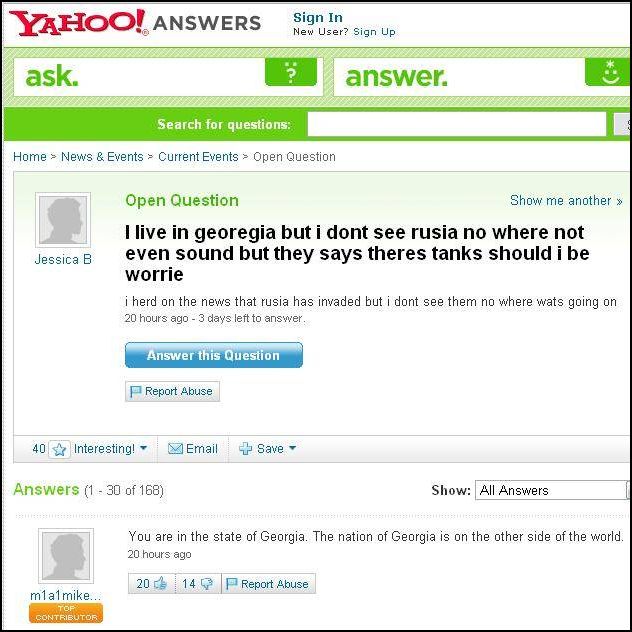
"I live in georegia but i dont see rusia no where not even sound but they says theres tanks should i be worrie"
Philips Cinema One : Impress your girlfriend! :)
"It’s a complete home-theater system… yup, believe you me when I say complete! This is all a DVD player, and MP3 player and iPod dock, a five-channel amp, six speakers and a sub-woofer built into the base. All that fits in all it’s soccer-sized glory. YES… YES… YES!"
Official Zack and Miri US Poster Is Here!
On the Beatles Remasters and Compilations
Charles Darwin to receive apology from the Church of England for rejecting evolution
"Charles Darwin: 200 years from your birth, the Church of England owes you an apology for misunderstanding you and, by getting our first reaction wrong, encouraging others to misunderstand you still. We try to practise the old virtues of 'faith seeking understanding' and hope that makes some amends."
Michael Tomasky: Born in the USA
"So you see, I don't sneer at people like Sarah Palin from a snobby foreigner's perspective. I abhor everything about her as a red-blooded and patriotic American. She wouldn't know the actual meaning of the phrase, the actual responsibilities of genuine patriotism, in a million years."
Katie Price: Really, Really, Big in Britain
"In the future, everyone will be famous for blah blah blah — you’ve heard that one — and now here is yet another account of someone who is famous for being famous, albeit one who has transcended the genre. It’s not too late to stop reading and turn to the article about wind farms."
Charlie Kaufman: The Complete Interview
"Apologies for breaking the chronology, but it took us a while to get this together. Below (or in this case above -- Stu), audio of my (meaning the Wired correspondent's) complete 2.5-hour-or-so interview with Kaufman, which took place on August 13. I wasn't sure what to expect going in, but as you'll see, Kaufman was an incredible interview—generous, candid, and funny. This conversation provided the bulk of the material for my draft. (NB: Kaufman is not involved with this blog in any way, but was kind enough to grant us permission to post this interview. It has been very lightly edited.)"
Kivalina, Alaska: A Melting Village
"It's been an incredible three or four years," says Colleen Swan, the tribal administrator for Kivalina's Inupiat residents, Alaska Natives who make up 97 percent of the town's population. "You think you've addressed a problem, then something else happens that you didn't expect. No matter what our volunteers did, the ocean sucked it away as if it were coming after us."
The Future Apocalypse Will Be Formal Dress Only
Where Are They Now?
"It's weird. You can get caught up in the ebb and flow of this business and it may not occur to you that, say, Neve Campbell hasn't been around lately. I miss her. I interviewed her in early 2004, just after Robert Altman's The Company came out. That was a masterful film, a great piece of work, on which Neve had writing and producing credits. It looked like she was really going places: from there, she was poised to play the great silent film star Louise Brooks in a biopic. I saw her again in James Toback's twisted When Will I Be Loved, which I liked more than just about anyone else. "
"I live in georegia but i dont see rusia no where not even sound but they says theres tanks should i be worrie"
Philips Cinema One : Impress your girlfriend! :)
"It’s a complete home-theater system… yup, believe you me when I say complete! This is all a DVD player, and MP3 player and iPod dock, a five-channel amp, six speakers and a sub-woofer built into the base. All that fits in all it’s soccer-sized glory. YES… YES… YES!"
Official Zack and Miri US Poster Is Here!
On the Beatles Remasters and Compilations
Charles Darwin to receive apology from the Church of England for rejecting evolution
"Charles Darwin: 200 years from your birth, the Church of England owes you an apology for misunderstanding you and, by getting our first reaction wrong, encouraging others to misunderstand you still. We try to practise the old virtues of 'faith seeking understanding' and hope that makes some amends."
Michael Tomasky: Born in the USA
"So you see, I don't sneer at people like Sarah Palin from a snobby foreigner's perspective. I abhor everything about her as a red-blooded and patriotic American. She wouldn't know the actual meaning of the phrase, the actual responsibilities of genuine patriotism, in a million years."
Katie Price: Really, Really, Big in Britain
"In the future, everyone will be famous for blah blah blah — you’ve heard that one — and now here is yet another account of someone who is famous for being famous, albeit one who has transcended the genre. It’s not too late to stop reading and turn to the article about wind farms."
Charlie Kaufman: The Complete Interview
"Apologies for breaking the chronology, but it took us a while to get this together. Below (or in this case above -- Stu), audio of my (meaning the Wired correspondent's) complete 2.5-hour-or-so interview with Kaufman, which took place on August 13. I wasn't sure what to expect going in, but as you'll see, Kaufman was an incredible interview—generous, candid, and funny. This conversation provided the bulk of the material for my draft. (NB: Kaufman is not involved with this blog in any way, but was kind enough to grant us permission to post this interview. It has been very lightly edited.)"
Only Connect.
TV Victoria Coren looks incongruous sitting behind a desk presenting BBC4′s new panel game, Only Connect. That’s because, with the exception of Balderdash and Piffle, all of her other television work is either playing or presenting poker games.
Maybe it just seems odd because she’s holding big question cards instead of the usual slightly smaller playing cards, or I’m too used to seeing her flouncing around searching for or justifying word definitions. Either way, she’s a more genial and forgiving questioner than Jeremy Paxman in the most intellectually stimulating half hour quiz show since University Challenge.
Actually, the closer touchstone is probably the impossibly difficult questions found in the 1970s heyday of this sort of thing in Top of the Form or Ask The Family. The format is fairly simple. Two teams take it in turns to try and work what links four words, pictures or pieces of music before the time runs out. The twist is the answers require some lateral thinking; in one round you’d need to know the pilots of the first three Thunderbirds and in which order so that you could name the fourth one, or what Bertrand Russell looks like and that he unsuccessfully ran for parliament.
BBC4 have been experimenting with this kind of programme for years, their equivalent of Radio 4′s Round Britain Quiz. But unlike Never Mind the Full Stops (too smug) and The Book Quiz (too exclusive), Only Connect enlists shlobs like us rather than celebrities, and there is a genuine competition with a title at the end. The teams are collected together through some shared interest – in the opening episode that was knitting or, um, not being psychologists. Each is asked to introduce themselves at the opening, and fans of nervous banter were well served by a moment in which Vicky asked one of the contestants if the jumper she was wearing was homemade, only to be told that it’s not called that any more.
Perhaps my brain’s gone soft after years of watching quizzes based on multiple choice questions, but much of the time the answer was hidden in the dark recesses of my brain, but only seemed to surface at just the moment after it had been given on screen. I did know Shakespeare’s seven ages of man, but floundered when faced with the final round in which the names of series of mathematicians were flashed up, sans vowels and with the spaces messed up. In other words, imagine A Question of Sport if the contestants were being asked about Ayn Rand rather than Ronaldo. And instead of a numbers board they had to choose from letters of the Greek alphabet. That last bit’s not a joke, by the way, in this quiz you really did need to know your alphas from your zetas before even being given a chance to ponder anything.
Which is probably why I enjoyed it so much. It requires a modicum of intelligence, not just from the viewer but the contestants themselves. Beat that In it to Win It.
Maybe it just seems odd because she’s holding big question cards instead of the usual slightly smaller playing cards, or I’m too used to seeing her flouncing around searching for or justifying word definitions. Either way, she’s a more genial and forgiving questioner than Jeremy Paxman in the most intellectually stimulating half hour quiz show since University Challenge.
Actually, the closer touchstone is probably the impossibly difficult questions found in the 1970s heyday of this sort of thing in Top of the Form or Ask The Family. The format is fairly simple. Two teams take it in turns to try and work what links four words, pictures or pieces of music before the time runs out. The twist is the answers require some lateral thinking; in one round you’d need to know the pilots of the first three Thunderbirds and in which order so that you could name the fourth one, or what Bertrand Russell looks like and that he unsuccessfully ran for parliament.
BBC4 have been experimenting with this kind of programme for years, their equivalent of Radio 4′s Round Britain Quiz. But unlike Never Mind the Full Stops (too smug) and The Book Quiz (too exclusive), Only Connect enlists shlobs like us rather than celebrities, and there is a genuine competition with a title at the end. The teams are collected together through some shared interest – in the opening episode that was knitting or, um, not being psychologists. Each is asked to introduce themselves at the opening, and fans of nervous banter were well served by a moment in which Vicky asked one of the contestants if the jumper she was wearing was homemade, only to be told that it’s not called that any more.
Perhaps my brain’s gone soft after years of watching quizzes based on multiple choice questions, but much of the time the answer was hidden in the dark recesses of my brain, but only seemed to surface at just the moment after it had been given on screen. I did know Shakespeare’s seven ages of man, but floundered when faced with the final round in which the names of series of mathematicians were flashed up, sans vowels and with the spaces messed up. In other words, imagine A Question of Sport if the contestants were being asked about Ayn Rand rather than Ronaldo. And instead of a numbers board they had to choose from letters of the Greek alphabet. That last bit’s not a joke, by the way, in this quiz you really did need to know your alphas from your zetas before even being given a chance to ponder anything.
Which is probably why I enjoyed it so much. It requires a modicum of intelligence, not just from the viewer but the contestants themselves. Beat that In it to Win It.
helpful and apologetic

Back on the Public Art Collections in North-West England (by Edward Morris) campaign trail and to Blackpool. The Grundy Art Gallery in its present form was opened in 1911 and is named after the family of benefactors who motivated its foundation. Cuthbert and John Grundy were both amateur artist sons of Thomas, a local solicitor. Regular readers will note that these museums are usual set up local businessmen (Edward does too) though their inheritance was enough to sink £2000 towards the building costs, and further funds in 1938 to aid the building of an extension and two more display rooms. They’re commemorated by two busts in the entrance hall by John Millard, the picture(or in this case bronze) of Edwardian gents. One was a gift from John to his brother and the plaque reads ‘a token of fraternal affection and esteem’ – the other a retirement present I think.
So much I read on the train and saw for myself when I got there. Because this is where this review parts company with being a review since – um – the main display galleries were closed for refurbishment. Again. Or again as in again I’ve managed to reach one of these places when the decorators are in. I did check the website this time, but this information isn’t on the main page or the one with visitor information but rather for current exhibitions. Apparently there’s a disconnect between what the gallery ask to put up on the website and what’s actually uploaded by the local council, but a new website up dated by the gallery itself is soon forthcoming so that should be sorted out. But not quickly enough for me not to walk through the front door, see the A-ladder, the blankets on the floor and get a sinking feeling, confirmed by the attendant on the counter.
He was very helpful and apologetic and seems to also be the person who helps if not designs the shows when they’re on. He explained that on a good day (in other words in a fortnight when the refurbishment is due to be completed . . . so close . . .) only a fraction of the permanent collection is on show because rather than have a static display, the painting and sculpture selections are themed. Previously I’ve railed against this kind of thing, but lately I’ve come to the conclusion that if you do only have a couple of rooms to play with but a largish collection, it not only allows you to illuminate aspects of your holdings that might otherwise be ignored but also motivates repeat visits amongst your audience, who might otherwise stay away from a static some might say stagnant display.
I did manage to see one old: on the stairwell, attributed to John Everett Millais is The Pillar Box, in which a late-Victorian lady surreptitiously posts a letter, her eyes fixed ahead, as though trying to hide this secret missive. The atmosphere is suitably Dickensien, with ghostly figures loitering in darkened streets. Also at present in bijou upstairs gallery (though also undocumented by the website) is a small exhibition of images by photographer John Gay, of Blackpool in 1949. Originally taken for Country Fair Magazine, they’re a brilliant snapshot of the town at its prime, the beaches filled with holiday makers, either snoozing in the sun or oddly, being ministered to by The Salvation Army (there’s a shot of them teach the crowd to sing ‘All Things Bight and Beautiful’).
What strikes you immediately is that almost all of the shots have the tower in them somewhere, looming in the background, impressively underscoring the identity of the place (without, these beach scenes could have been taken anywhere along the coast). After I left the gallery, promising to return when it was fully opened, I walked towards the tower to have another look. Like the St John’s Beacon in the Liverpool it dominates the landscape though I’m inevitably and unfairly going to prefer the Eiffel. This seems a bit unloved in comparison and costs a whopping £17 to visit (though that does include the circus). Having spent my train fair going somewhere but ending up nowhere, I decided instead to content myself with marvelling at it from the outside:

tasted like oily chicken

Liverpool Life I’ve just spent the morning and lunchtime at the launch of the Liverpool's Food & Drink Festival '08 which as you can see is at Sefton Park and within walking distance of home. Most of the main restaurants and café’s are represented with free samples galore. Diet out of the window, I proved definitively that there is such a thing as a free lunch, with lamb and beef burgers, pizza, cake, pan au chocolate, strawberries and cream all passing my lips, washed down with Fijian water which according the short lecture I was given by the stall holder is the cleanest in the world, untouched by human hand from aquifer to bottle.
I’m no Chez Pim, but there wasn’t anything too objectionable except perhaps for the stewed goat which tasted like oily chicken and had the consistency of lamb shank. It’s a wonder I haven’t got indigestion. Of course the problem with actually living above something like this, is that even when you’ve trotted away for the sake of your own health, it’s still temptingly within your own eyeline. Dare I risk returning later? Perhaps I'll just curl up with my goody bag, all Jacobs crackers and Green and Blacks chocolate topped off with green tea. Yum.
originally a caveman
feeling listless finds
I've been trying to decide what to do with the tumblr for months, and finally I've decided to turn it into a place to gather any videos and the like. In other words, use it properly. So that's somewhere else for you to subscribe to, because I'll not be repeating anything here. It's like an alternate multimedia reality. Latest video? Matt Damon: "I want to know if she believes there were dinosaurs four thousand years ago..."
Archrs - an everyday story of web development
The every day story of country folk turned into an astonishing web-based interactive drama without changing a word.
Play With Spider
For those of you missing La Princess.
Soundtracked - "Death Race" by Paul Haslinger
Brutally honest blog post from the composer for P.W.S.A.'s new film, which demonstrates how far along in the creative process it is that the music is conceived. John Ottman's talked about this very subject. Elsewhere, Charlie Kaufman directs.
Google News farce triggers Wall Street sell-off
I think as people reliance on the web for information rather than human contact intensifies, the regularity of this kind of thing will increase.
Steven Soderbergh working on Liberace film and wants Michael Douglas
Which is precisely why I love Soderbergh. I can't think of a single predictable career choice he's made.
Michelle Obama Interview: Her Father's Daughter
"Eventually I thought, This is a smart man with a good heart, and if the only reason I wouldn't want him to be president is that I'm married to him, no, I can't be that selfish.''
Jerome Bixby's Man From Earth
It's not often I'll unreservedly recommend a film, but Man From Earth is special. It's a low budget fantasy tale in which a man draws together all of his university colleagues out to his wood cabin just before he leaves forever and tells them that he was originally a caveman and has lived for fourteen thousand years. Their reaction is as you'd expect, but over the following eighty odd minutes the details of the man's possible life are laid out and through some great performances and writing from the late Bixby (he finished the script on his death bed) you begin to question what's possible. This is intelligent sci-fi of the kind which is rare in movies these days, questioning genetics and belief systems and in places has crystallised answers to some of the intellectual questions I've been wrestling with for the past few years. The cast includes the likes of Tony Todd and John Billingsly and a stunningly good David Lee Smith as the potential cro-magnan. It's K-PAX without the showboating.
I've been trying to decide what to do with the tumblr for months, and finally I've decided to turn it into a place to gather any videos and the like. In other words, use it properly. So that's somewhere else for you to subscribe to, because I'll not be repeating anything here. It's like an alternate multimedia reality. Latest video? Matt Damon: "I want to know if she believes there were dinosaurs four thousand years ago..."
Archrs - an everyday story of web development
The every day story of country folk turned into an astonishing web-based interactive drama without changing a word.
Play With Spider
For those of you missing La Princess.
Soundtracked - "Death Race" by Paul Haslinger
Brutally honest blog post from the composer for P.W.S.A.'s new film, which demonstrates how far along in the creative process it is that the music is conceived. John Ottman's talked about this very subject. Elsewhere, Charlie Kaufman directs.
Google News farce triggers Wall Street sell-off
I think as people reliance on the web for information rather than human contact intensifies, the regularity of this kind of thing will increase.
Steven Soderbergh working on Liberace film and wants Michael Douglas
Which is precisely why I love Soderbergh. I can't think of a single predictable career choice he's made.
Michelle Obama Interview: Her Father's Daughter
"Eventually I thought, This is a smart man with a good heart, and if the only reason I wouldn't want him to be president is that I'm married to him, no, I can't be that selfish.''
Jerome Bixby's Man From Earth
It's not often I'll unreservedly recommend a film, but Man From Earth is special. It's a low budget fantasy tale in which a man draws together all of his university colleagues out to his wood cabin just before he leaves forever and tells them that he was originally a caveman and has lived for fourteen thousand years. Their reaction is as you'd expect, but over the following eighty odd minutes the details of the man's possible life are laid out and through some great performances and writing from the late Bixby (he finished the script on his death bed) you begin to question what's possible. This is intelligent sci-fi of the kind which is rare in movies these days, questioning genetics and belief systems and in places has crystallised answers to some of the intellectual questions I've been wrestling with for the past few years. The cast includes the likes of Tony Todd and John Billingsly and a stunningly good David Lee Smith as the potential cro-magnan. It's K-PAX without the showboating.
well, sexy
Music I felt rather disconnected from the Last Night of the Proms tonight having spent the past month missing everything. I just simply failed to be excited by some of the programming for a few weeks at the beginning of August, didn't listen for a stretch and then got out of the habit. I felt ... as though I hadn't earned it, like one of those people who don't go to anything else but manage to grab a ticket for last night through the morning clearing service. There's no doubt though that it's rekindled my appreciation and I'm very thankful that I still record all of the televised concerts and I'll be able to catch up on at least some of the things I've missed.
I've not heard Beethoven's Fantasia in C minor for piano, chorus and orchestra, 'Choral Fantasy' before and as suggested by the very ill at ease Clive Anderson (who seemed to spend most of the broadcast with the same look in his eye as he gave Barry Gibb when the Bee Gee walked off the set of his chatshow) I could see the similarities with the 9th, almost a synopsis for the longer piece. Coincidentally his Piano Concerto 4's just truned up on my mp3 player and I can't think of anything that man composed that I don't like.
Special mention has to be made for Anna Meredith's froms, which could have been a rerun of the Harrison Birtwhistle/Panic incident, but because of its ambition, spreading the sound across the various sites simultaneously was clearly the best non-tradition moment of the night, just fascinating. The interview between Meredith and Suzy Klien was fun too, entirely knocking down the expectation that composers can be stuffy and rather over serious when talking about their music. Anna was as excited as you'd hope she'd be to hear how the piece turned out and well, sexy. If that's not the kind of thing which is going to drag me back to classical music, nothing is.
I've not heard Beethoven's Fantasia in C minor for piano, chorus and orchestra, 'Choral Fantasy' before and as suggested by the very ill at ease Clive Anderson (who seemed to spend most of the broadcast with the same look in his eye as he gave Barry Gibb when the Bee Gee walked off the set of his chatshow) I could see the similarities with the 9th, almost a synopsis for the longer piece. Coincidentally his Piano Concerto 4's just truned up on my mp3 player and I can't think of anything that man composed that I don't like.
Special mention has to be made for Anna Meredith's froms, which could have been a rerun of the Harrison Birtwhistle/Panic incident, but because of its ambition, spreading the sound across the various sites simultaneously was clearly the best non-tradition moment of the night, just fascinating. The interview between Meredith and Suzy Klien was fun too, entirely knocking down the expectation that composers can be stuffy and rather over serious when talking about their music. Anna was as excited as you'd hope she'd be to hear how the piece turned out and well, sexy. If that's not the kind of thing which is going to drag me back to classical music, nothing is.
Something In The Water.
 Books I wasn’t quite sure what to expect from a Torchwood novel. Spin-off books if they’ve been publishing for long enough tend to develop a format of their own away from their original property, especially in the case of television tie-ins where the story will inevitably be longer than the average television episode. In Doctor Who, the best authors, even when writing about a past version of the Time Lord, often enjoy the opportunity to be fairly experimental, taking advantage of the flexibility of the format. If Trevor Baxendale’s novel is anything to go by, the approach in Torchwood books is to be as close to the television series as possible.
 A mysterious virus is spreading through the population of Cardiff concurrently with the appearance of an equally mysterious woman and a not quite dead corpse. Much of the novel takes place in either the Hub, a suburban house, a medical centre and some marshland on the outskirts of Cardiff. None of the characters (as is usual in these things) really learns anything and counter to Jack’s annoying tv opening speech nothing changes. There isn’t actually anything wrong with that and certainly fans will probably be well served by what’s here. It’s just that there’s a lack of ambition which ultimately dulls your appreciation of the book.
Spoilers after the jump.
Baxendale isn’t really interested in big dramatic openings. His method is a slow burn, the characters strewn across the city following their own discrete narratives. Bob Strong, an English GP in the mould of A Very Peculiar Practice’s Stephen Daker is visited in his surgery by that mysterious woman, Saskia, an apparently recovering addict who has more on her mind than a simply check up, Jack and Owen chasing the Weevil equivalent of Jaws through a fish factory plus Gwen and Tosh investigating apparitions with one of Jack’s old flames. Regardless of arguments to the contrary between the characters, these threads are eventually tied together through the usual mayhem and co-incidences.
As with much of his Doctor Who writing, Baxendale’s skill lies in characterisation. Considering this was no doubt being written whilst the second series was still in production (the novel’s firmly set betwixt To The Last Man and Meat) he captures the new versions of all of the main cast brilliantly – Ianto’s wisecracks, Owen’s kinder heart, Tosh’s mechanisma, Gwen’s boggle eyed surprise and Jack’s inherent Jackness. The ‘guest cast’ are convincing additions too, particular Dr. Strong who ironically spends most of the novel incapacitated, the divorcee’s poignant sorrow at having no one to look after him and frankly wanting his mummy is a gloomy highlight.
Despite being one of those shouting and running stories, as with some of the best Torchwood episodes, it’s these moments of darkness which work best. Some of the few good scenes in the opening television series are recalled when Gwen realises she’s becoming desensitized by the carnage only for Jack to remind her that even one death has consequences which makes the predicament of the invader, survivor of a dying race something of a grey area. Like our favourite benevolent alien, she’s the last but unlike him, her continued existence threatens our planet and our endurance. Not that these weighty issues ultimately get in the way of the gunplay and jokes about Google and the Wikipedia.
In the end though, like the television series the book fails to find the right tone -- wanting so desperately to be adult without quite being able to commit. Some of this confusion possibly stems from the book having the same format and pagination as the new Doctor Who novels and because of this restricted word length like them it lacks the depth you'd expect for a work aimed at an older age group. Much more could have been said about Saskia, who in the end is less complex there an absence of thematic resonances the influence for which would really give the game away. At some point mysterious becomes anemic and when an infodump finally arrives if you're not too careful it can seem like an afterthought.
Similarly, we hear about the spread of the virus through News 24 and dialogue instead of actually reading about the civilians its effecting – imagine the film Outbreak without those amazing scenes in which we see a victim being processed or for that matter a Doctor Who and the Silurians in which we don't see Masters go to London. Certainly it's more dramatic for the regulars to be at ground zero of the problem but a novel has the facility to go beyond that, to give the story epic scope but instead we're left with the textual equivalent of the Roman Centurion from End of Days representing a global phenomena.
Despite a dramatic conclusion then, everything wraps up rather abruptly and considering everything that’s happened misses a moment of reflection. Unless it’s actually a cliffhanger to be resolved in the next book. But they're not allowed to do that are they?
Torchwood: Something in the Water by Trevor Baxendale
ISBN: 978-1846074370
RRP: £6.99
Release date: 6th March 2008
a few splodges of paint
Art It’s a unique experience seeing a painting of your own home on the wall of an art gallery. Not just my home but hundreds of others, all together, a history of domestic architecture all neatly laid out within the glance of an eye. It's within Ben Johnson’s exciting new vista, Liverpool Cityscape 2008 which was commissioned for our Capital of Culture year and is part of a mini-retrospective of his work at the Walker Art Gallery. Looking at the landscape straight on, our flats are at top right hand corner of the image (not including the sky), just behind the Anglican Cathedral, a speck in the distance. Funny to see the place I've spent the best part of fifteen years rendered in a few splodges of paint.
Johnson’s painting took up to a year, the last part of the endeavour under the watchful eye of gallery visitors. I didn’t visit then – I hate seeing works in progress, the better to soak up the artist’s entire vision and I’m glad I did – the finished product is mind-jangling. Even knowing that these days the artist uses computer models and assistants doesn’t draw away from the sheer amount of visual information in the picture and need to try and find all of the familiar Liverpool landmarks. The point of view Johnson’s selected is above the Mersey looking down on the town; we're briefly guardian angels of our own town, perhaps wondering where all of the people have gone (the only humanity in the painting is the artist’s brush work).
What struck me at least is that for all the pre-publicity about photo-realism, these aren’t documentary images. For a start, Johnson has painted in architecture such as the Museum of Liverpool and Liverpool One as they will be once they’re completed which makes this the look of the city in the near future, perhaps 2010. If there are any changes to these edifices then the image’s reality will become less certain; elsewhere in the exhibition, Walter Richard’s chaotic Modern Liverpool painted in 1907 bravely includes the Anglican Cathedral (not to be finished for another seventy years) with its original two tower configuration eventually simplified for reasons of cost and logistics.
But like all good artists Johnson is also keen emphasising some elements ahead of others for thematic purposes by selecting a particular topographical perspective. In his commission of Jerusalem, we’re looking down on the city from a far higher angle which allows him to include all of the three major holy sites and give them equal weight, the Dome of the Rock, the western-or-wailing wall and the Church of the Holy Sepulcre, having been tasked to produce an image that offers common ground between the three major Abrahamic faiths. We look at Hong Kong from lower down so as to emphasise the verticals of the city, sky-scrapers piercing the sky to the point that with the exception of piece of motorway ground level has gone, engulfed by greenery.
Liverpool is the most complex of the lot. Johnson seems to have decided to highlight those buildings that are part of the ‘gap toothed’ Liverpool skyline – the two cathedrals, St. John’s Beacon and the three graces, plus some of the new additions. From what I can see in order to do that he’s increased the curvature of the Earth so that the Anglican and Metropolitan loom over the city (which they do in reality, but not to this extent) and actually appear far further apart making Hope Street rather longer than it actually is. He also makes some details, such as the suburbs rather abstract and anonymous – I’d be interested to know if anyone living Toxteth way can pick out their home as well as I can. Of course, my sky line view of the city is from the opposite direction so is naturally going to be skewed, but if Ben Johnson’s to be congratulated its for creating a modern landscape that force us to question not just its content, but his technique as well.
Johnson’s painting took up to a year, the last part of the endeavour under the watchful eye of gallery visitors. I didn’t visit then – I hate seeing works in progress, the better to soak up the artist’s entire vision and I’m glad I did – the finished product is mind-jangling. Even knowing that these days the artist uses computer models and assistants doesn’t draw away from the sheer amount of visual information in the picture and need to try and find all of the familiar Liverpool landmarks. The point of view Johnson’s selected is above the Mersey looking down on the town; we're briefly guardian angels of our own town, perhaps wondering where all of the people have gone (the only humanity in the painting is the artist’s brush work).
What struck me at least is that for all the pre-publicity about photo-realism, these aren’t documentary images. For a start, Johnson has painted in architecture such as the Museum of Liverpool and Liverpool One as they will be once they’re completed which makes this the look of the city in the near future, perhaps 2010. If there are any changes to these edifices then the image’s reality will become less certain; elsewhere in the exhibition, Walter Richard’s chaotic Modern Liverpool painted in 1907 bravely includes the Anglican Cathedral (not to be finished for another seventy years) with its original two tower configuration eventually simplified for reasons of cost and logistics.
But like all good artists Johnson is also keen emphasising some elements ahead of others for thematic purposes by selecting a particular topographical perspective. In his commission of Jerusalem, we’re looking down on the city from a far higher angle which allows him to include all of the three major holy sites and give them equal weight, the Dome of the Rock, the western-or-wailing wall and the Church of the Holy Sepulcre, having been tasked to produce an image that offers common ground between the three major Abrahamic faiths. We look at Hong Kong from lower down so as to emphasise the verticals of the city, sky-scrapers piercing the sky to the point that with the exception of piece of motorway ground level has gone, engulfed by greenery.
Liverpool is the most complex of the lot. Johnson seems to have decided to highlight those buildings that are part of the ‘gap toothed’ Liverpool skyline – the two cathedrals, St. John’s Beacon and the three graces, plus some of the new additions. From what I can see in order to do that he’s increased the curvature of the Earth so that the Anglican and Metropolitan loom over the city (which they do in reality, but not to this extent) and actually appear far further apart making Hope Street rather longer than it actually is. He also makes some details, such as the suburbs rather abstract and anonymous – I’d be interested to know if anyone living Toxteth way can pick out their home as well as I can. Of course, my sky line view of the city is from the opposite direction so is naturally going to be skewed, but if Ben Johnson’s to be congratulated its for creating a modern landscape that force us to question not just its content, but his technique as well.
Elsewhere I've reviewed today's radio Torchwood. The episode is also also available to download here for the next seven days.
Superlambanana-on-and-on #9

The End. Seventy of the lambs were on display at St. Goerge's Hall plateau yesterday and today ahead of the final auction (average guide price about £3000). I managed to pick off some that I missed because they were in far off places like the Wirral (!) or Speke (?). The plateau was packed with people, many like me taking those final shots to try to complete the set, though I somehow managed in my photographs to make the place look emptier than it really was.
Some will no doubt choose the spider, but I think the Superlambananas will be '08s great legacy. They've managed to bring people together, not just in terms of community groups in the creation of the pieces, but in visiting and photographing them, seeing people like me with the maps or Echo supplements seeking them out. You saw that today. There was a genuinely good atmosphere, with people laughing and largely waiting patiently for their turn. I wonder how many will be back on the streets in a few weeks, having been bought up by people without a thought as to were to put them.
They'll need a very big garden.
two covers and a spine
Check Out Zac Efron's New Look in 'Me and Orson Welles'
Richard Linklater's latest film which I have somehow missed, even though it's directed by him and features Claire Danes and is about Mr. Welles. Though this is much the same thing as happened with Before Sunset so I shouldn't be too surprised. I am delighted though, and early reviews are good. Meanwhile, Baz's new treat is being trailed and Guillermo is making a film about Charles Dicken's last few months. Which knowing him, shouldn't look too dissimilar to this.
Anthony Edwards Scrubs Back in at ER
I stopped watching ER years ago -- the storylines were becoming repetitious and desperate and damn I just missed the original cast. But I might just catch up if the final season's trying to rekindle the old magic.
The RSC's King Lear with Ian McKellen, Frances Barber & Sylvester McCoy is coming to dvd.
Are you hoping what I'm hoping?
Cyrano de Bergerac
New film with Kevin Kline as Cyrano and Jennifer (shucks) Garner as Roxanne based on a stage version.
"Read ... read ... READ! I meant READ!!"
Matthew makes a confession...
Rick or treat?
Astley is asked about rolling.
Unofficial Torchwood Series Guide Copies from Fan Journals
Actually that should be 'quoted from'. I'm in there too again (from here), but some livejournalers seem to have missed the point and are braying for -- well it's not entirely clear what. I write for fun and am just happy to see my work quoted in something which has two covers and a spine and can be bought in the shop and be read by a much larger audience than on the web. It's a pity these people can't see it the same way.
Hoodies beware: Kelly Reilly takes revenge in Eden Lake
“I've gone from being a normal woman who cares for children to someone who will kill any kid that comes near me!” she says. “There are no f***ing boundaries any more.”
Milky Way's black hole seen in new detail
The appearance of an average spacial anomaly from Star Trek: The Next Generation proved realistic.
Huge tribute to Lenin visible on Google Earth
"The message, which translates as "Lenin is 100", was cut into a forest in a remote region of Siberia. Each letter is around 80 metres high, and the entire message stretches for 600 metres."
Beauty and the Beast
Which looks like Doctor Who as directed by Tinto Brass.
Your Pocket Guide To Speaking Palinguage (Vol. 1)
McCain's pulled ahead slightly in the polls, but I think it is just convention bounce and won't last too long. It won't end in tears. Especially if there are enough of these around ...
Richard Linklater's latest film which I have somehow missed, even though it's directed by him and features Claire Danes and is about Mr. Welles. Though this is much the same thing as happened with Before Sunset so I shouldn't be too surprised. I am delighted though, and early reviews are good. Meanwhile, Baz's new treat is being trailed and Guillermo is making a film about Charles Dicken's last few months. Which knowing him, shouldn't look too dissimilar to this.
Anthony Edwards Scrubs Back in at ER
I stopped watching ER years ago -- the storylines were becoming repetitious and desperate and damn I just missed the original cast. But I might just catch up if the final season's trying to rekindle the old magic.
The RSC's King Lear with Ian McKellen, Frances Barber & Sylvester McCoy is coming to dvd.
Are you hoping what I'm hoping?
Cyrano de Bergerac
New film with Kevin Kline as Cyrano and Jennifer (shucks) Garner as Roxanne based on a stage version.
"Read ... read ... READ! I meant READ!!"
Matthew makes a confession...
Rick or treat?
Astley is asked about rolling.
Unofficial Torchwood Series Guide Copies from Fan Journals
Actually that should be 'quoted from'. I'm in there too again (from here), but some livejournalers seem to have missed the point and are braying for -- well it's not entirely clear what. I write for fun and am just happy to see my work quoted in something which has two covers and a spine and can be bought in the shop and be read by a much larger audience than on the web. It's a pity these people can't see it the same way.
Hoodies beware: Kelly Reilly takes revenge in Eden Lake
“I've gone from being a normal woman who cares for children to someone who will kill any kid that comes near me!” she says. “There are no f***ing boundaries any more.”
Milky Way's black hole seen in new detail
The appearance of an average spacial anomaly from Star Trek: The Next Generation proved realistic.
Huge tribute to Lenin visible on Google Earth
"The message, which translates as "Lenin is 100", was cut into a forest in a remote region of Siberia. Each letter is around 80 metres high, and the entire message stretches for 600 metres."
Beauty and the Beast
Which looks like Doctor Who as directed by Tinto Brass.
Your Pocket Guide To Speaking Palinguage (Vol. 1)
McCain's pulled ahead slightly in the polls, but I think it is just convention bounce and won't last too long. It won't end in tears. Especially if there are enough of these around ...
It's far from perfect.
Life I'm an organiser. I'm not a manager -- which has become apparent on too many occasions -- I'm terrible at delegating and like to do everything myself -- but if a manager asks me to organise something I seem to be very good at it. I like projects, I like making plans and completing them. I like problem solving, puzzling over something which needs accomplishing and working through to the goal.
I suppose this is why I like research too; what I'd really like to be is in a profession where I spend the day answering complex questions with either the internet or a library as my source. The good things about having all of these genes is that when I realise that something needs organising around the house, my librarian tendencies kick in and some time later I'll find a solution.
I've been puzzling for weeks about what to do about my dvds, of which I have many. Not the commercial bought, special editioned, boxsetted oh look I have everything Woody Allen's directed ones -- they've taken care of themselves clinging together in a gap between two book cases on the wall. I'm talking about the many hundreds of films and programmes I've recorded from television sitting in boxes about the place.
The solution, or at least my solution, is to put them in chronological order based on the year in which they're supposed to be set. So with wikipedia and imdb to hand, I've been working through the piles and classifying them by the century, decade or year (depend on how specific a synopsis is) the story, fiction and non-fiction, occurs. That means that some genres are naturally dropping in next to each other, westerns and noirs, Edwardian costume dramas and futurist sci-fi. Fantasy realms are all being put together at the front.
It's far from perfect. Decade spanning bio-pics don't naturally go anywhere so I'm slotting them at the first year featured. Some stories aren't really set in a particular time period, rather a kind of generic sub-universe in which everyone were hats and togas or spurs or macs and carry guns or spears. But if you assume that its the Roman period (turn of the first millenium) or the Wild West (late 1800s) or the great depression or prohibition it sort of works. Plus there are films which cross cut between time periods, either because of flashback structures or something else. And doing things this way spoils a certain M Night Shyamalan film (though obviously unless you haven't seen it which seems to be too many people since it's his best work).
All of which is by way of an excuse as to why I may be blogging light here. It is a gargantuan but worthwhile task which I'm fitting in between attempting to construct a life. In doing it, I've found all kinds of things I'd forgotten I'd recorded and now I'll be able to find again. It's also a chance to catch up on all the music I've not got around to yet, and discover podcasts, something I've missed because of being trapped at 56k up until a month ago. So far: This American Life's a miracle and I've enjoyed the banter between Aleks and Jemima on The Guardian's Tech Weekly. Does anyone else have suggestions as to what else I should be listening to?
I suppose this is why I like research too; what I'd really like to be is in a profession where I spend the day answering complex questions with either the internet or a library as my source. The good things about having all of these genes is that when I realise that something needs organising around the house, my librarian tendencies kick in and some time later I'll find a solution.
I've been puzzling for weeks about what to do about my dvds, of which I have many. Not the commercial bought, special editioned, boxsetted oh look I have everything Woody Allen's directed ones -- they've taken care of themselves clinging together in a gap between two book cases on the wall. I'm talking about the many hundreds of films and programmes I've recorded from television sitting in boxes about the place.
The solution, or at least my solution, is to put them in chronological order based on the year in which they're supposed to be set. So with wikipedia and imdb to hand, I've been working through the piles and classifying them by the century, decade or year (depend on how specific a synopsis is) the story, fiction and non-fiction, occurs. That means that some genres are naturally dropping in next to each other, westerns and noirs, Edwardian costume dramas and futurist sci-fi. Fantasy realms are all being put together at the front.
It's far from perfect. Decade spanning bio-pics don't naturally go anywhere so I'm slotting them at the first year featured. Some stories aren't really set in a particular time period, rather a kind of generic sub-universe in which everyone were hats and togas or spurs or macs and carry guns or spears. But if you assume that its the Roman period (turn of the first millenium) or the Wild West (late 1800s) or the great depression or prohibition it sort of works. Plus there are films which cross cut between time periods, either because of flashback structures or something else. And doing things this way spoils a certain M Night Shyamalan film (though obviously unless you haven't seen it which seems to be too many people since it's his best work).
All of which is by way of an excuse as to why I may be blogging light here. It is a gargantuan but worthwhile task which I'm fitting in between attempting to construct a life. In doing it, I've found all kinds of things I'd forgotten I'd recorded and now I'll be able to find again. It's also a chance to catch up on all the music I've not got around to yet, and discover podcasts, something I've missed because of being trapped at 56k up until a month ago. So far: This American Life's a miracle and I've enjoyed the banter between Aleks and Jemima on The Guardian's Tech Weekly. Does anyone else have suggestions as to what else I should be listening to?
Subscribe to:
Posts (Atom)