Pocket Posh® William Shakespeare: 100 Puzzles and Quizzes by The Puzzle Society.


Even for the seasoned Shakespearean the idea of a quiz or puzzle book dedicated to the canon is a fairly intimidating prospect (fairly?).  Most of us probably know some of the plays very well, the tragedies and comedies most often produced and everything else as a vague recollection. How do you produce something which is accessible enough to be enjoyable for a general audience and distracting enough for scholars?

Apart from some straight quizzes, the Pocket Posh® William Shakespeare’s main approach is to present a series of puzzles that can mostly be completed without an extensive knowledge of the plays. The crosswords have a series of shaded boxes that will spell out a play or character once the grid is completed. Word searches, kriss krosses and code crackers list Shakespeare related words to be fitted in or found.

I went straight to the quizzes, which were indeed quite tricky, some questions asking for events in specific years which I think scholars are still arguing about. But I managed an (in my head) respectable 16/25 which included a guess for one of the posers on page one hundred and twenty-four the basis for which looks factually incorrect to me or at least is open to greater discussion than presented in the totality of the answer.

Which is the other danger with Shakespearean trivia – even the very language of the plays is hotly contested especially if there’s more than text being worked from. So it probably is just as well that behind the attractive wrap around cover, the bulk of the other clues in the book – for the crosswords – are far less ambiguous mostly consisting of straight general knowledge questions that we all have a shot at answering.

Pocket Posh® William Shakespeare: 100 Puzzles and Quizzes' by The Puzzle Society is published by Andrews McMeel. £5.99. ISBN: 9781449401252. Review copy supplied.

can't be a sustainable business model

Commerce Even though I don't drink much wine, one of my pleasures is visiting Oddbins to buy a bottle as a present for other people. My selection process has been honed over many years and is based on a simple premise -- does it have an interesting label?  The customer service is always of an extremely high standard. When I was last in Allerton Road, I happened to mention the purchase was for my mother's birthday and the vinter offered to gift wrap it for me, which he did with lots of frills and bows and the kind of artistic commitment not seen since Michelangelo lay on his back for four years, wiping paint and dust from his beard.

But the chain is in trouble thanks to big discounts by supermarkets and the bargain off licenses and a less discerning public pallet and though the Allerton Road shop is safe, they're closing the outlets on Bold Street and Castle Street as they cut back their total number of shops by a third.  This leaves, because of further closure in Formby and the Wirral, the Allerton Road branch as the only Oddbins on Merseyside.  I'm not that surprised. These are never busy shops, though when I asked one of the vintners about that they suggested I visit on a weekend evening and see the queues.  But that can't be a sustainable business model, and as it turns out isn't.

three videos of women doing brilliant things

That Day Because I'm lacking in inspiration, here are three videos of women doing brilliant things since it's International Women's Day.

Firstly, Hotpants Romance delivering a gig to a string of answering machines:


Something from poet Lana Citron:


And Jane Bond, because it's important:

a speculation frenzy in the wrong hands


Books Despite having read a few biographies of Shakespeare over the past few years, for some reason I never quite tire of them because like productions of his plays, they all seem to contain at least one memorable element which separates it from the rest, be it some new discovery or stylistic decision or approach to the material. Turn to the dedication page of F. E. Halliday’s Shakespeare: a pictorial biography and we find “To: BARBARA HEPWORTH in Friendship And Admiration”. As well as a Shakespeare scholar, he was a close friend of the St Ives circle after spending a year there during the second world war, a residency he later made permanent.

So the book is perhaps as interesting now for the biography of the author as the contents. But originally published in 1956 (this is a later book club reprint) it’s still nonetheless a fascinating read, not least because it’s less interested in the writing of the actual plays (which can be a speculation frenzy in the wrong hands) and spends much of its pagination offering a detailed context of the world in which the plays were written and performed. Viewing the canon in isolation, it’s easy to forget that Shakespeare’s career began at just the moment Mary Queen of Scots lost her head and the Spanish Armada.

Halliday also lucidly explains how the form of theatre Shakespeare employed developed from the first definable comedy (Ralph Roister Doister) and first definable tragedy (Gorboduc), both originally written to be performed by the boys of Eton. He argues that the reason Shakespeare gained such notoriety was because at his peak, no one else was writing with his quality and that it wasn’t until he reached semi-retirement that other playwrights found their voice. He also explains with clarity why the Globe is the shape it is: a mix of the traditional circular auditorium used previously for religious plays and the yards at the back of inns with their balcony viewing.

What kept me reading though was the obvious enthusiasm Halliday has for his subject (which isn’t always the case with some scholars). “No other writer has ever created a comparable company of men and women, humble and exalted, grave and gay, comic and tragic, noble and ignoble” he says before filling out the rest of that paragraph with a list of names (which fails to include anyone from Measure for Measure but I’ll forgive him that). On a few occasions his textual analysis amounts to printing a chunk of verse and pointing a lot in the way that some DJs offer their favourite tune with little to no explanation because, as is so often with Shakespeare, none is necessary.

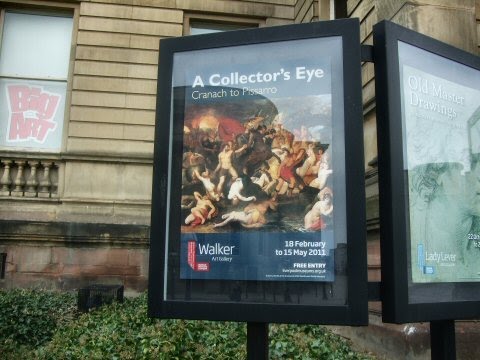
the Walker’s latest exhibition, A Collector’s Eye: Cranach to Pissarro, also intertwines these twin values


Art Watching as many television antiques programmes as I somehow do, I couldn’t fail to recognise Tim Wonnacott walking towards me at the Walker Art Gallery this morning. He was presumably visiting with a film crew for the next series of Bargain Hunt but was gone before I had a chance to ask him one of those questions I’ve often idled away at when I see otherwise professional dealers and auctioneers presenting these educational inserts for shows that would otherwise amount to just buying and selling. How do they switch it off or more precisely, can they visit art galleries and museums and enjoy the objects for the aesthetic qualities without attempting to size up their monetary value as well?

Coincidentally, the Walker’s latest exhibition, A Collector’s Eye: Cranach to Pissarro, also intertwines these twin values. This is a selection of pictures from the four hundred strong Schorr Collection, which has been assembled by collector David J Lewis over the past thirty-five years.  It's the kind of private haul which in earlier times could have been amassed by some local businessman and, through loan, donation or bequest might have been the basis for many of the collections of the many regional museums and art galleries I’ve visited in the past few years.  Lewis's taste, as the subtitle for the exhibition suggests, is for 15th-century devotional images and 19th-century French Impressionist landscapes.

As I think we discovered when I opened up my collection a couple of weeks ago, more than film and music, but not unlike food, most of us have very specific tastes when it comes to art and mine don’t quite match Lewis’s which meant the first half of the visit was a bit disappointing.  Most of these large canvases are very skilfully painted and colourful but left me feeling curiously blank no matter the pain and suffering some of them depict (cf, Cranach's Lamentation over dead Christ). But wanting to draw something from the experience, knowing Wonnacott was talking enthusiatically to camera somewhere in the building and inspired by the Walker’s request for us to think about the kinds of paintings we’d like in our own collection I hatched a plan.

I decided to pretend that Lewis had put all of these paintings up for sale and that with the infinite pretend funds that were now making my pockets bulge I could take one of his paintings home with me. Now the question wasn’t “Do I like this?” it was “Would it fit on the wall of the huge invisible mansion I’ve just acquired?” After strolling about a bit more and stroking my imaginary moustache, I decided that actually my vast fortune was large enough that I could treat myself and that really I should have two paintings. So I lifted François Marius Granet’s Interior of the Capuchin Monastry, Rome and Louis-Auguste-Gustave Dore’s Scottish Landscape into my trolly and headed for the tills.

It’s the lighting which stands out in the Granet, the painter skilfully building the scene from autumnal yellows and browns, the shapes on the curved walls of the monastery and the cowls of the figures defined by greays and blacks not unlike the cinematographer Gordon Willis, who was nicknamed the prince of darkness for his similarly dark photography in The Godfather. There’s also a curious amount of action in what should be a relatively static scenes, the friars depicted in various states of prayer some more energetic than others. In the accompanying catalogue we also discover that the painting is more accessible than most since the artist painted many versions, often with slight variations – some even include nuns.

Dore’s landscape has some elements which can’t be replicated in photography. A massive panoramic image, depicting a solitary figure in a Scottish wilderness stretching on for miles the artist’s brushwork gives the rocks and trees realistic textures and shading that creates an impression that’s welcoming but tinged with foreboding. He visited the highlands in April 1873 and resolved that most of his work after that would be “reminiscent” of the place – which is why I was drawn to it. Unless I’ve misread the accompanying text, this isn’t from life, it’s from memory and it’s just the kind of fantasy location my little cottage would be in. Though obviously if I really was rich enough I’d gladly give up both images to go and live in that cottage instead.

So I metaphorically put the paintings back on the wall before the thought police came.

in simplest terms

TV As ever with these things, I'm recording the whole series of Dr Brian Cox's Wonders of the Universe so that I can watch them all in one sitting later. Glancing at twitter during the broadcast, in simplest terms, this seems to sum up the content:


And this the reaction:


Can't wait.

The Horatio Project.

"The Horatio Project" was week long experimental residency at Smith College in Northampton, Massachusetts in which a group of students explored Hamlet's dying wish to his friend, to tell his story. Chris Rohman of The Valley Advocate reports:
"I was able to sit in on some of the "Horatio" sessions as an observer and occasional participant. Berkman explained that he was interested in the idea of Horatio-as-biographer because it encompasses multiple themes, including the questions of viewpoint, identity, inclusion and omission, social/political pressures and biases that hover over every attempt at writing a person's—or a nation's—history. As Hamlet was instructed by his father's ghost to "revenge his foul and most unnatural murder," so Horatio is charged by Hamlet, soon to be a ghost himself, to "report me and my cause aright."
In other words, make sure the world doesn't judge me too harshly.

Northern Broadsides production. On Tour.28th Feb until 28th May 2011.

Calling at Newcastle-under-Lyme, Scarborough, Halifax, Aberystwyth, Leeds, Belfast, Isle of Man and Kingston.  The pitch:
“What dreams may come …”

A restless spirit haunts the battlements of Elsinore. The veil between the natural and the supernatural is ripped apart, and a tormented young man teeters on the brink of madness. His choices are stark: revenge or mercy; hope or despair; life or death.

Northern Broadsides’ haunting production, directed by Conrad Nelson, employs theatrical sleight of hand to conjure ghosts of the dead and demons of the mind; bringing you an inventive and insightful take on the tortured Danish Prince.

Renowned for their startlingly fresh approach to Shakespeare and performed by a multi-talented cast of charismatic actors, come and see for yourselves why Northern Broadsides has won a loyal following both nationally and internationally.
Dates are posted at their website.

31 Adrian Lester


Hamlet played by Adrian Lester.
Directed by Peter Brook.

Sometimes when I sit down to record my impressions of these productions, I feel as though its my duty to give them good record because often there isn’t another record at least not one as detailed as I attempt. On this occasions, I’m trumped by Michael Billington of The Guardian, whose 2000 review of the original production at the Bouffes du Nord covers all of the main points and offers few things that I could disagree with so if you’re particularly interested I must direct you there. This isn’t a cop out, I don’t think. Just seems silly to repeat the work of a master, especially when he also includes such good historical context.

This is a very sombre Hamlet. Lester delivers much of his dialogue with a bitter lilt right from the off, his apparent madness minutely modulated to the extent that his familiars notice but we can’t always. What few moments of levity Shakespeare has injected are coldly rendered, the fishmonger becoming a genuine attempt by Bruce Myers’s intellectual Polonius to see inside the prince’s skull. Even when the Gravedigger incongruously sings The Belle of Belfast City, the moment is flooded with irony because Myers is doubling the part, effectively digging his own daughter’s grave having just dug his own.

I agree with Billington that the reason we accept the lack of political context is because unlike other productions what we’re seeing is Brook’s adaptation of the text rather than omission for duration's sake. He’s experimenting, offering a kind of improvisational jazz version of Shakespeare, showing how by moving the speeches or scenes about a whole new set motives and reactions can develop. Certainly with its three available texts and various placements for its most famous speech anyway, the play is perhaps the most malleable and indeed Brook shunts it as late as possible making us wait for the release.

One of the dangers with this approach is to demonstrate how well thought through the original structure is. Like Welles, Brook cuts Laertes completely from the first half of the play and the first inkling we have that Ophelia has a sibling is when he comes thundering in later from who knows where like the tragedy equivalent of a deus ex machina, to bring about the hero’s destruction rather than the usual reverse. When he’s confronted with the tragedy of his sister’s condition, I’m not sure we’re empathising with him, no matter how good Rohan Siva’s performance is because we’ve not seen them together earlier.

Yet over and over Brook surprises.  During the first emergence of the players, Hamlet’s idol’s monologue is offered in full. In Japanese. Which means that for once we really are concentrating on the performance, swept up in the breadth of emotion that Hamlet later envies so that when Lester later cries himself at the thought it’s devastating, particularly given the calculating stoicism he expresses elsewhere.  The Mousetrap later becomes unplugged Noh Theatre and though the speech is recognisably Shakespearean, the shadow of Kurasowa is still evident, as Jeffery Kissoon's often quite broad performance as the King finds a natural home.

Billington’s review is also especially helpful in pointing to some of the difference between the original production and the television presentation I’ve just enjoyed. He mentions a two and half hour duration without interval – BBC Four offered up about two hours ten in 2001, which even accepting edits for scenes changes still leaves a bit of room for omission. Is this where Yorrick and much of the rest of the Gravedigger scene, the spirit of which now remain in Hamlet’s utilisation of two skulls to represent the fate of “his excellent good friends”?

He also notes that the version he saw ended on Horatio and the question “Who’s there?” which on tv was also entirely absent, closing instead on the poignant image of the prince dying with his eyes open after whispering his final epitaph, “The rest is silence”. The former does perhaps speaks more the theatrical experience, directed as it often seems to be to the audience as much as the relief guards. The television production makes full use of the close-up and teasing out in this case the strength of Adrian Lester’s central performance that we can see the lights in his eyes extinguish.
Elsewhere I've reached my thirty-first Hamlet.

Rebellious Subjects Theatre in The Theater at the Tank, New York.4th until 16th May 2011.


The Pitch:
"Rebellious Subjects Theatre brings its lively and eclectic classical work to The Tank in May 2011 with a reimagining of Shakespeare's Hamlet. Using both of The Tank's theaters and the areas in and around as their largest playing space yet, the company delves into a modern world of Elsinore where cameras, both hidden and exposed, surround the players, blurring the boundaries of performance and privacy, exploring the nuances of appearance, deception, exploitation, and action within the world of the play."
Time and ticket details.

What's in a name?

Whilst it's true that the Hamlet we know, both the character and story have their origins in Scandinavia (from Saxo Grammaticus), Dr Lisa Collinson, a medieval Scandinavian expert based at Aberdeen University has found that perhaps the name at least traveled from elsewhere:
"Exploring even earlier, she discovered the name Admlithi (the "d" is silent) in an Irish story entitled The Destruction of Da Derga's Hostel thought to have been compiled in the 8th or 9th century. The tale recounts the story of a king who breaks social taboos and consequently meets a grisly end.

[...]

"The name Amlothi is highly unlikely to be Norse in origin," Collinson said. "There really is no convincing way to explain its form with reference to any known Norse words – although this hasn't prevented fine scholars from trying in the past.

"By contrast, the name Admlithi could certainly have been used by sailors to describe grinding seas, and it's likely that sailors played a critical role in its transmission to Scandinavia. The Icelandic poet Snow Bear was probably a sailor himself."
The story itself is not a new discovery; there is a translation available online and a thorough wikipedia page. But I do like that Dr Collinson's brave attempt to imply an extra connection with the play, that it can't be a coincidence that a character whose name may have its origin in an old Irish word for whirlpool would himself refer to that in his key speech ...
"To be, or not to be, that is the question:
Whether 'tis nobler in the mind to suffer
The slings and arrows of outrageous fortune,
Or to take arms against a sea of troubles,
And by opposing end them."

an air traffic control tower with arms

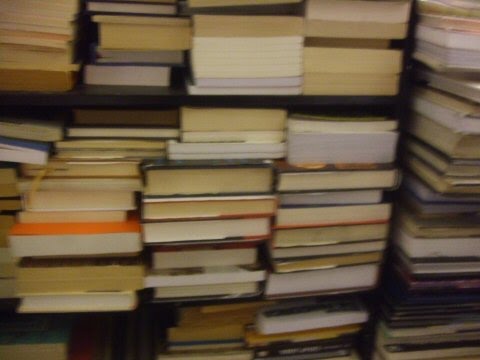
That Day I've been catching up on my reading. A couple of weeks ago I audited all the books on my shelves and made four piles. Books read that I wanted to keep, books read to go, books unread and books unread that I decided I didn't want to.  I discovered, as a result of the exercise, that I actually owned more books that I hadn't read than otherwise. So after rationalising everything I created a backlog to work through, generally in no particular order, leading to this rather murky art project:


I'm working through the oversized volumes first and have discovered that Klimt was a rascal by most accounts, that one of the original concepts for a moon suit looked like an air traffic control tower with arms, Samuel L Jackson's favourite film in 1995 was What's New Pussycat and that Uma Thurman once dodged a early career bullet (pity about the many that hit her later on).  I've also finally finished this Doctor Who novel.  What's next?  Ah, Dr. Fegg's Encyclopeadia of All World Knowledge.  My education continues.

a better second go round

TV After decommissioning Whites and Zen, the BBC have bizarrely confirmed there will be a second series of Episodes.

Generally in the wry smile area of comedy, the first series was only ever laugh out loud funny when directly referencing Friends and Matt LeBlanc's subsequent career, coming across as an HBO version of the spin-off show Joey, never quite comfortable in its own skin.

Assuming an emotional reset button isn't pressed, however, there is the potential for a better second attempt now that an element of proper bitterness has been injected thanks to the events in the final episode of the first series.

we could talk @Paul_Cornell into giving us some more from the Shalka Doctor?

Books The Liverpool Echo's Live Read 2011 live chat with Stephen Baxter happened yesterday and I inevitably asked a question, two in fact, as you can see from this exchange. And yes, I know, me and my one track mind:
Stu:
Hi Stephen. I was just wondering what happened to the Doctor Who audio you were writing for Big Finish. Is that still happening?

Stephen Baxter:
Sadly no. This would have featured Colin Baker. They liked the script but everything changed for Big Finish when the new Who took off, and I got canned! But I used the idea in a (non-Who) story called Project Hades in Asimov's SF Magazine. Also I'm doing a Who novel! Out in 2012, featuring the 2nd Doctor. Always my favourite.

Stu:
Wow. If I'm allowed a follow up, is this a one off or are BBC Books beginning a whole new range of past Doctor novels?


Stephen Baxter:
I believe it's a whole range featuring the old Docs and written by the likes of me - but I'm not sure who else is involved.
So there we have it. One of the reasons the BBC withdrew the book license from Big Finish was because they're launch some new range of Past Doctor novels and it with some prestigious authors at the helm, or whoever he means by "the likes of me".  Despite my initial excitement, this isn't a scoop, Baxter has mentioned this before in interviews in places like SFX Magazine.

Nevertheless it does open up the intriguing prospect as to what BBC Books now consider old Docs and if as I hope this means Eighth, Ninth and Tenth.  Ninth's tenure was so short he barely generated a couple of dozen stories in total including the tv episodes and it'll be interesting to see how they deal with Eighth, if we'll have stories set in the old BBC Books run or something totally new.  I expect the latter.

What about tone?  My assumption would be that they'll skew toward something similar to the recent Michael Moorcock number, for the slightly older reader but not with much that would worry kids who are interested in reading about the adventures of the weird looking men who keep flashing up in the Moffat era.  Or I don't suppose there's any chance we could talk @Paul_Cornell into giving us some more from the Shalka Doctor?

Our Read, The Reader Organisation’s big shared read

Books Another book related event in Liverpool I thought might be of interest:
From Bootle to the British Library

World Book Day, Thursday 3rd March, marks the launch of Our Read, The Reader Organisation’s big shared read and this year, it’s bigger than ever. There are 50,000 copies of a brand new book, The Unforgotten Coat, written especially for Our Read by Frank Cottrell Boyce be given away.

The Unforgotten Coat is about a young girl from Bootle, who begins to see things differently after she befriends two new Mongolian boys, who turn up suddenly at her school and tell her of their travels, was written especially for The Reader Organisation.

To celebrate the start of the world’s largest shared-reading project, The Reader Organisation will be taking 25 young people from Liverpool to London onboard a Virgin Train, accompanied by Frank Cottrell Boyce who will be reading the story aloud to them for the very first time. Many of these young people have never travelled outside Liverpool before, let alone visited London. The journey will culminate in a trip to the British Library.

Trains, and journeys, are very important themes in the story of ‘The Unforgotten Coat’ – and in its creation. Last year, after being asked by The Reader Organisation’s Director, Jane Davis, to write a new story for their book giveaway, Frank penned the first draft on the very same Virgin train route to London that the project will be launching from on Thursday. Frank says:

“I'm not sure what it is about trains - maybe it's that sense that you're going somewhere, or maybe it's that your time is limited, or maybe it's that magical thing of the world rushing past your window while you are sitting still which is a bit like dreaming. Whatever it is, I always have my best ideas on trains.”

The train journey marks the growth of this huge initiative, which began in Liverpool in 2003, under the name ‘Liverpool Reads’.

Aimed at encouraging more young people between the ages of 10-16 to read for pleasure, and share reading with others around them, Our Read begins with a huge book giveaway and a chain-read of the book at the Bluecoat on 3rd March.

Director of The Reader Organisation, Jane Davis, explained that the project is a hugely exciting new venture for the charity:

“Ever since 2003 we have had an annual book give-away, and this year, we can share our Liverpool-grown project with the rest of the country, which makes it very special indeed.”

“We really want people to read and share The Unforgotten Coat with friends, family, neighbours and teachers. You can find Our Read on Facebook and Twitter and tell us your stories: what you think of the book, who you’ve been reading it with, uploading photos – don’t keep it to yourself! Keep your eyes open for Our Read postcards hitting the streets and write to us telling us where you’ve from and who you’ve shared the book with”

Thousands of copies of The Unforgotten Coat will be available from 3rd March and people can pick their copy up from any library on Merseyside and the following city-centre locations:

Liverpool City Library at World Museum;
Waterstone’s (Bold Street and Liverpool One);
Costa coffee (Bold Street and Liverpool One);
Brew tea bar (Bold Street and Old Hall Street).

The books will also be available to pick-up from selected Merseytravel locations across Merseyside – this includes major train and bus stations such as Liverpool Central, Lime Street and Moorfields, as well as Merseyferry terminals at Seacombe, Woodside and Pier Head - and The Beatles Story.

at variance with sanity

Film Having faced the bitterness of not being able to see the ceremony for another year (though from what I hear I didn't miss too much this time), let's see how well I did in predicting Oscars 2011, of the categories I bothered to make prediction about (keeping in mind I still haven't seen most of these films):

Best motion picture of the year
I said: Inception
WINNER: The King's Speech

Performance by an actor in a leading role
I said: Colin Firth (The King's Speech)
WINNER: Colin Firth (The King's Speech)

Performance by an actress in a leading role
I said: Natalie Portman (Black Swan)
WINNER: Natalie Portman (Black Swan)

Achievement in directing
I said: Tom Hooper (The King's Speech)
WINNER: Tom Hooper (The King's Speech)

Art direction
I said: The King's Speech - Eve Stewart (production design), Judy Farr (set decoration)
WINNER: Alice in Wonderland - Robert Stromberg (production design), Karen O'Hara (set decoration)

Achievement in cinematography
I said: Matthew Libatique (Black Swan)
WINNER: Wally Pfister (Inception)

Performance by an actress in a supporting role
I said: Amy Adams (The Fighter)
WINNER: Melissa Leo (The Fighter)

Best animated feature film of the year
I said: Toy Story 3
WINNER: Toy Story 3

Adapted screenplay
I said: The Social Network - Aaron Sorkin
WINNER: The Social Network - Aaron Sorkin

Original screenplay
I said: Inception - Christopher Nolan
WINNER: The King's Speech - David Seidler

Best foreign language film of the year
I said: I didn't on the basis that Of Gods and Men wasn't there.
WINNER: In a Better World (Denmark)

Performance by an actor in a supporting role
I said: Mark Ruffalo (The Kids Are All Right) or Geoffrey Rush (The King's Speech) it's unclear.
WINNER: Christian Bale (The Fighter)

Achievement in music written for motion pictures (original score)
I said: Inception (Warner Bros.) Hans Zimmer
WINNER: Trent Reznor and Atticus Ross (The Social Network)

Achievement in costume design
I said: Antonella Cannarozzi (I Am Love)
WINNER: Colleen Atwood (Alice in Wonderland)

Best documentary feature
I said: Exit Through the Gift Shop (Banksy and Jaimie D'Cruz)
WINNER: Inside Job (Charles Ferguson and Audrey Marrs)

Achievement in visual effects
I said: Inception (Paul Franklin, Chris Corbould, Andrew Lockley and Peter Bebb)
WINNER: Inception (Paul Franklin, Chris Corbould, Andrew Lockley and Peter Bebb)

Achievement in film editing
I said: 127 Hours (Fox Searchlight) Jon Harris
WINNER: Angus Wall and Kirk Baxter (The Social Network)

Achievement in music written for motion pictures (original song)
I said: We Belong Together (from Toy Story 3, music and lyrics by Randy Newman)
WINNER: We Belong Together (from Toy Story 3, music and lyrics by Randy Newman)


Seven. Not bad. But some of these decisions are rather at variance with sanity as ever, not least giving The Social Network best score over Inception. At least sanity reigned in the Visual Effects category.

Faking the Classics on BBC iPlayer

Lend an ear if you have half an hour in the next six days to Faking the Classics, an iplayer hosted BBC7 documentary about "how fraudsters and tricksters have set out to fool us with counterfeits passed off as the Bard's" which has an excellent central experiment in which two RSC actors are asked to tell the difference between proper Shakespeare, a passage from Ireland's hoax Vortigan and presenter and academic Jonathan Bate's own hash-up.

an excellent central experiment

Theatre Lend an ear if you have half an hour in the next six days to Faking the Classics, an iplayer hosted BBC7 documentary about "how fraudsters and tricksters have set out to fool us with counterfeits passed off as the Bard's" which has an excellent central experiment in which two RSC actors are asked to tell the difference between proper Shakespeare, a passage from Ireland's hoax Vortigan and presenter and academic Jonathan Bate's own hash-up.

LiveRead 2011


Books Just a couple of days to go until the start of LiveRead 2011, Liverpool Daily Post & Echo's online literature festival which runs from March 3-5, 2011. Their press release offers a taste of what we can look forward to. Doctor Who fans should keep their eyes peeled:
WILLY RUSSELL has added his name to the list of major writers supporting the Liverpool Daily Post’s online literature festival.

The Blood Brothers creator will be giving a rare video interview on his life and work that will be featured in this week’s three-day event.

LiveRead is a celebration of Liverpool writing and writers, hosted on a dedicated section of the newspapers’ websites.

Whiston-born Russell said: “I’m delighted to once again be involved with the innovative LiveRead festival.

“I think it’s a terrific initiative – one which I’m sure will go from strength to strength.”

A playwright, screenwriter and novelist, Russell’s works for the stage include John, Paul, George, Ringo . . . and Bert, Educating Rita, Blood Brothers, Stags and Hens and Shirley Valentine, most of which have since been made into films.
His reworked musical, Our Day Out, enjoyed a second successful run at Liverpool’s Royal Court Theatre and is tipped for the West End.

A live-streamed book group discussion about Russell’s 2000 novel, The Wrong Boy, was a highlight of the inaugural LiveRead festival last year.

This year’s discussion will be based on Wirral writer Kevin Sampson’s Awaydays, the story of two teenagers drawn into football hooliganism that was made into a film in 2009.

World-renowned science fiction writer Stephen Baxter, a former pupil of St Edwards School, in West Derby, will be answering readers’ questions in a live online interview.

As will Ormskirk-based screenwriter John Fay, who started his career on Liverpool-based soap opera Brookside, and is currently working on the new series of Doctor Who spin-off, Torchwood.

Local authors Jane Costello, Jon Mayhew and Marc Gee will be reading from their latest books, while writer Cyan Dorman will be working overnight to create each episode of a brand new serialised story, Monsterocity, according to readers’ votes.

There will also be daily book giveaways, podcasts of music inspired by literature and photo galleries of illustrations.

Ebooks of poetry and short stories by Daily Post readers are also available to download free of charge.
So John Fay is in it from Doctor Who.

There is already plenty to look at on the LifeRead websites both at the Daily Post and Liverpool Echo. Good luck everyone.