Liverpool Biennial 2010: Nina Canell at Tate Liverpool

Art Currently a room at Tate Liverpool is dedicated to a group of installation pieces by Nina Canell inspired by the Neptune movement in Holst's The Planets or more specifically the spectacular and suitably otherworldly fade out at its conclusion. Listen:


The most suitable expression is On Thirst (Unequal Diameters) in which six many segmented glass tubes resembling a percussion instrument have been dangled from the ceiling containing samples of water from the River Mersey from various depths, from top to bottom.

There's sediment at the bottom of each of the segments which gives it a living quality and it's one of the rare occasions when a work at the Tate has reflected on its neighbouring expanse of water. Oh and of course there's the double meaning in relation to where the deity version of Neptune spends his hours.

Coincidentally, BBC Radio 4's Choice podcast this week also talks about the fade out, investigating its five hundred year history:
"How do you end a piece of music? For 500 years pieces always had a clear ending, often a climax with all the performers playing a rousing cadence which almost guaranteed applause. But in the 20th Century music often ended with a fade out instead. Holst's Planets Suite (written 1914 -16) ends with a chorus of women's voices sound fading into nothing - perhaps the first true example of a fade in music."
The score is on display in the gallery space and I urge you to stop and read the composer's direction on how to express the fade which reminds me of this quote from Alexander Graham Bell:
“When one door closes, another opens; but we often look so long and so regretfully upon the closed door that we do not see the one which has opened for us."
The BBC podcast should be available to download for the next seven days.

Astrid Kirchherr: A Retrospective at the Victoria Gallery & Museum, University of Liverpool.

Victoria Gallery & Museum

Photography The university’s art gallery and museum reopened in 2008 with a retrospective of “fifth Beatle” Stuart Sutcliffe’s paintings and two years later they’re poignantly offering a show of photographs from the other side of one of the more tragic cultural romances, with a selection of Astrid Kirchherr’s photographs from throughout the 1960s, focusing on Sutcliffe and the fab four in their earlier incarnation and some of her documentary work capturing the people of Liverpool.

After spending last Friday evening failing to visit the Open Eye Gallery because of the length of the queue outside, I had the rare pleasure of seeing Kirchher's work in an almost empty gallery save for a fellow visitor dashing out into the corridor with her mobile phone. My mp3 player spontaneously began playing the soundtrack to Lost in Translation, Kevin Shields and Air the perfect accompaniment to the images.

At one point a section of dialogue from the film played which I'd originally recorded for a mix cd as a message to someone but as I looked at this collection, I couldn't help but make a connection between Charlotte's uncertainty and Astrid who was similarly uncertain about her place in the world (judging by the interviews I've read). But whereas Scarlett Johansson's character chose writing, Kirchher stopped at photography:

Charlotte: I'm stuck. Does it get easier?
Bob: No. Yes. It gets easier.
Charlotte: Oh yeah? Look at you.
Bob: Thanks. The more you know who you are, and what you want, the less you let things upset you.
Charlotte: Yeah. I just don't know what I'm supposed to be, you know. I tried being a writer, but I hate what I write. I tried taking pictures, but they were so mediocre. You know, every girl goes through a photography phase. You know, horses... taking dumb pictures of your feet.
Bob: You'll figure that out. I'm not worried about you. Keep writing.
Charlotte: But I'm so mean.
Bob: Mean's okay.

If anything, the show best demonstrates the uncertain position Kirchherr retrospectively finds herself in, whether she (like Yoko later) (sorry) her connection with The Beatles chronology is what makes her work interesting or if she deserves our scrutiny in her own right. Would Astrid have been granted this retrospective on the strength of her ability to point and click alone if one of her subject hadn’t been the most famous rock band in the world?

The Beatles manager Brian Epstein certainly thought her a good enough photographer to commission her when he unveiled the new suited look for his band and she was the only photographer allowed to cover the Hard Days Night period which he'd otherwise forbidden from being seen. Otherwise her gender made working as a freelance photographer near impossible unable to attract magazines unless she was offering a new photo of John or Paul which is why she gave up in '67, relatively early in her career.

Fans will no doubt be very familiar with most of this work and the earlier shots pre-Ringo. But judging by the accompanying information, the curators have tried to include the less recognizable discarded frames offering more a sense of Kircherr’s process. Even the subtlest of differences between near identical headshots can and do mean whether we consider a Beatle to be brooding or charismatic or have a brooding charisma.

For those of us who don’t have a biography of the Beatles hardwired into our brains and think some other good music has been made since the 1960s, it’s the more artistic pieces that force us to linger. Kirchherr was a fan of the double exposure which she employed to essentially clone Sutcliffe in one street image and to show us what he might be thinking in another, merging a scene of them kissing with a portrait of the artist deep in thought.

Arguably the most interesting material is strewn through the two or three cabinets in the middle of each of the rooms filled with unlabelled candids of Astrid and various anonymous faces in Hamburg and elsewhere. It’s these which most persuasively suggest that were it not for The Beatles’s subsequent fame, many of the photographs framed and glazed on the wall could also just have remained well composed snapshots; it’s only in the later decades that they’ve become historical documents.

But the exhibition also has self portraits of Kirchherr and shots by fellow photographers. As well as eradicating the impression I had of her from Sheryl Lee’s portrayal in Ian Softley’s film Backbeat, they add lustre to the rest of the work, contextualise it. The iconic image taken by herself of herself by herself, used as the exhibition's poster (an early entry into the mirror project?) demonstrates that she had a presence all of her own.

Until 29th January 2011.

Liverpool Biennial 2010: The Bluecoat

The Bluecoat

Art In previous Biennials, the BlueCoat has been something of a cabinet of curiosities, a mish-mash of unusual and surprising objects smashing into one another thematically. But with 52 Renshaw Street rather fulfilling that application this year, my old school's ancient home has bravely kept its display to essentially four works with varying degrees of interactivity.

I visited last Friday night during the preview evening when every venue was "rammed" with people (the illustrative photo was taken later) and wondered throughout the experience whether artists prefer their work to be seen in these conditions, the spaces filled with people and the kind of collective reaction you might otherwise find in cinemas, theatres and sport stadia.

The work worth visiting for is Nicholas Hlobo's Ndize which fills the mezzanine floor and spills out into one of the other gallery areas and consists of thousands of streams dangling from the ceiling ready to be plunged into creating an environment that's both playful and sensuous. There are also "tunnels" leading to slightly sadomasochistic rubber figures or "players" as the Biennial catalogue describes them.

One of those works which is entirely impossible to describe properly (as the previous paragraph ably demonstrates) Hlobo's piece is just tremendous fun. A maximum of about ten people seem to be allowed in the environment at any one time, and the best way to "attack" it is to swim through the streamers, trusting that you won't knock into some stranger going in another direction but even more fun if you do.

Now and then you'll hit a wall, or as we did, an exterior window overlooking Hanover Street. One of the visitors made a very good point, if you'll pardon the language: "He should have covered the walls with mirrors so that when you get there you think 'The shitter's infinite'" Perhaps there's a health and safety aspect or quite simply he wanted to indicate that this new world does have an exit easily to hand.

Below that there's an installation from Ranjani Shettar in which a selection of web like shapes cast in bronze cast shadows against bare walls. Visitors are invited to step into the space, but Aureole doesn't seem to be of the art gallery, more the sort of thing which might work better as part of some chic architectural interior design were paradoxically it might be easily overlooked in favour of the colour of the wallpaper.

Like all bronze sculpture, The sections sit neatly between deliberate creation in the overall shape and allowing nature to take its course within the pigmentation. Shettar is interested in methodology and structure. She's resurrecting "lost" fabrication techniques, exploring the culture of south-eastern India. The men she works with don't see themselves as artists or craftsmen which has Warholian overtones (in his workshop, I understand, if you could screen print you were in).

Closest to the gallery entrance is The Cabinet of Carol Rama, a retrospective of work from the artist who's in her seventieth year didn't quite fit that model, probably requiring more attention than the cursory glance most of us were giving her, though potentially the large photographic portrait of the artist in her studio and the lines in her face arguably communicating as much as the paintings on display.

You may have already heard of her next door neighbour (and seen since it's one of the publicity magnets) the bewildering mix that is Daniel Bozhkov's Music Not Good For Pigeons, which arguably worked best the other night before entry because in having to queue up we had to imagine what it contained from glimpses through the exterior shell and the sounds within, building an ever increasing sense of anticipation.

Inside we discovered a replica of Liverpool Football Club dressing room inhabited on a large screen by a fractured documentary about the militant tendency in the city during the 1980s, giant cuddly pandas, CRT monitors showing this famous YouTube video of a sneezing Panda and the artist singing a cover of John Lennon's Imagine.

Sat in the packed room with the artist himself in attendance standing now and then to greet a friend it was difficult to know what to make of it other than to wonder why Liverpool football club has such an apparently small place to change. The piece would clearly be less effective with less people inside sharing glances from bench to bench perhaps trying to divine whether anyone else has a clue what it means.

In a recent report on Northwest Tonight, Bozhkov said that it was up to us humans to decide what the connections are which, along with the 'untitled' title is one of my pet hates. Such things should be inherently obvious in the work, or else outlined in the accompanying text, otherwise it leaves the artist open to a suggestion of copping out or not being sure of their own message.

The information in the Biennial catalogue enhances Hlobo's streamers with talk of an innocent game of hide and seek maturing into a caress of adult fantasy. The entry for Bozhkov's work largely concerns itself with description, the disparate elements even stranger in print, looking not unlike the infamous shopping lists Russell T Davies would hand to hapless writers on Doctor Who ("How about Queen Victoria, ninja Buddhist monks and werewolves? Oh sod this I'll write it myself...").

As I sat mesmerised by the replica shirts hung about the room I couldn't help wondering if the video material and bears distract the visitor from a rather more poignant statement about where people focus their dreams; for millions it's that dressing room and the men who inhabit it before and between sides in football matches. What if there'd been a greater selection of critters on display? Why not the Prairie Dog?

As with the rest of the official Biennial venues, the Touched display at The Bluecoat is available until 28 November 2010.

"I let a good thing go ..."

Music How is it that Gemma Hayes isn't more famous?


I didn't want it to be goodbye.

Liverpool Biennial 2010: 52 Renshaw Street

52 Renshaw Street

Art The Liverpool Biennial have been good enough to include this blog in their e-newsletter this week which seems like a reasonable hint to get around to mentioning their headquarters on Renshaw Street which I visited last Friday afternoon on the second preview day. Cleverly repurposing the empty shell of the old Rapid Hardware, with its long window space filled with art visible from the main bus routes from the south of Liverpool into the city centre it’s a near perfect way of publicising and creating awareness in a public space of the festival.

The interior is sympathetic to its previous usage. Rather than ripping everything out in favour of white cubing, as part of the Re:Thinking Trade strand which considers consumerism, most of Rapid’s fixtures and fittings are in evidence including the signs advertising special offers. The first thing a visitor sees as they step through the entrance is a classic garden shed housing a shop and café and park benches to sit at. Astroturf. It’s a space that is pleasant to simply spend time in on it’s own and a visual feast. And in three months it’ll be gone. Best make the most of it.

Billy Butler presented his BBC Radio Merseyside programme from there that afternoon. I continue to be amazed by technology which allows someone to broadcast to an entire region (and by extension a nation or the world if required) from a microphone and a laptop (or what looked small enough even to be netbook). The results is available on the iplayer for at least the next couple of days and it’s quite entertaining listening to Mrs Butler’s eldest mentally navigating this cutting edge contemporary art. He’s especially disturbed about Daniel Knorr’s The Naked Corner in which humans appear in the shop window with slogans daubed on their naked flesh. I can’t entirely blame him.

By necessity, 52 Renshaw Street also retains the shop’s labyrinthine make up and as with all the best gallery spaces, part of the excitement is in discovering each art piece, yomping up and down stairs, turning corners, passing through curtains, not really sure what you’ll be confronted with. That being the case, as with Laura Belam at The Oratory, I’m sensitive to not wanting to give too much away about the display so that people intending to visit will still be surprised about something. If you fall into that category, we’ll part company here. Except to say that amid the installation work, keep an eye on the paintings that make up The Human Strain strand too, especially the Zbynek Sedlecky which have a stunning emotional simplicity.

Now that they’ve gone, here are a few highlights. The aforementioned Sedlecky uses broad brush strokes to create gnomic urban socialist landscapes with muted greys and browns that emphasise the brutality of modernist architecture. The most recent example on display is Airport which turns the waiting area or lounge into a place of solitude overwhelmed with loneliness and darkness, despite some large white spaces and light past colours. Plastic chairs and human beings are reduced to their most simplistic elements yet somehow you’re forced into applying the detail yourself fighting against the inherent alienation on display.

If that’s quietly impressive, there's nothing quiet about Karmelo Bermejo’s The Grand Finale, Bank Load Granted to an Art Gallery Used to Pay a Firework Display at the Closing Ceremony of Art Basel Miami Beach, 2009 whose title alone has more depth and artistry than most work and makes a default 'untitled' title simply indefensible. A two and half minute video of the word “Recession” picked out in Helvetica through some golden pyrotechnics, it recalls the K Foundation’s similarly outlandish act of burning a million pounds, but we’re also witness to the one occasion when a crowd that aren’t financial wiz-kids making profit from other people's misery cheer and applaud that work.

Stepping into Alfredo Jaar’s The Marx Lounge is as close as a real person might get to Boorman’s stargate journey to a hotel room in 2001: A Space Odyssey. As the Biennial catalogue describes, its plush burgundy décor is “situated conceptually between a library reading room and the seminary environs of a public boudoir” […] “where audiences can sit, read, speculate and come to their own conclusions on the relevance and viability of Marx’s ideas today”, which is aided by a giant boardroom table filled with books around the topic some of which I discovered on closer inspection I’ve actually read.

For some reason, in the white heat of research for my film dissertation, I entirely failed to notice that, despite the title, Frederic Jameson’s Postmodernism, or, The Cultural Logic of Late Capitalism was a Marxist tract but with its deconstruction of the shopping mall and general disembowelling of consumerism you'd think I might have noticed. If I had noticed I might have made a decent stab at suggesting hyperlink cinema itself was inherently Marxist because it gave a collective responsibility for story to a range of different characters all working towards a satisfactory climax. Certainly puts an alternative complexion on Love, Actually. But I digress.

Similar critical of consumerism but in an entirely different, far louder way is Ryan Trecatin’s Tril-ogy Comp, a series of three videos strewn on televisions through the otherwise empty basement in which the artist parodies the editing and characters employed in the kind of reality tv shows that appear on Mtv or ITV2, the likes of The Hills or Keeping Up with the Kardashians or that thing with The Saturdays based on that thing with Girl Aloud (which is probably based on something else). In a heroic feat of observation, the artist is at the centre, screaming and talking in the second and third person about himself and generally saying things like “I’m not here to make friends”.

With its nanosecond shot length and abrupt soundtrack my initial reaction to the first what, episode? was not positive. In my notes I make reference to Daphne and Celeste suggesting that this must have been like inside their heads at the height of their what, fame? A typical quote is “Utterly horrible, headache inducing” but slowly as I moved from screen to screen I began to develop a grudging respect for the work simple because I realised that in fact my reaction to it was much the same as my reaction to that thing that it’s aping, mostly because through by mid-thirties eyes there doesn’t seem to be that much difference between them.

As with the rest of the official Biennial venues, 52 Renshaw Street is open until 28 November 2010.

Obi-Wan and Yoda living in exile

Film The Binary Bonsai has this lengthy essay on the creation of Chewbacca:
"Around 8.30 on Monday, April 12th, 1976 on stage 3 of Elstree studios in England, then the home of Mos Eisly’s Docking Bay 94 (and later rebuilt into the Death Star docking bay) and one certain Corellian hunk o’ junk, Peter Mayhew and Harrison Ford stepped in front of the camera for scene AA53, ‘Jabba and Han Solo in docking bay’, their first.

The rest is history."
Late on, the writer suggests that Chewie has nothing to do in Star Wars and that Lucas agrees.

They're wrong.

I think that Lucas, by including Chewie in the prequels has inadvertently retroactively given the wookie a pivotal role (I'm extrapolating from the this classic old Slate article) in A New Hope.

If you believe that the Jedi (or what was left of them) had a long term plan to retake the galaxy from the Empire, which includes the none wiping of R2D2's memory, the wiping of C3PO's memory and Obi-Wan and Yoda living in exile until required to nudge Luke (or Leia) along in their training, it's not entirely impossible that Chewie brought Han unknowingly to Tatooine for a long standing, all part of the plan, agreed rendezvous with Obi-Wan, effectively making Solo the sidekick.

Poor Greedo.

National Sculpture Prize 2010 at The Blue Coat Display Centre.


Art Still available for the next couple of days is as I've already heralded in the title, the National Sculpture Prize 2010 exhibition at the The Blue Coat Display Centre. I passed through yesterday on my way home from meeting/being in the same room as Vince Cable, still in my suit and when I brought out my notepad to write some notes for the next paragraph, someone came over and asked if I was from the Arts Council which was very flattering. Just a blogger, I said, not really wanting to give the wrong impression. It was still proof that I should wear my suit more often.

Of the objects in the space, my favourite is the People's Choice winner, Nicolas Moreton's "Oh Joyous Light". A giant stone ovoid, broken in two, it's rather an agate crystal which has rebelled and decided to obey the laws of Euclidean geometry. There's something other, uncanny about it, especially since Moreton has placed a light source in the centre bringing to mind the moments in films like Alien, Cocoon and The Fly when an incubator breaks open. It's the kind of work that frees the imagination. What could have escaped and where is it now?

The rest of the collection can be seen here and in the centre itself until the 25th September.

"Tonight is a complex sellout."

Film Given my own rubbish experience on seeing The Dark Knight, I wish I'd been in this cinema, when the manager went from screen to screen and handed the audience the riot act:
"Tonight is a complex sellout. That means we sold 2400 tickets for 2400 seats. There will not be an empty seat in the house. There will be no saving seats for friends that don't exist or dumping your coat or your bag in a seat next to you. Right now we have 8 people in the lobby who are telling me they have no place to sit."
And that even before he tells them to shut up with extreme prejudice.

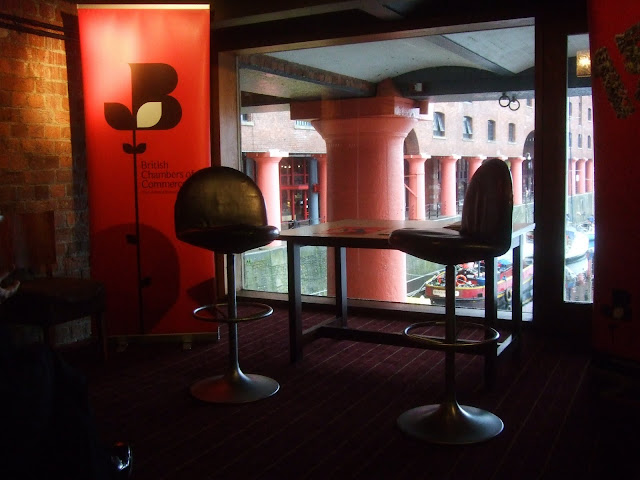
Vince Cable talks to the Liverpool Chamber of Commerce in the Pan Am Bar at Albert Dock Liverpool.


Politics I wore a suit this morning. Before anyone reading this who’s currently being choked by their tie in a sweltering office wonders what’s so special about that, I never wear a suit. Other than my MA graduation, I only ever seemed to have worn it to job interviews - for my present position and an ill-fated visit to BBC Birmingham three or so years ago. It still has some train tickets in the pocket from a less ill-fated interview at the Royal Bank of Scotland Credit Card Centre in Manchester in 2001. But it felt important this morning, because I expected everyone else would be wearing suits and so it proved as we sat down for a breakfast meeting with our present Business Secretary Vince Cable. Who was wearing a suit too.

Organised by the local chamber of commerce, this was a fringe event to the conference and about as close I’ll be getting to the event. For all my passionate justification for being a Liberal Democrat, I’m not actually a member of the party largely because I like the role of observer too much. If I joined the party they might actually ask me to do things like hand out leaflets and that wouldn’t do. Some mild Twitter canvassing is the limit of my participation, and ad-hoc participation at that. This was simply a chance to look a favourite politician in the eye and see if he is lying. We’ll get to that later.

The breakfast consisted of a buffet of French pastries and later bacon and sausages sandwiches (brown sauce). This was not a banquet. This was an opportunity instead for local businessmen and women to ask about the changes and policies and policy changes the coalition government are putting into place, the abolition of the Regional Development Authorities (RDAs) in favour of smaller Local Enterprise Partnerships (LEPs), the simplifying of the planning processes, making the balance in employment law between employer and employee fairer, the pressure on banks to invest and a few other issues I had difficultly following because I’m not a local businessman or woman. The room was less hostile than I expected, certainly more polite. There were moments of passion, some "delegates" with well researched, preprepared questions.

Vince is much more relaxed and articulate in person than on television where he can sometimes be a bit hesitant. He only became agitated once, towards the end when he was pressing home his frustration with the perception that the RDAs were the conduit for the likes of Europeans funding and not just the most convenient administrative body. He didn’t say much that hasn’t already appeared in interviews in print or on the radio (the gist is in this old Guardian interview), so no scoops sadly. Like any politicians he has talking points and stock answers reiterating that this new government is like a new board of directors at a failing company and that as in that scenario whatever is being done is never initially good for the workforce.

This is one of the few occasions when I’ve even been too intimidated to ask a question, largely because the question I really wanted to ask, about the change in the media’s perception of the party since they entered power was a bit off-topic and I didn’t want to break cover (feeling more like a gatecrasher as time went on). My ultimate impression was not of a man lying, but one dealing with the dichotomy of power. That ideology is inevitably stunted in government and that coalition is about compromise and that however many inspirational manifesto pledges they've made, it wasn't until they were faced with the beaurocracy that they really understood how many of those pledges and promises could be put into practice.

The Lib Dems know full well that much of what they’re doing is and will make them horrendously unpopular. But it seems, at least to me, that they’re making themselves horrendously unpopular with people who either didn’t understand what its leaders were saying during the election campaign or didn’t read said manifesto, often disaffected Labour supporters unable to grasp that the point of the Lib Dems is that they’re neither one thing or another and also in many ways a smattering of both of which ex-Labour man Vince is emblematic.

Afterwards, I chatted to a couple of very well informed people who were being directly affected by these changes in policy. They fear that the government is moving too fast, hastily putting into place changes when more considered thought might be required, and they might be right. But if meeting this secretary of state convinced me of anything it’s that we should all just wait and see and stop fearing the worst, which is perhaps the naïve view, and underscores why it’s best that I leave the politics to those other, better informed people. I'm glad we swapped business cards.

The Hope Street Feast 2010

Food The Sefton Park event begins the Liverpool Food and Drinks Festival, the Hope Street Festival concluded it. Many of the same stalls were in attendance today and before work I yomped on a giant prime pork sausage sandwich with, for fans of the Danny Baker Show, red sauce, brown sauce and yellow sauce. It was a very long sausage. It was also raining heavily though given the number of people I met I actually knew (which is surprisingly rare even in such a small city) attendance was still reasonably high.

There was also a tombola, in a caravan, at the junction of Hope Street and Hardman Street. Not one to let an opportunity for failure go to waste, I stepped up, paid my pound for a ticket, turned the barrel and went for a rummage. I asked the lady what I should be looking for. "It'll tell you" she said as I pulled out one of the small, rectangular paper wallets. I tore it open. "You're a winner!" It said. "I won!" I said. "Ha ha ha" At which point I realised what she'd explained beforehand. "You can choose any of the prizes. They were donated by the stall holders."

Which is were my trouble began. I'm a foe of choice. I spent three minutes trying to decide which sausage to have out of the four choices as the stall holder waited for a decision and in the end I just picked the prime pork sausage because it was at the bottom of the menu. I was watching The Special Relationship tonight and for once admired Tony Blair for taking a proper decision on Kosovo (or at the least the heroic Michael Sheen version of him). And we've already discussed the glories of the near random film selector, Lovefilm.

So as the hostess (for this was my own private game show) listed the prizes, which were sitting on a set of wooden shelves at the back of the caravan, I simply couldn't decide. Should I take the family ticket for a cathedral tour? No, that seems like a gluttony since I've already been. Two tickets for the Everyman Theatre? No, because at present, who am I going to ask and what about empty seat syndrome? She held up some photographic prints of places in Liverpool. Handy gifts perhaps but I wanted something for myself.

On to the food. Pasta, liqueur, wine. Flowers (empty seat syndrome again). Round and about it went, the indecision looking more embarrassing, she looking more pensive. Meanwhile, outside, a man selling programmes says "More content than the Lib Dem Conference" which throws me off my stride somewhat and all along I'm look at one item, entirely unlike the others, at the back of my mind thinking "I can't have that. Not that, surely. From all of these goodies. I'm the first winner, I have to send a clear message."

"I can't believe I'm going to say this. Um, can I have the bag of muesli?"
The brown paper bag is handed to me with some relief.
"Well" I said, "It'll last the longest time."
"Enjoy." She said.

And here it is:


Yum.

Liverpool Biennial 2010: The Cooperative.

The Cooperative

Art Currently the old Rapid Hardware paint shop is headquarters to The Cooperative, a group of seven local arts collectives, Jump Ship Rat, Sound Network, The Royal Standard, Red Wire, The Lost Soul and Stranger Service Station, Arena Studios & Gallery and Mercy. It has a performance area in the basement and gallery space which will have a rolling programme of weekly exhibitions across the Biennial period.

Part of the display is an archive of the cooperative’s previous work, something of a nostalgia trip for those of us who’ve been visiting these festivals over the past decade, a rare reminder of work which might otherwise have been fleeting in experience or ephemeral in the memory. Oh I remember that. Oh I remember that. Oh it’s that! Wow. I’m getting old.

I giggled when I saw again The Ballad of Lonesome Barry Row, a video piece featuring the story of giant rebellious yellow skip (Barrys Skip according to the stencilled sign on the back), as it sprouted wheels and began a journey through the back streets of Liverpool apparently with no space for steering let alone a driver, unsure whether I was seeing an impossible, magical item or the spirit of The Goodies. Or both.

Open Wednesday to Sunday 1pm-7pm, 18th September until 29th November.

Liverpool Biennial 2010: Day One

Art About fifteen hours ago, I stumbled up the steps of the entrance hall at the right hand side of St George’s Hall (opposite the Walker Art Gallery) to pick up my press credentials for today’s launch of the Liverpool Biennial. There’s something rather comforting, touching even, about entering a place and being greeted by someone who knows your name, gives you a card which will grant entry to various venues and a copy of the catalogue. As ever I felt slightly fraudulent standing in front of that table with only myself and the few of you as a potential audience, but honoured nonetheless.

On my way out, I was greeted by a tall smart man who introduced himself, but I was too embarrassed to ask him to repeat his name when I didn’t hear it the first time, especially since he seemed to have the word Director in his job title, so I can’t tell you who he was. We walked to the Biennial’s headquarters on Renshaw Street and my embarrassment in not hearing his name continued, when I told him I was a simple blogger and he treated me like any other member of the press by suggesting, with great passion, venues and art work I might like to see during the day, happy to answer the one question I had about the organisation of the Biennial.

The organisation of the Biennial reminds me of the way Ira Glass describes an impending episode of the This American Life podcast. The organisers choose a theme, then curators travel the world visiting other festivals and museums seeking artists who might be able to work within that theme. The artists, assuming they’re interested, visit Liverpool and then produce a proposal based on their experience of the city and how it fits within the theme, and after negotiating the proposal into something manageable, they’re commissioned to produce the work and after a year and a half, venues across Liverpool are filled with it. More on the theme later.

House

The Biennial Headquarters was not quite ready for visitors, so my new friend suggested that I see some of the public art in the area, which meant that my day began with this extraordinary piece on Duke Street, Do Ho Suh’s Bridging Home an apparently simple idea, complex in construction, detailed in its resonance. The artists spends much of their time shuttling between Korea and their adopted home of America and so they’re obviously interested in the culture clash, the melting pot created as different people’s find themselves in close proximity.

Except Suh is also discussing the differences between old traditions and futuristic modernism, the twist being that this is a new building in the old style between to apparently new buildings which have aged and fallen derelict. The result is an inexplicable, impossible object as though the space between two realities has become torn, this grand design defying gravity the result, perhaps drawn here by the street art on the building next door which asks us if we like our neighbours.

Whilst I stood writing the notes that led to these sentences, an old but elegant woman approached simply to say “Quite amazing isn’t it?”. Some Far Eastern students stopped to take photographs. A man in a business suit stepped off his route to come and take a look, shaking his head as he walked way. It is the kind of happening that requires you to stop and stare and gape not least because the people passing by on the street directly in front of the house, recessed as it is just out of view, must wonder what it is about them which is attracting so much attention.

Wall

Tala Madani’s Sunny Side Up, despite being a giant mural is surprisingly not that easy to find. At the gable end of some buildings on Fleet Street, I walked past it twice assuming it to be another example of the graffiti art which covers much of the area. When I asked a workman who was clearing the site in front, of flytipping and a wooden fence which had been blown over in the horrible wind last night, didn’t realise this was what I'd been interested in when I first asked him, even though it transpired he'd watched it being created.

He was excited to discover the patch of land he was working on had its own postal address and he stopped work for a moment and we stood looking at it and the mural together. He explained that the painting had been there about a week and that the artist or someone had spent one day adding the legs and the next the yellow smudges and that he preferred the giant painting of a God which it now obscured. It took me a moment to realise which were the legs. I still don't know what the yellow patches are supposed to be.

As I considered where to take my picture, a bedraggled bloke who didn’t look like he’d been to bed, perhaps kept company for the evening by a bottle of alcohol approached us, and asked the workman if he was a refuse collector. He replied in the negative, clearly wondering what business it was of this total stranger. The bloke then asked what he was doing. The workman told him he was clearing the site. The bloke asked him quite menacingly what he was standing around for. The workman grinned. I took it as my cue to take the photo and move on.

FACT Liverpool

FACT Liverpool led to complementary coffee and pan du chocolate. And Mark Lawson. At this point, I’ll quickly explain my absence from the blog these past few weeks, well if not absense, at least a suggestion of mild disinterest. A couple of weeks ago, the careful eco system of storage in my room looked ready to collapse, as one bookcase, perched precariously above another, gave every impression of wanting to fall down, taking my big television and everything else with it, caused by the weight of several hundred dvds slotted between it and the other wall.

After placing the bookcases next to one another on the floor, I now had nowhere to put the several hundred dvds and after sighing several times, and a few trips to Wilkinsons for plastic wallets and cardboard boxes, I set about the task of transferring nearly my entire shop bought dvd collection from their plastic display boxes into plastic wallets, storing the inlays neatly and then placing them into my insane dating classification scheme, entering the details into a huge database as I went.

Which took - a few - days. But having built up a rhythm, I then decided to also catalogue the many discs full of documentaries and music concerts I’ve amassed over the past few years, mainly from BBC Four, far more than I’ve ever had a chance to watch, a kind of insurance against the closure of one of the best television stations in the world due to a squeezing of the license fee. But since, over those past few years, I’ve never considered that I’d ever want to do anything so stupid as catalogue them, these discs often have simply BBC Darwin, Arts Docs or Mark Lawson Talks To … with no indication of what’s actually on them, especially who Mark Lawson was talking to.

So I’ve laboriously been placing each disc into the computer, checking the contents, entering them onto the database, then looking for the pertinent date via Google, usually from the BBC website, filling in the necessary information about the relevant series and episode and episode title when required. On the one hand it’s demonstrated that I’ve recorded more documentary series than I’ve remembered even existed, but on the other if I ever need a working knowledge on a given subject fast (as though that set of circumstances would ever come up), I just have to pull out the relevant box.

I’ve nearly finished but nevertheless I thought this was the most bizarre, unbelievable, antisocial perhaps endeavour anyone might attempt. And then I visited the Tehching Hsieh piece at FACT Liverpool and realised that I was but an amateur. For a whole year, between April 1980 and April 1981, Hsieh performed a work – this was in a gallery space – in which he would clock-on at a work machine and take a photographic self portrait. Every hour, on the hour. For three hundred and sixty five days.

The result is a room filled with small photographs of the artist standing next to the machine, in strips of roughly twenty four, with the clocking in cards at the top as proof of each day’s work, and a 16mm film projector showing these frames turned into a film in which we watch a man go from forced baldness to long hippyish hair, physically aging presumably through poor sleeping patterns, but with the same determined expression on his face which says that he will not be beaten by this self imposed prison.

It’s at the moment when I realised the scale of the work, in physical, psychological terms that I heared Mark Lawson’s voice enter the room followed by Mark Lawson himself. From what I subsequently gathered he'd later be discussing the work on the radio with a man that I was already discussing the work with (there are now four of us in the room including the invigilator) and for a brief moment I find myself in the midst of a live, unrecorded Front Row discussion as I noted that Hsieh’s beard didn’t grow which meant he will have had to have shaved regularly. They left shortly afterwards, but after seeing his name scrawled on a few discs it was quite a surprise to find that, albeit momentarily, Mark Lawson was talking to me.

There are internet memes in which people take a daily photograph, sometimes over much longer periods and so the aging is actual and natural rather than caused by the physical discomfort of having to wake up between REM cycles (meet Noah). But they’re about recording change, whereas Hsieh is desperate to keep each picture as similar as possible apart from these few difference. Now and then, a frame is darker because the bulb in the gallery space has blown or there are fewer shots because he slept through or had an engagement (the reason recorded on the clocking in card).

Only once has the artist gone crazy. It’s near the end, perhaps in mid February, a single shot in which his head is forward and he’s let his now long hair fall in front of his face giving him the aspect of early Slash from Guns and Roses. But in the next he’s back to normal. Perhaps it was his birthday, perhaps he had a little bit of a breakdown, but it’s proof that even in the most extreme regimented endeavours, it’s possible to have a lapse. But if he’s like me, he’ll be thinking that the work can never be perfect because of that one little mistake.

Think About Your Future

The Biennial often offers up The Futurist to see how a given artist will react to one of the great reminders of Liverpool’s popular cultural past. In 2006, the shutters were replaced by a sheet of glass so that we could see the old movie posters for One Flew Over The Cuckoos Nest and the shattered dreams of a thousand nights at the cinema strewn across the water stained carpet. This time, Emese Benczur has recreated the billing sign at the front but replaced coming attractions with the words, well you can see the words in the photograph. I’d wondered why the cinema sign had been repaired.

At present I’m think a lot about the future. I’m 36 next month, the kind of age which seemed ancient and indeed was middle aged in Shakespeare’s day. I don’t feel 36, but I can feel the rapid progress of time, so when I see a sign like that, it’s not an order to go forth with some new project, but a reminder of a project ongoing. Especially when it lights up. Of course, the artist is looking at the future in more global terms than my upcoming midlife crisis; she wants to think about what we’re doing to the planet, so those bulbs are carbon neutral. Still it felt like a message to me, Rudy. Um, Stuart.

Liverpool Biennial Press Launch

To St George’s Hall and the official press launch of the Biennial. Unlike previous years were the concert room has been utilised, this was more interestingly set in civil courtroom. Another digression. I originally met Lewis Biggs, the director of the Biennial, when I was seventeen and he was the director of Tate Liverpool. I was studying as part of my A-Level the post-war Korean artists who were exhibiting there and with some largesse I wrote to him requesting an interview. He agreed, and spent half an hour of his busy schedule in a meeting room at the Tate, fielding questions which on reflection could just as easily have been answered by the exhibition catalogue.

The main purpose of this meeting was for Lewis and the curator of the Biennial, Lorenzo Fusi, amid the ringtones of the gathered press, to explain the theme. The starting point, as is true of so many of these things, the global financial crisis and how the pits and troughs of inflation are mirrored in the art market. They decided that for this Biennial, they would try to attract art whose value wasn’t in some over inflated price tag, but the gut reaction of the viewer, them literally being “touched” emotionally or in some cases physically by what they’ve seen. As I think you might have noticed, most of the work I’d seen before that moment had certainly done that.

Tate Liverpool

There will be some people reading this wondering why I wasn’t somewhere else at 1:20 pm rather than inside the Tate Gallery, the sole member of the press walking around. Let’s just say my inability to read emails properly had led me to assume that my press credentials wouldn’t stretch as far as they might. But really it’s ok, since I was due in work soon anyway. Even if lunch for me actually consisted of holding onto a chicken sandwich for dear life in a gale whilst sitting on a bench opposite the Mann Island project and the new Museum of Liverpool, watching bits of tomato falling out of the bread and flying into the distance. I have now printed out a copy of the itinerary and I know what I’m supposed to be doing tomorrow (or later today).

It would also account for why, when I reached the Tate, the exhibits were quite ready yet so it’s probably unfair to offer too in depth a review of much of it, except to say that I doubt most visitors will have the same experience of Wannes Goetschatckx’s 1 without of seeing the many television screens featuring the artist in a range positions in a wooden box, on a swing, pacing a room from above, knocking tallys off the wall in chalk, sitting on a toilet, washing naked in a bath and have the artist in the space as well as though the sprite from the old Commodore 64 game Little Computer People has stepped out of the screen and is evidently wondering what you’re doing there.

The ground floor display space is consumed with an installation by Magdalena Abakanowicz. Embryology 1978-80 features giant, stitched organic looking oblong shapes, in various sizes arranged on the floor with a chalk path running through them. It’s the kind of installation I’ve always been a fan of, in which the same items are gathered together in different was depending on the space so that rather like a rock band on tour, although the elements are the same, the results may be different depending on the venue. To some extent it’s up to the viewer to decide what these shapes are, whether they represent potatoes, internal organs, or if there’s some kind of scatological quality. I will return.

John Moores 2010 Private View

After work, at 7:10pm, I attended the private view for the John Moore’s Exhibition at the Walker. As ever, it’s a bit of a mixed bag, the more “traditional work” trumping the abstract for emotional resonance, but given that it’s my first week back at work and I’m still adjusting, and I’d been looking at art for much of the day, it’s entirely possible I missed something. I definitely wasn’t as much in the party mood as the people dancing in the area at the back of the main entrance hall where the chairs and table usually are.

The show is rather different this year because it combines the usual British collection with entries and winners from a version of the competition presented in Shanghai. My favourite from their contingent is Le Weizhou’s Where Are We From Where Will We Go? in which an otherwise empty sheet of rice paper has a painted queue of people waiting patiently for something, similar to the famous Saatchi campaign poster “Labour isn’t working”.

In his untitled work, Jon Bradley has spread paint and resin across his canvas giving it an eye-catching gloss missing from other paintings in the exhibition. An impressionistic homage to The Great Wave and Turner and a dozen other landscapes featuring the sea, what’s clever is that there actually very few contrasts in shade across the canvas, the deep blues across the bottom of the composition creating a sense of foreboding, the shapes he’s created capturing the violence of a maelstrom.

A different kind of maelstrom is presented in Nicholas Middleton’s Protest, 1st April 2009. Middleton’s photo-realistic painting is a regular to the John Moores exhibition – I adored his Scene From a Contemporary Novel in 2006 but on this occasion he’s actually commenting on his own art form by offering a situation in which nearly every figure in view his holding some kind of image recording device, from cameras to mobile phones. This is an old, ancient even, media presenting the media that has theoretically out advanced it but in such a way as to find a middle ground.

Steve Proudfoot’s The Party is a glimpse into the kind of lower middle class household Mike Leigh also highlights so well, a family gather in the living room around a buffet table. Proudfoot captures neatly the solitude that often ensues at these events, the lonely geniality of sitting on the sidelines drinking wine and wondering why no one is talking, or at least talking to you. The hint in this painting is offered by the ghostly figure of a young girl dancing. Is this a party or a wake?

I slipped away home.

... blue light swirls about AMY's body.

TV Firstly, I emailed 2Entertain, the main retail publishing company for new BBC television product to ask if the third series of The Sarah Jane Adventures which is due out on dvd soon would also be appearing on blu-ray (it was the first series shot for High Definition). The 2Entertain DVD Enquiry teams says:

"I am sorry to have to disappoint you but upon investigation I can confirm that we have no immediate plans to clear and release this title on Blu Ray."

I have emailed a reply asking for an explanation.

Secondly, here is one of those bonkers predictions for what may happen with the much discussed "game changing" cliffhanger in the upcoming, sixth series of Doctor Who.

There's been some speculation that Karen Gillan will not be appearing in the whole of the next series and yet Amy Pond somehow is. How about:

INT. THE GEMINI PLATFORM. NIGHT.

... blue light swirls about AMY's body. Even further into the distance a silhouetted female figure is stalking away as though the weather doesn't even exist.

RORY:
What's happening to her? (beat) Doctor?

The platform continues the shake, the wind and rain buffeting the sides and the three figures.

THE DOCTOR:
I don't know. I don't know! Something, something, something. Something I've forgotten. Oh, I, no no no. Aaah. Oh. No not that either. Oh. [SHOUTING!] Oh noooo ... Amy Pond. Your name is Amy Pond. Amelia Jessica Pond. Amy! (to Rory) She can't hear us. (SHOUTING AGAIN!) You have to hear us. You were born in Scotland! In 1989. You're married to Rory. Your parents are Augustus and Taba ... oh of course they are! Grrrr. Amy! Amy!

The blue light stops. AMY drops to the floor like a rag doll.

THE DOCTOR and RORY try to approach her, but the weather continues to hold them back as they barely keep themselves standing, holding on to the guard rail for dear life.

RORY:
Doctor?

THE DOCTOR:
Amy?

Suddenly, Amy sits bolt upright, her eyes as certain as they've ever been. She looks at the ENVIRONMENTAL CONTROLS. She stands, her body rigid against the false forces of nature that whip against her body. THE DOCTOR and RORY watch her figure from a distance as it seems to walk with superhuman strength.

THE DOCTOR:
Amy don't! The controls are live. They're only low levels shocks but cumulatively the radiation ... let me ...

RORY:
Amy! Please!

THE DOCTOR:
There's nothing ... aaah ...

AMY, her face determined but wincing with pain, makes the necessary adjustments to the environmental controls. The rain stops. Then the wind. The fog lifts. Already THE DOCTOR and RORY are approaching their travelling companion who turns and curiously gives them a broad grin.

AMY:
I'll be with you in a minute ... ooh I'm going to miss this accent ...

Suddenly the peace is shattered again as AMY's body VOLCANOES!!! Golden energy blasting out of her head, her arms - beautiful, ferocious she snaps upright, ENERGY BURNING AWAY, fast, gone! And there she is. Blinking. Dazed. The New woman.

It's RIVER SONG!

RIVER:
Hello sweetie!

Fade Out.

Pause.

Fade In.

INT. THE GEMINI PLATFORM. NIGHT.

A tiny shuttle is lifting off, its thrusters finally able sustain flight, now that the environmental conditions are back to normal.

INT. SHUTTLE BRIDGE. NIGHT.

Familiar hands expertly work the controls of the shuttle. A small display flashes Autopilot in red LED lettering.

A hand, its fingernails a rouge red, reaches into a handbag. Next to a squareness gun and sits a small pocket watch, which looks infinitely old. The hand clicks it open. There's noting unusual about it, apart from the pretty swirls on the case.

As the interior of the GEMINI STATION is replaced with the dark void of space on the outside of the ship, we see a familiar face reflected in the viewscreen.

It's the older RIVER SONG!

RIVER:
Bye Amy.

FADE OUT.

TO BE CONTINUED!

on the subject of writing memoirs.

People Short interview with Elizabeth Wurtzel on the occasion of moderating a panel at the Brooklyn Book Festival which includes news that she has new book (possibly) coming and this insightful comment on the subject of writing memoirs:
"I think that I try to be careful about other people. I try to keep their lives private. I can’t think of anything in particular, I’m trying to think of something I wish I hadn’t said or done in writing. There are things I wish I hadn’t said or done in real life. When you’re writing a book or an article even, you go through so many drafts and edits and there’s so much time to reconsider everything, I think it’s pretty clear by the time you’re at the final point that you know what you’re doing. So, I can’t think of anything, but there might be other people who wished I hadn’t written something, but I don’t feel that way."
My heart went pop today for the first time in a long while. I'd almost forgotten what it felt like. I'm glad that it's still possible.

Liverpool Food and Drink Festival 2010

Liverpool Food Festival 2010 from the air

Liverpool Life The sun beats down on another Liverpool Food and Drink Festival launch at Sefton Park. The day began earlier than usual, 10:30am (I began queuing half an hour before). Unlike last year when I received what amounted to a free breakfast, there were perhaps understandably given the times we live in, less free samples, but still loads of tasty food at relatively cheap prices.

Desperate to try something new I ended up with old favourites with new twists: sausage on a bun (infused with damson), small pizza folded over (and containing lasagne pasta – both of the major Italian food groups in one), barbecued mushroom and a kind of spinach pie (essentially a free associating tortilla). Big lunch.

The tastiest experience was the cup of earl grey tea I bought from the Brew stall. Brew is the tea shop on Bold Street and they’re employing a contraption by adagio teas called the ingenuiTEA, a pain free infuser, which also means they can offer a wide selection of tastes in the middle of a field.

I was so impressed, I bought one.

The dried tea leaves go into the “jug” to taste. Hot water is poured on top. And we wait. Douglas Adams suggested two or three minutes, but I like mine a bit stronger, so about five minutes. During the process a bit of magic happens. The dark, tinder dry tea regains a bit of its life force and the water fills with actual leaves.

It’s fascinating. Here’s a picture from above, post "pouring":

Tea Leaves

And from the side:

ingenuiTEA

Once the tea has brewed, and this is the other miraculous bit, we place the “jug” on top of the cup and the tea dribbles out of the bottom into the cup/glass/flask/whatever you drink your tea from. Which is all rather more exciting than a mini-sieve or a cage on a chain or indeed a tissue paper bag. I can’t imagine wanting to make a cup of tea another way again.

I have my window open and can hear the festival continuing in the background as I type, at present what sounds like a square dance. I'm taking this break because some things are best enjoyed sparingly (plus I don't want to eat too much). I’ll be back out later for desert ...

Update Apple Tart with custard and cream (ooh) and some mocha and chocolate cake. There's only so much food a human can consume, it seems.

to see this in the real world

Liverpool Life It might not have escaped your notice, but the Liverpool Biennial 2010 begins next week which coincides with the opening of the John Moores Painting Prize exhibition at the Walker Art Gallery. The presentation of said prizes to the winning paintings is next Thursday and for the first time they're to be live streamed across the internet. Here is their press release:
For the first time in the history of the prestigious John Moores Painting Prize, the winner and runner-up announcements will be broadcast live.

This exciting online event will take place on Thursday 16 September 2010 at :
www.liverpoolmuseums.org.uk/johnmooreslive
The announcement will take place at 6.30pm but the broadcast will begin earlier.

Those tuning in will be amongst the very first to find out who has scooped UK’s biggest painting prize, along with artists, guests, critics, and associates attending the Walker Art Gallery in Liverpool for the private view and prize ceremony.

The John Moores Painting Prize 2010 live broadcast will give viewers a unique opportunity to see behind the scenes at one of the biggest events on the art calendar on the eve of Liverpool Biennial’s launch. Just add canapés and friends to throw your own ‘private view’ from the comfort of your home!

45 shortlisted artists from 3000 entrants are to be included in the exhibition, each with a chance of winning the £25,000 first prize or 4 runner-up prizes of £2,500 each. The paintings will be on display at the Walker Art Gallery from 18 September 2010 to 3 January 2011.

The long-running competition forms a key strand of the Liverpool Biennial and is always a hot topic conversation amongst art lovers visiting the city for the festival, both online and offline.

Join in with the discussion on Twitter using the #JM2010 hashtag. ‘Tweets’ will form part of a stream of conversation published on the broadcast page in the run up to and during the live broadcast. You can follow John Moores Painting Prize 2010 on Twitter at:

www.twitter.com/JohnMoores2010
Ironically, though I've been invited to see this in the real world, I begin work again next week which includes the usual late Thursday so will miss the prize giving either way. But I'm planning on popping in afterwards. If they'll let me in late.

"Einsteinium..."

Science "I'd like to take you now on wings of song, as it were, to try and help you forget, perhaps, for a while, your drab, wretched lives."


"I hope you've all been taking notes, because there'll be a short quiz next period."

like, much

Music Zooey doesn't say, like, much, but when she does speak she, like, totally captures why she's, like, so, like, amazing:
"I rarely do movies. I’ve done like one movie a year for the past couple years. I used to do a lot more, but I’ve just been a lot more choosy lately, so that I do have more time. I’ve been touring a lot, recording a lot, and writing a lot. I just do the movies I really, really want to do, and don’t overwork myself in that area. That way, I can concentrate on one thing at a time. I used to write all the time when I was working, and go home and stay up really late. I’ve just been spending more time doing music lately."
Or in other words, because she's careful or at least sparing in the kinds of films she chooses, she's able to retain a certain mystique or impregnability even in a triumph like The Happening. Which I've finally decided is a masterpiece of directorial vision. Make of that statement what you will.

He was right.

Politics This isn't the most well best thought through comment I've left anywhere (in fact it's rather rambling) but I was prompted to write this on the The Guardian website at this bizarre story:
My journalism tutor in one of his speeches -- he was very big on speeches -- said that within a couple of years of entering the profession he realised that ultimately it didn't matter who was in power because ultimately nobody is perfect which means that the situation will never be perfect.

Sometimes things would be better than usual, sometimes worse. But never perfect.

He was right.

Pick up the average history book, or a very good history book for that matter because there are some of those, and try to find a moment in the country or indeed the world's history when everything was ok. When no one felt hard done by and everyone was happy.

It hasn't happened yet. It may do. I'm an optimist so I think it may do. But not yet.

If Labour are in power, Tories are unhappy. If the Tories are in power Labour tell them that they're doing it wrong. The Lib Dems, as ever, are stuck between the both of them unable to do right from wrong even when they're actually in government for a change in the way that they could only ever be in government under the present political conditions.

If the present government imploded and another general election was called by Christmas and by some chance Labour got back in, can even their own supporters suggest that the country would be fixed, that everything would be sorted out? Well, no, of course not.

I know that in fact having an ideology gives us something to strive for and having something to fight against reminds us that we can be passionate about about something which matters which isn't the continuation of the species and through procreation or saving the environment.

But looking at this list of comments, I wonder whether people realise that nothing of anything we say about politics really matters. In the end.

reruns of old Pugwash cartoons

TV I'm back. Hadley Freeman reviews this morning's debut episode of Daybreak, ITV1's new morning showdown featuring new signings Adrian and Christine so I don't have to:
"What a strange thing Daybreak is looking set to be. An odd mashup of GMTV, The One Show, That's Life and, suddenly, Newsnight. No one is claiming that GMTV was a hothouse of intellectual thought, but, really, what on earth can one make of Daybreak – a news programme that shows clips of racing mobility scooters, a funnily shaped carrot and a bulldog on a skateboard and asks viewers to vote for the one they'd like to hear about in more detail. This segment is called Daybreakers, which I'm guessing is a pun of some sort, but one not easily grasped. Better to have called it "Like watching YouTube with an immature 10-year-old."
The main problem at this early stage is an over-abundance of format, the desperate need to give things like phone polls and news headlines ear-catching names and the big signings, with the exception of the interview slot, largely reduced to cueing in the next bit of the schedule be it the news, the adverts, the phone in quiz, the adverts, the sport news, the adverts, the funny animal stories, the rotating banana bowl and John Stapleton standing in a football stadium to illustrate a lot of people.

There's also an over-abundance of staff. Apart from the fact that the likes of the sport could just as well be read out by Chiles as the separate sports presenter and the news by Bleakley, the correspondents idea is an obvious attempt to replicate the guests who'd appear on The One Show talking about scrabble or duck billed platipusses or whatever.  But here there's too little interaction, not enough time for the more freewheeling conversational style which suited this pair so well on the other side.

Essentially, if anything, it seems an attempt to resurrect the formula of TV-AM in the Anne 'n' Nick era which presumably means before too long, converting for modern currency,  we'll be seeing Christian O'Connell roaming the beaches making fun of pensioners, the CG animated Sammy Stoat for the kids, and the show being replaced with reruns of old Pugwash cartoons and the Ashley Twins filmography when the production staff walk out on strike with Garroway being labelled a scab for crossing the picket line.